How to Lose Weight and Build Muscle | Sal Di Stefano
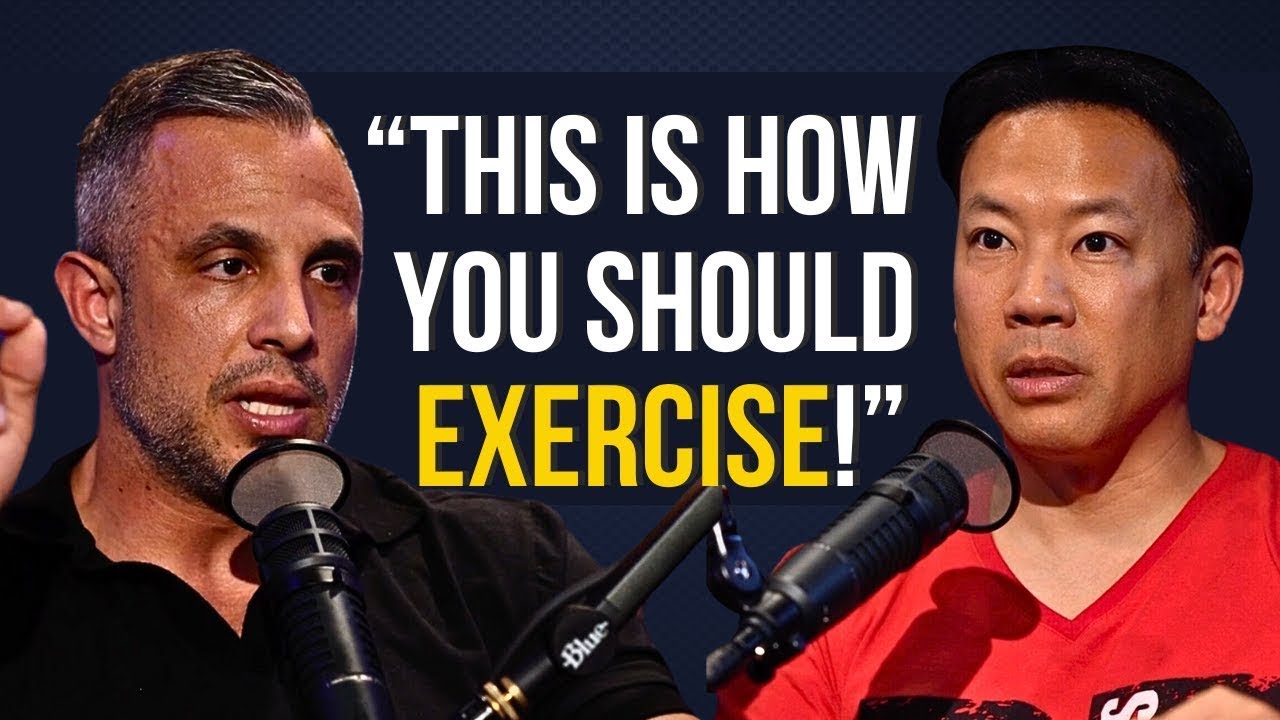
Sal DiStefano explains why strength training simultaneously burns fat, builds muscle, and sharpens your brain. Muscle loss, not just fat gain, drives the obesity epidemic and predicts mortality. Even a five-second daily contraction counts; the key is making exercise feel like self-care, not punishment.
Chapters
If you start exercising because you hate yourself, exercise is a punishment.
How much muscle mass do most people lose as they get older?
Effective workouts are not the ones that make you feel like you can't move anymore. In fact, that's ineffective. That's the opposite of effective.
The primary reason we have a brain is to control our movement.
It's less about secrets to keeping yourself motivated and more about what people tend to do to make this such a terrible experience where they don't want to come back.
I'm very motivated right now to work out.
One of the leading causes of death as people get older— people know heart disease and cancer. You know what else is up there?
Welcome back to the Kwik Brain Podcast. Your question for today is, how do you lose that stubborn weight and build mental muscles? If there was one thing that you could do that's going to help you to be able to lose weight, to be able to stimulate neurotransmitters like dopamine and serotonin, endorphins, reduce systemic inflammation, and so much more, wouldn't you want to know what that tool is? So I'm excited. to be in the Mind Pump podcast studio with the host of Mind Pump. We just did an episode, Sal DiStefano. He has been a personal trainer since age 18.
Yeah, a long time.
Wow. And he's also the author of this book, The Resistance Training Revolution, which I recommend all our Kwik readers go online and get their copy. Thanks for being on the show.
Yeah, I appreciate you having me on. Thank you. Thanks for coming on our show earlier.
Yeah, thank you. This is one of my favorite Podcast studios ever. And thanks for letting me record this conversation.
Thank you.
So we were talking about before we started to film, like, so outside you have this amazing gym and you and your partners, we just did an episode on your show. Make sure everybody follows Mind Pump and we'll put links in our show notes as we always do to your YouTube, to your book, to all your socials at jimkwik.com/notes. So fitness, this is something that we don't talk a lot about. But we do say this is one of the keys to having a limitless mind. Where do you start? I mean, is there like one exercise? I'm curious about things like if there's, you know, your favorite exercise, especially when it comes to building brainpower and BDNF and all that good stuff. But then also, how do you motivate clients?
Yeah, that's great. So I think we should start with this massive myth or misconception that The mind or the brain is somehow separate from the body. I remember when I was a kid, how people thought working out or building muscle could potentially, you know, it was connected to like the dumb jock, right? Like, oh, someone's very built, obviously not very smart. Or then the smart nerd is not very built type of deal. That's a huge myth because what makes the body healthy and fit also produces a brain that is fit and healthy and can process faster.
Yeah.
and can learn things better. I think we know this now, but people tend to not make the connection. Okay, so the question is, what's a great exercise or form of exercise that is going to be best for the brain? Now, to be clear, any activity that's appropriate is better than no activity. So improving your health through activity is always a good thing. But which one, if you had to pick one? And most people only pick one because most people are not fitness fanatics. You know, if they were, they'd probably work in the industry that I'm in.
Right.
Most people aren't going to dedicate a ton of time to exercise. So People want the best, you know, biggest bang for their buck. Okay. When you look at all the data and you consider all of it, and I'll get through some of it, strength training trumps any other form of exercise when it comes to brainpower. And I'll go down the list here for you. Let's start with insulin sensitivity. Okay. Or your body's ability to utilize glucose, right? For energy. The brain runs on energy. And we know that, I mean, Alzheimer's has been referred to as type 3 diabetes. And we can see there's a strong connection between insulin resistance and cognitive decline. Muscle serves as a storage vessel for glycogen, which is what we turn sugar and carbohydrates into. When you build muscle, you have a greater capacity to utilize glucose, or at least to, to store it. In fact, there's studies on severely obese individuals where they have them lose no weight at all. All they do is build a little bit of muscle and they have significant improvements in insulin sensitivity. And this is good for the brain as well. So there's, there's that one. You also have hormone balance, which is much more closely connected to developing and building muscle than it is to, let's say, improving endurance or flexibility or stamina. Now, why is that? The hormone profile that your body produces or needs when it is in an environment to build muscle and when it's told to build muscle, which is what strength training does, right? It sends the signal that tells your body to get stronger, build muscle. That hormone profile is what we could loosely refer to as a youthful hormone profile. So higher testosterone, balanced estrogen, progesterone. We talked about insulin, right? Sensitivity to insulin, an upregulation of androgen receptors, upregulation of growth hormone receptors. A better, more healthy utilization of cortisol. Cortisol starts to look more natural when we're in this kind of muscle-building state where it rises in the morning and then starts to drop in the evening. There's also the aspect of learning that occurs whenever we do a physical activity. So a lot of people think, yeah, you work out, your muscles are what get stronger, your bones get stronger, or things get looser, and that's what ends up happening. There's just as much central nervous system adaptation, if not more, That occurs from learning new skills, physical skills, as there is muscle or physical, let's say skeletal muscle adaptations. Strength training is one of the forms of exercise where I can move in any plane of movement. I have an almost limitless amount of exercises. It trains proprioceptive ability, right? My ability to know where I am in space and time. It's not a repetitive motion over and over again, right? You learn how to ride a bike. That's definitely a skill. If I ride a bike for exercise, there's definitely skill involved with that. But After a while, it's the same repetitive motion. Same thing with running, same thing with swimming and other forms of exercise. With strength training, I mean, I can move in the sagittal plane, I can move in the frontal plane, I can move in the transverse plane. I can strength train fast or slow, controlled. I can strength train for endurance and stamina or maximal strength. It's incredibly versatile. In fact, it's the primary form of exercise that rehab specialists use. for people who need to rehab from serious injury.
Yeah.
It's also the form of exercise I can use on anybody. I don't care what your limitations are. You might not be able to run. You might not be able to cycle. You might not be able to do other things. But there's a way I can use resistance training on your body to build strength. And that builds the brain. It builds the brain in tremendous ways. We know that it increases BDNF in the brain. All activity does, but strength training has this kind of unique ability To cause it to rise on a kind of continual basis. In fact, when you compare other forms of exercise, strength training is superior. It's also the only form of exercise that's been shown to halt the progression of beta amyloid plaques. No other form of exercise— all exercise benefits, but strength training has been shown to actually stop. And in fact, there was one study out of Sydney, Australia, where the researchers said it looked like it might even start to reverse. We just didn't do a long enough study. And they think it had to do with the insulin sensitizing effects of strength training. And then here's the main reason why I would choose strength training. You don't need to do a lot of it to reap its benefits. The muscle building process happens in the recovery process. So you could strength train once a week or twice a week, and you'll see significant gains in strength. The muscle loss or reverse adaptation that can happen from not being active is much slower with strength than it is with other physical adaptations. And maintaining the strength that you build requires way less work than it took to get there. Some studies show it's about a fourth. Some studies show one-ninth of the work required to build strength and muscle is needed to maintain it. So this makes it uniquely suitable for modern life, uniquely suitable for the average person who You know, they don't live to work out. They work out to live. So that's what I wrote this book about, is really about that, about why this misunderstood form of exercise has been labeled as just a way to look good or maybe improve athletic performance. But in reality, it's the ultimate form of exercise for longevity.
Amazing. Do you have too much to read but too little time? Are your shelves full of books that you haven't read yet and become shelf help? Not self-help. And that's why I created the Kwik Reading Course. 15 minutes a day, 21 days will absolutely transform your life. Just go to kwikbrain.com/reading, use the code PODCAST15, and you'll get instant access. So we're talking about exercise leading to blood flow, the neurotransmitters, the BDNF. Potentially lowering inflammation. Also, let's talk about for weight loss, because, you know, we had Dr. Daniel Amen on, the brain doctor, and he said, as your waistline expands, your brain actually shrinks.
That's right.
And there's so many people that want to lose weight, and a lot of people will go to running or cardio.
There's a different connection there that people aren't making, right? So we refer to the chronic health epidemic as the obesity epidemic, but really what we're looking at is a smoke. What we're failing to look at is the fire. What's causing this in the first place? Obesity itself is an issue, but it's the fact that we're under-muscled. That's the big problem. Muscle is metabolically active. When you have more muscle, you have a faster metabolism. Now, this buffers you against the ills of modern life. When you look at studies on diets, okay, they'll put people on, on what would be considered unhealthy diets, high in sugar or high in certain fats that aren't good for you. When the calories are below what the person burns, about 95% of the negative effects are erased. In fact, some scientists like to poke at the health industry by going on terrible, what would be considered terrible diets. Like, I'm just going to eat McDonald's, or I'm just going to eat food from the 7-Eleven, but I'm still going to lose 30 pounds, and I'm still going to show improvements in all my blood markers. And they do. And how do they do that? They don't eat a lot of calories. They burn them off.
Right.
So muscle's metabolically active. It speeds up the metabolism, which allows you to eat more and stay leaner. I mean, if I could do anything right now to solve whatever, you know, the obesity epidemic or help people lose weight, it would be simply to speed up people's metabolism. So if I could do that right now and people just continue eating the way they do, they would be much leaner. So when it comes to obesity, and you mentioned the study about waistlines, really, if you look, further in the data, it's less muscle that's connected to lower brain volume, which makes sense. Body fat is not nearly of an active organ on the body as muscle. Muscle requires a lot of brainpower to move and to function and to control and to maintain. Body fat, not nearly as much. In fact, when you look at the scans of obese individuals, you don't just find lots of obesity or lots of body fat. you find sarcopenia, you find low levels of muscle mass. And then one other thing to add to this, they've very clearly— and this is backed by data— there's one metric that will predict all-cause mortality better than almost any other metric, and that's a grip strength test. Now, there's nothing magical about strength in your hand. Really what it is, is it serves as a proxy for total body strength. So that right there, they could test your grip strength and predict with better accuracy than almost— think about that— almost any other single metric. Of course, there can be extremes, but if you come in with high blood pressure or cholesterol or lipids that are off, a strength test will tell them more information. And that's because we just don't have the strength or the muscle. And our bodies are only ever as strong as they need to be because it's expensive tissue. You know, we evolved in environments where Energy was hard to come by, right? It was hard to get calories. Our bodies will only keep as much muscle as it thinks it needs, because otherwise you're just a calorie-expensive machine. It would make no sense to have a V8 engine when gasoline is $20 a gallon, right? So our bodies are like, you don't need the muscle, then we're not going to keep it. I mean, if you've ever had a cast or a brace on a limb for 2 weeks and you take it off, you know how fast things can atrophy. So that's the real issue. And it's not just the amount of muscle, it's also the health of the muscle. We do have these ways of testing this now, but they're not widely used. Muscle can also be healthy or not healthy. It could also be infiltrated with fat. It could be less useful in terms of utilizing glycogen. So think of like a filet versus a ribeye. And we don't test for that yet. But when they do look at that and look at muscle quality and health, Very strong connection between that atrophy of the brain, loss of cognition. It's all connected. So if you're only going to exercise a couple of days a week, which most people, if we're lucky, we'll get them to do a couple of days a week of structured exercise, make it strength training. You're going to get way more in return for those couple of hours than you will with almost anything else.
That makes sense. When you're talking about atrophy, and I've just entered my 50s, how much muscle mass do most people lose as they get older?
The percentages vary on the individual, but it's in the 5% range for every 5 years or decade. Or so. But here's the problem. They've done grip. So remember, grip strength is a proxy for total body strength, right? A college student today, they've done this recently. So I think the last 5 years, college student today has the grip strength of a 65-year-old in the early '80s.
Really?
Yeah. So our starting point is so low and you're still going to lose muscle mass as you get older. By the way, if you strength train, you significantly thwart that muscle loss. So you said you're You're 50. I mean, you could build a tremendous amount of muscle and strength at 50. Your age will impact your max potential, maybe not at 50, but let's say at 60, you might not be able to reach a barbell squat like you would when you were, let's say, 25 or 30, but it's not going to be too far off. And you'll definitely be a lot stronger than you would be if you didn't do strength training. By the way, this is also connected to things like bone mass. And, you know, here's another thing. Mobility and cognitive performance and function are also very strongly connected. One of the leading causes of death as people get older— people know heart disease and cancer. You know what else is up there? Falling down.
Yeah.
Falling down and hurting yourself. If you've ever taken care of somebody who's in advanced age, who has suffered an injury, has to stay in a hospital bed—
Broke a hip.
There's a saying in medicine, break a hip, die of pneumonia. Decline in physical health is rapid, but what's more alarming is the decline in cognitive health. I remember the first time I experienced this. I had a client who was in her late 70s. She was already in early signs of cognitive decline. And she worked out with me for a couple years. And yeah, I don't know if you could tell that she was still going down. It looked like we were maintaining pretty good. And she would see me once or twice a week. Her daughter hired me to train her. Well, anyway, she ended up falling on her own at home, and then she couldn't come work out. She got hurt or whatever. 6 months, she was in rehab, bed rest. It was a bad injury. I ran into her at the grocery store. Her daughter had taken her grocery shopping. This is 6 months later. Remember, I trained her for 2 years. She didn't recognize me. That's how fast the cognitive decline happened from the inactivity. I saw this happen with my own grandparents during the pandemic. During the pandemic, of course, grandma and grandpa old. Let's keep them. Let's not get them sick. Keep them away, whatever. That lasted for about 8 months. Finally, we're like, look, we need to be around them. They're not doing so well. They need to be around people. They need to move. And it looked like my grandparents had aged, you know, 8 years. It was, it was scary.
Lack of movement.
Lack of movement, you know, and the brain is a part of the body. It's very, it is a part of the body. So this separating of them, and that's just how we learn in Western societies. We take a system, we go deep on it. And I get that. But then we forget that it's all connected. I mean, is your cognitive performance going to be affected by stress in your life or a spiritual crisis? Of course, it will also be affected by your inability to move and function, have mobility and strength.
And moving will help reduce that stress. The primary reason we have a brain is to control our movement. So it's not just a mind-body connection. There's definitely a body, a body-mind connection.
Yes.
When we're talking about motivation, and so I'm very motivated right now to work out at this moment because of all the reasons that you've listed. Do you have a way of getting clients? Sometimes they procrastinate, they don't prioritize it. I know there's not one pill or a secret that—
No, actually, I'll tell you, because I got really good at this towards the end of my career and my co-host the same. And we didn't work together, by the way, at the end, we just came to the same conclusion. It's less about the secrets to keeping yourself motivated and more about what people tend to do to make this such a terrible experience where they don't want to come back. Okay. So the first thing is the amount of intensity that you need to apply to get your body to adapt is appropriate to your current fitness level. So to use another type of adaptation in the body, like the skin's ability to tan, if you've been living in your mom's basement for, you know, 15 years, how much sun exposure do you need to start to elicit a tanning response?
Right?
Anything beyond that causes what? Sunburn.
Right.
Sunburn is not going to get you a tan any faster. In fact, it's going to take a lot longer because you surpassed your body's ability to adapt. And I get it. Social media does this, right? We highlight the beast mode and beat yourself up and like you have to survive your workout, right? Effective workouts induce adaptation. Effective workouts are not the ones that make you feel like you can't move anymore. In fact, that's ineffective. That's the opposite of effective. You should feel at the end of your workout more energized than you did before you started. You should not feel like you just survived. Like, oh my God, I gotta go lay down on the couch. You went too hard for your body. You gotta set the adaptation signal in motion and then leave it alone. That alone demotivates people like crazy because they go and they try and it's like, I'm gonna go through hell every time I go work out. No, this needs to be a good experience. The second reason why people lose the, you know, call it motivation or discipline to continue, is that they start for all the wrong reasons. They look in the mirror and they say, I look gross, or I'm fat, or I'm inadequate. I hate myself. I hate myself. If you start exercising because you hate yourself, exercise is a punishment. This is why what I just referred to earlier as the beat yourself up model initially feels cathartic. Initially, when I get off the couch and go beat the crap out of myself and I come home and I tell people I had a great workout, well, yeah, I hate myself. Of course it's going to feel good at first and it won't last. I promise you that much. Instead, go with the following framework. I'm going to care for myself. Not that I hate myself. And you should be honest. You can say, look, I haven't been taking care of myself. I deserve to be taken care of like somebody I care about. I'm going to go to the gym. And I'm going to take care of myself. Number one, that feels a lot better.
It's a different mindset.
Totally different mindset. Number two, it also feeds into number one. I'm more likely to train myself appropriately because I'm doing this to take care of myself. This also applies to diet, by the way. I know we're not talking about diet, but if I'm trying to lose weight because I hate myself and I'm trying to diet in a way because I hate myself, well, now diet becomes restrictive.
Hmm.
If I'm eating because I care about myself, because I want to take care of myself, it is not restrictive. In fact, balance, which everybody talks about this with diet and exercise, got to create balance, right? Because how does, what does everybody's workout and diet look like? On or off, right? It's either I'm doing it or I'm not doing it at all, right? Balance is baked into caring for myself because usually that means I'm eating something healthy. Sometimes that means I'm having a pizza with my kids because we're enjoying a movie together.
Right.
So those 2 things alone will make the biggest impact. And then there's a 3rd thing. The 3rd thing is this. Here's the structure. Okay. And I'm going to start with this. Motivation is a feeling. Stop worshiping the feeling of motivation. It's going to go away. Okay. Like, just like you can't be happy all the time. People who worship happiness end up addicted to drugs or distractions. Motivation is wonderful when we have it. And by the way, I don't need to tell you to work out when you're motivated. I've never had a client have a problem going to the gym when they're motivated. It's when they're not motivated that becomes a challenge. Okay. So what do we do then? Well, here's what you do. Start like this. Ask yourself what you could do now. What's one step I can take forward with fitness that is challenging? It has to have some meaning. Otherwise it's not going to be worth anything to you, but also realistic forever. That's the context. What is challenging yet realistic Forever. Whatever that is, and you have to be honest with yourself, whatever that is, that's the perfect step. Start there. And then here's what'll happen. You'll do that once it becomes a habit. Once it becomes a behavior, then you ask yourself again, what's the next step I could take that is challenging yet realistic forever? And then here's what's going to happen. I'm going to sound like a wizard now to your listeners.
Okay?
Here's what'll happen if you do what I'm saying. You're going to take that first step. And it's going to take a while before you take that next step. And that's okay. You're going to stay there. You'll notice improvements. You'll notice you're going to feel better. By the way, pay attention to all the benefits that come from it, not just the scale. In fact, I tell people throw the scale away because we tend to ignore the other potential good and bad signs that our body's telling us because we start— we always worship the scale. Okay, throw the scale away. So you take this one step, notice the benefits. I feel better. I have more energy. I'm sleeping better. Okay, this is cool. And here's what'll happen. You'll do that for a while. And then when you're ready, you ask yourself again. And then when you're ready, you ask yourself again. The time between steps starts to become shorter. And the steps naturally become larger. Here's what's happening. You're developing the skill of discipline. You're building a skill that is going to last with you forever with this. And this is how you develop a lifelong relationship because it's a relationship. A lifelong relationship with exercise and with fitness. And then the last thing I'll leave you with is this: your workouts, your fitness, the best way to utilize it is to use it like a multipurpose AI Swiss Army knife. Okay? Use it to improve the quality of your life regardless of the context of your life. Okay? Sometimes that means I'm getting good sleep, lots of energy, not a lot of stress. I'm going to go see how strong I can get. I'm going to go push myself in the gym. Sometimes that means, oh man, I lost my job, going through a divorce. I'm not getting good sleep. Maybe I got a new baby. I got to go and just get rid of a little stress and just feel better. So my workout's not going to be as intense, but again, I'm caring for myself. If you build that kind of relationship with exercise, it will last forever. for the rest of your life. If it's always about chasing the PR, pushing yourself, you're going to have those moments in your life when it's not going to work out for you. So those, those steps right there are what I found to be the keys to successful long-term commitment.
So many actionable ideas. I love it. So this is like a masterclass. Do you have courses for our audience?
We have workout programs. They're called MAPS, Muscular Adaptation Programming System. I believe we have 13 or 14 of them now. You can find them at mapsfitnessproducts.com. But I tell people this, look, we do 5 podcasts a week. We have a YouTube channel where we also, we show the podcast on there. And then we also have a YouTube channel where we demonstrate exercises and give it. So it's a separate channel. We also have free fitness guides at mindpumpfree.com. Don't buy anything from me. Listen to all the free stuff that we provide. Okay. When, when we've given you so much value and we've changed your life and you're like, okay, now I want to go to the next step. I want to follow a structured program, then come pick the right one. But for now, like we give so much free stuff. We coach through free channels the way we used to coach our clients. So do that first. Check that out.
Yeah, I love it. We'll put links to all the courses, to the free links that you mentioned as well. Your social media also at jimkwik.com/notes. The book also is an amazing guide. Yes. Not only do you have all the documented research, but you have like step by step. Is there, is there minimal viable like return? Like in terms of, is it like 2, 3 times a week?
No, no, no. It's just a little more than you're doing now. They even have studies that'll show one 5-second isometric contraction a day will yield strength gains. So yeah. And look, if you're doing nothing now, a little bit will get your body. Think of it again. I use this, the tanning analogy. Just train yourself appropriately. Go to the gym and practice exercises. Stop trying to beat yourself up. Get better at the squat or the deadlift or the bench press or whatever. Do just a little bit and let your body adapt. That, by the way, that's not the slow way to get there. People confuse. They think it's a trade-off. It's like, oh, there's a fast way and there's a slow way.
No, no, no.
It's yes or no. There's a right way. And then there's everything else. Is a total fail. That book, by the way, I wrote for the average person. So it's literally like I am communicating to the average person. And my goal with it is to get people to be able to do this on a long-term basis. I'm not trying to create fitness fanatics or bodybuilders or extreme athletes. They're already bought in. I'm not talking to them. I'm talking to the average person who just wants to live a better life, wants to reap the benefits of feeling fit and healthy and having optimized hormones. And that's who I'm talking to with that book.
Amazing. Follow Sal, everybody. Get a copy of the book. Get your resistance strength training in and subscribe to the Mind Pump podcast.
Thank you.
Thanks for being on the show.
Thank you so much.
More from Jim





The Library of Minds: Brain Coach: How to Stay Sharp When AI Does the Thinking | Jim Kwik





