How to Make Important Decisions Quickly and with Confidence | David Meltzer Jim Kwik
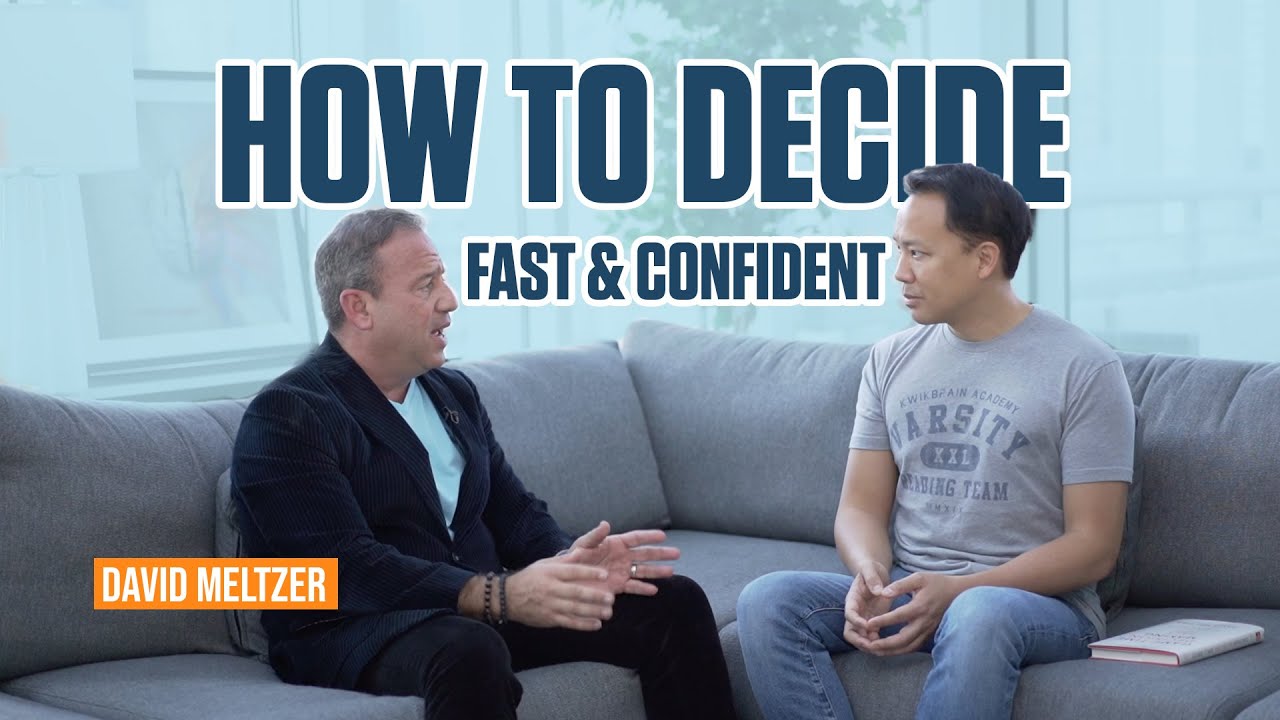
David Meltzer breaks decision-making into four personal values: personal, experiential, giving, and receiving. Aligning choices with these values removes paralysis. He practices four daily values—gratitude, forgiveness, accountability, inspiration—spending just seconds each day on them, plus a 2-minute meditation and quarterly check-ins with his spouse.
Chapters
Welcome back, Kwik Brain. The question for you today is, how do you make great decisions quickly with confidence, with clarity? And I'm very excited to have a dear longtime friend on this show. We've been trying to make this work for quite a few years.
Since you started, I think.
Exactly. This is David Meltzer, and he is the founder of SportsOne Marketing, author, We're going to talk about his most recent book, which is Game Time Decision Making. And thanks for being on the show, buddy.
Thank you. I was wondering if all those words started with a K or a C. Being a branding expert, I was thinking K. So I'm going to do this quickly, but thanks for having me on.
No, thank you. I know you and I often want to be able to record our conversations, and because they're priceless.
Yeah.
And I've learned so much from you as a friend and as a mentor. As a peer. And I think the quality of our life right now— I think everyone would agree that their life right now is the sum total of the decisions they've made up to this point. But are there any classes on how to make a good decision, right? School teaches you a lot of like what to learn— math, history, science, Spanish— but they don't necessarily teach you how to learn and how to think.
And I see this decision-making like Yeah. You know, we make so many decisions in a day. Most people don't pay attention to sleep, but it's the number one habit that we all share and we spend the most time doing it. The next would be decisions. There's so many decisions that you make every day, but people don't train us how to do them. We don't practice making decisions or understand how decisions are truly made quantifiably to, to make the best decisions. How do we assess the situation in a quick manner to make the best decisions. And what I have found as an executive coach in dealing with some of the biggest decision makers in our world—
Sure.
—is that it's all value-based to start. That if you spend the time practicing knowing your values, that it allows you to literally, in my opinion, unconsciously make the best decision for yourself that is a balance between 2 different spheres. One, the pragmatic sphere of money. So I believe money is an object of energy that we put into the flow, and if you buy the right things, you'll be happy. If you buy the wrong things, you won't. But faith is always in conflict and with money, and when we make decisions strictly in a monetary analysis, we're not really utilizing our values. When we institute values into a quantitative monetary decision, it actually gives us a greater result because it really blends in Faith. And one of the tricks to do that beyond knowing your values is to extract time from the decision-making. And it's— time is the nemesis to making decisions. And so if we can allow ourselves to do an analysis saying, what would my analysis or my decision be if there's no such thing as time? Everything changes. So that framework of utilizing our values, extracting time, can help you consistently make the best decisions because I think it blends both realms, utopic realm of faith with the pragmatic realm of monetization.
I like that a lot. I think a lot of people fail to make a decision and then they put it off and they put it off and they put it off and it takes a lot of energy. It takes a lot of time. How do people begin finding— how would you define values?
So values for me is to understand there's 4 types of values. One is our personal values. character, love, integrity, different things that you may in your own person be. Then you have experiential values that starts from the time— I believe in multiple lifetimes, but let's just say from the womb on.
Okay.
You have these experiences and there's values that are created by what you've learned through the inaccurate senses you have and the inaccurate memory that you have. Then you have the giving values. How is this going to provide value to others? is giving to me.
Okay.
And then receiving values, which has the most interference, I believe, between you and the connection that you have between inspiration and you, is that most people are afraid to receive. They create interference through ego-based programs. A lot of them are in our DNA. I call it the quantum memory that we've inherited from at least 4 generations— great-grandparents, grandparents, parents, to us. But it allows us— we feel guilty for receiving. We don't feel worthy of what we have. We somehow think we shouldn't ask for what we want, but I create a flow with those 4 values. And for me, when I did my analysis, I have 4 firm things that make a decision for me. One is gratitude.
Okay.
So I find the light in everything that I'm assessing. I look for the positive, the best situation. I see things through it that other people will never notice. It raises my awareness when I'm looking to— I get to do this. What's the light, the love, the lesson in it? 2 is interesting, was forgiveness.
Really?
Yeah. I think in order to make an appropriate decision, I have to forgive myself for the lessons I haven't learned. Forgiveness, self-forgiveness? Self-forgiveness, because I can't give what I don't have. And I think once I've forgiven myself for the lessons that I haven't learned, it allows me to drop out of the ego-based consciousness and into a truth consciousness. It connects me to an actual emotion that tells me this is a good decision regardless of whether I put my hand in the fire before and I haven't learned that lesson. The next then would be accountability. A lot of people when they make decisions, they're already going to blame, shame, and justification. They're already creating void shortages and obstacles in their decision-making process. They're always thinking, already thinking when they make the decision, what excuses could I have if this doesn't work?
Before.
Beforehand. And I believe that happens consciously, subconsciously, and unconsciously. And then the last one of values is inspiration. And I think this is the most misunderstood thing. I shifted the paradigm of my understanding when I make decisions that I used to think when I did it in a monetary sense, will this inspire me? You know, making this decision, will this motivate me or inspire me? What I learned was When I shift to, I'm always inspired, I'm connected to the greatest source of energy, power, and light at all times. In fact, I can prove it physically that my thumb has more kilowatts, you know, could light up all of Manhattan here. But I'm not utilizing all that power because I'm creating a corrosion and interference between that source and me. And so if I'm going to make an inspired decision, I'm looking to see how could I lessen the interference between that which I'm connected to in me? How can I create less corrosion? Which are all based off of conscious experiences that I have, about 10,000 new data points a day, thoughts, 40,000 of the same thoughts that exist in my subconscious that are really creating these neural pathways, which you know much more about. And then I believe that that creates a frequency to my unconscious competency.
So are you making decisions consciously, or are we talking about A combo?
Yeah, consciously, subconsciously, and unconsciously. So consciously, I'm making a decision based upon harnessing what I understand of my subconscious and understanding or having awareness of who I genetically and like literally, uh, mathematically am. I believe I have a quantum memory, and so the more that I become aware of my quantum memory that my personality traits are indicative of My characteristics are indicative of it. Those values that I talked about are indicative. The obsessions and addictions that I have are indicative of a programming.
Interesting.
Now, through my decision, I can activate through the epigenetic layer of my DNA that I believe I can activate different personality traits to expand or accelerate a better decision.
So how are you defining that? What's the difference between subconscious and unconscious then?
So subconscious would be the 40,000 of the same thoughts that I'm having mostly when I'm sleeping or daydreaming, but my brain has actually utilized those to create neural pathways, to create efficiencies or discipline.
Right.
So some things we just know how to do, and those exist in my own experiential values in my subconscious. The unconscious to me is more quantum. For me, it could be millions of lifetimes of information. that is stored in a code, and that code can be accessed and changed and activated and deactivated. I probably know this much of what I'm talking about, just so you know, but I have a great sense. And these defined terms may be incorrect, but I have a great sense, and I coach this way.
Yeah.
We were talking about how I can carry 50 executive clients at a time and have a waitlist is because I believe in coaching through that continuum. And the only proof that I have is that 100% of my clients, it works. And it takes 10 minutes literally a day in order to effectuate practicing this.
So what does that— now, before I ask you about what those 10 minutes look like, when you're talking about those values and we're talking about things like gratitude and accountability and inspiration, are you recommending that the people who are listening and watching have Prioritize those values, or are they individual towards you?
Those are individual towards me. So, you know, everything— we're all different. Yeah. And that's what makes us great. And so when we learn our values though, people— and I've seen people with completely diverse values of mine, you know, that can make very quick, good decisions. Because what makes a decision good or bad, right? That's a condition or judgment. What makes it good or bad is, is it aligned with your values? So The better that you know your values, then you're going to determine in your head, and others will too, a portion of them, of the 4.2 billion people that have access to you, a portion will be like, good decision. Every decision I make, I can find plenty of people that would tell me it's a bad decision. Why? Because my values are different than theirs. They're just decisions.
Right.
But if you're going to feel good about your decisions and get the results that you want, you have to know your values.
And it would help also to know your partner's values, your significant other, your team's values, because it would explain a lot of their decisions.
It's such a good thing to say because I do this with my business partners as well as my wife, and I've been happily married 23 years. She's only been happily married 12, the last 12, because I was not the guy that I am today. But what's interesting is I learned to go literally quarterly with my wife, and we spend an hour apart writing down our values for the next quarter and what we'd like to do according to decisions we'd like to make. And then we get together, right? We don't talk to each other and we see which ones are the exact same and where our values are not aligned. And then we discuss compromise or submission or some other things that may be beneficial. And I really believe that as As parents sharing those values, we don't have the normal circumstances. I have 3 teenage daughters. You can imagine the conflict that that causes between parents that values aren't the same.
Right.
And we send different messages that are not healthy to program our children to be happy and healthy as well. And so we really— and I do that with my business partners as well. The learning curve that you get from that short hour separate and then the short hour together is extraordinary because Because once again, now we're making decisions on the same page. And the only way to do that is the conditions and judgments of the values have to be the same.
Because you could do it with confidence because you have clarity. And it requires less energy. It requires less time. Like, I know, like, literally what happened was you texted me and said you were in town and to be able to get together finally. Yeah, this happened. And I was just like, text right back. I'm like, great, let's do it. And again, I had to put no energy, no time into it. My values, when I think about my values, and we could go through how you could elicit their own values, people who are listening, are things like love, growth, contribution, adventure. And for me, it was an easy decision, no time or energy required, or minimal, because love, friendship, relationship, growth, I know that I'm gonna grow.
That's what we shared for this one. We're like, oh my gosh, 20 minutes of growth.
Exactly. And then, and also the contribution that it's going to have to the world who's listening to this. And also adventure, meaning a sense of joy and fun, because this is going to be a great experience.
And mine was the same way as I went down the list. And because, you know, you go places and you forget these special people, right? Because we travel a lot, and I've been really more cognitive of the fact of I'm making lists so that when I go to each city, that I'm literally prioritizing through my values, who I reach out to, to figure out the limited time that I give and have to share these experiences that just accelerate and grow what we're trying to do.
And to the point we could feel fulfilled and happy is where we're aligned with those kind of values because we demonstrate our values to other people based on where we invest our time and attention. It's hard to tell somebody this is something valuable to me, and you're not putting any effort or energy into it.
Absolutely. And you see that through sports or art or music. If we all had the same value, we would all like the same things, right? Right. And even in politics and in education, it's all value-based. But I'm, you know, out here trying to make people happy, right? My main mission in life is to impact 1,000 people like you that I know can impact another 1,000 to impact another 1,000. To be happy. That's over a billion people in their lifetime to be happy. But in order to do that, the real message is let's explore and practice our values. That's really knowing— I've seen the evolution of my marriage because that's the longest, most intimate relationship that I've had. And I love the fact that, you know, I can tell my wife I'm not going to give that any energy, or, you know, everything will come at the right way at the perfect time. Where years ago, if I told Somebody that— what are you talking about? You're going to rely completely our whole economic future on the fact that everything's going to happen the right way at the perfect time, or you're not going to give it energy? Imagine getting a tax audit and saying, I'm not giving it any energy. Without having your values aligned of what that means, your marriage is probably over.
That makes sense. The key then to make better, quicker decisions is to be clear on our values. How does somebody who's listening— sorry, and we're in New York City, so there's a bit. So the key then to make really good decisions quickly is to be clear about your values. How does somebody find out what their values are?
Right, so we have to practice, you know, and I believe in daily practice. 2 minutes of meditation is worth more than 2 hours a day, is worth more than 2 hours on a Saturday. So I've created a system, number one, to feel okay about lowering the bar.
Okay.
So if we're going to do and practice something every day, you have to be comfortable that I've lowered the bar, that I'm a bite-sized person. And because those bites become chunks, become glaciers, if we do things in that progression and trust it. So what I do is allow people to give a minimum amount of time every day to do a value assessment of the decisions or the activity or actions that they've taken. And it could be as little as a minute a day. To do that. And I'll even start with an exercise if someone's not sure. I start with gratitude because most people, I feel that's the most powerful value you can have. It's basically saying everything in your life is good.
Right.
By being grateful. So if someone says, where do I start? I'd say 0.1 seconds a day, say thank you before you go to bed and thank you when you wake up, and your life will start changing. You'll start the action of creating a value-based decision-making because you'll start just making decisions out of gratitude instead of fear. Right. And I want to say one thing about fear that I've learned through this process. People think they're motivated by fear. You're not motivated by fear. It's the biggest soul-sucking, energy-sucking thing out there. What it does is focus you. So if you can be aware that fear will focus me, and focus allows you to get outcomes that you want, Being focused because you're doing stuff every day when you're focused, and that continuum goes from your conscious to subconscious to unconscious. But it's going to suck your energy. So I look to fear as just focus, and I look for another by exploring gratitude and forgiveness or whatever my values are. Every day you can start with 0.1 seconds a day and start there, but you're going to start building the habit and start thinking about your values. And it'll be really interesting, like every day it's still kicks me in the face, especially in New York. I will walk by someone on the street and pass them up because I'm in a hurry— time.
Yeah.
And I want to help them. Once I give them money, it leaves my hands. I, I don't care what the money is used for. It will pull me back to them now because my values are so strong. But in the past, when I was practicing learning what my values were, I would start analyzing, why do I feel guilty walking by that person? Why do I— I started asking questions. This is the practice of value and decision-making and the combination of the two.
What would be one of those questions to help people hone in on their values?
Why do I feel this way is the main question. Why do I feel this way? Not why did I do it? Why do I feel this way about blank? If you start practicing that question, you're going to really hone into what your values are, and you're going to start trusting those values, faith, and saying, no, I live by gratitude, I live by accountability, and I'm going to stop and hand a dollar to that person, or $100, doesn't matter. And even if I give a dollar and say to myself, why do I feel bad? I should give them more. Then I got to ask myself, why do I feel bad about helping someone I don't know?
Hmm.
And explore that. This is how we learn our values, and you'll start learning about your own continuum of how you can be happy. Because it's truly just happiness is a perception. And unfortunately, a lot of people have the wrong perceptions. You know, suicide, anxiety, fear— these are overwhelmingly growing, not shrinking. You know, I look at college graduates. When I graduated college, 10% of graduates were anxious, fearful, or depressed, or suicidal. 10%. Today, 90%.
Wow.
This is a perception.
Yeah, there's a lot of people have that uncertainty. And so when you're asking these questions, questions could be also, what's most important to you?
Good question. Part of this practice is do it now. Do it now. This is a quick way to do it. Do it now. Number one, it started with time. When I realized you people, these woo-woo people that we hang out at the Transformational Leadership Council, talk about being present, right? It frustrated me because I really didn't understand what they meant. I'm like, I'm here. But what it means to me is do things now. Meaning if you can do something now, do it, because you'll save at least half as much time. If you can't do it now, then put it into a repository, a list, a folder, whatever you want to do. And that allows me to prioritize by importance, what to do next. When I'm evaluating what's important, I'm exploring my values, right? E-value, energy value, emotional value. That's evaluation for me. Now, here's the interesting thing. Time. Time again, right? The framework, take time out of it. I don't do what's urgent. I do what's important first. And this is, I think Roosevelt came up with years ago. You delegate if something's just urgent. Delegate somebody to do it. I prioritize by what's important. And the more that I know my values, either it is to evaluate, it also makes it easier to do things now, which saves me more time and makes me more statistically successful at what I'm doing.
And by doing those important things, you have less buildup of urgency. So some people are neglecting what's important and like their health or the relationship, and then all of a sudden it becomes urgent out of—
Here's where it stemmed from. My values really Simply, I started creating time into what I was doing. I always put my family first, then my business, then my health.
Mm-hmm.
And through this analysis, my own practice, I completely turned it upside down. And my wife is the one that was catalytic to it. She said, we, you know, we lost a lot of money. I went bankrupt in 2008. And when I made it back, I said, honey, what can I do for you? You saved my life. I couldn't do this without you. you. What do you want? She said, I want you to take care of yourself. I get choked up.
Yeah.
Like, what do you mean? She goes, well, if you take care of yourself, I know you'll take care of others. And I was getting heavy, right? I wasn't eating right. Business was going great, family was amazing, you know, everybody's happy and healthy except for Dave. So I said to myself, from today on, I'm gonna spend a minimum of 1 hour a day on my health because I can't give what I don't have. And if I I'm not here, all those other things are going to fail. And so I literally completely transformed myself through that value. The interesting one that I did that changed all my relationships— family. I give a minimum of 30 minutes a day to my wife, no matter where I am. Not all together. 30 minutes to my 9-year-old son, 2 minutes to my teenage daughters, minimum a day. They wanted— I wanted 5, they gave me 2. And my mom, 1 minute. And here's what's interesting about values. When I said I'm going to spend 1 minute with my mom, I felt bad. And I said, why do I feel bad? And I said, what does my mom really want from me? I said, well, I'm a parent. There's 4 things that I want from my kids. One, I want to know they love me. 2, I want to know they appreciate me. 3, I want them to be happy. And 4, healthy. So at a minimum of 1 minute a day, if I could share that with my mom, right, right, which I do every single day— text her, email her, and call her— one of those. And I just say, Mom, I just want to and tell you thank you because I'm so happy, so healthy, and I appreciate you and I love you. And it's changed my whole relationship for 1 minute a day.
And those little moments, little by little, a little becomes a lot.
Exactly. And you start understanding your values, what it really means when you say, I value my family. It also works the other way. I've been able to fire friends, right? I had a lot of people surrounding myself with the wrong energy, ideas. And through understanding my own values, it propelled them away from me. Or I just straight out said, this is about me, not you, but I'm not going to be spending time with you anymore. I just wanted to let you know that I appreciate our friendship, but it's not good for me.
And that's part of making a decision. When you say yes to somebody, make sure you're not saying no to yourself. Part of making good decisions is making boundaries around our time, our energy, our emotions.
Yeah, saying no. I gave some money to a homeless guy today and it was like $5 and he saw what I was holding and goes, give me that $20. And I literally said no, right? Because it's not within my values.
Right.
I'm like, you said you needed something to eat. There's plenty of places to eat for this and I want to save enough to give to other people as well.
Yeah.
And that truly drives me. This book, Game Time Decision Making, which I utilize a pregame analysis tell you what I'm going to teach you, great lessons of decisions. Then I just use sports stories that show what these great leaders have been able to do, because in sports you have to make very quick decisions and then do a post-game analysis. And so that was the idea behind Game Time Decision Making, was to allow people in a friendly, easy way to start building these habits. At its core though, is what I truly believe, is that what we do every Every day is the most important thing. And lower the bar and just start doing it.
And you build those decision-making muscles because a lot of people, they put things off and then that gets stronger, procrastinating, or their energy is going somewhere else.
And you're one of the people that inspired me in the direction that I moved because what you do is exactly— and did— to even expound and expand upon what you've been able to teach people, it started with that type of thing. You kind of started right there by being able just to read.
And it's amazing that everybody's watching this right now, you know, when they have a big decision— where am I gonna live, who am I gonna be with, what am I gonna do— those little decisions, they can become big decisions, especially if you do it over and over again, because then it gets deeper into your subconscious where it becomes more—
And you said it interestingly, thing because of big decisions. What I find is that the bigger the decision, the more people don't vote for what they want. They start voting for what other people want. Interesting. And if you know your own values, you won't go searching for other people's values and their opinions and their expectations. Advice is great, counsel is great, but values— you know, my mom told me, which, you know, it's— nobody cares about me more than my mom, but when I graduated law school, I had a choice to be a real lawyer or to sell legal research online and literally told me, you need to be a real lawyer because the internet's a fad. I'm so worried about you. And it was hard for me to go against that.
Sure.
But voting for myself— now, back then I didn't have the practice of values, but I just had some inclination and trusted my faith that I was making. And then I hedged it by saying I could always, you know, I took the bar instead. I could always go back to the law. So there's reality of the negotiation that occurred. That's the blending of the monetization. That's a good example of me blending money decision with faith.
Mm-hmm.
Very pragmatic with just faith. And it's funny, here's one of the interesting things I've learned. Every time I make a decision on just faith, it turns out better. But I'm still too afraid. I have to illuminate to everyone. Being someone who practices this all the time, I love the fact when I'm like, nope, I'm just too afraid to make this on faith. I'm going to make it— this is a money decision and it may be scarce. It may not be aligned completely with the values that I have. And even though I know in my heart that the faith-based decision, I still live in the man-made construct of time and I won't allow time to be extracted. I want it now. Or, you know, the college— there's all these little things that you think of that aren't faith-based. And that's the, for me, the fun part of the journey that allows me to enjoy the consistent everyday persistent pursuit of my potential. But it's still just a pursuit, and I have learned to love my imperfections in that journey.
Well, that's amazing. What would your challenge or advice be to everybody? Final words?
Final words is really easy, but my challenge would be to say thank you for 30 straight days before before you go to bed and when you wake up. And my advice is really simple: be kind to your future self and do good deeds. If there's any question of where to start, just ask yourself, what would a kind person do? And what's the good deed to be done?
I love that. I love that. I value your time and your talent.
It's amazing.
How can people find out more besides—
Yeah, my name is the best way. So David Meltzer. I'm @DavidMeltzer. David Meltzer on YouTube and LinkedIn. My website is my first initial, last name, dmeltzer.com.
Amazing. I recommend everybody takes a quick screenshot of this episode or of this video and tag Dave, tag myself in it, and share your big aha. What was one thing you got out of this conversation that touched you in a certain way that you maybe feel inspired to be able to share with other people? Because when you share it, You get to learn it twice. Tag us both in. As always, I'll repost some of my favorites. Dave.
You're amazing.
Thanks, buddy.
Thank you. Hi, Kwik Brain. It's your brain coach. I want to thank you so much for watching this video. 3 things to do. Number 1, make sure you share this because when you teach something, you get to learn it twice. Update your learning so you can update other people's learning as well. Number 2, make sure you subscribe to this channel so you don't miss a thing because if you miss a video, you miss a lot. Finally, make sure you hit that bell so you're notified Notified and you find out when we put out the latest and the greatest. One extra thing, if you want really close attention, then text me. Here is my phone number: 310-299-9362. Did you remember that number? 310-299-9362. Shoot me a text And we'll stay in touch. Ask me your burning question. And I wish your days be full of lots of life, lots of love, lots of laughter, and always lots of learning. I'll see you in our next video.
More from Jim





The Library of Minds: Brain Coach: How to Stay Sharp When AI Does the Thinking | Jim Kwik





