How to Manifest Your Dreams Using the Power of Your Mind 🔮
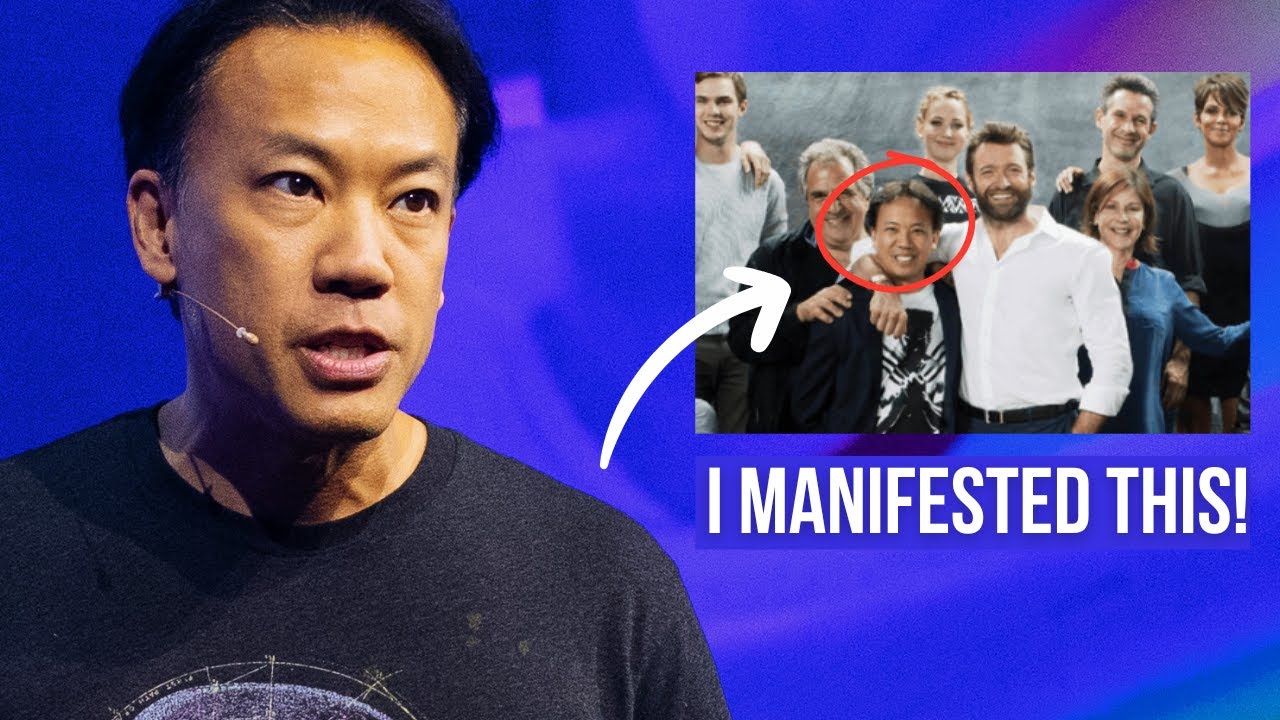
Memory expert Jim Kwik explains episodic future remembering, a neuroscience technique where vividly imagining future events activates more brain regions than normal recall. He shares how he rewrote his identity after a childhood brain injury and offers a morning visualization exercise to encode goals into memory and accelerate learning.
Chapters
One of the world's leading experts in brain performance and accelerated learning.
Expert on optimum brain performance.
Boy with a broken brain.
He's the founder of Kwik Learning.
Get ready to upgrade your brain with Jim Kwik. Jim Kwik.
Jim Kwik.
Jim Kwik.
Jim Kwik.
Jim Kwik.
Jim Kwik. Jim Kwik.
Kwik Learning. Jim.
Jim.
Jim Kwik.
Brain expert.
World's leading memory coach and New York Times bestselling author, Jim Kwik.
Brain genius, Jim Kwik.
Jim the Brain Kwik!
This is a young boy who, when he was 5 years old, had a traumatic brain injury and spent the next 15, 16 years on learning, on learning quickly.
Instead of simply accepting defeat, he set about making up for his shortcomings through an obscene amount of hard work.
Jim's book Limitless is a phenomenal bestseller.
His hyper-effective techniques have been sought out by the likes of Virgin, Google, the United States Air Force, Nike, Zappos, Marriott, NBA, SpaceX, 21st Century Fox, Harvard, and Singularity University.
Jim Kwik is in this house!
I love him! Jim Kwik, everybody! Thank you, thank you.
So I woke up this morning in Maui in Hawaii, and I find myself here. Maybe we, uh, We co-manifested it together. I was listening online and I really miss the Mindvalley tribe. Aren't they doing an incredible job? And I want you to ponder a question that I was thinking about backstage as I was listening, maybe a question to help you integrate this and really Really on lock. And the question is, what part of me, you, right? What part of me is still negotiating limitations?
Ooh.
Just maybe you can meditate on it for a few seconds. What part of me, as you listen to everything today and tomorrow, Where do you find that resistance? What part of me is still negotiating with limitations? What I wanna share with you in the time that I have with you is a quick tool to— Kwik is really my last name. Really to What if tomorrow's goals, tomorrow's dreams, what if you can make them feel like they were yesterday's memories? Right? I'm a memory coach, and I'm gonna show you how to utilize the power of your memory to amplify your manifestation. What if tomorrow's Dreams, your deepest dreams, desires, your goals. What if they could feel like they were as real as yesterday's memories? Now, you've tried a lot of things. How many of you read all the books? You do vision boards? You have affirmations? But you also still, at some level, feel stuck. After all of that. And, you know, if you know my story, you know my origin. There's been times in my life, especially in the beginning, where I felt stuck. And Limitless is not about— if you read my book Limitless, it's not about being perfect. It's about advancing and progressing beyond what you currently believe is possible. But the truth that a lot of people don't want to talk about is that Growth can be hard, right? Like, I don't know how you're explaining to your friends and family where you are at this moment. But growth— like, life is difficult for one of two reasons. Either you're leaving your comfort zone, right, into the unknown, trying something new, or life is difficult because you're staying in your comfort zone, right? And growth can be hard. Change can definitely be scary. But I feel that nothing is as hard and scary as being stuck somewhere that you just don't belong.
Yeah. Yeah.
And so, many of you know how I started on this path. I've been teaching now, I'm going to be 52. I've been teaching now for 33 years. And it wasn't always easy, right? It's— and everyone's always fighting battles that no one knows about. My parents immigrated to the US, didn't have any money. We lived in the back of a laundromat that my mom worked at. You know, I had my brain injury when I was 5 years old. And as a learning expert, it's hard to talk about. Like, I had focus issues, I had memory issues, I had migraines every day when I was 5 years old. I just thought it was normal. But how many of you believe that with struggle comes strength? Yes?
Yes.
Like, I don't know one strong person that had an easy life. And with challenge comes change, right? And this power— and this— as we're on this quest to realize and reveal our fullest potentials, there's adversity. But adversity could be an advantage for sure, right? I remember because I couldn't read for a few years like all the other kids because of my traumatic brain injury, It really had an effect on my self-worth, my self-confidence, my self-esteem. I mean, I never wanted to be called on in class. I would literally shrink so I wouldn't be bullied or get the teacher's attention, right? I didn't want to take up a lot of space. I was very fearful of public speaking. My 2 biggest challenges growing up were learning and public speaking. And, you know, life has a sense of humor because what do I do? I just public speak on this thing called learning all the time. And so I remember when I was 9 years old, many of you know this, I was slowing down the class. My nickname back then was Jim Slow. Kids could be very, very harsh. I was being teased very harshly one day because I just didn't understand the lessons. And the teacher would have to repeat herself over and over again in front of the whole class. So it was very embarrassing. And because I was being teased, the teacher came to my defense. She pointed to me in front of the whole class and said, leave that kid alone. That's the boy with the broken brain. And that label became my— it turns out okay, okay? But that label became my limit, if you will, because every single time I did badly in school, I would say, oh, because I have the broken brain. Every time I wasn't picked for sports, because I have the broken brain. And so that was my identity. And we could talk about changing our identity, 'cause I think the actions we take are evidence that we are the person that we say we are, or that we wanna be, right? And so, going through this, I wanna talk about how to use your brain, your memory specifically, to create your future, which is interesting, right? This idea here, The tool I'm going to share with you is a tool that I— so, how many of you have gone through Superbrain? Raise your hand. So, in Superbrain, I train people how to remember facts, figures, foreign languages, give speeches without notes. If you took Superreading, how to read faster with better comprehension, right? And I also show you how to remember your past. And that's called your episodic memory, the episodes of your life, right? The events and experiences in your past. And I wanna show you how to take that and actually build your future, 'cause your mind doesn't know the difference between something that you're vividly imagining and remembering and something that's real, right? And so what if you could, tomorrow's goals and dreams, you could imagine like it's a memory, like that it's already, how much certainty would you have? How much confidence would you have? How much gratitude? How would you show up when that's the case? In fact, when they do fMRIs, right, brain scans on individuals, they'll see that there'll be heightened levels of activity and connectivity when somebody is actually imagining what I call— so it's called episodic future remembering. Episodic future remembering. When you're remembering the future, actually 11 brain areas get activated and connected, as opposed to if someone's just remembering, then it's about 6 brain regions. So, it's a huge mental upgrade, if you will. And so, when you're thinking about this, where would you apply it? Like, for me, very simply, Many things you could be able to do is your morning routine. How many of you have a morning routine? And so, for my morning routine, for example, instead of touching my phone, I would just imagine— imagine doing this tomorrow morning, please do this. I would challenge you in the morning, before you get out of bed, do this mental time travel. Just close your eyes, and I want you to imagine you're coming back to bed. And somebody asks you, how was your day? Very common, right? And I want you to say, that was an amazing day. Crushed it today. Best day ever. And then you reverse engineer it saying, what had to happen in order for me to feel that way? Right? And it becomes a blueprint. And I come up with 3 things personally and 3 things professionally. And that's my target. Because it's not about time management. It's more about mind management. And the most important thing is to keep the most important thing the most important thing, right? So even do this. This is an experiment. You can stay sitting, but I want you to just close your eyes, take a breath, and I want you to imagine a time in the past. Imagine a time in the past, something that happened in the past, and I want you to point in that direction.
Okay.
Some of you are familiar with timeline therapy. Point in that direction. Where's that feel like that memory is? Point right now. Physically point. Okay. Now I want you to take a breath and I want you to think about something in the future, something you know will happen in the future. You're gonna wake up tomorrow, you're gonna have a coffee, you're gonna fly home, and point in that direction. So when— and this is a Gross simplification. If you connect those dots, some of you pointing in the past in the front, in the back, front was the future, or left was the past, right was future. If you connect those dots, you have a timeline. So what I would do is in the beginning, I would train my mind and put the things that I wanna remember or create in that timeline in the future, right? As if it already happened. You know, one of the ways I use this, when I was 9 years old. Many of you know, down the street, I got a call and I flew here from New York. I got invited to speak at 20th Century Fox. And it's interesting manifestation. I ended up meeting my future wife on the security line in the international airport at JFK. And that's a different story. But when I did this presentation for them, they said— I did a brain training for their team. They're like, this is the best training ever. Thank you so much. And they gave me a tour of the lot, similar to this. And I saw this Wolverine poster. How many of you are superhero fans? And I said, I can't wait for that to come out. The chairman picks up the phone, and 5 minutes later, I'm in this theater like this watching the Wolverine movie that wasn't coming out for a few months, right? It was a perfect Friday afternoon. And he says, how was the movie? I was like, it's great. Thank you so much. I tell him my story that I couldn't read as a kid. I read by reading— I learned to read by reading comic books. And my favorite comic books was Wolverine and the X-Men, not because they were the strongest, it's just they didn't fit in, right? I felt growing up I didn't fit in with my issues. I told him when I was 9 years old, I used to ride my bicycle around my neighborhood because I found out the X-Men school was in Westchester, New York, a suburb of New York where I lived. And that was so real, I would obsess about it every night. And he's like, Jim, I didn't know you liked superheroes and X-Men. We're filming a new X-Men movie in Montreal. We have another, you know, 30 days of filming. Do you want to go? I was like, yeah, totally. I was like, what can I do for you? He's like, just teach the crew, cast what you taught us, how to speed read scripts, memorize lines, be focused on set. I was like, I totally do this. I get on the plane the next morning on Saturday. They call it the X-Jet. And I'm the last one there. And the entire cast of X-Men's there. And I don't see Hugh Jackman and Patrick Stewart. I see like Wolverine. And I'm sitting between Halle Berry and Jennifer Lawrence going to film, right? And when we're there, I got to see my superheroes come to life. And better than that, a week later, I go home, and this is the manifestation part, and there's a package waiting for me the size of a TV. I open it up, and there's this photograph. It's me and the entire cast of X-Men. And even better than that was the note, which I hope it lands. It said, Jim, thank you so much for sharing your superpowers with all of us. I know you've been looking for your superhero school ever since you were a kid. Here's your class photo. And I just, I share this with you and the power of manifestation because I would obsess. I would see it, I would feel it, I would imagine it. And in this movie, it's about time travel, if you saw it. It's about the future, it's very apocalyptic. And Professor X sends Wolverine back in time to tell the younger Professor X what to do to to save the world. And you could do that too. That's mental time travel, right? This is this episodic remembering of the future. And what would that future self tell you right now? Like, what do you need to hear right now? Or what would you have told your 9-year-old self, right? And so you could play with time because the bottom line is this, there's a future self that's patiently waiting You know, and the goal is we show up every single day until we're introduced. Thank you everybody— much, everybody. Thank you, thank you, thank you.
More from Jim





The Library of Minds: Brain Coach: How to Stay Sharp When AI Does the Thinking | Jim Kwik





