How To Overcome Stress and Relive Pressure (with Jay Shetty & Jim Kwik)
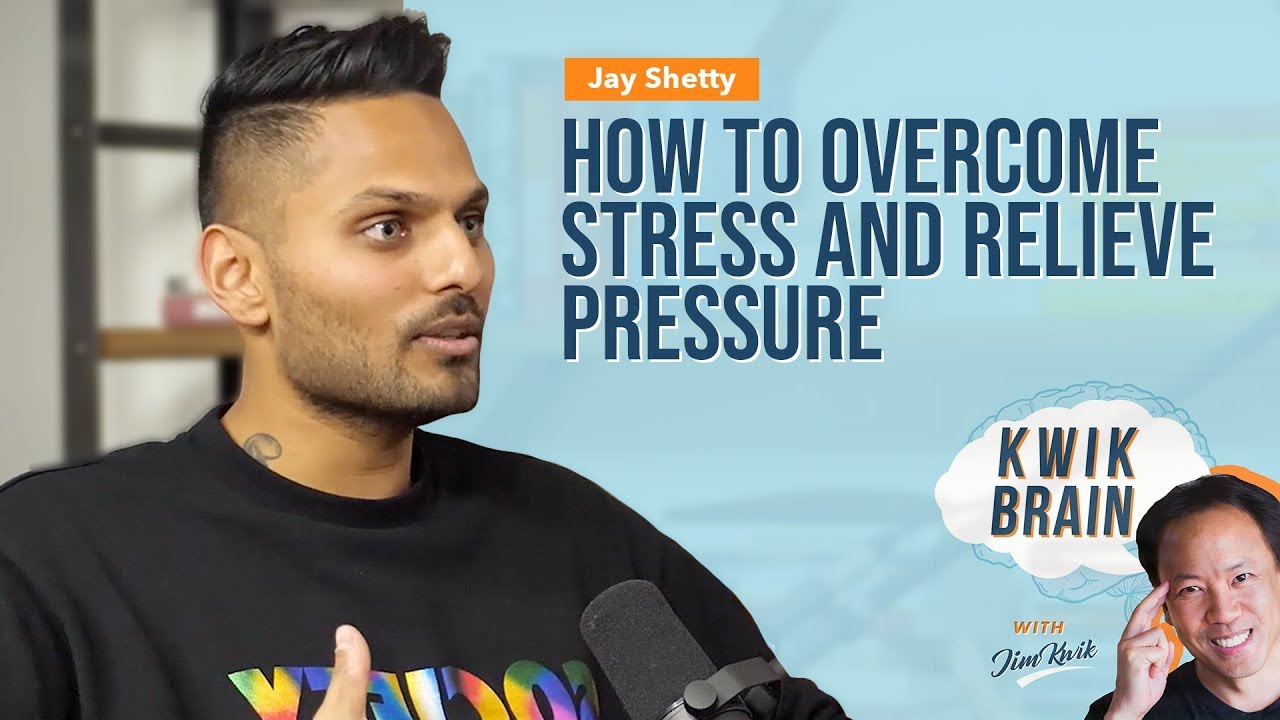
Jay Shetty explains stress as a mismatch between mind and body, then teaches three monk techniques: equal-count breathing to sync them, visualization like Lewis Hamilton uses before races, and sound awareness to stay present. All three take minutes and need no apps.
Chapters
Welcome back, Kwik Brain. So here's your question that we saw on Facebook is, how do you overcome stress and relieve pressure? I mean, in this day and age where we're drowning in information, we have so many demands on our life, so much conflict and so much drama, and you don't have time for yourself. How do you actually do this? And so we're so thrilled today. I am so thrilled and honored to have a very special guest, a very special super friend, if you will, Jay Shetty. Now, most of you know Jay Shetty's a He's an acclaimed storyteller. He's a viral video creator. He is literally the man, and we're glad to have you. Thanks for being here, Jay.
Thank you, Jim. Thanks so much.
You know, we were just having an incredible conversation, and your words have profound impact. You're all about sharing and inspiring wisdom, which I really think, you know, we're drowning in information, but we're starving for that wisdom right now. And we're in this conversation about stress. I mean, we live in this world where we were just having this conversation with people so busy and they're stressed out of their minds and they feel so much pressure more than ever and it's just getting worse. And so how do we relieve that pressure? How do we overcome that stress?
I've developed 3 really practical methods that I learned while I was a monk to overcome pressure in different areas of life. So one of the things I often talk about is a lot of us feel physical and mental pressure throughout the day. And one of the reasons why we feel that is because either our mind is ahead of our body or our body is ahead of our mind. So I'll explain what I mean by that.
I like that.
So often, how many times have you had it? Anyone who's listening right now, I'm sure you can relate. How many times have you had it where you're running to your next meeting, so your body's moving really fast, but your mind's going, I wish we were still in bed, right? Your mind is still tired, your mind's still feeling fatigued from the day before or whatever it may be. And sometimes we have it the other way around. Your mind's racing, it's saying, okay, we've got this to-do list, and now we've got this to do, and now we've got this to do. And your body's going, ugh, why can't it just be Friday already? Why can't it be the weekend? Because your body's tired. So what we generally experience in our life is either our body's ahead of our mind or our mind's ahead of our body, and that creates friction. That's a disconnect in our life. And we were just talking about this, that we feel alignment when what we think what we say and what we do, that's when we feel harmony.
Right.
So the way to do that, one really practical tip— I do it all the time, especially when I'm rushing onto stage to speak at a conference, or I'm walking into a meeting and it's been a long day, or whatever it is— I focus on my breath. And what I do is that I breathe in for the same amount of time as I breathe out. So when you breathe in for a count of 4, and breathe out for a mental count of 4, and you imagine the numbers in your head— so you want to breathe in and count to 4 in your mind, and you want to breathe out and count to 4 in your mind— you're aligning your mind and your body. Because now your breath is breathing in for 4, the counts in your head, and then you're breathing out for 4 and the counts in your head. So what you've basically done is taken either your body and your mind, whichever one was ahead or behind, And brought them back in alignment.
And they're back in sync.
Totally back in sync. And it works every time. Like, try it out. I do it all the time.
We should do that right now with everybody. Let's do it.
Yeah, let's do it.
Let's just do this.
Okay.
So how do we— how do we— how do we start? So if people— we're not closing our eyes.
We don't—
do you have to close your eyes?
You don't have to close your eyes.
Okay, because some people might be driving or on the treadmill.
Totally. Yeah, so you don't have to close your eyes at all. All you need to do is breathe in through your nose.
Okay.
Count to 4 and then breathe out. 1, 2, 3, 4. Breathe in for 4. 1, 2, 3, 4. And breathe out for 4. 1, 2, 3, 4. And your count is at your own pace, at your own time. You may count faster than me, you may count slower than me, that doesn't matter.
And use the word mindfulness. I mean, I, I feel more present when I do that. Yes, something like that just brings me into the moment where I'm not like ahead of myself or I'm not like behind.
Exactly. And that's all we ever experience. All we ever experience is the past or the future, right? So this is one way of just bringing your body and mind exactly where you are right now. So that's step 1. The second one that I love for dealing with pressure and stress is visualization.
Okay.
And one of the reasons why I love this one is everyone from Lewis Hamilton through to David Beckham has used visualization.
Yes.
So Lewis Hamilton would visualize the racetrack before actually driving in a Formula 1 race. David Beckham would visualize a free kick before taking a shot at a World Cup tournament. And this visualization allows you to deal with the pressure and stress before the actual activity. What it does is it allows you to fast-forward. It's almost like time dilation. You're fast-forwarding an experience and and bringing it to the present where you're not experiencing that pressure and stress, right? So that you can engage with it better. So if you're scared, for example, for if you've got a really big meeting or a big pitch coming up, if you live that meeting and visualize that meeting now and visualize yourself walking in with confidence, visualize yourself not falling over on the stage, right? Visualize yourself starting that first word that you say with composure, with eloquence, with effectiveness, then when you actually walk into that space tomorrow, you're going to carry that energy with you. And this is one of the biggest mistakes we make, that we stress before, right, but we don't prepare before. And so visualizing what's about to come reduces— reduces the stress because it lets you deal with it now, and it lets you plant thoughts and energy into the future. And that's really what a visualization is doing.
Right.
It's letting you plant the energy of feeling composed and relaxed now into that feeling. So what I do before I'm about to go on stage, I always visualize myself walking on the stage, and I do that to make myself feel comfortable and reminding myself I'm not going to trip on stage, you know, which we all fear as speakers. And, and it allows me to feel confident before I walk on. So visualizing any experience— a meeting, a lecture, an exam, whatever it may be, a test, whatever it is you're doing.
And it's like mental rehearsal.
Totally, that's all it is.
The mind doesn't know the difference between something you vividly imagine and something that's real. And most people could use that superpower, if you will, for something negative, like visualizing something they fear was gonna happen, and then they're actually practicing that in advance also.
Totally, yeah. And that's what we mostly do. We mostly mentally rehearse what could go wrong, right? So we mentally rehearse tripping up on going—
How would you do that?
We, we do that because we think We think dwelling on our stress and pressure helps deal with it, right? But it doesn't. Dwelling on anything increases it. So the only way to deal with it is to reprogram ourselves. You've just been speaking about this, to reprogram ourselves to deal with it how we want in the aspirational sense.
I love it.
To create that visualization. That's step 2. And step number 3 for me, which I love about again bringing the consciousness— so the first one we did, breath was the body, right? Visualizations for the mind. And this one's for the consciousness or your soul. And one of the ways of making your consciousness come alive— so it's said that when we're in a coma or even towards the end of our lives, the only sense that's still active is sound, right? We can still hear sound. And all of us, even when you wake up in the morning, you don't wake up to a visual, you wake up to sound. Sound is able to wake you up.
Mm-hmm.
So similarly, to wake up our consciousness, to really be alive in a space and to bring our best energy. We can actually become aware in any space, even the space you're in right now, of the sound. Sound is touching your consciousness at the deepest level. So even if we just take a moment right now, me and you, where we are, and we test ourselves just to observe the sound in this space, wherever you are, that's going to bring your deepest attention to that place.
I noticed that the pressure and any kind of stress is just like, it just melts away.
I'm glad you felt that. I felt it too.
Yeah. Yeah.
And you're just there. You just be with sound. And that's why I always say to people that if we're always scared of— if we're always scared of being lonely, it's because we've never learned to be alone, right? If we never learn to be alone, we'll always feel lonely, right? And hence being alone— and I know me and you love being alone and we're both quite introverted— but when we're alone and we're able to just Listen, not to silence, there is sound.
Right.
It allows you to just be present. So those are my 3 tips on dealing with pressure and stress.
I love that.
In any scenario. Try different ones out at different times.
And the great thing about it is we're talking about, we're talking about breath, visualization, and sound, and they're— it's quick and it's free, and people have instant access to it.
Totally. You don't need an app, you don't need to download anything, you don't need to carry anything around with you.
Yeah.
The world is a living app if you use it that way.
It really is.
The world has all of this already.
Yeah, there is no app for that.
Totally.
Thank you, Jay.
No, thank you.
What I would recommend everybody do right now, we talked about this, in order to learn something really well, you teach it. So I would recommend every single person, you screenshot this episode, you tag Jay, you tag myself, and you put your big aha. Which of these 3 are you gonna practice right now? And Jay, how would people stay in touch with you? Absolutely.
You can find me on Instagram, Facebook, or YouTube.
You're like everywhere.
Yeah, J-A-Y-S-H-E-double-T-Y.
Jay, you're the best.
Thank you, Jim.
Take care, everybody.
More from Jim





The Library of Minds: Brain Coach: How to Stay Sharp When AI Does the Thinking | Jim Kwik





