How to Regain Your Brain Energy with Dr. Steven Gundry & Jim Kwik
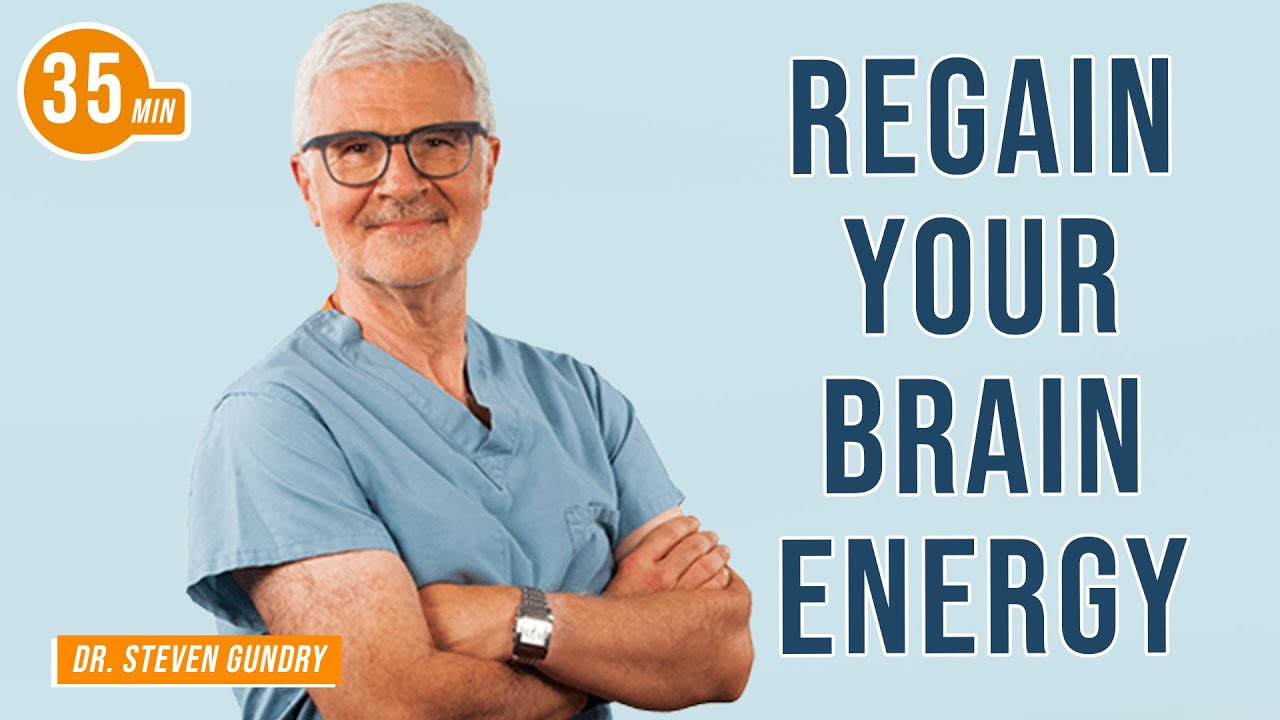
In this Kwik Brain episode, host Jim Kwik interviews cardiothoracic surgeon and nutrition author Dr. Steven Gundry about the modern epidemic of chronic fatigue, brain fog, and low motivation. They explain how ultra‑processed foods create a "rush hour" in mitochondria, overwhelming the cell’s ATP‑producing pathways, and how our culture of 16‑hour eating windows compounds the problem. Gundry introduces the concept of a trans‑kingdom communication system where prebiotic fiber feeds beneficial gut microbes, which then release postbiotic compounds that signal mitochondria to boost energy. Time‑restricted (intermittent) eating is presented as a paradoxical but effective strategy: compressing the daily eating window to about six hours reduces mitochondrial traffic and improves ATP output. Practical, incremental steps are offered—gradually shifting breakfast later each day, adding inulin‑rich foods (radicchio, Jerusalem artichoke, chicory), and avoiding meals within three hours of bedtime—to re‑energize the brain. They also discuss neuroinflammation, leaky gut, the glymphatic sleep‑clearing system, and how poor sleep timing diverts blood flow away from the brain. The conversation ends with calls to action: read Gundry’s new book The Energy Paradox, listen to his podcast, and share one small habit change with the community.
Chapters
Welcome back, Kwik Brain. Your question for today, this is an important one. This is a real vital one, if you will, how to regain your energy. We get so many people on our private Facebook group asking about this. They feel like their vitality is lacking. They're suffering from insomnia. They have difficulty concentrating. They're slow to focus, uh, their alertness. Um, they might have a mid-afternoon slump. So what can you do about it? Well, our guest today has written a brand new book with the answers, Dr. Steven Gundry. He's a distinguished cardiothoracic surgeon. He's a pioneer in nutrition. He's written multiple New York Times bestsellers, including The Plant Paradox, The Longevity Paradox, and he has a brand new book, The Energy Paradox: What to Do When Your Get Up and Go Has Got Up and Gone. He's also the host of the Dr. Gundry Podcast, which I was honored to be on. Welcome, Dr. Gundry.
Thanks so much for having me, Jim. It's a pleasure to see you again. I'm glad you're doing well.
Yes, wonderful. Now, I think this is going to be a very popular episode, Doc, because I can't tell you, we have a, you know, very large community and we have a lot of data what people are asking about. And one of the things we talk about is this thing called energy. In my book Limitless, we break down the motivation equation that I call it as P times E times S3. And P is purpose. You need purpose to get your motivation. You need S3, small, simple steps, so it's not overwhelming. But the big thing there is E, which stands for energy. How is someone to be motivated if they're tired, if they're lethargic, if they just ate a big processed meal? You know, I tell people that exhaustion can make a coward or, you know, somebody unmotivated in a heartbeat. So. Thank you for being on the show. And how— what— why is there this— why is there a rise, an epidemic of just people being tired? You know, what's going on?
Yeah, actually, in surveys, about 60% of Americans complain of fatigue or generalized tiredness. And in fact, visitors to my website, Gundry MD, they're Number one and number two reasons for visiting are need more energy and I'm tired all the time. Those are the two main visits for Gundry MD. So this is, uh, this is an epidemic and it's, um, it's, I think a lot of it is our, our own making. And you mentioned, so you have this kind of fast food meal and then you You know, all of a sudden you're slumping in mid-afternoon and you go, oh my gosh, you know, did the toxins in the fast food meal kill me? No, what's happening is, and you and I live, you know, outside or inside of large cities, and we have— we're overfed but underpowered. And if I was going to have anybody take anything away, Our mitochondria, which are the little energy-producing organelles that make our energy currency ATP, we could compare to a freeway. And freeway in Los Angeles, for example, where I live. And the process of making ATP takes protons and electrons and runs them down a freeway. And we gradually produce ATP. If we have rush hour to our mitochondria with tons of traffic coming in, our mitochondria aren't able to process that much traffic. And literally things grind to a halt. And we have rush hour in our mitochondria, particularly because now we have processed and ultra, ultra-processed foods. That instantly is absorbed as refined sugars, refined fats, and refined proteins. And all of these are instantaneously whacking into rush hour, and all the on-ramps are filled. Nothing moves. And just like any rush hour, tempers flare. Um, Fender benders happen and we're stuck. So that's number one. Number 2 is our culture. We used to think that we eat 3 square meals a day and 2 snacks. In fact, in our culture, we're constantly snacking and the average American actually eats 16 hours a day.
So Yeah.
And what's happened is, so imagine 16 hours of rush hour and no, if you will, downtime, uh, except when you're sleeping. But even when we're sleeping now, we don't have the downtime. Well, we can get into that. So we're overfed and underpowered because nothing moves in our superhighways of mitochondria anymore.
So if somebody's feeling tired, they're feeling moody, if they're zapped of energy, you know, and this happens— you're seeing people, we were just talking before we started recording, this is any age and stage also as well, correct?
Yeah, it's, um, it's amazing how many millennials now are suffering from low energy and brain fog. In fact, I actually wrote this book Because I was, I was on my way to do a PBS special to, to make some money for public television, which I love to do. And I was going into Orange County, Southern California, and I get a call on the car phone that said Mary, who was going to host, you know, my segment, wasn't going to make it in today. And I said, oh dear, you know, something come up? And they said, yeah, she, she said that she Just doesn't have it in her to to come in today. She's she's exhausted, and you know this is you know thirty-year-old millennial, and I'm going wow, just doesn't have it in her. And so I I ruminated over that for days, and I said you know I'm I'm missing something here. So many of my patients we use a code called fatigue and malaise, and fifty percent of the patients I see have. Fatigue and malaise. And as the process in The Plant Paradox and The Longevity Paradox, that fatigue and malaise goes away. So I said, you know, I'm missing an obvious point here. What they came in for, it goes away whenever we teach them how to eat. And I should write a book that we really need to learn how to eat again.
So what would some of the key points— if somebody's listening to this right now and they're suffering from this low energy crisis and they, they're a little hard on themselves because they don't know why this is happening, what would you recommend that they do in terms of next, like, small simple steps?
Yeah, and that's actually what the book does is take small simple steps. So if I was going to have one recommendation to really change your energy levels, it's paradoxical. And that is the more I can shorten the window of time that you eat from the start of the day to the end of the day and compress that eating window, whether we want to call it intermittent fasting, whether we want to call it time-controlled eating, but if we narrow the length of time that rush hour occurs in your mitochondria, you will actually produce more energy. So again, it's paradoxical. The less window of eating, the shorter window of eating, and a perfect window is about 6 hours, the more energy that you will produce. And interestingly enough, I was actually, as far as I know, the first person to write About time-restricted eating in my first book back in 2006, and I for the last 20 years during the winter eat one meal a day, and I compress all my calories to a two-hour window. So two twenty-two out of twenty-four hours I don't eat. And in terms of energy, if not if you don't eat breakfast and if you don't eat lunch, and I'm not telling everybody to do that. You got lots of time on your hands to accomplish things like reading books. Uh, so that's number one, but what I don't want people to do is jump off a cliff and say, okay, tomorrow I'm not going to eat till noon. Uh, because 80, 80% of Americans are metabolically inflexible and they can't switch from burning sugar to burning fat as a fuel. And Lots of people have heard about a ketogenic diet, but most people fail on a ketogenic diet. So what I do is, okay, let's suppose you eat breakfast at 7 o'clock in the morning. Tomorrow, you're going to eat breakfast at 8 o'clock in the morning. On Wednesday, you're going to eat breakfast at 9 o'clock in the morning. And then we're going to go to the end of the week. And then guess what? You get the weekend off. You can do anything you want. The following week, we're going to step down one more hour. So if you ate breakfast at 8 o'clock the Monday before, you're going to eat breakfast at 9 o'clock. By the end of 6 weeks, you're going to not eat, break fast until noon. And it'll become so easy. And you'll say, wow, I don't know how to do this. Just like you have to teach people how to train their brain to read properly. Um, and it's steps. And just like an athlete has to, in steps, learn a skill or learn power, we've got to learn this in steps. And that's what the book does in The Energy Paradox. Simple steps.
Yeah, small, simple steps is very doable where we have these, you know, as Dr. BJ Fogg talks about, these tiny little habits. Now, we talked about, and I would recommend everybody talk to their health practitioner, you know, and so obviously, so people could be responsible for their own actions and their own behaviors. But little by little, a little could become a lot. So you're where you were saying rush hour is 16 hours, and then if we shorten that to something like 6 hours, then it's less taxing and we could generate more energy. So that's the when. What about just as a guide? What kind of what kind of rules do you have with your patients or you know for your students to be able to make good decisions on on what on what to eat?
So one of the one of the big things that's been missing from our diet over the last fifty years, most people have heard about probiotics, which are friendly bacteria, and people eat their yogurt to get their probiotics. Or they take a probiotic capsule. But what's been missing in that equation is prebiotics, and prebiotics are what the good bacteria eat. And we can classify them as fibers or resistant starches. If you look at a hunter-gatherer society like the Hadzas in Tanzania, they eat about 150 grams of fiber every day. If we're lucky, the average American may eat about. 12 grams of fiber every day. And what's happened is you could swallow all the probiotics you want, but if you don't give those probiotics what they need to eat— there's a communication system that we'll hopefully talk about between our gut microbiome and us, particularly our mitochondria, and that communication system are called Postbiotics. So we got probiotics, we got prebiotics, and now we have postbiotics. You have to have prebiotics to give the microbiome the energy they need to produce a communication system that tells our mitochondria to produce energy. And those are postbiotics. So The more prebiotic fiber I can get into people, and we can do this with food. For example, very simple, easy way is inulin-containing foods, and these are all the chicory families. Things like radicchio, things like Belgian endive, things like Jerusalem artichokes are basically pure inulin. You can even use a sweetener that's pure inulin. It's called Just Like Sugar. I have no relationship with them and it's inulin, or you can take inulin powder, inulin capsules, and this directly feeds friendly bacteria.
And how does that relate to energy?
So when these friendly bacteria have what they want to eat, They produce compounds, excuse me, that are called postbiotics. And there is a newly discovered language where the microbiome talks to our mitochondria. And this language is literally called the trans-kingdom communication system. We are a symbiotic organism. Let me give you a great example from the book. Chinese researchers took individuals, volunteers, and put them on a water fast for 7 or 14 days. All they had was water. They were given 100 calories every day of prebiotic fiber. Now, that means we couldn't digest it, but the bacteria could.
Digest it.
These individuals made it 7 days, 14 days at full energy levels without hunger because they were feeding their gut bacteria what they needed to then tell us to make energy. And the fascinating thing, there was no hunger in any of the volunteers. And I've confirmed this myself and my other patients. So what we do Is if I'm going to have you skip a meal, I'll just have you drink some prebiotic fiber and you will get through just fine because you actually gave the bugs what they want to eat. And they go, hey, we're full.
Great.
Thanks a lot. Move on. Nothing to see here.
And do you refer to the— some people say that the gut is the second brain. Is that something you subscribe to?
I've got an entire chapter on the gut is probably the first brain, and the guy up here is actually just getting orders from the folks down below. We actually have more neurons centered in our gut than in our entire spinal cord, and for every fiber of the vagus nerve, that is the brain's way of talking to the gut and the heart. For every fiber going from the brain down to the gut, there are actually 9 fibers going up from the gut to the brain. So we probably got this all wrong. In fact, behind me is one of my favorite sayings: the road to health is paved with good intestines.
That's a perfect, perfect way to conclude this, this conversation. Dr. Gundry, how can people find out more about The Energy Paradox? I recommend everybody here go get the book, certainly. Where do they find it?
So, uh, Amazon, Barnes& Noble, please go to your local bookseller. Um, you know, you can order it online. You can find me at gundrymd.com, drgundry.com, the Dr. Gundry Podcast, where I've had the pleasure of having you on, Jim. Um, wherever you get your podcasts and And if I don't show up on your internet feed, I'm doing something wrong anyhow.
All right, I would challenge everybody here to trust your gut and also share this with somebody else, meaning that you can take a screenshot of this, either video if you're watching this on YouTube, or if you're watching this or you're listening to it on iTunes, on Spotify, and tag Dr. Gundry, tag myself so we get to see it. And share one thing, just one small, simple step you are going to do to be able to tap more of that necessary vitality, that energy that we all desire and we also deserve. I'll repost some of my favorites, and I'll actually send out a copy of Dr. Gundry's new book to one person just as a thank you. So. Speaking of thank you, Dr. Gundry, thank you so much for being on our show and for the great work that you're doing to help give people the energy back, to reclaim their energy so they could do the things that they were, they were meant to do.
Yeah, like I say in the book, one parting thought: let me assure you, fatigue is not your fate, and you can get your energy back.
I love it. Thank you so much. How do you overcome and fix mental fatigue, that brain fog that holds you back. And we're excited to have back on our show a very important guest, Dr. Steven Gundry. He's a cardiologist, a distinguished surgeon. He's a pioneer in nutrition. He's a New York Times bestselling author of The Plant Paradox, Longevity Paradox, and a brand new book called The Energy Paradox. And he's back on the show. And thank you so much for being back on, Dr. Gundry.
Jim, I'm grateful to be back on the show. And I'm so excited to talk about this today.
Yes. So in our previous conversation that we had when we had you on our show, we talked about how to regain your energy. And in this conversation, I wanted to talk about some quick tips on specifically the complaint a lot of people have when they're working at home or they're learning from home. They get this Zoom fatigue. They almost get this mental fatigue or this, or this brain fog. And you and I were talking before we started recording that this is actually a signal. It's a sign. What is it a sign of?
This is a sign that you actually have neuroinflammation. And it's actually one of the more exciting areas of research. We, most of us kind of understand inflammation. Inflammation obviously occurs. When we get the flu, for example, and we feel like crap and we don't want to move and we don't want to think, we maybe just want to binge watch a TV show. What we're learning now is that we have inflammation in our brain in much the same way, like the flu. And just like the flu makes us not want to move and not want to think, Neuroinflammation is happening in our brain. So if we have brain fog, if we have mental fatigue, it's actually a warning sign that a process is starting in our brain that if we don't stop it, it's going to end up in cognitive impairment, dementia, Parkinson's, Alzheimer's, all of the epidemics of cognitive impairment that's happening. And it's Traced to this inflammation in our brain. One of the things that I've discovered, and others, is that brain inflammation actually comes from inflammation that starts in the gut and from leaky gut. And if you had asked me 15 years ago about leaky gut, I would have laughed you out of the room. Now, because of sophisticated tests, I can tell you that Most people who have brain fog have leaky brain from leaky gut. And we can actually measure these things happening in the brain. And what's happening is that our neurons, which normally would communicate to other neurons with outposts of dendrites, and these dendrites are now being nibbled away by the police keepers of the brain called the microglial And the microglia are bodyguards, and if they sense that there's danger coming up to the brain, they actually chop away the outposts to protect these neurons, almost like calling back the forces on the lookout post back to the castle when a horde is attacking, and even pulling up the drawbridge to the castle. Uh, and sadly, brain fog, fatigue is actually an early warning sign that this process is happening in your brain that you can't feel, but we can measure it. The exciting thing is, and the reason I wrote this book, is that this is a fixable problem, and it all depends on how we Eat when we eat, and the state of our microbiome. In fact, you have an energy part of your book Limitless. I have an energy equation in this book that I've kind of stolen from Eisenhower and from Einstein: E energy equals m squared c squared.
Okay.
So the M squared stands for microbiome and mitochondria, the energy-producing organelles, and C squared stands for chrono, time, consumption, what I want you to eat. And so you can maximize energy by maximizing your microbiome, giving them what you want to eat, In turn, they will maximize your mitochondrial energy production, ATP. And then if we time your eating so that we lessen the amount of time that work has to be done in food eating, the better we're going to be. Now, translating that to the brain, we know that the brain has to go through a rest cycle. No animal can survive without sleep. That's— it's been tried. I made it— the longest I ever made it without sleep was 72 hours as a surgical resident. I do not recommend that. And I can tell you that we make some bad decisions after not sleeping for 72 hours. What we have to have is a brain wash cycle. Where the brain literally cleans itself of inflammation and debris. And this occurs— it's called the glymphatic system and occurs during deep sleep. And most deep sleep occurs early in the sleep cycle.
Right.
What we've done, because we eat all day and late into the night, is digestion takes huge amounts of energy. We divert huge amounts of blood flow to our guts to digest food. We have to have huge amounts of blood flow to our brain during deep sleep to do this wash cycle. And what people are unaware of is that if we eat close to bedtime, within 2 or 3 hours of bedtime, all of our blood flow is down in our guts when it should be being directed to our brain. And we literally build up debris and debris. And one last thing on the same subject. We know in exercise where we are exercising our muscles, if we continuously exercise, if we continuously stress our muscles, that they eventually have no time to repair and we begin to injure. It's the same thing with our brain. Our brain has to have downtime and it has to have Downtime from being bombarded with activities and also with food. So the more we can give our brain downtime from literally not processing food, the more it has time to repair itself.
That makes a lot of sense. And I'm going to link to and encourage everyone to listen to our last episode where we talked about a little bit more on timing in terms of chronotype. And also we talked about prebiotics. And probiotics and postbiotics. You really need to listen to that episode. I'll link it in the show notes at jimkwik.com/notes. And so it's not even just when you're eating because you're eating late at night that you're not going to have the energy to clean out kind of your— you're in that deep sleep where your sewage system kicks in. It's also with the quality of the food that you're eating, because if it's taking up a lot of energy, some of the food might not even be real food that takes up a lot of energy to break down.
Yeah, one of the things that's happened to us is about 60 to 80% of most of the food we eat now is, is ultra-processed. And this food, I call it Frankenfood, whatever you want to call it, isn't food at all. And one of the things that's happened because of this is Normally, if we ate whole foods, it takes a considerable amount of time for the sugars in that food, for the proteins in that food, and even the fats in that food to be broken down. And what's happened in our modern diet is that we now have incredibly quick-acting sugar. We have quick-acting protein, literally amino acids that have been predigested for us, and quick-acting absorbable fats. And we just have this literal wham of rush hour in our energy-producing mitochondria that they can't process all of this hitting simultaneously. And like we've talked about, it's literally rush hour.
Mm-hmm.
16 hours a day. And it's no wonder that after we eat a fast food lunch, that we're dragging and we're, you know, our brain is just not processing at 2 o'clock in the afternoon.
Is there, are there certain foods that you have as favorites, um, with regards to, uh, when we're talking about energizing and eating energizing foods for, for your mind?
Well, interestingly enough, the more you eat for your gut microbiome, The more they will actually provide energy-enhancing postbiotics that are actually used by your brain. Fascinating work out of Japan showed that people with Parkinson's disease have a gut microbiome that doesn't make hydrogen gas.
Mm-hmm.
Hydrogen gas is actually a essential to make ATP. Most people don't realize this. And they found that people with Parkinson's disease don't produce hydrogen gas, whereas people who don't have Parkinson's disease have a gut microbiome, a postbiotic hydrogen gas.
Yeah.
They gave people with Parkinson's disease hydrogen water, which is hydrogen gas dissolved in water. And they symptomatically improved dramatically once they had hydrogen gas in their system. So we're— I used to joke, and my advisors tell me not to say this, Jack LaLanne, who was really the godfather of fitness in my opinion, used to say, if it tastes good, spit it out. Now, you can see why, because I write cookbooks among other things, I don't say that. But what he was saying was you should be eating for your microbiome and not for this 2 by 3 inch piece of muscle, your tongue. So the more prebiotic fibrous foods we can eat, for instance, like, like a sweet potato, just as an example, the more fibrous foods like asparagus, like leeks, like onions, like the cruciferous vegetables, the more you're eating for your microbiome. And then the microbiome make these communication systems that actually feed your energy systems in your brain. And it's, it's, it's amazing how fast this, this can change around in, in literally 3 days. You can completely change your microbiome from an energy-sapping microbiome to an energy-producing microbiome in just 3 days. And there's really good studies to show that. And I take readers through this.
Yeah. And I highly recommend your book. We talked about, you know, the power of the gut and how it's like having another brain there. It's creating the serotonin and all the essentials that you need. And it's wonderful to know, just acknowledge for everyone who's listening to this, that it's You know, what if you change— what if we change our mindset and that we're eating not, uh, nothing tastes as good as feeling energized and focused feels, right?
And, uh, yeah, you know, you're right. Early on, 20 years ago, one of my first patients when I started doing this in my new career, uh, I asked him next—
last—
next time I saw him, I said, so, you know, how you doing? He says, you know, Feeling well never tasted so good. And I think that's so true.
Yeah. And it's interesting how you go from being a cardiologist to be able to actually go upstream to not necessarily dealing with the symptoms, but what is the cause of this inflammation and some of these challenges? And by the way, food can be like— in your books, you have lots of recipes, which I love. So it could be, you know, not only nutritious but also delicious.
Oh yeah.
That also as well.
Yeah.
I want you to— the food you're going to eat is— I want you to eat food that you love, but food that loves you back. And that's what I've been trying to do now for 20 years.
Yeah. And that shows you that you're going to love your brain also, the choices that we make with what we put inside of our body.
Well, yeah. You know, Daniel Amen and I have been become friends because, you know, he's one of the world's great psychiatrists who has come around to realize that probably most mental illness is correctable by changes in our gut. And, uh, we've just been talking to the wrong part of us for, for many, many years.
So.
Yeah. Well, what you eat matters, especially what you eat and when you eat matters, especially. For your gray matter, for sure. Dr. Gundry, thank you so much for being back on our show. Where do you recommend people get your book?
Anywhere you can find books— Amazon, barnesandnoble.com. Uh, please go to your local bookseller.
We love our local bookstores, so go there and ask for The Energy Paradox. Yeah, and I encourage everyone to take a screenshot of this episode and whatever wherever you're watching about, you subscribe to our YouTube channel. We have over, well over half a million subscribers there, or Spotify or iTunes, and take a screenshot and post, um, something. And what I want everyone to do is just post one little thing you're gonna do that's gonna help you to have more, more mental vitality. What, what's one small, simple step you're gonna do to help reduce mental fatigue or that brain fog, tag Dr. Gundry, tag myself. We'll put all the links also in our show notes, always at jimkwik.com/notes. And so that way we see it, I'll repost as I always do some of my favorites, and I'll actually gift a copy of The Energy Paradox to one person just as a thank you for being an active learner and listener. So, Dr. Gundry, thank you so much for being back on our show and for sharing this knowledge.
Jim, I really appreciate it. And one last quick takeaway for an action item: stop eating 3 hours before you go to bed and watch what happens.
That's a game changer.
Hi, Kwik Brain, it's your brain coach. I want to thank you so much for watching this video. 3 things to do. Number 1, make sure you share this because when you teach something, you get to learn it twice. Update your learning so you can update other people's learning as well. Number Number 2, make sure you subscribe to this channel so you don't miss a thing, because if you miss a video, you miss a lot. And finally, make sure you hit that bell so you're notified and you find out when we put out the latest and the greatest. One extra thing, if you want really close attention, then text me. Here is my phone number: 310-299-9362. Did you remember that number? 310-299-9362. Shoot me a text and we'll stay in touch. Ask me your burning question, and I wish your days be full of lots of life, lots of love, lots of laughter, and always lots of learning. I'll see you in our next video.
Bye.
More from Jim





The Library of Minds: Brain Coach: How to Stay Sharp When AI Does the Thinking | Jim Kwik





