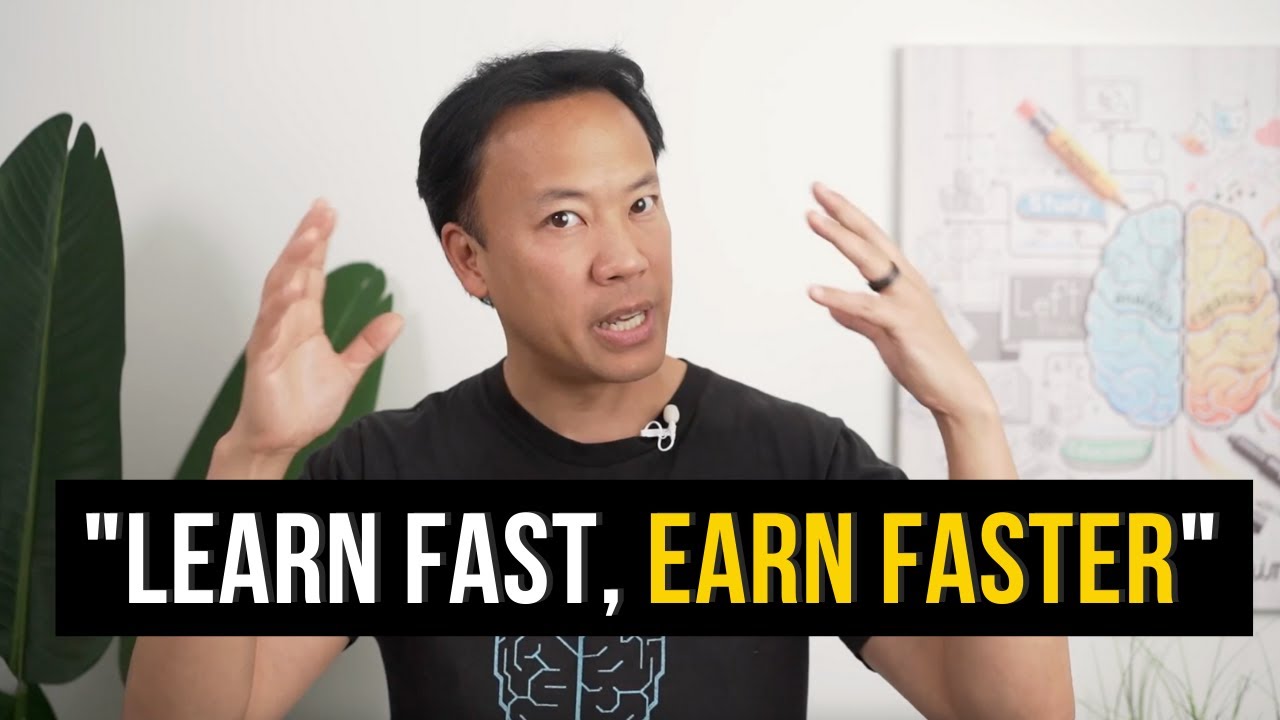
In this 22‑minute YouTube session Jim Kwik, a brain‑coach and founder of Kwik Learning, demonstrates a practical memory‑training exercise for memorizing a 12‑word cryptocurrency seed phrase (or any password). He begins by highlighting the high cost of forgetting—lost time, missed sales, and even millions of dollars when a seed phrase is lost. He then presents a live test of 12 random words (capital, notebook, pilot, monkey, laser, moon, shoe, circus, tennis, cigar, panther, piano) and asks the viewer to recall them. After the recall attempt, Kwik introduces the “chain‑link” (or story) method, walking through a vivid, absurd narrative that links each word in order, emphasizing visualisation, emotion, and absurdity as memory hooks. He explains why the method works, compares it to other techniques (peg, memory palace), and stresses that memory is a trainable muscle. Kwik expands the technique’s applicability to brain foods, speech points, foreign languages, names, appointments, and any knowledge‑economy task. Throughout, he promotes his 30‑day Kwik Recall program, invites viewers to join his Discord community for deeper discussions on future tech (VR, AR, Web3, etc.), and ends with standard calls‑to‑action (subscribe, share, hit the bell, contact phone number). The video blends instructional, motivational, and promotional tones.
Chapters
How to remember your seed phrase for your crypto wallet or any passwords that you need to easily and effortlessly. Hi, I'm your brain coach, Jim Kwik of Kwik Learning, and I'm going to help you to learn quickly. Have you ever come up with a password or maybe you have a PIN number or a passcode, or maybe a phrase for your crypto wallet and you just lose it? You cannot remember it. You feel absent-minded or you're nervous that you're going to forget it. I believe two of the most costly words in life, and definitely in business, are I forgot. I forgot to do it. I forgot to bring it. I forgot that conversation. I forgot that meeting. I forgot what I was going to say. I forgot that person's name. Every single time we have these thoughts, we lose time. We could lose productivity. We could lose a sale, and we could lose a lot of our wealth. You see the headlines where people have forgotten their seed phrase, and they've lost millions of dollars. You know, and that's the the cost of forgetting something. So what can you do? And so I'm gonna walk you through an exercise, and even if you don't need to memorize a seed phrase or a password at the moment, do this exercise with me because this is mental training. You know, your memory is use it or lose it. There's no such thing as a good or bad memory. There's a trained memory and an untrained memory. So let's get training. This is gonna be great mental exercise. I'm going to give you 12 words to be able to memorize. Now, when we're talking about a seed phrase for your wallet, they have to be done in a very specific order, right? Because the syntax or the sequence makes a difference. Because you could have the right words, but if you reverse them, you're not going to get the same result. Obviously, it's not going to open, just like a safe won't open even if you have the same numbers and they were misplaced. Or maybe a phone number If you even didn't have to have the same digits, if some of those digits are rearranged, you're not going to get to the person you need to. And so the syntax or the order is very, very important, the sequence. So I'm going to go through this and give you 12 words that could be your seed phrase. Now, even if you don't need to memorize it, again, do this exercise with me because it's great mental training for your imagination, for your focus, for your creativity, and of course your memory. So Are you ready? First, I'm going to test you. I'm going to give you the 12 words and do the best you can to memorize it. Please don't write these down, but let's see how many you can remember right off the bat. Okay? So, we'll just make up random words. Number 1 is capital. Number 2 is notebook. Number 3 is pilot. The 4th word will be monkey.
Monkey.
After that, you have laser. So imagine, just imagine you need to remember the word laser. And then moon, like the moon and the nighttime sky. Fantastic. And then I want you to remember shoe. And then from shoe, remember the word circus. And after circus?
Tennis.
And after tennis?
Cigar. Panther. And piano.
All right, I should probably be memorizing these along with you also. These are 12 words. Now what I want you to do is take a moment, pause this, and Write down as many as you can recall. Okay.
How did we do?
How's your memory? Did you get all 12? Probably not. 11? 10? How many people got 8 or less? And you're really proud of it also as well. Well, let me show you a fun technique. If you've gone through our Kwik Recall course, which is our 30-day program on how to really multiply your memory, become a memory master, then you know many different tools to memorize this, and you probably got all of them, and you could do it forwards and backwards. You could use the peg method. You could use a method like the memory palace. In this one, what I'm going to do is share with you a process called chain linking. And chain linking is kind of like, imagine the links of a chain, right? The chain is connected with these links, and that's how your memory works. One thing will remind you of another thing, which will remind you of another thing. So let's, let's do this. Actually, I want you to think about the first word, and that word is capital. And what you want to do is see it vividly in your mind's eye. Imagine a capital or a capital building wherever, whatever country that you live in. And from there, I want you to imagine the capital is shrinking down so it's on the COVID of the second word, which is notebook. So imagine, and when you're seeing this, I want you to see the notebook. What is it? What is it made of? What color is your notebook? And even if you can't imagine it, just feel it like it's there. Fantastic. And who's reading the notebook is a third word, which is pilot. I want you to imagine a pilot on a plane reading this notebook with a capital on it. Now, something interesting is the, the pilot has a copilot, and that copilot happens to be a monkey. And that's your next word. So I want you to imagine monkey. That's your 4th word. How big is the monkey? What kind of expression does the monkey have on? What color is the monkey? If you want to make it even more memorable, you know, make it a, make it a purple monkey. Maybe this monkey has a superpower. And its power is it could shoot lasers from its eyes. And that's actually the next word, the 5th word, laser coming out of the monkey's eyes. And it's going and it's hitting the moon. So imagine the laser hitting the moon. Can you imagine? And it sounds so ludicrous, it's so childish, but who are the fastest learners? Children, right? They're very playful. They use their creativity, imagination. And the laser hits the moon and what comes out?
The moon.
The moon splits open and out comes a gigantic shoe. I want you to see the shoe. Notice what color the shoe is. In fact, so vividly, what brand? What kind of— what's the brand of shoe? All right. Gigantic shoe. And that would never happen. That's what might— it makes it stand out. It becomes unforgettable. And the shoe floats back onto the earth and it lands in what? A puddle. The next word, which is circus. Imagine the circus, the, the tent, and there's all these animals all over and clowns, a big circus. And what's different about this circus is there's a big tennis match. And during this big competition, you see the umpire, and the umpire is smoking what? A cigar, right? Cigar. And cigar is your 10th word. And smoking the cigar, you smoke everywhere, it's annoying a lot of people. And a giant animal comes out from the audience and it grabs the cigar, and that animal is a panther. Imagine a panther going and putting its teeth around the cigar, running into the corner, and he— the animal, the panther, starts playing the piano. Imagine what it's playing. What song is it playing? Now, that was a very simple story, right? I like to call the chain linking the story method, where in order to remember something better, you could turn it into a story. Because before there were printing presses, before there were computers, how did we remember things? Through stories. We would talk about, tell parables, and we'd tell stories around a campfire. And that's a wonderful way to be able to recall information quickly and long-term. So do you remember the story? Do you remember the 12 words? Let's do it together. What's the first one? Capital. Capital shrunk down on the COVID of a— your notebook. Very good. And who's reading the notebook? Say it out loud.
The pilot.
And the co-pilot is what kind of animal?
A monkey.
Very good. And the monkey does something out of its eyes. It has a superpower. It shoots what?
Laser.
That's number 5. Laser hits what? The moon. It's a full moon. Moon cracks open. What comes out? A gigantic shoe. Notice the color. Notice the brand. The shoe falls down to Earth, lands into a circus, and it disrupts a what? What game were they playing?
Tennis.
Very good. And the umpire was smoking a cigar. And what animal comes and steals the cigar? Say it.
A panther.
And the panther ghost plays what musical instrument?
A piano.
All right, very simple technique. One of the best ways to improve your memory is through exercise. And so by doing this exercise, you have the ability to be able to remember things that are important to you. And it doesn't have to just be a seed phrase. That could be very important, obviously, but you could use this to remember brain foods. You could do this to remember Points of a speech. You could use this to be able to remember— really, the application is absolutely limitless. Now, if you enjoyed this session, I encourage you, and you want to go deeper and learn a whole toolbox of memory techniques, I encourage you to join our Kwik Recall program. This program is for busy people who want to get ahead quickly because memory is a force multiplier. In the military, a force multiplier is something where you take the same amount of input but get multiple output, multiple rewards. Because most people are working so hard for so little. And this is something where memory could actually make you money, where you can remember facts and figures, foreign languages, give speeches without notes, to be able to remember people's names, to remember appointments, to be able to, to be able to impress others with your knowledge. Because today we live in the knowledge economy. Where the faster you can learn, the faster you can earn. Because knowledge is not only power today; knowledge is profit. But it starts with a good memory. Remember, Socrates said learning is remembering. Learning is remembering. So if you want to join our Quick Recall program, join countless people from 195 nations sharing their best strategies to remember more, to level up their learning and their life. Just go to quickbrain.com. /recall. That's kwikbrain.com/recall. And I promise you, this program is one you will never forget. Now, by the way, talking— when we're talking about seed phrases, and people ask a lot of times in our private Facebook group about the future and technology and how it affects our brains. And if you're interested in having deeper conversations, I want to invite you to join our Discord. Discord is a platform for communication where we could empower you, educate you, and connect with each other. Now, a lot of the conversations going on in our Facebook and our app, which most of you are part of, we are going to have the conversation about the future of learning, the future of education, the future of brain health, and how technology is affecting our ability to perform. So if you have any interest in the following topics, whether it's virtual reality, augmented reality, the metaverse, Web3, NFTs, the convergence of exponential thinking and the future of performance, future of work, future of learning, then I invite you to join us. Just go to discord.gg/kwik. That's discord.gg/kwik. It's absolutely free. We'll be uploading new content every single week to be able to help you to really get a grasp on where the world is going. I'll be doing some special interviews exclusively in that platform. And here's the thing, how do you become limitless in a limited world? The answer is very simple. We do it together. It's kind of cheesy, but it's true. When you see the word team together, everyone achieves more. More. And so I wanna thank you for watching this session and make sure you subscribe, whether it's on iTunes and Spotify, YouTube, and more, that this is the beginning of a journey, this adventure that we're all on to realize and reveal our fullest potential. I believe there's a version of yourself that's patiently waiting. And what's the goal? The goal is we show up every single day until we're introduced. I'm your brain coach, Jim Kwik.
Be limitless.
Hi, Kwik Brain.
It's your brain coach. I want to thank you so much for watching this video. 3 things to do. Number 1, make sure you share this because when you teach something, you get to learn it twice.
Update your learning so you can update other people's learning as well.
Number 2, make sure you subscribe to this channel so you don't miss a thing because if you miss a video, you miss a lot. And finally, make sure you hit that bell so you're notified and you find out when we put out the latest and the greatest. One extra thing, if you want really close attention, then text me. Here is my phone number: 310-299-9362. Did you remember that number?
310-299-9362.
Shoot me a text And we'll stay in touch. Ask me your burning question. And I wish your days be full of lots of life, lots of love, lots of laughter, and always lots of learning. I'll see you in our next video.