Jim Kwik: My Morning Routines
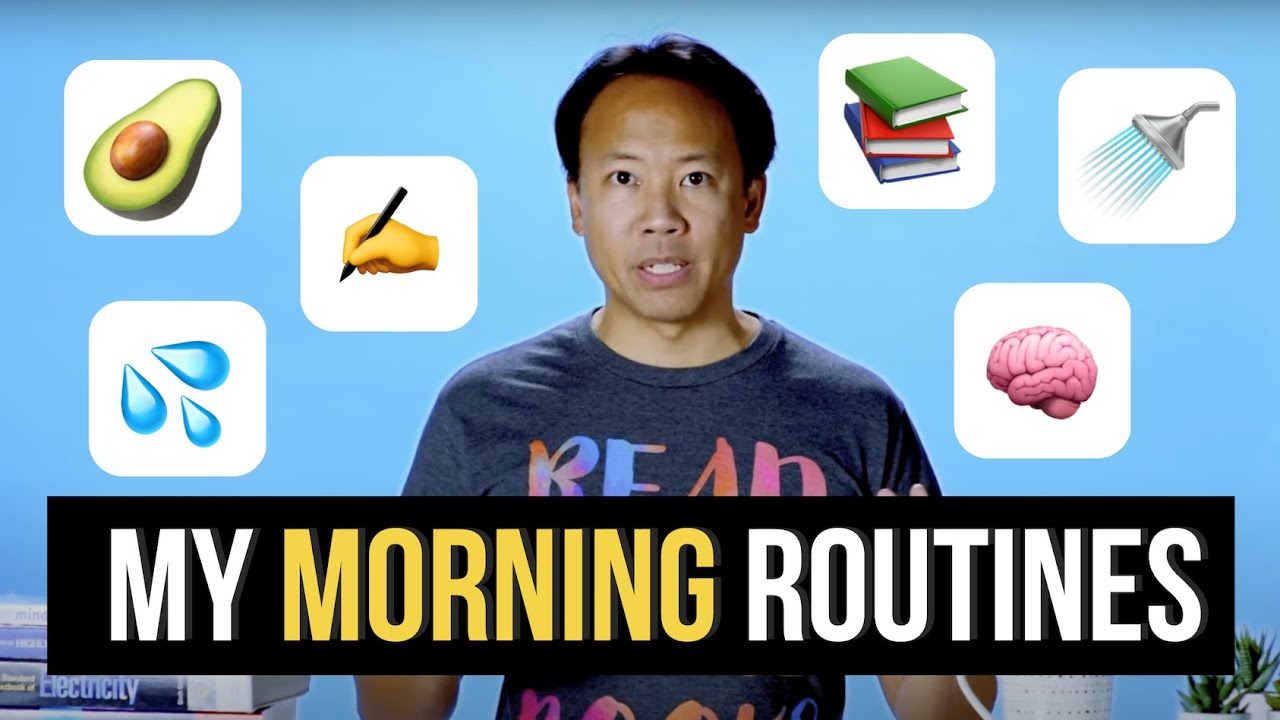
In this instructional video Jim Kwik shares his personal morning routine designed to "jump‑start" the brain and set the tone for a successful day. He frames the routine around the power of habit, emphasizing that "first you create your habits, then your habits create you." Kwik outlines a series of optional practices—dream recall, making the bed, hydration, brushing teeth with the non‑dominant hand, a brief cardio burst, cold‑water shower, a nutrient‑dense brain‑power smoothie, reading, journaling, and a strict no‑phone policy for the first hour. For each habit he explains the underlying science or anecdotal evidence (e.g., dream‑derived insights, cross‑lateral brain activation, inflammation reduction, gut‑brain link) and how it contributes to mental clarity, focus, resilience, and overall productivity. He also introduces the concept of a "not‑to‑do" list, urging viewers to avoid phone use first thing in the morning to prevent distraction and reactive behavior. The overall message is to design a concise, intentional morning ritual that builds mental fitness and momentum for the day.
Chapters
In this lesson, I'm gonna share with you the secret on how to jumpstart your brain every single morning so you win that day. And really what we're talking about is the power of habit. So how do you jumpstart your brain every single morning? Well, I'm gonna share with you some of my favorite things to do every morning to jumpstart my brain. Now, when I go through this, this is my personal routine because I believe in order to win the day, You have to win that first hour of the day. Does that make sense? In order to win the day, you gotta win that first hour or 2 so you get some positive momentum. And when we're talking about this, often people wake up and they don't have a clear process. I believe first you create your habits and then your habits create you. Write that down. First you create your habits and then your habits create you. First you create your routines and things that you do, and then those things create you back. You create your habits of working out, you create your habits of of studying, you create your habits of meditation. Whatever your habits are, you do them and then they become you. Research suggests that about 40%, minimum of 40% of your day is habitual. 40% of your behaviors are things that you do without even thinking about it. They are like these invisible scripts. But where did they come from? Where did your habits come from? I'm here to say that the things that you want most, the treasures you want most, are hidden in your daily routine. The treasures you want most in life, the love, the relationships, the health, the great fitness, the great grades, anything you want to be able to create, it's found in your daily routine and who you're being in that day. So let's go through this. I'm going to give you a handful of things I do every morning. Now note, you do not need to do every single one of these things. These are the things that I do. I'll share with you why I do them, And ultimately try them, and then you could trust your nature. See what's working for you and go forward with the things that resonate with you. So you don't have to do everything, but you want to do some of them, all right? Because some days you won't have time. You're traveling, you have an early morning test, exam, you didn't get a good night's sleep. Maybe you missed some of the things in the morning. That's fine. Be kind with yourself. For right now though, I'm going to give you some of these things, write them down, and then say, okay, I'm going to try these 1, 2, 3 extra things in the morning, all right? It's not meant to take It's meant to save you time, to make time in productivity and performance. All right, so let's say I wake up in the morning. The first thing I do is I remember my dreams. I remember my dreams. You're like, Jim, what does that mean? Well, this is what the research says, is that when you're— you'll probably spend about 20 years of your life sleeping, about 3 to 5 years of your life dreaming. But when you are reading and studying all day, Your brain doesn't shut off at night. If anything, it's more active at night. And what are you doing? You're consolidating short to long-term memory, but you're also coming up with great ideas and new learnings. Your brain is still learning at night through the process of dreaming. Did you know Mary Shelley came up with Frankenstein in her dream? Paul McCartney came up with the song Yesterday in his dream. A chemist came up with the framework for the periodic table, which I know you know a lot of those elements, In his dream. Elias Howe, inventor, came up with the sewing machine in his dream. Jack Nicklaus, the golfer, was able— he was in a slump and he didn't know what to do. And in his dream, 'cause he was shooting high 70s, for those of you who play golf, he dreamt himself changing his grip in a dream. And he woke up the next morning with the solution and he started shooting in 60s. Your brain is incredible. Your dreams are a tool to help you to be able to learn, but most people don't remember their dreams. So I go through a process, 6 steps on how to remember my dreams. The next thing I do from there is I make my bed. You're like, Jim, yeah, well, what does that have to do with anything? Like, why do you have to make your bed? Why is that good for your brain? Here's the thing, write this down. How you do anything is how you do everything. How you do anything is how you do everything. And if you want an excellent day, you wanna start with excellence. There's a reason why in the military they make their bed a very certain way. Certain angles, certain inches with precision, because you do something with excellence and then you're more likely to take that excellence into your life. Because really, when we're talking about habits, habits, that's excellence. Excellence is a habit. So you make your bed. And remember I talked about the power of clean environment? Clean environment is good for your brain. How good does it feel coming back at the end of your day Going back to success. You come full circle back to success. Make your bed for a better brain. Another thing I do is I hydrate. We talked about this during your brain breaks. You could lose up to a pound of water in your sleep through respiration and perspiration. Your brain thrives on hydration. It's the number one brain nutrient. Get hydration, right? So tall glass of water. Next, and that's also where I'm taking my nutrients, some of my supplements, maybe my probiotics, which is Your gut, by the way, is your second brain. Just a little thought there. Highest— second highest concentration of nerves there. So once you have that, I brush my teeth. You're like, yes, Jim, obviously everyone brushes their teeth. Remember when I say— remember I talk about toothpaste reminds you of the elements? All of that is done purposely to help trigger all of this remembrance in your life. But I brush my teeth, but here's the caveat. I do it with my opposite hand. Brush your teeth with the opposite hand is good for your brain. You have something called cross-laterals, that one part of your brain controls the opposite side of your body. God forbid you know somebody who's had head trauma or a stroke. If there's brain damage on the left side, if there's paralysis manifests, it's on the opposite side. So research suggests that one part of your brain controls the opposite side of your body, but it's not a mind-body connection only. There's a body-mind connection that using your opposite hand while you do things could stimulate different parts of your brain on the opposite side. So if you're using your dominant hand on this side, that part of your brain gets the stimulus. Use your opposite side. So what else can you do? You could eat with your opposite hand. Studies done by Dr. Lawrence Katz on longevity, keeping senior brains alive, was all about a lot of it's simple things you could do to stimulate and upgrade and keep your brain alive. Wonderful. So you're using your opposite hand. The other reason why I ask you to use your opposite hand, it keeps you present. Remember we talked about memory and observation and the power of presence, how it helps your memory? A lot of people, they're everywhere and they have trained their distraction. You need to starve your distraction and feed your focus. And what helps you to do that is by being present. When you brush your teeth with the opposite hand, it forces you to be present. You can't concentrate on other things and get your job done right, and so it forces you to be in the now. Another great practice of exercise of your focus. From there, I do a light workout. I don't do my primary workout, but there was a study done at Appalachian State University saying, when's the best time to work out for weight loss and sleep? Was it 7 AM, 1 PM, or 7 PM? 7 AM, 1 PM, or 7 PM? 7 AM. And they found that actually 7:00 AM was the preferred time. Now, why? I would say whatever's good for your heart's gonna be good for your head. So good for your heart, blood flow, oxygen, getting your heart beating, it feeds your brain. Also, those people in that group that worked out in the morning slept better as well. We talked about the power of sleep. So I don't do my full workout in the morning, but you wanna get your heart rate up for about 3 minutes. to jumpstart your brain. So you could do a number of things, but just jumping jacks, calisthenics, jump rope. I like jump rope a lot. 3 minutes of exercise, get your brain pumping, your heart pumping, but your brain pumping also as well. Also, I take a shower. All right, again, you could do any of this in any order. I take a shower. You're like, yes, obviously, Jim, that's— most people take a shower. But I take a cold shower. Studies done on cold therapy Basically say it helps to lower inflammation in your body, and inflammation, research suggests, starts a lot of challenges and a lot of dis-ease, lack of ease in your body. So take a cold shower, and you don't have to start by taking a 10-minute cold shower. You could alternate going from warm to cold, warm to cold, because it creates a pumping effect in your body, which also could be beneficial. But cold therapy is basically— if you hit your knee on a coffee table, you put ice on it. And it reduces swelling, it reduces inflammation. So cold could serve you. And so lower the temperature. Don't— now obviously if you have the flu or you have a cold, you don't want to be in the cold. Use common sense, right? But alternate, maybe 10 seconds of cold, you know, 30 seconds of warm, going back to 10 seconds and see if you could sustain. Also, the reason why I do a cold shower, this is a primary belief that I have that you could adopt. Is do the difficult thing. Do the difficult thing because you want to train yourself to have resilience and grit. It is a muscle like anything else, like your focus, like your motivation, like your energy. Any of that can be trained, like your memory, but also your grit and resilience. A reminder to do difficult things because if you just do the easy things in life, the easy thing in life is to procrastinate. But if you do the hard things like learn these lessons now, you sharpen the saw and everything gets Easier after that. So you put yourself in hard situations like taking a cold shower, and next time you need to perform and show up for yourself— maybe you have to give a talk in front of a class or in front of an auditorium, or you need to take a test, or you need to push yourself— you've developed some emotional reserve and grit and emotional fitness. It's not just mental intelligence, it's mental fitness. Just like with your body, I want you to be mentally fit, strong, energized, flexible. Take a cold shower. From there, you can do a lot of different things. I like to make a brainpower smoothie. Brainpower smoothie, go back to your brain foods and take them all and put them into a blender. I like things to be easy and fast. Put it into a blender so you have your avocados, your green leafy vegetables, you have your water, your hydration, your dark chocolate, your blueberries. Pro tip, don't put eggs or wild salmon and sardines into your brainpower smoothie. But you make your smoothie and now you have your nutrients all there, highly digestible. And then what do I do from there? I do a little bit of reading. I do a little bit of reading because, as you see from this shirt, read more. Reading is to your mind what exercise is for your body. Do a little bit of your studies while you're drinking your brainpower smoothie. A great time to uplevel your brain when you're most alert. And another couple things that I do really fast is I journal. I journal because when you write and take notes, a different thing happens. You'll notice patterns of genius that geniuses— if you think of da Vinci and Marie Curie and Einstein, they all wrote in journals, and their journals are priceless right now. They were geniuses, so they wrote in journals. But is that really what happened? Is it because they were geniuses that they wrote in the journals, or is it because they're writing all the time in their journals that they became geniuses? Interesting, right? So a good pro-life tip: write in a journal because that's a great way of building your self-awareness, building your mental acuity, building what they call your episodic memory about the things that's going on. And notice, by the way, the one thing I did not mention of all these things you do to jumpstart your brain is the thing that most people do. What is the first thing you do when you wake up in the morning? Most people They check their phones. They check their phones. I want you to have a to-do list and put these things on your to-do list. You know, make your brainpower smoothie, do your little workout, do your deep breathing and meditate, and take your cold shower, brush your teeth with the opposite hand, make your bed, do these things, remember your dreams. But also, while you have a to-do list, I challenge you in this lesson to have a not-to-do list. The most successful people in the world, and many of you know the people that I train, They have a long not-to-do list, things that they will not do. These are their non-negotiables because as the book says, another great book, Good to Great by Jim Collins, you must say no to good so you can say yes to great. And say no more often. Say no to things where you're putting your— there's a big opportunity cost to your time and attention, so don't overcommit. And so you can say yes to things that really matter. And what should be on the top of your not-to-do list? Checking your phone the first hour of the day. Now here's why. When you first wake up, you're in a relaxed state of awareness, a brainwave state called alpha and theta. But when you're in those states, the relaxed state, you're extremely suggestible, extremely suggestible. So if you pick up your phone the first hour of the day, you're retraining your brain, rewiring your brain for 2 things. Number one, for distraction. Every like, share, comment, cat video, you're getting this dopamine flood, which makes it very addictive, which trains your distraction. You're building your distraction muscles. So you wonder why you're reading or you're sitting in a lecture center and you can't pay attention? It's because you wanna stop. Stop touching your phone the first hour a day 'cause it's rewiring your brain for distraction. But the second thing, the second reason you don't wanna touch your phone first thing in the morning, It's rewiring your brain to be reactive. It's training your brain just to react to things. And here's the thing, you're never gonna have a quality life, much less day, if you're just reacting to what's going on in the environment. Because you know this, you get one text message, one voicemail, one email, something from a friend, whatever puts you in a bad mood, you take that mood on the entire day. and it disrupts your productivity, your performance, your profit, your positivity, and your peace of mind. I have a friend named Brendon Burchard, New York Times bestselling author of Motivation Manifesto. He says this about your inbox. Your inbox is nothing but a convenient organizational system for other people's agenda for your life. Let that sink in. So if you're just reacting to everything, you're never gonna be proactive Which is one of the laws, habits of highly effective people in Stephen Covey's book, 7 Habits of Highly Effective People, is be proactive instead of reactive. Because if you're just reacting, then you're on defense and not on offense. So what I do is when I'm journaling, I'm writing the things that will make this a great day. I'm going to begin with the end in mind. I'm going to put first things first, like another habit of success that Stephen Covey talks about. The most important thing is to keep the most important thing the most important thing. Put first things first. I write down 3 things I want to do for myself professionally, 3 things I want to do for myself personally, and I don't touch my phone until I do one of those things. And they don't have to be big things. It could be a simple workout or journaling, but I don't touch my phone until I get one of those things done. But the main idea here is this: don't wake up and just pick up your phone and be reactive. Technology is a tool. It's not good or bad. Fire, like a tool, it could cook your food or it could burn down your house. It's how you use it. But if you pick up your phone out of habit to drive distraction, reaction, because you're bored— technology is a tool for you to use. But if the technology is using you, then who becomes the tool? You do not want to be a tool in this equation. So what I want you to do is commit not touching your phone the first hour of the day, you'll see a productivity lift that you cannot imagine. So here, remember this: the treasure you seek most is hidden in your daily routine. First you create your habits, then your habits create you. Do it by design. Take any 1, 2, 3 of the things I mentioned this morning and test it on yourself. And limit the amount of phone usage you're doing first thing in the morning. You'll be more proactive, you'll be less distracted, more focused. In the comments, I want you to share the one or two things that—
More from Jim





The Library of Minds: Brain Coach: How to Stay Sharp When AI Does the Thinking | Jim Kwik





