Kwik Brain Episode 11: How To Memorize & Give Speech Without Notes
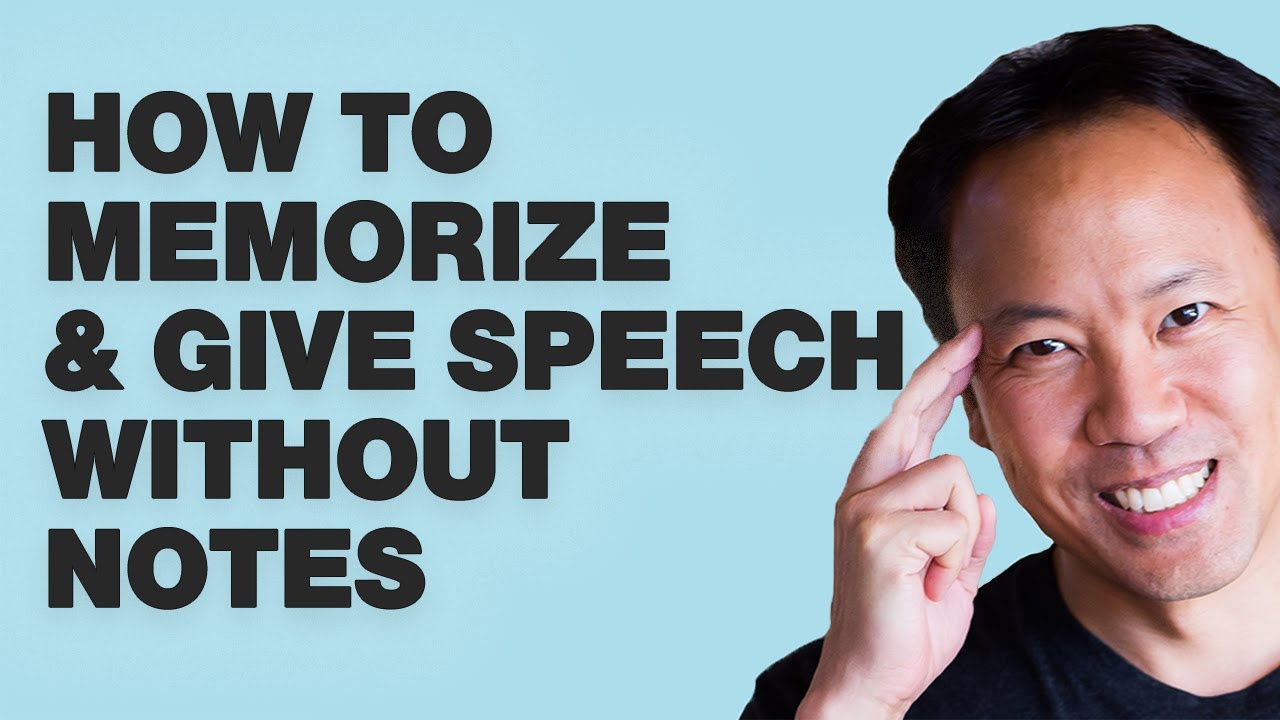
Jim Kwik teaches the 2,500-year-old memory palace technique to memorize a 10-point speech without notes. Pick ten landmarks in your home, attach vivid images to each one representing your speech points, then rehearse forward and backward. The method works because your brain remembers places better than abstract information.
Chapters
Welcome to Kwik Brain, bite-sized brain hacks for busy people who want to learn faster and achieve more. I'm your coach, Jim Kwik. Free your mind. Let's imagine if we could access 100% of our brain's capacity. I wasn't high, wasn't wired, just clear. I knew what I needed to do and how to do it. I know kung fu. Show me. Welcome back, Kwik Brain. How to memorize and give a speech Without notes. How do you recall, remember the talking points of the things you need to say when you're giving a toast, maybe a presentation in class, maybe you're on television, or maybe you need to give a thank you speech? And in the spirit of thank yous, I just want to thank you for all the support, all the shares, all the reviews. You know, our goal is to help as many people enjoy better and brighter brains, and we can only do this with your help. Growing up, labeled the boy with the broken brain and having learning challenges. I'm so thrilled to see all the incredible reviews and stories that are coming out of this. So I want to also congratulate you. I mean, think about how much you've learned up to this date. You know, the first episode on how to learn any subject or skill faster, the second one on how to improve your memory now, the third one was the 10 keys for unlocking optimal brain health, and how to read a book a week, 52 books a year, my top 10 favorite brain foods, and how to remember names, and how to read faster. All these wonderful topics, and this is— You could tell this is not just a podcast. This is your, this is your Kwik Brain Coaching Academy, if you will. You're tuning in every single week for your life lessons, for your learning lessons. And remember, we keep this quick. Every episode so far has been under 20 minutes 'cause I know you're busy. And so this episode's, it's gonna be in the same spirit because I'm gonna teach you how to remember a speech in minutes. And this is great because you've already proven to yourself with prior episodes that learning doesn't have to be slow. Learning doesn't have to be boring. Learning doesn't have to be a chore. It could be fun. It could be fast. It could be incredibly effective that you don't need to repeat things over and over and over again to be able to retain it once you're using these skills. And that's what this is all about. I'm gonna teach you how to remember a speech without having to rehearse it 100, 200, 300 times. Because your most valuable resource you have is your time. That's the one thing you can't get back. And that's the goal of this podcast. It's all about helping you to learn things faster so you could achieve faster and succeed faster also as well. So let's get into this. This technique I'm going to teach you is called the loci method, and it's short for location. It's also been called the memory palace. And this is what people would do before to memorize stories and presentations and poems before technology, before they had smart devices, before they had teleprompters, before there was computers, before there was a printing press even. Now this memory technique is about 2,500 years old, and it's attributed to a Greek or orator named Simonides. So the story goes, Simonides was giving a reading, and when he was done giving his presentation, he leaves the building and something really tragic happened. The building collapsed and it killed everybody that was there. And this is before, you know, buildings weren't made of sheetrock and wood. It was made of stone, right? So he, as the lone survivor, had the responsibility of coming back in and helping the family members identify their loved ones. And it was really hard, but he was able to do it because he remembered where everyone was sitting. He remembered where they were in place and in space. And what we found is through— as hunters and gatherers, we didn't need to know— as the brain evolved, brain didn't need to know, memorize words or memorize lots of numbers or the things we need to do nowadays. It needed to remember where things were, where the enemy tribe was, where the clean soil was, where the good water was, where the good food was, and so on. 'Cause that was your survival back then. And so we learned to store information in filing systems around us. There are filing systems that are around that were very familiar to us, if you will. So what we're gonna do here is we're gonna take places that we are familiar with. You think about your home, you think about your workplace, you think about the mall, and we're gonna set up certain landmarks and places. And what we're gonna do is we're gonna take the main talking points for your speech. Because as many of you know, I train some of the top actors in Hollywood how to speed read their scripts and very specifically how to memorize their lines. But these are lines verbatim, word for word. But when you're giving a presentation in front of a group of people, you don't necessarily wanna sound rote and rehearsed. You just wanna remember the main key points to your speech, don't you? Right? You wanna know the order and the sequence of the main points of the, points that you want to be able to express to your audience and such. And also you want to know the order because let's say you're in the middle of your speech and somebody distracts you or somebody asks a question and you go to answer them and you come back and you don't remember where you were, right? And so this is going to help you to be able to do that. And so what we're going to do is we're going to say, let's say we wanted to know 10 points to a speech and you wanted to memorize them forwards and backwards. Number 1, I would say Make your key points. So whatever you want to teach, and remember, we did a whole episode on when you want to learn something, you teach it, because when you teach it, you get to learn it twice. So I encourage you to do that with each of these episodes, is to pay it forward and share it and teach it to somebody else. But let's say you have 10 points to a speech that you want to be able to give. Maybe it's in marketing, maybe it's in health, maybe it's for your company or career. And if you don't have one, use prior episodes as a way to reinforce what you've learned in these series. So we did an episode on the 10 keys to unlock optimal brain health. We also did an episode on my top 10 favorite brain foods. So you could use those, you can memorize those 10 points if you like. So once you have your key points, the second step is to create 10 landmarks. 10 landmarks, for example, in your home. And we're going to walk through and do that with you now. And finally, number 3, once you have your landmarks, let's say the first place is the microwave, the second place is the stovetop, the third place is the refrigerator, the fourth place is the dishwasher. And the 5th place, let's say, is the sink. Once you know those landmarks, you put the— the 3rd step is to place an image reminder of each key point of your speech in each of those landmarks. So you take the first key point and you put it in the first place in your home. You take the second key point and place it in the second place. And by the way, if you've ever found yourself saying, well, in the first place this, and the second place that, and the third place this, That languaging actually came from this 2,500-year-old memory technique. The technique itself has disappeared. We're bringing it back as part of your training. But the languaging is still there because that's how people used to memorize what they needed to talk about. So, those are the 3 steps. Make key points of your speech. Number 2, create the landmarks around your home or your office. And finally, number 3, you place an image of those key points into each of those landmarks to help you to remember the order because it becomes a filing system. Now let's do this right now. What I want you to do, you know, every single episode we make it interactive because that's key. We don't learn passively, we learn actively because learning is not a spectator sport. We know that. So we're going to roll up our sleeves and I'm going to take you through an exercise. And remember, I'm your coach here and this exercise is going to help you to focus. It's going to help you to increase your creativity, your imagination, and your memory. So what I want you to do, if it's safe, if you're not operating heavy machinery, you're not on a treadmill, you're not driving a car, I want you to take a deep breath, exhale, and just close your eyes. And what I want you to do is I want you to imagine you're standing in the doorway of one of the rooms of your home. So imagine you're standing in the doorway of one of the rooms in your home and you're just looking around and you see a lot of stuff. Right? You're thinking, Jim, I should have cleaned before I listened to this podcast. You have a lot of stuff in this room, and what I want you to do is we're going to take 5 places in this room and make them landmarks for you. 5 different places. And here are the rules. I want you to go clockwise. So starting on your left, I want you to go in a circle. I want you to pick 5 places. Now, I want you to pick places, not empty space. So don't pick that corner of the room. Pick— That lampshade in the corner of the room, right? Or that bookshelf in the corner room. Think— pick things. I also want you to pick things that are relatively big. So don't pick the knickknacks that are on the coffee table. Pick the coffee table. And I want you to also, if there are more than one of an item in a room, I just want you to choose one. So if you have 4 chairs in this room, don't make the first one the first chair, the second one the second chair. Just pick one chair, right? So if they're identical items, just use them once. And I just want you to go clockwise in this room. And I want you just to say, okay, the sliding glass doors is number 1. Number 2 is the radiator. Number 3 is the china cabinet. Number 4 is the dresser. Number 5 is the dining room table. Whatever it is for you. Okay? So I want you to go through 1, 2, 3, 4, 5, and do that now. Okay. You could also pause it if you need more time because remember, this is a coaching program. So you could pause it and when you're done, come back. Okay. Now that you have items 1 through 5, places 1 through 5 in your first room, now I want you to walk into an adjacent room. So walk into an adjoining room and notice there's a lot of stuff in this room also. And I want you to repeat the process, but instead of doing 1 through 5, I want you to imagine 6, 7, 8, 9, 10, going clockwise, picking large items. Go ahead and do that now, and you could take a minute and just pause it and come back. Okay, welcome back. Now, did you do the exercise? You must remember, knowledge is not power, it's only potential power. You don't know something unless you do it. That's my— as a coach, I'm telling you, you need to be able to act on it. And so people could repeat, oh, I know how to remember names, but if you're not doing it, you don't know how to do it. So I want to encourage you, if you didn't do this exercise, make sure you do it so you can build these mental muscles. Now, now you have 10 places in your home. Later on, you could build another 5, another, you know, 15, 20, 25, depending on how big your home is. And you're thinking, Jim, I live in New York City. I have a studio apartment and a bathroom. And that's pretty much, that's pretty much it. Then you could go into another apartment. Then you could go into your office. Then you could go into your car. You could get creative about this. So this is one of my favorite exercises and techniques and tools to be able to not only memorize a speech, but memorize facts and figures and such. So here's the second step. Now that you, you have these landmarks that are there, what I want you to do is take each of your key points and we're going to place each of your key points in these actual places. So let's take the example And you could do this for your own example, but just coming back to, let's say we talked about the 10 keys for unlocking optimal brain health. And the first key in that was number one was a good brain diet. So in this example, if you wanted to memorize and give a speech on the 10 keys for unlocking your optimal brain health, which was an earlier episode, it was episode 3 in this series, then what I want you to do is take a good brain diet and put it in your first place. Take a good brain diet, put it in your first place. So let's say the first place again happens to be a radiator. I want you to imagine on the radiator, on this heating device, are the blueberries, the walnuts, the avocado, the salmon, all the things we talked about in that episode, which I encourage you to listen to if you haven't already. And you're like, Jim, I can't imagine that. Well, just imagine you're imagining it. Remember, pretend you're an 8-year-old because you're lighting up different parts of your brain. Because Einstein said imagination is more powerful than knowledge. So the second example is you'd walk over to your second place and think about what your second place is. And using this example of the 10 keys to unlocking your optimal brain health, the second key was killing ANTs. ANTs stands for automatic negative thoughts, according to Dr. Daniel Amen. Automatic negative thoughts. But imagine on— you go to the second place, whatever your second place is. Let's say it's a piano. And I just want you to imagine you're killing ANTs on the piano. Do you see that? Good. Now notice you don't have to take a lot of time to be able to see it because if you have the intensity, you get the result. Go over to your third place now. Go to your third place and whatever your third place is, maybe it's a couch. I want you to imagine your third point to your speech turned into a picture. So let's say your speech was again unlocking optimal brain health. The third point on that was exercise. So I want you to imagine you're doing pushups on the couch if that's your, if that's your third place, for example. Are you doing sit-ups or crunches on the 3rd place? Okay? Do you get the idea? So what I want you to do, and this is your exercise and your homework, this is— remember, this is what you're practicing right now so then you get the results. Because practice equals what? Progress. Practice equals progress. So what I want you to do right now as your homework assignment is I want you to go through, make sure you have your 10 places. You could write them down on a piece of paper if you like so you know them forwards, and then rehearse them backwards. And then I want you to make a speech of 10 points. And if you're not sure, go back to prior episodes and take one of our prior episodes on your top 10 favorite brain foods or your top 10 unlocking optimal brain health. And I want you to commit that to memory. Each of those points turn into a picture and put them in each of your places. And then I want to know how you did. So make sure you tag me on Instagram, on Facebook, on Twitter @JimKwik, K-W-I-K. And that's also where I'm also posting regular micro lessons, if you will. For those of you who don't get enough of the Kwik Brain podcast every single week, those are little micro lessons. So you can follow me there and tag me, and I'd love to hear your results. How many of the 10 do you remember forwards and backwards of your next talk? So remember, memorizing a speech doesn't have to take a lot of time when you're using a technique like this. So use the loci method and you will confidently make your recall faster, sharper, stronger, As it should be for any Kwik Brain. Want to double your brain speed and memory power? If you'd like to learn rapidly and get ahead faster, I'd like to give you my brand new Kwik Brain Accelerator program. You will discover exactly what I teach my clients to learn, read, and remember anything in half the time. There is no charge. It's my gift to you for being one of our subscribers. That's kwikbrain.info. Or simply text the word podcast to 916-822-7246 and we'll send you a direct link. That's 916-82-BRAIN. Growing up struggling with learning challenges from a childhood brain injury, it's been my life's mission to help you have your very best brain so you could win more every single day. Now, want more Kwik Brain? Here are 4 ways to fast-track your results and lock in what you just learned into your long-term memory. Remember fast. F-A-S-T. The F stands for Facebook. You're not alone on this journey. I invite you to join our free private online group. There you can connect with me, your fellow brain lovers, links to resources, and even submit your questions for me to answer in future episodes. Go to kwikbrain.com. That's K-W-I-K brain dot com. The A stands for apply. Act on what you learned today. Remember, knowledge is not power; it's. Potential power. It only becomes power when you use it. So use what you just learned. The S stands for subscribe. Don't miss the next episode and other free brain training. And finally, the T stands for teach. You want to learn faster now? The key is to lock it in right away by teaching it to someone else. When you teach something, you get to learn it twice. Here's a simple way to do that. Leave a review on iTunes. Leave a review with your biggest takeaway from this episode. You could also post and share this podcast on your social media. It helps us spread our mission of building better, brighter brains. And of course, tag us so our team can properly thank you. #KwikBrain, K-W-I-K Brain. Mine is @JimKwik, K-W-I-K, on Instagram, Facebook, and Twitter. So what does FAST stand for? Facebook, apply, subscribe, teach. I'll see you in our next episode of Quick Brain. Until then, remember, you are faster and smarter than you think.
More from Jim





The Library of Minds: Brain Coach: How to Stay Sharp When AI Does the Thinking | Jim Kwik





