Listening with Curiosity with Larry King & Jim Kwik
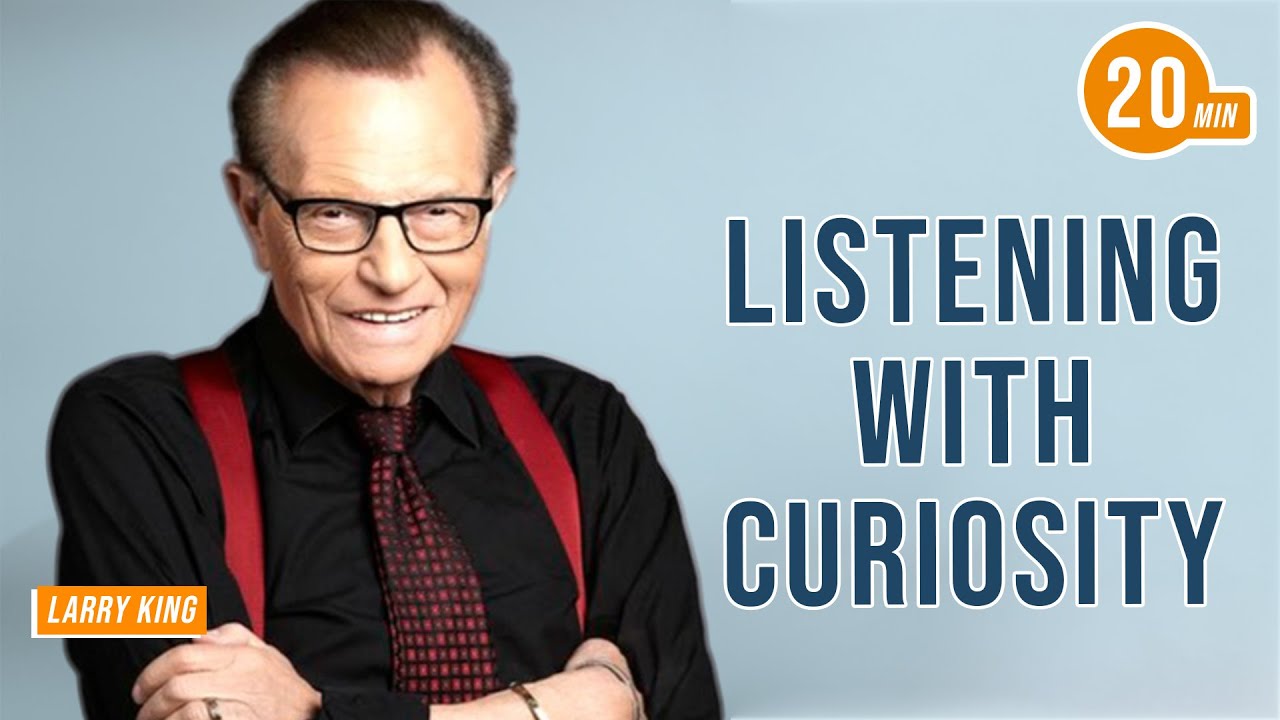
Larry King shares his interviewing philosophy: ask short, curious questions with no agenda, and listen for the next question to emerge. He recounts adopting his name on air out of nervousness, turning a tense WWII pilot interview toward fear, and his belief that every person is interesting if you stay present.
Chapters
Welcome back, Kwik Brain. Your question for today, how do you become an incredible listener? And we have an extremely special guest on here today. I'm so excited. He's a, he's a mentor and an icon in my eyes. I actually have a picture of the two of us on my desk that really inspires me to ask the right questions, to be an active listener on our show, Kwik Brain. Uh, the one, the only, the legend, Larry King. Thanks for joining us, sir.
Don't be nervous, Jim. I know how you get. I know how you panic when you have to interview people like this. Just be calm. I will do my best to carry you.
I appreciate that. You know me so well, and I owe you so much because of not only as being a lifelong inspiration, but also I had challenges with my breathing because my sleep apnea, and you recommended an amazing doctor in Beverly Hills. I went, uh, ended up having surgery at UCLA and it fixed up a lot of my, my issues with my throat and, uh, and, uh, my voice back before one of my presentations that I had to give. And it was the only time I ever lost my voice after 20 years of speaking on stages. And so, uh, so thank you, sir. Um, so the conversation I wanted to have with you is about you and I have all of, I have so many of your— these books that people are watching on video. You have interviewed everybody and you have met everybody and you are the— I hold you in such high regard, your ability to ask the right questions, to be an incredible listener. For our people who are listening at home, let's talk about the theme of listening. What is the secret behind listening?
Well, I've been doing this for 63 years. And I never, Jim, I never had an agenda. That is, I never went into any interview predisposed to liking the person or disliking the person, agreeing with the person or disagreeing with the person. Since I took that position, what I had to do was listen.
Hmm.
And the most important part of interviewing Is listening because the answer usually leads to a question. So I never had questions prepared for me. I went into it open, listened. Now, that's a risk to that. What if the guest just doesn't want to respond? Well, nothing's perfect. There's never been the perfect interview, but I tried all my life to be the best at what I do. That is Ask good questions, short questions. If you look up my whole history, you find very few questions that ever ran 3 sentences, mostly 2 sentences, mostly just why. You know, you could ask why all day. You know, I wanted to do this. Why? Why did you do it? It's so, it's so wonderful. And another thing, when I got into a subject, I never thought about yesterday's subject or tomorrow's subject. The guest today is the one that counted. So if I were doing the President of the United States as the next guest after this guest, this guest counts because you can't throw it away. You know, it is what it is.
And how do you, how do you remain that present? I feel like that you have an incredible presence and part of your incredible presence comes from being powerfully present with people. They know you, and it's almost when you and I have had breakfasts in the past, it's like you ask a question and you sincerely want to know the answer, it seems.
No, Jim, I, I don't know if I have an answer to that. I've always done what came easily to me. First, I'm in a business that I always wanted to be in. I always wanted to be a broadcaster. I thought I'd be a baseball announcer. I fell into interviewing very early. And I got to love it. I interviewed Bobby Darin, was the first famous person I interviewed, the great singer. And boy, I loved it from the minute I started the interchange. I got that little bounce that you get. And the minute I started talking and listening to his answers, following up, I loved every minute of it. And I love challenging interviews. I love people that don't want to come forward and then getting them to come forward. It's just my life is— it's, I'll tell you the truth, it's 63 years and I still get a kick out of doing it.
Yeah.
So when that light goes on, something goes on in me and it reflects in what I do. I just, I guess the word you use would be passion. I have passion for what I do. I also I have a great deal of passion for public speaking. So I speak at a lot of events, conventions. I did a tour where I did a comedy tour. I love humor. I love interviewing comedians. I love making people laugh. Laughter is a one— you know, I had a doctor tell me once, 83 good things happen in your body every time you laugh. Wow.
Larry, when you're saying you're— some of these difficult interviews, can you give me an example of one that started out difficult but you were able to turn it around?
Okay, I'll give you an example. We— there's an organization called Aces. Aces are pilots who have shot down more than 5 enemy planes in warfare. Started as an American organization but became international. Vietnam Aces, there were German Aces in World War II. And it was a social organization. All they did was meet once a year in a different part of the world and tell war stories. That's what they did. And one year the Aces Convention was in Miami where I started out. And we had an ace living in Miami. He shot down, I think, 7 German planes in World War II. So they booked him on my radio show. And the Miami Herald was following him around. He came in. The show was from 7 to midnight, from 9 to midnight. He was the guest from 11 to midnight. I had an hour to do with him and no backup. He sits down, he shakes hands, and his hands are sweating, sweating. And I begin the conversation, I begin the interview and I say, my guest is whatever his name was. He was an ace in World War II. What attracted you to flying? That was my first question. And he said, I just liked it. And leave me right there. I just liked it. I got into like the third question I asked him was, if there were enemy planes up above this radio station right now and we had one lone plane here, would you take it up? Yes, I would. Yes, I would. I said, I certainly wouldn't. Yes, you would. By the end of that interview, I turned it around into talking about fear. So instead of talking about shooting down planes, I talked about being afraid, overcoming fear. He admitted he was fearful. By the end of that interview, I turned this guy into a monster. We flew into the sky. I could see the perimeter. I saw the target. He gave 10-minute answers because what I did was make him comfortable. Now, I didn't know it would turn out that way, but when you got an hour and you've only 5 minutes in and the guy's not responding, you got to go somewhere. And to me, I related it to my own. Would I be afraid? I'd be scared to death. So what do you do with fear? How do you handle fear, especially in a situation Where you're up in the sky and there's nowhere to go. How do you deal with that? Do you overcome it? I remember he was saying, no, you never do. You're always fearful. And he said fear drove him. His fear of being shot down maintained his staying up. So I thought, well, that was years ago. You made me remind me of it, but that's an example.
When you're talking about this and I'm thinking about, I'm getting a little nervous being on your show coming up.
Well, that show is a new show for me. That's called Positive Voices. And I do it with a professor of positive psychology at the University of Pennsylvania. And we just go back and forth firing questions. So it's an interview, but it's more of like a press conference.
Okay.
Guest. So we ask simple questions going right to the heart of the matter. With you, I think we'll talk about genius. So how would you define— so I would ask how you define genius. What is— is a genius ballplayer the equivalent of a genius physicist?
Right, right. And are these questions that you have— would you say you have a natural curiosity?
Oh yeah, that's my number one. If I would say, what are you, Larry? I am curious. I'm curious. You do not want to sit next to me on an airplane. I would drive you crazy because I'm curious about everything.
Mm-hmm.
I'm curious about people who consider mundane things. For example, Studs Terkel, the great Chicago writer, told me once, it's so true, nobody is boring. You have to bring out one of them because everybody thinks they're interesting. So if you're, if you're interviewing a garbage collector and he's been doing it for 20 years, he's proud of what he does. You can draw him out into explaining where that pride comes from. What feeling do you get after the street is clean? Everybody's interesting. Now, that's, that's the role of the interviewer, to bring that out, to make what is interesting, interesting to the listeners. That was always my role. Make this show informative and entertaining. I call myself an infotainer.
Infotainer.
I never did dry. I didn't like being dry. I mean, you could read from the encyclopedia and you'd learn something. I always had a sense of taste. I loved what I was doing. I think that came through. I love television. I love radio. I loved all forms of communications. I love speaking in front of people. I just, I got no way to explain this, Jim, that I love the whole ball of wax. I love it all.
So passion, empathy, curiosity. Now, have you always—
All of the above. Curiosity first.
Curiosity first. Have you always been a curious person?
Yeah, I wasn't a good student. My father died when I was 9 and a half years old. I lost it. I was a good student up to then and I lost interest in schooling. I just barely made it out of high school. I never went to college. I always wanted to be on the radio, but I didn't know where to go and how to do it. And then One day I was walking down the street in New York. I'd had about 5 different jobs. I was 22 years old.
Hmm.
And a friend of mine said, see that guy over there? He's the chief of announcers at CNN— at CBS. His name is James Sermons. I went over, I said, Mr. Sermons, I want to get into radio. What advice? And he said, well, I think you ought to go down to Miami. There's a lot of stations. There's no union. So there's a lot of older people and younger people. And the older people are in broadcasting on the way out and the younger on the way in. Give it a shot. Well, I went down to Miami. I stayed at my uncle's house. I had no money. I was 22 and a half years old. And I knocked on the doors at radio stations and they threw me out. You know, you have no experience, goodbye. And then I got to this small station. On Miami Beach, WAHR, 250 kilowatts. And the program manager said, here, read the news, you know, test yourself. I'd never spoken in front of a microphone. I sat down and read the news. He said, well, you sound pretty good. We don't have an opening yet, but we get lots of turnovers here. If you'd like to hang around the station and watch the way they rip and read the news and watch how they handle microphones, The next opening you got. So I hung up. I lived at that station. I was there day and night watching the night shift, watching the day shift. And then the station manager called me in and he said this one guy was leaving and I would be the host from 9 to noon every day playing music. And then in the afternoon I would do sports and news.
Wow.
My life's dream was about to come true. I couldn't go to sleep. This was— I was going to start on a Monday morning. Friday, I'm picking records out, what I'm going to play. I stayed up the whole weekend. I was so wildly driven. This small little station. I'm about to go on the air, about 10 minutes. And the program director says to me, what name are you going to use? Oh, that's right. I said, what? He said, what name are you going to use? My name was Larry Zeiger. Now they would use that. But then you had a name like Zeiger, people couldn't spell it. So what do you want to use? I said, I got no idea. And he had the Miami Herald where I would later write a daily column. He had the Miami Herald open and there was an ad for King's Wholesale Liquors. He looked at that ad. He said, how about Larry King? I said, okay. He said, all right, your name is Larry King. I legally had to change later. Now I'm about to go on the air. The music starts, Les Elgar's Swinging Down the Lane. Da da da da dee dee dee da da da dee. Now I lowered that a little and turned the microphone on because I'm supposed to say good morning. Nothing comes out. I bring the music back up. I bring it down. I bring it up. Nothing's coming out. And the program director kicked open the door in the control room. He said, this is a communications business. Damn it, communicate. And I turned the record off and I can remember to this day, I said, good morning. My name is Larry King. That's the first time I've said that. Because I've just been given that name. This is my first day ever on the air. I'm scared.
Hmm.
Because this is what I wanted all my life and I don't want to blow it. Please bear with me. That's all I said. And I played the record. I never was nervous again, ever. And I've had professors of English tell me, what you discovered that day was the secret of a broadcaster. There's no secret. Be yourself. If you're yourself, you can't make them like you or dislike you. You got to just be you. And then when you look, he said, now look at the genius of what you did that morning. Any error you made during that show, playing the wrong record or skipping, the people listening are going to say, hey, it's his first day. Let's forgive him. Let's understand him. Look what he's going through. So I learned that and that held true for 63 years. I was never nervous again. Wasn't nervous my first day on television because I said to myself, this, it is what it is. This is all you can do. It's not brain surgery. It ain't brain surgery. And as long as you tell yourself it ain't brain surgery, you're not going to change the world. Although I saw a funny cartoon the other day. of people about to begin brain surgery, and the doctor says to the nurse, it ain't television.
So vulnerability, you were authentic, you were raw, and you were extremely real. You know, in your life experience, and you've interacted with so many individuals with various backgrounds and stories, What would you say is the meaning of life? Have you come up with any way?
There's an old joke, life is a fountain, in which a man goes to this famous Swami and says, what is the meaning of life? And the Swami says, life is a fountain. And for the next 50 years, this guy travels the world asking this question of world leaders, politicians, bishops, What did he mean? What is— what do you mean by life is a fountain? None of them had the answer. He finally goes back to his home place, visits the Swami who's now 95 years old. And he says to him, Swami, I came to you 50 years ago and I asked you for the meaning of life. And you said life is a fountain. What did you mean? And he said, life isn't a fountain.
I love that. Larry King, I want to thank you for being on.
Jim, my pleasure. You're going to be on Positive Voices later with us. I'm sure you'll enjoy it. You'll love the professor. He asks good questions. Great seeing you again. And remember, Jim, life is a fountain.
Life is a fountain. I love that. Challenge everybody who's watching this right now or listening to take a screenshot of this video or this show, tag Larry King, tag myself, and share how you would like to be remembered and what is life to you. And I will repost some of our favorites and send a copy of Larry's book and my book to some of our favorites. Larry King, thank you so much again.
Thank you, Jim. Thanks a lot.
Hi, Kwik Brain. It's your Brain Coach. I want to thank you so much for watching this video. 3 things to do. Number one, make sure you share this because when you teach something, you get to learn it twice. Update your learning so you can update other people's learning as well. Number two, make sure you subscribe to this channel so you don't miss a thing because if you miss a video, you miss a lot. And finally, make sure you hit that bell so you're notified and you find out when we put out the latest and the greatest. One extra thing, if you want really close attention, then text me. Here is my phone number.
310-299-9362.
Did you remember that number? 310-299-9362. Shoot me a text and we'll stay in touch. Ask me your burning question, and I wish your days be full of lots of life, lots of love, lots of laughter, and always lots of learning. I'll see you in our next video.
More from Jim





The Library of Minds: Brain Coach: How to Stay Sharp When AI Does the Thinking | Jim Kwik





