My Morning Routine for a Limitless Day | Jim Kwik
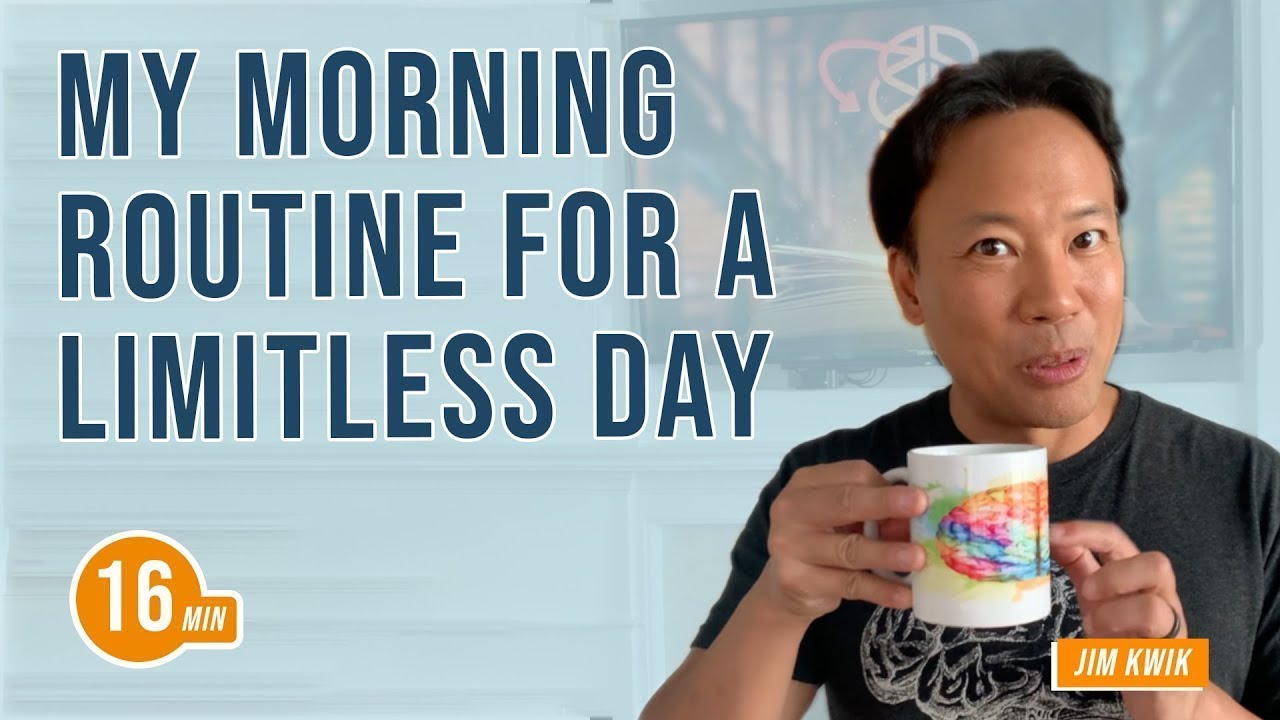
In this interview, Jim Kwik walks through his complete evening and morning rituals that he credits for high performance and mental clarity. He begins with an evening routine that includes reviewing the day, noting gratitude, meditating on a purposeful question, recording dreams using a 6‑step 2‑minute process, a brief prayer of thanks, and making the bed with excellence. He emphasizes a clean, toxin‑free sleep environment, mentioning his organic Avocado mattress, a ChiliPad for temperature regulation, and tracking sleep quality with an Oura Ring. In the morning, he starts with natural sunlight (or a light‑therapy device), hydrates with lemon water and probiotics, brushes his teeth with his non‑dominant hand to engage the reptile brain, and performs a 3‑minute body‑weight exercise routine. He follows with a cold shower, a tea or “brain‑power” smoothie (occasionally practicing intermittent fasting), and a concise journaling session where he writes three personal and three professional goals. He avoids phone use, reads light fiction rather than technical material, and uses a 5‑Minute Journal. Kwik also shares how to adapt these habits for children, stressing involvement, teaching dream‑journaling, gratitude, and simple movement. Throughout, he frames the habits as principles of excellence, gratitude, clean environment, and priority management, encouraging viewers to customize the routine to their own lives.
Chapters
We're going to answer this question. Jim, what are you doing with your morning routines? I want to get a little bit more specific. How cold are your showers? How long are your cold showers? What are you doing with your Brainpower Smoothie? I really wanted to address these questions right away for you. And, and part of it was, Jim, when do you start your day? You know, what time? And actually, my day for me, my mind starts the night before. So what I do When I go to bed, 2 things I do that I'll share with you, and we'll do a whole episode on it, is I review my day. And so I go through and I review my day, and that helps with your episodic memory. It helps you to remember the episodes of what happened that day, especially if you're not leaving the house very often, or you are working from home or living at work. You're not really sure which of the differences. The reason why everything tends to blend together— are you experiencing that?
Yes.
It's because we don't have those things that stand out. You're not going out to restaurants or to plays or movies, and so maybe everything blends in. And so one of the ways to prevent that and reduce that is by reviewing your day. Like, what did you do when you wake up? You know, what did you eat for lunch? Conversations that you had. And it could be difficult at first, but by doing it— remember, there's no such thing as a good or bad memory. There's a trained memory and an untrained memory. Okay, after that, besides reviewing my day and then highlighting one or two things I was grateful for that day, I always like to to end my day with gratitude and start my day with gratitude, as you'll find out, that you don't have to wait for a greater life to be grateful. You could be grateful and you'll have a greater life. And we've done episodes on how to rewire your brain using gratitude for appreciation, for peace of mind, for productivity and performance. But what I'm doing right before bed is I actually, using that same power of your mind to wake up, I ask myself a question. I kind of meditate on a question that would help move my life or my mission more forward, or something that you want to be able to solve. Because use that power to harness, because you'll come up with treasures in that night. So when I wake up in the morning, I'll often have dreams about it. And so the very first thing I do is I remember my dreams. Now listen, if you haven't, I'll put in a link as we always do, jimkwik.com/notes. And again, I appreciate my assistant who's holding the, the camera this long. So if you're listening to this on audio or watching this on video, So let's give a shout out for her also as well. So what you're going to do here is I write down my dreams and I go through a 6-step process to remember my dreams, which is very fast. It literally only takes 2 minutes. Listen to that episode if you want to be better at remembering your dreams and the things that you program for the night before. Now, after that, I do a quick, uh, kind of prayer. I think the most important prayer is thank you. It puts you in a grateful state. I want to start my day with gratitude, and then I make my bed. Now, just a couple things on the setup here. And again, you do not have to do every single thing perfectly. The goal here is just take the principles of what I'm sharing and then apply it towards you, customize it, because I don't believe there's one diet for every single person or one, you know, way of being productive for any other specific person. Find what works for you, and that's really the best. When I talk about making your bed, you do it with excellence. And again, if you haven't listened yet or watched this episode on my morning routine, please search online Jim Kwik morning routine and watch this video on Instagram, on Facebook, on YouTube, on iTunes, on Spotify. Listen to that first, okay? Because this will make a lot more sense to you. Well, coming back here, we make our bed, we start our day with excellence. How you do anything is how you do everything. Now keep in mind, one of the big questions we got was, where do you get all the time, right, to do all this? And I'll show you. I'll go at the end how long each thing takes, but I'll give you an idea. When I'm making my bed, how long does it take to make your bed? Very, very little. But I do this with excellence, and then you take excellence throughout your day. I also talk about clean environment. A clean environment— your brain loves a clean environment. How great does it feel to come back to a well-made bed? Because you come back to success. But also clean environment, which I don't talk about a lot, is free from chemicals and toxins.
Yeah.
You know, their carpeting and furniture is known to have some kind of off-gassing, these chemicals that have been shown to disrupt hormones, that potentially create respiratory challenges and also cognitive issues also as well. For me, I'm not compensated for this, but I use an Avocado mattress. Avocado is a great brand because it's 100% organic And natural. And so it doesn't contain those, those chemicals that could potentially do harm. Also, it's carbon negative, which is really great because it's not even carbon neutral, actually has less of a carbon footprint than, than base zero. So I'm not— again, if you're interested, check them out. Those are the ones that we did research that works really well for me. Also, another thing that I'm not compensated for, I use a chili pad. Cheese, by the way. This is not like planned. This is just we do reading before we go to bed. Home edit. You could come to my home also because we love a clean environment. So, but we use a chili pad, and chili pad actually has been shown the temperature we keep on the cool side because it's been shown to help you get better sleep and deeper sleep. If you Some people get warm inside their bed. We have a ChiliPad mattress. I could put a link again in the show notes to be able to cool the mattress down. By the way, I check my sleep using an Oura Ring. It's not how long— people ask all the time, how long should I sleep, Jim? For me, it's not about how long you sleep. It's the quality of deep sleep. Deep— and this is oversimplistic, but deep helps you to be able to, you know, recover your body, and REM is where you're recovering your mind. And so I use an Oura Ring, then I charge it here. I use it more for sleep than I use it for activity, but it measures heart rate variability and a number of other things. Again, I'm not compensated for it, it's just something, a tool that I use. What's Jim reading, by the way? I'm reading this book by John McPhee, McPhee, McPhee, and this is Levels of the Game. I also read comic books. What I don't do is I don't read technical information at night. I don't want to get in my business executive education, um, you know, psychology kind of mode, things I normally read, nonfiction. I want to read usually light fiction or something that's story-based because I want to just kind of enjoy it and then just put it to rest. You notice 2 journals here. I have a dream journal which I capture, and this is no particular affiliation. I do happen to— I've been using 5-Minute Journals, and I give these out. Oh, that's cool. as gifts a lot. Um, so Alex and Mimi, Icon, thank you. Um, again, check them out. This is a 5-minute journaling process you could do at night and in the morning. So I do that. And then let's, um— by the way, one of the other rituals I have is I get up. When I get up, I look at, um, the sunlight. And if it's not— because it helps me to maintain my circadian rhythms. So it's very important you get sunlight first thing. And if you don't, there's a device by Dr. Daniel Amen, BrainMD. And this light here, I'm not going to turn it on because I don't want to blind you. It gets pretty, pretty bright, and then it mimics that natural sunlight. And so that's something, again, I'm not affiliated with. All right, so I, from there, I drink a glass of water. I have lemon in it. I have my probiotics. You don't have to watch me do that. I do brush my teeth. Uh, but I'm not gonna make you watch that. But you know I use my non-dominant hand to engage the reptile brain. Make sure you watch that episode again so you get more specifics on it. And then from there, I, I read a study done at Appalachian State University that I got from our friend Sean Stevenson, who's been on the podcast a number of times talking about sleep. And it basically says, when's the best time to exercise for weight management and better sleep? Is it 7 AM, 1 PM, or 7 PM? Morning, afternoon, or evening? And, uh, hope this is flattering light. Um, I realized that, uh, I— the conclusion was 75% deeper sleep in the morning if you exercise. And but I also found out something interesting. It doesn't have to be your big exercise. And so only about a few minutes, 3 minutes. So what I do from here is I go and I just do 3 minutes of exercise. Now you could do calisthenics, You could do jump and jumping jacks. You could do jump rope. What's good for your heart is going to be good for your head, and that's what I want to activate. By the way, this is, this is my X-Men photo for those of you who read about it in Limitless. So if you know what that is, it's very meaningful to me. Okay, so in here, this is where I do my reading and my research for our programs that we offer at quicklearning.com. We have these 21 30-day programs for speed reading. Memory enhancement is the second program, and thinking, which is people want to think faster and have a better focus, make better decisions, solve problems. And the fourth flagship program that we offer is one on student success, and that's very, very popular. It's a must for any students of any age and stage. And so I come here, I do research to be able to provide to you the most important information that's usable and practical. Here, I have a number of plaques from schools that we've sponsored. We're very passionate with My Learning Challenges as a team to fund schools and on that for children who don't have access to education. Not only that, but healthcare and clean water. As you know, we donated— I want to thank our Limitless community. We just recently, $50,000 went to Pencils of Promise of the latest donation, and that's to build schools. And so we're very proud. So thank you everyone who purchased the book. Also Alzheimer's research in memory of my grandmother. This is a simple exercise that I do, again, by Bellicon. I'm not affiliated with them. It's a rebounder. Some of you know the power of rebounding, and it's just, it's a way of activating all your cells. But this is the exercise that I kind of, my go-to. Also, I used to be a runner back in school, and they might call it quick, right? Running those long-distance marathons was pretty strenuous on my joints. So here it's very soft. And again, this is something that I do. But I switch it off, right? So, but 3 minutes of exercise is what's most important. All right, so wonderful. Now from here, like you think about the things, we're hydrated, we're moving, and again, just 3 minutes of exercise. I come to my office and this is really where I create. And so I'm gonna do the rest of it right here. Beverages I talk about in the morning. Now, I'm not a big coffee person. I drink more tea. It's been more, I don't know if it's a cultural thing or a preference, you know, in terms of my personal taste. Hold on one second. But remember, booking a beverage goes a long way for me, especially first thing in the morning. Remember your dreams and win the morning, win the day. What do I do? Okay, so what I'm doing is I'm remembering my dreams. Takes just 2 minutes to go through. The next thing here, making the bed, only takes 1 or 2 minutes. Drinking water—that doesn't take any extra time. If anything, it's just you're always—you're already doing it. Three minutes exercise—it adds things absolutely because the big thing is where do I get time? Because my goal is for not this not to take time—is to help you to make time and focus and energy and productivity and more. Exercise three minutes. Brushing my teeth should take the same amount of time. That's interesting. Cold showers—if anything—it's less time. Tea smoothies on occasion. Sometimes I do intermittent. fast, and you might have heard episodes of that I've done with past experts. Journaling— here's what I do. I take 3 minutes to journal. And what am I journaling in the morning? I'm writing down 3 things I want to achieve personally and 3 things professionally. Now, the biggest way to save time on this is it's not just what you're doing, it's also what you're not doing. Notice The thing I said, I didn't say I did, which is touch my phone. And I know this is controversial. I understand some of us have to check our phones because our life depends on it. Our career depends on it. Again, take these guiding principles and apply it for you. Now, what do you do with children? All right. Then, which is a lot of people ask now, fill in the blank, children, you know, whatever responsibilities that you have that basically will take you away from doing these things. Well, first of all, if you do the math, we're, we're, we're, we're not talking about a large amount of time. There is an investment because for anything, worth having, it's going to take some effort or energy or time. My thing is to do it with children. All right, so what kind of things can you do? You could teach them to remember their dreams, or even the night before, you could go through an exercise where they ask themselves a question that they want to dream about, right? You could go through their day and ask them 2 or 3 things that they were grateful for. Having them first thing in the morning go through and have a dream journal and just write down their dreams so they're Doing that when they wake up and they get in the habit of doing that. You've heard the episodes I've done about how Mary Shelley came up with Frankenstein in a dream and all this great information and treasures. You know, what are your children possibly dreaming about? Teach them to make their bed. That's wonderful. Teach them to be grateful first thing in the morning to start their day. Wonderful. Drinking water. So I would, I would involve them in this. Help them to do the— make them a brain power smoothie if you want, if that's part of your regimen. Or also just Do some exercise. You know, when you're with them, get them to do the Super Brain Yoga or some of the educational kinesiology we've talked about in episodes here also as well. So the big thing is involve them, right? Don't let them go automatically on a device if it doesn't have to be. And I'm, again, I'm very pro-technology. It allows us to have a communication, to inspire, to instruct, to connect also as well. But again, Technology is a tool for you to use. You don't want that technology to use you because who becomes the tool? Then you do and your family does. And so my biggest recommendation would be to involve them in it. And the things you can't do, you just simply can't do. You know, if it's possible to go to bed a little bit earlier, wake up a little, you know, you could always kind of negotiate in your mind and with your family, with your loved ones, your own rules. But the idea here is to make it fun, make it playful. It's not So much about time management. It's really more about priority management. Remember this: if you take anything away from this, the most important thing is to keep the most important things the most important things, right? The most important thing is to keep the most important things the most important thing singular. And so the goal here is not we all have 86,400 seconds in a day. That's the only thing that's really truly equal, right? Not everybody has equal everything, but you will the time and whatever you're putting into it. So take a picture of this episode, a screenshot of this episode. So tag me in it and share your non-negotiable of 1 or 2, 3 things, or share your whole morning routine. When you teach something, you get to learn it twice. It makes you more accountable. And just remember this: you are the greatest project that you will ever get to work on. Make time and take your time to create magic. May you sleep easy tonight knowing that you can handle whatever tomorrow throws at you. May you wake up with your mind energized, your heart inspired for a new day. As you stare at that blank page before you, may you drench yourself in words unspoken. May you live your life with arms wide open. Today is where your book begins. The rest is still unwritten. So I want to thank you so much for, for joining me for this episode. Make sure you subscribe and do the things that every single episode that we talk about, and we'll see you in our next lesson.
Hi, Kwik Brain. It's your brain coach. I want to thank you so much for watching this video. 3 things to do. Number 1, make sure you share this because when you teach something, you get to learn it twice. Update your learning so you can update other people's learning as well. Number 2, make sure you subscribe to this channel so you don't miss a thing, because if you miss a video, you miss a lot. And finally, make sure you hit that bell so you're notified and you find out when we put out the latest and the greatest. One extra thing, if you want really close attention, then text me. Here is my phone number: 310- 310-299-9362. Did you remember that number? 310-299-9362. Shoot me a text and we'll stay in touch. Ask me your burning question, and I wish your days be full of lots of life, lots of love, lots of laughter, and always lots of learning. I'll see you in our next video.
More from Jim





The Library of Minds: Brain Coach: How to Stay Sharp When AI Does the Thinking | Jim Kwik





