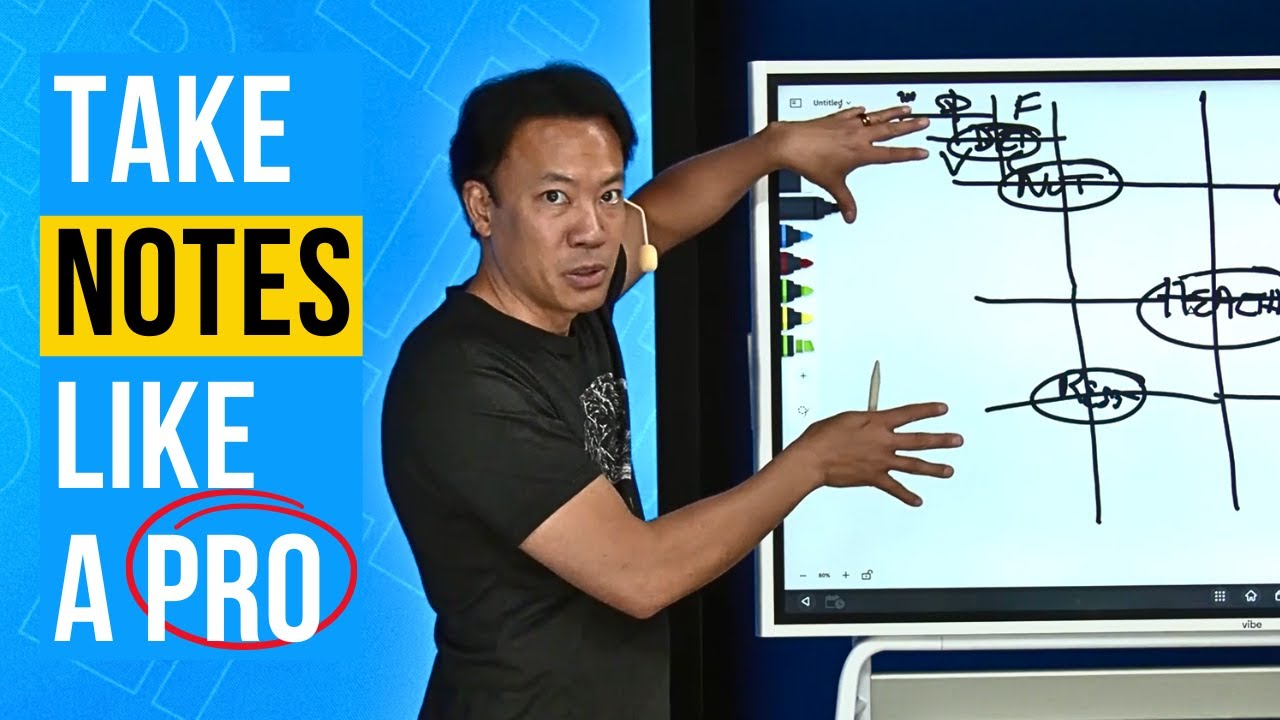
Jim Kwik teaches a four-quadrant note-taking method based on George Miller's finding that brains handle groups of four better than seven. Breaking topics into four categories, then subdividing each into four more, creates a visual map that fits one page and forces deeper understanding than linear notes.
Chapters
Here's a simple way of taking notes. It's kind of my version of mind mapping. For those of you familiar with mind mapping, we do teach that, you know, in the program. I want you to do this. Put a line— just take a fresh piece of paper and just draw just 4 quadrants. All right. So, what I do is I will map something. Let's say this is the title of my book. Actually, we could do this together. This is a way of— we tend to remember things. If I was to put, like, this is not a real number, right? But just if I was to put something like this. 1, 2, 3, 4, 5, 6, 7, 8, 9, 10. Right, that's 1, 2, 3, 4, 5, 6, 7, 8, 9— well, that's more than that. So 1, 2, 3, 4, 5, 6, 7, 8, 9, 10. So let's erase this one. All right, so let's say it's a 10-digit number. In order to be able to remember that, you know, 10 digits is a little bit beyond. There's something out of a study done at Harvard by George Miller saying 7 plus or minus 2. 7 minus 2 is 5, 7 plus 2 is 9, that you could generally remember things, 5 to 9 pieces of information consciously, right? Once we get beyond 9, it gets— you really need one of the tools that, you know, things that we teach to get beyond your conscious attention, right? But, if you were to go like this and all this, I go like this— no, I did have it right, right? Yeah, 1, 2, 3, 4, yeah, 1, 2, 7, 7, 7, 10, yeah, 7, 10. Oh, I put the 1 there. If I was to go like this, let's say that's 9, then it's all of a sudden you're remembering 4 pieces of information, right? And it's a lot easier, 11 digits, right? So, 4 is the magic number when it comes to memory because if George Miller says out of Harvard that you could retain 5 to 9 bits of information, like if you met 20 people, you'd probably remember 5 to 9. Right? If I gave you a list of 20 words, you'd probably remember 5 to 9. But if you chunk things together, you could remember a lot more. So how does this work? Okay. All right. So if you can remember things in 5 to 9, so 1 less than 5 is 4. So making 4 quadrants helps you to remember things also as well. So let's map something together. Let's say we have something called— A list. I don't know, health. Oops. Let's say we have something called health, and that's the topic we want to take notes on. Maybe the book we're reading or a book we're writing, health. If we were to break health down into 4 categories, what would some of them be? Just put it in, like, in order to have better brain health, let's say. Just put what some of the— okay, so diet. So diet is what? What category? Diet. Why are you taking diets? Why are you focused on diet? It's nutrition, right? So, one category could be nutrition. So, what I want you to do is break this down into fours, and then this would say nutrition. You see that, how that works? So, this category, this quadrant is nutrition, but I'm going to break nutrition down. But what else besides— I see exercise. So, I want you to go like this, exercise. Exercise. And then, this could be exercise. What else? If there's 2 more parts that covers, like, 80% of health, what else would fall underneath this? Could be— okay. So, let's put, like, rest. Okay. And then, if there was one more that covers, like, 80% of health or brain health, You have nutrition, you have exercise, you're getting rest, which can be meditation, sleep, whatever. And then what would be the last one? It could be anything. I mean, this is for the environment, emotional intelligence, being outside. All right, let's put environment for now. All right? So, now notice this. This is how I write books. This is how I take notes. Nutrition. Where else do you get your— where do you get your nutrition? Food. Diet. Diet, okay. So, you could break this down into 4s and this would be diet. Do you see that? And then, if you break diet down into 4 categories, what else would fall— how can you break down diet? What are different ways of doing it? Different types of foods? Okay, yeah. So, maybe like this quadrant would be proteins, right? This could be fats. This could be fruits and vegetables. Do you see how that works? This could be carbs. And can you break proteins down into 4 categories? Do you see how you could have here, like in protein, wild salmon related to protein, related to diet, related to nutrition, related to your brain health? Do you see that? And the reason I take notes this way is because— you know what the worst way of taking notes is? Full transcripts. Yeah. You know, when university studies— I speak at a lot of universities the past 30 years— when people are tested and they have verbatim notes, they don't test as well as people capturing key ideas. The other problem with verbatim notes, imagine metaphorically you have 20 pages of notes. There could be something more important on page 17 than it is on page 1, but your brain can't linearly see that. But here you have one-page view and see the relationship between all of the— how things are related, right? Nutrition, you could also be supplements, right? Right? And then you could break down supplements. You have vitamins, you have minerals, you have herbs, right? You could break things down and then all of a sudden you could break vitamins down into categories and all of a sudden see how vitamin— this specific kind of vitamin D, which is a hormone, but vitamin here is a related vitamin, which is related to supplements, related to nutrition, related to your overall health. And you could do this for everything. Can you break exercise into categories? Aerobic, anaerobic, yoga, right? You could break that down. Can you break environment down? Yeah, this could be people, relationships, because that's in your environment, right? This could be air quality or whatever. This could be water. This could be whatever. Rest could be sleep, could be meditation, it could be bodywork, whatever you're doing. You see how— so this is— and the great thing about books, everyone, is you could take 7 Habits of Highly Effective People, you know there are 7 habits, and all I do is chunk them and into fours. Even if there's 7, I'll chunk the couple that are together and put them in the same brackets here. And one of the best ways of taking this, if I'm taking Richard Dolan's book, is I— where do they— they give you this. Oh, thank you, Richard, for signing this. That was so sweet. I have the largest collection of signed books, like, ever. All right, so like here, how do you map this out? Really easy. His table of contents has 8 sections, so I'll just put 2 of them here, 2 of them here, 2 of them here, and then when you go into the actual chapters, I put the subheadings here. Does that make sense? And the fact that I have to think how I'm gonna organize it, even if it doesn't fit perfectly in the 4 by 4 by 4, forces me to really understand it so much deeper.