Understanding Your Habits with BJ Fogg, PhD & Jim Kwik
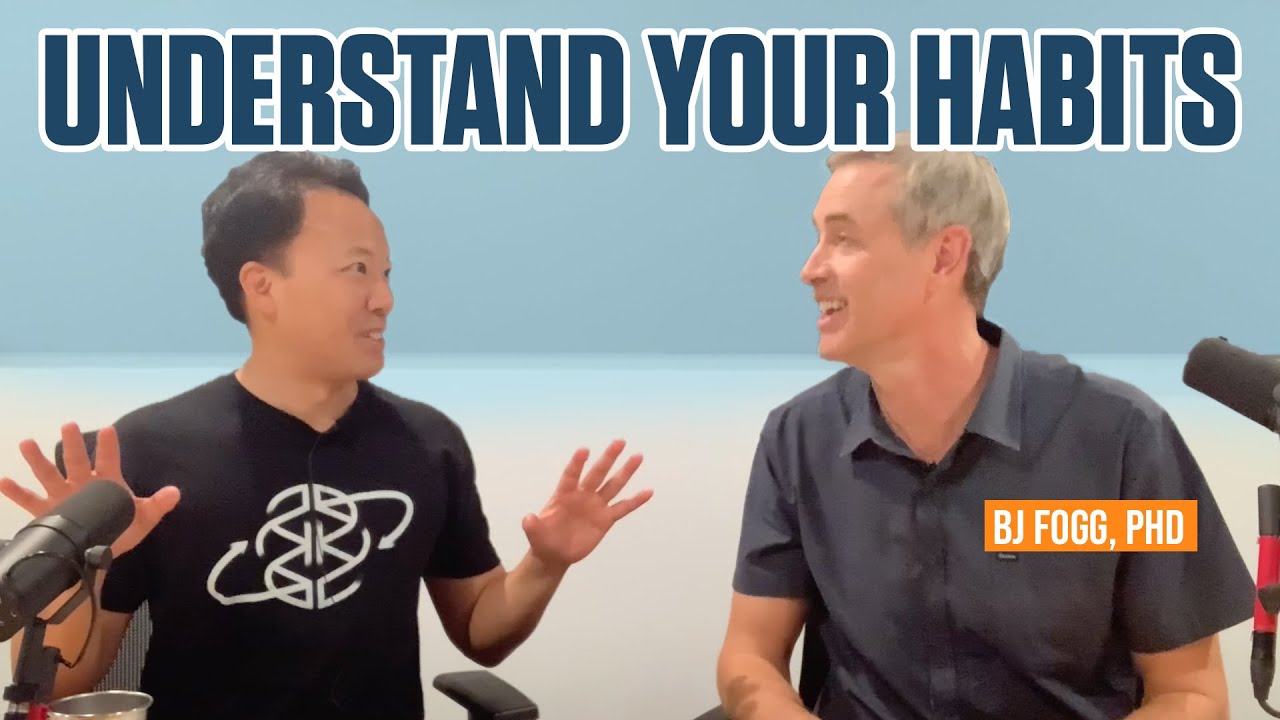
In this interview, Jim Kwik hosts behavioral scientist BJ Fogg to discuss the core ideas of Fogg’s Tiny Habits method. They begin by defining habits as automatic actions, using a garden metaphor to illustrate how habits grow or wither depending on how we tend them. Fogg shares concrete "tiny habit" recipes—such as opening a book on the subway or turning on an audiobook after buckling a seatbelt—emphasizing the need to make the behavior extremely small and anchor it to an existing routine. The conversation then shifts to the role of positive emotion, or "celebration," as the neural trigger that wires a habit, linking dopamine release and myelin formation. They critique common myths about habit formation (e.g., 21‑day repetition) and argue that intensity of emotion, not sheer repetition, creates lasting change. Fogg outlines a three‑phase flowchart for untangling unwanted habits: (1) create new positive habits, (2) focus on stopping the undesired behavior, and (3) swap it only if needed, all grounded in his Behavior Model of motivation, ability, and prompt. The interview concludes with practical resources—a free five‑day Tiny Habits program, the Tiny Habits book, and encouragement for listeners to apply these ideas immediately.
Chapters
Welcome back, Quick Brains. I'm so excited about this episode. What is a quick and easy way to understand your habits? And I'm excited here to be back again with Dr. BJ Fogg, and we have a really awesome setup.
Very sophisticated.
This is very sophisticated. Actually, the first time I interviewed you, we were both at a conference. BJ is a behavioral scientist, and he founded a lab at Stanford University, the Behavioral Design Lab. And we did previous episodes, and we recorded this— this was very early in my— you were one of my first guests on the show, and we just did that on my phone.
Bam bam.
And so, because the goal here is to create amazing content that's usable, that's practical, that anybody could do, And we're gonna talk about your new book. It's called Tiny Habits. Congratulations.
Thank you.
It hit the New York Times, which is an amazing accomplishment. I'm very excited about this work. I think a lot of people over the years have probably asked you, where's the book?
I know.
Where's the book? On Twitter, it's like, when's the book coming out? That's been years.
Yes. I know.
You get the same thing.
Yeah, we do. And I feature you actually in, I was showing you this, this is my upcoming book coming out in a few months, Limitless. There's a whole area talking about and citing your work because you, this is amazing. So I'm excited about this conversation about a quick and easy way of—
Understanding.
Understanding habits. And then people all the time, as you're listening to this, think about a habit you either want to adopt, or a habit you actually want to mitigate and reduce, because I think we all have those things. And so where do we start? How do you understand habits? What are habits?
You know, there's— well, habits are things you do quite automatically without thinking. And so a decision is the opposite of habits, and you can map them out on a spectrum that on one end is a decision like, oh, what am I gonna wear today? You know, so I was deliberate about what I was wearing today. Whereas habits you do without thinking, such as what briefcase am I going to take? Well, that wasn't a decision. I always use the same briefcase. So habits are things we do automatically. But there's an analogy for habits that I talk about a little bit in this book, but not overly done. But I think it's the fastest, quickest way to really understand what habits are and how they work. And it's to think of habits as plants. And think of your collection of habits as like a garden that you have. And so each flower, tree, shrub is a different habit, and they're in different locations in your garden, just like habits are in different locations of your routine or your life. You can not do anything to the garden and just let whatever grow, like bad habits.
Mm-hmm.
Or you can deliberately design what you want, which is what I'm advocating in Tiny Habits and elsewhere. You can design for it. Yeah.
Now, is there, in this metaphor, are there ways of nourishing a habit?
Let me give 2 specific tiny habit recipes that work for that, that I know from research. And there's, I'm sure there's more. And then we'll map it back to the garden analogy. So for reading, you know, say you want to read more.
Yes.
That's an abstract thing. You've got to make it specific and super, super tiny.
Okay.
So in one case, it could be all you're doing is just opening the book.
Okay.
So the habit is just open the book to where you left off, and then you— that's really tiny. It's about as tiny as you can get.
Pretty much.
And then you find where does it fit naturally. Does it fit after you sit down on the subway on your commute to work? Does it fit after you start the coffee maker in the morning?
Okay.
So you're finding where's the placement. So that's really important. Make it tiny, find where it fits well. After I sit down on the subway, then, then I open my book. So that's the recipe. If it's Coffee maker. It's like after I start my coffee maker, then I open my book. Now, so that's super tiny, and because it's so tiny, it's not hard to sustain. Okay, so that's the hack in tiny habits, is you make it so small that you don't require lots of motivation to do it.
Mm-hmm.
Now, you can always do more than open the book, and hopefully most of the time you will. And in the tiny habits method, you always do the tiny version. You can do more if you want, But if you do more, like read a paragraph or a few pages or a chapter, that's extra credit. So in your mind, you're thinking of it as extra credit. And in the future, you do not raise the bar. You don't think, oh, now I'm up to a chapter a day. No, it's always the tiniest thing. Now, that said, for your listeners, for Kwik Brains, it's gonna be underwhelming to open the book. So pick the tiniest thing that has meaning. So it might be a paragraph or it might be a sentence, okay? But I really just— opening the book actually worked. The, the other approach that has worked, um, I haven't done this because I don't drive in a commute, but people who commute is after I click my seatbelt, I will turn on the audiobook player.
Got it.
So it's so tiny you just turn it on, but you know where it fits. After I click my seatbelt, you turn on the audiobook player. In fact, there's a story in the book about a woman named Brittany. You might have met Brittany before, Linda's daughter, where she was getting through 8 books a month. Here, I reel it back in and say at least 5, because 8 sounds like I'm exaggerating.
Right.
That's what she told me. So I reel it back and I say at least 5 by doing that. And so rather than having the books stack up on her nightstand by her bed, which caused her a lot of stress because they just stacked up, she found this way with tiny habits to start Not reading, but listening to books and so on. So in each case, it's you make it really tiny, find where it fits, just like you would in a successful garden. Now you wire it in. So this is where I think your previous question was. What causes it to wire in? What causes the roots to grow?
Mm-hmm.
And in Tiny Habits, there's a hack for that. It's called celebration. And what you do is you fire off a positive emotion. You cause yourself to feel a positive emotion And that's what makes your brain remember and want to do it again.
Yeah.
You're hacking your brain through this thing called celebration. And in the appendix here, I give 100 different options, and I give some exercises so people can find the celebration that works for them. So it's anything that you can do in the moment that will cause you to feel a positive emotion. And the way that works, the way— what's going on is the emotion causes the dopamine to regulate in a different way.
Mm-hmm.
So your brain takes note, and it has to do with the myelin sheathing of the neurons or whatever that makes it— makes that pathway more reliable. So you're using this technique called celebration to hack your emotion, which then hacks your brain and wires in the habit, which is a whole different way of looking at habits than repetition creates habits, because that's not what creates habits, it's emotions.
Yeah, a lot of our students who are listening around the world, they— we talk about adding emotion into memory, that information by itself is very forgettable, but information tied to an emotion becomes a lot more memorable. And even if people think about things that they are triggered by, a song that could take them back to when they were in high school, Yeah. or a fragrance or a food that they would automatically be transported as a child and bring back all these, All these memories. But, you know, our students know that all learning is state-dependent in general, and that if people are, you know, associate to reading boredom, or they use it to fall asleep, those aren't great emotional states to be associated with an act that you want to have more of.
You know, and I'd be interested in your experience on this. As I teach Tiny Habits, and I've taught 40,000 people personally, a certain percent resist the The celebration piece, the emotion piece. They want to be— it's like not for them. And I'll stereotype, engineers and people from the UK are like, nope, not for me. It's like, well, guess what? Then you're not getting the full benefit of the method. You're not. Do you have people in Kwik Brains who are like, yeah, yeah, that emotion stuff, I don't want to go there? Do you find resistors?
We have, um, I mean, certainly some people are— they have some kind of a belief or filter around That even at seminars, that if they don't wanna go to a seminar that people are jumping on chairs and rubbing each other's backs and listening to loud music. But it's not, I feel like, obviously it helps enhance an experience if people are more up to it. That's interesting. So what you're saying is, let's say we want, people know leaders are readers. They're going out and they're ordering your book and they're really good at ordering and putting things into Amazon, that cart, you know, or going to a Barnes& Noble and coming out with books. But really what they're doing is, when we're thinking about this seed analogy as like a plant, what we're doing is you have the book and then you're setting a great environment. Either you're commuting to work or you're sitting down with a cup of coffee and you just open up the book. And you're setting it where you're making it so small, requires very little. So easy. A small, simple step that requires Very little energy or effort.
Yeah. And if you find the right spot, the habit just feels like natural. It's like, why didn't I do this before?
And then, so this takes away the question that people have is how many— how long does it take to form a habit? Because it's not about frequency or duration, it's about more intensity.
Yeah, it's the intensity of the emotion. So if it's an intense emotion that your brain associates it with the behavior, so it has to be within You know, it can't be 30 days later. It's like as you're doing the behavior, immediately after, that's what your brain has to associate, that positive feeling with this thing that you want to become a habit. The problem with the repetition idea, which is widely circulated in bloggers and headlines and things like that—
21 days, 30 days, 66 days.
Yeah. You look at the research people are citing, the most common citation does not show that it creates habits. correlates with habit formation, but there's no evidence that it causes it in that paper. So people are confusing causation with correlation, which is a common thing. And the problem from an everyday person perspective is if you think that it's 21 days or 66 days, that you can— if you just endure something for 21 days, that it'll magically form.
Right.
Then your whole look at how behavior change works is one of suffering and endurance, where first of all, it doesn't wire in because of repetition. And second, you don't have to suffer and endure to create habits. You can do it in this uplifting, positive way. And that's a major theme in the book, is you change best by feeling good, not by feeling bad. And if somebody's feeling like, oh, I've got to— in order to create a reading habit, I'm going to have to suffer for 21 days or 56 days. Oh, it's a pain. They procrastinate and maybe never get to it. So it's not just conceptually wrong, it has real-world implications to believe that repetition creates habits. Whereas emotions, then you do it through positive emotions.
And that takes us to this conversation where people think that changing their habits is hard. You know, it is something that you have to struggle or suffer with.
Some habits are, some habits aren't, you know. You know, certainly you could have a habit of going to the gym and you could easily uproot that habit if you wanted to, for example. And then there are some habits, and I address this in the book, some, you know, addiction's a hard word to define.
Sure.
And if there is a life-threatening or very serious, you know, bad habit or addiction, go get professional help. There's— don't rely on any book. But as you come to things like snacking or maybe yelling at your kids or negative thoughts or things like that, sure, you can use tiny habits to change those behaviors easier than most people think. Forming habits, really easy. Untangling bad habits is a little bit harder, but it's still doable. And notice I don't say break bad habits, it's untangle.
Untangle.
There's a process, and I explain that here, the process In fact, can I get geeky for a minute?
Yeah, let's do it.
Let's do it. Jim, this is one of the things I'm proudest of in the book, but they would not let me put it in the text, my editors, because it was too technical. So there's a 3-phase flowchart, page-by-page master plan. This is what you do. So if you have a persistent bad habit, phase 1, you focus on creating new habits. You don't worry about—
And these could be habits, because you actually mentioned something. So it's not just external habits where you're opening up a book. or going to the gym. It could be habits of thought.
Yeah.
Or habits of emotion where you have a temper.
Yeah.
And you just have this association.
Yeah.
Same formula.
Yeah, exactly. It all comes down to motivation, ability, prompt. My behavior model, right? And so here you can see right here in the flowchart, motivation, ability, prompt. You flow through it. If phase 1 doesn't untangle, say, the negative thoughts, Or the saying critical things to your spouse or what have you. You go to phase 2 where you then focus on stopping the behavior. Motivation, ability, prompt. If that still doesn't do what you need, then you go to phase 3 is where you swap. So often people say the only way to stop a behavior is swap it. That's not true. In my plan here, swapping comes in but only at the end if nothing else has worked.
So you're saying there's a belief out there that if you want to stop a habit, you have to replace it with something else?
That's widely a headline for many things.
Interesting.
And that's not— I mean, there's things we can simply just stop doing, right? Right.
What do you recommend right now for people? Because we're going to continue this conversation and we're going to do another episode. Where do you recommend people start based on this conversation here? What's one thing they could do outside of getting the book?
Go to— there's a free 5-day program, the one I've offered since 2011. Go sign up for that. It's free, and it gives you an appetizer to this, and it works. And certainly the book is— I mean, it's so much of my work pulled together finally in one place.
Mm-hmm.
So yeah, the book's a great way to go. There's some other videos, but those are probably the steps. If you don't want to spend anything, just go sign up for the 5-day program. Yay, and you'll learn from that. And then if you do want to buy the book, buy the book. And, you know, it's— I'm just really happy it's pulled together, and I'm just getting such good feedback from people who did Tiny Habits like years ago. There's people that did it in 2012 and '13 that are like, I just saw your book, and oh, by the way, I didn't tell you, but your work transformed my life.
We even have— it's come up on past episodes, even our Ramit Sethi. He came on to talk about financial, you know, learning and such, and he's always referencing your, your work also as well.
Yeah, yeah, Ramit's awesome. So, so I, you know, and I think the takeaway, I mean, you know, besides doing tiny habits and the book and so on— yes, do those things— is guess what? You can change your habits easier than you think. And now there's a process that's a system. You don't have to guess at any point. I mean, I'm big on systems. So there's a systematic way, step by step, that's really reliable, and it's fun. I mean, at least I think it's fun, and other people say it's at least pleasant. It's uplifting.
For sure.
It's not like beating yourself up. It's the opposite of that.
I love that. I challenge everybody right now to take a screenshot of this episode, whether it's a video or you're listening to it on audio, and tag us both on this. on social media, @JimKwik, K-W-I-K. And you're on Instagram.
Finally, finally, finally, finally. Even though my student was the co-founder and I started in 2010, I stopped 'cause it's like, I'm a private person. But now I'm getting back on board. Good.
And so tag us both there. We'll have all the links always at jimkwik.com/notes. And what do you want people to share when they post? Maybe they're like an aha they had from this conversation or maybe a tiny habit they wanna—
I think, you know, this book is an, in some ways an intervention to help people feel good and learn to feel good and use those feelings to change. So anything about your positive emotions or how it's affected you to feel good rather than bad, and we need that now more than ever.
More of those stories. As always, I'll repost some of my favorites, so make sure you tag us both in there. And BJ, thanks for coming back on the show.
Thank you.
Hi, Kwik Brain, it's your brain coach. I want to thank you so much for watching this video. 3 things to do: Number 1, make sure you share this because when you teach something, you get to learn it twice. Update your learning so you can update other people's learning as well. Number 2, make sure you subscribe to this channel so you don't miss a thing because if you miss a video, you miss a lot. And finally, make sure you hit that bell so you're notified and you find out when we put out the latest and the greatest.
One extra thing, if you want really close attention, then text me.
Here is my phone number.
310-299-9362.
Did you remember that number? 310-299-9362. Shoot me a text and we'll stay in touch. Ask me your burning question, and I wish your days be full of lots of life, lots of love, lots of laughter, and always lots of learning.
I'll see you in our next video.
More from Jim





The Library of Minds: Brain Coach: How to Stay Sharp When AI Does the Thinking | Jim Kwik





