Why an Infinite Mindset can become your Biggest Advantage | Simon Sinek & Jim Kwik
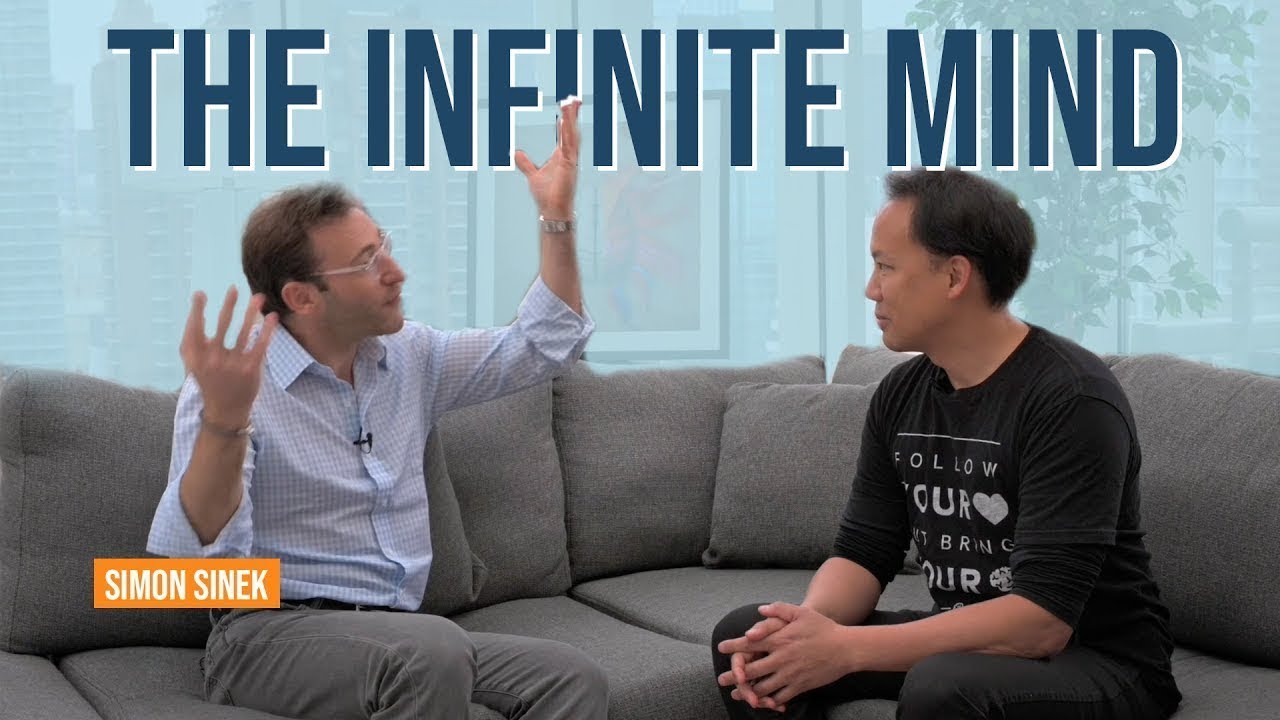
Simon Sinek explains why treating career and business as infinite games, not finite ones with winners and losers, builds trust and innovation. He outlines five practices: a just cause, trusting teams, studying worthy rivals, existential flexibility, and courage to lead. Leaders like Kip Tindell and Sam Walton succeeded by prioritizing long-term purpose over short-term metrics.
Chapters
Welcome back, Kwik Brain. Your question of the day is, how do you live with an infinite mind? And I'm excited to have this conversation with my good friend Simon Sinek.
So good to see you.
Bestselling author, eternal optimist, and author of the brand new book, The Infinite Game. Congratulations on the book.
Thank you very much.
So I wanted to talk to you about this for a while, and, uh, it's such a good read. I recommend it to everybody.
Thank you.
I've gifted it out A dozen copies already.
Thank you.
What's the— why don't we set some definitions? What's a finite game and an infinite game?
In 1986, a philosopher by the name of James Carse articulated these 2 types of games, finite games and infinite games. A finite game is defined as known players, fixed rules, and an agreed-upon objective. Football, right? There's always a beginning.
Chess. Chess.
Anything like that. There's a beginning, middle, and end. And the objective is to win. There's a winner and there's a loser, right? Then you have an infinite game. An infinite game is defined as known and unknown players. The rules are changeable, which means you can play however you want. And the objective is to perpetuate the game, to stay in the game as long as possible. We are players in infinite games whether we know it or not. There's no such thing as being number one in your marriage.
Mm-hmm.
You can be number 2, but you can't be number one. There's no such thing as winning career. No one's declared the winner of careers, right? And there's definitely no such thing as winning business or winning life.
Or winning parenting.
Or winning parenting or winning education. These are all infinite games. But if you listen to so many people, they don't actually know the game that they're in. They talk about being number one, being the best, beating their competition. Based on what? Based on what agreed-upon objectives? Based on what agreed-upon metrics? Based upon what agreed-upon timeframes? There's no finish line. The problem is, is when we play in an infinite game, a game with no finish line, with a finite mindset, play to win, there's a few very consistent and predictable outcomes. The big ones being decline of trust, decline of cooperation, and decline of innovation, which all lead to the eventual weakening and demise of the relationship or, or the business.
So can individuals— because I know we're going to talk about leading with the infinite mind and potentially even learning with the infinite mind— can individuals Do they get to choose the game?
We don't get to choose the game. I mean, life is an infinite game. Business is an infinite game. You know, education, learning is an infinite game. We don't get to choose the rules of the game. In some cases, we can choose if we want to play or not. You can choose to start a business or not. But most of them, we don't get to choose the rules or choose even if we want to play. You know, you're born into life, and congratulations, you're a player. The only thing we get to choose is how we want to play. Do we want to play with an infinite mindset or with a finite mindset? And the choices we make will significantly determine not only the outcome, but how we feel about the journey.
So if somebody has a job and they're going to an office and they have a 9 to 5 Monday through Friday, that— how does that work?
You still play with an infinite mindset, which is, are you going to work to make more money than everybody else, get promoted faster than everybody else, be number one at the office? Or are you going to work to contribute to something bigger than yourself? To be of value to the people to the left of you and to the right of you? To be of service to the people to the left of you, to the right of you? Are you there to continuously improve and grow and be better than you were yesterday? You can absolutely show up with an infinite mindset, and the journey you have at work is actually vastly more fulfilling when you play with an infinite mindset than when you play with a finite mindset.
Wait, so walk me through the progression here. So your books, Start With Why and then Leaders Eat Last, how do they relate to this progression?
My work is semi-autobiographical. It's my own journey. Start With Why was about the loss of my own passion from my work and how I refound that passion. And it turned out that it worked. And it worked for my friends. And so I ended up talking about it and writing about it. Leaders Eat Last is about trust and how we form teams that are built on trust and what happens when that— when we have trusting teams. And Leaders and Infinite Game is really then what happens when you have purpose and you have trusting teams and you have to sort of operate in the world. The interesting thing is, you know, the value of Infinite Game in my life is, you know, I'm an idealist. I talk about these idealized work environments and, you know, an ideal world. And it's very often I'm accused by people in power or people who've made a lot more money than me, they basically say to me, you know, you don't understand business. None of this would work in the real world, they keep telling me. And, you know, I think we all hear that. I think we all have this discomfort. Many of us have this discomfort when we go to work, you know, that this can't be the best way to run a business. You know, where there's annual layoffs because you miss the arbitrary projections and sort of it's based on fear and intimidation very often. And just very often we have this uncomfortable feeling at work that there has to be a better way, but our bosses and our bosses' bosses tell us that they know better and they're more accomplished than we are and they've made more money than we have and they have more power than we have, so we go, we just sort of sit quietly and just do as we're told, right? We sort of assume that they're right. So when I discovered this concept of finite and infinite games, immediately I recognized that uncomfortable feeling we have is because these people who claim that they understand business better than we do, they're all playing with a finite mindset. In other words, they don't understand business better than we do.
Mm-hmm.
We're onto something. So being an idealist doesn't make me crazy. It means that they're actually not playing with the right mindset for the game that they're actually in, to the detriment of of their own organizations and even their own joy that they can feel in their own careers. So it was a huge weight off my shoulders when I discovered this infinite game. It was just a wonderful feeling.
So was that the impetus for you writing the book?
I mean, there was a series of things. I recognized the value of how many of us, myself included, were playing with the wrong mindset for the game that we were in and then found ourselves struggling with things like trust and cooperation, found ourselves Dealing with innovation issues in our organizations where we couldn't— how do you drive innovation? How do you tell people, be more innovative? It's hard to do. So the discovery of the infinite mindset made me realize the reason I was also struggling with these things is because I was making the wrong decisions, because I had the wrong mindset. So I had to change my mindset for the game I was actually in, and things have been very different as a result.
So the person who's watching or they're listening to this right now, What would be a great place to get started to be able to adopt a more infinite mindset?
Well, I talk about 5 practices that are required. I talk about having a just cause. I talk about building trusting teams. I talk about studying your worthy rivals, having a capacity for existential flexibility, and maintaining the courage to lead. It's a little bit like exercise. If you were to ask me, you know, what's the most important thing to do to be healthy, I'm gonna tell you you have to exercise and eat healthy and sleep and nurse your personal relationships, and, and you're going to say to me, where do I start? Just, just start. Like, just pick one, you know? It doesn't matter. You're going to have to do them all, but just, just start somewhere. And the infinite game is, is kind of the same, you know? Is there an ideal scenario? I mean, there could be, but at the end of the day, just, just start, you know? It's, it's okay. You're going to have to do them all eventually.
So it's kind of like that— it's like the C between the B And the D, where the B is birth, the D is death, and the C is choice?
Yeah, I mean, it's— there's a wonderful poem called The Dash. You know, on our tombstones, it has the day we're born and the day we die, but it's really the dash that matters. You know, it's what do you do with the dash? So that's what this is about. It's what are we gonna do with the dash?
Are they— do people have to decide every single day to have that infinite mindset? Of course.
I mean, this is not easy. It's simple, but it's not easy. We have to decide every day if we're gonna— how we're gonna eat. We have to decide every day, you know, what time we're gonna go to bed and what time we want to wake up. We have to decide every day how we treat the people in our lives and how we want to be treated. Yes, yes, yes. I mean, unfortunately, this is real hard work. It requires discipline and focus and yeah, and every day is a challenge. You fall off the wagon.
And it could be— You know, we're hypnotized because in the performance space, they use metaphors of sports all the time.
All the time. Overuse them. It's kind of funny to me in infinite organizations how often we use sports analogies and war analogies to motivate our people. But they're the wrong analogies because we're talking about winning in games that have no finish lines. And we talk about making decisions in order to win in a game that we don't know how long the game lasts. So, they're the wrong analogies and they direct the wrong behaviors. The analogies I like to use are analogies like lifestyle, like exercise, you know? You can have goals in the infinite game. There are always finite games in the infinite game. But the infinite game provides the context for that finite game. So, here's an analogy. You want to be healthy. You can have health goals. You want to lose X amount of weight by X date. It's motivating. You need it.
Right.
You want to measure the pounds. You want to measure how much you're losing. You want to measure how many reps you can do, you know, how many push-ups you can do. Because as you get better, you feel like you're making progress. It makes you feel like you're advancing towards your goal. But what happens if you miss your goal? What happens if you don't lose the weight by the right date?
Right.
Have you failed?
No! Or you don't hit your KPI.
Or you don't hit your KPI. Like, it's fine. You're even— you're way healthier now than when you started because you've been doing all the right things. And the goal was important to help you drive and motivate. But if you miss the goal, you just keep working out. It's fine. And that's the problem. Even if you hit the goal, you can't quit. You still have to keep working out for the rest of your life. So the infinite game is the same thing. It's a better analogy. You have to have metrics. You have to— you can't run a marathon without mile markers, right? Because you have to measure speed and distance.
Mm-hmm.
The infinite game is the same. We still need to measure how fast we're going and how far we've moved towards our just cause, to advance our vision. We have to know that we're making progress. We have to know we're making progress in the right direction. So there's always finite games, but to what end is the question that the infinite game will ask. So yes, an infinite mindset is something that you can maintain every day. It's not the absence of finite games. It's the context within those finite— within which those finite games exist.
And overall, the results actually, reading your book, the results are actually better when you have—
Over time, yeah. I mean, this is the thing. There's so many finite strategies that can be deployed that can absolutely have short-term Sure. But it doesn't last. I mean, you can, you can, uh, you can have promotions and sales to drive end-of-year sales, you know, so you can hit the— hit your target and everybody thinks you're a hero, right? But you built no relationships and you gave away profit to make it happen, you know, just so you can hit some sales target. Um, or you can build relationships and, and nurse it and, and build your business very differently. So the same applies to the way we manage our lives and our friendships as well.
So is it— so there's not— exactly. So friendships and relationships is an infinite game because you never, you never win that.
Right. You can't win friendship.
It's not about achieving something, it's about advancement then?
Correct. The finite game is about achievement, and that's— there's nothing wrong with that. That's fine. But the infinite game is about advancing something, advancing something bigger than ourselves, advancing towards something, committed at committing our lives to advance towards something, and we'll never get there. You know, but we'll die trying. That's the point. You and I have both committed our lives to have an impact in the world and in the lives of others. And we have an idealized state of the world that we imagine. You want as many people as possible to capture the full power of their brains and live healthier lives. I want to create a world in which people wake up feeling inspired, feel safe at work, and return home fulfilled at the end of the day. Neither of us will ever achieve perfection. But we'll die trying. And the end of our lives, we'll look back and say, did I go from here to here? Then my life was worth living. So the metrics matter, but, but, but we do it with the hope that others will take our torch and, and carry on without us, which is the ultimate goal of the infinite game, that we actually inspire others to carry our— carry on our cause without us.
Who in your mind represents somebody who's really embodied the— in playing the, uh, The infinite game, that mindset?
There's no one, there's no perfect infinite-minded leader, and there's definitely no perfect infinite-minded organization. There are some that serve as good examples. I think Kip Tyndall, the founder of The Container Store, definitely infinite-minded. He wanted to build an organization that served people, and he was willing to make short-term sacrifices in order to do things for the greater good. So for example, he pays his frontline retail staff extremely well. Other people think he's crazy to pay them that well. But as he explains, you can't hire somebody off the street and recreate the kind of knowledge and devotion that somebody has after working for 11 years. Why not pay them more? It's actually, over the course of time, more expensive to keep hiring people, right? But in the short term—
But if you're looking at quarters—
If you're looking at quarters, it looks ridiculous, right? But if you look at the length of a career over the course of 11 years, this employee was way cheaper, way more productive, and way more valuable to your organization than the new hire, the new hire, the new hire, the new hire. I think in the early days, Sam Walton was infinite-minded, you know? He believed in serving the average working Joe, which is why he made the decisions he made for Walmart.
There are examples of people outside of business as well. Martin Luther King.
Martin Luther King, of course. You know, people who are trying to advance a cause bigger than themselves, who have a dream. And Martin Luther King's dream is still alive.
We're close. Even after he's passed?
Even after he's passed.
Because it was bigger than—
We've taken on— we've taken his torch and carried it on without him. And though we will never fully achieve his dream, we're closer than we were. And that's the goal, to keep moving the needle as best we can towards that vision. The way I like to think about an infinite mindset and what Just Cause is, is it's kind of like an iceberg, right?
Mm-hmm.
You know, the visionary is the one that looks at ocean and imagines what lies beneath the ocean, this iceberg. You know, and talks about it, like, with such clarity as if it really existed. But you look out at the ocean, there's nothing there.
Right.
That's why we call them visionary, because they can literally see things we can't see. And then they start working. They commit themselves to it. And a little bit of iceberg pops up, you know? And somebody says, I can see what you can see. And that visionary goes on to describe what's under the ocean. And others say, we can see it too. We can see what you imagine. And they commit themselves to working hard. And other people think they're crazy. There's no way an iceberg can exist. Look at the size of what— what you've achieved, but they talk about what they can imagine underneath. And they work hard and they see a little more and a little more. And before you know it, there's enough iceberg that other people can say, oh, it is real. We can see what you can see too. But the visionary understands that no matter how much success they have in their life, in their career, no matter how much they've achieved, there's still disproportionately amounts more that is unseen.
Hmm.
There's still so much more work to do. There's so much more iceberg underneath the ocean. And this is the same as civil rights. Martin Luther King could see what the rest of us maybe couldn't see. I have a dream. And he talked about it in words so clearly that we could imagine it as well. And we committed ourselves to help bring that vision, that dream to life. And though there is much of an iceberg out of the ocean, there is still way more work to do to advance the cause of civil rights. And that's why we keep working on it. And when we work on it, it gives our life and our work meaning and purpose, which is a wonderful way to live a life.
Last night I watched, uh, we watched the new Disney Plus, and they have a documentary on there about Imagineers.
Yeah.
And Disney's story and how he saw the theme park and nobody else did, but his— he would keep on repeating the vision over and over again.
Yeah. Until people could see it beyond the orange orchards and Yeah, I mean, Disney was a true infinite-minded thinker. And he was actually dissatisfied. As much success as he had— remember what an innovator this guy was. Steamboat Willie was the very, very first cartoon that had synchronized sound. Never been done before. Snow White in 19— what is it? 1940? Steamboat Willie was 1928. Snow White was 1940, I think.
Right?
feature-length cartoon where you can get actually invested in the characters and there's a real dramatic story. Never been done before. Snow White was a huge success. Put Walt Disney on the map. He made a ton of money. Disney became a huge organization. Went on to make other feature-length cartoons. Fantasia and others like it. And Disney was always dissatisfied because once a film was made, it was done. It was over.
Mm-hmm.
And he wanted to do something that could continually evolve and help advance His vision of a of an idealized and idyllic life where we would leave our stress behind and come into this world that you know instead of watching the the the film where we would for escape we would we would walk into it for escape. We literally leave our worries behind, and this was Disneyland, and he loved Disneyland because he could keep tinkering and tinkering and tinkering. And even now, a modern-day Disneyland. Very, very few of the rides that exist today existed in Walt Disney's lifetime. They've all been replaced because it lives, it breathes, it can stay up to date, it can stay modern, it can stay relevant. You've got Star Wars and Marvel and all these new things that can be brought to the Disney world so that we can escape, continue to escape. And it really is an amazing place to go to Disney.
It is.
It, you know, we leave all of the things that cause us stress and comparison, all these things in the real world. You know, there, it's a very egalitarian, beautiful place. So yeah, no, true infinite-minded thinker. And that one product and what the Imagineers build, 'cause the Imagineers build everything in Disneyland, the parades, the rides, everything, that's what they see. They're constantly working, they're constantly improving. It's a game of constant improvement, which is what— Which is what the infinite game is.
In future episodes, I want to have this conversation with regards to leadership and also learning. So I'm really excited about it. Where can people get the book?
You can buy the book at fine bookstores everywhere and even some not so fine ones. Wherever you like to buy books.
Great. And then in terms of starting point, I know you could write— people could write whole books on all the different things you could do to parent and all the different things you could do for wellness. Is there a practice, a good place to start, though, to adopting an infinite mindset?
You know, I really like this concept of worthy rivalry. I get more questions on worthy rivalry than any of the other practices, and it's an easy one to adopt. It's, you start to view the other players in the game not as competitors to be beaten, but as rivals to be compared to, rivals that you can learn from. in our industry. You know, there's other people who write books and give talks and make podcasts and all these things. And if we're competing with them, it means we want to get more viewers, more book sales, and, you know, whatever it is, more gigs every year. And we're— but to what? What? There's no— like, what's your metric? Like, as somebody, you know, you can think you're number one based on the metrics of your choice and the time frames of your choice. Rather, it's better to identify the other players as rivals. Some of them are worthy of comparison. In other words, they do some things better than you. And instead of hating them and trying to compete with them and best them, rather learn from them. And because their strengths reveal to us our weaknesses, and if we have our weaknesses revealed to us, that means we can work on those weaknesses and work to become better versions of ourselves and wish everybody else the best of luck. I love that.
I love that so much, Simon. I recommend everyone go and get their copy of of the infinite game. I would challenge everybody actually to take a screenshot of this episode, tag Simon, tag myself on Instagram or on Twitter, on Facebook, and then share, share their aha, one thing that they could do to be able to adopt an infinite mindset.
Thanks, Jim.
Thanks, buddy.
Appreciate it.
Hi, Kwik Brain, it's your brain coach. I want to thank you so much for watching this video. 3 things to do. Number one, make sure you Share this because when you teach something, you get to learn it twice. Update your learning so you can update other people's learning as well. Number two, make sure you subscribe to this channel so you don't miss a thing. Because if you miss a video, you miss a lot. And finally, make sure you hit that bell so you're notified and you find out we put out the latest and the greatest. One extra thing: if you want really close attention, then text me. Here is my phone number: three one zero.
310-299-9362.
Did you remember that number? 310-299-9362. Shoot me a text and we'll stay in touch. Ask me your burning question, and I wish your days be full of lots of life, lots of love, lots of laughter, and always lots of learning. I'll see you in our next video.
More from Jim





The Library of Minds: Brain Coach: How to Stay Sharp When AI Does the Thinking | Jim Kwik





