Your Next Chapter LIVE
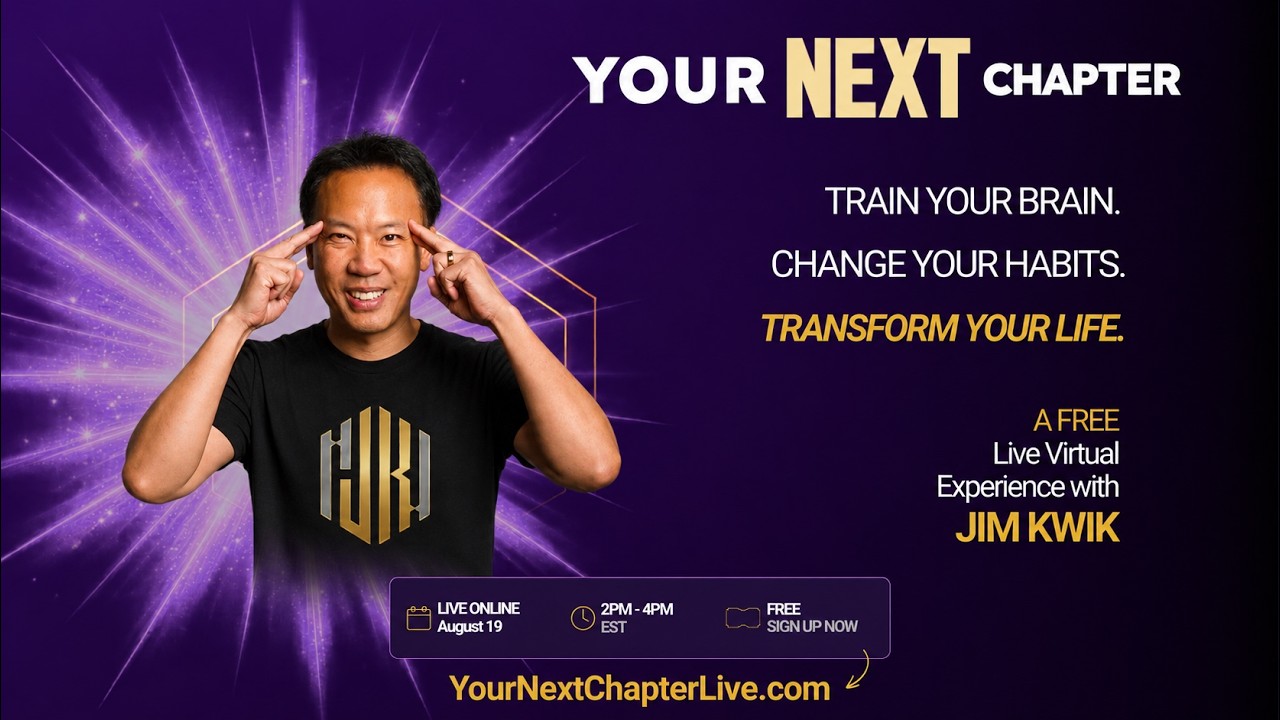
Jim Kwik closes a live seminar by introducing Limitless Daily, a five-minute morning routine of reading, a story, and an affirmation that works like brushing teeth for your brain. He frames small daily choices as votes that build confidence and reshape identity over time, and announces his book launches September 8 with a live event September 11-12 in New York.
Chapters
Um, I need to get starting. Starting. Yep. You good? Hi. We're live, right? Wait, put in the chat that you could hear me right now and that you're ready for a great couple hours. Uh, Daniel, yes. Curtis, live. Anna, Jacqueline, Faye, yes, we're good. What about on YouTube? Here also as well, live chat. Uh, sound works. One Eye Penguin, very cool. All right, let's get started. Um, I'm so glad that you're here, not just because you registered, but not just because you showed up, but because out of everything that you could be doing right at this moment, you decided to invest 2 hours of your precious time. And that's time, your attention is everything, and we're gonna talk about that today. And you're investing it also on Orindu, and the one person you'll spend every moment of the rest of your life with, which is you. And so I don't take that lightly. I'm gonna pour into you the next couple hours. And I'd love to know, just get a feel. I just landed in New York City. I took the red-eye to be here today in studio. I'd love to know, would you do me a favor? Tell me in the chat. And if you see my eyes move, I have multiple screens here. Where are you joining us from? Where are you joining us from? Kentucky, Oregon. Kevin's in Oregon.
Texas.
I think Denver. It's a good thing I'm a speed reader. Portugal. Melbourne, Australia. Austin, Texas. Sophie, Switzerland. Uh, here we go. Pakistan. London. Delray Beach, Florida. Yes, you're ready. Yes, I love this. This is amazing. I mean, this is incredible, right? All, all over the world, uh, thousands of people signed up for this, uh, special gathering. Different backgrounds. You have different stories. You probably have different dreams, yet I believe that every one of us is here for the same reason, right? You wouldn't have signed up for the next chapter, um, you know, like, if you didn't believe that your best chapter hasn't been written yet. You know, one of the, uh, supporters of our, uh, Limitless book— Oh no, they didn't get that picture.
Is, uh— Oh no, they didn't get that picture.
Can we mute? Can we mute everybody? Is Natasha Bedingfield. I don't know how many of you have purchased my book in 2020, Limitless: Upgrade Your Brain, Learn Anything Faster, and Unlock Your Exceptional Life by Hay House. Me, me, me, David. Thank you, Thomas. Thank you, Star. Nina. We sold 2 million copies, donated proceeds to charity. We built schools in Ghana, Guatemala, Kenya. We're very proud of that. But Natasha Benningfield, who I got a chance to work with, says, ability to expand your mind and shine a light on your inner genius. Like my song Unwritten says, your life is your story. Limitless will help you write yours with new possibilities. And that's what we're going to do today. All right. So I just want to presence that, is that you are the author of your life. You know, and every single day you wake up and it's a clean page, right? It's a clean page and you get to write what you want. You get to create. You take the invisible and make it visible. Um, before we go any further, I want to ask you another question. I want to make this interactive. I'm going to ask you to play along here with me. Uh, just answer honestly in, in one word, just one word. What, what brought you here today? What made you sign up? Type it in the chat. Just one word. Don't you don't have to think about it too much. What's like one word besides besides me? All right. Growth, freedom, curiosity, compassion, rejuvenation, direction, possibility, learning, self-knowledge, improvement, growth, peace. What's that? Like peace? Next level growth.
Growth, growth.
Need, change, learning, focus, possibilities of— you're available? Yes, I'm glad that worked out in your schedule. Learning, improving. This is amazing. I mean, I just want to— I want you to notice something. None of those words were about making money and buying cool things and impressing everybody else. They're about becoming more of who? More of yourself. And I really think that's beautiful. You know, I'd like to make you a promise. Not about the next year, not about the next month, just the next 2 hours. By the time we finish today, you're gonna leave with something practical that you could use tomorrow morning. Not someday, tomorrow. Something that will help you Think more clearly, feel more capable, and really, how many of you want more momentum in your life? Positive momentum. Some people have momentum in the direction they don't want to go in, but positive momentum. How many you want to be? If there's a gap between where you are and where you want to be. But I think it's really interesting when I asked if there's like one one word, you know, you didn't talk about things. You talked about you want peace, you want direction, you want some inspiration, you want some learning, you want. Growth, right? And I think these are universal, you know. Um, you know, this is not just inspiration. Maybe you get some inspiration today. Inspiration is wonderful, but inspiration without implementation, it usually expires by the next day, right? And so today we're going to change that. Um, I want to tell you something that I don't think gets really, um, talked about enough. Most people— and by the way, you could share this with your friends. I, I don't know if that's But this is this is live right now, and we're going to go for a couple hours. And you want to take notes. But the other way of doing this is how do you become limitless in a limited world? We do it together. So if you have an opportunity to send the link or post it to your fans, your followers, your friends, your family, and they can go on the journey with us. All right. I want to talk about change. Like most people believe that they're one breakthrough away, and this is not often talked about. I I don't really think that, and that hasn't been my experience. After coaching entrepreneurs, Olympians, actors, students, parents, CEOs, teachers, whatever, right? For more than— I'm 53— for more than 34 years, you know, I've noticed that genius leaves clues. I've noticed something very surprising. Very— listen to this— very few lives are changed by one extraordinary day. They're changed by ordinary days Live just a little differently, right? If you're heading in this direction and you make a course correction, just step in this direction, not much, could be 1%. But over the course of a day or a week or a month or over a year, you could end up in a completely different destination. Some people call it their, their destiny, right? And your life is largely the sum of your days. And your days are largely shaped by your habits. Duke University says that about 40% of your behavior is habitual. You're not even thinking about it. So first you create your habits, then your habits create you. And your habits are shaped by things like what you repeatedly do, what you're training your brain to do, which— what you're repeatedly thinking, what you're repeatedly saying to yourself, what you're repeatedly feeling, uh, what you're— how you're— how you're repeatedly behaving, right? Because what happens, you know, how many of you heard the word neuroplasticity? That phenomenon where our brains could remodel itself, and it remodels itself based on what's important. If you're doing something repetitively, you're telling your nervous system that this is important, so get good at it, right? And so what we want to be able to do is to be able to to be present. There's a quote in my in my book Limitless that life is the letter C between the letters B and D. Life is C between B and D. You can write that down. B is birth and D is death. Life, C, is choice. Like, your life is the sum total of all the choices you made. And I feel like, um, I mean, how many of you know what metacognition is? Put it in the chat. Metacognition. What is it? Tell me, tell me, uh, what is metacognition? Thinking about your thinking, the awareness. Thinking about your thinking, awareness of your thoughts, awareness of your Maria, your of your thought process. Exactly. So part of what we're talking about here is being conscious of the choices you've made up to this point. Like your life is like the I believe that these difficult times. Let's just talk. Real and raw. These difficult times, they they could distract you. These difficult times, they could diminish you. They could define you, or these difficult times, they could develop you. Right? We always we always decide. Like you decided to be here when you didn't have to do that. A lot of other people decided not to be here, right? And there's a consequence, right? Either way, positive or negative. I mean, who knows? I want to let let's presence this idea. Let's, if you're willing and you're you're not driving or anything like that, I love to try just a 30-second exercise. Take a deep breath and just exhale and breathe normally and close your eyes. Another deep breath and a little bit longer exhale. Now the mind doesn't know the difference between something you vividly imagine and something that's real, and we're always doing mental rehearsal. The question is, are we rehearsing something that we want, creating a result that we want? I want you to imagine this thought experiment in exactly, let's say, 1 year from today. Let's say it's August 2027. All right? Even if you can't imagine it, imagine it. But I want you to imagine a year from now, you're waking up and you have a smile on your face because it's been a great year. Now I'm gonna ask you questions. All right? I want you to imagine a year from now, it's August of 2027. You wake up and you are just happy. You're smiling. So how do you feel? Keep your eyes closed. What are you— what are you saying to yourself? How are you saying it? How healthy do you feel? How calm are you? How's your energy? What are some of the habits that you designed that are now automatic, where you took your, your shoulds and you made them into musts? Here's a question. Like, as you go through your day a year from now, what are you proud of? Who are you surrounded with? Who's surrounding you right now? 365, 366 days from now, who who have you become? Take one more breath. Exhale. Open your eyes. Tell me in the chat what what did you see? Just just one sentence. Really quick. This is the active part. You want to learn faster. Learning is not a spectator sport. So you want, you want to get engaged. I want to get this in your body. So I do these exercises because you don't need another masterclass. You don't even need another book. You need, you need implementation, right? I am a successful writer living my dream in my dream cottage. Very cool.
Grounded energy.
Happy, healthy person. Better work-life balance, having more fun. Accomplishments from me being happier, not worrying. A new family, new learning faster, a completed goal. I felt free. Joy, gratitude. To feel good and confident, peaceful. I think peace of mind is high currency. A deep sense of well-being, Dina. Rhonda's focused on health. I'm happy, feeling excited to be alive. Touring without a defined destination, David. Go. Sandy's dancing. Okay, so this is an important question. How did you get there? You just hope for it? You know, hope's not a really great strategy, you know, without a path and without the discipline of practice. It becomes a fantasy, right? I mean, dreams without daily action, the honest thing is they stay dreams, right? Which is exactly why I spent over a year creating something, which is the theme of today, unlike anything that I've ever created before, any podcast, any online program, any book. But, and many of you know what it is, but before I start telling you about it, how many of you have like an origin story? You know, because if you met me as a child, you would, My teachers would have been surprised if I read a book, you know, much less wrote books. You know, I would— I'd spend my life now where I just help people live, you know, and learn without limits. You know, it's something that was very, very different. You know, the quick of it— my last name really is Quick, so it's not like a stage name. When I was 5 years old, I I was in kindergarten class and I had an unfortunate fall, a traumatic brain injury. And I would have migraines every day. I would have balance issues. I would have to study so much harder than all the other kids. That was a big challenge. Brain fog. These were challenges. How many can you identify with some kind of setback? It took me 3 years longer to learn how to read. That was a big challenge. I remember when I was 9 years old, I was slowing down the class and a teacher, she kept on having to repeat herself. It was just for me, but everyone knew it was just for me, right? Like, even though she was repeating to everybody because I just didn't understand. And she said— and I was being teased— she said, leave that kid alone, that's the boy with the broken brain. And I want you to think about this for a second, reflecting. You know, adults have to be very careful. How many of you have children? Put in the chat. How many of you once were a child? Put it in the chat. Adults have to be very careful of external words because they often become a child's internal words. So, you know, that, that phrase became my inner dialogue, meaning what she said for 5 seconds with good intention, broken brain, right? I carried that story with me for 10 years. And, you know, when I opened this conversation, I talked about the first conversation you have with anybody is with your yourself. You know, your mind is always eavesdropping. You could write this down. Your mind is always eavesdropping on your self-talk. That's the program that's going to run. If you truly understood how powerful your mind is, you probably wouldn't want to say or think something you didn't want to be true. And that's not to say you have a negative thought and it ruins your life. You know, you could eat one donut and it doesn't ruin your life. But if you ate that donut 80 times a day, every single day, there'd probably be a consequence, right? Same thing with those thoughts. Thoughts, in a lot of ways, are an instruction. You know, your brain's like this incredible supercomputer, and your self-talk is the program it runs. So if you tell yourself, "I'm not good at remembering people's names," you probably won't. You won't remember the name of the next person you met or that you will meet because you program your computer not to. It was an instruction, right? It was a command to yourself. And you know, so I struggled all through school. And that was my label. Every single time I did badly in school, I would say, oh, because I had the broken brain. I was picked last for sports. Oh, because I had the broken brain, right? And so the limitation, right, we're talking about becoming limitless daily. The limitation wasn't really the brain injury. Certainly that was a big part of it. But I think what was a bigger part of my limitation growing up to age 18 for 13 years was the story I was telling myself about that injury. And it's kind of interesting because— and if this is useful to write something down— in times of pressure, you know, when you're stressed, you don't rise to a level of your aspirations, your goals. You fall to the level of 4 things. And I would write these down because this is what the book is about. You, you fall to a level of your standards, your systems, Your stories and your self-image. How many of you could relate? You know, one of my, one of my mentors, uh, Dr. Wayne Dyer, right? And it was, it was interesting. I remember we were speaking at a Hay House event in Vancouver, and I was just curious. I was like, I was like, you know, I never asked you this before. How do you prep before you go, you know, on stage and do this amazing transformation for everybody. And he doesn't. He says a little meditation and he walks out and it flows through him. How many of you ever been in a flow state before and you're just channeling, you know, from like the source, right? And pure genius coming out, you know, unfiltered. But he also says, you know, he talks about 2 of the most powerful words in the English language, the shortest is I am, right? Because whatever you put after that Determines your your future, right? Your destiny. You know, when you say I am a procrastinator, that there's a consequence that and you cannot outperform your self-image, right? And so a big part of the nature of my work is helping people change the way they identify themselves. But it doesn't happen through one event. It helps. It happens by creating evidence every single day that you are the person. That you want to be, that you say you are. Does that make sense? And so, um, let's, uh, let's back up a little bit. Have you ever, um, how many of you ever known exactly what to do? Like, this is— you probably, if you're watching this, you're in our community, you've probably forgotten more about personal growth, spirituality, wellness, you know, learning than most of your friends and family have— will ever learn. Is that fair? Uh, is that fair? This is probably not the first broadcast you've ever attended. It probably won't be the last. But I want to show you how it's going to be a little different. So, um, if you know what to do and you're not doing what you know, let's just be honest. Like, how many of you know there's benefits to eating healthier, exercising, reading more, spending quality time being present with family? Maybe getting off your device a little bit more, starting that business, writing that book, having that difficult conversation. I think the treasure we seek is often hidden in the work we're avoiding, or the work or the treasure we seek. Maybe it's hidden in the things that we're scared to take on, right? Because life is difficult for one of two reasons. I don't know if this has been your experience, but I think life's difficult because you're leaving your comfort zone. You're right. You're going to start writing that book. You're going to say hello to that person. You're going to start that business, right? You're going to work out. Life is difficult because you leave your comfort zone. Life could also be difficult if you stay in your comfort zone too. Life can get very difficult. You know, it might be a nice place to visit, but nothing grows there, if we're honest. You know, and so I want to show you like how to build mental resilience and have peace when you're like somebody who's more physically fit. They have a level of peace because they have capability. They have a level of confidence. Same thing mentally also as well. You know, it's the challenge. And this is— I'm on a little bit of tangent here, but I think this is— I'm reading the room here, literally all these rooms. Modern life is optimized for comfort, right? I mean, we live in this comfort crisis where if everything is being, you know, temperature control and light, everything is just easy. You could DoorDash everything. You don't have to work for, you know, everything. And the challenge is You know, there's benefit of doing the work, right? And if if we don't push ourselves in a way where we're just stretching, not where we're breaking, but that's how you build a muscle, right? You give it novelty and you give it some nutrition. Same thing with emotional muscles. Same thing with your mental muscles also as well. And so, if knowledge were enough, then why isn't everybody healthy, right? You know, why isn't everyone wealthy? Why isn't everyone feeling fulfilled? Why isn't everyone kind and compassionate? Because knowing and becoming are not the same thing. They're just not. You know, one of the biggest lessons I've learned over the past few decades is information doesn't change your life. Your behavior does. And behavior isn't driven by information alone. It's driven by your mind, right? In fact, I look at intelligence and we could talk about artificial intelligence I believe that, you know, I'm actually concerned that natural intelligence will become artificial. You know, for me, intelligence is how do you use your brain and direct your mind to create the life you desire and deserve? Somebody can know a lot about health, but if their health doesn't reflect that, how intelligent are they? Or somebody can know and quote every single wealth book and investment strategy, all that, but if their bank account is not growing or right? Then how, how intelligent are they? So I feel like intelligence— it's like somebody could read a book and put it on the shelf and not do anything with it, and their life is no better off than somebody who's illiterate, who couldn't read the book to begin with. Knowing is not becoming, all right? Knowing is not— it's not becoming, right? Knowledge is not power. It has the potential to be a lot of power. It only becomes power when you use it. So questions I want you to ask— this is how One of the ways you could get yourself to use this information. First of all, I would ask yourself throughout this conversation that you have to get the most out of it. I would ask yourself, how can I use this? Like, get obsessed with that question. Like, it's just like if you're prompting AI, you could ask like, how can I use this? Right? And it'll give you answers. This is the most important intelligence technology you have is your brain, right? How can I use what I'm learning right now? Second, why must I use this? Because it has to go from your head to your heart to your hands. H cubed, right? You can visualize things in your head but not act with your hands. Check in with the H, which is symbol of the heart, symbol of emotions. We are not logical; we are biological. When you think about dopamine, oxytocin, serotonin, endorphin, we are this neurochemical soup. And one of the keys to a better memory, you know, as a memory trainer, is adding emotion to something, right? How many of you put in the chats? There's a song you could hear a few notes; it could take you back to when you're a teenager. Or there's a food or fragrance could take you back to when you're a child, right? Because information by itself is forgettable, but information when it's combined with emotion becomes unforgettable, right? That's how we teach people to remember facts and figures in foreign languages, because speeches without notes, you know, walk into a room, meet 20 strangers, you remember all their names, right? Or remember what you read, all of that. But memory, that's one thing that's obvious, right? You know, when you forget what you read, would you forget what someone said? When you forget what you're going to do, when you forget to go to a meeting, when you forget Then then that you waste time, you lose trust. I was in Miami a couple months ago, and I did a memory training, and somebody came to me afterwards and said, "Oh my goodness! I wish I would have met you two months ago." And he tells me a story. He's in he's in commercial real estate. This gentleman lost. He says, "So Jim, I," and he was stuttering. He's like, "I lost a fifty million dollar deal because I called the client the wrong name twice." Right. And so that, that, that's something that we fix, right? And we have number one memory program in the world, students in every country. Limitless talks about it also. But I also think it's not just remembering facts and figures in foreign languages, it's remembering who you are. I want you to remember who you are before you were told. Before I was told I was broken, who is that person, right? Because it's about— I think this gathering is about transcending. It's about ending the trance, the hypnosis through marketing and meaning that says you're not enough, that you're not worthy, that you're broken, or the internal, like the, the self-hypnosis of you saying these things to yourself. And so I think one of the big, you know, myths in personal growth is if I just find the right book, the right podcast, the right course, the right coach, then everything will finally click. Has who's thought that right? Don't get me wrong, books matter, mentors matter, coaches matter, ideas matter, events they they they matter. They can absolutely, but none of it can change your life because all the podcasts and we're gonna get real here. All the podcasts, courses, books, none of it works unless you work. You know, and insight can change your inspiration. But only a daily practice will change your life. And you can write this down: You don't become what you know; you become what you repeat. I'll say it again: You don't become what you know; you become what you repeat, what you practice. So like how many? I love this. I love how positive everybody is here and how you're answering each other's questions, supporting. That's how we do it, right? It takes a village. How many of you know the basics, right? How many of you know sleep matters? Exercise matters. Connection matters. Gratitude, which you appreciate, appreciates. Most of us know these things. So if we know that stuff, then why are people struggling in these areas? Because your brain isn't designed— It isn't designed to reward information. What's your brain? It's meant to keep you alive and to conserve energy, right? Your brain is constantly asking this question, can I automate this so I don't have to think about it? Because what does automation do? It saves effort, saves energy. You don't have to think about it. That's why habits are so powerful. The problem is, are the habits getting you to where you want to go, to be, to do, to have, to share, you know, to contribute in the world? Or is it taking the opposite direction? One of the— you know, one of the secrets to having the life of your dreams is stop feeding the life you don't want with your thoughts, with your habits, with your repetitive behavior, what you're practicing, what you're saying with yourself, the projects you're taking on, the focus that you have, the people that you're spending time with. You know, like you have to really do this little bit of an audit, right? So the exact same brain, though, that automates unhelpful habits can automate empowering ones. You know, and this— I know this because I live this, right? Just like you do. You know, when I was recovering from my childhood brain injury, you know, I kept waiting for that magical day, you know, when I could finally feel worthy enough, confident, you know, ready, you know, normal. But, but that, that, that day never came, right? Because eventually I realized something: confidence doesn't come first, action comes first. Like, just, just think about when I was talking about memory— facts, figures, foreign languages. Great, that makes you— what a great advantage to be able to read 3 times faster, remember what you read, do all the things that, that we've been doing for years. But memory is also like, you get confidence by remembering your successes. You, you, you, you feel, you feel fear because you're remembering like your failures, right? Your wisdom is remembered. It's remembered lessons, expertise. Your expertise is remembered experience, right? And so this idea of memory is key because if you lose half of it, Like, how effective are you? But if you could grow it and remember who you are before the world told you who you are, before especially, especially media, right? Social media and everything else. So confidence, the goal here is you create evidence that you are the person that you say that you are. And confidence is the receipt because you've earned it. Like, think about anything you want in life. It requires a little bit of effort. You want strength, you have to use your strength. Isn't that interesting? You want energy, you have to use your energy. You can't just sit and binge-watch things and just— you're not going to have more energy that way, right? You want more focus, guess what? You need a practice for focusing. You want even a better memory, you have to use the memory that you have, right? Whatever you want most, that's what you invest. And you appreciate, because what you appreciate appreciates. Right? What you appreciate appreciates. It grows. So let's do this. In the chat, type this complete sentence: I'll be happier when— and just fill in the blank. Don't overthink it. Just whatever comes to mind. I'll be happier When I'll be happier when I retire. I'll be happier when I stop working at night. I'll be happier when I finish the book. I'll be happier when I could help others. I'll be happier when I could give up fear. I'll be happier. When I could travel to see the grandkids. I'll be happier when I could start dancing. I'll be happier when I'm done. I'll be happier when I'm healthier. I'll be happier when I have a relationship. I'll be happier when I find peace. When I realize my dreams. When I get married. Okay, so like, let's take a pause here. So I've read the responses. I just want you to notice this pattern, right? Like, notice how very sharp minds, right? Like how we how we could postpone that happiness, right? We postpone life. I'll be happy when. I'll feel worthy when. I'll start living when. But, but here's the challenge. If your happiness always lives in the future, it's really hard to actually arrive because every achievement simply creates another when. That, that, that's why this gathering right now in the present, that, that's why it isn't about becoming someone else. It's about becoming more fully yourself and remembering who you are. Starting today. I mean, this is the idea: your life changes when your days change. Your life changes when your days change because what's your life made up of, right? Those individual days. You know, because if you want to win the day, you know, the year, you have to win the months. If you want to win the months, you have to win those weeks. If you want to win those weeks, you have to win those every single day. I get this question. Somebody just posted it. You know, what do you think the biggest mistake people make? I don't think it's— it's not that they dream too little or too small. I feel one of the mistakes— I call it a lie, a limited idea entertained— is that they under— they, they, they, they overestimate what they could do in a day and they underestimate what they could do in a year. I mean, just think about this for a second. Nobody— you don't become healthy and fit by working out for the entire weekend, 8 hours a day, right? You don't brush your teeth for 3 hours and then you're done for the year. You don't, you don't have a great relationship with a stranger and all of a sudden there's this epic romance, right? And so nobody becomes super amazing in one lesson. Nobody builds trust in one conversation. Nobody becomes wise from reading one page in a book. Everything meaningful in life, it compounds because consistency compounds. It's not dramatic. It's quiet. It's silent. It's one day at a time. And this is where the science becomes what I think is incredibly hopeful. You know, for decades, people believed that the adult brain was fixed. Your memory, the brain, it was like, like your shoe size. Today we know something very different, right? Your brain is changing all the time. We've talked about it for years— neuroplasticity, right? Your experiences, your thoughts, your attention, your repeated behavior strengthen the neural pathways while others, they get— they weaken because they're pruned. And that's why it's so important to use the information that you learn, because it's use it or lose it. You see my shirt here? You know, use it. Because the thing about it, if you put your arm in a cast for a year, it wouldn't stay the same, right? It wouldn't grow. It would atrophy. Whatever you don't use, you're going to lose. And so when you learn something, there's this forgetting curve. When you hear it once, within 2 days, you lose 80% of it because you're not using it. Because if you don't use it, your brain's thinking because it wants to optimize. It's thinking, wow, they're not using it. It must not be important. So it just purges it, right? And so it's interesting because the future isn't determined solely by your past. Your brain is listening to what you're practicing right now. And everyone is always practicing something. I promise you. They could be practicing procrastination, doom scrolling, negative thinking, or they could be doing the opposite, right? They could be practicing focus, flow, peace, happiness, right? So let me share something that changed my own life. Every morning I have a mantra that says mind before media. All right. And here's some science. I'm going to give this to you right now. There's a window when you first wake up. I've never taught this before. When you first wake up, There's something called sleep inertia, and sleep inertia is this process where you go from a sleep state to a waking state, and certain cognitive functions start coming online. It's like you're you're rebooting your computer, right? It's coming online. What comes online? Your alertness, your awareness comes online. Your attention starts coming online, and it's interesting because your working memory, which is your short-term memory, it's the cup is empty because you haven't. You haven't— it hasn't been filled with, you know, what's going on yet, right? So here's something that you could take away immediately. That window, sleep inertia, it lasts anywhere from 15 to 45 minutes on average. It depends on what stage of sleep you woke up in, REM sleep, deep sleep, and so on. It also depends on your circadian rhythm. It's about 15 to 45 minutes. Here's the interesting thing. The mental inputs you put into that window has a disproportionate effect on the rest of your day. This is huge because the one thing that's equal is not education. Not everyone's same education, income, network connections, but everybody has the same 24 hours in a day, hopefully, right? So it's not even about time management; it's about mind management. You know, you become limitless through leverage. And part of that strategy would be leveraging that window of sleep inertia. So those first 15, 45 minutes when you first wake up, your mental inputs have a disproportionate effect on 3 things. I'll make them 3 Fs. Your focus, like what you put into that window, will disproportionately influence what you're gonna focus on the rest of the day. The second F, your feelings. Have you ever, like, first thing in the morning picked up your phone and you got a social media comment or a WhatsApp message or an email from a client or whatever, put you in a mood for hours? That's that— they call it attentional priming and emotional priming. First thing in the morning, it's like it's white snow. Nobody else in your neighborhood has run their cars and their tires and their footprints all through. It's It's possibility, right? It's like you reboot your computer first thing in the morning, comes online. Not everyone— everyone else hasn't opened up all those tabs. It's not using up all this energy. It's not distracting you. It's not using up all this RAM and memory, right? It's like a whiteboard. Imagine this. You wake up in the morning and you have a clean whiteboard or a flip chart. And later on, people are just putting everything that they want, you know, what's important to them, their agenda for your life, right? How you're all reactive, all the distractions. And then how are you going to plan your day? Because clarity is that power. So this window is very important. The third thing it affects, besides your focus and your feelings, is really important— how you frame situations throughout the day. Like, imagine in that window you pick up your phone. I'm saying this is like— that's what most people do, and they're doom scrolling. And what are they experiencing? Conflict, war, comparison, like you name it, right? Like, nobody How ludicrous would this be? You wake up in the morning and you invite 200 strangers into your bedroom to talk about whatever the heck they want to talk about that morning. No one would do that, right? That's kind of like what most people do with their devices. And so what it's wiring your brain disproportionately for is distraction. And you wonder why you can't focus with the kids. You can't be present on a training or a Zoom, you know, or an important meeting because you've flexed your distraction muscles. During that window, and it's amplified, right? What else? Now all of a sudden, not just distraction you're wiring yourself for that day, but just but reaction. You get one email, WhatsApp, social media update, whatever it is, and all of a sudden you're fighting fires. You're on the defense. You're on your heels. How do you create an amazing day? How do you even come close to winning the day if you're just fighting fires? You know our friend who's written for Hay House Motivation Manifesto and other books. Brendan Burchard. He says your inbox is nothing but a convenient organizational system for other people's agenda for your life, right? And it kind of makes sense, all right? You wake up and the first thing you're doing is taking care of everybody else's thing. So mind before media, write that down. Intention before interruption. Direction, set your direction before distraction, right? And so you want to protect that window because that's attentional priming. And emotional priming. You know, for me, like now the positive of it, what can you use that window for? Connecting with a loved one, prayer, meditation, gratitude, right? Reading some scripture, setting your goals for that day. That will— if you do something like do a gratitude exercise during that window, guess what? Throughout the day, it's going to affect your focus and your feeling and your framing. Guess what? Surprisingly, you'll see more blessings in your life, right? That's, that's— and this is why I wrote Limitless and what's, what's to come, is because you don't get an owner's manual for your mind, right? It has literally created everything that you see that humans have made. Every relationship, every technology, everything, right? It is the key and control panel for your happiness, for your wealth, for everything. But it doesn't— no one shows us how to use it, you know. And you wonder why you're stressed, you're distracted, you know, you have burnout. And I want to remind you that sometimes you're burnt out not because you're doing too much. Sometimes you're burnt out because you're doing too little of the things that light you up, the things that make, that make you come alive, right? That's priority management. That's mind management. The most important thing is to keep the most important thing The most important thing. That it's it. You know, when you get options, forget about the FOMO, the fear of missing out. You know, step into like that JOMO, right? The joy of missing out. Like for me, you know, when people opportunity, I say this is my this is my filter. If it doesn't help me grow, glow, or flow, I say no. I can't do that for everything, but as a as a generality, yeah. If I don't feel like it's helping me grow. Or glow or flow in my life, then I say no, right? But like it's a mind management before anything else. Mind before media, intention before interruption, direction before distraction. So before you look at any email, before you look at social media, before you look at the news, ask yourself, ask yourself a question at a time like who do I want to become today? Not, not what do you have to do? Like, there's like 200, 300 things on your to-do list, right? But who do I want to remember? Who do I want to become? Because the quality of your life is shaped less by your to-do lists and more by your to-be list, by your to-feel list. Remember the syntax of success: you be, do, have, share, right? Be, do, have, share. Like, you know, what's really popular here in America is lotteries, right? Somebody just won this A huge amount. What happens to lottery winners over, over, over, over time? It's almost comical. What happens? Yeah, they lose. They lose all the money and more because they be, do, have, share. They jump to the have part. They have millions of dollars, but they were never being a multimillionaire, so they were never doing that behavior, much less have something to share, right? So identity changes behavior. Behavior reinforces your identity. And over time, that becomes your life. Like, for example, I'm a big fan of that daily using that time, right? And I use it to read. So because I could have greater— especially I'm filtering what I'm putting in, right? It's like nobody would doubt or debate if the first thing they did in the morning Was eat donuts and I don't know what people eat anymore. Donuts and muffins and you know whatever it is. Would that affect how you focus later that day? Would that affect how you feel, right? With insulin, with the glucose spikes, with inflammation. Of course, right? Would that affect also how you frame and deal with people? Of course. That that's what you're putting in your body. I'm telling you, like what you put in your mind is is more important. Because this is everything. Your mind controls what you eat, right? It controls the decisions that you make. So you don't need another podcast or another productivity system. You don't even— maybe it's not even about needing motivation. And maybe, maybe some of you don't even have to work. You shouldn't be even working harder. Maybe what you've been missing is a simple daily practice that only takes a few minutes, right? That reminds your mind Every single morning, like who you are becoming. Like imagine reading every single day. Then after a few weeks, you start seeing yourself like I am a reader. Does that make sense? By the way, an article in the and we're in a public we are in a big publisher publishing house. Like article in the Atlantic. You know what percentage of people read something every single day? Not emails or social media, but actually read like a book. Every day, 16%. This is— books changed my life. I wouldn't be like— it literally changed my whole life for the better, right? You know what percentage of people never read one book a year? 51%. Latest stats. And I think part of it also, yes, I think TikTok and short form, that's affecting things. AI slop, sure. But I also feel like people aren't good at reading anymore, anymore than they are good at writing. Right? I mean, like, and so whatever you don't use regularly, you get weaker at. And, you know, that's why we teach people how to read better. Well, like, when's the time you took a class called reading? You're 5, 6, 7 years old. So the difficulty demand has increased a lot, right? But how you read, it's the same. So that gap creates information anxiety, higher blood pressure, compression, leisure time, more sleeplessness. Everything is figureoutable because the ultimate skill that you have, what's built— like, no, no, um, like, think about nature biomimicry, right? Like, think about, like, every, like, creature has some kind of superpower. I like superheroes. I taught myself how to read by reading comic books. Some, some creatures could fly, some could breathe underwater, some creatures super strong, some creatures super fast, um, some people could climb. Like, human beings, like, we're not Necessarily good at any of those things. We're not super strong or super fast, can't breathe underwater, can't fly. But what's our superpower? Right here, our mind. So we can fly, we can go underwater, we can go super fast. That's the power of being able to do this, like take your imagination and you know, and that what Einstein said, imagination is more powerful than knowledge, right? But I think the most important thing that you imagine, or I call it there's an up, there's an For you see a purple book back there. That's what we're getting to. There's there's one entry in there, and one day talks about something that I created called future episodic remembering. Imagine you have your goal, and even maybe who you are twelve months from now. Remember that exercise in August of 2027? And you remember it's so vivid to you as if you're remembering what you had for breakfast. You're not. you're not disconnected from it, and you're remembering it happening, and you remember the habit. Like, even when, uh, we— I have a new book I'm really excited that's coming out. I don't visualize my, my exercise in mental rehearsal is not thinking about visualizing it on some bestseller list. My visualization, my practice was opening up my laptop every morning to write it. That's what I wanted to practice. Think about what you wanna be, do, have, and share, and then reverse engineer it. What are the habits that if you did it consistently would make that goal or dream inevitable? It's really hard to stop somebody who knows where they're going and why they're going there. You know, and so like, this— What's your favorite book? I, I— Limitless, I wrote in a couple months. Uh, it was gonna be like— it was the first book. I had 30 years of curriculum, 8 hours a day. I— it was therapeutic for me to write. How many, how many of you write? Thomas, Kwik reading is amazing. Thank you. Jenna, you bought it but you haven't used it yet. You get no points for buying something and not using it. Um, that, that's me just kind of cajoling you to use it. Um, like, for— like, I think if your mind is full Then you write. If your mind is empty, then you, then you read. Does that make sense? So this companion, this guide that I— it took me over a year to write. And I'm gonna tell you because, uh, well, if you've— this is something different than I've ever written before. And I'm just gonna tell you just one minute.
Is it—
do I have your permission just to tell you about it for 2 minutes? You're the best, Daniel. Yes, Brayden, Valerie. So, um, it's not a— it's not a book to finish. I like so many people after Limitless did so well. For 3 days, it took over— it took over, uh, Obama's spot to be the number 1 nonfiction book of all of Amazon, uh, for 3 straight days. Um, I'm very happy with it because of the work that, you know, Alzheimer's research for women— women are twice as likely to experience Alzheimer's than than men, in memory of my grandmother who I lost when I was 7. But I think you learn to earn to return, right? You know, but it's not about a book for us. We want to create a movement, right? It's a mission to build better, brighter brains daily. All right, it happens to have some books and podcasts and courses and stuff, all the stuff that we do, you know, in terms of supporting people to have their best brain of their life. So they got the change your brain, you change your life. You change your brain, you change, you change the world. So for this one, Limitless people couldn't wait for the next book. Publisher wanted the next book. And I was like, I don't— people don't need another book, right? They don't, they don't need another book to finish and put it on the shelf. What, what you need— and I'm gonna call you on like, I don't— I think everyone needs ears. What you need is a new habit. You need something that you could do a few minutes a day, and consistency compounds. Right on our podcast, you know, a couple million subscribers on YouTube. We have close to 100 million downloads on our podcast. We had James Clear, Atomic Habits, on years and years ago, and he was just saying if you improve 1% a day over the course of a year, how much better are you at that something? Twice as good? 4 times as good? 5 times as good? That'd be amazing, right? 10 times as good? You'll be 37 times better improving 1% because consistency compounds. Like, if you're persistent, you could achieve it. You could lose that weight. You can make a bunch of money. But if you're consistent, you get to keep it, right? There's a big difference. So what you don't— I don't think you need— and I'm all over books, right? You know, I, I, I read 5 books a week still. Leaders are readers. Have you seen photos of me with Oprah and Elon and you know, Bill Gates, whoever. Like, people ask how we bonded. We bonded over books, right? And think about it, like, somebody has decades of experience. I'm just surrounded by books, right? If somebody has decades of experience they put into a book and you sit down and read that book in a few days, you could download decades into days. That, that's incredible, right? Besides reading is to your mind what exercise is to your body, all that, right? But how do you become a reader? And what are those few minutes during that sleep inertia time that'll make the biggest difference? So That's the goal. So that's what I wanted to teach you. You know, I want to teach you something that completely changed my life because it changed my mornings. You know, we have morning routine videos on YouTube that have 5, 6, 7 million views, right? If you want to win the day, you have to win that first morning, right? But you'll never look at the 5 minutes in the morning. Like, by the way, reading 30 minutes a day And this is not at all about reading, but you know, if you're watching this, it is kind of about books. 30 minutes a day is only 2% of your day, right? For all the benefits that come from that. So let's talk about why mornings matter. I talked about sleep inertia, right? When I ask people what's the one thing that they'd love to change about their life, they want more, right? They want more confidence. They want more health. They want more energy. They want better relationships. They want All the things you mentioned, you know, peace, right? You know what fascinates me? Those are all the outcomes. That's not where change begins. Change begins earlier upstream. It begins with a moment, with a choice, with a new thought. The challenge, you know, you have 60,000 thoughts a day. The problem is 95% of the thoughts you have today are the same thoughts you had yesterday and the day before that. How are you creating a new behavior, feeling, habit if we're just thinking exactly the same thing, right? That's the same computer program. So repeated long enough, it becomes who you are. That's all a belief is. It's a thought that you repeat over and over and over again. So something that completely changed my life wasn't like a billion-dollar idea or a product, this new productivity hack that I saw on social media. Something much simpler. For me and for our clients, you know, what would happen if you didn't let the world decide how you began your day?
Think—
just think about the average morning. Alarm, phone, social media, doom scrolling, brain rot, news, somebody else's agenda, someone else's priorities, somebody else's fears. Before you even got out of bed, your attention has already been rented out. So like, think about— there's a currency there. Like, think about what you said. You pay attention. Think about the word pay. If every time you put your attention somewhere, you had to take out your credit card, you would preserve your attention, right? Every time you go on Facebook, you had to take out your credit card and enter in your number and everything else. And then you go to, I don't know, Instagram, and you have to do the same thing. You wouldn't spend that much time there because you see the real cost. You think about how do I protect and save my attention, this currency. You'd be thinking about also what can I invest my attention to where I'm going to get something, a huge return on investment or return on attention. Because where your attention goes, guess what? Your thoughts follow, your emotions follow, your decisions follow, and your habits follow. And eventually that's your life, right? It's attention, thoughts, decisions, habits. And then that's life. That's destiny, right? Your attention, thoughts, decisions, habits, and your destiny. So your brain, it learns, right? It is recording what you always pay attention to. It has an algorithm like social media does. What's the algorithm of social media? How many of you are on Instagram and you're not even seeing the people you're following anymore? What are you seeing? You're seeing whatever you engage with, they show you more of, right? That's the algorithm. Guess what? Your mind has the same algorithm. Whatever you spend time focusing on, you will see more of. We could talk about the reticular activating system and how your brain is a deletion device and it filters, deletes, distorts, generalizes, and focuses on things that you engage with. Whatever you engage with, you get more of. So your brain becomes more likely to notice, to remember, to act what you're repeatedly placing in front of it, right? You buy this car at this, you know, look at that, you suddenly see the same car everywhere, right? That's your reticular activating system. They didn't suddenly manufacture an extra few thousand in your neighborhood overnight. Your brain just started paying attention to it because it was important. Same thing happens with gratitude, problems, possibility. This is attentional priming, and you begin to perceive. So here's your question: what are you priming your brain to notice every morning?
Fear, comparison.
Urgency, scarcity, or on the other side, possibility, purpose, growth, hope, compassion. So let's do something really quick. No phones, no distractions, just us. Just sit comfortably, feet on the floor. And just take a just take a slow breath in, longer exhale, and ask yourself: What kind of person does today need me to be? What kind of person does today need me to be? Not not next year, not not months from now, not not forever. Just today. What's on your to-be list? Do you need to be more patient? Do you need to be more focused? Do you need to be more courageous? Do you need to be more present? Do you need to be more compassionate? Do you need to be more disciplined? Just choose one word and type it into the chat. Determined.
Mercedes.
Focused, learn and grow. Kind, present. Oh nice, courageous, courageous, disciplined. More patient, Claudius. Peaceful, fun, Karen. I like it. So like most people when they're in conflict, they're having a spirited debate with a family member, right? Most people are thinking, or a coworker or client, they're They ask themselves— you do this too— what do I need to say? Oh my goodness, what do I need to do? It's not what you say and do. Step back. Before you ask, what do I need to do to make this better, or say to make this better, I challenge you to ask this question: who do I need to be? Because if you choose to be loving or compassionate or empathetic or patient, guess what? The saying and doing will take care of itself. Because it's be, do, have, share, right? So if every morning, you know, before the world interrupts you, you reminded yourself exactly who you are and who's counting on you to be that person, not once, not when you remembered, but every day, how different would one year look like? What would that year That August 2027, because most people underestimate what they can do in a day, but they again dramatically, dramatically underestimate what they could become in a year, right? Because they underestimate compound, compound growth, just like money, right? 1% better doesn't sound exciting until you repeat it 365, 366 times. A single page isn't life-changing onto its own until it becomes a ritual. Right. A single choice isn't transformational until it becomes who you are. Right. And then that's why I didn't want to write another book that people would finish, put it back on the shelf, and it becomes shelf help, not real self-help. You know, I wanted to create something that our community would live with. And so, um, this is emotional for me. We're in studio here. This is one of the first times I got to see this book. It's called Limitless Daily. You'll notice, first of all, the color, because it really pops on a shelf. I have more books than anyone else I know, and I know a lot of people. I don't have a lot of purple books, but I didn't do it for branding. I did it for becoming. And this is probably the most personal project I've ever created, not because it's the newest, because it's the one I hope You're you'll still be opening a week from now, a month from now, years from now, long after today. You know, and and and I I could go through it. You really love this if you read Limitless because the question was like this is amazing, but how do I live this every single day? Right? But that's not why the book came about. Um, so I'm I mentioned I'm fifty-three. I have a three and a half year old son and a one and a half year old daughter. My daughter came a little bit early. My wife's water broke on Thanksgiving when she was cooking Thanksgiving dinner. Now I have a ritual where every morning I write. I'm very creative in the morning. I'm an early bird and I like to— I'm most creative and I don't fight, you know, like who I am. It just, it flows. And I write every morning for as long as I can remember. And I'll write gratitude or I'll write what's on my mind or what I want to focus on this day. or something I'm just creating. When we're in the hospital, when I was looking at my wife holding our daughter, who was just born, and her brother was also on the hospital bed, who was 2 years old at the time, I don't know how this happened, but I started to write to them for when they're older. For, you know, 'cause I am an older parent. God forbid I wasn't here 20 years from now when they're an adult, and what would they need to hear from me if they're going through a really difficult day? And, um, and so I started to write about things like fear of failure, self-worth issues, you know, negative self-talk, um, imposter syndrome, burnout, you know, a fear of other people's opinions. you know, other people molding into other people's expectations, right? There's always a limitation. Like, you know, me being called broken, really, I, I want to embody— I felt that limitation. It was a limit, you know. And limitless is not about being perfect. Limitless is about advancing and progressing beyond what you're currently demonstrating, redrawing the borders and boundaries of what's possible, right? And so I started writing, uh, to her and my son For when they're adults, right? But if I wasn't there, and then, um, and then guess what I did the next morning? I continued to write on a different idea and a different challenge that would limit them that day, make them not feel worthy. They weren't feeling worthy, or that they're in control, you know, or they were bullied, or whatever it happens to be. And these are all— guess what? I was writing. I think for you writers or coaches or parents, I think we're best suited. This is my friend Rory, who we had on the podcast. My friend Rory Vaden. He says that you are best suited and powerfully positioned to serve the person you once were. I just literally got goosebumps. Like I call them truth bumps. That's why everything I do, my the educational courses, the books, the podcasts, our nutrition supplements, everything. It was for the person I was that needed it at that time that didn't have it. And so I wrote every day, and that's why Limitless Daily, where Limitless took less than 2 months to write, this took over a year. And I started sharing my notes with friends that were going through difficult times, because I think that's what you do. You learn something, then you live it. Then you teach it, right? And when you teach it, that's why you want to learn anything is because how it benefits you. But then the other reason you learn is so you can share it with somebody else. And guess what? By teaching it to somebody else, you know it better, right? They call it the explanation effect. And I had friends, you know, and family members that I just share these ideas with. And then someone in our community is emotional, is going through a health challenge. And I shared the book, like the manuscript for this book, because I wasn't even completely sure. I knew it was going to be a good book. Um, and I'll play— some of you know Dr. J.C. Dornick. We call him the Dragon. He hosted our Limitless Live event. We've had him on the podcast. He's an author. Um, and he has a video. I don't know if we have this video queued up, but he just sent this to me.
Hey there, I'm Dr. JC Doornick, otherwise known as the Dragon. I'm an author, public speaker, and a host of the Make Sense with Dr. JC podcast. And this September, I'm also going to have the privilege of being one of the emcees for the Limitless live event that's going to be right here in Greenwich, Connecticut. So come see me. More importantly, I've had the privilege of calling Jim Kwik a close friend for over 25 years. And if there's one thing that I've learned from Jim and all of my own work, And especially from life recently, is that what we allow in our minds really matters. As a creator and a communicator, my mindset is everything. And I'm sure you can understand, I have to protect it from distraction, outside opinions, negative feedback, and sometimes even my own thoughts every morning that I wake up. And unfortunately, since being diagnosed about a month and a half ago with stage 4 cancer, This has become more important than ever, and I'm sure you can relate. I gotta tell you, I am fighting with everything I got to get well, but I'm also fighting to stay focused, creative, grateful, and fully engaged in my own life. And what that means is that I have to protect my brain from noise and be incredibly intentional about what I feed it every day, what I allow in. I always say that what we consume every day ends up being what we assume. Every day. So one of the perks of being Jim's friend, I recently got an advanced manuscript on my birthday of Jim's new book, Limitless Daily, and something magical happened. Every morning I have this simple 3 to 5 minute high-value read that, yes, inspired me. It taught me something new and it gave me a focus and a theme for the day, which is very, very important. But here's the freaky part. I told Jim this the other day. It started to feel like I wasn't just reading a book. And as you can see, I read a lot of books. One of the side effects of being friends with Jim. It felt like I was having a conversation with Jim about me, not just me in general, but the time-sensitive version of me that existed that day and at that time. Somehow what I read each day became the message that I actually needed that day. Now, I can't tell you that Limitless Daily cures cancer, but I can tell you this: I'm getting well and experiencing miraculous results in my treatment. And one of the main things that I attribute to that progress is maintaining a healthy, grateful, focused, and truly limitless mindset. I don't know if I can translate this in words, but Jim's daily reads have become a massive part of that for me. This book, it's just different, and it's not something that I think people should consider getting. I think this is something that just makes sense to just have. So I'm just so grateful for Jim's work and what he's done with Limitless Daily. And I can say, as somebody that knows a lot about Jim, this is by far his best work, and it's going to have an impact on the world.
Um, that, that was unsolicited, but I just want to give JC a lot of love and prayers. Um, for those of you who will go to Limitless Live, you know, many of you are joining us in, uh, Greenwich, Connecticut Limitless Live. Maybe the team can arrange a discount code for everybody here who wants to come, but he's one of our hosts there also as well. But he is a— he, Dr. JC, is a force of nature, you know, an inspiring force for good. Interesting, Mercedes keeps on pointing out the purple. Let me— besides it standing out, it's about becoming. I color matched this color. This is very— see, this is why this book's so personal to me, because after, you know, um, friends and family getting these kind of results, because that's who I wrote it for, is for family. So it's very— it's— I, I want to— just like I want to feed my kids the best, and for when they're adults, I went back and I had this science on every entry, you know. And we polled, like, you know, everyone in our community to see the biggest issues that keep them limited. Whether it's burnout, imposter syndrome, fear of failure, procrastination, everything that will get you out of flow where you're where you're feeling your best and you're performing your best during that sleep inertia time. So the recommendation is to do a five-minute read. Now it's a three-minute read with a two-minute exercise with a new identity statement. So it's really stacked, just like if you're familiar with the limitless meth you know mindset motivation methods and the crossover the three eyes. inspiration, ideation, and implementation. You have a new idea written in an inspiring way with a, with the science to back it up. And like, there are daily— but like, you literally go in here and you put in, you know, August 18th, and there's an entry for August 18th, a brand new idea written in an inspiring way with the science to back it. And some dailies, they pull on Stoicism, or they pull from Buddhism, right, or Judaism, or something, right? This pulls from science, science of the mind, which is psychology or science of the brain, which is neuroscience. So I wanted to— like a lot of our community likes that. And then it has an identity statement to pull it all together. So you are this person. And I'm really proud of this work.
I—
the reason I made it purple, because I mentioned I'm an early bird. My son is too, at 3 and a half. And we have this ritual watching the sun come up, you know, each morning. And I took a picture of this, of the sun, and we— it was like this shade of violet, this purple, and it color-matched it with the COVID of the book. Also, just gonna get a little geeky here, because that's going from night to day, right? That's that transition. It's also, you know, there's— what's the purple chakra? The crown. Right, so it's associated with higher education, associated with higher consciousness. Purple also is— for thousands of years, it was the rarest, most coveted color because it was hardest to create. Thousands of years ago in the Mediterranean, they would have to extract it from these snail shells, so it was a very tedious process. That's why it's used in royalty. in robes, right? Because it's rare. I believe you are rare, that your superpower is you, that there's a world that exists solely because you're in it, that it's not how smart you are, it's how are you smart, and we're all unique. So I made it purple not as a brand. Certainly it's going to stand out on a shelf, but I don't think it's going to stand on your shelf. I think it's going to stay on your nightstand, right? That you're going to protect your mind before you go to your device. And you're going to talk to the person that is most important, which is yourself. I mean, sure, like JC said, it's kind of like having a 3-minute conversation with me each morning. But the purple— and I could go into purple psychology, color psychology, if you look it up— sovereignty and wisdom. Sovereignty and wisdom. Like sovereignty, you have agency, right? Regardless of how people think about you and their expectations or your fear of missing out or how not looking good or The economy. You have sovereignty, right? You have agency and wisdom. And wisdom is not information. Wisdom is lived experience that's reflected on, right? And so I'm very proud of the work. That's all I'm going to say about this book. And I hope we can go on this journey together every single day because it has dates. So everyone in the world is literally— we're going on the same page. So I'll go lives. We have a companion where I'm going to send you questions for that day as a gift. So if you wanted to get your, your copy, um, it's really easy. You have it on, um, on the site wherever you're seeing this right now. And for— this is the thing that most people like to do with these dailies. They started a small print run. Everyone's— the families are talking about that entry, and they're talking about it at work, right? They're going through on their own in the morning, but they're having discussions around meals. And so here, for a limited time, if you wanted, we're doing something very special with our courses, even one day with me, and we'll gift you the books where you could give them out as gifts, right? So as part of the, the launch or the release to celebrate it, if you will, then you have options there. And so you could just take a picture of the QR code or go to limitlessdaily.com. I think the information is on this page wherever you're watching this on YouTube, should be written down there. There's different options. Most people do the middle one, so they get like, you know, what is it, like 20 copies of the book and they gift it out. And this is something you do. This is not meant to be read. Do not read beyond the date that was assigned. You're not going to read this in a few days, put it on your shelf, and then it just stays there. This is a daily practice, right? So instead of doom scrolling, instead of headlines, instead of comparison, competition, anxiety, instead of someone else's promises that you're feeding your mind, right? You begin with your own wisdom. With intention, with real hope and help, with real possibility. You know, you know, remember this forever: the first conversation you have every day should not be with your phone; it should be with yourself. Right? Because every morning you're introducing yourself to the person you're becoming. You know, the goal here is we sh there's a version of yourself that's patiently waiting. A year from now, in August 2027, remember who that person is. Remember what they're proud of, what they've gone through this past year. You know what they're saying to themselves, who they're surrounded with, the energy they feel, right? That smile on their face. There's a version of yourself that's patiently waiting a year from now. 366 days. I do 366 days for leap year. All right. So February 29th, I don't want an excuse to get out of the habit. But this is the habit of showing up for yourself in just 3 minutes a day, right? And what can you do when you show up for yourself and you keep your commitments? You see yourself different. I want to just point this out because this is really raw. If you have a friend or family member that constantly tells you they're going to do something and they don't do it, how much trust do you put in— you could still love them, but how much trust do you have for their words? Very little, right? The conversation you're having with yourself, sticking with your commitments. What's, what's the consequence of saying, oh, I'm going to do this, I'm going to read every day, you know, I'm going to start, you know, stop this, start this, whatever it is, and you don't do it? You erode that trust, right? The most important meta habit is doing what you say you're going to do. This— what I like about this, first thing in the morning while you have clear day Nothing. Clear, pure snow. Clear whiteboard. The computer just kicked on. You have energy, you have focus. 3 minutes on this, you're doing something immediately good for yourself during that window, attentional priming, where disproportionately affect your focus, your feelings, and your framing of the day. You know, and I don't know a better— like, if you brush your teeth for 3 minutes a day and you don't do this, that, that's the challenge, right? And so what I would say is I hope to be on this journey with you. You know, if it resonates with you, you know, I'd love to invite you to something bigger, you know, than just today's event. This is not just reading a book. This is our community creating a movement, right? A community of people who are deciding that growth isn't something they'll visit occasionally. This is something they'll practice daily and where you become unrecognizable after a year. where you have to reintroduce yourself, where your goals become inevitable because you started your day with purpose, with direction, with intention, with following through on a commitment. And so if you want to— if I'm going to— I'd be honored, you know, if you're part of this. Um, I— this is weird because I don't like this. Like, I'm gonna be true. If, if you don't buy this book, it's probably not going to affect me in any way, shape, or form. I'm just gonna be honest. Uh, but it could affect you if you did or did not do that. And I, I don't want to— I like to talk like that, but that's how I wish somebody would have talked to me when I was struggling, because they care about me, because there's kindness. You have this inner voice inside of you that's a critic that says you're not enough, that you can't do this, or external critics. You have to turn that critic into a coach. The coach tells you the truth. They're honest with you. They do it in a kind way and they're forward-facing, right? They're moving you forward. It's not just telling you something and just leaving there. They're moving you forward. And you want to turn your own critic into your coach. And, and here's the thing, this is one of the entries. What would you—
Hmm.
One of the entries here is this: have you ever watched a television show or a movie and you're just, you're so connected to that main character? but they're going through some stuff. But you know, like, happiness, success, the thing that they need and want the most is right there. And you know what they need to say, what they need to realize, what they need to own, to embody, to do. And you're like screaming, you're screaming at the screen. Are you— you know what I'm talking about? Or maybe you know someone who's doing that. Imagine this thought experiment. It's one of the days here. I'm not gonna go through the science of it, but imagine there's been, like, cameras on you for years. They've seen everything that you're going through right now. They see your dreams, your aspirations, your struggles in private, right? What are— what's the audience screaming at you to do?
Right.
And so this is the idea, because what's that individual a year from now screaming for you to do today? And I'm not saying this to buy this book. I'm saying today, tomorrow, what is your future self asking and begging you to do today? What little things? What little things to stop, to start, to do less of, or to do more of? Those are the only choices you can make to make a better life. You either stop something, start something, do less of something, or do more of something. And I'm a big fan of stop Touching your phone in the morning, do less doom scrolling, start reading first thing in the morning, and do more of living your life. Because I don't think, again, that we're, that we're burnt out sometimes because we're doing too much. We're doing too little of the things that light us up, and that's the goal. Yeah, that's very observant. There are 52 rays of light here for each of the weeks. There's a lot of Easter eggs here, I'm not gonna lie. This is not by accident. It's also, I didn't wanna do a month on motivation, you know, and a month on focus and a month on self-worth. I break it down to the seasons. You know, we all go through winter, spring, summer, and fall. And in our business, in our body, sometimes our body or health is winter. Sometimes our relationship's in summer. Sometimes a business or something else is in the fall. Right? But I'm very proud of this work. You know, this is you. How many of you got the latest phone? You get the latest version of Zoom. You get the latest ChatGPT. You get the latest app, whatever it is, right? You upgrade that stuff all the time. What about this? This is their five-minute upgrade every single day, right? And that's why we created it. So again, it's at limitlessdaily.com. And if you want to go beyond the book, then we'd love to be able to support you with one of those 3 options. And it would be my pleasure. I want to thank the team also for putting that up. Now, I know I'm going to do a Q&A at the top of the hour with those of you who did the VIP. I think that was an option. I just got in from San Francisco off a red-eye, so I'm not fully up to date. But I will—I'm still going to share. But I want to give you an opportunity to look at that. Somebody asked about our event. I'll give you—is it okay if I just tell you about that and I'll go back to teaching? This is a year-long journey at least that we're going to take together. I'm going to read it every single morning, and you know we're going to do—I'm going to do some lives. I'm going to text or email you. The questions, the prompts that you would give to AI, the prompts to live and reflect on that day. But a lot of you want to get together because especially in an AI world, you know, it's about connection. And it is, but you know, if you listen to our podcast, we did one on longevity and happiness, the longest study, longitudinal study at Harvard over 80 years. So diet is important, exercise is important. What's more important? Connection. Community. So that's why we wanted to create this community. Limitless Live, as Dr. JC was talking about, is coming up in a few weeks. It's not for everybody, but it's for those people who are starting with the book. Bring the book with you and the journey begins there. There'll be 1,000 of us. We can't fit everybody. 1,000 people in Greenwich, Connecticut, right outside of here in New York City. And every single speaker and guest talks about core principles of Limitless Daily. We have Steven Kotler talking about flow states. He's the number one researcher in the world on flow. He's written multiple New York Times bestselling books on the subject, like Stealing Fire and other ones. And what does this book help you to do? Remove the friction to flow. Because if Limitless Daily helps to remove distractions, lack of self-worth, imposter syndrome, fear of failure, you're going to more easily enter that flow state. Right? We have Hal Elrod speaking. Is that limitlesslife.com? It should be a link somewhere. Hal Elrod has written— Miracle Morning has sold millions of copies. It's the number one morning routine book ever, right? Hal Elrod, he's just a good soul. He's gonna talk about morning routines because he has this SAVERS method, right? 6 keys to have a miracle day. He believes every single moment is the best moment ever, but one of them has to do with this reading. Um, if you want a better brain, we are bringing in the father of biohacking to show you how to have your best brain. Because how are you going— if you have brain fog, if you struggle with, uh, uh, attention issues, you know, if you have memory lapses, it could not— we certainly teach you the process, the, the, the software on how to remember names or learn foreign languages, do that. But if it's a hardware issue, then learn the latest from him also as well. All right, so we've handpicked a number of individuals. I just talked to Goldie Hawn. She's coming and we're having a fireside chat. It's amazing. And our audience, I could tell you, like, yes, amazing people on stage, but the person to your left and to your right is— I feel is going to be just as impactful. People come for the content or they come from the connections. They come for both. And so that's limitlesslive.com, and there's a discount code. I think you could, you could get up because tickets, while it's limitless, seating is limited. So you can save up to 30% off on tickets just using the code LIMITLESSDAILY at checkout. This is gonna be a fun one. Louisa, oh my goodness, we got the most engagement of any podcast we've done. She's a neurophysiologist. She came on the podcast and I just like, we have to make, we have to get her on stage. Emily is one of the top AI voices out there and she's going to talk specifically how to use AI to enhance your HI and talk about the consequence of cognitive offloading and cognitively surrendering and not being able to think. And so Gary of the Human Garage, a lot of energy. Talk about signals is locked in your fascia. Your fascia is more than just a body-wide communication network. It is constantly sending signals to your brain, and if it's not released and it's holding a lot of energy or a lot of tension, you're not getting a clear signal. It's getting distorted, and maybe people think it's stuck. Maybe you've seen him work on Leanne Rhimes that. Got a billion views, right, impressions, the emotional release that came from it. But only putting people I put on stage are people that positively impacted my life. A lot of them I paid to be— to, to, to be their client, to be coached from them. So that, that's it. So September 8th is— you get the bonuses, the gifts on September 8th. The book comes out on September 8th, which is less than a few weeks from from now, and I would love for you to be on this journey with me. And if you want to celebrate the expedition, the event 3 days later is where the book comes to life. I'll be signing all the books there also as well. Love to meet you in person. A lot of our speakers are doing signings and photos, but this is a place you're gonna— I could tell you I met some of the most important people in my life at events, you know, and I'm very proud of our community So that's enough. That's enough on that. So I hope you make the decision to be able to go if it helps you grow, glow, and flow. Limitless Daily, Limitless Live. All right. So what's one aha takeaway? Valerie sounds like a bestseller. I appreciate it. That means a lot. What's one takeaway? And I'm going to I'm going to teach something this last, this last 30 minutes. Mind over matter. Connection requires focus. What you appreciate appreciates you. Yes. Can't wait to get my copies. Thank you every— thank you all for those of you who got the bundles and you're gifting it. Books. I I gift books to everybody. It's my favorite thing to gift. Um, I've never seen someone spin a book on your fingers. Morning routine. The power of morning routine. Sleep inertia. Attentional priming. Consistency. Jomo. Unlimited capabilities. Andrea, I like it. Consistency compounds. Junko, you learn to earn to return. Fairy Butter 79. DZ, mind before media. The morning amplification, the disproportionate— is that wild? Intentional priming during that sleep inertia time, disproportionate results. Mercedes just ordered your previous book today. Thank you. Mind before media, focus feelings framing. Dino. And by the way, by codifying this for yourself, that helps you remember it, right? It's retrieval practice. And that's one of the most important things you could do for your memory is retrieval practice. That's why with AI, all right, there's so much here. You could, you could, I love all this. I can't choose one. Paige Louise, I can't choose one. I ran out of paper. Starting writing on a receipt. That's awesome. So I have a lot of Kwikisms, right? These are all new, the ones that are in here. And so every single day I want them to be sticky and take up real estate, you know, in your mind. And I appreciate you. There's, there's, there are a lot of quotes that even when I whipped out that Brendon Burchard Hay House quote, you know, your inbox is nothing but a convenient organizational system for other people's agenda for your life. I was talking to Les Brown 2 days ago, and he was—he made this video. He said that he—he knows all these quotes. He's like, because I've known Jim Quick for 32 years. You know, Les Brown. Shout out to Live Your Dreams. A couple people speaking I mentioned at Limitless Live around AI. All right. So I'm going to give you something very functional right now that you could take with you. How many of you using AI in some way, shape, or form? Consistently, and and if you're willing, oh look, a lot of yeses. How are you using it? Oh, I actually. Can you go back to the beginning of that? No, no, that's actually really good. That's good. Yeah, back. Yeah, so like right there, just. Up a little bit. Every day, every day, the daily practice sets your posture for the truth. I do. I confess. Be do. Okay. Accelerate tasks. Automate for translation. Let me give you an idea here that's going to be useful for you. That's another takeaway to use more of your notes. By the way, if you're taking notes, make sure you review your notes. What I noticed because I had galleys, what people are doing is they're taking notes. Because it's kind of like I spread it out, but they're taking notes inside the book, which I think it's brilliant. I think it's— oh, I love this book. I read it. So let me give you a couple ideas about AI, and I'm going to give you how I use it. And specifically, this is what I believe. I think AI is a tool for you to use. And it could amplify and it could scale, but it can only scale and amplify what you bring to it. Now, I'm going to bring this back to the book because it's all about human intelligence. All right. I believe human intelligence is more important than artificial intelligence. AI could scale and amplify, but it can only scale and amplify what a human being brings to it. Let's say a human being is confused, right? They are in survival mode. They are unclear, right? They're chaotic. It'll scale that. That makes sense. If somebody is clear and competent, you know, and capable, it's going to scale that. So AI right now, it's not even a competitive advantage. Like I see it on people saying this. It's not competitive advantage. Everybody has access to it, so it can't be a competitive advantage. Your competitive advantage is your human intelligence, right? It's because somebody could use AI to create a nice. I don't know, some of the things they mentioned, like a social media post, right? Fair. Somebody else could use AI to create the next, you know, meta-learning app billion-dollar venture. It's the human intelligence that's brought to it that gets magnified. Now, here are a couple things to be aware of. And throughout time, technology has changed the way humans think. When we started using words, Right? A couple hundred thousand years ago until written word, right? About 300— let's say 300, 3,000 BC. The writing changed how we think, right? It was a way of taking— because you would pass the Iliad or the Odyssey based around just words, stories, right? Here's something that's interesting. When the printing presses came, it changed the way people think. Let me fast forward something you could all relate to: calculators, GPS, the internet, right? Where the industrial age is a force multiplier for for physical, right? And it made us not have to work so hard physically. What I'm concerned about with modern convenience and an AI age is that we're not going to work have to work mentally. Now what's the cost? They call it cognitive offloading. Cognitive offloading is— in Limitless in 2020, I wrote about 4 supervillains. What are they? Digital deluge, right? Information overload. That's why we teach speed reading, memory, accelerated learning to learn faster. Digital distraction. Every like, share, comment, cat video, app notification, social media alert just driving you distraction. That's why we teach focus and concentration. Third one, digital dementia, where technology is remembering for you. Keeps your to-do list. It keeps your calendar. It keeps your grocery list. It keeps all the phone numbers, right? How many phone numbers do you know before? Used to know? How many phone numbers do you know now? Not that you want to memorize, you know, 500 phone numbers, but it should be very concerning we've lost the ability to remember one phone number or PIN number or password or something we just read or something we're about to say, right? The fourth thing I wrote about, the fourth horseman of mental pachos, is digital dementia. Reduction. And that was where technology is thinking for us, right? And I was writing this before AI was, was everywhere, because a calculator, it, it's still useful. I was at dinner at a client event, there's 10 of us, and then check came and it was individual, and 4 people took out their phones, opened up the calculator app to divide that, that, that bill by 10. Now, now, if that doesn't humor you, then math is important, all right? Because it's logic, right? But if I put my arm in a cast for a year, it wouldn't grow stronger, it wouldn't stay the same, it would atrophy. That's the mental atrophy. That's digital— it's not— it's cognitive offloading, but it's also cognitive surrendering. Because what happens for a society or a civilization Where we've lost the ability to critically think, to sort through misinformation, to be able to have strong judgment, logic. Well, what happens en masse? Like, some people would say, like, okay, it's gonna be very much easier to manipulate authorities, right? Agendas. And also, even if it— set that aside, if everyone's like has lazy thinking muscles, Then everything that we create is just derivative, right? It's generic because it's all the same, right? And so you don't want to— like, there's this MIT study where they took 3 groups of students at MIT, Group A, B, and C, and they had to write essays. This was recent, the past year. Group A used ChatGPT to write their essays. Group B used Google. Group C— and I'm simplifying this, but you got the principle. Group C didn't use either. Now, when they scanned their brains, which A, B, or C was most engaged? Group C, because they did the work. Which was least? ChatGPT. Copy and paste, not a lot of work. More important than that, when they were tested for comprehension and memory, which group remembered The most? Group C, because they did the work. Which group remembered the least? Group A, because this is the thing, just like physical, like on the plane here, there was someone next to me and they were watching, they had headphones on so I didn't hear it, but I haven't seen this movie since it came out, Wall-E. Has anyone seen Wall-E?
No.
With the robot? That goes, that goes out in space. You remember this?
Yeah.
And then you remember, like, the situations, like when they're on the big ship and all the humans, they're morbidly obese and they're in these pods and they have screen, big screen in front of them and a big gulp of soda here. Remember one of the guys fell out, he couldn't get up, and the 4 people, 4 robots put him back in. Right? It's use it or lose it. And I talk a lot about, you know, in our— in this book about like there's entries on cognitive flexibility and cognitive antifragility, where cognitive resilience is bouncing back under stress. And we all want to be able to do that. Like, I want to— like, I wrote that for my kids because I want them to bounce back. Cognitive antifragility is bouncing forward because that's how nature works, right? Heat adaption Right, is a way of bouncing forward. Lifting weights, you adapt, and what was, what was heavy becomes light because you, you didn't bounce back, you bounce, you bounce forward, right? You're actually stronger because that's adaptation. You know, uh, children, young children who are exposed to soil and bacteria, their, their immune system is more robust.
That's right.
Because they're, they actually get stronger because of it. And so the challenge with modern society, and I would put AI included in there, is it's optimized for convenience, right? Temperature, light, DoorDash. You don't have to leave your home, right? It's optimized for convenience. So you always have to make a choice when it comes to AI. Like if your office is on the 7th floor, an elevator is a form of technology. Very convenient, but then you don't get your steps in. Is that fair? So I'm all for using technology. I think it's a great amplifier. For me, it's about augmented intelligence. It's a partner for you. But this is how I would use it so we don't cognitively surrender, so we can maintain our mental muscles. All right. So they don't get flabby. Right. So look at this acronym: BUILD. BUILD. All right. Before, this is my mantra. When you're talking about intelligence, build your own intelligence before you borrow intelligence from AI. The B, let's say you have a situation where you're gonna go to AI. Before you do that, just take five minutes and do this. The B is brainstorm. Just brainstorm this situation yourself, right? Before you're spoonfed for something that might be also misinformation too, because a lot of AI will. placate to you and make you sound like— make you— it can make the person, the most non-intelligent person, feel like super intelligent, right? Let's be honest. So brainstorm about the situation, right? Use your own mind, right? What's going on here? How does it relate to what you already know? The— and I'm using BUILD— the U in the acronym is understand. This is where curiosity— like, I'm really hoping that my positive view for AI Is we go the other direction, which is optimistic, where it'll force us to become more human. Like, no human being's going to out-process or out-compute what AI could do. So how are we going to be relevant and important or compensated in the workforce? It's going to force us to be more human. And that's what this book is, right? It's going to help with your emotional quotient, with your empathy, with your curiosity, with your imagination, with your problem solving. with your ability to adapt, learn, unlearn, relearn, with your ability to socially connect, leadership, influence, social networks, bonds, all the stuff that makes us real human. And I really hope that this AI evolution leads to a human renaissance because it'll force us. You know what a big challenge is though? It's the identity. You spend all— somebody has spent all this time focusing on a subject. Coding, graphic artists, radiologists, right? What did you see this where AI is a thousand times better than the human eye that can make errors? Like what happens when you spend years and years and years working on something and in your career, and that's mostly people's identity. I am right. I am my career. I think there's gonna be crisis there because. Again, our lives are defined by how we define ourselves. All right? So going back to how to build your intelligence, brainstorm first, understand. What did Einstein say? And it's attributed to Einstein, so who knows who it was really attributed to. If he had 1 hour to solve a problem, he would spend 55 minutes working on defining what that problem is. All right? I think a lot of people— that problem is the prompt. The prompts that you go to AI with, you know that some people are just asking lousy prompts. But those are the same prompts you ask yourself. Why can't I lose weight? Oh, here are all the answers. Like, imagine AI doing that, right? You know, why am I not enough? Oh, here are all the reasons you're not enough, right? That's kind of what we're doing. And so you ask different questions, you get better answers. So I think most people are optimizing for the wrong problem. And I would spend the understanding defining what that problem really is, all right, and understanding that. So that's a U. The I in BUILD is your imagine. You imagine. Imagine 3 solutions for this problem. Now that you define this problem better, right, you refined it, come up with 3 answers yourself before you go to AI, right? And the other reason you do this, like, I would actually use thought experiments. Here's one of my favorite questions I ask all the time when I have a difficulty or demand or some kind of situation where I feel stuck. I'm like, what if— how would a 5-year-old look at this? Like, I just like— or how would somebody 5 times smarter than me look at this problem, right? So you could have fun using your imagination, right? That's imagine. The L in BUILD is leverage AI. Then I'll go to AI. But notice how much I primed. I brainstorm, I understand the problem. I come up with my— I imagine solutions to problems myself. So I'm not atrophying, right, the cognitive surrender. And I don't think you want to get in the habit of off-putting your— your brain needs friction, right? It needs the effort. Without challenge, you don't get change. If AI removes all the friction and it's easy, then you get no growth. I'll share something that I haven't shared. We have a podcast, 500-something episodes, whatever. Like, it's a big podcast. I had somebody, uh, we had a— there's somebody out there that has a lot of really fancy stuff out there, um, quotes. Um, a friend of mine set up something to have a conversation with them on a podcast. I said, okay, I don't know this person. And I was really excited because I went through— I always do my homework and look at all these quotes. It's very inspiring. I'm like, wow, this is very thoughtful. Not just inspiring but insightful. And I asked, I asked questions. And these, in the beginning, they're kind of like, you know, layup questions, right? Things I'm curious about. This person didn't know anything. And I don't know if he— if it's just team is creating all this content or AI is doing all the content, but clearly this person didn't do the work. You cannot buy a fit body. You cannot buy a great relationship. Anything worthwhile you can't buy. Right? And that's what I feel like AI, if it's doing the work for you, you can't buy a fit mind, right? There's something called cognitive reserve, which is what the book is based on. You could have 2 people who are seniors that, you know, genetically are kind of the same. Maybe their brain is in the same state, but one will be completely independent and the other one is not independent, you know, relies on care. is losing their memory, right? All the— and stack that, right? What's the difference? Research is talking about suggesting it's cognitive reserve. Cognitive reserve is like a retirement bank account, right? You're putting away for the future. You want to build your cognitive reserve. And there are 3 things that really, really have been shown to do that. Physical activity. mental activity and social activity. That builds your reserve. So when things get tough, you have stuff put away for a rainy day mentally, right? And so every single day with Limitless Daily, I introduce something new in a way that you maybe haven't heard about before, getting you to take one little action that you earn, right? If you listen to our work, you know about dopamine. We've talked about this in the podcast a lot. Dopamine is a molecule of motivation, but it's not— you have to get motivated to work out, then you work out. You do a little bit of a workout. What— because what's the heaviest weight at the gym? It's the front door, right? You put on your running shoes, you do something, you earn the dopamine. The challenge is a lot of people's dopamine systems is out of whack, right? The science term. Why? Because they're getting free dopamine. It takes no effort to doom scroll. To go to a website for stimulus, to junk eat, binge eat, or binge watch something. No effort. So you don't have to earn it, right? So in the book, there's a tiny 2-minute— actually, you read it for 3 minutes, 2-minute exercise with an identity statement that will change your life. It's a big affirmation that you step into, but the 2-minute exercise is only 2 minutes because it's so small. But that's your earned dopamine. And what happens when you start showing up for yourself? You read every single day. You start seeing yourself in a different way because you're creating evidence that you are the person that you say you are and you do the things that you say you're going to do. Who's going to stop that person? Like, honestly, if some people say nobody's helping, if no one's helping you, then there's probably no one there to stop you either. Right. And so you are so many different ways limitless. And maybe I have 35 years of of experience and evidence to back this up from people of all walks of life, ages and backgrounds, ethnicities, you know, gender, history, IQ, financial situations, right? But it's not because I'm so great, it's because you are, right? And it's your journey. You just need a guide, right? I'd be honored to have a, like, a 5-minute conversation with you and every single day with this. It's like a little coaching first thing in the morning where it gets you intentional. You know, with your own voice, right? Get get this right. And then after you leverage, so then the then the L in build is you leverage AI, and you don't have to go to AI to solve. I wouldn't even put that question. What I would be going using AI for because it's it could be sycophant like like a sycophant just placate to you make you you know placate to your ego. I would say like you know what am I what am I missing here? Create an argument that goes directly against what I. Think, right? Or point out my blind spots, my cognitive biases. Stress test this idea. Is this really a good idea? Or what are the real risks here of starting this book, this venture, this whatever, partnerships, this whatever it happens to be? That, that I think is an intelligent way of leveraging AI, right? And then finally, the D in BUILD— 5 things you do. BUILD before you borrow intelligence. You build your own intelligence. The D is you decide. Because while AI can compute and process and give you a lot of Human beings, human intelligence—they decide what's important, right? Humans, humans decide what things mean, and then humans have to decide what to do with that information, right? And that's your human intelligence. You don't want that to atrophy. You don't want that to get weak. You want to be able to use it on the daily, five minutes in the morning.
Limitless Daily.
Okay. In 10 minutes, we are gonna stop and I'm gonna go to the VIP for those of you who joined with the VIP and the recording of this and everything else and do Q&A. So have them please ready and then, or even raise your hand on the— there are a lot of people there. Raise your hand on Zoom maybe, or everyone do that. Um, let me, let me just— there's— I'm getting a lot of questions here. Uh, that's amazing, um, that you got this for your friend. Yeah, if people could do that, I think it's a— the middle one, that's the most popular people that I'm being notified for, because then you get the speed reading program and all the other ones as our gift, plus you get the books for your friends. For the maybe for the holidays, which would be amazing. So questions: Limitless Daily every morning takes about five minutes total, three minutes to read, two-minute exercise with the affirmation. Every page is a little it's a little different. There's a story, there's a science behind it, there's one simple action. You know, and it's designed to be less like reading a book. And more like brushing your teeth. You don't brush your teeth once for 3 hours and then you're done for the year. You brush them a few minutes every day because consistency beats intensity. And your brain, just like your teeth, deserve the same care, right? You know, when you wake up in the morning, it's like, it's like a rudder on a ship, or it's like you're, you're going on a plane, you know? And if you're just off 1 degree over the course of that flight, Or that day, right? The hours in the day, you could end up in a completely different city or even a country. And then you have other people's turbulence, you have headwinds, you have disruption, or maybe somebody's actually, you know, hijacking the plane and taking you somewhere you don't want to go. We have those sometimes, those days, like what happened to my day. And this is a reminder, you know, in the morning, I'm taking you from the passenger seat, walking to, to the cockpit. And put you in the pilot's seat, that you're the pilot of your day, you're the pilot of your mind. You know, maybe I'm the co-pilot helping you through navigate this because, you know, I've logged a lot of hours in this area. But the change, you know, that's how you change what seems like it's overnight success, right? Like, imagine this is your brain workout for 5 minutes a day. That's like over the course of a year, that's 365, 366 reps, right? That absolutely can change the person that you can become. So I hope Limitless Daily becomes, you know, so much more than a book. You know, I hope it becomes your and someone you love, their morning conversation with yourself. So I wish somebody— I want to tell you something I wish somebody told me years ago. You You don't become your future, you know, one year from now. You become your future when? Today, in this moment, because that's all that exists. Not all at once. One decision. Like, I guarantee you the things that you really like in your life came from one decision, one habit, one conversation, you know, one morning at a time. Stacked. You know, people— somebody posted about 20 minutes ago in the chat, in the main chat, you know, when did your life change? And maybe they're expecting like one big breakthrough that healed, like I went to a hyperbaric chamber and just fixed my brain or whatever. The traumatic brain injury was one limitation. You know, but the bigger limitation was the story I told about that, right? And so my life didn't change because of one giant decision. It changed because I started making small decisions that eventually changed who I believed I was. Because here's something, you know, as we come— as it comes up to your hour, I hope you never forget— talk about memory— every action you take is a vote. A vote for the person you are becoming. You read something today, that's a vote. You worked out today, that's a vote. You called your mom, that's a vote. You practice gratitude, that's a vote. You kept a promise to yourself, that's like 10 votes, right? You don't become confident before you act. You become confident because you've collected enough votes. You've con— you've collected enough evidence that you are this person. Right? You learn something, you live it, and then you've earned the right to teach it, right? Because the life you live are the lessons that you teach. And your mind finally says, you know, maybe this really is who I am. That's a year from now, August 2027. Remember, imagine it, feel it. What do you hear? What do you— what are you saying to yourself? What are you proud of? What's lighting you up? Right? And then work daily for it. You know, a lot of people, I'll believe in myself, then I'll begin. The brain works almost the opposite way. You begin, you start collecting evidence, and then your belief catches up. It's not even faking it till you make it. It's facing it till you make it, right? You're doing the evidence. That's why I don't want you leaving here trying to become a different person. Right overnight, like be yourself, right? That like be you, like love yourself, be yourself, like do do you yourself unless you're a jerk then be somebody else. But vote for yourself right today and do it the next morning and the next morning and the next morning until your identity just that's just who you are, right? You read every single day for I guarantee you read every single morning with Limitless Daily for five weeks. You're going to see yourself as a reader. Not someone who has to try to read something, right? Like just like you go to gym a certain amount of time, then you start seeing yourself a different way. So that is what we have. The book comes out September eighth. The bonuses are there now. Somebody asked about a ticket to our event Limitless Live. You get the thirty up to thirty percent discount ends on Friday. Because this event is going to be filled. And so if you want to be able to join us, you know, I really hope you— I hope to meet you in person, you know, as well as— oh my goodness, some of the individuals that are coming to this. I mean, at our events we've had the CEO of Sprint, the founder of WordPress, Quincy Jones came all the time. It's like, those are some of the main names, but this, this one is going to be out of this world. But like, who would go to this kind of event? Right? People that resonate with this. You meet your people, you know. And for me, I think right now finding your tribe, because, you know, sometimes growth can be scary. It could be lonely, right? Change can be scary and hard, but nothing is as scary and hard as being stuck somewhere that you don't belong. So, you know, this is the choice you want to be able to make today. You know, and I just think we are the sum total of all the choices we made up to this point. And what I would say is, will this help me grow? Will this help me glow? Or will this help me flow? You know, and if it's not, say no. Maybe it's not for you. If it is, this is where the book comes to life. You know, September 11th and 12th, right outside New York City. This is where the expedition starts. This is where you'll meet your tribe that's going on the same thing. But either way, I want to thank you for taking your time and your attention, because that means everything. I want to thank my team, because it takes a village. The crew here in studio and from Hay House and Penguin Random House. Thank you to the Kwik team, Limitless team, everyone that That's here because it takes a village, and yeah, this is this is last year's event was a lifeline for me. Good people, thank you. Everything is there. I think everybody has Mark. Thank you for your super job. Everyone, all the comments. Happy birthday, Barb. I'm gonna stay now. Here. Did a team— I'm looking at our chat here. Are we good? Um, I don't know. Um, on Amazon, I'll ask K-House because they are here also. Books go out September 8th, but that's an Amazon thing. Somebody's saying that maybe it's in October. We'll talk about it. That's the energy. That's exactly why we created Limitless Live. It's not a conference. It's a homecoming. It is a true gathering of people who are like-minded, people who absolutely refuse to be able to believe their own limitations. And so it's not another conference. It's really a homecoming. And I hope to see many of you there. It'll be a very special gathering. And that is amazing. So thank you. Thank you. Lots of love. You have— I get the team. I've been asking, they have everything? Do I need to make any other announcements while before we go?
No.
Okay, we're good. Wish your days be full, lots of life, lots of love, lots of laughter, and always lots of learning. Be limitless, everybody. All right, on on Zoom. Wow, we have a lot of people. Oh wow, even more. Um, let's take a two-minute bio break. This is your brain break because we went two hours straight. Have your questions submitted here. I want to thank everybody who's watching on on YouTube also as. As well, or wherever you happen to be watching this. And thank you for supporting the book proceeds. You know what we do, you know, if you've supported in the past, it's going to go also to good cause. So knowing that you're benefiting for it for a year or 2 years or 3 years or maybe 50 years. But those of you got packages, we have some surprises there also as well. So if you're gifting that book to other people, you know, I want to thank you for supporting the book, helping it get out to more people, because Books can change people's lives if they're used daily. Ready? All right. Thank you, everybody.
More from Jim





The Library of Minds: Brain Coach: How to Stay Sharp When AI Does the Thinking | Jim Kwik





