Inner Excellence: Train Your Mind for the Best Possible Life with Oprah and Jim Murphy
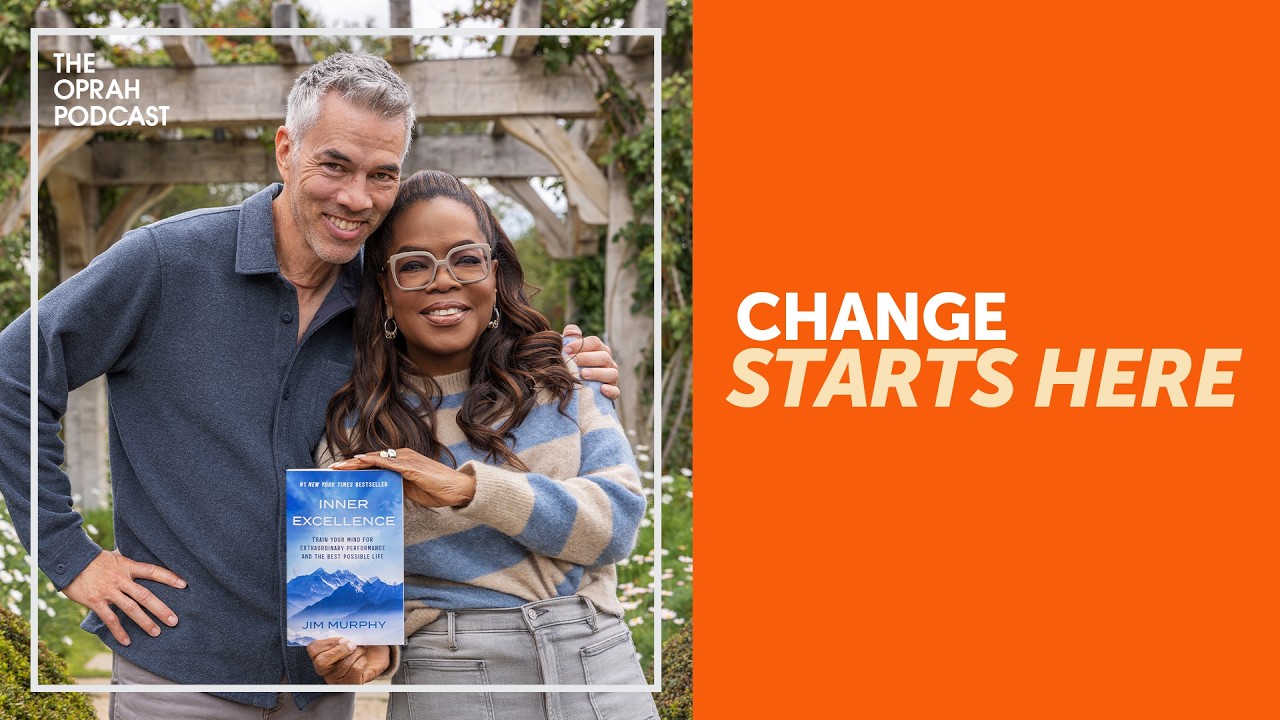
Oprah interviews performance coach Jim Murphy about his book Inner Excellence, which went viral after NFL player AJ Brown was spotted reading it. Murphy outlines his core framework: five questions to confront fear, four daily goals including gratitude and presence, and mastering ego to find lasting joy rather than fleeting happiness.
Chapters
This episode of The Oprah Podcast is presented by our partner, GEICO. In a short span of just, like, 20 days, I heard, this book, Inner Excellence, sold 200,000 copies and shot to number 1 on the New York Times bestseller list.
I feel like the reason Inner Excellence is helpful for anybody is that I realized that we all have this deep need for unconditional love and a fear of not getting that love.
That's right.
We all want to have a life where we're learning and growing and feeling free.
The year that I made $1.5 million, I had to get an emergency hysterectomy, and my commission check hit my bank account the day I was lying in my hospital bed. And that was such a super crazy surreal moment when I just realized this, this isn't it.
One of the reasons why Inner Excellence has been such a powerful tool for so many people It's the first time they've tapped into there is more. Hi there. Welcome to the Oprah Podcast. I certainly appreciate you joining me here. And I wanted to ask you all a question. If you would just think for a moment and try to imagine this for yourself, a life where you feel completely free to make decisions That continue to enhance your every experience. You feel free from self-doubt. You are not held back by fear. A life where you feel effortlessly connected to your true self, living as the person you believe yourself to be created to be. Imagine that. Well, my guest, Jim Murphy, is the author of the book that went viral last fall.
It's called—
Inner Excellence. And he believes that that life is possible for you, for me, for everybody. So let me explain first who Jim Murphy is, in case you haven't heard of Jim. Hi, Jim.
Hi, Oprah.
When an eye condition ended Jim Murphy's lifelong dream of playing professional baseball, he moved to the desert to write and research Inner Excellence. He spent 5 years studying the science of peak performance, interviewing sports psychologists and elite coaches. And when the book came out in 2009, it barely sold. Jim reworked his book and self-published a new edition in 2020. That version didn't sell either. One fateful moment changed everything. During an NFL playoff game with nearly 40 million viewers watching live, Philadelphia Eagles wide receiver AJ Brown was seen reading Jim's book on the sidelines. In an instant, Inner Excellence took off. Going from— listen to this— ranking 523,497 on Amazon all the way to number 1. And then Heisman Trophy winner, NFL number 1 draft pick Fernando Mendoza read the book, right? And in a short span of just like 20 days, I heard this book, Inner Excellence, sold 200,000 copies. And shot to number 1 on the New York Times bestseller list. So how did you process that velocity?
Yeah, Oprah, it was, it was very intense. And that week was actually a very intense week because my mother was dying.
Yeah.
Yeah. January 12th was, was the wild card game. And then she died January 16th, so 4 days later. But it was an answer to prayer because she was suffering. But so that week, very somber and kind of lonely. Business was slow. I hadn't paid off my credit cards. So for the first time in years, I just didn't have the cash flow to pay off the credit cards. And then Sunday night, I get all these texts and I thought my mom had died.
Mm-hmm.
And so, it said, you know, you gotta turn on the game. And that week, everything was going crazy with all the interviews and everything. And it was 3:00 AM and my heart was racing in the middle of the night. And I was like, what is happening? And then I just felt like it was just so much coming at me. And then in the morning, it was just this huge relief 'cause I felt God saying, Jim, you're not the one that did this. You're not the one doing it. You can relax. Your purpose stays the same. Just continue to do what you're doing. And that was such a huge relief because I was like, I don't know how to do this. What am I supposed to do?
So was that— was that a voice or a feeling or what?
You know, I think the number one thing that— and, you know, you're a very spiritual person. And I think it's to realize that there's a power greater than you, no matter what you believe, that— Yeah.
There's something causing the sun to rise every morning.
Yes.
And connecting with that power is the most important thing that you could ever do. And so, for me to connect with God and to feel like we have a relationship where I can hear his voice is so important to me. And so, but it's not always a voice. It's like—
An inner knowing.
I felt like God saying, like in my mind, it was like God saying, Jim, you don't have to worry about all that.
So I want to talk about your path to inner excellence. So tell us about the moment you decided to give away all of your possessions and move to the desert.
Yeah, I was— I'd always, since I was little, I always dreamed that I was going to be a superstar. And what I thought that meant was to be the guy that every guy wanted to be and every girl wanted to be with and hitting home runs and this superstar. So when my career ended, it was such a devastating thing and I was so lost. And so I went back to being a personal trainer like I was in grad school. But I always had this, this sense that I wanted to make a bigger difference than just the physical. And then I get a call from a teammate in pro baseball in Tucson, Arizona, Ricky Scruggs. He's building a baseball academy. He said, can you come down for the first weekend to launch it? And it was just the perfect timing. I just, I had this screensaver that said, those destined for greatness must first walk alone in the desert. And I just thought, you know what? I need a fresh start. And I think part of it was leaving behind everyone that would say, Jim, why would you change anything? Your life is great. And I didn't want to be thought of as my past. I wanted to make sure I come to a blank slate. If anything is possible, what could I do? Because I wanted to make sure that when I— when it came time for me to die, that I had fully lived.
And so when you've always had your identity as one thing, And you can no longer have that identity any longer because of an illness or medical condition, or you lose your job or whatever. What is the first road back to finding your true self versus your role or your identity?
Yeah, so when I start with anybody, it could be working with you, a pro athlete, or anyone, the first thing I wanna know is how you wanna feel in your life. Because when you're at your best, when you're having a great day, when you're performing your best, you feel a certain way.
And so—
Okay.
interesting because all those years I was doing the Oprah Show, I would sit and talk to the audience afterwards. And this led me to asking people, okay, so what do you really want? And people would always just say, I just want to be happy. But a lot of people could not identify what that was. And I'd say, well, what does that mean? And they'd say, well, I want my kids to be happy. And I want to have a happy family. But what does that mean? So when you identify happiness for yourself, How do you tell people to do that? What— how you want to feel, what does that mean?
Everyone wants to be happy, but happy is far too limiting. So, first of all, I think we really need to identify terms here. So, I define happiness as a positive temporary feeling based on what's happening. You get good circumstances, you're happy. Bad circumstances, things that you don't like, you're not happy. And so, it's far too unstable. And in a way, people come to me very often when they're underperforming and I help them perform better. And so in a way, it's like they want better transactions, they want better results. And so it's kind of like, I just want to be happy, Jim. I want better circumstances and results. Can you make me happy? And what I do is I teach them how to have joy.
Yeah.
And I define joy as a deep sense of well-being, freedom, and gratitude. It's an inner buoyancy and delight that comes from sacrificial love. It's a very different pursuit.
Was there a moment in your life when you realized that success on the outside did not necessarily equal peace on the inside?
Yeah, I think in the desert, realizing that I'd always had this dream of being a superstar and that what I've always really wanted is just to feel fully alive. Because I would ask my clients, like, what is it like as a pro baseball player? What is it like? Why do you play? And then I started to ask everyone that, like, why do you do what you do? And then I realized that I wanted to feel fully alive. And the problem that most of us run into is we have a single story for our life, like I did. My single story was I have to be a pro baseball player that becomes a superstar. And if that doesn't happen, then I'm a total failure. And that was That was an illusion. When you realize that you want to feel fully alive and that you have your idea of how that's going to happen, but that's— it may not be anything like that.
That may not be the path.
Super important to understand.
Okay. So what are the other— I think that's just such a— that articulates so beautifully what I think most people are looking for. I always say everybody wants to be able to live to the truest, highest expression of themselves as human beings. That's what we're all looking for. The path that you take to get there is up to you. But what— that's the reason why I can relate to anybody in the world, because I know no matter who you are, where you come from, what your station or place in life is, you want the same thing I want. And that is—
Exactly.
Yes.
Yes. I feel the same way. I feel like the reason Inner Excellence is helpful for anybody is that I realized that it's about optimizing the human. It's— we're all human. We're— we all have this, this deep need for unconditional love and a fear of not getting that love.
That's right.
We all wanna have a life with amazing experiences and deep enriching relationships where we're learning and growing and feeling fully alive.
Do you think that is still true now, even with— I just was reading the other day that 86% of 16 to 38-year-olds wanna be influencers, that this drive for fame And this notion that fame will bring you the ultimate success and that everything is aligned with how famous you are, how many clicks you get, how many people know you, how many likes you get. Do you think that that's still true, that people have the deeper yearning just to be alive, or has that changed?
Fully alive, to feel fully alive. Yeah, it doesn't matter what that person thinks that they want to do. I want to be an influencer. I want to be rich and famous, whatever it is. It's because they want to feel a certain way. They're looking for the best possible life. And they're like, okay, influencer is the way I'm going to do it. I'm going to be like Oprah. I'm going to be rich and famous, whatever it is. They see that. But in the end, everyone wants that same thing, that to feel fully alive and have that deep contentment.
And then that's why so many people, for when they were seeking the wrong thing, if you're seeking, you know, to be an influencer, you're seeking just to be famous. You realize how empty the acquiring of those things are without a deeper, a deeper reason.
And the great thing is that when you develop yourself and you learn to, say, walk in love and not fear and master your ego— we'll talk about these things— then you become better at anything that you do. And then so maybe you're working on being an influencer, but then maybe you switch to something completely different. But it doesn't matter because you've been developing yourself.
Our listeners tell us that the podcast is resonating with you and is serving as a bright spot in your day. That means a lot to me. So here's the thing. I would really appreciate it if you like and subscribe to The Oprah Podcast on YouTube or wherever you podcast. It's just a quick tap of the subscribe button. And that way, you won't miss an episode in your queue. You don't have to pay anything. I know subscribe usually means you're paying something, but this time it means you just are notified when there's something new. There are many more to come that we're excited about. So thank you for watching and listening. Those of you who watch the Oprah Podcast or listen to us, you know every story we share, every guest we welcome is chosen with purpose. And when people share their stories, we're reminded that we're not alone in this journey called life. As the official insurance partner of the podcast, the folks at GEICO understand that the way we move through life Life is full of unexpected turns, and who we move through it with matters. And I know that life starts to move even faster as a new school year begins. Fall routines get underway, the calendar fills up. Whether you're waiting in the school pickup line, loading up the car for a weekend getaway, taking a quiet drive home after a hard day, or cheering on your son or daughter from the sidelines, these moments remind us the road is not always a straight line. GEICO is there with insurance designed to help keep you covered along the way. And with your support, we all just keep driving forward. And that, dear listener, is everything. So Inner Excellence is about training your mind for extraordinary performance and the best possible life. That's why so many athletes love this book, and that's how it started trending in the first place. But you say that we've never actually been taught how to manage our mind.
So how do we go Eckhart Tolle's book has had a huge influence on you. His first book, The Power of Now.
The Power of Now, and then, yes.
One of the things that's so great about what Eckhart talks about is that you are not your mind and you are not your thoughts.
Yeah.
And your mind is something that we need to train. But what I learned in the desert, and this is the number one thing that I learned that's so important for everyone to understand, is that your heart is more important than your mind. We use the mind to train the heart. But your heart, your spirit, your will, that's— your heart sends a signal to your mind that gives it the foundation to think clearly and to see beauty.
Yeah.
And you also write that how you feel comes almost entirely from what you think, and you move towards what you think about. I want to unpack that concept for a moment. How does what you think about become your actual experience in life?
So one of the number one things about inner excellence is learning to expand what you believe is possible. And beliefs are feelings, and thoughts become feelings. And so learning how to handle feelings is one of the most important things anyone can ever do, because most people are never gonna reach their potential in life. And because they come to the edge of their beliefs, the edge of their feelings, and they're too uncomfortable, and then they back away.
Mm-hmm.
And so, but one thing that's, that's, I did with a couple of guys that had a mental block that I've been using with every single client now is help them understand how to deal with these feelings and these fears. So, there's 5 questions to ask yourself. Like, say you're really nervous about some event or something that's giving you anxiety. One is, am I willing to face my fears? 2 is, am I willing to fail? 3 is, am I willing to look foolish? 4, am I willing to face any feeling? This is a big one because most people are not willing to face any feeling. And 5, am I willing to face any feeling and sit with it if it never goes away without trying to push it away?
Well, that's a lot. That is a lot. Most people don't even want to look foolish. I mean, at number 3, most people don't want to do it if it's going to make me look foolish or other people are going to think That I'm foolish.
Right. And that's the ego mastery that we need. If you want to live a great life, we have to learn about this part of our mind that's always threatened, always comparing, always puts you on trial, and how not to be scared to that.
Page 108, you talk about the ego. Everything is here to teach me and help me. It's all working for my good. The ego is caught up in temporary pleasure while mastery is focused on permanent and powerful. Virtues. That's been one of the guiding light principles in my life. How did you come to know this?
Well, in the desert, I realized that the heart is the key. But then the big question was, well, how do we train the heart? Like, I've never heard anyone say this. I didn't know what, what that meant. And then I really just looked at the Bible and understood that, that humans were created for relationship. And the deepest need that we all have is for unconditional love. It's our greatest need, our greatest desire, and our greatest power.
Yeah.
Because love is fearless. What happens as humans is we get so caught up in our own lives and so caught up in the transactions. I just want better results.
Yes.
But realizing that you don't know what's best for you and that my continually thinking about myself is what's limiting my life. That self-centeredness is the biggest challenge that we face in performance and in life. And if you can get outside of yourself, and so there's no self-protection whatsoever, that's when you got possibilities.
Well, you say there are 2 paths in life, a life of freedom on a narrow, risky path that involves facing your fears to pursue your dreams and true self, or a guarded life where you travel a wider path of relative comfort and safety to pursue false temporary rewards with less risk into your possibilities. Really, what I've learned, you're either walking towards fear or you're walking towards love all the time.
Yeah, exactly. When I think about inner excellence, I think about self-mastery. And when I think about self-mastery, I think about mastering the ego, the part of your mind always threatened, always comparing, never satisfied.
Right.
And when I think about mastering the ego, I think about being 3 things: unembarrassable, unoffendable, And unirritable.
Unembarrassable, unoffendable, and unirritable.
And so most of my life, I've been a slave to my ego. And so, in other words, I didn't want to be embarrassed. I didn't want to look foolish. I was constantly comparing. And what do people think about me? It's human nature.
Yes, that's what human beings do. Yes. And so now you have your— I was talking to somebody the other day, and they were saying, I said, so now have you mastered the ego or managed it? And they said, no, I've alchemized it, which I think is pretty powerful.
Yeah.
So like I said, in just a few weeks, Inner Excellence sold hundreds of thousands of copies. And now the message is connecting with readers across generations. Jyoti is joining us.
Welcome. Hi there.
Hi there.
So great. Thank you for having me.
Welcome to our conversation.
Thank you. I'm so excited to be here. So my story is, you know, like every little girl, I dreamt of a Cinderella story, the white picket fence, 2 kids, the dog, the man.
Yeah.
But my life ended up taking a slightly different path. Couldn't find a man. So I jumped into my career. And early on in my career, I had this whiteboard where I had written $200 grand, made the $200. Then it was $500, made the $500 grand. That it was $1 million. And the year that I made $1.5 million, I had to get an emergency hysterectomy. And my commission check hit my bank account the day I was lying in my hospital bed. And that was such a super crazy, surreal moment when I just realized this, this isn't it. And 5 years later, You know, I'm just still on the same hamster wheel of the corporate world because I don't know really what else to do. And I feel like I sort of set the table for a life that did not come to sit with me. So my question for Jim is, when your identity gets shattered and you don't even get the opportunity to try, where do you go from there?
Yeah, I think that's so common in Western culture especially. There's this obsession with, with being successful materially and And in the book, I talk about possessions, achievements, looks, money, and status, and realizing that what you really want is so much more. You wanna feel fully alive. You wanna have a life with amazing experiences and deep, enriching relationships where you're learning and growing and making a difference. And you can absolutely have that, and you can start pursuing that today. But it's understanding, okay, well, part of it, I'm gonna have to learn more self-awareness about my ego. The ego, the part of me that's always comparing, always threatened, always on trial. Am I good enough? Did I do— am I okay? Do people love me? Am I accepted? And until you really get more self-awareness on that, it's gonna be really hard to pull yourself out of that trap. And no one's gonna pull you out of it. That's what, you know, I left for the desert because I had to find a way to stop and pull myself out of it. And I'm not saying you have to stop everything and quit your job and move to the desert. But if you wanna live an extraordinary life, you're gonna need to learn that, what do I really want in, in my life?
Are you thinking about that question right now?
You know, I am. And I wonder, is it possible to do both in parallel? So, you know, can I still keep on this high-paced, high-fast, high-demanding tech sales job and not have to move to the desert? Or is it sort of like you have to make that drastic shift?
The most important thing is to understand, well, what is my number one? Everybody worships something. Everyone has something that they love most. And you've got to make that decision now. What is it going to be when you grow up?
Oh, that's a good question, Jim.
Because if you don't make the decision, then the decision is made for you. And it's going to be making money in your job and being successful. And that's okay if that's what you want, but you've already told me that was empty. And so realizing, okay, what is going to— what is the most important thing to me? And then you can start taking steps towards it.
Do you have any idea?
You know, I, uh, I think that it is a family or giving back or being able to, um, have children or raise children. But again, I think I'm so stuck in this while— because this goal of hitting this financial goal wasn't what I wanted it to be in my mind. What if it's the same thing and I can't, like, give a kid back, right? So I think I'm just sort of Stuck in this.
You can start with how you want to feel. Because, like, can you share with us, like, how do you want to feel in your life if anything's possible? How, like, when you're having the best day ever, like, how you feel?
Carefree, free-spirited, light.
When's the last time you felt that?
It's been a very, very long time. I'm not gonna lie.
Have you ever felt that in your whole life? When you're a kid?
Yeah, I've, I've definitely felt that when You know, I met my now fiancé and fell in love and was just so super in love with him and still am. So I feel that every time I, I'm in his arms or if we're at a music festival or, you know, I think that would be the biggest moment that I have felt that way.
Well, you can feel that again. What's inter-axial is what we do is we start off with how you want to feel and we start to design our life around getting that feeling more often. We don't wanna be a slave to our feelings, but when you're at your best and the life that you wanna live, the best possible life feels a certain way. And the more you understand, okay, I wanna feel peace and joy and freedom. Then if you think about that every day and you're like, okay, am I feeling that today at work? What do I need to do to get that feeling today, right now? What do I need to do that right now? And then you might realize, okay, I gotta make a few changes. Whether it's changing the whole job or changing how you're arranging your days.
We have given you some food for thought here today.
I love it.
I love it.
Tap into your own inner excellence and have the best possible life. That's what I'm excited about, because I can see it in your eyes that you're think— you're having your own ahas here. You're thinking about it differently, and you're thinking about the questions you need to start asking yourself. Thank you, Jordy. Thank you.
Thank you. I'm trying not to cry. Thank you.
Okay.
Good to meet you.
No, go ahead.
Have a, have a full-on cry as soon as we hang up. Okay. No, these are really important questions for your life. And one of the reasons why Inner Excellence has been such a powerful tool for so many people is, I think for a lot of, of people, particularly young people, it's the first time they've tapped into, there is more, there is more than the doing thing that you've been doing. And what Jim has so beautifully articulated is that it's possible for you to get to the more by asking yourself the right questions to get there. And so none of us has to just take the path that we always thought was the way. 'Cause you, you have now just exactly shown what I was saying earlier. So many people wanna be influencers, they want another thing so that they can get to the $1.5 million. And you get to that and you realize, what is this? It's wonderful. I can have the things. I can have my beautiful things and accoutrements. But what is it really? And so the fact that you're having these thoughts as you are sharing with us today, that this is big. This is big, girl. Let's celebrate this. This is big. This is what the journey is all about.
Absolutely. Thank you for writing the book, Jim. Yeah, I can't wait for what's next.
So great to meet you.
Great to meet you. And so your advice to somebody who's on the journey and seeking to remove themselves from being controlled by their ego and wanting to master that in a way that allows them to be the greatest advantage to themselves is what?
One of the things that you can think about is when you have something that you're really your ego's saying, I really have to have this, it's really important, and I can't screw this up, is to ask yourself, what do I want more, to be successful in this moment or to master my ego? To get what I want right now, even though I don't know what's best for me, do I just want what I want? Or do I wanna live a great life and not, and get better at these moments? Because obviously the wise answer is, I wanna get better at these moments, and I don't wanna be a slave to my ego. And if that's the case, then we know that the best thing for you may not be to get what you want, so you can learn to embrace that uncomfortable feeling, I hope you're enjoying my conversation with Jim Murphy.
Jim has now written a new book called The Best Possible Life: How to Live with Deep Contentment, Joy, and Confidence. Pick up a copy, and while you're at it, maybe one for a friend. This is, first of all, a beautiful book title, The Best Possible Life, because everybody wants the best possible life. Do you think it's possible— do you think it's possible, Jim, that everybody can have the best possible life?
Yeah, yeah, absolutely. So in the past, as I was growing up, I just really thought it was about getting really, really lucky. good circumstances.
Yes.
Which, as we know now, that I define as happiness. And it's just so fleeting based on, you know, there could be a worldwide pandemic, could wipe everything out. Like, there's so much out of your control.
Yeah.
And so I was talking to this, this athlete the other day, and he'd never heard of inner excellence. And we were talking about golfing in a major. And I said, you could go out there and you can have the same experience that you would feel on the back 9 in a major, like the biggest event in golf. You could feel those nerves. You could feel that aliveness next weekend in your own tournament, because your circumstances is not what dictates how you feel. How you feel is based on your interpretation of your circumstances, what you see, and the beliefs that you have. And so what we want to do is learn to cultivate the imagination and pull ourselves out of the, the, all these transactions that we can't control.
What do you find is the biggest stumbling block to people being able to cultivate their imagination?
Busyness. It's being in, it's being in a world that's so busy and so much going on outta your control. It's like, I don't have time to do this. And so it's so important to make sure, am I going in the right direction? Because I think it's, it's, it's really sad to spend your life getting really good at something that doesn't matter.
Yeah. So people who are trying to figure out what does matter for them should be asking themselves specifically what question?
Well, it starts with, how do I want to feel? And then we go into, how do I want to live? Who do I want to become? What is my purpose?
And most people are going to say, well, I want to live. I want to have enough money to pay my bills. And I want to be able to live in a nice house and whatever. But I'm trying to get people to think about what is the more? What is the more that it is that they're looking for? And to be able to articulate that in a way that you're— that becomes your North Star.
So when I ask people this, what do you really want? Why are you doing what you're doing? And then they'll say, they'll give me an answer. And then I keep asking them, well, what does that give you? And then in the end, what we finally get often is freedom. I just wanna be able to do what I want, when I want, how I want. But I think that's also an illusion. I don't think having a life of the most choices is what people want most. I think what people want is to be connected to a vision and a purpose beyond themselves. You know, freedom, the root of the word freedom, it means to belong.
Yeah.
To be loved.
So people being able to create a vision. I said this so many years ago, you want a vision for your life and you want a vision for your family's life. so that everybody within the household is headed in the direction of that vision or that dream, correct?
Yeah. And freedom is really about getting out of this natural self-centeredness that we all have, this inherent human self-centeredness to see everything from my eyes and how it impacts me. It's important, especially when we're younger, not to mention, you know, just safety. I've gotta look both ways when I cross the street. But this self-reliance becomes problematic as we get older.
Right.
Because if you want to do something great, you have to connect with a power beyond yourself.
Absolutely.
Self-centeredness leads to fear.
So we have another listener joining us. Lindsay, I hear you recommended Inner Excellence in your annual holiday letter this year. Tell us, tell us how this book has impacted your life and why you wanted to pass it on.
Okay. Thanks so much for having me. I've learned so much from the both of you. Jim, I read your book last year, loved it, but I am having trouble with one of the lessons that you recommend about becoming detached from the outcomes of your goals. And then Oprah, earlier this year I saw a news clip from an interview you gave in the '80s where you said your talk show will do well, but even if it doesn't, you will do well because what matters in life is how you treat others and how you treat yourself, which I think is a masterclass in having both confidence and detachment.
So this show that's just getting underway nationally—
Mm-hmm. It's going to do— it'll do well. And if it doesn't? And if it doesn't, I will still do well. I will do well because I'm not defined by a show.
You know, I think we are defined by the way we treat ourselves and the way we treat But I'm someone who doesn't necessarily let myself enjoy the process, and I can become very attached to my goals. So, Jim, my question for you is, what are some practical strategies to practice detachment?
So the first thing that, that is really important is, is to be very intentional in how you speak to yourself and you speak anything that you speak out loud, because beliefs are what's running your life. We never wanna say anything present tense that we don't wanna continue, which you kind of just did. You said, I'm someone who, who doesn't focus on the process, it's just the attachments and the results, and you don't wanna be that way. So, the first thing is, we always say, if you wanna share something about the past, about that you don't wanna continue, make sure that you say it's past tense. So, you would say, in the past, I was not able to, you know, be free from attachment and, and, uh, wasn't enjoying the process. And so that's the first. In fact, that's one of the 9 disciplines of inner excellence, to speak the truth about the past. We never want to put labels on ourselves. Like a lot of people say, my anxiety. Anxiety is at very high levels now. So we never want to say, claim it unless it's something, because I don't tell people what to do. I ask a lot of questions and help them clarify what they want most, and I help them get it. And so I'll say, is that something you want to own, your anxiety? And so if they say no, then I said, what I think you might consider is don't claim it as your own, then don't say it's my anxiety. Say the anxiety that you've had. So that's the first thing, is to really be—
Yeah.
Language.
Clear about your language.
Very helpful.
Yeah. Very helpful. And let me just share this story with you. I learned detachment the hard way. There was a movie. First of all, there was a book called Beloved written by Toni Morrison, one of the great all-time. And I worked on that movie for 10 years. And I was so excited. I was on the COVID of Time magazine. I did like 700 interviews when that movie was coming out. And on the night of the release of the movie, I was so excited and had a party at my house and everybody was there. And the next morning, Saturday morning, I got a call saying the movie has failed. The movie has failed? It's only been out one day, I said. The movie has failed. The box office didn't do— I was beaten by the bride of Chucky. OK?
OK.
Toni Morrison, beloved, was beaten by the bride of Chucky. I didn't know Chucky had a bride or there was a Chucky at the time. But OK, so I learned a lot about that. And I immediately went into the thing that I— my go-to was macaroni and cheese and—
Comfort.
Comfort and overeating. And I was in a real depression. about that movie for several months. I could feel myself sinking, sinking, sinking, sinking. Even though I had to go to work every day, I could feel I was behind the veil. And I one day had Gary Zukav on my show who wrote Seat of the Soul, has been a great spiritual teacher for me.
Yeah.
And I said, Gary, I think I'm in some kind of depression over Beloved. And he was saying how much he loved Beloved. And I said, I'm in a depression about that. And he said, why? I said, because I did this movie, and then it bombed at the box office. And he said, well, why did you do the movie? What was your intention behind doing the movie? What was the reason? And I said, well, I did the movie because I wanted people to know that even though an entire race of people, my people, endured slavery, that we came out on the other side of it. and we were still able to love.
Yeah.
And he said, I felt that. I said, well, I didn't want just you to feel it. I wanted millions of other people to feel it. And he said, let's talk about the process of doing it. Let's talk about what you felt when you were doing it and what you felt when you were offering it to the world and when the fact that the world has not received it, but what did you feel like in the offering? I said, oh my God, it was the best experience, the best. He goes, that is what matters. So now that you've given it to the world, it's up to the world to decide if they want it or the world doesn't want it. But you did what you were supposed to do. And that is how I learned. That was in 1998. And from that day forward, everything I ever did, I did with the idea of it's about the journey for me. It's about the experience. It's about the why, why I'm doing it. And if you receive it, you receive it. And if you don't, I did what I was supposed to do. Does that help you?
Yes, very much so.
It's about how it makes you feel and why you are doing it. And you are doing it in service to something that's bigger than yourself. And if you are able to accomplish that and be with that, that is what matters. You offer it. And so I do everything. Everything I do now, it's like it's a gift I'm offering. You like it or you didn't like it? Oh, you didn't like it? Well, I sure did love picking it out for you. I sure did love doing that for you.
Yeah.
And that's how I learned to detach.
Back to my favorite part of Inner Excellence, where Jim says the purpose of your life is to learn, grow, and serve others.
Yes.
And when you focus on that, you can help yourself become detached from outcome.
If you really are focused on the learning, And the growing, which I learned so much from that process of doing that movie and failing. And also in the service to others. And now I'm, I'm only serving people who are willing to listen. So if you don't wanna listen and you don't care what I'm saying, that's okay. 'Cause I'm not talking to you. I'm only talking to the people who are.
Oprah, that book, Seat of the Soul, was really meaningful to you.
Yeah.
And there was a paragraph that you read twice in your book.
Yeah.
And it was about intention.
Yeah.
Can you share a little bit more about that?
Well, intention is at one with cause and effect. I learned from Gary that the 3rd law of motion in physics, which is every action is an equal and opposite reaction, that before there is actually an action, there's a motivation behind that action. And we all have it. And that the intention is going to determine what the ultimate reaction is gonna be. And so if your intention is to serve and to offer this as a gift, that's one thing. If your intention, as Gary said to me, uh, as he was asking me about, you know, me being depressed about it, if your intention is that— when I said, well, my intention was not just that you would enjoy the movie, Gary, millions of people. He goes, you would've made another movie if you wanted to speak to millions of people.
Mm-hmm.
That movie is not speaking to millions of people. You did the movie you wanted to do because That's how you wanted to speak to people. And he's right. When we tested that movie, everybody said, well, is she a ghost? Is it Casper the Ghost? Is it whatever? So you knew that it wasn't resonating with the audience in the same way that it—
Right.
'Cause it's Toni Morrison. Okay. And so he said, you would've, you would've done another movie 'cause that was an art house movie. That wasn't a movie for millions of people. So that was the big lesson for me. But it, really taught me detachment. Don't do anything unless you are willing to offer it as a gift to the world.
Mm-hmm.
Offer it as a gift to a person personally. And if— That's very powerful.
Yeah.
I actually, one, one time years ago, and then I'll stop talking about myself. Okay. But this was the other great detachment years ago because everybody in my family was asking me for money. I brought everybody together and I had what I called the dinner of a lifetime. And I gave out checks and trusts and all of that to the people. And the lawyer who set all of that up to me said— this is after Beloved— he said, you have to give it with complete detachment and knowing that if every single person in this room takes that money and decides they want to burn it or they want to pee on it, you're going to be OK with it.
Yeah.
And if you can do that, then give it away. And that's what I did.
Oprah, one of the things I think might be interesting for this conversation is in that book, Best Possible Life, I talk about these 3 worlds that we live in. Yeah, you do. I use this with every client, and it's not in Inner Excellence. Essentially, the 3rd world is a world of results and circumstances that you talked about was really, you know, we've all obsessed about that. You know, it's the bottom line, win or lose, success or failure. So that's what I call the 3rd world. And the 2nd world is your inner world and all the actions that follow. And then the first world is the unseen world that controls the world we can see, touch, and feel. And it's the, the first world is the world of, of everything that's eternal. And then the third world is the world of everything that's finite. And so—
Mm-hmm.
In the second world, we, you wake up and you're in your second world and you're working. But what happened to me is I was obsessing about this third world. But if you wanna be great in your life at anything, we need to learn how to be fully engaged in the second world, unattached to this world. So we've gotta constantly pull ourselves out of the third world into the second and first world. And the first world is, is, uh, is your life purpose. And, and that's where inner peace is and joy and love and patience and all those great things.
Has the question of detachment been answered for you today, sister?
Yes. Yes.
Okay.
Going forward with offering gifts and the power of intention and focusing on The first world.
Yeah, the first world. Thank you so much. Thanks.
Thank you.
Thank you so much. Thank you. So you've worked with elite performers and athletes and leaders and people operating at the highest levels. What have you noticed that they were all quietly struggling with that the world might not be able to see? Is there a common thread?
Yeah, that we're all human. And I think when you realize that, The superstars, celebrities, they all really want the same thing and they have the same fears.
You know, it doesn't matter how many square feet you have, it's the same thing.
Yeah. And they're, they're also gonna be self-conscious. They like, do they, do people like me? Like, how did I do right there? Like, it's not like, okay, now I'm Oprah. Now I just relax. I'm all good for the rest of my life. You're like, they're still being human because we're created for relationship. And so understanding that every human has this deep need to connect with others and connect with God and feel centered and connected.
Mm.
Justin posted this about how Jim's book has impacted his life. See what Justin said here.
You may have heard of this. You may have not. It comes from this book called Inner Excellence. 4 years of college basketball, I swear it made me go on, like, a spiritual journey almost. These are the negative voices inside of your head. They block learning, growth, and performance. The critic is the one that's constantly judging everything. It may even make you question yourself. The monkey mind is exactly what it sounds like. It's when your head's just jumping all over the place, characterized by a lack of focus and then overanalyzing everything. The last one is the trickster. This is the voice in your head that leads to self-doubt. What I've learned from that book is that you have to become a master of your own ego. Most importantly, you got to be present. And you can't do that if you're worrying about the past or the future. This book really helped me when I was at low points in basketball and just in my life in general.
Well, Justin is joining us from Rhode Island. Hey, Justin. Thank you.
Thank you guys for having me.
That's so great. What made you post that video?
Basically, I was struggling a lot too. Really, with my journey in basketball, Inner Excellence has just been such a great point for me to really reference in my life. And it's really helped me throughout my 4 years of college basketball.
Wow.
It became a spiritual guide for you.
Yes, definitely. This book taught me to be really present and overall just enjoy the process of basketball rather than the results. My question is, for a college athlete like me whose entire identity has always been built around their sport. How do I figure out who I am now that I'm done playing?
Yeah, thanks, thanks for asking. And so we were talking earlier about how you wanna feel. So there's a few things that we would start with is be clear on how you wanna feel in your life and how you don't wanna feel, and then clarify how you wanna live and face adversity and the person you wanna become. And ideally, we wanna put that into one life purpose, one sentence.
Give us an example, Jim.
Well, my purpose is, is to share God's love, wisdom, and courage with athletes and leaders around the world. And so it's so easy to get caught up in, in, uh, um, I just want to be successful as a basketball player. I just want to, you know, make a lot of money. I was talking to a Major League Baseball player the day before opening day, and he said, you know, I want to have a great season. I want to hit .300 and hit, you know, 20 home runs or 30 home runs or whatever. And I said, essentially you're asking, well, Well, how do I make this year great? And I said, you need to focus on personal growth, because if you just, you need to regularly pull yourself out of all the transactions of daily life and remember that it is a spiritual journey, because what is way too much out of your control, there's, there's chaos and fears and things that you, you don't know what to do with. We got to pull ourselves out of that and make sure that you're clear on how I want to feel, how I want to live, who I want to become. And what I value most and start to create a life outta that.
So I think, and you know, after reading Inner Excellence, that it's about asking yourself the bigger questions and being able to answer the bigger questions. I mean, even though your life has been wrapped up in basketball and you are a great athlete at this moment in your life, that is not all that you are or that all that you will be. So the bigger question of, Who do you wanna be and what do you want that life to look like beyond the success of basketball are the questions you should be forming for yourself now. That's, that's what I hear Jim, Jim saying. And what are those questions for you? Have you thought about it?
Yeah. Basically what brings me the most passion, what makes me feel most free in life. And I have a really big passion for health and fitness and also cooking. I found a love for it while I was at college the last 4 years. So those, those are the real ones that make me feel present and bring joy to my life.
One of the things that I think is really important is to— the greatest lives that I've ever lived, there's passion. And passion literally means to suffer, to find something that you're willing to suffer for. And in the end, making a difference in someone's life. So if you want to make a difference in someone's life with fitness and cooking, you can do that. And remember, that's why you're doing it. Because if it just becomes about, you know, making money, then it becomes very stressful.
Yeah.
What was your biggest takeaway from the book?
So my favorite part, I actually have the book with me, but the diagram that it's a— the diamond, and it puts zo right at the top. Zo, the ultimate feeling. And that's my favorite part, trying to find that zo in my life. And living in it and being fully emerged.
So that's a Greek word for fullness of life.
Yes. Yes.
Yeah.
Wonderful. Justin, thank you so much. What brought the book to you anyway? How did you discover the book?
So funny enough, it was a random present from my grandmother. She got me it. I didn't know anything about it, and I just loved it. I fell in love with it. My coach would see me reading it. He's an avid reader too, and he was really impressed with it. And I was really impressed with it as well.
And so now you've passed it on to other friends, right?
Oh, I tell everyone.
I know that's what happens.
You gotta read it.
If you're an athlete, read this.
And even if you're not an athlete, it applies.
Yeah.
And, and so did you, have you walked away? I mean, it's hard when you're in the middle of it because when I was doing the Oprah Show all those years, 25 years, I actually realized I was more than a talk show host. And I realized that I was— that the show was more than just a show. But I knew— and also one of the reasons why it was easy for me to bring it to an end myself without, you know, anybody, you know, telling me I had to or being, you know, or ratings being bad is because I could feel that it was time to move on to something else. And so easier for me, I think, than a lot of people. If you suddenly, if you're an athlete and you hurt yourself and you can no longer do it again, and, and that's your full identity. But I always realized that I, that, that life itself was bigger than this thing that I was doing. Have you reached that point yet where you realize that you, your life is bigger than basketball?
I'm starting to get there. These last couple months, it's been tough, but I'm starting to realize there's bigger purposes than what's in store for myself. And I think helping others and putting something before myself is what will fully meet my passion.
Oh, that's wonderful. Thank you for sharing your story with us. Thank you.
Thank you, Justin.
Thank you so much, Matt. I think it's wonderful that someone in his generation, as young as he is, has come across the book and is now fascinated by this journey that we're all on. So, Jim, you describe yourself as someone who worshiped the god of success. So I know a lot of people listening, everybody's pursuing success. So what's wrong with pursuing success?
Yeah, there's, there's nothing wrong with it. The problem is when you become a slave to it.
Yeah.
And I don't tell people what to do. I try and help them clarify what they want most and help them get it. And that's why it's really making sure that you redefine success.
Yes.
Like with Inner Excellence, what we do is we have 4 daily goals. And the overarching goal is to learn and grow.
Yeah.
Because like I shared, you don't know what's best for you. So, we wanna make sure every day we're learning and growing. And then the 4 daily goals: give the best of what you have every day, be present, because in the present moment, there's no fear, be grateful, because gratitude is directly linked to inner peace, inner peace is linked to inner strength, inner strength is linked to mental toughness, and they're all linked to Beauty. And then the 4th goal is to focus on your routines and only what you can control. And the number one, the first goal about giving the best of what you have, what's really important there is understanding some days are gonna be my, what I call the 30 or 40% days. You don't got much.
Yeah, it's the best of what you have on this given day.
And understand, like, I don't have much today. Recognize I don't have much today, and it's okay. I'm gonna give the best of what I have and, and It may not be good at all, but that's all right.
Thank you for writing this book. Thank you for writing them both. Has writing the books actually— do you feel that you've been enhanced by your own writing?
Oh my gosh. So the week of January 12th, Sunday is the day AJ Brown read the book. And I'm walking around downtown Dallas by myself, somber. And I look up at this skyscraper and that book, the first version of that, when I self-published, now it's published by Hachette. I look up at the skyscraper and I felt God asking me, at the time I didn't know, it was just this thought in my head, but now I think it was God asking me, Jim, would you rather have written Inner Excellence and everything that you learned in writing it, or would you rather own that skyscraper for hundreds of millions of dollars? And I thought about it. I thought, no, I wouldn't trade it for hundreds of millions of dollars. And that was the month I didn't have the money to pay off my credit cards. And so I thought, whoa, well, that's pretty significant. And at least you got that. And then a few hours later, everything changed.
I think that's divine, don't you?
Yeah, for sure.
I think that's definitely God saying, good answer, boy. That was God saying, good answer. Thank you for being here, Jim. Thank you. Thanks to you, Justin. Thank you for Zooming in with us. And Lindsay and Joyti, thank you all. Go well.
Thank you, Oprah.
Thank you, Jim. It was great. And thank you to our friends at GEICO for presenting today's episode. If you're looking at how to achieve peak mental performance, pick up one or even both of Jim's books, Inner Excellence and The Best Possible Life. Simply scan the QR code right there on your screen. Our listeners tell us that the podcast is resonating with you and is serving as a bright spot in your day. That means a lot to me. Here's the thing. I would really appreciate it if you like and subscribe to The Oprah Podcast on YouTube or wherever you podcast. It's just a quick tap of the subscribe button, and that way, you won't miss an episode in your queue. You don't have to pay anything. I know subscribe usually means you're paying something, but this time, it means you just are notified when there's something new. There are many more to come that we're excited about. So thank you for watching and listening.
More from Jim

The Truth About Failure: Why It’s the Secret to Great Leadership Feat. Jim Murphy
Jim Murphy: Overcoming Adversity and Finding Purpose Derives From Inner Excellence

Motivational Author Jim Murphy Talks ‘Inner Excellence’ Book & More with Rich Eisen | Full Interview