David Newman Interviews Joe Apfelbaum On Doit Marketing Podcast
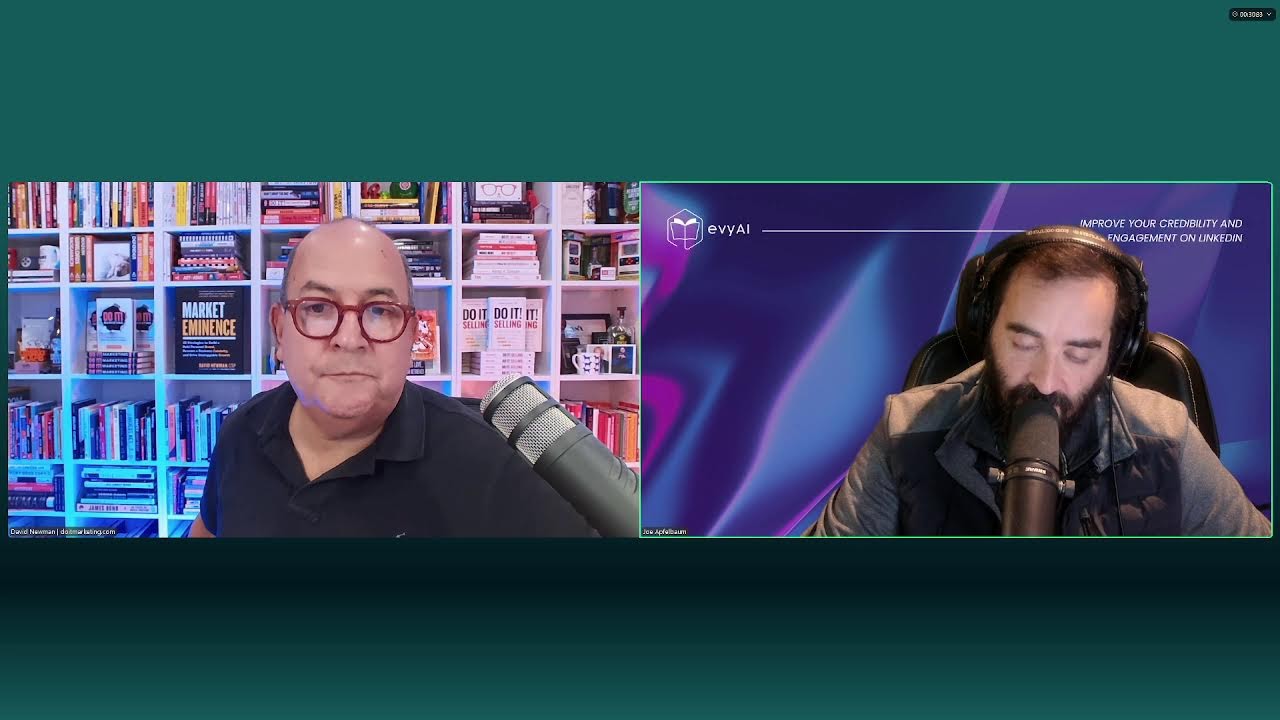
In this Do It Marketing Podcast episode, host David Newman interviews LinkedIn strategist and founder Joe Apfelbaum. Joe recounts his journey from teenage web developer to SEO specialist at Ajax Union, then to LinkedIn authority and creator of the AI‑driven platform Evvy AI. He explains Evvy AI’s role as an aggregator of best‑in‑class AI tools—text, image, video, and lead research—delivered through a single dashboard, emphasizing two unique pillars: a comprehensive strategy (the Evergreen Networking System) and a vibrant community of 1,500 engaged users. Core values of time efficiency and authenticity guide the use of AI agents, which automate research on prospects, generate personalized content using persona‑trained language models, and create hyper‑realistic images via Nano Banana. Joe outlines a three‑step “3 Ps” strategy (Plan, People, Promise) and stresses the importance of identifying Centers of Influence (COIs) to secure warm introductions, noting that 60 % of LinkedIn users never post and most senior executives are “muggles” on the platform. He addresses concerns about AI‑driven outreach being spammy, reframing it as intentional befriending backed by genuine care, knowledge, and trust. The conversation concludes with actionable resources: a demo phone number, email, LinkedIn shortcut URL, and a discount for the 99 Hacks Club, reinforcing the message that a solid strategy saves a decade of effort.
Chapters
it right.
Oh, I love that.
Probably not doing it right.
There you go. Yeah, you got to do it right.
Yeah. All right, here we go then. Well, my friends, we're here talking about leads. We're talking about leads. We're talking about LinkedIn. We're talking about prospecting. We're talking about doing this smartly in the year 2026 and beyond. And I could not have a more appropriate guest. Mr. Joe Apfelbaum, welcome to the show.
Thank you for having me on the show. I'm excited to be here. I'm excited to do it.
Well, thank you. Yes, do it with the trademarked exclamation point. That's what we're here to do. Before we get into all of that, though, for the few people who do not know the Joe Apfelbaum story, could you please share with us a little bit about your professional journey that brought you to the work that you're doing today? And some fun pit stops along the way.
They say if you build it, they will come. I built it, nobody came. I built many websites for people, 'cause when I was a teenager, I decided I'm gonna start getting into building websites for people. My father wanted me to be a rabbi. I didn't really wanna be a rabbi, so I just decided I'm gonna get into computers, and I got into it. And you know what? I built a lot of websites, and I really enjoyed building them, but You know, it didn't end up getting me— it didn't end up getting my clients the traffic that they needed to be successful. And so I had to learn, I had to learn how to market. That's what I had to do. And marketing is a very powerful thing when you do it correctly. I learned how to do something called search engine optimization, where I got people to rank really high for key terms. And back in the day, it was really easy. All I had to do is change the title tag. a meta description, add a couple words to a page, get a few links, and boom, they were ranking number 1 on Google in no time. And so I had over 1,100 clients. They became clients of Ajax Union. We were featured as one of the fastest growing companies in America, servicing many, many customers. People were loving what we were doing for them, and we were doing a really great job. What I realized is at some point, that I needed to start getting much bigger customers because I was limited to my growth and servicing a lot of small businesses.
Yeah.
And so to get bigger customers, cold calling wasn't the answer. Um, I needed to do networking and relationship building. And so I started getting really good at relationship building and networking. And that also completely changed the game for me because I became really good at that. And that's how I kind of started getting into LinkedIn. Um, I realized that you could network on LinkedIn globally, not just in the US. 'Cause LinkedIn's in, you know, over 200 countries around the world. Um, and I became a little bit of an expert on LinkedIn. People started hiring me to teach them how to use LinkedIn. I created a course, a coaching program, and then when AI came out, I built a technology called Evvy AI, which is my current business. And I have clients in 40 countries around the world and we're servicing over, uh, 23,000 users. So we've been doing some pretty fantastic things and helping a lot of people. And now in the world of agents, we're helping people be able to do much more on LinkedIn using agents.
There you go. Amazing. For the people watching the video, Joe has a white dog who just kind of popped into the background, and I have a white dog who's right next to me right now because we have the lawn guys doing all this crazy blowing and leaf blowing. So welcome to the white dog club.
The White Dog Club.
Welcome to the White Dog Club. Can you see her over here?
Uh, now I do. Oh wow, that's a beautiful dog.
Thank you. This is Gracie. What's your pup's name?
Her name is Basil.
Basil.
Yeah.
Adorable. I saw Basil on your website.
Yeah, she's a mascot.
She is the official, official dog of Evvy AI.
Yeah.
So I wanna channel something that our listeners are probably thinking. that needs to be corrected immediately. When you put together AI with networking, with LinkedIn, with agents, automation, they're thinking, oh my God, it's one of these robo-spam, horrible, I'm gonna get banned off LinkedIn. Everyone that I reach out to is gonna know that I'm a mega spammer.
Mm-hmm.
This is the worst possible way to use LinkedIn. Because you're one of the few people that used LinkedIn and mastered LinkedIn and was teaching LinkedIn before AI took over the universe. Uh, tell us about why this is different and why they should not have those concerns.
In our business, we have 3 core values. One of the core values is, uh, time is precious. You gotta save time when you're doing things still. But at the same time, the second core value is be authentic.
Yeah.
Which means that you wanna be authentic whenever you're doing networking and relationship building. You don't wanna have a robot do everything for you. There are certain things that you hire an assistant to do, and there are certain things that you would not hire an assistant to do, even if it was a human assistant.
Yeah.
So a robot is just a replacement for a human assistant. It's not there to replace you. It's there to help you. So I'll give you an example. One of the things that I use my robot for is I have it research people for me. So you've seen me do this. I push a button and all of a sudden the robot goes off on the internet and tells me what you do, who your target market is, what your message is, how you help clients. It gives me conversation starters. It tells me all your notable achievements. It tells me the business opportunities that we can do together. That's a really nice thing to have front and center when I'm having an authentic conversation with somebody.
Yeah.
And that also saves me a lot of time cuz I don't like doing all that research on Google and manually doing all that stuff. The other thing that I can do is I can push another button and the AI will tell me every podcast that you've been on and all the conversation starters with every single episode of every podcast you've been featured on. How nice would it be to have that front and center when I'm having a conversation with someone for the first time or somebody that I have known for a while already and I wanna know what they're up to, and all of a sudden I push a few buttons and I have everything in front of me.
Wow.
The other thing that I wanna know is every article that you've written and the ones that have gone viral and which ones have gotten the most exposure. And what were the key terminologies of the things that you're talking about in general? And I want to know your DISC assessment, and I want to know your Myers-Briggs, and I want to understand every single social profile that you have and where you have the most followers and where you spend the most time. And I want to know about your company and how many employees you have. And I want all that information in front of me in 2 seconds. I can't do that unless I have an agent. So that is me trying to build a relationship with you. So that's one dimension.
Yeah.
The other dimension is idea generation. I don't always have the best ideas, so I have my agent come up with ideas for me on a daily basis for things that I could be posting about, not just on LinkedIn, but on all social media, Facebook, Instagram, Twitter, Substack, even TikTok. Our technology will come up with all the ideas for you and have them for you in front and center so you don't have to think about What to post ever. You always have the ideas, or even if you're on a LinkedIn Live or on a podcast, it'll give you the ideas for what to talk about because it knows you really well. And then it will create content for you. And that content is authentic because we have something called personas where we train the AI to use your exact words, your exact vernacular, the exact tone that you speak in typically, and it will draft it for you. Now, when AI drafts it for you, It's never going to be perfect, just like when an assistant drafts a post for you, it's not going to be perfect, but it's going to be 80% of the way there. And if I can have an agent and an assistant help me be able to get the right ideas, research the right people, get my post 80% there, then I'm much further along. Our technology also has templates that I myself wrote that it serves up to me when the time is right. So for example, if I'm on a webinar, I'll have all my webinar templates that are ready to go that I can use that I've written myself But they're templates with keyboard shortcuts that I can impregnate into any website or into any tool. Same thing if I need prompts ready to go or anything else. And the same thing with creating images. It used to be like Midjourney and those other tools, they would create images that are really, really good, but they don't look like you. So they're not authentic. They kind of, your face looks off or whatever. With Nano—
6 fingers.
With Nano Banana, I only have the middle finger. With Nano Banana, I only, I, your face looks exactly like you. So now you can't cannot distinguish between what is real and what is not real. So now I'm able to create really good graphics like infographics and photos of myself and perfect text on images. And now I'm able to show up as myself without having to actually put on a suit, but it looks exactly like me. It is me because Nano Banana knows how to be able to take your perfect face and put it in any situation.
Yeah.
And it's such a powerful thing. So we have all that built in. Again, saving time because time is precious and being authentic because we believe that authenticity's the only way to build real relationships.
So not to get too into the geeky stuff, which I think you and I both enjoy, but Evvy AI is sort of an aggregator of all these different platforms and there's APIs going out to kind of the best in class for images and text generation and lead research and all of these different things. But it's all in one dashboard. It's all in one place. Is that correct?
So it's 3 different things that you need to think about that everybody needs. There are 3 things that you need. You need the technology, but I'm not gonna come up with my own AI. Why don't I lean on Gemini and Grok and Claude and ChatGPT and Copilot? Why don't I lean on them to let them do what they do best and I'll do what I do best, which is combine all that. Same thing with the top image generation, video generation, all that. All that's available to you within our platform. It makes it really easy for you to do all that stuff. But there are 2 key components that most platforms are missing. There are other aggregators that are out there, but they don't give you these 2 things, which number one is strategy and number 2 is community. We have a course and a coaching program called the Evergreen Networking System that for Evvii Pro users, we throw that in. It has 9 modules. It teaches you how to come up with a marketing strategy, with a business plan. It helps you pick your target market. It helps you create your messaging. It helps you tell your stories. It helps you kind of put the whole strategy together, even optimizes your profile for you.
Yeah.
And now you have a really good optimized profile telling your story aligned with your strategy. And then it takes all your connections and organizes it into a dashboard and helps you be able to know what to say to who and how to say it strategically. So strategy's very important. The next component is community. As soon as you sign up to EvAI Pro, you get access to a community of 1,500 people. These are not just regular people. These are people that are actually engaged on LinkedIn and they want to network and build relationships. So could you imagine if you had a group of people that were out of the box, ready to have a conversation with you, build a relationship with you, get to know you, and you skip ahead of the line? So not only do you get the technology, You get the community and the strategy, which is our unique competitive advantage that nobody else could really stand on because I'm bringing the community, I'm bringing the strategy, and I'm combining the technology in a unique way that most people haven't done yet.
Yeah. Very, very nice. Uh, I wanna go back to something that you said that I think is really important that probably made some of our listeners' ears perk up, which is, I wanna find every post on LinkedIn. I wanna find your, you know, Myers-Briggs, disc, every podcast you've been on. If we're selling into either, uh, Inc. 5000, uh, or Fortune 500, so medium-sized companies all the way to the big, big whales, these CEOs, these founders, these executives, it is rare that they're active on LinkedIn. They probably have a LinkedIn profile because everyone has a LinkedIn profile. They sometimes don't post like the CEOs, the founders, the bigwigs. They sometimes don't engage. Someone else sometimes might manage their LinkedIn inbox. They're probably not on a lot of podcasts. So, so this is, this is in Harry Potter terms, this is wizards and muggles. So you and I are wizards, right? We write books, we have an online presence, we have some market eminence, we have a following. People know our personal brand. They know our company brand. They know what we do, how we can help them. Our target market, they're sometimes muggles. They're just regular executives. They're regular VP of marketing. You know, the last post on LinkedIn was someone just got hired from 4 months ago. Hey, congratulations to Jim who just joined our team, and that nothing else is posted about them. So they're a little bit undercover incognito. How— what do we do about those B2B prospects that don't have the visibility that you and I might have?
I would say the majority of your target market, if you're targeting the Inc. 500 or Fortune 500 companies, the majority of them are gonna be muggles. That's the reality of it. The majority of them are not gonna be engaged on LinkedIn. As a matter of fact, the majority of LinkedIn users are muggles. The majority of the people on LinkedIn, 60% of LinkedIn users have never really posted anything on LinkedIn and they're not really active. A very few percentage of people are actually posting on LinkedIn and engaging LinkedIn. But if you can find, let's say, 100, 200, 300 people that work with your target market— these are networkers, they work with your target market currently— and those people are very active on LinkedIn, they're the wizards.
Yes.
And they're networkers. And if you can find those people and build a relationship with them, they're going to introduce you to the people that have a LinkedIn account but are not active on LinkedIn. And that's the fastest way to get a meeting with those people anyway. If I hit you up directly on LinkedIn, you're not gonna wanna talk to me. But if you come introduced to me by one of your friends, you're gonna— 80% of the time you're gonna get on the phone with me because you don't wanna look like a jackass when you make— when someone makes an intro, you're gonna get on the phone just because I told you to get on the phone with them. It's just not nice if you don't.
Right.
And you don't wanna be the person that's not nice. And so that's the approach anyway. I look at LinkedIn as a 24/7 networking event. I don't look at it as a prospecting platform, although a lot of people look at— they don't understand the value of networking. And that's why we call it the Evergreen Networking System, where we teach people how to network and build relationships. 3% of cold calls get you on the phone with people, but 80% of introductions turn into meetings. And so I would rather get an introduction any day of the night than to try to do a cold call to try to get in the door. Because as soon as I come in, I already borrowed the trust of the person that made the intro to me. So I'm not a stranger anymore. I'm in there as a friend. I'm a warmed-up referral. So my suggestion is to use LinkedIn to figure out who those people are connected to. And if they're connected to a few people, that means they know those people well. So for example, let's say you're talking to the CEO of a $100 million business called Acme Incorporated. I made up the name. Okay, so I reached out. I'm trying to reach out to the CEO. I see he's not active on LinkedIn. He's not posting. He's not engaging. He has an account and he has 700 people he's connected to. By the way, the average CEO has 930 connections on LinkedIn, but let's say this person is below average. They have 700 people. And I see that we have 3 mutual connections, Alice, Sam, and David. I contact Alice, Sam, and David, and I say, Alice, Sam, and David, each one individually, obviously, I say, how well do you know this guy from Acme Inc.? And 2 of them say they don't really know him well, they just connected to him a while ago. And one of them, David, he says, what do you mean? He's literally my, my father-in-law, or he's my, my brother, or whatever.
Right.
And then I said, do you mind making a warm intro between me and him via email? And then David's like, of course, I'm happy to do it. What do you want me to say? I tell him what to say, he makes the warm intro. Now I'm on this phone with the CEO of this $100 million business that no one else has access to because I use the unlock Which is the mutual connections on LinkedIn to get in the door. And it's my preference that he's not active on LinkedIn because once I'm in the door with him, I don't want anyone else to get in the door.
Right. Oh my gosh. So, so I've been, I've been teaching some version of this just very, in a very shallow way, which is to treat LinkedIn as a search engine for people, right? You don't wanna be the one that's like connect and spam, connect and spam. spam, right? Post and, you know, just post all kinds of nonsense just for the sake of posting. But if I want to get to Joe, to you, and I've got— we've got 17 mutual connections, right? Because we can see that sometimes on LinkedIn. Doing the offline research and asking my network, hey, how well do you know this character, Joe Apfelbaum? Oh, he was in my audience once at a thing 5 years ago. Don't know him from Adam or Eve. Or like you said, he's my brother-in-law. We went to high school together. We just had lunch last week. I know him really well. Would you be wonderful enough to tee me up with an introduction? Because I think I might have something that would be valuable to his company. Sure. What do you want me to say? And then you give them what to say, right? You give them the email typically, because then it takes the work out of it for them. Just copy, paste, send, and then you're in the conversation.
So.
The, this is so, so powerful. And the next thing that I hear our listeners say, well, David, Joe, it sounds like a lot of work. Sounds like I, I need to have a pretty good idea of who my ideal prospect is. And what do you say to that? Or how can Evvy AI help us zero in on that dilemma?
The biggest problem that people face is that they don't have a strategy. I always say the right strategy will save you a decade. Not knowing who your target market is. Not knowing who your target market is means you lack a very important part of your strategy. So my 3-step process for creating a strategy is the 3 Ps: the plan, the people, and the promise. The plan is what is your marketing plan, LinkedIn plan, and what is your, uh, what's your business plan, marketing plan, and LinkedIn plan? Your, uh, your people is identifying who is your ideal client and then who are those people that'll walk you in the door. I call them COIs, centers of influence.
Yeah.
And then the third P is the promise. What are the pains, goals, dreams, and fears of your ideal client? And what can you do to speak to those pains, goals, dreams, and fears of your ideal clients? And we have an AI-generated framework that will automatically ask you a few questions and then literally write this whole thing up for you in seconds. So that's part of Evvy AI Pro and the Evergreen Networking System, where we kind of interview you, ask you a few questions about yourself, Most of this info we can just pull from your LinkedIn profile, but a lot of LinkedIn profiles are not updated. So we tell you, we ask you a few questions, we onboard you, and based on that, we create your business plan. We tell you exactly how much money you need to make, how many leads you need, what you should be doing on LinkedIn, who your target market is, who your center of influence, the titles, how to find them on LinkedIn. We even create search queries for you. And then we come up with all the pains, goals, dreams, and fears, the problems, The solutions, the questions, the statements, where your people hang out, what type of lead magnets you need. Basically everything you need all set up in just a few minutes by asking you a few questions or pulling it from your profile. It's already generated. Or we do AI research on your website. If your website's updated, we'll get all the info and then boom, you're ready to go. Now it's all about understanding what your stories are. And we have a whole story generator where we write up all your stories, including your origin story and the different types of stories that you have. We have, uh, the ability to create all your headline, your about section, your experience section, all done for you. Um, that's, that's really, really powerful.
Yeah.
So we have all the stuff ready to go, uh, for people that want to be able to be more successful on LinkedIn. The key is strategy first, because if you don't have the right strategy, you're gonna end up wasting a lot of time.
Oh my God. Folks, this is it. This is it. I cannot tell you how many conversations I've had in the last 6 months with people where I ask them, well, who are you trying to reach? And they go, well, you know, here's— you know, I'm sure you've had this too. Well, it depends. And then they go into this exercise that I call reading tea leaves. Well, I worked with this engineering company once, and then there was the trucking company, of course. And then, you know, there was the yarn store in Vermont. That was not a bad client. And It's like, no, no, no, I'm not saying look in the rearview mirror. I'm saying, who do you want now going forward? Big question.
100%, 100%. Big question mark.
No idea, no idea. So it's amazing. You know, it's very hard to hit a target that you cannot see. Very hard.
It's impossible. I always say, if you're targeting everyone, you're targeting nobody. So that's a big problem.
Now, the centers of influence— I go back and forth on this, and I think our audience has gone back and forth on this. They say, okay, it could be a trusted advisor, it could be a consultant, maybe it's their accountant, maybe it's their financial planner. All of these people who are in these professions that are the typical centers of influence, after 40 years of terrible networking where people have tried to take advantage, They've tried to barge in. They've tried to steal their clients. Whatever they've done, these poor people that have these trusted advisor relationships, I think they're burned out, they're jaded, and they're scared. So now we come across, even doing our amazing research with every AI and having all of this, you know, coming in very smart, very, very sophisticated in our profiling. What's going to get these trusted advisors to open up to us? where they've been burned and screwed over before?
I would say the number one thing that's going to get people to open up to you is the know, like, and trust factor. People don't care how much you know until they know how much you care. So you got to get people to know you, like you, and trust you. How do you get people to know you is by you sharing of yourself online. That's the number one factor that people will get to know you, that you'll know that you're different because they know your story and they know who you are. That's number one. Number 2, How do you get people to like you is they are like you, they will like you. So the more you share of yourself, the more they could identify similar stories to the problems that you have, the vulnerabilities that you have, and so on. And the third component, trust. When, when you get to know somebody else, they automatically trust you. That's just what happens. When, if, if I don't know anything about you, then you don't trust me so much. But when I start Doing AI research on you, and now I know every podcast you've been on. Suddenly you're like, this guy knows me.
Yeah.
So I feel like I need to trust him more because he knows me. We want to be known by people. Like, think about your whole life, you're trying to get known by your lovers, known by your friends, known by your clients, known by your prospects. So if I get the time, if I take the time to know you, then you'll trust me more, especially if you know how much I care about you.
Yes.
Yes.
And for the people listening, that might be because, again, this might set off people's radar. I'm just channeling our listeners here. That's my job here at the show.
Channel away. As long as you're not channeling aliens, we're good.
No, no, we're not channeling aliens. We're not channeling evil spirits. People hear what we're talking about, Joe. And as smart as it is and as necessary as it is essential, They say, well, that sounds— that sounds a little bit manipulative. That sounds like we're just sort of, you know, putting out the honey trap and we're trying to snare people.
I—
the way I reframe this, I call this intentionally befriending the people that you want to be friends with. And you just said it a moment ago. You know, if people are married, right, how'd you find your spouse? How'd you close that deal? Just by randomly sitting around going, oh, I hope something happens. No, you wanted to intentionally befriend this person in a romantic way. How'd you get the job that you've had or your first job? Right. I just sat around and I hoped some employer would come around. No, you intentionally befriended people that are in that company or that know that company. This concept of intentionally setting your sights On a genuine relationship that you want to enter with a value mindset, a giving mindset, a generosity mindset, a mutual benefit mindset. There's nothing skeevy or schemey or weird about intentionally befriending people that you know you can help and similarly that you know might be able to help you. So all that mindset around, boy, this whole intentionality and zeroing in and targeting It feels kind of skeevy. It's like, this is how humans have been doing it for 3,000 years.
And here's the other thing I want to add to that. I think you're right. Humans have been doing this intentionally, connecting and building relationships. I think when people hear that you have a strategy to build a relationship and it doesn't sound organic, they don't feel like that is a friendship. They feel like it's more of a game or like a sport. And that's kind of like, that makes them feel uncomfortable with with them making friends as a game or a sport. But realize networking and life is a game. Life is a game, and you can decide to be strategic and make friends strategically, or you can wait for friends to come to you. That's your choice. If you believe that making friends strategically is unethical or manipulative, or you're uncomfortable with it, I would tell you to reinspect your beliefs that are disempowering Because something bad happened to you in your life that you took as bad, and that's controlling your ability to strategically build relationships, and it's stopping you from you being able to meet your potential. And right away, you might have pushback to that because most people will be like, well, nothing bad happened to me. I was like, let me tell you something. If you're a human, you have trauma. Some people have trauma because they had too much money. Some people have trauma because they had too little money. Some people have trauma because they didn't have trauma, so they have a trauma about not having trauma. Everybody has trauma, and that's how we grow. A butterfly doesn't just become a butterfly. It has to suffer through the cocoon. Otherwise, it has crooked wings. And so what I would tell you to do is just look through your beliefs and ask yourself, is this an empowering belief? Because it's just a belief. Beliefs are neutral, just like nature is neutral. The wind blows on everything. It doesn't just blow on you. The wind literally blows on everything. And so if you're taking it personal, If you're saying, oh, I don't like this, it's not that you don't like this, it's that you have a belief that this is manipulative because somebody hurt you in some way so that you think that this is the same as that. But it's not true. This is just a way for you to get where you're going. And often, because of my outreach, because of my befriending, because of my strategy, people will thank me to the endless of the world saying, oh my God, thank you for befriending me. I would have never reached out to you because I have my trauma, and the fact that you overcame yours to be able to be open enough to connect with people and be a conduit of blessing. And that's what I want to be. I want to be a conduit of blessing for people. And so because I know what I offer is extremely valuable, I feel driven to continue to put myself out there. And I'll come across people that don't like it at all, that will think it's manipulative, and I'm okay with that. That's just their belief. It doesn't reflect The value that I'm adding.
Oh my gosh. A million percent. A million percent. Well, as we're landing the plane here, I'm going to ask you 2 final questions. The final, final question is, what links can we share with people in the show notes? Where can they go to find out more about you and Evy AI? But before we get to that, if folks were to take one overall concept from our conversation today about the power of networking and connections and relationship building, What do you hope that one core takeaway would be?
I believe that the right strategy will save you a decade, and most people are using energy without strategy. So if you could take one thing today, is inspect your strategy for the upcoming year. Make sure that you work with someone to help you craft a strategy that will help you be able to meet your goals faster, more productively, and more profitably. If you would like a demo of Evvy AI, you could simply send the word demo to 973-841-8888. That's 973-841-8868, and an AI will respond with a demo. And if you'd like to meet with me, you could always let me know through that number that you want to meet, or you could always email hello@evviai.com, and my team will be more than happy to help you out and get you up and running and support you. We love helping people and love making a difference for people. And of course, if you want to check my LinkedIn, you can go to joelinkedin.com. That's joelinkedin.com. It forwards to my LinkedIn. It's really easy for podcasts. It's one of my 99 LinkedIn hacks. I have 99 hacks and a pitch ain't one of them. And so if you go to 99hacks.club, you can join the 99 Hacks Club. We actually have a discount right now for all the listeners here to get $900 off the 99 hacks. It's usually $1,000, but you can get it for $99 if you go to— if you go to 99hacks.club. But I just want you to take away the concept of strategy because if you do things methodically, If you do things strategically, you're going to get where you want to go and make your impact much faster. So Stephen Covey talks about this in The 7 Habits of Highly Effective People. At the end, he says, you got to sharpen the saw because if you have 8 hours to cut down a tree, you can spend all 8 hours with a dull saw. You can spend 15 minutes sharpening the saw. So spend some time being strategic and you're going to be able to have a bigger impact.
Totally amazing. And all of those links, by the way, including the phone number, to text will be in the show notes directly below this episode at thesellingshow.com. Joe Apfelbaum, you are a rock star. I appreciate you. Thank you for dropping all this wisdom with us today.
Thank you for having me on the show. Really appreciate it. And I'm looking forward to connecting with you more and for making your life better.
There we go, man. That time flew by. That was totally fantastic. Very, very fun.
We landed the plane, baby.
We landed the plane. It's funny, when your assistant person came on,
More from Joe




How to Beat the Algorithm: Remove Hidden Watermarks & Scale Content with evyAI






