Dorian Lam + Joe Apfelbaum talk about Linkedin and AI
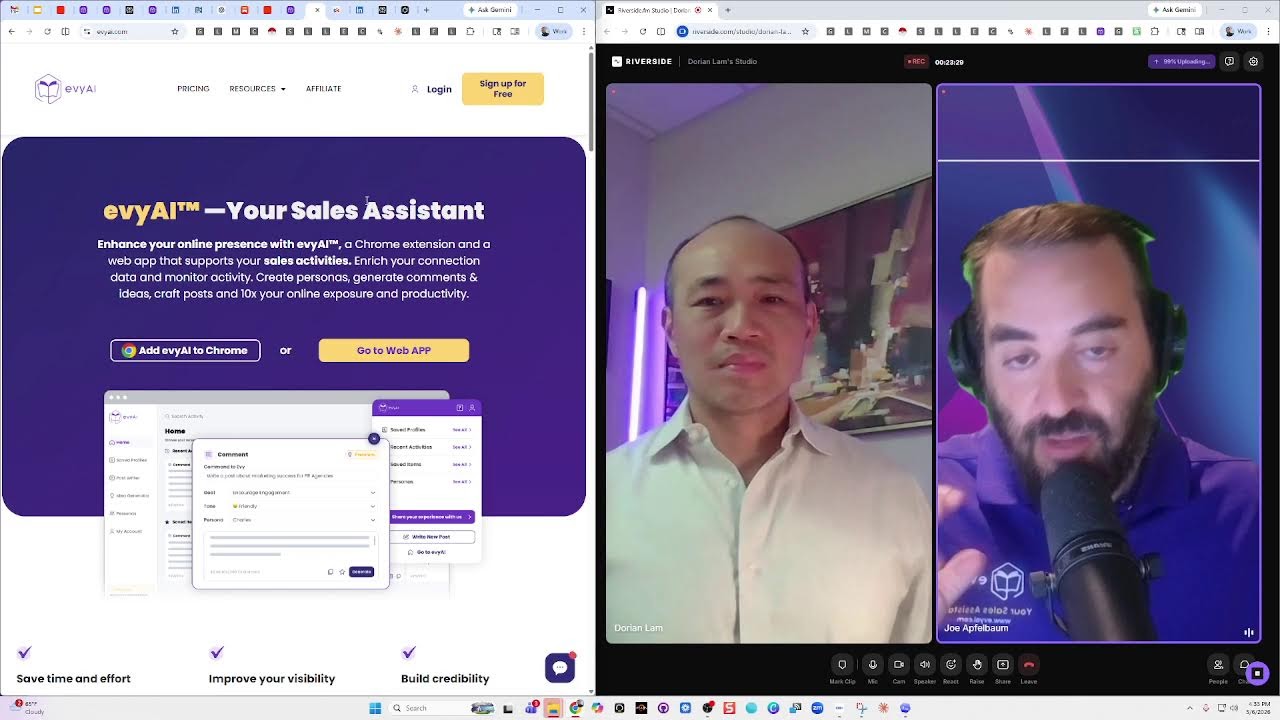
In this interview, host Dorian Lam talks with relationship‑marketing expert Joe Apfelbaum about the central role of authentic, giver‑focused networking in business development, especially for real‑estate professionals. Joe shares his personal journey from building websites and SEO to founding Ajax Union, High Energy Networking, and the AI‑powered platform EvAI. He explains why LinkedIn is the premier tool for deep relationship research, outlines a three‑step system (strategy, asset building, action) and a "greet‑feed‑meet" workflow, and details practical LinkedIn tactics such as profile optimization, connection limits, networking one‑sheets, and a hack for displaying contact info. The conversation highlights common pitfalls—spraying‑and‑praying, transactional pitches, and bot usage—that can lead to bans, and contrasts them with a soul‑centric approach that emphasizes giving, authenticity, and long‑term trust. Joe demonstrates how EvAI automates comment generation, post creation, contact discovery (280 million records), and rapid research agents to support genuine outreach. Finally, he offers advice for new entrepreneurs: define clear business, marketing, and LinkedIn plans; identify ideal client profiles (ICPs) and centers of influence (COIs); set specific financial goals; and consistently act with authenticity and a "close‑in‑mind" mindset.
Chapters
it, if you're authentic, if you're a giver, if you're looking to lean into the relationship, which you need to do in real estate, I think that that's really the crux of it in terms of like, don't be transactional, build relationships, get to know people. That's the idea.
Okay. So that's pretty much the core of it, right? I mean, unless you—
No, that's fine. I'm totally cool with that. Let's rock and roll. I'm ready to go.
All right. So you've done this before, obviously. We're probably going to— I keep the episode somewhat short. I've been looking at the analytics. Most people don't watch the full 20-minute show, but the clips do very well. So, I mean, this is all your avenue, but just so I get it out from the housekeeping perspective, my team will create clips and then I share the clips with you. It'll just be you. You share it, I share it. That's what gets the most kind of clicks. 100%.
Yes.
So, all right. So let me see. Let me get some water.
Let's get some water. Let's get some water and let's get rolling. I'm excited about this.
So am I. So I'll hit— I'm going to hit record. You'll see a countdown. I'm going to go through a brief intro and you're going to know it's your cue. And I pretty much say, hey, Joe, tell us a little bit about yourself. Let's go. You know why you came about with Ajax Union and EVAI.
All right, awesome.
Here we go.
Let's go.
Hello everyone, and welcome to the next episode of Start with the Close in Mind. Today's episode is about something all of us need to do in some way, shape, or form, whether you're developing business, raising capital, or trying to win deals: building relationships. It's something people talk about constantly. But very few actually do well or try to create a process around it. A lot of people want business growth through more visibility, more leads, more opportunities. But in a way, that approach is backwards because when you focus on just content and platforms and tools before they focus on the actual connection, they're doing it wrong. So my guest today, Joe Applebaum. Has spent years helping people generate business through relationship-driven marketing, network, and business development. He's also deeply involved in AI and how people are using it inside outreach, communication, and growth. But what interests me most is the human side of it. He'll tell you more about that, what actually creates trust, what creates consistency, and why some people seem to build momentum while others don't. So today I want to get into what Joe is seeing, what's actually working right now, what isn't, and of course, how you can start with the close in mind. So Joe, welcome to the show. Let's start with some background about you and how you ended up creating Ajax Union and EvAI.
You know, the famous saying is, if you build it, they will come. You ever heard that before?
Yeah.
So when I was growing up, I thought to myself, what am I going to do to add value to business owners? My mother, told me to go to the library to get self-educated. She said, formal education will make you a living, self-education will make you a fortune. And so, took me to the library, and I decided to start learning how to build websites. I built websites for hundreds of people, and then people started complaining to me. Build it, they will come.
Mmhmm.
I said, build it, they will come, but nobody came, so I had to learn how to do SEO, search engine optimization. I got really, really good at SEO, and people— I started learning about this concept called recurring revenue, And instead of building a website and being done with the customer, people would come to me over and over and over, month after month to keep doing their SEO. And fortunately, I was able to build one of the fastest growing companies in America. We were on the Inc. 500, which ranks all the companies that are private companies to see who has the fastest growth every year. We were number 178.
Wow.
Along the way, I realized, Dorian, that getting clients from SEO is not the same as getting clients through relationship building. Because through SEO you get anybody and everybody. So the clients are usually lower value in terms of how much they're willing to spend and lower trust. But when I was able to get clients through networking and relationship building, I was able to get clients that were paying me $45,000 a month retainers versus only like $4,000 or $3,000 or $1,000 a month through SEO. And so I realized networking has so much more value, and especially when it comes to Things related to real estate, relationships are where it's at. And so when Microsoft decided to pay $26.2 billion for LinkedIn, I went all in into LinkedIn. I decided I'm going to go all in into it. I'm going to start building relationships. I did all the marketing. I do Facebook, Instagram, Twitter, all this stuff. But LinkedIn is where you find a lot of information about people. And if I want to build a deep relationship with you, Dorian, I have to know you really well. And on LinkedIn, I know that you're the CEO of Cornerstone Land Abstract, but I learn a lot more about you. I know that you're an author. I know that you're a podcast host. I know that you're a transaction risk advisor to attorneys, developers, and investors. These are the things that I learn about you both personally and professionally from LinkedIn. On Instagram, I don't have much information about you. On LinkedIn, I know every job you've ever had. I know that you were a member of board of advisors for PSY.
YFI.
I know all the different things that you were involved with from the beginning. I know that you went to NYU. I know that you went to St. John's University where I was also a person that comes in and teaches students on how to be able to build relationships and do networking. And many of those students have learned from my book, High Energy Networking. And so I love teaching people and building relationships, but growing up, I knew nothing about business. I watched my mother struggle in the Lower East Side to try to build her store and eventually After 10 years of trying, she went outta business and I was able to build one of the fastest growing companies in America. And the way that I did it and sustained it for decades is through the relationships that I built, but not just with my clients, but also with my vendors, with my friends, with the people in my life, with my employees. I have employees that have been with me for over a decade, and that usually doesn't happen nowadays because people don't take the time to get to know people and really build those relationships. And now with AI, I believe that people are being less authentic and less authentic and less authentic, and they're, they're doing things with bots, and bots don't have souls, Dorian. We want to connect with the soul of the human being. We want to— and my father wanted me to be a rabbi, and I actually studied to be a rabbi, became a rabbi, but realized that wasn't something I wanted to do. And so I got into business and technology, but I still brought the soul along with me.
Yeah, that's great, Joe. We're gonna We're going to hold and table soul. We're going to get back to that. But in sharing your history, right? I mean, first of all, kudos to that, right? I mean, from creating websites to SEO, and you didn't even cover EVAI yet, and we will get to that. But, you know, starting from that kind of Microsoft acquisition of LinkedIn, number one, even before that, you realize the value of business through real human relationships, right? And then, you know, It kind of eyes opened up when you realize that LinkedIn is this universe of being able to very quickly figure out how people have experiences that you can tie to, right? And find common ground, and then you know kind of start you know with you know hitting the ground running versus trying to figure out a lot of the things that you normally would. So. Tell us about just even the journey from LinkedIn, and then tell us how and why you created EvAI. Because one of the interesting things you said there was that, you know, everybody leans very heavily on technology to kind of automate everything, right? And then with the advent, especially more recently with AI, you get the sense, and you could tell when you get these types of emails or interactions, but that it's AI-generated. It really is no thought behind it. And it's just more of like casting a wide net and seeing seeing who actually comes back. But you've done it actually better and you've created a whole company and platform around it. But what are your tips and tricks with LinkedIn and how should people really use it versus not?
Well, the big thing about it is a lot of people connect with other people and then they pitch them right away. That's one thing you definitely should not do. It's a big mistake. Also, if somebody comments on your post, acknowledge them. Like actually get to know them and build a relationship. I feel like when I post something on LinkedIn and I get dozens of likes and comments on my posts, it's with the people that I actually know. I'm part of the Executives Association of New York City together with you, and we have about 80 members. I actually take the time to go through each member's LinkedIn profile and to determine to see if they've posted recently, and then I like and comment on their profile. And often I will also call them up and say, by the way, I saw that you posted about that it was your wife's birthday. I just want to take a moment and wish you a happy birthday. Hope you enjoyed it, or whatever it is. Or I'll send them a text message in addition. So taking it a little bit deeper, taking it off the platform. The point of LinkedIn is not to be on LinkedIn. The point of LinkedIn is to actually be in a relationship with somebody, a real relationship, and not to run away from it and use it as an excuse. So for me, it's like, be authentic, be real, get to know people. Most people are not wishing other people happy birthday on LinkedIn, and you can see everybody's birthdays on LinkedIn. You can see when they have a job anniversary. You could see when they change jobs and they get a new job somewhere. So use the information that you get from LinkedIn, leverage it to actually make the connection and be deeper with them. It's like, for example, one of the things that I teach people is leave comments on posts. The problem is that people don't have the time or they don't have the mindset, the emotional energy to leave comments on posts. So we created a comment generator with our tool, Evie AI, that will draft a comment authentically on your behalf. Same thing with post writing. It's important to write posts, but we use your persona. We learn your profile, your persona, your content style, and then we write posts that have a hook, main points, call to action, and hashtags But that actually sound like you.
Yeah. So, you know, that's kind of the fine line, right? Using technology and then in your example, LinkedIn, to actually build relationships and not use it to be even more superficial, right? Because there is this element where it's very superficial if you're not really spending time just clicking around and only really interacting for the sake of interacting. And the way you framed it is that it's more than that. Use LinkedIn to actually build Real relationships. So on that note, with commenting and things like that, what do you have to say about consistency and follow-through? So that's kind of the beginning, right? That's the beginning of the interaction. I see Joe, I like his post. I love the images you put up. And it's like, you know, at what point do you kind of progress through that to what's, what's even your system, right? Is it a call? Is it an email? Is it a text? You know, talk us through that.
I have a very specific system that has 3 steps. First, strategy, then building assets, and then taking action. When it comes to strategy, There's the plan, the people, and the promise. So Dorian, you need a business plan, a marketing plan, and a LinkedIn plan. Then you need to figure out who the right people are. So when you're connecting with people, you need to figure out people that are ICPs, ideal client profiles, and you need people that are COIs, centers of influence. Then what you need to do is in terms of the messaging is once you know who the people are, you know their pains, their goals, their dreams, their fears, and the questions that they ask. Once you have that as a strategy, and by the way, our AI will build that whole thing out for you, the plan, the people, and the promise. Then you need to start telling stories because, Dorian, features tell, stories sell. People don't want your advice. They want to know your story. Just like when I started this off, I said, remember when I started doing websites? I said, people, if you build it, they will come. People love hearing that story. And eventually I had to go and learn how to market it because if you build it, they will not come. You need to market your business, market yourself, put yourself out there. So I tell constantly, I'm telling stories of how I went here and how I went there and how I did that and how this person told me that. And so learning what your stories are are very powerful. We have an AI that will write up all your stories for you. We'll like look up every podcast you've been on, every story that you've told, every story about your company, and organize it all for you and help you be able to disseminate your story in an organized way and align with your promise and align with the people and align with your plan. Then it's about optimizing your profile because when someone Googles you, the first thing they find is your LinkedIn profile often. So making sure you have a good photo, a good banner, a good headline, a good about section. And making sure that it's AEO-friendly, answer engine optimization friendly, so that the LLMs could pick it up. Then having the right systems is important. But if you want to get people on the phone, it's about not spamming them, posting with authority, commenting with credibility. But then there's a process I called greeting, feeding, and meeting that I take people through. So when you're starting to communicate with someone, you don't go straight for the close. You go with the close in mind, but you don't go straight for the close. If you try to go straight for the close, you're going to get rejected. So instead what you do is you greet people. So when I connect with somebody, the first thing I do is thank them for connecting without asking them to buy my products and services.
Right.
Because no one's ready to buy your products and services right when they meet you. What they need to do is get to know who you are, know your story, build a relationship with them, understand who you are. And then you want to feed them, which means invite them to things, give, give, give, give, give. There, I have 5 different I's that I teach people in my programs on how to be a giver. And then finally, then you can offer a meeting if you guys are having rapport talking back and forth, then you say, hey, Dorian, let's go to the Ned, hang out, and have some lunch, you know?
Yeah, and that's, you know, what the core of your message is, it's the habit is really using the platform to gain the access, and then reaching out to people in the right way with the right intention and being genuine and authentic as well. And realizing that the tools aren't about just scale, right? The tool is actually using the tool in a way where it represents you, like you said, through the persona and through, you know, strategy, real strategy with regards to who your target group is. And then the follow-through, right? The habit of actually reaching out to people consistently and realizing that it's not about reaching out to them for the business. It's about reaching out to them for the relationship.
And the follow-through has to do with you having a list. So for example, you have 6,951 followers on LinkedIn. When we work with you, what we do is we download all of your followers and put it into something called a connections dashboard. In your connections dashboard, you're going to segment your connections into 3 components. First of all, who are the people that you recognize? Those are the low-hanging fruit. Out of your 6,900 people, you might have 1,000 that you actually recognize. And of those 1,000, which one of them are ideal clients and which ones of them can refer business to you? They're called centers of influence. And which ones are the ones that are engaged that are likely to comment on your posts because they're engaged LinkedIn users. Once you filter those out for the people that are centers of influence, you have to set up meetings. I call it prioritize. So it's recognize, strategize, and then prioritize, and then use a limited amount of people you can meet each month. So if there's only 30 people you're gonna meet month 1, 30 people month 2, 30 people month 3, that's about 500 people a year that are centers of influence. So I would split the meetings between Meeting ICPs and COIs 50/50. So you'll meet 500 ICPs, 500 COIs, and then you know exactly who you're meeting when and who you're reaching out to. So if you're only trying to target 30 COIs and 30 ICPs every single month, you're much more likely to take the deep approach to really getting to know them, actually getting on the phone with them, actually figuring out how you can actually add value to them, and that's how you're going to close more business and get more referrals.
Yeah. And that's, that's great. I mean, that, that is really, to me, the most effective way to use it. Right. But what I do want your advice on as well is, you know, what are people doing on LinkedIn now that just clearly doesn't work anymore, where it may have worked before? Because what you've— what you saw before, before kind of LinkedIn got a little more aggressive.
Yeah.
Is that it was, it was really easy early on to accumulate X amount of followers, whereas now it's It's a little more hard to—
It's a lot harder. It's a lot harder, but the one thing about LinkedIn is that every single follower, every single connection becomes a follower. So you can now, they limited you to 100 per week, which is enough. It's 5,000 a year. So if you want to send out connection requests, you can send out 5,200 per year. And that's okay. Sending out 5,000 a year and you're getting, let's say, a 50% connection rate on that, that's 2,500 new people you can build a relationship with. And that's besides the ones that are doing inbound to you. So if you're getting 5,000 outbound and 5,000 inbound, that's 10,000 per year new. We had a client that got in, we taught him exactly how to send connection requests. He got a 50% connection rate. He was actually in the real estate niche targeting real estate investors specifically. And he was able to get over 1,000 new real estate connections. And he was able to do some really big business as a result of the connections that he built that he actually took offline, but started on LinkedIn. And one of the things that he did really right was have a business networking one-sheet on the platform. A business networking one-sheet explains who you are, what are your projects that you're working on, who you want to meet, and how to introduce you. And then it has your skills, experiences, and passions, and your contact info. A big mistake that people are making is that they don't put their contact information on LinkedIn. If you go to joelinkedin.com, which is my profile, you will see my cell phone number on the top right under my logo. And by the way, the hack is to change your experience, your education to just be your contact information. And then it shows up right under your logo on the top of your profile. And so I tell people WhatsApp me, and then often people that look at my profile that are not even connected to me will send me a WhatsApp message. Now we have a one-on-one conversation even without connecting, because if you don't have LinkedIn Premium, you just can't reach out to anybody. You don't have InMails. It used to be that you could just message anybody, connect with anybody. Now they majorly limited the connection notes. If you don't pay for LinkedIn, you can't really send too many connection notes. And the same thing with how many people you can connect on LinkedIn. And you also have to have a verified LinkedIn. It's very complicated now what, what you need to do on LinkedIn. You could still make it work. There's 1.2 billion people on LinkedIn and it's growing fast at a rate of 3 new members every second. So LinkedIn is fast growing. It's global, it's powerful. People are paying attention to it, but you have to learn how to do it right. So if you make the mistake of being transactional, Or if you try to use robots, you're going to get banned from LinkedIn. So you got to be careful.
So going back, right? What's not working anymore?
What's not working is spraying and praying, hoping for the best. People have gotten smart. You can't just DM a bunch of people. People will complain about you and then your account will get banned. So just spraying and praying and hoping for the best doesn't work. You need to have a strategy. What doesn't work is being able to just send your contact information to people and telling them to call you. Nobody does that anymore. Um, and also it used to be that you would be able to download your connections and get everybody's email addresses. That doesn't work anymore. Now you just get their LinkedIn URLs. In my opinion, it's more valuable to have a LinkedIn URL than an email address, because if somebody would work at a bank and then they moved to another bank, they just changed their email, but they didn't change their LinkedIn profile. So it's important to get people's LinkedIn profiles, which is really nice to have. And we have a directory inside Evvy AI with 280 million people in it with their emails and cell phone numbers. So you get access to all those things. And if, and we also give you AI research. We have 7 different agents that you could use within EvAI that will research every little piece of data about a specific person. We have an agent that will look at 500 websites in 30 seconds.
So, so this is a good opportunity to bring, bring up EvAI to, to tell us about EvAI. So folks, Joe also created a platform named EvAI that has, he just reamed off 3 of the most amazing tools about it, but tell us about that a little bit.
Yeah. So if, if you don't have somebody's cell phone number and you want their cell phone number, there are different ways to be able to get their, their email address and cell phone number. Evvy AI is a sales assistant for social media where you push a button and then agents will go off and research the person. It'll tell me your target audience, your key services, your, uh, the way that your clients benefit from you. It'll gimme your email address, your phone number. It'll gimme conversation starters. Like for you, it told me, what's the biggest title risk you spotted in New York City commercial deal lately? Or how has Real Estate Warriors helped pros balance wellness, and high-stakes closings? Or can you share insights from your $15 billion plus in closed transactions on capital strategies? It basically goes off on the internet and looks you up everywhere. And in seconds, it pulls up information that allows me to build rapport and have a real relationship with you. It also writes comments on posts on LinkedIn. It helps you generate posts. It helps you generate images. And we have a community with people from 40 countries around the world that are willing to comment on your posts. And so building that relationship, having the right data, we have 280 million emails and phone numbers in the system, the right community with people that are engaged on LinkedIn. We also train people on how to properly use LinkedIn within the system. So combining all those things together, that's what creates a game-changing experience to allow me to build real authentic relationships and not just spam people.
And Joe, I'm clarifying, you said 280 million contacts, right?
Yeah. So we have 280 million people inside Evy AI, and you can access, like, for example, you type in google.com, you will see the 300,000 people that work at Google with their emails and phone numbers right within Evy AI.
That's amazing. So that brings us to the topic that I tabled intentionally, bringing soul to the relationship. We're bringing soul to networking. Tell us a little bit more about that outside of all the habits that you kind of And the best practices that you told us about LinkedIn and how to use that. I mean, there's obviously a lot more to it, right? The, the, the actual connection itself, meeting you and I, right, in person or whomever it is. What are some of your tips in that arena? Because that is the strongest statement you made, putting your soul into the network.
I would, I would say the difference between AI and a human connection is that a human has a soul and AI is just a bot, a prediction machine. So if you just have a profile, someone's profile, there's no real value in the connection. by just having someone's LinkedIn profile. But if I know you, if we meet and we just are like soul brothers, we like connect on a deeper level and I'm able to really show you who I am without ego, without wearing a mask, just being there with you, connecting with you and building that relationship, that's really everything. That's the power of the technology is to be able to really bring in the soul into it and build a real relationship with people. 'Cause most people that are out there today are being transactional. And if you remove the transactional component of Of the connection, and instead you're sitting there as a giver, and you're authentic, and you're building a real relationship, that's when the connection happens. It's not about me trying to do something with you, it's about me trying to witness you, and you trying to witness me, and for us to be present in each other's lives and know that we're not gonna take the money with us when we die. We don't take any of the money with us, but we're here on a soul's mission together to support each other, and to help each other, and to learn about each other. That's a competitive advantage in a relationship that you cannot do using technology.
Yeah, I mean, it's being a witness, right? I mean, that's powerful what you just said, right? Because a lot of people do think of relationships transactionally and they don't allow it to, you know, I guess a wine terminology here would be let it breathe, right? So it's like you gotta watch it kind of mature in a way where It starts from thinking and starting with the close in mind, which is long-term, right? And not just thinking about the immediate satisfaction of either a transaction or trying to get something out of somebody, right? So we talked about things that people are doing right now. We talked about habits that people should stop doing. And we talked about how to really add soul to a relationship and add soul to just a Nurturing of a relationship so that it actually can develop, right? So what if somebody was starting a business today? What would you tell them?
The first thing you need to do if you're starting a business and get very, very clear of your business plan, marketing plan, LinkedIn plan, get very clear on your ICP and your COI, get very clear on the message to your ICP and COI, which is the pains, goals, dreams, and fears of your ideal client. That means have a strategy. In one word, all that is have a strategy. The plan, the people, the promise. Then make sure that you're authentically yourself. If your competitive advantage when you're starting a business brand new is being you. When I show up to a meeting, people want to know who I am before they want to know what I do. People want to know that you care. People want to know that you're here. People want to know that you're real. And if they trust you, they'll do business with you no matter what you sell them. That's the real crux of it. So telling your story, making sure that you have a really solid profile that the LLMs can find you. Making sure that you have a system of follow-up that I was talking about, the recognize, strategize, and prioritize process. And then making sure that you're taking action every day. If you have your goals, if you have your plan, if you have the right people that you know that you're talking to and you're willing to ask people for help, you're going to be successful. If you're not really sure how much money you want to make in your business, like I was talking to somebody yesterday and I said, how much money do you want to make? He's like, I'm not about the money. I just want to add value. And they want to start a business. There's no metric for them to latch onto. So Set a goal. It could be $100K in profit. It could be a million, a million dollars in profit. I don't care what the number is, but have a goal and have a way to get there. And if you don't have one, hire a coach to help you iron that stuff out. It doesn't have to be expensive. Get it down, write it down. Ask and you shall receive. When you pray to God, don't just pray for him to take care of you. Pray for something specific. Pray for a specific amount of money, for a specific connection, for a specific relationship. And the more specific you are, the more you will be able to attract what you want in your life. You have to be so specific that you should iron out how you need to feel, and you need to feel that and be in that vibration before you actually receive it. And that's where the soul comes in. If you have, if you have the trust, if you have the faith, if you're, if you're courageous enough to hope and to connect and then go out to give people what you want, if you give enough people what they want, you can get anything you want in life. So if you want to make money, help other people make money. If you want to get healthy, help other people get healthy. And what's going to happen is you're going to take your life and your business to a whole new level.
Joe, that's amazing. The nuggets you dropped right there, I mean, dropping knowledge. Thank you so much for that. Where can people find you as we wrap up?
It's really easy to find me. If you want to get my book, go to highenergynetworking.com. If you want to find me on LinkedIn, just go to joelinkedin.com. And if you want a demo of Evy AI, just send the word demo to 973- 841-8868. This way the AI can reply to you, send you all the information that you need, and we can build a relationship authentically when hopefully we meet in person.
That's amazing, Joe. So today's conversation really comes down to something simple. Relationships still drive business. You know, the platforms change, the tools change. Now even AI is entering into the picture too, right? But trust, Consistency and follow-through still matter. The people who generate the most opportunities usually are not chasing quick wins, right? They're staying present, they're following up, they're building real relationships with soul over time.
With soul.
With soul and witness. And when you start with the close in mind, you stop thinking about networking as a transaction. It just makes it even more beautiful. You start thinking about it as something that actually develops and compounds. So, Joe, Thank you so much for being part of the show today.
Thank you for having me. It's such a pleasure to be here, and I'm looking forward to seeing you at the next lunch.
More from Joe




How to Beat the Algorithm: Remove Hidden Watermarks & Scale Content with evyAI






