Interview with Elie Goldring EOS Coach + Joe Apfelbaum
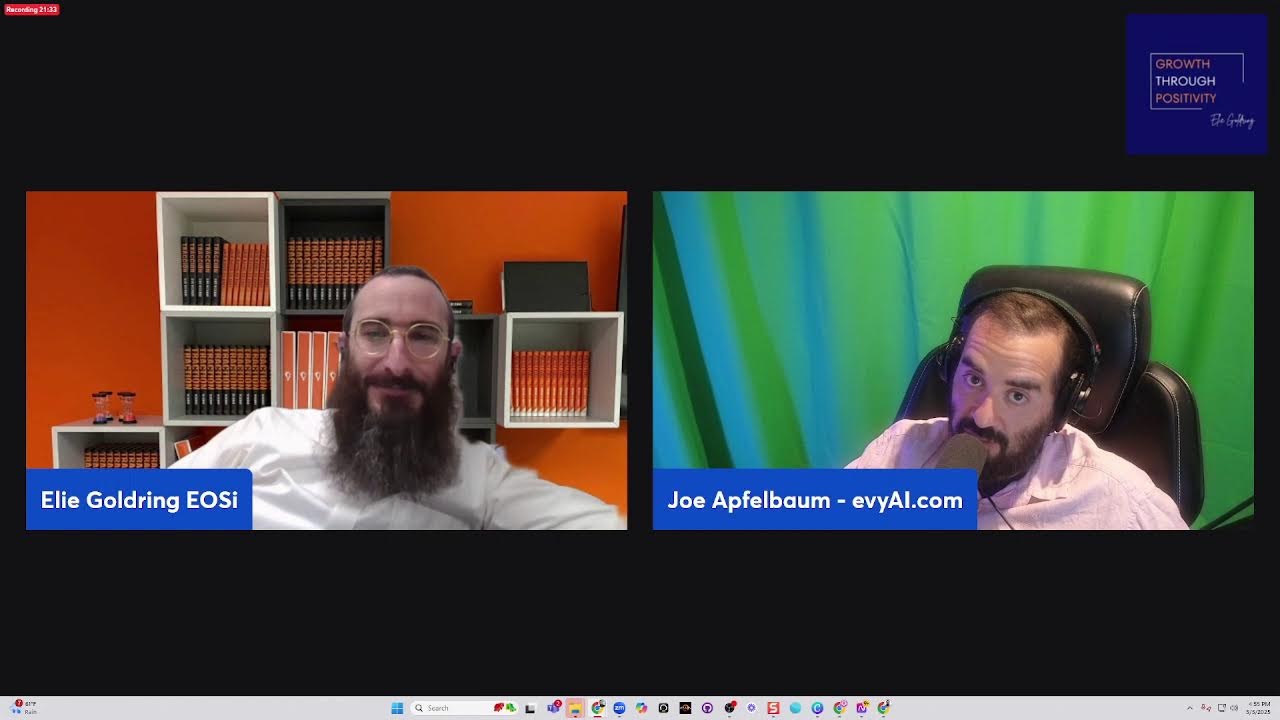
In this episode of Grow Through Positivity, host Elie Goldring (an EOS implementer) interviews Joe Apfelbaum, founder and CEO of Eviai, about building sustainable businesses, leveraging LinkedIn, and using AI tools. Joe shares his personal backstory—watching his mother’s failed storefront—and how that fueled his drive to avoid failure. He emphasizes the importance of strategy, especially the Entrepreneurial Operating System (EOS), and outlines how right people in the right seats, clear strengths, and data‑driven decisions lead to profitability and fulfillment. The conversation dives deep into Evvy/Evvii AI, a suite that automates LinkedIn commenting, outreach, lead generation, and even books meetings via an AI “agent.” Joe explains how the tool frees founders from low‑value tasks, allowing them to focus on high‑energy activities like relationship‑building and personal development. They discuss hiring philosophy (culture fit, Gallup Top‑5 strengths, GWC), the concept of “Sitzfleisch” (staying power), and the importance of scaling profitably rather than chasing volume. A recurring theme is the “1,000‑person” network strategy—focus on a core group of ideal clients, break it down to 250, 75, 10 daily contacts—to create deep relationships and consistent pipeline. The interview also touches on personal growth, giving mindset, and the spiritual angle of serving others. The episode ends with a live demo of Evyi’s interface and a call‑to‑action for listeners to engage with both Elie’s EOS coaching and Joe’s AI platform.
Chapters
Are we live now?
I am live. So welcome everybody to another great episode of Grow Through Positivity. We have a former guest on for the 2.0, the one and only Joe Apfelbaum, president and founder and CEO of eviai.com. Now before he says a word, which he's just like me, extrovert, visionary, go-getter, driven. I gotta tell you guys, I signed up to the EVI full-blown. He'll tell you what the package is called. It's at a discounted rate. So whenever you listen to this podcast, I hope he'll honor it just from this podcast. You gotta get used to using tools that just make everything in life simple. And for those people that are out there to build a network, to grow their sales channel, to grow their company, LinkedIn is a platform that is a gold mine. And you need to become educated, knowledgeable, understand all the resources that are out there to utilize it, simplify it, and grow with it. So with that, it's my honor to have Joe back on. And Joe, your energy every single webinar, class, workshop, live event on LinkedIn, your energy is always top, top at a notch. Now I know it's all human nature and original, so tell me, what about AI or the tool Evvy AI inspires you to drill into everybody that passion?
So for me, I watched my mother try to build her business in the Lower East Side for a decade and eventually go out of business. And people always say, why did her business go out of business and you were able to build one of the fastest growing companies in America on the Inc. 500, generate millions of dollars in revenue, and make such an impact and still have the company running 17 years later? What did you do differently? And I say one word, and it wasn't luck. It wasn't the 4-letter word luck, which I love, by the way. I love the word luck. We're lucky that we're even here, that we're alive. But luck's not going to help you build a multimillion-dollar business and keep it running past 10 years where 90% of businesses go out of business in the first decade. Half of them go out of business within 3 years. So how do you keep going? It has more to do with strategy because success leaves clues. If you take a look at the other people and what they're doing, you'll see a lot of people are using EOS. They're using a strategy. That's what EOS is. It's a strategy. So using the right strategy, you could be successful, especially if you're looking at the data, you're looking at the numbers, you're looking at the people, you're making sure that you have the right butts in the right seats. If you're doing things correctly, you're not only going to be more profitable, you're also going to be happier running your business in a successful way. I see a lot of people that are running businesses, they're making money, but they're not really feeling fulfilled deep down inside. And I found a business that allows me to tap into my trauma from when I was a teenager, because watching my mother try to build her store in the Lower East Side and eventually go out and go— going out of business really lit a fire under me to think to myself, I got to figure out how to make this happen. I don't want to be like my mom and fail. I don't wanna like disappoint my kids and have them not be able to have the things that they want or be able to give the amount of charity that I wanna give or be able to make the impact with other people. And I went on a personal development journey because just building a business is not enough. Having a strategy for every aspect of your life is really the key. And so for me, I'm fired up because I found what I love to do and I found my unique ability. And when you find what you love to do and you find your unique ability and then you delegate the rest, And you find the people to support you on the things that you're not interested in doing, you're not good at, or even if you're good at it, it's not the best use of your time. Finding ways for people to support you. And you know this because you have a great assistant. I met your assistant. We had a great conversation. They say that if you don't have an assistant, you are an assistant. And there are aspects of my job that I need to do that I really don't like doing. For example, Generating a comment on LinkedIn. I don't want to have to read the post and try to figure out what to say. It takes up way too much energy. I'd rather use my energy learning Torah. I'd rather use my energy having a conversation with you and connecting and building a relationship, or trying to figure out how to network and interact with other people. That's what I enjoy doing versus trying to figure out what to say on a comment. So I have a technology that's an assistant that will sit under. your comment, and if you want to write a comment, it just generates the comment for you, and that solves the problem. That solves the problem, but what people don't realize is the strategy plays into who you need to be commenting on every day. So if you have a list of 1,000 companies and you're targeting people in, let's say, Lakewood, and you have a list of 1,000 companies that are doing over $1 million a year in revenue and they want to scale to $10, $15, $20 million, and you know that out of those 1,000 companies, 250 of them, their CEOs are on LinkedIn, and out of those 250, 50 of them are posting once a month or twice a month on LinkedIn, LinkedIn, you have to be an idiot not to have the list of those 50 in a list and make sure that you're in the comments of them every single time. So when you pick up the phone and call them, they recognize you, they know who you are, and they're willing to take your call because they see that you're paying attention to them. People don't care how much you know until they know how much you care. And so leaving a comment on someone's post shows that you care, but it doesn't mean you have to do the actual work. Being strategic means being smart, being effective, and being efficient. Stephen Covey, in his book called The 7 Habits of Highly Effective People— he didn't say highly efficient people because efficiency does not always effective. Sometimes you want to save money, but you end up spending a dollar to save a penny. You ever heard that saying before? Dollar wise— a penny— penny wise, dollar foolish. You don't want to be like that. You want to be smart in the way that you invest your time, your effort, your energy And emotional energy is a real thing. There's a guy named David Allen. Have you heard of him? He wrote a book called Getting Things Done. Very, very powerful book. If you ever feel like you're not organized, it's because you didn't read that book. ADD is not really a thing when it comes to being organized. It's more about understanding your energy levels. And if you can start channeling your energy in the right way, sometimes you're in the mood of making phone calls. So have a call list, be organized about it. Make sure that your assistant has a call list ready for you. If you're, if you're in the mood of writing content, Making sure you have your project list ready for the content that you need to write. If you're in the mood of socializing, making sure you understand who you need to be socializing with so that when you need to socialize, you can actually be strategic. And using your energy correctly, knowing when to rest, knowing when to go on vacation, knowing when to turn things off, knowing when to recharge is very important to listen to your body. And yes, I can be fully on when I'm on these things, but I need to also be fully off often. They say you have to rest, rest, rest, rest, rest so that you can practice, practice, practice so that you can perform. And when you perform, you're performing once. So when you see me on a call and there's 58 people that are live and that are with the program that I'm engaging and that I'm driving them, it's because I rested for 12 hours before, not because I was going on adrenaline on empty. And the reason I was able to rest is because I have systems and processes that allow me to be able to know that what I'm doing is the right thing. Because I have a plan. Awesome.
I have one question just to follow up because you gave so many great pieces of wisdom there, from right people in the right seat, unique ability, strategy, plan, vision. Did you— because I know that you were on a journey before AI, it was on LinkedIn and all— but in regards to when you're ready to hire the next person, do you take the risk of hiring someone? Or is it that you have a seat strict, like very, very specific outline with the role so you know exactly who you're looking for?
It depends if it's a high-level— it depends if it's a high-level hire or a low-level hire. If it's a low-level hire, you just hire it, train them, and figure it out. If it's a very high-level hire, for example, a COO or a CFO, you have to have a seat ready for that. 'Cause you're not gonna invest $300,000 a year on getting a person in and you're not sure what the seat is. Unless you're like floating in money left galore and you just believe in the person, you want them in there, then that's fine. But if you're a business that's bootstrapped or you don't have tons of extra money, hire the low-level people, the people that are more entry-level or they don't have the experience, or maybe they have some experience but not in your industry, but they're really good people. Hire for culture first and then elevate the people from internal. It's much easier for you to get somebody that really understands the business and You know, you say the GWC thing, gets it, wants it, and is capable. Making sure that you get people first that align with that, and then you can find them the right seat in the organization based on their own unique abilities, based on what they, what they know how to do and what they're really good at and their personality. I recommend everybody do a Gallup Top 5 Strengths. It's mandatory for all my employees to do, where we identify if they're like the type of person like me that's like an activator that starts things but never finishes things. Find, then those are the wrong people to do project management. You need project managers that are achievers, not activators. Activator, you just basically need one, me. You're stuck, come to me, I'll get you unstuck. But everybody else, I don't need a bunch of ideators hopping around for that. That's not, that's not going to help execute. I want the least creative people in my organization that know how to take things and get them done. And they're creative in their own way. But if they need to tap into somebody that has ideation but can't have no Sitzfleisch, With zitzfleisch, for those of you that don't know what it means, to me, a person that can sit down and just get things done. I'm not the type of person that can just sit around and like monkey. I just, I need to be stimulated constantly. I need to be coming up with ideas. I need to be researching. I need to be learning new things. I can focus, but if I'm not, if I'm not mentally and emotionally stimulated by something, I'm gone. I'm done. I can't. I'm gonna go do something. I'm gonna find something else. I'm going to go down the rabbit hole. I was building an agent yesterday that does research for you and builds you your target market and finds you leads and then automatically reaches out to those leads and then automatically organizes it in your database. So that's the type of stuff that lights me up. You know, like if I can build a system that does this for people, Evvy AI is not just a place where we write posts and comments and messages. It's not just a place where you take your connections and organize them. It's not just a place that does AI research. We want it to be a real agent that you can rely on to do outreach for you on your behalf and book meetings for you. So that's kind of like where we're headed in the future because that's what turns me on. That's what gets me excited. You know, I truly, truly believe that in the age of artificial intelligence, not relying on technology is basically like still using a fax machine and making your clients fax you stuff. You got to learn how to use this technology and stop being afraid of it. But 60% of people say, avai dezara, avai dezara. It's not avai dezara. It's AI. It's just a computer. You can turn it into a void desire, just like you could turn anything into a void desire. You could turn an orange into a void desire if you want to. So instead of just saying running away from it, learn how you can leverage it. Sure, you need guardrails. Sure, you need to be careful. Sure, you need to make sure that you meet your values and that you do things in the way of tradition. But don't just like completely X out a completely big category that can change lives, that can That can literally make a person not have a heart attack, that can help heal like the worst diseases. This is a blessing. Don't throw away the blessing. Learn how to leverage the blessing if you can't handle it. Some people get too much business and then they end up not being profitable because they didn't have a good structure. You think that if you're losing money on the first 10 customers, you'll make it up if you get another 1,000 customers? No, you're not. You're going to go out of business faster. You're going to need more loans to make up for all the money that you're losing. Have a profitable business to begin with. And then grow profitably, grow from the profit. And thankfully, that's what we're doing with our business. Our agency, when we started our marketing agency back in 2008, it wasn't very profitable. Yes, we generated $1 million. We had a good strategy to acquire customers, but I didn't really know what EOS was then. I didn't really, I wasn't part of Vistage or EO or any of these groups. I started learning about that when my company hit $4 million in revenue. And I started thinking to myself, why am I adding 50 new customers and losing 50 new customers? Why is my churn 100%? Why am I just spinning my wheels here and I can't get past $4 million in revenue? How am I going to get to $10 million in revenue? And I started attending and then I started asking myself, screw revenue. It's all about the EBITDA. It's all about the earnings before interest, taxes. And like, I need to figure out how to make profit so that I have the right cash flow. I already had good cash flow because my clients would prepay me. You know, like a lot of businesses, they first have to sell, they first have to get the inventory, and then once you have the inventory, then you can sell it. So now you have this entire— so the more sales you have, the more inventory you have to have, the more it costs you, and the less cash flow you have. So you have a cash suck business. I had a cash flow business from the beginning. I would— somebody would pay me $1,000, I would then hire people to do the work, and they would pay me another $1,000, I would then hire people to do the work. So that's the ultimate cash flow business. And that for me is powerful. Now with Evvii AI, people will often pay for the year. So I have a year's worth of cash flow to be able to do things. So now that, now I can accelerate much, much bigger. And also my profit margin is much higher now, and I can properly scale to be a business that can do $10 million, $50 million, $100 million, impact a lot of people, you know, but you have to work on yourself. You know what Jim Rohn said?
Yeah.
Ellie, Jim Rohn said, And this is Tony Robbins's coach. He said, you can only grow your business as much as you grow yourself.
Yes, I heard that line. I don't know where it comes from. It's very powerful.
People attribute it to him and he probably took it from somebody else. Eventually it all goes back to Misha. But you know what? Yeah. Bottom line is we have to become better. We need to do personal development, which means we got to let go of the ego That stops us from showing up for other people. It's so easy for me to be worried about the opinions of other people. Oh, I don't wanna post because somebody might think about me X, Y. Who cares about how someone thinks about you? Who are you? Who do you think you even are? You think you're some God? You're just a human being. You're just a part of God. There's God within you, but you're not God yourself. And so start being present for other people. My goal, whenever I meet somebody else, is I ask myself, how can I add value to this person's life? Because I truly believe that chesed is the most important thing, which means kindness. The secret to living—you know what makes me feel alive really—is giving. You know, think about it. What did I do today? I had a free event. Fifty-eight people showed up, and I gave them my heart and soul. I helped them each present themselves. I helped them each get comments on their posts. I helped them each get clients. And you heard what the people said. People like, "Oh my God, this is amazing, incredible." And my goal is not to serve a billion people. That's what LinkedIn is. LinkedIn's a billion people. My goal is just to have a community of 1,000 engaged LinkedIn users. This is so doable. You know, if you look in Torah, you know, I don't know if you guys ever read the Bible, but if you ever look at the Bible and you look for the number a million, that doesn't exist. I looked for it, I couldn't find it. You know what number exists? 1,000,000. Alfei alofim, which means a million, but they use 1,000. So 1,000 is doable. I always say, if you want to be successful, have 1,000 people that know you, like you, and trust you that are your ideal clients, your ideal centers of influence, and engage with them often. And what's going to happen is you're going to realize, oh my God, this is doable. If you had 1,000 businesses in your local area that were all there and could afford and need EOS, I'm telling you right now, if you only focus on those 1,000 and you had a conversation with every single one of them every year or every quarter, You would identify the ones you can serve and you would have your roster filled up. Do that. Work on your top 1,000 and see what happens. And every quarter, focus on 250. And every month, focus on your top 75. And every day, focus on your top 10 and then see what happens.
I got to touch on one piece that you mentioned over there, your influence circle or your inner circle. Talk to the audience a little bit more of the importance. I mean, you just drilled down going from 1,000 to your 10. But how do you— how does someone reflect and make sure that they're a giver instead of a taker?
What you need to really ask yourself is, what is your agenda when you meet somebody else? Are you just thinking about yourself like most people are? Most people are consumers, not creators. That means they're busy trying to figure out What they can take, what they can suck like a mosquito, like a yitush, a mosquito. They're just trying to suck blood. They're trying to get, get, get, take, take, take. You need to realize we live in the world of abundance. Naturally, you're in survival mode. So if you're in survival mode, like most people are, you're not working from your highest vibration. You're not working from the highest level. God or the sun doesn't concern itself if it's getting enough. What it's concerned— what it's doing is it's focused on its mission, which is to give. That's the mission. The rain just rains. It's not trying to get anything from anybody. It just rains. And so what I want you to do is I want you to make it rain. I want you to make a difference in this world. I want you to stop worrying about if you're getting something back for what you're giving. Sure, you got to be smart and you got to make it profitable and it's got to be a win-win. But focus on giving, focus on making a difference for your customers. You know, what makes me the most happy is when I look at my customers and I realize how much I'm doing for them every single day. And you know, with Ajax Union, for the longest time, I didn't feel that way. I honestly really didn't feel that way. I've serviced a lot of customers and sometimes I got them to the first page of Google, but just me getting them to sell more stuff doesn't mean that they're more profitable. So I've gotten a lot of customers to be very successful and they were so successful that they went out of business. Think about that. Because they didn't have a strategy. And now I focus first on strategy. So I meet with people and I help them out. And I sit with them. I said, okay, what is your business plan? What is your marketing plan? What is your LinkedIn plan? Who is your target market? Who is your ideal client? Who is your audience? Who is your center of influence? What are their pains? What are their goals? What are their dreams? What are their fears? How do we speak to them? How do we get them on the phone? How do we get them to have a conversation? How do we really impact them? How do we tie your story into it? How do we make sure that you're showing up with the right presence? And we give you a framework that step by step, you just answer a few questions and AI does the rest of the heavy lifting. You don't have to be a writer anymore. You don't have to be a strategist anymore. All you gotta do is talk to us, work with us. We'll meet you every single day on Zoom and hold your hand throughout the process. And that is something that I never was able to do with my agency because we were actually doing the work. So when you're actually doing the work for people and you don't have AI doing all the work, now I have to start hiring, spending my time hiring writers and PPC people and SEO people and email marketing people and strategists and graphic designers and this and that and the other. And then I'm busy hiring people instead of busy servicing customers. I had 75 full-time employees in 3 locations, but now I'm in 37 countries around the world and I don't have to hire tons and tons of people to do the work because AI using swarms can do an unlimited amount of work with super agents. It's unbelievable.
So with that, I'm going to call it an end to this 2.0, 2-part show because we're going to split it to be able to load it onto LinkedIn unless you have a trick of the trade. But before we do that, I want to share with everybody, like I said, I am a paid subscriber and a hungry individual to learn how to use more of Evy AI. So I want to show everybody. I'm going to do a presenting of a screen here.
Yeah, share your screen and show everyone while I tell— while I tell you the hack on how to get a 4-hour video onto LinkedIn.
Hold on one second. Okay, that's gonna get crazy, guys. Get crazy over here. So hopefully you could see here, and I have what's called a sidebar where I write content. Yeah, templates. One second. I, I— sorry. Save profiles, save templates. And then I have all of these different resources down here, different personas, different communities, the demos, the ideas. Gentlemen, I'm telling you that it is for free. What I couldn't get done in 20 years, I got done in 2 weeks. You got to get educated, you got to get knowledgeable. Reach out to Joe. He's got a tremendous amount of wealth and knowledge, and he's willing to give it to you for one reason: he wants you to succeed. You heard it, you saw his passion. Go ahead, Joe, take it away for the closing remark.
I just want to say to you, whatever you want to achieve in your life, you're going to get from your relationships. Whether you want kids, whether you want anything that you want in your life, you're going to get from your relationships. And so start nurturing and taking care of your relationships You're going to get the best employees through your relationships, through your advisors, through the people that are close to you. So make sure that you take the time to start building those relationships. Now, there's no better platform to build professional relationships than LinkedIn. WhatsApp is good. Facebook is good, but LinkedIn is the best. There's 1.2 million people there. It's growing at a rate of 3 new members every second. And we have this unique expertise that we really, really deeply understand LinkedIn. We deeply understand business. We deeply understand marketing and we, deeply understand what it means to build a successful business. And we want to give you the education, the training, the network, the support. And then we want to support you along the way to make sure that you're actually using it and that your employees are using it so that you actually get success. So thank you very much for having me on the show, Ellie. I'm so glad that I'm able to add so much value to you. And I'm grateful that you're in my life. You're an amazing friend, an amazing coach. And I hope people hire you as an EOS trainer because as an EOS implementer, because you do such a great job for the businesses. I know specifically the businesses that you're helping, and making such a difference for them. So make sure that you get that 90-minute session with Eli for your business so he can show you how you can break through the ceiling. If you're at $5 million, he'll show you how you can get to $25 million. If you're at $25 million, he'll show you how to make it to $100 million. Make sure that you meet with him. There's no business that's too small or no business that's too big. He can really make a difference for you. So reach out to Eli if you're looking to, to get traction in your business.
Thank you, Joe. And likewise, reach out to Joe right here on LinkedIn. Every hour of the day, 6 days a week for all of your AI needs and to really help you create the impact that you are able to do by tapping into these
More from Joe




How to Beat the Algorithm: Remove Hidden Watermarks & Scale Content with evyAI






