LinkedIn Training with Joe Apfelbaum 2025
LinkedIn strategist Joe Apfelbaum explains why LinkedIn is a 24/7 global conference for decision-makers, sharing his "99 LinkedIn Hacks" and a post-creation formula. He walks through his "22 Questions" outreach framework and a case study where a client closed $500K in six months targeting Inc. 5000 CEOs using these methods.
Chapters
who is sitting in New Jersey. Hi, Joe. So good to have you here.
Hey, so good to see you. Thank you for having me on your podcast. I'm so excited to be here.
Yeah, me too. We met over the years in different locations, I believe, through entrepreneurs organizations. We both don't remember too much about any of these encounters, but I'm glad that our paths crossed again because you've got so much. You're so multi-passionate. You're passionate about very many things and you're really good at very many things too. One of your passions is LinkedIn and how to leverage LinkedIn strategically. You also, I know that you're not about that, but you do have a very impressive following of almost 52,000 followers. And I know that you're, for you, it's like, I don't actually care about that number. I care about being strategic. So what I'm really, and I love that you say that because it's not about the followers. So what I'd like to chat about today, and mainly you will chat, Is LinkedIn.
LinkedIn.
Why LinkedIn? How to use it.
And people do ask me, they say LinkedIn doesn't have the most followers. You know that? LinkedIn does not have the most followers. So why would I spend so much time and effort and energy getting to know LinkedIn? There's Facebook, there's Twitter, there's Instagram, there's TikTok, there's so many other platforms. Why LinkedIn? Here's what I tell people. LinkedIn is the world's largest professional social network. Do you want to go viral and maybe get seen by millions of people, or do you want to get seen by the right people? When someone looks at your profile on LinkedIn, you see their first name, their last name, their company name, where they work, where they worked before, where they went to school, your mutual connections, and often their email address and cell phone number. This is not available on any other platform, and— When you tie in artificial intelligence with deep research, you feed it a LinkedIn profile, it will tell you everything about the person, everything about the company, and how to be able to engage with them, whether it's networking, marketing, or prospecting, whether you want to buy their business or whether you want to sell your business to them or whatever it is that you want to do. You want to get a job, anything that you want to do from consulting to relationship building from a business standpoint, LinkedIn is the place because of the data. Because of the access and because of the atmosphere. I would rather walk into a business networking event if I wanted to build relationships than to a wedding. Of course, I'll go to a wedding and I'll have fun and I'll dance and I'll shake my booty. But on LinkedIn, you're walking into a 24/7 global conference, a place where people come to be professional and to take their businesses to the next level. So wouldn't you want to be where all the millionaires hang out? 38% of people are paying for LinkedIn. Most people on Facebook and Instagram, they're there for free because they're broke. 80% of people are living paycheck to paycheck. That's the reality of life in the United States and for sure around the world. People don't have enough money. Most people don't even have $1,000 in savings. But on LinkedIn, it costs $1,000 a year to have LinkedIn, and there— 38% of the billion people that are on there are paying for a LinkedIn subscription, either them or their company. And so think about that for a second. Take a moment and let that sink in, in terms of the idea of you're surrounding yourself with people that pay, pay attention. Let that sink in.
Thinking. It's sinking in. I'm thinking about it. I'm thinking about it sinking in.
You're sinking about it. What are you sinking about? There's a famous, by the way, there's a famous commercial with a German U-boat that's in the water, and there's a guy's like, Mayday, Mayday, we're sinking, we're sinking. And the German commander picks up the phone. What are you thinking about? That's such a famous commercial. Yeah, it's so good.
Oh my goodness. Yeah, I heard about that one. That's a good one. Not even a dad joke. Joe is pretty good at dad jokes too, but that's not even, that's actually a pretty good one.
Yeah, I'm actually a trained stand-up comedian too. So it's not just—
Are you really?
Yeah, yeah, yeah.
Okay.
I've overcome a lot of fears. I've overcome a lot of fears in my life. One of my fears was public speaking. Another fear was being on social media, having my photo on social media. So as I kind of like started getting over my shame and putting myself out there and telling my story, on LinkedIn, most people are lurkers. You know what a lurker is? Someone who just watches. They're not necessarily taking action. So if you post on LinkedIn, you get 1,000 people to see your post. Many of them are going to be founders, CEOs, executive directors, like those people, but they're lurking. So learning how to get them to engage, to come out of their shell, is really, really key. And getting the right people to engage is really powerful. That's why I believe in the concept of LinkedIn surveys, because people can engage without engaging. It's like a really powerful concept. But I have this thing called 99 LinkedIn Hacks. I have many, many, many, many LinkedIn hacks that I can go through to show you ways To get on the phone with people, to get clients, to get engagement, to find data. And if you learn the right hacks, the right strategies, the right skills, you'll be more successful at everything that you do. I'm not about getting rich quick, but I do like to be smart when I do things. You know what I mean?
Absolutely. I would love to quickly ask that question. You said you've overcome also whatever fear it sounds like, like you have, you're facing it head-on, you know, speaking, then you become a comedian, which is the hardest bloody thing to do if you're scared of speaking. LinkedIn, you know, posting on LinkedIn, you said you felt—
Very hard, very hard.
And so many people, so many listeners would feel uncomfortable, like, I don't know what to say and what do people say. So, first question is, how do you overcome that fear? Secondly, let's talk about some of these 99 LinkedIn hacks, and maybe you have a link for people to go and have a look. At the other end.
100%. Yeah. So you could look at my profile. I put up, I actually wrote all the 99 LinkedIn hacks on my profile. So if you go to my profile, you'll be able to see them all there. But the idea, this is the idea. The idea is that you are there to serve your target market. You're there to serve your customer and you making yourself small and not sharing your thoughts, not sharing yourself, not opening up your mouth. You are doing your customers, your ideal customers, a disservice. Service, because you need to be sharing yourself with the world. No one wants to do business with like a fake profile. People want to do business with a warm person, with a real person, with a warm body. So if you want to connect with somebody else, you can't just hide under the table at a networking event. You got to show up, and understanding how to show up in a professional way is key. Think about that. So many people, oh, they don't have a photo on their profile because they don't want people to notice them. I'm like, hello, you ever walk into a networking event with a paper bag over your head? You don't do that, right? So you walk into LinkedIn, show your photo. You don't like what you look like? Well then catfish people. But show up some way. Show up some way. Just show up with something. You know, like I don't catfish anybody 'cause I like the way I look and I think I look great. But some people hate the way they look. So I'm like, all right, so lose weight. You're 700 pounds. Lose a little weight if you wanna look better. You know what I mean? But if you don't, put something up there. Put an AI avatar, put something there. that people can connect with so that they can build a relationship with you. But in terms of posting, here's a formula. Use a hook, main points, call to action, and hashtags. And we have an AI assistant that you push a button, it makes you a post in a second, just like that. You, you, you don't have the ideas of what to post about. You push another button, it gives you 4 ideas. You select one of the ideas 'cause it knows who you are and it knows who your target market is. And so it'll just generate the ideas for you. This used to be a big problem for people. It's not a problem anymore in the world of AI. The problem is not knowing what to post because, you know, you go to Evy AI, sign up for a free account, push a button, you got a post done. You want more ideas, you push ideas, ideas, ideas, all the ideas come out. It's not about that anymore. It's about, are you actually closing deals as a result of your network? Somebody says, does LinkedIn work? You know what I say? Here's a better question. Does networking work for your business? Does relationship building, does referral marketing work for your business? If the answer is no, then networking's not going to work and LinkedIn's not going to work. Because LinkedIn is a 24/7 networking event. I want you guys to let that sink in. It's a 24/7 networking event. You know that when I started my company in Brooklyn in 2008, I didn't have a network. I had no network. Did I have a LinkedIn account? I don't even know if I even had a LinkedIn account. Maybe I just had created one, but I didn't really have a network. I had a few classmates. I didn't really know people in the community. Some guy referred me a guy. He turned into a customer and then word of mouth. I didn't have a network. Now with LinkedIn, you can have 30,000 followers by just adding 30,000 connections. That's the max limit on LinkedIn. You could add 30,000 followers by adding 30,000 connections. That means if you do business with, say for example, vice presidents of sales at pharma companies or at healthcare companies, and you go on LinkedIn and you see there's 17 million of those people in the area that you serve and you're not connected with 1,000 of the right people, of 2,000, of 3,000, you're missing out. And so many people are trying to get followers on Instagram. Why are you trying to get followers on Instagram? Instead, go to LinkedIn, add connections. Every connection automatically becomes a follower. I don't understand why people don't do this, but I kind of do. It's because of lack of education. People don't understand that on LinkedIn, when you literally send somebody a connection request and they accept, You know what happens? They become your follower, your connection, but also your follower. That means you're building an audience for yourself. So if a CEO's listening to this and they don't have their entire sales team obsessing over LinkedIn and getting them trained on it, they are missing out a tremendous opportunity on the table because LinkedIn is a 24/7 networking event where your sales reps should be master LinkedIn. They should connect with the target audience. And then from there, you can move off to Twitter. You can move off to Facebook. You can move up to YouTube. You can move up to TikTok. You can move, but start at LinkedIn so you know who the person is. 'Cause you have their first name, their last name, their company name, where they work, where they worked before, where they went to school, where they went to school before that. Like everything about them, your mutual connections of how you can get in the door with them. When I saw your profile with your 7,900 connections, and I saw that you only posted twice last week, I was thinking to myself, there's a missed opportunity. You should be going bananas on LinkedIn. Not just basic bananas, but bananas on LinkedIn. We should be going bananas. But again, it's about being strategic. Here's what I do for my clients. Here's a hack. Download all of your connections. Download all of your connections. And we have a button in our AI that will download all your connections. You download them all and put them into a dashboard. Then identify who do you know and who do you not know? You have 7,000 people. Who do you know? Who do you not know? Number 2 is who is strategic? Who's in the position to do business with you or refer business to you? And number 3 is— Who's in the position to refer business to you? When are you going to set up a meeting with them? What are you going to say to them in order to get a meeting with them without trying to be salesy? Everyone hates to be sold, but they love to buy. So how do you use the 22 questions that I give you? I'm going to give you 22 questions. I'm not going to be able to give them all to you now, but I have 22 questions that you can ask people that will want them— that they will want to respond. 22 questions. You can ask anybody these 22 questions. They will want to respond to you in a meaningful way. And I take people through the greeting, feeding, and meeting process. So that there's a strategy. See, a lot of people don't take action, not because they're not smart, not because they're not motivated, it's because they're missing a checklist. Have you heard of The Checklist Manifesto?
I have, yeah.
Such a powerful book. He said that people were getting killed left and right at hospitals, and the one thing that saved all these people was a checklist, because the nurses were just kind of randomly doing things and they were missing things out. A checklist will save— but imagine you had a checklist for networking. Imagine you had a checklist for prospecting, for marketing, And suddenly you started getting results. We had this one woman that came to us. She was, first of all, targeting the wrong people. You're targeting the wrong people, you can get people on the phone, but if they're the wrong people, it's not going to work. I reformatted her targeting. She started targeting CEOs on the Inc. 500. You know what the Inc. 500 is?
Yep.
5,000 fastest growing companies in America. It used to be 500 when we were on it. Now it's Inc. 5,000. All companies are over $2 million in revenue. Some of them are a billion in revenue and they're fastest growing private companies in America over the course of 3 years. 100,000 companies apply to it every year. Only 5,000 get let in. Okay? So I gave her the full list of the Inc. 5,000 with all the contact information for all the CEOs. And she started reaching out with the messaging recipe that I gave her with the 22 questions. She closed $500,000 in 6 months. The year before, she barely made $20K. And she's a coach for CEOs. Let me tell you, this thing works. And solely from LinkedIn. She got rid of her Facebook. She got rid of her Twitter. She got rid of all the noise she was making on the internet. She focused on LinkedIn. She started getting appointments. People actually want to talk to you on LinkedIn. Why would a CEO get on LinkedIn if they didn't want to be networking? Explain. You have the option to cancel your LinkedIn account. If you're a rich person and you don't want to network, you're not going to have a profile. You're going to hide. You're going to hide in your bunker. You're going to get a bunker in New Zealand and you're going to hide in the bunker. You're going to get a bunch of people to come with you to your bunker and lock them all in. And you'll make a little network, a LinkedIn network inside your bunker because you're wealthy and you don't care. But if you're like most people, you want a personal brand, you want AI to pick you up, you wanna be known, you want to have a certain status. LinkedIn not just gives you the network, it gives you the net worth too.
2 questions on LinkedIn. A lot of people try to engage and they send these really crappy, annoying messages. You have 22 questions that I assume are not lame.
Not me.
So what do you suggest that people, you know, you get these messages too from people, hey, I have a web— people that have never met me before, I have a webinar next week, or hey, I have this new exclusive thing, I'd like you to be a part of it. And it's just usually lame. So what do you suggest? What is a good way to connect?
I would suggest, I would suggest the following. When you walk into a networking event, do you take your business card and just shove it in someone's face with Scotch tape and put it on their mouth like this? Do you do that? Do you hold them down at a quick meeting?
I don't even have a business card.
Right? Do you sit there and say, I have a webinar, listen, I have a webinar, you better attend next week. Do you walk over to someone and do that? No. So why the hell are you doing that on LinkedIn? Act like a regular human. I walk over to you on LinkedIn, I'm not going to say, I have a webinar coming up next week. I'm going to say happy birthday. I'm going to act like a regular person. It's your birthday? Great, happy birthday. If I see that you're going bananas, I would ask you, are your bananas ripe? I would do something to get your curiosity, to talk to you. I see that you posted. I talk about the post that you posted. Why not talk about the person's post? Why not talk about the person, period? Oh, I saw you were an EO for 15 years. That's crazy. Are you still an EO? That's a question you'd want to answer, not, hey, can you come to my webinar? That's a stupid thing to say. That's a stupid thing to say. And people are lazy and they don't have training and they're treating LinkedIn like it's a market. It's not a chicken market. You don't come in and say, buy one, get one free, buy one, get one free, yelling like an idiot. We're not selling chicken here. We're building relationships. If we were selling chicken, you would say, come to my webinar. We have a webinar with roosters and chickens and hens and ducks and everything you want. We even have alligators in our webinar. But this is not a webinar. You know what this is? This is not a market. This is a networking event. It's a place where you come to build real relationships. And when you're building a real relationship, not a fly— a woman called me today. Her name is Kayla from Boston. She called me up. She works for a company, and she calls me up. She's like, "Hey, Martin, are you there?" I was like, "Who is this?" She said, "Kayla." I'm like, "Okay, Kayla. Kayla, what company do you work for?" She tells me her company name. I look up her company name. I quickly look up Kayla. I find her profile. Boom! Find. I was like, "Oh." I ask her if that's her last name. She says yes. I'm like, "Are you in Boston?" She's like, "Yes." I said, "Did you go to this particular school?" She's like, "Yeah." I said, I see you're within a department of— I took over the whole call. She's like, hang on a second, I have a question about your agency. I was like, before you ask the question, I'm gonna answer your question, but can you hang on one second? Before you ask the question, I need to know how many sales reps are in your department? And she's like, I don't know, we have thousands. I was like, excellent. I'm gonna send you a demonstration video of my AI. I wanna try, I want you to help, I'm gonna help you. I said, I'll get you into my company, but you need to get me into your company first. 'Cause I wanna work with you and you called me, right? You called me, you wanna do something for me? Today's my day, right? It's my birthday today. She's like, it's your birthday? I was like, no, I'm kidding. I said, you called me. You want to do something for me, yes or nay? Or yes or yes, I told her. And she's like, yes. So I was like, I want you to watch the demo video and I want you to help me out. I want you to watch it and tell me who within your organization we can get to start using this software. And of course I'll help you. I'll listen to everything that you have to say about whatever you're trying to sell me here. But I said, I'm here to support you and build a real relationship. So I see that you have a pending connection request with me. I'm going to remove some other woman, okay? Some other woman named Haley. I'm going to remove her now and I'm going to add you instead. But I want to let you know that it's very important because I have 1,100 people waiting to connect with me on LinkedIn. And I saw we had a pending connection request with you and you booked a meeting in my calendar and I'm happy to talk to you, but I'm letting you into my network. I don't want you to take it lightly, I said. I'm going to have your back, but I need you to have my back. I said, you in? She's like, I'm in. I'm in. I said, when I message you, I want you to reply. And I promise you, I'm not going to try to sell you anything. What I'm going to try to do is get into your organization and help you guys succeed. Are you with me? Yes or yes? And she says, yes. I'm like, excellent. Now I have a prospect that's like a major pro— but I'm building a relationship. It's different. And this is someone calling me, but I also do this when I call people.
So many good points. 2 questions. One, you've kind of answered, you know, a lot of people talk about also LinkedIn automation software. I assume you don't believe in those too much given your approach, or you do? And if so, how?
Officially on the record, LinkedIn does not allow automation. And if you use automation, it's against their terms and conditions and they can ban you. So that's the record. That's the official on the record. Off the record, a lot of people are using automation and if you use it smartly, there's a lot that you can do. There are things you should do. There are things you shouldn't do with automation. The problem with automation is that it's not personalized. Now you're going to try to personalize some stuff. It's not going to be personalized enough. So I say instead of using an agent, use an assistant. So you could still use automation, but you'll streamline what you're doing with templates, with AI, with personas. Like I'll give you an example. Let's say I was doing business with, you know, Jessica, let's call her Jessica. And I wanted to reach out all, all of the Jessicas that— here's one of the hacks. I call this the first name hack. If you go to my network on LinkedIn, you click on my network and then you click on my connections, right? You're going to see 7,000 connections. It'll load up your list of connections. And then there's 2 search bars. There's a top search bar and then there's a second search bar. If you click on the second search bar, it says type in the first or last name of the person you want to search. When you type in Jessica, It'll show you all the Jessicas that you have. So what I would do is I would craft a very personalized message to all the Jessicas because it's the same thing that I'm doing. Jessica, it looks like we've been connected here on LinkedIn for a while, and I noticed that we haven't recently engaged. I'd love to know, are you still using the platform or have you given up on it? I will send that to my 30 Jessicas. Now, before I send it, I will open up their message and I will see the last thing I sent them. Now, chances are I already sent her 14 messages asking her different things and trying different methods, but she's obviously not using the platform. She's not logging in. She's not seeing it. So I will send her this message, and if she doesn't answer me, I will disconnect from her because what's the point of being connected to all these Jessicas if they're not responding to me? When I send that message, I usually get a pretty high response rate because people don't want to say that they gave up on something. No, I haven't. My mother has this, and my father's not feeling well, and I— then my dog ate my foot. Whatever. People will just start giving me their excuses about why, about why they're not doing LinkedIn. A lot of excuses. You know what I say? I say—
The dog is an interesting one.
I know. I always say you have reasons or you have results. That's what I say. I'm not going to say it to these people because that sounds a little judgy, but I'll use one of my 22 responses. Can you tell me more about that? Like, I'll use something that will make them want to speak about their problems. And you know what happens when I solve your problem? I get paid. I get paid. Sometimes I get laid, but I get paid. I usually get paid. That's what happens.
Yeah.
I usually get paid when I solve your problems. So I want to solve people's problems on LinkedIn in a professional way. Support them, be kind, be helpful, be generous. There are 3 I's: introductions, invitations, information. Most people are just sending information, information, information. No one needs your stupid information. That's why we have ChatGPT. That's why we have Grok. That's why we have Gemini. That's why we have Meta AI. That's why we have Claude. This is why we have Perplexity. We have these AIs that gives us information, an unlimited amount of information. How about connect me with someone that can add value to my life? How about invite me to an event, but first ask for permission without giving me details? Hey, I'm going to an event in Sydney next week. Would you like to join me? It's exclusive for entrepreneurs. Not sure if you're even interested. But if you happen to be available, let me know and I'll send you some details. That would get you turned on versus, I have a webinar tomorrow at 2 PM. Please show up. Don't be late. It's about XYZ and it's about SEO, SEM, social media, PR, and everything that you could possibly think of. And we're going to jam-pack it. Sign up. Only room for 4 people left. Do it now. Do it today. Sign up. Why didn't you do it yet? Did you do it? Did you get it? Come on. Come over. Let's go. You should have been done already. Why aren't you there? Did you not get my last message about the webinar? Here's another link in case you lost it. What the hell? I don't want that. Do you know what I want? I want a real relationship. That's what I want.
Yeah. I'm glad that you bring this up because you have been in marketing for a very long time too, and you would see all sorts of crappy marketing and good marketing. Hey, one quick question because I'm kind of almost like I'd like to challenge one of your thoughts. You said, and we're going to share your AI too because it's really good and I want people to have a go at it. You said when it comes to content, you know, people, you don't have to struggle. You literally just go to ChatGPT, go to your AI, and it gets, gives you stuff, gives you post content, blah. I find personally that when I use, I obviously I come up with content or get brainstormed with ChatGPT. When I use content that has very 80% been written by AI, I get so much less engagement than when it's from me, and I find it really boring. at the moment to be on these networks because so much of the crap that is out there I know has not been written by the person.
It's a big problem when people don't train the AI. It's a big problem. That's a huge, huge, huge problem. People are doing it wrong. If I go to your profile and I see that you posted something random from AI, that's not helpful at all. That's more information. But if you say something like, last night, the dance floor buzzing with energy, the music was pulling me in, cacao in hand, hips swaying, Thoughts wandering. Gotta love a Monday night nance party to celebrate a friend's birthday. You see, AI can write like that.
Actually, I gave AI my ideas and then it did the writing.
Okay, but, but that is beautiful and that is well done. That is beautiful and that is well done. And I sometimes tell AI to put in typos.
Interesting.
You know why?
Yeah, interesting.
Because people think if it's a typo, it can't be AI.
Yeah, yeah.
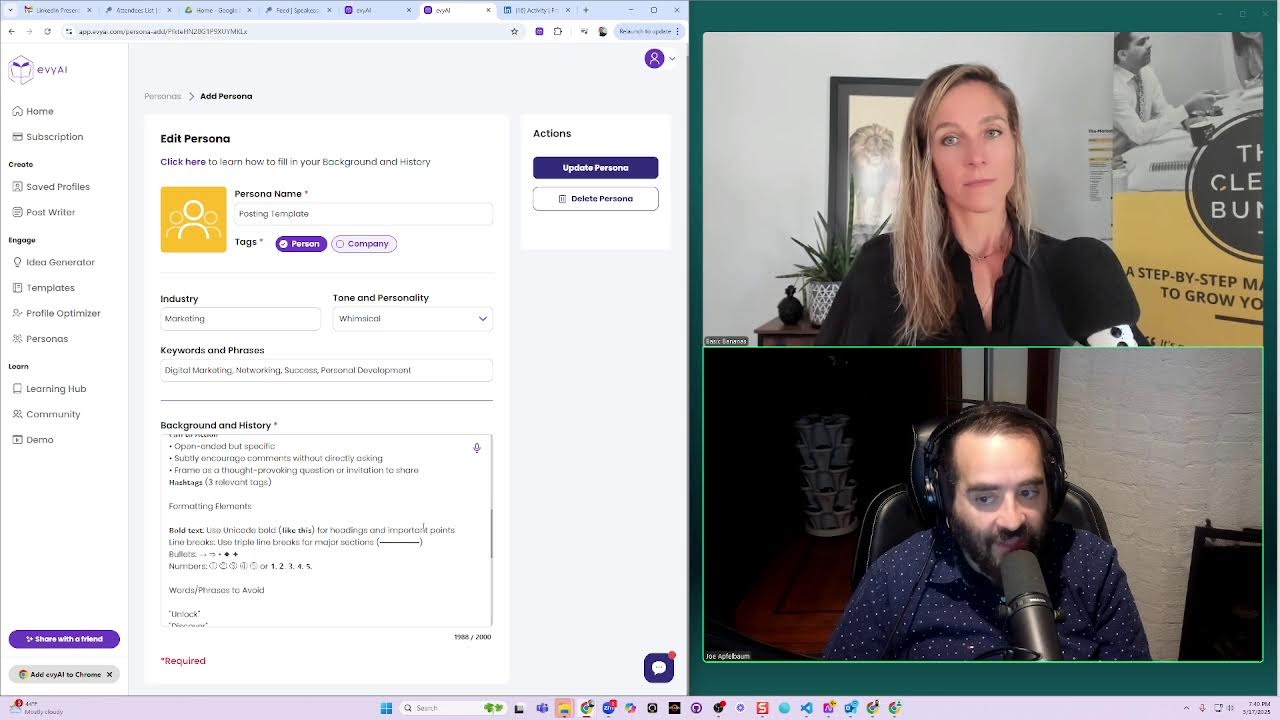
Meanwhile, the AI wrote the typo. The AI literally wrote the typo because I told it to. I even have a drunk AI that will act completely uncoordinated and completely drunk. I have a psilocybin AI that will act high. I have all the different types of things. You can do anything you want if you're creative enough. You could be anything, but don't be lazy. Don't be lazy. That's a good point. Unless you wanna be a lazy AI. So there is something called prompt engineering, and I teach people how to create solid personas. So let me read you one of my prompt posting templates. Act as Joe Apfelbaum, CEO of Evvy AI. Make the content lighthearted, but always keep it professional for LinkedIn. Don't do anything that would make Joe look bad. Be positive, light. But witty. Joe's a single father of 5, rabbi turned entrepreneur, loves to rap, play chess, and rollerblade. He's a speaker, author of 5 books about business and personal development, and the CEO of several companies. So write a post like this. Hook, 1 to 2 sentences, no emojis. Start with a personal story, contrarian view, or surprising statement. Keep it authentic and human sounding. Re-hook, 2 to 3 lines. Challenge conventional thinking, create curiosity, to click the See More button. Main points with Unicode formatting and emoji bullets. Use arrows and other Unicode bullets. Includes 3 to 5 main points with supporting details. Add contrasting points if relevant. Value delivery. Practical takeaways. Insights from personal experience. Open-ended call to action. Open-ended but specific. Subtly encourage comments without directly asking. Frame as a thought-provoking question and invitation to share. Include three hashtags, formatting elements, and then I go through it. Words to avoid: unlock, discover, game changer. Comment below all this bullshit, and then I give it an example format of how it should put the format in with with placeholders and everything. And now AI's trained to sound someone like me because I gave it a training. that I personally like the output. Now I have many other outputs. I have whimsical outputs, I have philosophical outputs, and my AI can do all of it without prompts. I don't have to do any prompts. I set this persona in, I click a button, and it's there. It's extremely powerful. I have one for WhatsApp, for Twitter, for Facebook, for YouTube, for comments, for DMs, for connection notes. I even have a recommendation writer that will write recommendations on LinkedIn. I've received 500 recommendations. I have ones that will automatically put a video. I did a 90-minute video on Alex Hormozi's book, $100 Million Offers. I did a 90-minute video. It takes that 90-minute video and it injects it in the comment and it writes all about what the post was about. And it says, by the way, check out this video that relates to the post in this way. And it puts a picture of the video in the comment like that. Or my book, High Energy Networking. It ties my book in and then puts a link to Amazon automatically. So there's email reply. I have a robust email reply that gives me 2 separate options in my voice to whatever it is the person's emailing me about. And the 2 options are there and I can select which option and boom, go. Have a good day. AI's powerful, but you have to learn how to use it. And the way that I train it with my voice is I have a microphone inside Evie AI, which I talk to it. So if I see a post and I want to say something, I will talk to that microphone. Every— I will polish it and send it in. And now I left a comment literally in my voice, but I don't want to have to use my clickety-clacky fingers. I have other use for my fingers, like eating chicken. I eat chicken with my fingers. I don't want to type up messages and comments. I want to use my voice. I want to speak. We're all talented with our gorgeous voice. Why not use a voice? And I'm on a mission to give people a voice. Online using AI.
You're clearly doing that, and I'm really excited to— we're also going to host a masterclass for our members and for our community, so we'll announce that very soon. Our Genius Punch members are also going to get a little treat, a little personal session also with Joe. And Joe, as we're coming to the end here, are there any final words? I know you could keep talking for hours. You have so much to share. What are some final words?
Here's some final words. I believe that the secret to living is giving. That means trying to figure out how to add value to other people without asking for anything in return. The secret to living is giving. If you feel like your life is kind of like chugging along, use LinkedIn to build those relationships and to be in a giving state and know what you want. And be willing to sacrifice and give of yourself. And eventually the universe will give you anything you want in life. So I just want you to keep that in mind. The secret to living is giving. And at the same time, energy without strategy is a waste of time. So make sure that when you are giving, you're being strategic and that you are putting yourself in the right circle, surrounding yourself with the right people and realize the following and write this down if you're not driving. The right strategy will save you a decade. Stop spraying and praying. Instead, get the right strategy, get the right network, and it'll change your life.
So powerful. I love it. Thank you, Joe. I'm really excited to also share another session with you very soon with our audiences. Thank you again for joining us today, for making us laugh and almost cry and And all sorts of different emotions, I think, listening to this episode. Thank you, the listener, for tuning in. As always, really appreciate you. And if you know someone who would enjoy this conversation here with Joe, please share this episode. I'll post the links to Joe's LinkedIn also here and his software.
More from Joe




How to Beat the Algorithm: Remove Hidden Watermarks & Scale Content with evyAI






