Michael Wish + Joe Apfelbaum Discuss LinkedIn Strategy
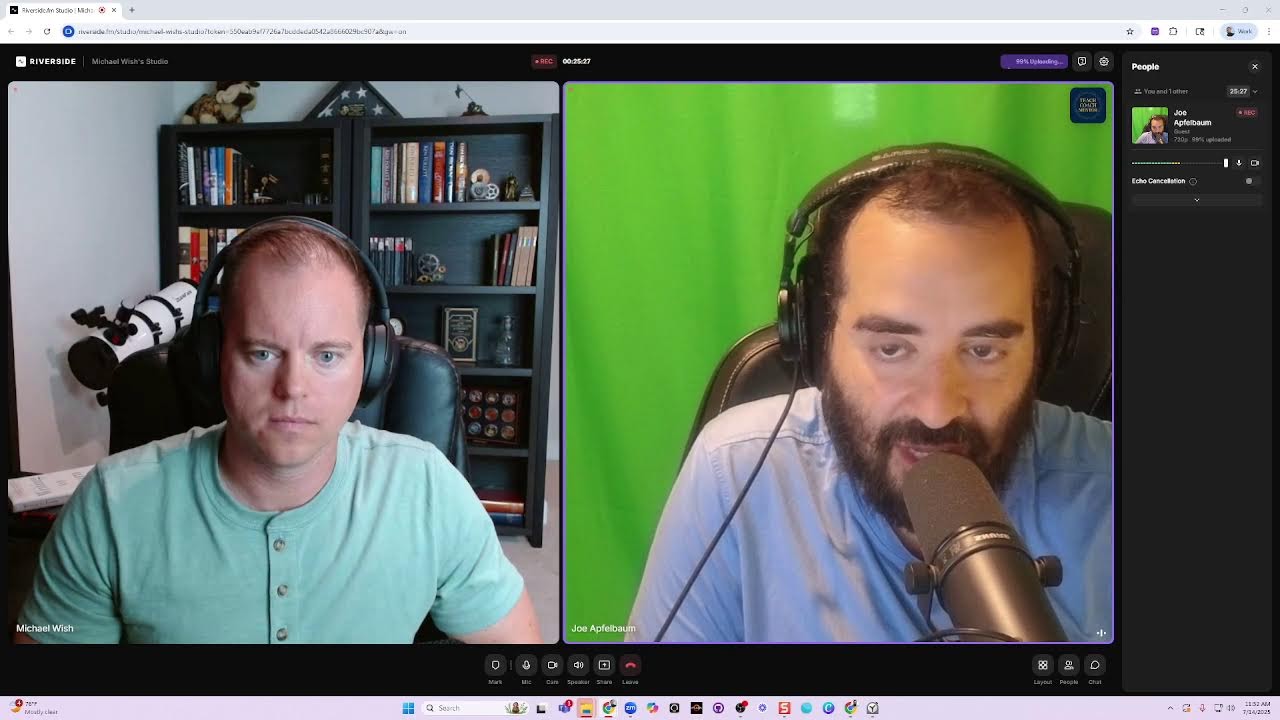
In this July 15, 2025 YouTube interview, host Michael Wish (Marine Corps educator) talks with entrepreneur, speaker, and founder of Evvy AI, Joe Apfelbaum. The conversation moves from the energy of a recent LinkedIn posting party to Joe’s personal evolution from a shy introvert to a community‑building leader. Joe explains how he uses his AI platform, Evvy, to research prospects, craft authentic LinkedIn content, and automate personalized follow‑ups while preserving human rapport. They discuss the structure of their growing LinkedIn community—posting parties, breakout rooms, regional chapters, and an affiliate program—aimed at creating a supportive network where members help each other succeed. Core company values (time is precious, authenticity, experiment joyfully) are unpacked, and Joe shares how these guide product development and community culture. The dialogue also delves into personal‑development advice for young people: self‑authoring exercises, values clarification, habit formation, and using pain or rejection (e.g., 100 dating rejections) as growth triggers. Joe outlines a scaling vision: impact 1,000 engaged LinkedIn users first, then leverage technology to reach a million entrepreneurs, partnering with large enterprises. Throughout, both hosts emphasize the importance of genuine connection, rapport, and joyful experimentation in networking, marketing, and personal growth.
Chapters
Everyone seemed to genuinely want to connect with each other. We're all— I mean, probably everybody is selling something, right? I mean, everybody's looking to expand their network. We all have our own selfish interests, but like, that felt like everybody wanted everybody else to win, right?
That's the key. Yeah. And could you imagine when it grows to 1,000 people? We're gonna have 1,000 people that are in this world. I'm not gonna be able to host a party for 1,000 people every time, so Yeah. But, but there's gonna be breakout rooms and we're gonna kind of change around how it works and there's gonna be customized events for different areas like, you know, Australia and different areas. So we're gonna break it into chapters, but it's, it's just so exciting to see how many people wanna support each other. So you're absolutely right.
Yeah, that's awesome. Um, speaking of which, uh, we have, I contracted with an AI company as their like education guy.
Okay.
And they're launching, uh, like a weekly coaching group on AI tools, instructions, that kind of stuff. I don't— I have to check to see how many they have. I think they're projecting 40 to 50 folks in their group. And so I would love to pitch EVAI. Amazing. That group.
Yeah. We have a great affiliate program as well, just so you know.
Yeah.
And you're in Maryland, right?
I am. Yeah. Amazing.
Amazing. I'm looking at your LinkedIn profile right now, and we're also gonna go live. If you don't mind.
Yeah.
Okay, cool. Yeah, let's rock and roll.
Let's rock and roll. Hey, Joe, thanks for coming on the show.
Hey, thank you for having me. So excited that we are here.
Yeah, so we're taking a little bit of a kind of detour in the shows that we've done recently. Recently we've talked a lot about teachers and kind coaches. But today I wanted to ask about learning a little bit more because you have learned a lot about LinkedIn, which is to say that you've learned a lot about people. I think in every business, I think everyone says at some point this business is a people business. And that's because if you're not dealing with other human beings and really interested in their success, well, then you're not going to be successful yourself. And so I was really struck. I was in a call with you last week. And your energy on Zoom was huge, right? I've never seen that much energy in a Zoom call. Like, I have a hard time sometimes getting students in the actual classroom when I'm making jokes and, you know, getting them involved to pay attention. And yet in a Zoom call, you had everybody typing in keys and, and I don't know. So you're a natural at it. And I wanted to just take a few minutes today and ask you how you got to that place and what you're up to these days. So here we are.
I'm, I'm, I'm, I'm a— so first of all, thank you for having me on the podcast. Really appreciate it. I've started off as a, kind of like an introverted, scared, shy person. You wouldn't see that from who I am today, but I had to kind of evolve as a human being by doing a lot of personal development to who you see today as a leader and an educator and an author and a speaker. I had to become that. I had to even change my name from the name I had before to the name I am now. Like, I changed my whole identity of who I am because I didn't want to be that shy kid that's scared person who is afraid to have his photo online. I wanted to be someone that shows up with courage, with confidence, so I can really impact people and make a difference. And I know that you're an educator, public speaker, and founder and CEO of Vela Logos. Am I right about that?
Yeah, yeah.
And you're a STEM-focused edtech venture driven by your motto, helping students go from confused in the classroom to confident and capable.
Yeah, so that's what we put on the LinkedIn page, right?
That's amazing. So I, I just push a button and my artificial intelligence helps me see everything about the Teach, Coach, and Mentor podcast and everything about you. So it's just amazing that I can pull up all this information in real time so I know everything about you and how you're a regular contributor on high-impact topics. So I went from, from being a person who was super scared to a person who now builds communities and helps people generate $100,000 in profit in their business And the path that I took to get there was a path of deep personal development and a lot of pain and a lot of effort and a lot of energy and a lot of just taking action, even though I'm scared, just taking action and learning all the different ways and creating systems and processes and strategy for everything that I do. So like, I watch other speakers like a hawk. I watch every little thing that they do. And I'm like, I like that. I'm gonna implement that. I hate that. I'm definitely never gonna do that. And so I learn from other people. I read books, I hire coaches, and I go to workshops. Part of the National Speakers Association for many years, part of Entrepreneurs Organization. I go to a lot of seminars. I watched Tony Robbins' UPW, Unleash the Power Within, 3 times. Read all of his books. He's the number 1 speaker in the world. So really like understanding how does he speak? How does Gary Vaynerchuk speak? How does— how do these speakers that attract massive audiences, how are they showing up? And so based on that, I'm able to learn what it is these people are doing. And once I learn what they're doing, now all of a sudden I'm able to build a deep, meaningful relationship with people and make an impact. So one of the things that I realized is that, you know, there's— most speaking engagements are super boring. Like, they're very, very, very boring. And I wanted to be the opposite of boring. I wanted to be engaging. I actually learned to be a class clown in school by trial and error. And I got so good at it, I got kicked out of school, but I was also the valedictorian. So I got really, really good at that. And then I got really good at marketing as a result of me getting people's attention. So how do you keep somebody's attention? That's really the question, because attention is the number one currency in the world right now. That is, you know, why Facebook is where it is, why Microsoft is where it is. It's all about the attention, getting people's attention. OpenAI, Got the attention of a million people, a million users in 5 days, 100 million users in 2 months. So you're getting that level of attention. That's powerful. So how do you get people's attention? How do you sustain their attention? And what I learned was it's really, people are just thinking about themselves all the time. So if you can make it about them, if you can think about, okay, how can I serve this person based on who they are? And using a tool like Evvy AI, it helps you rapidly build rapport with people because I know everything about you with a click of a button. I just do a little bit of AI research and boom, I know everything there is to know about you. And that helps me understand how to be able to build that relationship. So, you know, in order for me to do that, I gotta put my own ego aside. And that's something that a lot of people can't do.
I really liked— I just, 2, 2 quick things to pull out there. The first was that, that you're using AI, but, and I've talked about this with people many times, is that you're using it in a way that helps you build a better connection with another human being. I think a lot of folks are concerned that AI is just gonna take over all the conversations. That someone's post will be AI, someone's response will be AI, but that's not what you just did a few minutes ago. You used your tool, tool that you built in order to find out more about me and connect with me and find out what I'm doing, right?
So it's basically, it's basically the opposite of what most people are using AI to do. People are using AI to automate and then be able to just spray and pray. That's, that's how marketers ruin everything. I use marketing for me to go deeper with people. So if I send a mass email to a group of let's say 1,000 people, okay, I sent them all the same email. Maybe I try to customize each email as much as possible for each person. So maybe I'll add their name, maybe I'll add their city, maybe I'll add what language they speak or whatever it is. But then if they actually open it, I'll send them a message saying, I noticed you opened it but you didn't click on it. What's up with that? Or if they click on it, I notice which link you clicked on and I will send a separate campaign saying, I had 3 separate links there. I noticed you clicked on the link about bananas. Apples and oranges. I noticed you clicked the link about bananas. I'm curious to know what about bananas did you enjoy the most? Or something like that to really get to know them and really figure out, or I would even pick up the phone and call them and say, hey, my team just notified me that you were interested in the bananas because you clicked on it. I'm curious to know if you actually clicked on it on purpose or you made a mistake. And they'll be like, no, no, I clicked on it on purpose. I love bananas. I'm a monkey. And I'll be like, oh my God, I love monkeys. Part of my DNA is monkey DNA. And then we start having a conversation about bananas and monkeys.
Connection made.
Yeah. And I built— and the key is to build rapport because if you build rapport with someone, then you have trust. It's so interesting how people will trust you based on the rapport that you build with them, not how good you are at something. Like, you can be a terrible coach, but if you— you will be much more effective as a terrible coach at coaching If you can build a rapport with your client or your student.
We're social animals, right? So I mean, those connections are— that's the first step in trust is building that kind of that baseline rapport, right?
Yeah. The first step to trust is building that rapport. Keeping the trust is about keeping your word and making sure that you have integrity and that you're matching values. But we judge people based on how much rapport we have with them. So if you're walking into the Harvard Club and you're walking in with a dirty t-shirt and you're limping and your toenails are sticking out of your shoes, typically the people there are gonna be like, I have zero in common with this person who's experiencing homelessness and they're dirty, and the guards will kick you out right away. But if you walk in with a beautiful suit and beautiful shoes, no one's gonna question you, no one's gonna ask you if you belong at the Harvard Club or not. You're gonna have instant rapport, the guards are gonna open the door for you and bow to you, and everybody's gonna be like, who's this person? I wanna connect with the person. But if the opposite happens, if you walk into, into, let's say, a cruise and you're wearing a perfect suit and everyone's in their Hawaiian shirts and you walk in with a crispy suit, they're gonna think that you work there and that you're the manager or something. No one's gonna have rapport with you. Yeah.
Well, let me— I wanna back up a little bit because earlier you were talking about how you were an introverted, shy kid and you didn't wanna be that anymore. So I work a lot with young folks, and one of the issues that we work with is too much introversion or even too much extroversion, right? Because if you're too extroverted and you constantly dominate the conversation, And you don't actually show that interest in the other person, even if it's there, it's just difficult. You have to learn how to tailor that back. Now, most people don't make wild transformations like it sounds like the one that you made. Most people are able to just modify a little bit here or there. So what recommendation do you have for the kid? Mostly young folks are the ones that I work with, maybe middle school, mostly high school and college, that want to make those changes. and they're not sure how to start?
Well, number one is you have to be committed to personal development. That's number one. Most people are not. Most people are committed to pleasure. So you really have to ask yourself, am I willing to do the work or do I just wanna feel pleasure? 'Cause if you're just into pleasure and you're chasing skirts or whatever you're doing, then you're not gonna have growth because growth doesn't happen in the comfort zone. If you wanna be comfortable, and most people are in their fear and they're in their element and they just wanna be comfortable, This is not the road that's going to be successful for you, 'cause you're not gonna be able to grow if you're comfortable. As a matter of fact, you're gonna stay in your shell. You're gonna stay with your besties. One of the ways that I was forced to grow is by not having besties, and by one time having a bestie and that person betraying me, and me saying, I'm never gonna have a bestie again. And then me feeling pain for not having besties and feeling like I'm the odd man out. And watching everybody else have their cliques and I didn't have a clique. And instead what I did was I went around and I became friends with all the odd man outs. And I didn't— wasn't odd. So we were all odd man outs together. And I was the one, the glue that pulled together all the odd man outs. And that's kind of what I'm doing now is I'm finding the coaches and consultants that haven't made it and pulling them together and creating a band of brothers, a band of sisters, getting them together and helping them help each other. and helping them help themselves with the right strategy, the right community, and the right technology. And people look at me like, oh, you're such a hero. You're doing great. I'm like, this is just what I do. This is what I'm programmed to do. I'm just being present to who I am and who I've become based on the pain that I've felt in my life. And the truth is, if you're not willing to feel pain, you're not gonna grow. So you have to be like, you have to have a real good reason why you want to overcome this. And if you don't have a compelling reason and a compelling purpose, you're not gonna do it no matter what. If you're like, oh, it's a nice to have thing. Yeah, you're chilling with your bros. You're not gonna grow. You're gonna be the average of the 5 people you spend the most time with. You have to pull away. You have to be with yourself. And you have to realize, I want— you have to have like a compelling trigger. And sometimes the universe gives you the trigger. Sometimes your trauma gives you the trigger. Something suddenly, something happens, you get betrayed. Or something happens. And when that happens, grab on to the horns and hold on tight and get ready for growth. Sometimes it's because of the divorce, sometimes because somebody cheats on you, sometimes because somebody hurts you physically, mentally, emotionally, spiritually, in some other way. Use that as a growth. There is no losing in life. There's only winning or learning.
Yeah, we actually had an entire podcast where we talked about Failure versus success. And the title is called Win or Learn. So you're spot on with some of the things that we've been chatting about recently. It's funny, as far as making, making growth and making change, this is as true in kind of your personality and your life as it is in just learning in the classroom. Learning doesn't happen when things feel easy. If things feel easy, you're not actually learning, right? It has to be really difficult. You have to be struggling to remember what's going on. You have to write things down without reference to the book. That growth only happens when, when things are tough. And I, I heard a, and this is a story from years ago, so I forget who it is. I can put it in the show notes, but there was a psychologist who was working with young men who were struggling to assert themselves, struggling to, you know, be present and be a little bit more extroverted. And before this psychologist would work with them, he had a task, which is that they had to go out to 100 girls and ask them out on dates.
Wow.
Did not matter what the success rate was. It could be 0, it could be 1, it could be 20. The point was you need to go and you need to get rejected 100 times, right? And show the commitment and show the effort that no matter how painful it is, you're willing to go through the personal development process. You're willing to experience that pain for growth. And he would not start working with them until he had 100 rejections.
That's incredible. And that's incredible because, you know, when I got divorced, I took a class on how to approach people, specifically in the dating world, just to kind of learn how it works, because I felt like in this MeToo movement, you can't talk to people of the opposite sex. You just can't.
Yeah.
You walk over to somebody, and what I learned through this course, which by the way, I took with a woman in London, an ethical woman that teaches you how to be able to approach people in a meaningful way and how to ask for consent and all this jazz, and I walked over to to people and I started realizing, and I learned this from her, is that a lot of people want to be approached, but they want to be approached respectfully. If you learn a system and a process of how to approach, and I got really, really good at it, now I could approach anybody, but I use it from a business standpoint. I'll be at a trade show and I'll approach somebody using the dating method that I learned and it works much better in the networking world, but it works great in the dating world.
That's cool.
I'm actually not looking to date. But if I wanted to, sometimes I'll challenge people and I'll be like, get me 10 numbers right now, or get me 10 names, which is easier than getting numbers. And so, you know, there's a process that you have to go through, but you have to be willing to take the rejection. But if you follow the process, your likelihood of success is 10 times higher. If you understand that you cannot take responsibility for other people's states, how to interrupt people with respect. and with dignity, how to be able to know yourself, know if you're being present or if you're being self-conscious. That takes a lot of personal development, Michael. And if somebody is able to get over their ego and to get over their current thoughts of, you know, not accepting yourself, not loving yourself, feeling like you're not enough, worrying about how much other people love you and how good you look in front of the eyes of other people, if you can get over all that, You're going to be much better at sales. You're going to be much better at life, and you're going to be much better at deep intimacy and connection with other people.
Yeah. So tell me what you think about this. So for our students, we start off with a self-authoring process, right? It starts— it has to start with deep reflection because I find that especially when I ask a young person any sort of deep question about themselves, it's, well, I've never thought about it. I've never, I've never even considered it. So the first thing that we do is, is have them sit down. and self-author for 20 to 30 minutes on their past, their present, and their future. Figure out who am I? Where did I come from? Almost as if you were on a date. If your date said, who are you? Where are you from? How would you respond in a deep and meaningful way? Who are you right now? And then we ask them to build out that vision 10, 15, 20 years from now. What does that person look like? Not just what do you want to do when you grow up? Not just how much money you're going to have, but like, who is that person? Are they a pillar of their community? Do they donate to charitable organizations? Are they ripped and shredded from the gym? Like, what is that life actually look like? And then, and this comes the painful process, is like identifying the gaps, right? Where am I now? What have I just written out is the version of myself I want to see 15, 20 years from now? And where am I falling short? And that part's really painful. The good news is, is that you've got 15 or 20 years.
Yeah.
You can find a habit or 2 habits or 3 habits, and we help them do that, that you can start now that over the next 15, 20 years are going to pay huge dividends. So, whether it's making a change in your identity, again, you don't have to wholesale make that change today, but you do have to make one change in your life now that over the next 10 years is going to make a huge difference. So, maybe going out and asking 100 girls out on a date today sounds terrifying.
Yeah.
You're just going to put yourself in a stress-induced Anxiety zone that you can't function in. But maybe you can ask one a day, and maybe instead of on a date, you just talk to them. But if you do that for the next 5 years, you're gonna have 1,500 conversations with a person of the opposite sex, and eventually you're gonna look back and think, why did I ever think that that was a difficult thing to do? Right? And so the, the time compounding there of those efforts really makes a huge difference. huge difference over time.
I think that's a very noble thing for, for you to do with students, for it to have self-discovery. I think self-discovery is really important. There's the Maslow hierarchy of, of, uh, of needs. So like most people are on the bottom rung where they're not getting their basic needs met. So they're not gonna move up to self-actualization. Helping people to get up to self-actualization could be really helpful. But if they don't have their basic human needs met, if they don't have love, if they don't have enough water, if they're not exercising, if they're not doing the basics, They're not going to be able to even think about self-actualization on the top of the pyramid. So that's really important to get people to go up there. What I tell people, it's like really thinking about where you've been and your trauma as well, like helping them understand what happened to you at 9, what happened to you at 16. If your students are under 25, there's still something yet to come. So they have a lot more to learn.
That's right.
So they haven't had their third wound yet. And so like, just realizing who you are is really important, but also who you've been and what is your relationship with your parents right now? What is your relationship with your friends? And then also figuring out what's really important to you. Like, what is important to you right now? What are your values? Most people don't put language around their values and having a value discovery exercise, regardless of what your goals are or where you wanna be, 'cause also a lot of 18-year-olds, 19-year-olds, 20-year-olds, they don't know where they want to go. And, yeah, and frankly, it's not even important for them what they want to be in 5 years or even setting goals now. I think it's more important for them to identify what is really important to me right now in my life, and how do I put language around that, and how do I be able to communicate to other people, and what actions am I taking to be able to be living in congruence with that? Because sometimes people are there to satisfy their needs and they overlook their values. And when you can match your needs and your values, then you can get really, really present It's like matching your mind and your heart together, which is something that I believe people in their teens, if they practice more of, they'd be able to be more present.
No, that's fantastic. I think we'll definitely add a value exercise early on. I think that's really important. So what is next for you, by the way? So, well, tell me what you're— I know you have Evie AI and you worked with LinkedIn and you have this new group that you formed, but Tell me about that and then tell me about where it's headed.
So the reason I came out with Evvy AI and the reason why we created the software is because a lot of people, we were training them on how to use LinkedIn and they weren't taking the actions they needed to take because they didn't have the time, they didn't know how to do it authentically, and frankly, they just, they just didn't have the ability to go and write content and leave comments and the creativity. They had a lot of writer's block. And so we created software with artificial intelligence that helps you do all that and save a ton of time. One of our core values is time is precious, 'cause we truly believe that we can save a tremendous amount of time to entrepreneurs. And also the amount of people that we can help with courses is not the same amount as the amount of people that we can help with technology. And I really want to impact a million people deeply. And so in order to do that, I first have to impact 1,000 people deeply. We have over 1,000 paying customers already, but our goal is to get 1,000 engaged LinkedIn users. So our short-term goal is get 1,000 people in the community, that are willing to engage every single day and that are willing to build relationships with other people and kind of really get to know each other. And that's kind of like what you experienced in the posting party today. And then from there, just keep building it out. We're looking— we're building partnerships with large publicly traded companies that have millions of clients. And we are in the current process of testing out relationship with their clients to see the impact we're able to make on their clients. And that's going to help us be able to scale very quickly and be able to impact a lot of people. You know, with my marketing agency that I've had for over almost 2 decades over 17 years, I was only able to service 1,100 clients total over the past 17 years. But with a software company, I'm able to impact a million people today. Like if a million people signed up to Evvii AI, I can impact them deeply today. I can give them the strategy, the community, and the technology they need in order to generate $100,000 in profit. So I'm like on a mission to doing this and to seeing this through and impacting people very deeply. And if anybody wants to come along the journey, there's 1.2 billion people on LinkedIn. And we work on Facebook, Instagram, Twitter, TikTok. We work everywhere. But LinkedIn is where people have everybody's first name, last name, company name, where they work, where they went to school, everything about them. So it's much easier to find out information about people on LinkedIn and build rapport and be authentic. That's our second core value, be authentic. And as you can see from our personas that we built, we're able to be authentic. And so just kind of giving people the skills that they need in order to engage, to be responsible, to be building relationships. That's really where we're at and what we're doing. And so, you know, we have a great affiliate program as well. When you refer business, we pay 20% for 3 years, very generous. So we're basically paying you 60% of the revenue. So it's just really, really interesting how we're able to build relationships. And a lot of our clients that have come in, they brought 10 people along the way with them. And so even in the first year, they may double back whatever they spent. So it's really nice to be able to see our community leaning into this and the money that we're making, we're reinvesting into building out the technology, we're bootstrapping it. And it's been going really, really well. We built some really stable, secure, powerful technology and we keep adding agents and we keep adding new features. So it's just exciting what we've been able to build.
Yeah. Well, full disclosure, I've joined your community. It's a phenomenal community. I think when I— because I'm new to the entrepreneurial space, I'm new to business, and in my mind, I had this image that I was going to join this cutthroat group of people that were all out for themselves and everybody's fighting over the last little bit of market share. And I have experienced the complete opposite. And that's especially true with your community where, man, it's a party. I mean, people want everyone else to succeed. Everyone's willing to support and help each other. It's really unique. It's not something that, as I slowly transition out of the military here, that I thought I would find in the business space. But entrepreneurs are really a special breed of people. I want to finish up with 2 questions. You'd mentioned a couple of values. One of the values was time is precious, and the other value was authenticity, right?
Be authentic. Yeah.
But be authentic. That's right. So, what are your other values? And then, if there are more, and then the last question would be, I want to get a little touchy-feely here. How does it— what does it feel like when you see that you've impacted or that you have the potential to impact so many more folks, right? You see, I mean, a guy like me, I'm brand new to the community and I'm just pumped about it. Or you see the folks that we saw this morning in the posting party that were like the guy from Australia. He's like, I don't know what I'm doing here. Do you remember that? He was like, I'm not sure why I'm here, but he was so excited, you know, and he worked with charities. He's not even doing for-profit stuff, but he was just pumped to be there. So what does it feel— what are the other values? And then what does it feel like when you see that?
I'm a very big fan of having few rules and repeating them often. So values are almost like rules for engagement. And so for me, it's always going to be the rule of 3. Like, you know, having 3 makes it really, really easy to remember. So For me, making sure that the value's also in line with where we are right now, not just aspirational values or permission-to-play values, which is like, you know, a lot of people say trust or whatever it is. No, those are permission-to-play values. Like, where do you— where are you right now? And so when it comes to artificial intelligence, having the value of be authentic is extremely important because, as you said earlier, but there's another value that's kind of the opposite of that, which is experiment joyfully. Because AI's not gonna give you always what you want and you have to experiment. And networking is not always gonna give you what you're looking for and you have to experiment. And marketing is about testing and you have to do it. You have to do the process joyfully in order for you to be able to attract what you want. If you're in pain and you're feeling lack and you're feeling the opposite of abundance and you're in scarcity mindset, you're not going to be able to attract $100,000 in profit. You're, you're going to be in lack and you're not going to be a giver. So you have to be able to just tune in, experiment joyfully, be authentic, making sure that you're following the tenets that we're teaching and keeping it light, keeping it joyful, keeping it friendly, being a giver. That's extremely important to us. And so if you kind of follow the value of experiment joyfully, that's really important. For me, I would say I'm able to be really present knowing that there's nothing else that I need to be doing than this. Like, for me personally, how I feel, I feel really present. I feel really at peace, and I feel really excited about the ability to impact a million people. I've always wanted to impact a million people. I just didn't know how I was going to do it. And I didn't— and I thought maybe coaching would be the way, but I don't think— that I have the wherewithal to be able to coach a million people at once. I don't think I have that ability, but I think that—
It'd be a hell of a Zoom call.
Yeah, it'd be a hell of a Zoom call to have a million people on a Zoom call, but, and it'll also be very expensive. But what I would say is kind of like just being present for one person at a time and knowing that that person can impact 1,000 people. Like on LinkedIn, I don't know if you know this, but on LinkedIn you can add connections, right? Every connection that you add, like I added you as a connection, feel free to accept if you want to. I had to remove a different Michael because I have over 500 Michaels I'm connected to. So I had to remove another random Michael that hasn't responded to me and I added you instead. And one of the things that I realized is that every person on LinkedIn can have 30,000 connections. That's the limit on LinkedIn. If you have 30,000 connections, you have about 700 right now, but if you have 30,000 connections, you automatically have 30,000 followers. Whereas with Instagram and Facebook and all the other platforms, like if you get a follower on Instagram, if you follow someone else, that doesn't give you a follower automatically. But on LinkedIn, when you add a connection, the other person automatically follows you if they accept it. So that's an interesting method of getting followers. Plus you get everybody's email address. Often you get their cell phone number as well. And you got a lot of information about the person. So for me, teaching people how to be authentic, How to experiment joyfully, how to connect with other people, how to build relationships. That for me is like the key to unlock the door of presence. And that's what I feel when I'm, when I'm in this journey. I feel really present because for most of my life I felt more analytical and strategic. And now I'm learning the process of just being present and allowing the universe to unfold. And with me manifesting but not forcing.
Yeah, well, you've embodied that today because you had no reason to do this podcast with me. We just met a week, less than a week ago. So, you know, that's the authenticity, you know, is exuding from you throughout all of this process. And I really appreciate it. I will think I'm gonna have to steal or add one of your values to mine. One of mine has always been aggressively curious. And now I want to tack on be experiment joyfully at the end of that. I think those two, there's something really powerful about connecting those two things. I have to find out a way to articulate that a little bit better, but—
Yeah. And using Evie AI, it can help you articulate it better. You could just say, Evie AI, I have this value and I want to combine this value. Give me 10 suggestions. And Evie AI will just spit out 10 suggestions for you.
Perfect. All right, Joe. Well, hey, I really appreciate your time. Thanks so much for coming on. This has been This has been a really incredible conversation.
Thank you for having me. Appreciate you having me on this podcast, and thank you for all the work that you're doing. It seems like you're doing great. Congratulations. And thank you for your service. Were you in the Army?
Oh, thank you, Joe. I'm actually in the Marine Corps. I'm still in now. I haven't, I haven't retired yet.
Wow, that's incredible. Thank you for, thank you for being a Marine, and thank you for protecting us.
More from Joe




How to Beat the Algorithm: Remove Hidden Watermarks & Scale Content with evyAI






