Thought Leadership Strategies - 071 LinkedIn Live 2024 with Joe Apfelbaum
In this 70‑minute live stream, Joe Apfelbaum walks viewers through what thought leadership is, why many professionals fear the label, and how to deliberately become a recognized authority, especially on LinkedIn. He uses multiple AI generators (ChatGPT, Meta AI, Claude, Perplexity, Gemini, Microsoft Copilot, Pi.ai, Evy AI) to brainstorm and refine a six‑module "Engaged Thought Leaders" course, demonstrating how each AI offers a distinct perspective on modules such as finding your voice, creating high‑quality content, choosing a platform, communication skills, networking, and monetization. Joe showcases his own community of 1,015 paid members, shares concrete LinkedIn tactics (profile optimization, commenting strategy, content cadence, ad funnel design), and demonstrates supporting tools for video editing, graphic design, and automated posting. Throughout the session he engages the audience with interactive prompts, live Q&A, and calls to action to join his AI Business Development Circle or Thought Leadership Community. The video serves as both a conceptual framework for thought leadership and a practical, tool‑driven workflow for building, scaling, and monetizing a personal brand.
Chapters
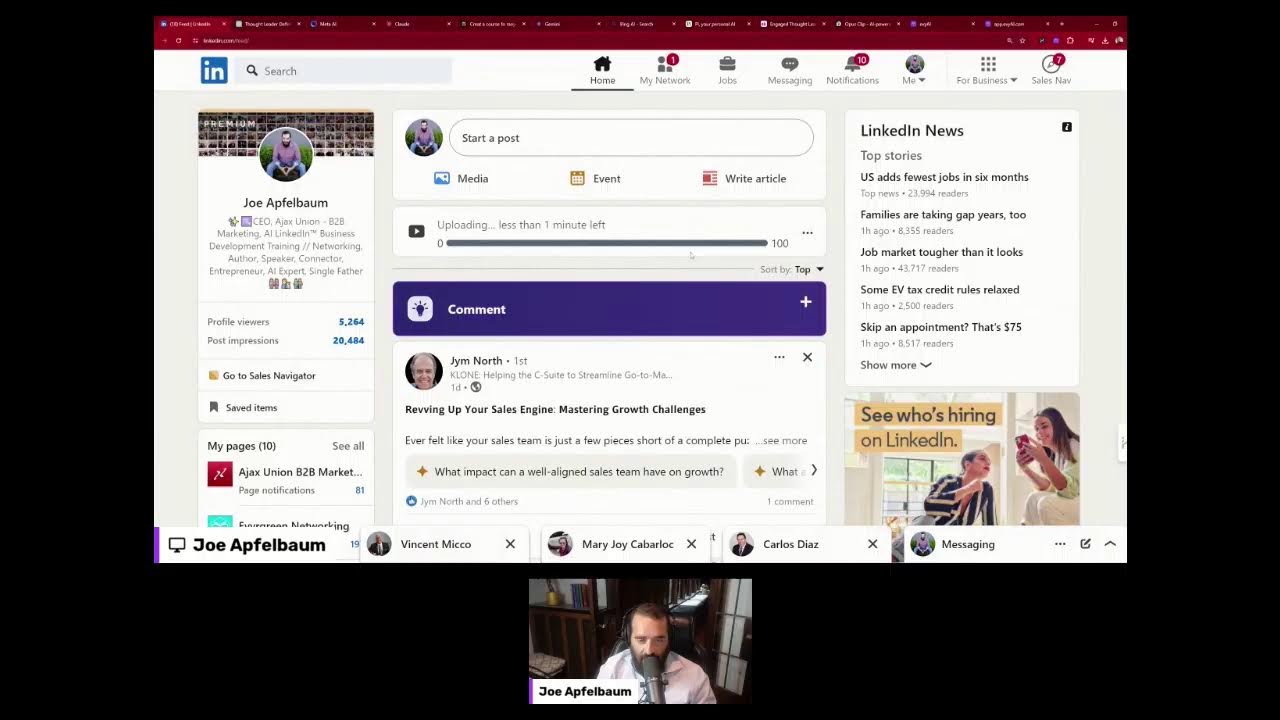
That's what I want to talk about today. So let's talk about thought leadership strategies. What I'm going to do is I'm going to put my finger up like this, just move it up. Oh, look at that. Ooh-wee. Just zooming in. So I have an artificial intelligence webcam, and if I move, it moves with me, which I absolutely love. So what does it mean to be a thought leader? Have you ever wondered that? Ever wondered what thought leadership means? Some people say you can't call yourself a thought leader. It's too arrogant. It's too cocky. Other people say, I strive to be a thought leader, but being a thought leader is a big deal. Not everybody's a thought leader. You have to be called. It's a designation that somebody else puts upon you. You don't have the right to call yourself a thought leader. And some people are like, hey, I want to lead with my thoughts. So what is the definition of a thought leader and what does it mean to be a thought leader? What does it mean to be recognized as a person who's a thought leader? I thought I would ask artificial intelligence. So let's see what it says. I'm going to ask, I'm going to ask the AI, what is a thought leader? What is a thought leader? Let's see what it says. It says a thought leader is someone who is recognized as an authority in a particular field or topic and is often sought after for their expertise, insights, and innovative ideas. Ideas. They typically have a deep understanding of their subject matter and are influential in shaping the direction of discussions, trends, and developments within their industry or community. Thought leaders often share their knowledge and perspectives through various channels, such as public speaking, writing articles, books, participating in panels, engaging on social media platforms. They're known for challenging conventional thinking, offering fresh perspectives, and inspiring others to think critically and creatively about important issues. In essence, a thought leader is not just knowledgeable about a subject, but also someone who actively contributes to advancing the conversation and driving positive change within their sphere of influence. So with that being said, are you a thought leader? Now I'm going to ask the AI, I'm going to say, explain a thought leader. To a 10-year-old. Let's see what it says. Sure thing. A thought leader is like a superhero of ideas. Just like superheroes have special powers and use them to help people, a thought leader has a special kind of knowledge or skill in something important like science, technology, or art. And they're really good at what they do, and they share their ideas and knowledge with others to help them learn and understand new things. People look up to them because they're so good at what they do. They often help shape the way people think about certain topics and ideas. So in a way, they're like heroes in the world of ideas. Oh my gosh, that resonates. That resonates with me on so many levels. Heroes in the world of ideas. Wow. That is a powerful way to think about thought leadership. That actually made me feel good. I'm an ideator. I love coming up with ideas. I love sharing my ideas with the world. Do you like ideas? Are you like me? Are you like the type of person who likes ideas? Write ideas in the chat if you're an ideator like me and you love coming up with ideas, you love sharing ideas. Also give this video a heart if you're watching the YouTube, if you're watching the Facebook or the LinkedIn, let me know what you're thinking. Let me know if you're with me, if you're watching the live or the replay. Being a thought leader for a long time was elusive. A lot of people are afraid of the concept of thought leadership. Like it, there's like a mindset shift that needs to be made in order for you to even want to be called a thought leader. Like a lot of people don't even want to be called a thought leader. So I'm going to ask the AI, I'm going to say, what do people, what are business professionals afraid of in terms of being called a thought leader? Let's see what it says. You ready? You with me? You with me? Okay. Fear of scrutiny, fear of commitment, fear of failure, fear of overshadowing colleagues, And fear of pigeonholing. Those are all legit. I think fear of pigeonholing might be the one that people are the most afraid of because they're like, oh, if I become a LinkedIn expert or if I become an expert on YouTube, that means that I'm going to miss out the opportunity on speaking on different topics. But pigeonholing, or as they call it, niching, they say the riches are in the niches. Do you agree with that? Do you think that the riches are in the niches or do you feel like, you know what, I'm not so sure. I'm not really so sure if the riches are in the niches. Let me know what you think in the comments. I'd love to hear from you. I did a presentation. I did a few presentations today. One of the presentations that I did today is called How to 10x Your Profile Views on LinkedIn. And I'm going to jump into LinkedIn just to kind of show you some things that you could be doing to be a better thought leader in your industry. Not everybody is able to do this. Not everybody's capable of doing this. Not everybody's even interested in doing this. But if you're interested in being a thought leader and being with other thought leaders, write thought leader in the chat. I'm curious to know if that's something that you're even remotely interested in becoming part of. I'm gonna share my screen just to kind of— this is what I do. I always share my screen. And I kind of walk people through this stuff. All right, so we're about 6 minutes into this live. Let me just share my screen. I'm gonna zoom in just a little bit here for you so you can kind of see this up front and personal. So I see Mark, uh, Svensson. Mark Svensson is here. He posted 9 hours ago. I'm gonna give him a like. I'm gonna acknowledge him, and then I'm gonna share a quote. Now, I don't have to actually write the quote. I can have the AI write the quote. But me sharing other people's quotes is something that thought leaders do. In my experience, that's what thought leaders do. Thought leaders are networkers, they're relationship builders, they're idea generators. And I'll be like, love your content. Okay. I just said, love your content. I just shared with him that, and now I'm building a relationship. This is, this is what I do. I, I go ahead and I build relationships with people. By leaving comments. So my question to you is, how many comments do you actually leave on a daily basis? Personally, I strive to leave at least 5 comments every single day. And if you're not leaving comments, you're missing out. You could leave a quote as a comment. There are other types of comments that you could leave as well. It doesn't have to be a quote. For example, I can talk about my book. So I'm going to drop a comment and it's going to actually put a link and a picture of my book, High Energy Networking. That's another thing that thought leaders do. Thought leaders have books. They publish books. Doesn't have to be a physical copy, but it's really easy to publish a physical copy of your book these days. Most people don't do it. Most people will never do it. I'm going to do a short little comment here. Thought leaders have ideas. They share their ideas and they're willing to take a position. Thought leaders are willing to take a position. Are you willing to take a position? So I'm going to go right into ChatGPT right now. We're going to go to ChatGPT and we're going to ask ChatGPT, create a course for anyone who wants to be a thought leader in their industry in 4 modules, in 5 modules. Okay, let's just, you know what, I'm going to do 6 modules. All right, so number 1 is understanding thought leadership. Number 2 is identifying your niche. Number 3 is content creation and distribution. Number 4 is building your personal brand. Number 5 is thought leadership communication skills. And number 6 is sustaining and evolving your thought leadership, just like that. Okay. If you wanted to make it easy, if you wanted Each module to be really easy to follow and have something actionable they can take into practice in just a week. What would you change this outline to? All right, let's see. I wanted each module to be really easy to follow. So discovering your potential, defining your niche, creating and sharing content, building your personal brand online, communicating skills, sustaining your thought leadership journey. Interesting. So I need to, I need to take this outline that I just created. I just created a little outline, you see, for a course. And what I'm going to do is I'm going to make this my own. I'm going to take this outline right now and I'm going to make it my own. by thinking to myself, okay, this is just a rough draft of a potential course on thought leadership. And what I'm going to do is I'm going to take this and think to myself, okay, what do I think are the 6 parts to being a thought leader? What, what are the, what are, what do I think? And, and what I'm going to do is I'm also going to go to meta.ai. I don't know if you guys ever heard of meta.ai, but I'm going to do the same thing here if you wanted. to create a course. I'm just gonna copy and paste this here. Create a course for anyone that wants to be a thought leader. Continue with Facebook. I wanna continue with Facebook. Well, let's see. Let's see if this works. Oh, it wants me to receive a code. Text me again. Let's see if this works. All right, I'm gonna log in and we're gonna try Meta right now as we speak. We're gonna try this here. You with me? Let me see. All right, so we have this, we have the Facebook thing. Create a course for anyone who wants to be a thought leader. Identifying your niche. So they start with the niche. Building your personal presence. Content creation and storytelling, networking and collaboration, public speaking and presentation skills, and establishing authority. I kind of like this one better. Now let's try Claude. Claude. Okay, and we're going to continue with Gmail. We're going to go in with this. We're going to hit continue. And we are going to say the same thing. Identify your niche, build your thought leadership platform. Oh, I like that. Pick your platform, create high-quality authoritative content, networking. So they included networking, establishing credibility, and monetizing your thought leadership. Oh, I like that one. I like that one a lot. So now I'm getting ideas. So I came over here. This— they didn't talk about monetizing. They didn't talk about monetizing. They didn't talk about networking. No networking over here. Let me see. Ctrl+F networking. All right, the networking and relationship building, they kind of talked about that. They talked a little bit about networking, but it wasn't like a main thing. It was kind of like a Lesson 3, networking with peers. It's not the same. Like here, they made it front and center, relationship building. They kind of mixed it up over here. Let's look at Perplexity. Let's see what it does. Define your unique perspective. Ooh, this one's good. Crafting content. Crafting content. Create a robust online presence. I like that one. And establish industry credibility, foster a loyal audience, and monetize. Okay, so they really focus on monetizing it. I love this. Let's check Gemini. Let's check Gemini. And as you can see, I'm misspelling it. I'm misspelling it every time. Create a course for anyone that wants to be a thought leader in their industry in 6 modules. Okay, define your niche, build your foundation, create high-impact content, amplify your reach, build relationships, measure success, and monetize. And that's the bonus module is monetize. Wow, wow, look at that. Look at that. So if I took all these, if I took ChatGPT, Meta AI, Claude, Perplexity, Gemini, and I kind of took the best parts of all of them and I put it together and I created my own thing. Think about that. Think about, you know, there's, there's many different perspectives. There's something called the 6 perspectives. Could you imagine if you also bring Bing AI? You bring Bing AI into this. They're not going to let me do this over here, but Microsoft Copilot. I'm going to go here. Let's see what it does. Determine your area of expertise. Okay, so they, they really, they really kind of move it around here. So becoming a thought leader in your industry involves establishing authority in 6 steps. Determine area of expertise, produce regular content, avoid self-promotion, find your niche, build your personal brand, and network and collaborate. It's very simple. It's almost like 6 different tips over here. So instead of saying find your niche, it says determine your area of expertise, post regular content, avoid self-promotion, find your— so over here he kind of moves find your niche to like the bottom. Interesting. See, it doesn't even say find your niche here, but find your niches later on. They say find your niche first, but Copilot's kind of like, oh, bring your niche to the top. Very, very interesting. So we got 1, 2, 3, 4, 5, 6 different perspectives from 6 different AIs. Let's get, let's get one more, Pi.ai. Let's get Pi.ai involved over here. Let's go next, next, next. My name is Joe. My name is Joe. Nice to meet you. Let's, um, let's do— Hi, it's lovely to meet you. I'm quite knowledgeable about almost every topic. Use me as an extension. I can write stories, brainstorm ideas. All right, so I chose that voice. Nice choice. Now you can hear me. All right, so let's do that. What should we talk about first, Joe? Okay, Joe, what did you want to talk about? Below is a suggested outline for a 6-module course designed to help individuals become thought leaders in their industry. The course aims to provide insights, tools, and practical strategies to establish oneself as an expert And authority in their field. Module 1, Discovering Your Niche and Finding Your Voice. A way identifying your unique strengths, skills, and experiences. Exploring potential areas of expertise. Okay, so I like this. I like finding your voice. So finding your voice, I would say, would be the first thing, the first part, finding your voice. So we're gonna go here. We're gonna go to— are you guys liking this, by the way? Are you guys, are you guys loving what I'm doing over here? Let me know that you're loving it. Just write, I'm loving it, in the comments. I'm gonna go to the comments and see what you guys are saying over here about this. Do you find this interesting? Do you not find this interesting? Do you like it? Do you hate it? Let me know. I'm gonna go to my profile over here and I'm gonna see if you guys have been commenting or not. But drop a comment. Let me know where in the world you're dialing in from. We're just getting started over here. Find your voice. That's the one. Finding your voice, I think, is, is a foundation. It's almost like finding your voice in your niche and your area of expertise, kind of like all combined in one. That really resonated with me a lot. So I'm going to go ahead and give it a heart and I'm going to pop it in as a comment there. So that would be number one, finding your voice, identifying your skills, your experiences, exploring areas of expertise, differentiating yourself. Developing a strong, authentic voice. That really, really talks to me because I have a mission. My mission is helping people find their voice. So that I would say is kind of like number one, finding your voice. Let's see what else I got over here. Developing your area of expertise and knowledge base. Well, when you find your voice, you don't need to really develop your expertise. I don't really care about that so much, but it's more about like, what is your voice? What is your interest? What are you excited about? I like the idea of number 2 is creating high-quality content and resources. So let's kind of put that together as the same as the next thing is creating high-quality content. Let's do that. That would be the second thing that I think is essential to being a thought leader is just like being able to create quality content. And then we'll just kind of say, okay, establish strategic content plan, identifying optional formats, crafting and engaging valuable— Audience, blah, blah, blah, websites, communities, all that stuff. Okay, good. So we'll put that as number 2, thing number 2 that I like. All right, is there anything else that I like here? So I like finding your voice and I like creating high-quality content. I like picking your platform. Like, what is your platform? Identifying, connecting key audiences, monetizing. I saw somebody else wrote about picking your platform, determine your area of expertise. I like this. I'm just gonna put this in the category of, of the voice category. I think that that's where it goes. Um, but I'm, let me see where, where somebody said something about one of these AIs said something about picking your platform as one of the first things, defining your unique perspective. Let's see, was it Meta? Who talked about platform? Oh, right here. Your thought leadership, building your thought leadership platform, create your content strategy, building your platform. I would say picking your platform, picking your primary, your thought leadership platforms. I'm just going to write your thought leadership platform, like your main, what is your main platform? That's what I want to say. You know what I mean? So I'm going to go back up here and I'm going to do as a primary thing, your thought leadership platform. And then I'm just going to say, develop a strong platform, develop a content strategy, leverage social media. Okay. So I'll go in here and kind of say, this is my, this is my number 3. So if I was going to pick, number 1 would be finding your voice. Number 2 is creating high-quality content. And number 3 would be Your platform. That would be 1, 2, and 3. All right. Now, if I need another 3, what would I pick? So let's go over here and take a look over here and see what's going on. So discovering your potential, that would be finding your voice and setting clear goals and all that stuff. Okay. Let's see, building your online brand, communication skills. So this is really important. So I'm going to say communication skills. Okay. would be the next thing that I would really focus on. And then I would focus on networking and then monetizing. So communicating, networking, and monetizing. So communication skills, because that I think is really, really important. I'm going to copy this here like this. And then we're going to find the networking one. So who's— who talked about networking? I think it was Meta that talked about networking and collaboration. So I'm just gonna call it networking. I'm gonna go back over here. I mean, they all kind of talked about it, but I'm gonna drop it in the comments over here. Networking. And then, um, I am going to just grab, ooh, develop a mentorship mindset. I like that. Okay. We're gonna go here and I'm gonna put this here. And now I have module number 4, which is networking. Uh, no. So module number 1. Is finding your voice. Module number 2 is creating high-quality content. Module number 3 is your platform. Number 4 is communication skills. Number 5 is networking. And number 6 would be monetizing. So like creating books and stuff like that. So let's go and find the monetizing, monetizing your thought leadership. This one, monetizing. I'll just go like that, monetizing your thought leadership, 'cause I think that's important. I think that when you monetize, there's like a level of responsibility that you start having. As a result of that. Developing products, speaking, consulting, all that type of stuff. Yeah. And this way you kind of take it seriously. It's not like, oh, I'm just public speaking. No, no, I'm a professional speaker. I take this seriously. You know, it's a craft. All right. So there you have it. We have a very powerful, a very, very powerful, um, course that we kind of outlined over here. So now what I'm going to do is I am going to go back into ChatGPT and I'm going to start over and I'm going to say, I have an idea for a course on thought leadership called Engaged Thought Leaders, Engaged Thought Leaders Masterclass. Okay, that's what I want to call it. Here are the 6 modules. 1, Finding Your Voice. 2, what's the second one? Do you guys remember? Uh, let me go back here. That's why I put it over here because I forgot. Finding Your Voice, Creating High Quality Content. I'll just copy it from here. Creating high-quality content. Number 3, what's the third thing? The third thing is picking your platform, picking your platform, your thought leadership platform. Let's say mine is LinkedIn. Um, 4, Let's see, 4 was communication skills. Public speaking, writing, online presenting. And then number 5, what was number 5? Let's see, number 5 is networking. No, didn't I pick 6? So finding your voice, creating high-quality content, picking your platform, communication skills, 4, networking is 5, and monetizing is 6. So networking, communicating, monetizing, uh, communicating, networking, networking and relationship building. And then number 6 is finally— number 6 would be monetizing with books, consulting, speaking, and courses and communities. Can you help me flesh this course out? With lessons for each of the 6 modules. Make them all simple and actionable. Okay, so now I'm going to press Ctrl+C, copy this, and I'm going to ask each one of the AIs to do this for me. Okay, check this out. Each one of the AIs are going to go ahead and build me out this course individually. What happened over here? By continuing, you agree. All right, I agree. Steal my, steal my information, ladies and gentlemen. All right, let's see what it does. All right, so we're going to go through it one by one now. By the way, are you guys learning something? Say, yes, I'm learning something. I find this highly valuable. I'm using 7 different artificial intelligence tools with 7 different perspectives to help me craft the perfect course that I'm gonna use for my thought leadership community. So here's my thought leadership community. It's called the Engaged Thought Leaders Community. I currently have— 1,000. 15 members that are paid members of this community where we kind of come together, build relationships, connect, get to know each other. You see everybody introduces themselves— CEOs, entrepreneurs, marketers, inventors, accountants, people from all walks of life, business consultants, uh, journalists turned media trainers, all types of really, really interesting folks over here that are part of this. And what I wanna do is I wanna teach them how to be better thought leaders. And in order for me to do that, I wanna create a course. I first created a community, I put a bunch of people in there, and now I'm creating knowledge for them to be able to be better thought leaders. And the way that I'm thinking about this is getting options from the artificial intelligence software. Then I'm going to create this incredible course. So let's see what each one of these came up with for me. All right, so here's the course that I created. Finding your voice, creating high-quality content, picking your niche, communication skills, networking, monetizing. Wow, okay, so this is how it did this. So lesson 1 was self-reflection, defining your perspective, and then crafting your personal brand statement. Ooh, I like that. And then creating high-quality content, understanding your audience needs, content creation strategies, content optimization techniques, Selecting your thought leadership platform, doing your profile, engaging with your audience, and then public speaking, writing, and online presentations. And then building your network, cultivating relationships, leveraging networking opportunities, identifying monetizing opportunities, creating offers, and then marketing and selling your offers. Ooh. So sweet. Okay, so I'm gonna turn this into a bunch of different videos that I'm gonna create, and I can literally just have the AI build the whole video thing for me. So check this out. Finding your voice, identifying your values, passions, identifying your unique perspective, clarifying your message. Okay, so that's like creating a message of who you are. Creating high-quality content, headlines, intros, visual content. Wow, this gets really into the nitty-gritty. Picking your platform, optimizing your profile, blah, blah, blah. Communication skills, crafting a compelling story, fundamentals of public speaking, online presenting and webinars, relationship building, finding the people, and then developing a book, creating a consulting offer, and then building speaking and course business. I love that. What does Claude say? Claude says finding your voice, develop your unique perspective, your pain points, Create high-quality content techniques, writing compelling headlines, using visuals and stories, optimizing your LinkedIn profile. Okay, boom, boom, boom, boom, boom, boom. And then writing, publishing a book. Okay, good. And then let's see what Perplexity says. Identifying your unique experience, discover your authentic communication style. Ooh, lessons. So this kind of breaks down the lessons here. I like the way that Perplexity breaks it down. There's like, okay, Okay, so there's the module and then the actual lessons. Conduct a SWOT analysis, define your niche, create a buyer persona. Wow, I like this a lot. This is very actionable. It'll almost create a framework for each one. Look at that. Look at the way it does this. Overcoming public speaking fears. Ooh, these are the actual lessons. 5 lessons for each module. I like this so much better. Okay, let's see what Gemini did. Gemini also broke it down into lessons. Wow. Oh, I'm gonna have a field day with this. This is so much fun. So what I'm gonna do is I'm gonna organize this. I'm gonna put this into like a, a, uh, a spreadsheet and kind of organize it out and plan out each module. And then what I'm gonna do is I'm gonna have the AI write up the script for me so I don't have to think. I could just, or actually what I can even do is I can have, my talking head Mojo Apfelbaum teach this. I don't actually have to teach this. That would be cool for me to have Mojo Apfelbaum write the course. Mojo Apfelbaum actually present the course as well. So I don't know about you, but that's— that would be phenomenal to have. Actually, do you want me just to create the course, right? Have— okay. Let me stop sharing my screen for a second. I actually have to call my kids. But we just spent 30 minutes just communicating with AI and just having the time of our life. I don't know if you had fun, but I had such a good time. This is what I do for 3 hours every single month. And I don't just work with 7 different AIs. I also work with tools that help you with graphic design, with video editing, with— you wanna see a video editing tool that I'm using? I just dropped a video in there. I just did a Zoom today for 30 minutes. Let me just quickly share my screen and then I'm going to hop off because I want to talk to my kids. But check this out. I'm going to go here. I'm going to go to my little video editing place over here and I'm going to pull this video out. I'm going to see what we have. And then they're like, oh my God, all these people want to connect with me and all these people want to sell me. And they don't really understand the power of LinkedIn. So I break it down into 3 simple steps: branding, building, and booming. What is branding? Branding is having a strategy. I believe that the right strategy will save you a decade. Most people don't have a strategy. If you don't have a strategy, how are you gonna be successful? So there are 3 steps to building a strategy. You need to have your plan. What do you want to achieve? You need to know who the people are, who is your target market, who do you want to connect with? And you need to understand what is the promise? What is your message that you're giving them to either connect with you or do business with you or whatever it is? That's the foundation. That's branding. Wow. Such a good video. I like that video. I'm actually gonna put it up as a YouTube Short. I just downloaded the video. Let's listen to the next one the AI created for me. These are companies that are doing tens of millions of dollars, if not hundreds of millions of dollars in revenue. I don't just connect with anybody. I'm connected with the right people. And I recently hit 30,000 connections on LinkedIn. I have over 47,000 followers. Not every follower— people can follow you without connecting to you. But when I post something on LinkedIn, my average post gets between a few hundred views to a few thousand views. And my top post last year got 1.7 million views. These are companies that are doing tens of millions of dollars, if not hundreds of millions of dollars. That's me sharing the value of LinkedIn. That's cool. Let me see this. And I'll be like, oh my God, Svetlana's from Paris. Are you from Paris? You look like you're in a spaceship. I'm gonna click on connect. Okay, so I can't see what's going on over there, but I'm gonna press the little pencil sign. I'm gonna have the AI reshape the, the design of this. So I'm gonna do landscape. So it'll kind of change it to landscape, or I could even do square. No, landscape is better. And then I'm just going to, it's a 2-minute video, so I'm just gonna have it save and recompile. It'll just save and recompile that video as a, a wide video instead of a, you know, instead of one of those long videos. And so I can go through this and listen to this. So if you have a really good top-of-the-funnel offer for someone to download a white paper or something like, you know, 5 different ways to use ChatGPT for CEOs and finance companies. And then you focus on CEOs and finance companies and then they start filling out that form and then you have an automation to get them to the middle of the funnel and then to the bottom of the funnel, then that's gonna work and you're gonna get success from LinkedIn ads. So if you have a really good top of the funnel offer for someone— So that's how you do, that's how you do LinkedIn ads. Cool. Yeah. So for me it was more about if you, okay, there's your assets building. What assets are you gonna have? What stories are you gonna tell? You gotta tell stories even with the AI. You gotta teach it the stories that you have. And on LinkedIn, telling stories is really key. They say that features tell, stories sell. Then you need to have an optimized profile. Most people don't have an optimized profile. There are 20 different elements on your profile that you need to optimize. The key one for SEO is really your summary and your headline. And then using the right automation tools, making sure that you have the right technologies and the tools to help you do things faster, to help you find people's email addresses and cell phone numbers and properly connect with people and, and Leave comments and automate social posting and things like that. And then the, the third step is booming. There's your assets building. What? Okay. So that's it. And then we did that. And there are 3 results you want from LinkedIn. You want exposure, people to know you. You want credibility, people to trust you. And you want to be able to have meetings with people. You want them to be able to like you. People are not going to like you unless they know what you're like. and they build a relationship and they have a call with you or they get on a webinar with you or whatever it is. So those are the 3 things you want. You want exposure, credibility, and you want meetings. If you are able to do the foundation by having the right strategy and then you have the right assets, then you're able to get those 3 benefits from LinkedIn. Now LinkedIn allows you to connect with up to 30,000 connections. Now there are 3 results you want from LinkedIn. Okay. So now I'm going to take that video. And I'm going to have Evy AI write me a post about it. So I'm going to copy this. I'm going to go to Evy AI, which is another chatbot, which I highly recommend you guys use. If you're using LinkedIn and you're not using Evy AI, highly recommend you use this. I'm going to click on Post Writer. I'm going to select my tone. My tone's going to be friendly. I'm going to do an educational post. My goal's educational. I'm going to use the regular Joe Apfelbaum persona. I'm going to paste in the, the, I'm going to paste in the transcript of that mini video that I just did, right? I just downloaded that video. And then what I'm going to do is I'm going to go into LinkedIn and I'm going to just upload the video to LinkedIn. I'm going to go right up here to LinkedIn to the top. Now I could put this into a tool that will automatically schedule it for later, but I just want to quickly get this out of the way. Oh, I don't know what I did over here. Oh, there you go. Okay, so I'll do this one, 6:47. That's the latest one. I'm going to upload this. I'm going to press next. Now the content is going to come from Evie AI, so I'm just going to press copy here. You see there's a copy button. I just wrote the whole content. I'm going to go into LinkedIn. I'm going to paste the content right here. Did you know that LinkedIn can help you be the gold ticket, not just growing it but truly enhancing your credibility? Blah blah blah blah blah blah blah blah blah. Let's dive in. As a CEO and entrepreneur, blah blah blah blah blah blah. Here's the secret sauce: start with the right strategy and assets. Your strategy It should be a reflection of your personal brand, blah blah blah. Remember people that are da da da. As someone who's navigated the highs and lows of the marketing world, da da da. I learned the authenticity. I challenge you. What's the one thing that you want to share today? Drop it in the comments. Boom boom boom. Together we'll unlock it one connection at a time. Okay, great. I'm going to press post, and I just posted a little short video that's a couple seconds long with a well-written post that has a hook. That has main points, that has a call to action. And Evy AI does many things. It's a comment generator, a post writer, a recommendation creator. evyai.com. This is, this is like hacking, you know? It's like, oh, look at this. The post is here. It's live already. So I'm gonna share, I'm gonna click on these 3 dots. I'm gonna click on copy link to post. I'm gonna go to my current live that I have over here, and I'll share the link to the live for you to be able to get. In the live. I'll just drop the link to that. So if you're watching this live right now, you will have a copy of this in the live. Anyway, I hope you enjoyed this. Let me go on Facebook real quick and see if anybody has left any comments, because people typically will leave comments on Facebook or— okay, nobody left a comment on Facebook. That's good. I'm gonna go to YouTube, see if anybody has left any comments on YouTube. joeapplebaum.com/stream. One person's watching on YouTube. Great. That's good. I'm gonna— I'll drop a comment on YouTube if you catch this replay later. Let's see if we can drop a comment. I can drop a comment on my own post. What's going on, ladies and gentlemen? How come I can't drop a comment on my own post? All right. I'll have to learn how to do that a different time. Anywho, that's what I got for you. Thank you so much for watching. Really, really appreciate you being in my life. Thank you for this opportunity to share my thoughts with you and to show you how I do what I do. If you want to join the AI Business Development Circle or the Thought Leadership Community or anything else, just let me know. Send me a DM. You can find me on LinkedIn. My name is Joe Apfelbaum. Boom, boom, boom. Download Evie AI. Start using AI.
More from Joe




How to Beat the Algorithm: Remove Hidden Watermarks & Scale Content with evyAI






