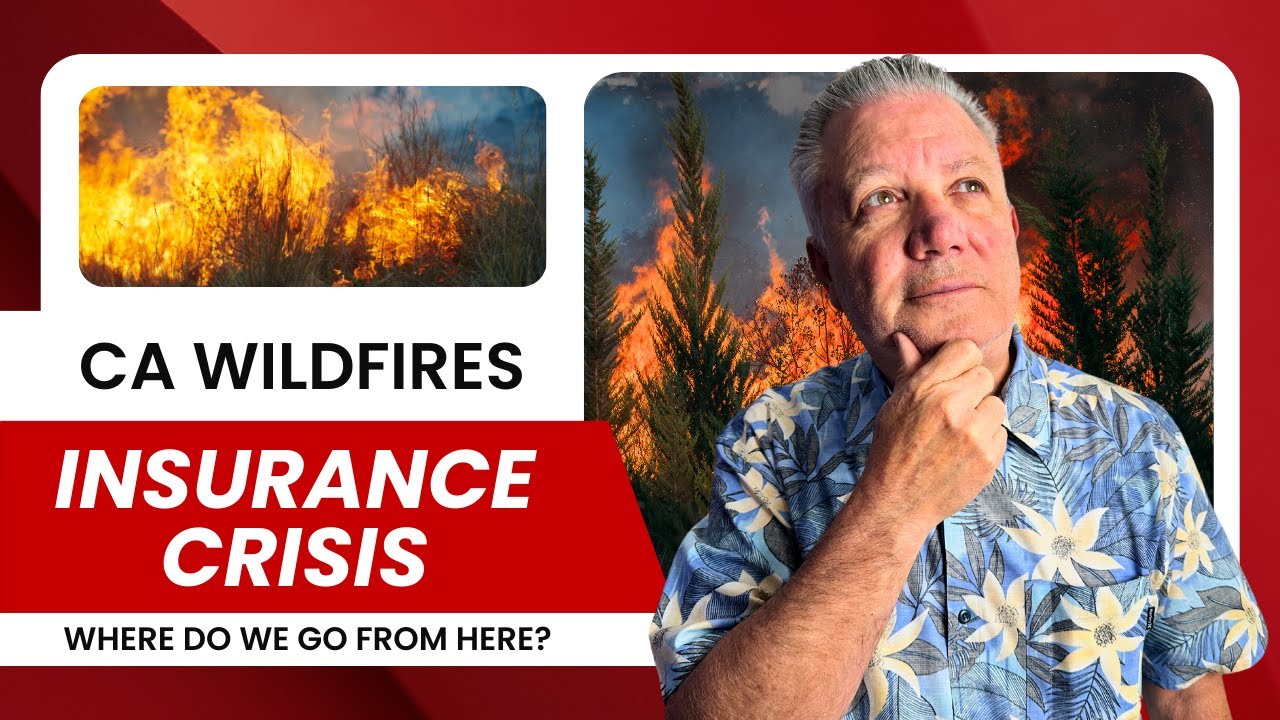
In this YouTube video, broker and longtime investor Joe Homs (contact 949‑625‑4533) introduces a deep‑dive into the California homeowners‑insurance crisis triggered by increasingly severe wildfires. He weaves together news clips, commentator remarks, and interviews with residents and officials. The video explains how a series of catastrophic fires—most notably the 2018 Camp Fire—have driven premiums sky‑high, caused major insurers such as State Farm to stop writing new policies, and led the California Insurance Commissioner to impose a one‑year moratorium on cancellations. Commentators blame both the insurers for pulling back and California’s Democratic‑run government for regulatory constraints that keep premiums low for insurers but unaffordable for homeowners. The discussion expands to a national perspective, citing Senate Budget Committee findings that climate‑driven extreme‑weather events are spiking non‑renewal rates in states like Florida, Louisiana, and North Carolina, potentially echoing the 2008 housing crisis. The video warns that the lack of affordable coverage could force homeowners to abandon rebuilding, depress property values, and jeopardize mortgage lending. The FAIR Plan, California’s private stop‑gap fire‑insurance program, is presented as a limited, under‑funded safety net that many view as “anything but fair.” Throughout, Homs frames the situation as a critical warning for investors, urging vigilance and suggesting relocation or alternative investment strategies may be necessary.
Chapters
Imagine losing everything to a wildfire and then realizing your insurance company won't pay up. That's the nightmare thousands of homeowners are waking up to. Hey everyone, Joe Holmes here, broker, mentor, and investor for over 40 years. Today we're diving into a shocking reality: how wildfire victims are facing an insurance crisis that could lead them completely stranded. As someone who spent decades in real estate and investing, I've seen how critical Let's break this down and see what really is going on.
Fires could be one of the most expensive natural disasters in U.S. history. The state facing an insurance crisis that has already left thousands of Californians struggling to find and keep affordable homeowners insurance. ABC's Christiane Cordero in Pacific Palisades.
This is an insurance crisis that It was man-made by our government, by the people running California. That's all this is. Everybody saw this coming, and now everybody's in a panic mode.
Tonight, many homeowners affected by the devastating wildfires in Los Angeles taking their first step toward rebuilding their lives, filing an insurance claim. I'm so sorry, but as too many Americans know, No, getting compensated can be difficult, and in California, the system is facing a crisis years in the making. Insurance premiums soared after the Camp Fire in Northern California's Butte County in 2018, at the time the deadliest and most destructive wildfire in the state's history. Several major carriers have since restricted fire coverage or stopped writing new property insurance.
Can we blame the insurance companies for this? No, you can't blame them. They've already paid out millions of dollars, maybe billions. of dollars on fires. This is, again, this is this Democrat-run California that caused this. And of course, yeah, let's protect the homeowners and let's keep the fees low for the insurance companies so that they can't even make any money here. I don't blame them for leaving. I really don't.
Policies in California entirely. State Farm, California's largest provider of homeowners insurance, announcing in 2023 it would stop accepting new applications from California residents, citing, among other things, rapidly growing catastrophe exposure.
Is that a red flag or what? I heard a red flag there, but nobody's listening to the red flags that have been constantly going off.
You know, fire danger here, fire danger there, fire here, payout claims there, red flag, red flag, red flag, and nobody changes anything.
Insurers pulling back. Thousands of California homeowners have been left without coverage.
These insurance people decide—
I'm sorry, it's not the insurance people. It is not the insurance people. If they can't raise up their fees Accordingly to whatever is going on in a particular situation—hurricanes, floods, earthquakes, and now fire—which California is basically on fire the entire year—it is not their fault.
To cancel their fire, and we're going through this, and it just happened, and they have no fire insurance.
The California Insurance Commissioner issuing a one-year moratorium to protect.
I'm also calling on insurance companies to suspend any pending non-renewals and cancellations that homeowners received before these fires started.
Isn't that nice? He's calling on insurance companies to suspend cancellations, which he has really no authority to ask them to do that. And if I was running an insurance company, I'd say, yeah, thanks, but no thanks. We're just gonna pull out. Completely. And then you figure out what you want to do with insurance. This is nuts. This is crazy.
This problem isn't unique to California. An investigation by the Senate Budget Committee finding that climate change-driven extreme weather events are leading to increasing non-renewal rates and spiking premiums across the country, particularly in Florida, Louisiana, and North Carolina. The report suggesting the insurance crisis could lead to a housing one with echoes of 2008, saying—
Oh my God, let's go back to 2008. I would love to go back to 2008. Uh, these climate-driven insurance crises, just crazy. Uh, like, did we just wake up and say, uh, yeah, there's fires in California? There's hurricanes in the middle of the country, and Florida has a lot of water damage that occurs every year. No, that has been there forever. You need to insure yourself so that if it does happen, you have the proper insurance. And sometimes, yes, it's more expensive than you thought, and maybe you ought to think about Not living there, not building that place back up. I know that probably sounds really cruel, but if my house got blown away, you know, every year, I'd probably relocate someplace else.
This is predicted to cascade into plunging property values in communities where insurance becomes impossible to find Or prohibitively expensive.
Yes, and I agree with that statement totally. I don't live in Florida, but I hear all this stuff going on in Florida that the values are plunging for that reason, because you can't get insurance on a property. So you have to go without insurance, and nobody wants to go without insurance. Plus, the lenders are not going to lend any money On the property if, if it's not insured. So I do hear that, yes.
Climate change is no longer just an environmental problem, it's a looming economic threat. Whit, a spokesperson for California's FAIR Plan, the state's private stopgap fire insurance program, says they are aware of misinformation spreading online about their ability to pay claims, but they want to reassure homeowners that they have prepared for disasters like this. And intend to keep their commitments.
I love the way that, uh, some government officials name these things Fair Plan. The Fair Plan is anything but fair. It is the last resort for insurance. It does not cover 100% of the property. It does not cover liability insurance as well. So you have to get Maybe 2 or 3 different policies to cover you completely from what insurance companies were covering before. Uh, just because you come up with a name called Fair Plan doesn't mean it's fair.
This is a wake-up call for every homeowner and investor out there. What's happening in wildfire zones today could happen in other high-risk areas tomorrow. Have you or somebody that you know faced insurance issues like this? Drop a comment below. I'd love to hear your thoughts. Thanks for watching the video. Make sure you like and subscribe and share this video so that other people can get informed. We'll see you on the next one.