3 Shortcuts To Unstoppable Success
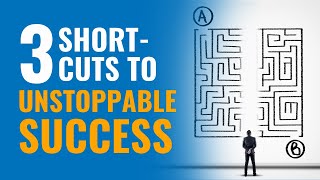
John Assaraf (speaker) delivers a motivational YouTube talk outlining three "shortcuts" to predictable, accelerated success: (1) create a clear vision with specific goals and a compelling "why" to activate motivation and the brain's planning centers; (2) align conscious goals with subconscious conditioning by reprogramming limiting beliefs and habits (techniques: "I used to... now I am..." reframing, visualization, cognitive priming, affirmations) so neural dissonance and self-sabotage are reduced; and (3) follow proven blueprints/systems (franchise-thinking), seek training, peer support and templates to avoid costly trial-and-error. He supports claims with personal anecdotes (mentors Alan Brown, Bob Proctor, Walter Schneider), neuroscience references (left prefrontal cortex, occipital lobe, limbic system, conscious vs. subconscious ~3%/97% framing), and practical calls-to-action (daily review, 10–15 minutes of subconscious alignment, commitment vs. interest). Tone: motivational, instructional, anecdotal.
Chapters
I don't want to invest one second on why I can't. I want to invest all my time, energy, attention, and focus on how I will, because I must. Here's a question I want to ask you. In times of uncertainty, in times of unpredictability, is it true? Is this a fact, what I have up on the screen right now, that many successful people struggle first before they ultimately succeed? Is that true? Right. Yeah. Many of us succeed, but it's not a rocket ship ride straight up. So anybody who tells you, you know, that there's a straight rocket ship ride straight up, you probably missed the rocket ship ride yesterday where the rocket went up, but then it came down and crashed. So even the most successful people in the world struggle first, fail first before they ultimately succeed. And one of the reasons for that. Can anybody guess what one of the reasons is that people who are relentless in their pursuit fail because they try lots of things. Anybody who tells you that everything they try and everything they do works is a liar. Not true. Even the most successful people fail in different areas of their life. Now, you can learn from your own mistakes and your own failures or what's the other option? What's the other option? One of the secrets to my success, Learn from others, right? So you can learn from others as well what they did well and what they did not so well. What is it worth to learn from others? For me, it's been worth, you know, my whole life. Success is on the shoulders, standing on the shoulders of people who have succeeded before me. So many of you know this question, right? And do you believe that there is a formula, recipe for predictable success? I want you to think about this question for just one minute. I will share a couple stories with you, and I want you to think about this for just a moment. There is 108 billion humans have walked on the face of the earth and we've been doing science, biology, chemistry, science research for 500 or so years, right? Proper science. If somebody wants to lose weight and keep it off, for example, is the how to available either in a book on YouTube through a coach, a mentor or somebody, is the how to available? So Lisa says, no. Everybody else said, if you want to start a business and learning how to sell and market and manage and do finance and do legal and do it, is the how to available? If you're serious, right. If you want to be in a loving, caring, kind relationship that's mutually respective, is there a how to. Are there things you should do and things you shouldn't do, right? Absolutely. So Whether it's health, wealth, relationships, career or business, or anything. For the most part, for 99.9% of the goals that you and I want to achieve, the how to if we are serious, is readily available, right? You know, we have our mobile phones, we can go on to Google, YouTube, we can ask friends, family, etc. So if you want to bake a double chocolate fudge cake, can you follow a recipe? And if you follow the recipe in the right order, can we duplicate a chocolate fudge cake? If we follow our recipe. Now, if we take the recipe and then we throw in something that shouldn't be in there, we can mess up a really good baking is a science. That's right. I see that we have a baker. What about a Rubik's cube? Many of you know that I'm a Rubik's Cube lover, right? If you want to learn the Rubik's Cube, you can try and figure it out on your own, right? Or you can go onto YouTube and watch a 10 year old kid who knows the exact algorithms of what to turn left and what to turn right and what to turn clockwise or counterclockwise and you could solve the Rubik's Cube. Would you agree with a 2x2 in less than 10 minutes, a 3x3 in less than 20 minutes, a 4x4 in less than half an hour. If you were what if you were what if you want to live a healthy lifestyle. Do we know the recipe for eating well, for sleeping well, for exercise, nutrition, et cetera? Of course we do. What about building a business? The recipe is there. Some of you know this story and I'm going to give you some very specific examples. So I'm going to tell you the story a little bit different. When I was 19 years old, many of you know I met this mentor. My life was going in the wrong direction and I am not doing really well at 19. I am 59 now. Now this mentor asked me what is it that I wanted to achieve. And I had no idea other than getting a car, making more than $1.65 an hour. I want to move out of my parents house. Those are my goals. But he asked me for some of my bigger goals and dreams. And since I didn't have any, he had me write down what kind of lifestyle I wanted to achieve. He asked me what kind of contribution did I want to make to my parents. He asked me what kind of car I want to drive, what kind of home I want to drive, how much money I want to make, how much money I want to save how much net worth I wanted. And all of the questions he asked me, I had no idea, no idea how to answer. And so I just made stuff up from a TV show that I used to watch. And guess what? He made me write it down. Now, I didn't know it then, but I know it today, that the very act of getting clear on what you want, creating a powerful, clear vision of what you want, and having specific goals, timelines, goals, when you're going to achieve timelines, is one of the most critical things you can do if you want to use your brain better. Why? Let me explain this, ok? When you set your goals, there's a part of your brain called the left prefrontal cortex, the Einstein part of your brain. When you set the goals of what you want to achieve, even if you do not know how to achieve it, even if you do not know how to achieve it, when you set those goals up and you create a powerful vision using your brain, and you activate the vision center in your brain, the occipital lobe, it is what is connected to your motivational centers. So what we want to understand, the first shortcut I can give you right now is even if you don't know how to achieve it, okay? Even if you don't know how to achieve it, you have to start with a vision. No differently than like a captain of a ship has to choose her destination, where is she going to end up? Or a pilot of a plane has to choose his destination where he wants the plane to land. There's a lot of turbulence and things that happen along the way, but that's when you adjust. But the first thing that you must have is the vision and specific goals of what you want to achieve. And I'm going to repeat this 100 times. Even when you don't know how to achieve it at first. Why? Well, we already established five minutes ago that all of the how to, if you are serious, is available. So you don't stop yourself from achieving goal or setting goals just because you don't know how to. Right now, all the how to comes after you make the decision of what you want. Does that make sense? Fundamentally? I'm going to give you a whole bunch more stuff over the next hour. So what I want to know from each one of you, are you ready to create a vision that is worthy of your life? Are you ready to create goals that you will learn how to achieve? How to is easy. Now, second part of the equation is when we are setting goals and a vision, yes, we Use that part of our brain. Yes, we want to activate this part of our brain, but sometimes there is another part of our brain called the limbic system that gets in the way. So in many cases, people that have goals don't activate the emotional center of their brain to give them the reasons why they're going to overcome any of the obstacles or hurdles that are in their way. Now, is it true that we will all have obstacles and hurdles along the way to achieving our goals and dreams? Is it true that maybe we have beliefs that might get in the way, or limiting beliefs or fears, or we feel we're not worthy of it, or we are uncertain, we procrastinate, or we self sabotage? Is it true that that's going to happen? Yes, we're human. Now. If your self doubt, if your fears, if your limiting beliefs, if your self image is bigger than your why, why must you achieve it? If your stories, reasons, excuses, etc. Are bigger than your why, then the stories, reasons and excuses win. And even though you have a vision and goals, you don't have the motive for action. The motivation for action. And so what do you think you must do if you want to get your brain working for you instead of against you? If one part of your brain says, this is what I want, this is how I'm going to achieve it, but another part of your brain, the deeper parts of your brain, okay, say but I'm not good enough, I'm not smart enough, I'm not worthy, I don't know how to achieve this. I can't achieve this. What do you think is going to happen? Do you think you're going to take inspired action? Or do you think your stories, reasons and excuses are going to win? So what you must do when you set a vision and goals for your life, you must also ask yourself, why must I achieve this? How many of you would get rid of any stories, reasons or excuses that are holding you back right now? Would you upgrade your knowledge and upgrade your skills so that you become the woman, you become the man capable of achieving that goal no matter what? Will you allow your limiting beliefs to hold you back? Will you allow your fears of failure or fears of being embarrassed or ashamed or ridiculed or disappointed hold you back? Or will you take inspired action no matter what, honestly, with integrity and professionally, of course you would. So if the why is big enough, what you have to do and what you have to change and what you have to learn becomes easier. I didn't say easy, I said easier. Do you see why you have to have a reason why you must achieve it. In the absence of emotional or two or three reasons, people, God, disappointing yourself in the absence of not having a big enough why, you're going to activate that Frankenstein brain that's going to hold you back all of next year. And another year is going to go by where you have this vision, you have these goals, you have these wants, you have these desires, but you don't have the motive for action through any of the obstacles. Many of you have seen my former home in the movie the Secret. How many of you saw the movie the Secret where I had a vision board of the home that I wanted, the car that I wanted, the lifestyle that I wanted. Well, this was the home. On the vision board, I take all of my goals, I put them on my vision board. Do you have my exceptional life blueprint here? I put them on my vision board. I look at them every single day. I create plans for them. And by taking what my first mentor taught me back in 1980 of creating my vision and my goals and my big why, I will show you a couple more shortcuts in a moment. And looking at them daily and making progress daily, I was able to achieve my dream home, dream lifestyle with my wife, written some books, built some companies. And I don't share this with you to impress you, but I want to share with you. You know, I left high school at grade 11. I wasn't supposed to succeed. I didn't have the IQ at that time. But by setting some goals and then following through, because I had the motive for action, I was able to achieve a few awesome goals in my life. And that's why I love to share it with you. There is a process, a recipe that you can follow. So that was number one. Now, Mr. Brown asked me this question back in 1980, and many of you that are in my programs now, you know or have heard me speak or on a podcast, heard me say that. He asked me this one question, and the answer to that question changed my life. So the question he asked me after I wrote down my goals was, are you interested in achieving your life's goals and dreams, or are you committed to achieving them? And when I asked him what the difference was, he said, if you are interested, you will do what is easy and convenient. But if you are committed, you are going to do whatever it takes. So I am going to ask you, you gave me one goal that I looked at. Double your income, triple your income, buy a house in Spain, make a million dollars, start your business, become a coach, write A book. Are you interested? Are you committed? Interested people do not achieve their goals. Interested people have hope and prayer, okay, as their core strategy. Committed people achieve their goals. And listen, if you have small goals, okay, you'll achieve them. But if you're not committed to being the author, being the coach, starting that business, being successful, paying off your debt, having enough for retirement, traveling when we can all travel again properly, and living the lifestyle of your dreams, then you're going to have excuses instead of solutions. Does that make sense? Right? And many of you are saying you're committed, right? And a lot of you are not even prepared to put in that you're committed. So what's holding you back? So let me share with you my second mentor, and many of you saw my good friend Bob Proctor in the movie the Secret with me. And he's been a dear friend for 40 years now. And there's a couple things I learned from him. So from Alan Brown, I learned shortcuts, number one, vision goals plus big why, and daily focus on those goals and being committed to. To my goals. Ok? So my second mentor, is this helpful, by the way, I'm going to break this down for you into very, very easy steps to understand and follow, right? So Mr. Brown did that for me, Mr. Bob Proctor, who is still, I think he's 86 or 87 now, still, you know, helping a lot of people. So here's something that he showed me, and this was the beginning of my fascination 40 years ago with the human brain. The parts of the most powerful biocomputer in the whole universe. Can anybody guess what it might cost to replicate what you already own? What do you think it might cost scientists or technologists to replicate? All right, what you already own? We've invested already over hundreds of billions of dollars, and we're just starting to understand what this does. We've already invested hundreds of billions of dollars trying to build computers that work better than our brains. Now, we have some computers that can work faster, but not the parallel processing that this organism does. But you already know a little bit about it, right? How many of you heard right? That 3% of your behaviors, your deliberate behaviors, 3% of your thoughts, okay, or 3% of your behaviors around your goals is because of your conscious mind. How many of you have heard that? And then how many of you understand that just like there are different parts to a car, different parts to your watch, different parts to an airplane or a boat. A boat. You can tell I'm a boat from Canada, there are different parts to your brain. So there's the conscious part of our brain which is responsible for choosing deductive reasoning. I want this versus that. This is what I want to have. This is what I don't want to have. Pretty simple. Our conscious brain, we can use our imagination, right? We can use our imagination. We can imagine what our life will be like with what we want or without what we don't want. And then we can have the desire and the why that we can just sit and think about, right? So we can use our conscious mind to choose to imagine and to come up with reasons why we want to or don't want to. That makes sense so far. I'm going to try. I'm simplifying this as easy as possible for you. So then we have this other part of our brain that's called the subconscious or otherwise known as your automatic self. So think about this. Were you born with any beliefs? Were you born with any habits? Were you born with any perspectives or born with any paradigms? And the answer is no. No, no, no. Which means we developed beliefs, we developed a self image, we developed fears to certain things, we developed habits that drive our behavior day in and day out. Does that make sense so far? So 97% of your life and my life, okay, is us just operating the natural conditioned patterns that we have gained since birth, right? And so by the time we are in our twenties, right, twenty. By time we are in our twenties, mostly by the time we are twelve years old. By the time we are in our twenties, our beliefs, perspectives and habits are already ingrained in our subconscious mind. And so if 97% of what we are doing is ingrained in our subconscious mind, is it possible? Is it possible that you are achieving the health, wealth, relationships, career, business, finances, goals that you are conditioned to achieve versus what you are capable of achieving? Is that possible? Is it possible? Listen, 40 years ago, I started to learn the difference between the two and become somewhat of an expert in understanding the brain and behavior and perspective and habits and beliefs. And so wouldn't it make sense? All right, think about this. Let's say you have a mobile phone and you have old software. What would be a logical thing to do? Let's say you have a computer and there's old software upgrade. So if your subconscious mind, your conscious mind is what chooses, but your subconscious mind is what's conditioned. So if your subconscious conditioning, okay, doesn't line up with your conscious desires, right? Conscious desires don't line up with your subconscious conditioning and your software doesn't make sense that we have to Upgrade the software. Right, So I started this process 40 years ago. And what happens from a neuroscience perspective is when your conscious goals don't match with your subconscious conditioning, neural dissonance or chaos happens in our brain. And this is what caused us to procrastinate, to self sabotage. This is what causes the Einstein part of the brain, the left prefrontal cortex, to lose the blood flow. And the blood flow goes to the Frankenstein part of your brain. All right? The part of your brain wants to keep you stuck in your current comfort zones. And we can actually see blood flow changing from different parts of our brain that affect motivation, affect behavior. So what we want to do is this. Understand, let's say you want to achieve 150,000 doll, but you feel you're only worthy, or you're conditioned to earn 75,000. Or if you want to earn 75,000, but you're conditioned to earn 20,000, when there is that disconnect, you have neural dissonance. Does that make sense so far? If you want to become a millionaire, but you have some software program that you're not smart enough, then guess what you do? You sabotage your success. If you want travel and stay in five star hotels and travel business class or first class, but you can't afford it, there's a disconnect. If you want to have your dream home and dream life, you want to become a coach, you want to write a book, but you feel you don't deserve it, you're not smart enough, not good enough. If there is a mismatch between our conscious goals and desires, all right, and our subconscious programming, we will sabotage our success. So fundamentally, does this make sense to you? All right? Because if you feel like you want to have something, vision, goals, dreams and a big why, you have to create alignment. All right, give me one second. I just need to change something over here. So there are only four things that can get in your way. And I'm not going to spend a lot of time on this, but I'm going to share with you what can get in your way. So number one, if your vision and your goals are not aligned with your self image, self esteem or self worth, what do you think is going to happen? Do you think you're going to take inspired action in spite of not feeling worthy enough? Do you think you're going to take inspired action if you don't believe you are worthy of achieving the goal? Of course not. Now, what about limiting beliefs? I have a vision and a goal to write a book, to become an author, to make Three times more money, become a millionaire, whatever the case might be. But you have a limiting belief. Do any of you have a limiting belief here? I'm going to give you one technique right now to help you eliminate limiting beliefs. Give me a limited belief. In the chat right now. Give me one limiting belief. I will give you a technique, a technique that will help open up your brain instead of close your brain up. So I'm not good enough or I'm too old, I'm not reliable, I'm not smart enough. There's way too much competition. Not strong enough. Okay, pay close attention. When we have a limiting belief, what are we really saying? We're saying, okay, if we want to go to a higher level of understanding, is that somehow this pattern in my brain got wired, right? Connections, the software became connected, then reinforced, and now it is causing me to think, believe, perceive and behave in ways that match this limiting belief. Does that make sense so far, since we weren't born with any beliefs and we develop beliefs, Some beliefs are constructive and positive, some are negative and destructive. So what if you said to yourself, here's the technique. I want you to write down your limiting belief, and I want you to write down something right after that, I want you to write down in past tense, I used to believe that I'm not smart enough, I'm not good enough, I'm not skilled enough, I'm not reliable, I'm not worthy. And now I'm learning that I am good enough, am smart enough, am worthy enough, am capable to achieve my goal of blank. So we write out the limiting belief, we create a counter belief and we tell our own brain, I used to believe that and now. And we write out the positive and connected to our belief. Now, if a belief is nothing more than a pattern that we learned and reinforced, what if we took a belief that we wanted and what if we impressed it into our subconscious mind and we deliberately changed our own subconscious conditioning? Do you think that might help you achieve your goals and dreams? Now, what if we have disempowering emotions like fear, fear of failure, fear of success, fear of being embarrassed, ashamed, ridiculed or judged. If we have a vision and a goal, but we have a fear, which part of our brain is working? If we have fears, Frankenstein brains active, trying to protect you, Right? So can you use the. In the past, I used to. Now I am learning how to. Now I am taking action. Now I am becoming everything I need to become to achieve my goals and dream. Can you use that little technique for fears or limiting belief? Or self image challenge. That is just one of many, many techniques. And then obviously if you don't have the knowledge or the skills that is actually going to create fear and uncertainty. And in brains, when we feel fear or uncertain, that's called stress in our brain. When we have stress in our brain, we don't want to take inspired action. Does this make sense? Fundamentally. All right. Because when you want to achieve your goals and dreams, then you want to align your conscious and subconscious together so that you have your beliefs, emotions, self esteem, habits and your paradigms aligned. And what that is called is coherence. Right. We have self image, self worth, self esteem. We have emotions, fear, uncertainty, knowledge and skills. And if anybody wants to take a picture of this right now, please take a picture of it and do me a favor and post it on social media. So I'm doing a wonderful training right now with John Assaraf and take your cameras out and take a picture of any one of these slides. I'm totally cool with it. And just do a inner size, inner size exercise for your physical body. Inner size for your brain. Based on my new best selling book, the New Science to Unlock youk Brain's Hidden Power. Does that make sense so far? Ok, so we want to create alignment. And so let me ask you a question. All right. We have talked about all the lessons I learned from my second mentor. So how do you think you can create neural or brain alignment between conscious and subconscious? What do you think you can do in order to create coherence, alignment, harmony? What about visualization? Can you see yourself with a self esteem worthy of goals? Can you see yourself letting go of limiting beliefs? Can you visualize using the occipital lobe? Okay. Activating it. Martha says act as if right. Behave your way into a new neural pattern, speaking it out through movement. Visual arts, Visualizations. Yes, absolutely. Think about this for just a moment. If you did not have any beliefs, perspectives, paradigms, habits or any fears when you were born, other than the fear or reaction to loud noises, then your brain became conditioned to believe certain things about yourself and about what's possible or not, or to fear certain things. You learned those things. Well, we can unlearn the things that disempower us and we can deliberately and consciously evolve ourselves. And I'm going to come back to what did we say earlier? We first started the session today. We said that the how to exists. The question is, are you committed to right. If the how to exist and you're committed, then you can do it. And Lolita. Yes, New Grooves in the brain, new roads. New roads, New roads in the brain. So we can use affirmations, visualizations, meditations, subliminals. We can behave our way into it. We can do mental contrasting techniques. Absolutely. That is the way you do that. I started doing something called cognitive priming 40 years ago. Cognitive priming is every morning when I wake up. I review my goals, I review my beliefs, I review my why, I review my vision every morning. I inner size to create strong, empowering neural patterns and networks and beliefs. Now, is it true that your perception of what's possible, your perception of yourself, is your projection? Is it true that your perception about yourself and your perception about what's possible, also your projection? Of course it is. Our brain is looking for things in the physical world that match the internal map of reality that we have been conditioned to have. Our brain doesn't see what's out there. Our brain only sees out there what's in here. So the old adage, I'll believe it when I see it, it's wrong. It's when I see it in here, that's when I will see it out there. Does that make sense? So you have to see it and perceive it in your mind's eye and in your heart of hearts first. Then your brain projects and finds you everything that is in line with that. So perception is projection. My third mentor, somebody I love dearly, still talk to on a regular basis, Walter Schneider. And at the age of 22, I met this man, Bob and Alan I met when I was 19, 20, 21, 22. And then I met Walter Schneider. And Walter Schneider shared with me some lessons that were the leverage points for exponential growth. Right? For exponential growth. Not for like, you know, from 1 to 2 to 3 to 4 to 5. It's like 1 to 50, 50 to 500. 500 to 5 million in terms of steps, Right. So what did Walter teach me? Well, I want to shift your mind right now for just a moment. Walter still to this Day is the CEO of ReMax of Europe. All of Europe, Indiana, Wisconsin, Minnesota, New England and all of eastern Canada. And Walter's company this year will do about 50 plus billion in sales. 50 plus billion in sales. Now, when I met Walter, he had just bought ReMax for Eastern Canada. And so ask yourself this question. Why do people invest $25,000 to $500,000 for a franchise? Let's think together. Okay? Let's think together. Why do people invest 25,000, $50,000 for a franchise? Like, why would somebody do that? Why would they just Start their own business in real estate or sandwich shop or oil changing burger. So Deepak says, systems and proven because they know how it works. It's a formula established and trusted. Right. So what is more expensive, figuring it out on your own or following a blueprint? Like, what's more expensive figuring out on your own or paying for a blueprint? Right. Starting from scratch is the most expensive. Not knowing the formula or the blueprint is the most expensive. Right. And so a lot of people think that I'm going to save money by figuring it out on my own. And you know what most people do? They don't achieve their goals and dreams. Why? Because it's so complex to figure out all of the different complexities of whether it's a business or life. But I want you to understand the thinking behind this. Right. So how many of you love blueprints like I do? I mean, I love paint by number. I don't want to spend my time figuring it out. I want to spend my time doing what works. I want guidance and coaching, of course. But I want to just, like, tell me what to do, why to do it, how to do it. Let me go. Right. And so if you're into blueprints like I am, that's great. Let's dive into shortcut number three when it's thinking like a franchise owner. Okay? So, Wendy, don't reinvent the wheel. So thinking like a franchise owner. All right, take off your you hat right now. I want you to put on your franchise owner hat right now. And many of you have already said this. A franchise owner pays 25 or 50 or 100,000 or $500,000 to follow a process that works. That's taken in many cases years and millions of dollars in many cases, or hundreds of thousands of dollars to figure out what doesn't work so that you can figure out what does work. Right? So we established earlier that highly successful people fail, but then they succeed because they've learned from their mistakes or the mistakes of others. So wouldn't it be logical and smart of you to follow a process and blueprint that works? You want to lose weight, we know how to lose weight. You want to lose fat, it's a whole different story. You want to have a better relationship, we know how to do that. Build a business. We know how to write a book, we know how to do that. Become a coach, we know how to do that. Grow the business, we know how to do that. So follow a system that works. Do you all agree it's better to follow a system that works. I think many of you said yes. What about a franchise? Structured coaching and ongoing training that they have every single franchise. And many of you know, I owned ReMax of Indiana. I had 85 offices, 1200 salespeople, $4.5 billion a year in sales of what we used to do before I sold it. And every single week, we had training to upgrade knowledge, to upgrade skills, to support our franchisees that would pay us between 15,000 and $100,000 for a franchise. Okay, In Indiana. So they had ongoing training and support. So not only could they learn from me and the experts that I brought to them, but they could learn from each other. So there was group learning that happened. And so if we figured out something that worked over here, we would share it with everybody so that we would lift each other up as we climb. Does that make sense? Do you like that saying, lift each other up as you climb? Right? So that is what we did. And then, as I mentioned before, the support needed to overcome obstacles. Every one of us on our path to life, success is going to have obstacles. There is just no way around. Anybody who tells you it is a straight rocket ship right up to the top is lying to you. It just doesn't happen that way. However, when many people are figuring out challenges together and helping each other lift each other up as they climb, then the path and the process becomes easier because you are not wasting your time figuring it out on your own. So the collective mind and brain that we have, you know, working with others helps, right? And then imagine that, you know, five people all got together and they said, we're committed to each other, to helping us achieve our health goals, financial goals, life goals, business goals, whatever it is, right? Are we better as a pack or individually? If five people or 50 people or 500 people? All right, we are all working as a team to help each other. We are stronger in packs. You know, we are stronger in packs. A lot of times the people that want to be alone, a lot of times it is out of fear, right? And so PACs really, really helps. And so the three shortcuts for you is first and foremost, create your vision, goals, and your big why. So you activate the motivational centers in your brain, the limbic emotional centers in your brain, and the visual cortex and motor cortex part of your brain, right? Can all of you do this? Your vision, your goals, and your big why. Can you get it done? Done? How many of you can get this done? Clarity is critical. Critical. Even if you don't know how, even if you don't know what to do even if you don't have the knowledge or skills yet. When we are committed, what do we do? When we are committed, what do we do? When we are committed? When we are committed to a goal, we act. Do we find a way? Yes. We take action. What do we do about fears or uncertainties? What do we do about that? When we are committed, what do we do about our fears? When we are committed, what do we do about our limiting beliefs? When we are committed, what do we do about uncertainty? What do we do? When we have obstacles? What do we do? If we are committed, we do whatever it takes, right? We figure out a way. Listen, I want to share some of you. This is a little secret. You can have excuses and stories and reasons why you can't, and you can have success, but you just can't have them at the same time. So which do you want? Do you want your stories, your reasons, or your excuses and your limiting beliefs to drive you? Or do you want success to pull you and lead you towards it? Which one do you want? We all have stories, reasons, excuses. I can give you a ton of them. Why I can't, but I won't even go there. I don't want to invest one second on why I can't. I want to invest all my time, energy, attention, and focus on how I will, because I must. I want to focus all my energy and attention on how I will, because I must. Now, how many of you feel like you must achieve your goals and dreams before you die? How many of you are prepared to have a little bit of discipline so you don't have a lot of regret? Right? A little bit of discipline to avoid a lot of regret? Of course, then you must be committed. Then what you want to do is create the subconscious alignment. And wouldn't it be worth it to invest 10 or 15 minutes a day, 10 or 15 minutes a day to create subconscious alignment? Right? Of course, it's worth it. And then follow a proven blueprint for success, right? So those are three shortcuts, you know, for unstoppable success. Don't figure it out on your own. Follow a proven blueprint. Hey, this is John. And if you like that video, watch the next video because it is packed with things that you can do right now to achieve success way faster than ever before.
More from John






Millions of individuals around the world are grappling with various mental & emotional health issues




