Code to Joy - The Four-Step Solution to Unlocking Your Natural State of Happiness
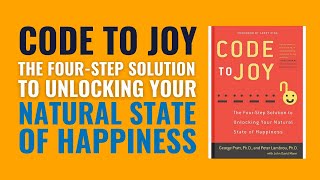
John Assaraf interviews Dr. George Pratt about his method for removing subconscious beliefs that block happiness. Pratt uses neuromuscular feedback to identify microtraumas from childhood, then clears them in four steps: identify, clear, repattern, and anchor. A woman named Stephanie spent her life feeling worthless from one childhood event until the process freed her.
Questions this video answers
April 12, 2012.
codetojoy.com.
Chapters
Hey, friends, this is John Assaraf, CEO of Praxis Now. And with me in studio here is my great friend Dr. George Pratt, who is one of the leading psychologists in the world, author of four books. He's got a private practice in La Jolla, California. He's been doing specialized work with individuals to become their best. I mean, individuals that are academ Award winners, Grammy winners, business executives like myself, Olympic medalists, Super bowl winners, professional athletes. He's spoken at Tony Robbins events, Larry King Live many times. He's worked with Ken Blanchard, and his celebrity client list is unbelievable. Most of it is confidential. However, I can mention that he's worked with Larry King, Carmen Electra, Rob Diedrecht, Dara Torres, who you may remember as the three time Olympic medalist in swimming, and Dr. Spock. And he's written, I think this is your fourth book, right? Code to Joy. He's written four amazing books, Hyper Performance, Release youe Business Potential, Instant Emotional Healing, which is a process he created for instant emotional healing. And I mean instant, you know, acupressure for the emotions and a clinical hypnosis primer. I mean, he's got incredible endorsements by Apollo Osterde. You may remember Edgar Mitch Mitchell. I'm endorsing him. Ken Blanchard endorsed him. My friend Jack Canfield does, Dr. Daniel Amon, brilliant brain guy, Marci Schaimoff, and just a host of other people. And the reason is his material is cutting edge, world class. And George has been chairman of Psychology at the Scripps Memorial Hospital here in La Jolla, California. And he's been on their staff for, what is it, over 15, 20 years already?
Quarter of a century.
Quarter of a century.
I'm dating myself right now.
He's dating himself. But what I can share with you is there's. There's probably nobody better in the world that can help you get into the psychological reasons that may be holding you back from being your best, having amazing performance and really loving your life and being happy and feeling like, yeah, this journey is amazing. Now I'm here to talk with you and with him specifically about this amazing book that is just coming out called Coach of Joy, called Four Step Solution to Unlocking your natural State of Happiness. Natural state of happiness. So if you're feeling doubts, fears, lack of confidence, lack of certainty, if you're feeling like you're not living in a natural state of happiness ongoing, there's got to be something happening up here. And you know, I love the human brain and what it can do. And this guy is one of my Go to guys and is one of my advisors on the brain. And I want to invite him in the studio to talk about this book so that you could be happier and you can unlock your code to joy. So George.
Hey buddy, good to see you again.
Handshake, baby, handshake. So let me ask you a question. This book is all about really the code to happiness, the code to joy. Give us a little bit of insight of why you wrote this and why you wrote it now.
Well, you know, it's an interesting thing. Many of us go through life and we're doing fine, but we're not doing what we are capable of doing. In the book we call it the fog of distress. It's like a faint veil that seems to interfere with our enjoying life fully. This really comes from something that's called microtraumas. These are small events, very small events that affect us really subconsciously. I'll get back to that in a moment. When I first started in practice quite.
A while ago, long time ago, you.
Said we were going to try to minimize that. Don't pay any attention to that. In psychology, we didn't really have tools that were very effective. We had the standard talk therapy, which were, which is helpful in many ways, but not really any power tools. So I started studying clinical hypnosis in graduate school and then advanced with that. And so my first book was on how to use hypnosis clinically in medicine and psychology. And I developed a tremendous love and respect and admiration for the subconscious. And I really realized how much of our lives, even in high functioning everyday lives are controlled really by the subconscious. I know this is right up your alley because you have such an appreciation and so much of your work is associated with this. Well, now we know even in the last several years that we can even count the number of neurons that fire consciously versus subconsciously. And the ratio of consciously to subconsciously, it's 1 to 1 million. So the factor is 1 million times 1 to the number of conscious neurons firing per second happening at the subconscious level.
So I mean a million unconscious neurons firing while let's say 1:1 conscious neurons fires.
The ratio is 1 to 1 million. So it's like 40 neurons firing consciously to 40 million subconsciously. So we might as well use those that power to help us. And so it's starting out using hypnosis along with other tools. Now it makes sense to use that kind of tool even in everyday high performance work. So starting off working with people with challenges and then what kind of challenges?
You said micro traumas. What kind of micro traumas are the people that are watching this right now? What are the people that come to see you? I know a lot of them. Okay, they're looking well. I know. Well, I know a few of them. Sorry, I know a few of them and they're looking to just upgrade their performance. They're already performing well and they're saying, okay, what can I do mentally to get to the next level? So the average person out there, what are the micro traumas, people that are watching, what are they experiencing every day?
Micro traumas, like I'll give you an example from the book, Stephanie. Very high functioning executive, ran a large company, had gone through a divorce. She came in, she said, well, I'm not performing like I would normally. I think I need a little tune up desensitization on this. And she started telling me about this. I said, there's something more than that. Now we have tools to help get at subconscious material very rapidly. Neuromuscular feedback, it's phenomenal. So I started using that technique because we have people with their own answers with neuromuscular feedback. And the problem was not the divorce or anything else. She had. Actually, because of her poor performance, she put her company in bankruptcy. She had a lot of her own money in there too. So this was a devastating moment. And she said, I know I should have come in long before. Well, what. We determined that when she was seven years old, she was going out to help her aunt move some furniture. And her aunt was so grateful at her effort and she worked for several hours and her aunt gave her a quarter, just a thank you. And she was so excited because this is the first time she'd ever been paid. And she was so excited to tell her parents. She was expecting encouragement and excitement and honey, that's so great. They humiliated her. They demeaned her. How could you take money from a family member? They did this at dinner and it was horrible. She was traumatized when we found that and we got into that, she was crying and this affected her whole belief system about herself. In the book, we identify seven limiting life beliefs and one of them is worthlessness or feeling powerless. She felt worthless. She felt like she didn't deserve to succeed. And as a result of going back, identifying that, correcting that she could feel a difference how things lightened in her life. She came in and she was about a 7 on a 0 to 10 scale of depression. Even when we cleared that early childhood event, that went down to zero from an event at age 7. She's going, how could that be.
So she's been holding on to this child. She didn't even know it for she thought it was divorced many years. And it affected her performance, helped her bankrupt her company and obviously become miserable, unhappy. And part of what go to joy is unlocking that.
And in the time since that happened, she has now become successful again. She is living a full life. She is remarried to a great person. She has put her life back together. But she is an advocate of the system. She should do an infomercial, I think. But what happens is it's so amazing that something that seemingly minimal in a person's life could have that profound effect. And that's why I said it's a micro trauma. If you were hit by a bus and in the hospital for a year and you came out and you had a problem riding the bus or being on the street, we'd understand that was a huge obvious trauma. These are little traumas. I mean parents talking to you about receiving money, a quarter. But that changed her life and it changed the company. So. But it is possible to correct that.
So what are some other micro traumas? This one was where would this get in worthlessness, not good enough. It's obviously not smart enough. But where did that fit in?
That felt that was under worth. Under worth and then also feeling powerless. So it fitted into a couple. It fit into a couple of those. And that's what happens with many of these. And the. In the first chapter we have a belief assessment so people can take a look at the seven beliefs, see where they are. So we guide you to it. And there's a system of going through the book, a four step system of identify, clear, clear the energy field. I'll talk to you about that in a moment. And then repattern, where you actually go in and do something to clear the subconscious and conscious mind simultaneously and the body's energy system and then anchor all of this. That's what it's about. I'll talk to you about a couple other people too. As we're talking about these events, I'll mention another person too. This person, you know, and he's nice enough to have posted this on my website, Frank. And he said that he cleared a couple of beliefs. We did this over a period of time and it's not confidential. He said that in an easy, effortless way by clearing these beliefs subconsciously. In two months he lost £20 with no effort. He put together a business model that grossed a million dollars. And I think he did everything except improve his gas mileage.
Very good.
And because he was able to use all of his potential, what happens is most of us use a very small part of our potential subconsciously. You can check that with neuromuscular feedback. And there are mechanisms with the belief system to help empower people to use more of your own given gifts, which is very exciting.
It is. I mean, that's the field I love, obviously, is, you know, what's causing the blockages, what's causing your lack of the results that you really want and living your ideal life. And I see a lot of people who are out there busy, busy, busy being productive that are miserable. And when I saw this book and I saw that you were teaching what you charge. I know, a lot of money for your patients.
It's not as.
It's not a lot of money for the average person. When you're getting into a charging.
It'S a fraction of what it's worth, isn't it?
He charges a fortune, just so, you know, for people to see him at his practice. And the material is in the book, which is great. People are, I think, afraid to ask for help. I think there's something in our society that says, you know, I'm okay, I can handle it. And they're suppressing real feelings. There's one side of them that I see. I have these goals, I have these dreams. I feel something that tells me I can achieve so much more. And I've got these blockages that I just keep hitting. It's like hitting the wall. Hitting the wall. I don't know if you remember. There's the fly story. One of my friends, Price Bridges, says, there's a fly buzzing around, hits the windowsill, falls down, gets back up, flies around, hits the windowsill, falls down, and eventually the fly dies. And when my friend Price looked just over his shoulder, the door was open. And why didn't the fly choose that strategy when it was just seconds away? What prevents people from seeking help, from saying, you know what? I'm really ready to just break through and break free.
That's a beautiful point. People get stuck in certain patterns, and they don't feel either worthy or they feel powerless to do anything about it, or they feel that they're alone in the process, or that there's no hope for them, or that they feel so guilty they don't want to ask for help, or they don't feel that they're worthy of getting help. Going back to how I ended up starting to work in the optimal performance area and even adapting it to business and professional athletes, etc. What I noticed, even when I had all these great ideas when I started in practice, people didn't follow the suggestions. I thought, well, wait a second, people are paying me, I'm encouraging them. But there's a block. And what happens is we have these subconscious blocks that we don't know are there. So your just description with the window, that's exactly what it's like. And so we want to remove that block. We call them blocking life beliefs. And so when you can identify what they are, you know how to clear them, you know what the symptoms are. I'll give you another example. And this is, I don't know if you've ever seen Rob Dyrdek's show on mtv. He's a skateboarding icon and philanthropist and a businessperson who's done very well with his business model. He's. He's got his own MTV show now. And so Rob, this is all not confidential, in fact, and you can tell.
Them.
It'S not confidential. And so he's even on my website demonstrating this. So he had a show at the time called Rob Durdek's Fantasy Factory. And on the show he had his cousin who was, let me politely put it, he was lost and a young guy, very nice guy. And so he decided to bring, as one of the episodes on Fantasy Factory, to bring his cousin down to me from la, and he wanted me to do to his cousin what I did with Rob. Now, Rob very generously credits me, even on the back of the book, with somehow creating everything that he has and has accomplished, which is not the case, but he's a great guy. So I did on the episode, and I did on the episode what is actually in the book in terms of clearing beliefs, using the subconscious, and also using the body's energy system. So what has evolved now over the years, since I started in practice, started using the subconscious. We call it the flea and the elephant. If a flea is riding an elephant and the flea wants to go to the beach and the elephant wants to go inland, you're going to the beach, or I mean, you're going inland. Yeah.
You're going inland.
Yeah. Wherever the subconscious the elephant wants to go is where you're going. The flea, the conscious mind, you are following along. And so if we understand that we've got that down now, we have new discoveries. The energy field, we have polarity in our body. We have a plus and a minus at either ends of our body. We have a biofield of energy that surrounds us that we can measure. This is not science fiction anymore. We can. We can apply this in very important ways.
In the old ways. That was curling photography that was able to show us the energy field around the body.
There is an energy field, even, that is associated with this neuromuscular feedback that I was talking about. Fortunately, before my last book came out, there was a large medical school study on neuromuscular feedback indicating that when you say something that's true or congruent, all your muscles are 5 to 15% stronger in your body. So you can actually. You're using polarity in the body to in fact, tune into some of these subconscious and these energy processes. So we're using the subconscious, the body's energy system, the energy field around you. But you're like a battery. You have a plus and a minus. Now adding those features, we're off to the races. And that's how I got involved with some of the swimmers.
So when we're talking about the code to Joy, if I'm reading it correctly, first it's the recognition, okay, that I've got some blockages, whatever they are. There's some beliefs that can hold you back. Then it's the release of them and reframing them is one of the words that you used to.
Then I would imagine repatterning. We identify what they are, and then we prepare the body for a treatment using some breathing techniques and other techniques to stabilize you. Then we do techniques that influence the energy system, your subconscious, and your conscious mind using a variety of techniques, from imagery to some of the other things that are in the book. I won't get too complicated. It will take a little too long.
To explain, and you need to buy the book. Okay, so we're here. So you buy this book and give it to your friends because it's a phenomenal book. So we can call a spade a spade.
My mother would appreciate it. Thank you. And then the repatterning is when we were actually going in there and fixing this using several tools. And it's all very pleasant and really gentle, but powerful. And then the last state step is anchoring it so that you can have these reproducible effects on an ongoing basis and to have it stabilize with you. That's what's really nice, too, so that you're not having to retreat yourself all the time.
I love it. I was reading this morning about how viruses multiply and how a memetic virus, a thought, an idea you've got, your mind, can. Can multiply and multiply and multiply and take over your brain and the Negative ones multiply like a virus and then you've got these recurring patterns and the positive ones multiply and have the recurring patterns. From what I got from the book, you're teaching me how to stop the negative viruses or patterns in the brain and create new ones using a four step process that will help them release it. And obviously once they release it and they feel like they're filled with more joy and enthusiasm and it's all positives and install positives.
So the idea is to clear the negative and then install positives and then strengthen the positives. So that's your default mode, so that you are clear of this window, as in the fly analogy, that's been blocking you subconsciously, so you don't even know it's there. You remove that and then everything is now available to you. So what happened with Drama on the show? Did the subconscious clearing the energy, the subconscious on the show, he really was kind of lost then. What happened is he wanted to be a record producer, but he didn't have much motivation and he hadn't learned how to do anything anyway. So Rob let me know three months later he had started doing some records with some people and he was working at it. Then he started a clothing line and as of three months ago, he made $12 million last year gross. So there's somebody. Talk about a block. Now, we know that for most people, you ask what kind of the biggest block is. Usually it's confidence extending outside of your usual customary way of thinking. We know that it's pretty easy to double your income, to increase it, say 100% or at least 50%. That's pretty easy. Increasing your income 500% is a big issue. So when you remove the blocks, you install proper thinking patterns, you use imagery, you do all these things simultaneously. You start using more of your subconscious potential. Then it's a new world and it's much more fun. Yeah. And it's much more exciting. So all these things are possible and it's exciting. We can also do this for health, for relationships, for personal development.
So you don't have to be a professional athlete. You could be a homemaker, you could be a business owner, you could be somebody in school, you could be somebody that's got a job, somebody's got a business, and makes no difference. This is what I call groundbreaking new processes, groundbreaking ideas based around neuroscience, which George is very, very well versed in with being at Scripps Memorial and having the background that he does in brain scan imaging and working with some of the most incredible individuals in the world. And so for those of you who thinks this has been a fun interview and a knowledgeable one coming from George. I'm just asking the questions. Go pick up five copies of this, not one, one for yourself and give four to people that you know are also not achieving their potential so that you know that you are not just helping yourself, but pay it forward and give it to four other people. I'm going to buy a stack of these to give away to my team and to my friends. I suggest you do as well. Use it for yourself, use it for your families.
We have a little website for the book.
Okay, so the website for the book is codetojoy.com codetojoy.com C O D E codetojoy.com and the book is also going to be available at Amazon, Barnes and Nobles, every bookstores. And so you heard it here first. Pick it up. Codetojoy.com Order it right now. Order five, not one. Order five. Give four away and pay it forward. And whatever George does, you guys, what I'm telling you, he's got some of the most amazing processes and tools in the world. He and I have been dear friends, but we haven't been dear friends because of a friendship. We came together because we had such an interest in the brain. Then we became friends. And so one of the best in the world. Amazing book. Pick this up and share this interview with your friends. George, thank you so much. Congratulations on your new book.
Thank you.
Code to Joy. And all of you, pick up five copies, not one, five copies. Pay it forward because it's going to come back to you tenfold. Have an amazing day. Go to codetojoy.com Thanks.
More from John






Millions of individuals around the world are grappling with various mental & emotional health issues




