John Assaraf Interview With Dan Burrus
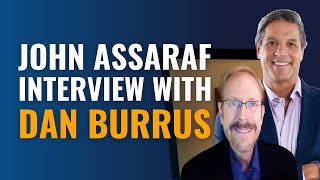
Dan Burrus discusses Flash Foresight, his framework for spotting future trends before they hit. He breaks down seven triggers starting with finding certainties, uses marketing shifts from TV to niche online communities as an example, and says you need to spend an hour a week thinking about your future and acting on hard trends.
Questions this video answers
January 19, 2011
flashforesight.com
At least an hour a week.
Chapters
Hey, friends, this is John Assaraf, and I've got one hell of an amazing treat for you today. Right now I'm on Skype with my good buddy Dan Burris, and he's just launched an amazing new book called Flash how to See the Invisible and do the Impossible. Now, a flash foresight is a binding flash of the future. Obvious. Now, if you want to know what that means and how specifically it will affect you, I'm going to interview dan for about 10 or 15 minutes to give you some key things that you can take away from Dan Burst, who is known as one of the top, if not the top, futurists around technology in the world. Plus, he's got a whole bunch of other hidden geniuses within him. And we'll get some of that out for you today. Dan, thanks for letting me do this. I love this book. I had a chance to go over it and the seven triggers and the seven steps you've got there on how to apply flash foresight is absolutely amazing. Maybe you can give the people who are watching this or listening just a little bit of insight as to what got you to write this book and why now.
Well, one of the reasons I wrote this book is because change has been relatively slow compared to what we're about to experience. And over the last 25 years, I've been helping CEOs from companies like GE and Google and major corporations do exactly what the subtitle says. See the invisible and do the impossible. And John, you know, ever since man set foot on this planet, we've been doing impossible things, including going to the moon and doing a Skype interview. And the way to do skills something that is impossible is to see and look in places that you've never looked before and see either solutions to problems or opportunities that were previously invisible to you. So the seven triggers are doing just that, giving you that burst of future insight. So let me give you a couple of quick examples of some triggers, then we can talk about a few one of them that I really like a lot.
Before you do, I just have a question for you. Just to set the frame rate, who specifically is this book written for so that the people have the right frame here.
Yeah. You know, this book is written for anyone who is going to be alive and well in the future. And I know that sounds kind of crazy, but you know, we're going to spend the rest of our life in the future and most of us are way too busy to think about it. Let's think about it a second. The five years before GM went bankrupt. Were those executives all busy? And, and the answer is, yeah, they were really busy. Didn't help them, did it? And Lehman Brothers, before they disappeared from the planet Earth, were they all busy executives? Yeah, didn't help them either. So my, my worry here and the reason I wrote this book is we are all busier now than we were last year. Would you agree with that?
Oh, God, absolutely.
Yeah. And we're. And so we're getting busier. Well, you know what? I'm going, whoa. I'm worried because we're all so busy, we're going to miss it, we're going to blow it. Because right now I believe there's more opportunity than we ever had ever before. But the news is telling us the world is doing terrible. I mean, let's face it, bad news sells, good news doesn't sell. And if there's no bad news to report, they give you anniversaries of bad news. So what I wanted to do with this book is blow away the fog of bad news. Let everyone see the mountain of real, real tangible opportunity in front of us and not get sucked into being busy, but take a second and really be strategic.
Love it. That's why I love the book. I mean, you know what? You're forcing people to slow down and see, okay, like you said, see the invisible, do the impossible. You've got to start now. And I know the first trigger. You've got to start with certainty. And so let's get into what you were going to say before, but I want to make sure people understand this is for you. If you're going to be alive, as Dan said, this is, is for you. So let's keep going.
Yeah, again, if you're spending the rest of your life in the future, it is, you know, we're in an uncertain world. I mean, when are foreclosures going away? When is your home price going back up again? When what's going on with health care? How are the Democrats and Republicans going to get along with each other in a world of amazing uncertainty? I have to ask myself, what am I certain about? Because strategy based uncertainty has high risk, but strategy based on certainty as low risk. So one of the triggers I give and one of the things I teach is how to actually find absolute certainty. For example, right now in this hemisphere, as we're talking, it's winter. I'm certain that next will be spring, followed by summer. Now I'm certain about that. Now, is that the only certainty? And the answer is no. There are literally not tens, not Just hundreds, but thousands that we can be certain about. Just like we can be certain that the next iPad and iPhone will have a better processor in there and more memory, both in the cloud and so on. If you understand the power of certainty, you can see invisible opportunities and again, gear your business towards that. I know we're short on time. I won't go into that any further. Unless you want to.
So when we have certainty, the other thing that you talked about is one of the triggers in order to do well, is once you have that certainty is to start anticipating. Okay, what's coming down the pike. Let's talk about that for just a moment.
Yeah. Based on the certainty. And I make a case for this in the book, that we are no longer in a time of technology driven change. We are in a time of technology driven transformation, which is very different than change.
What's the difference?
Well, thanks for asking. If you take a. Back when I was a young guy, I could listen to one album on one spinning disc and then there was a change that let me listen to one album on a smaller spinning disc. Towards that was called the cd. And it was nice, got rid of the hiss and the pop and the scratches, but it was a change, not a transformation. Now in my pocket right now as we speak, and my phone is all my music. And it transformed. It didn't change. It transformed exactly how I listened to music. So in that same way, John, we're about to transform how we sell, how we market, how we communicate, collaborate, innovate, train, educate. And my point in the book is if you are only changing those things, you will fail. And I don't want you to fail. That's why I wrote that book.
Awesome. And so you cite so many different examples of change versus transformation. What are some of the transformational things that you're seeing that's going to really transform all of our lives?
Well, just very quickly. I mean, I picked quite a list of things that every one of us do, like sales and marketing. Let me give you a real quick one. I was working with a company that was had a sports drink and they had a patented process that allowed the water in the drink to absorb into your body faster. And I won't get into the science of it, but they were about to do a major television commercial letting everyone that was interested know about this. Now I said, what percent of the audience that's watching television is interested in rapid hydration, which is the benefit of water absorbing into your body faster? And of course they said, well, if you're an Athlete, of course you'll recover faster. That's a benefit. So I said, what percent? And they had some poll that told them how many people and what percent would be interested. And I said, let's just think for a minute. Just out of Yahoo, I'm not even talking Google, just out of Yahoo and their communities of interest, how many communities of interest are there of people that are triathlons? How many triathlon communities of interest that have thousands of members each are there? They didn't know. And I did know 1072. Each one with thousands of members all passionate about competing in triathlons. By the way, what percent of that group is interested in a product that would give them rapid recovery?
100%.
Thank you, John. All right. Now then I said, well, how many football, how many basketball, how many baseball, how many soccer? By the time I was done, within about two minutes, we had earmarked about 30 million people that would be 100% interested that we could reach at a fraction of the cost of doing a national television ad. That is not change, that's transformation. We're going to transform the whole thing.
And so that's my starting with certainty of where the people are anticipating that you shouldn't be doing television. And let's use the online communities already.
Let me just take a tweak on that. Instead of we shouldn't use television. One of the concepts that I get into is the both and principle here and that is there you can use television, but if you're only using television, you're making a mistake. You need to have now not a media centric focus to marketing, but a rather a media neutral. And instead ask yourself, what am I really trying to do and what are the all the tools, old tools like tv, new tools like a blog, what are the old and new tools that I might use in combination to get what's done?
And so we're really having to think differently about our whole lives. Let's maybe shift, if we can for a second, Dan, and let's take the average person out there that's not into sales and marketing. How will they be able to learn from this book from the seven triggers in their own personal lives as opposed to let's say selling and marketing and businesses?
Well, you know, most of the time what a lot of people do is one year becomes the next, becomes the next becomes the next. And all of a sudden they're 90 years old going, what happened? And I'm trying to say, wait a minute, let's just think just a little bit, let's think about our future and how you view the future shapes how you act in the present. Right now, there are people that are buying IBM and selling IBM. The difference is really how you perceive the future of IBM, isn't it? So some people are going to drugs, some young people, and other young people are going to college. What's the difference? It's how you view the future. So if you. How you view the future basically will determine the future, you. Because your view of the future will determine your future. And I'm saying right now, we're going through this transformation. You need to change your view of the future and realize the opportunity there is. That's one. One other quick one here. And that is we're all faced with challenges. I don't care who you are, we all got problems. I got them, you got them, we all got them. And one of the seven principles that make the invisible visible that applies to every single person is to take your problem and skip it, get it out of here. Why? It's not the right one anyway. No wonder you can't solve your problem. You're working on the wrong one. You're smart. You would have solved it by now. So one of the principles is that the problem that you have is really not the right problem. You've got to peel it like an onion, skip the one you think you have, get down to the one that you really have. And then I offer some simple tools for quickly solving it that has helped so many individuals at all different ages, whether they were young people, people going to college, it didn't matter. Solve seemingly impossible problems, including gigantic companies that frankly, that one principle, take your problem and skip it so that you can find the real one and solve it. It's worth the book right there.
I love it. And that, by the way, everybody is tip number four in the list of seven. There's just seven amazing tools. When people start to apply this way of thinking, it reminds me of something that Wayne Dyer said many years ago. He said, when you change the way you look at something, the thing that you look at changes. What I found when I was going through the seven steps, I was finding that I was asking myself different questions and I was actually starting to predict more of the behavior and the relationship that I have with the future right now. Was that one of your.
Absolutely. Matter of fact, I was just talking to a mutual friend of ours, Jack Canfield from Chicken Soup, and he said that it changed his whole way of thinking about his business because he realized that he was not being anticipatory enough. Rather, he was being, like most of us, reactionary, which means, oh, there's a new tool called Skype or there's a new something and reacting to it. But what his insight was to me was that, you know, change is happening now so fast.
Right.
Dan is right. I've got to be not kept trying to keep up. Frankly, keeping up is a fool's game. All you'll ever do is be keeping up to somebody else. I need to be anticipating and trying to jump ahead based on certainty. See, once you take the crap chute out of it and you realize you can be certain about something, then the power of anticipation really can happen. So I think that's what happened to you, that's what happened to Jack, and that's what I want to have happen to our readers.
Well, it's interesting because, you know, we're obviously early in the year right now. I've got my goals set up here on my wall. I've got my new business goals, my strategic plans I'm going to actually be reviewing. I actually called my team, I said we're meeting all day Wednesday to make sure that the strategic plan that we have for our business and I'm going to do this with my wife to make sure the strategic plan we have for our own health and our lives is based on certainty and anticipating what's going to happen the next year, 2, 3, 4, 5. And start thinking and doing it today.
Absolutely. Because if you don't, someone else will. If you're not transforming your business right now, someone else will. And so again, I think the power is there and the timing is right for this to be done now.
I love it. I love it. Everybody, we're talking about flash foresight. And you can pick up the book and actually pick up a couple copies, some for yourself and some for your friends and family at Flash Foresight. That's F L A S H F O R E S I g h t.com flashforsight.com Dan, I'm going to leave you with the parting words to my friends and colleagues around the world around your book. What's one last piece of information advice you want to give them before they go and buy the book?
Well, that is to spend at least an hour a week thinking about your future. After all, you're going to spend the rest of your life there. Maybe you ought to think about it.
I like that.
And identify what I call the hard trends, the certainties, and then take action on what you see because, you know, you can talk about and think about, but it's all about action. So do it. Take the time to think about it and then act on it.
Love it. All right, everybody, I hope you've enjoyed this mini little interview. Hopefully it gave you some good ideas, good tips and gets you to think a little bit, which is the highest function of a human being. This is John Astroff saying God bless you and thank you so much.
More from John






Millions of individuals around the world are grappling with various mental & emotional health issues




