Why I Turned Down $100k In Revenue Today
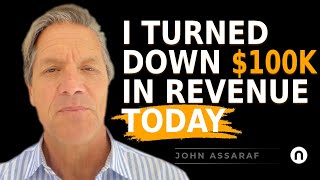
John Assaraf turned down a $100,000 client to focus on building predictable revenue instead. He argues that systems generating consistent qualified leads are worth more than one-off sales, and shares his routine: 30-minute daily planning with his assistant to identify the three highest-impact tasks.
Chapters
My team thought I was absolutely crazy for turning down $100,000 today. One of my clients wanted me to work with him on an extended period of time to help him build his company. If I'm working on helping somebody else build their business, then obviously I'm not working on building mine. And if somebody's willing to pay me that amount of money to help them build their company, then that time must be worth it for me to invest in my company. Which leads me to the real point that I want to make here. When you are building your business, you need to know what the critical few things are that you need to do every day, every week, every month. And you need to know what to say no to. As an entrepreneur, you have to work on your own business to make sure that you have the right processes in place for marketing so that you have a consistent flow of leads coming in every day, every week, every month. There's a formula that I teach every business owner that I do choose to work with, and that is traffic times conversion or prospects times your ability to convert those people into paying customers. What creates predictable revenue? And here's my question for you. What is worth more to you as a business owner to make sales and income or revenue, or to create a process that consistently brings in leads that are qualified that then you can convert into paying customers? One business consistently has to work on getting new prospects, new sales every day, every week, every month through hard work. But a business owner who invests the time to build the process of how do I create a consistent revenue stream because I have leads all the time is a business that's worth more. Just so you know in the world, if you're going to go and raise money, investors that are smart are going to say, okay, does this company have to keep figuring out every day, every week how to get more money in the form of sales and revenue versus have they figured out how to make their income more automated, more predictable? And guess which business is worth more. The one that is more predictable is worth five to 10 times more than the one that is consistently struggling to make revenue. So the reason I said no to $100,000 client is because there are things that I know I could be doing in my own business to make it even more predictable than it already is. And so a couple things for you to think about as you're building your company, the CEO of your company, whether you're a solopreneur or solo professional, or you have three or 30 or 300 employees, I want you to ask yourself this Question. That's actually two questions. Number one, what is the highest impact activity that I should be doing every day? Based on your skills, based on your competencies. And then what is the highest income producing activity that my sales team or my marketing team needs to be doing every single day? So when you have your highest income producing activity for you, and the next question is this, what are your three highest impact producing activities? So for example, a high impact activity is developing a marketing plan. A high impact activity, developing a sales process. A high impact activity is generating okay, leads through affiliates. A high impact activity is making sure that your website and your pages are branded properly so that the look and the feel that you have is consistent and congruent. That emanates trust and rapport and creates a relationship when somebody lands on your page or on your website. So in business there are what I call the trivial many things you can do, but there's also the critical few things you can do. When you focus on the critical few in sales, in marketing, in management, in finance, in legal, in product development, in client care, in technology, then you are working on your highest income producing things per hour. And since you and I, we have time, right? We have time from 7am in the morning till 5, 6 o' clock at night. As entrepreneurs, sometimes seven days a week, we want to make sure that what we are doing in, in time gives us the highest roe, which is return on our energy and then roi, which is return of our investment. Excuse me. And so when you are focusing on high income, high impact activities and you have your team focusing on that as well, if you don't have a team, this is how you need to think now. You are going to be productive, meaning you're going to get things done versus active or reactive. So a little bit of your skill set every day should be to leveling up, okay, your productivity. So how do you set up your day, your week, your month so that you are highly productive? So let me give you an example of something that I just taught one of my clients. Who his companies generate about $50 million a year. We talked about my schedule. So on Sunday nights I take about 30 to 45 minutes of my evening before, you know, maybe I watch a movie or something and I look at my calendar for the upcoming week and I ask myself, what three things am I going to accomplish this week that are high impact or high income? Three things, who do I need to engage to make that happen? What tools or resources do I need? And then I put those things into my calendar for the next week. For Monday, Tuesday, Wednesday, Thursday, Friday. And then on Monday morning when my assistant and I meet every day at 8:30-9:00 clock to review the day, review the week, she and I calibrate what is going to get done for the day, what's going to get done for the week so that I can accomplish my goals instead of just setting or having them. So we have a planning session every day for 30 minutes where we download back and forth, whether it's the emails that came through, ideas I had, you know, from one day to the next. And then we organize and prioritize and then we do what I call is actionalize, Organize, prioritize, actionize. So that means that I am going to take what it is that I said I'm going to accomplish and I'm going to create my action plan and steps to make sure that it gets into my calendar. I block out that chunk of time to do it to completion over the course of however many hours or days it's going to take. Now why is this important? Well, so many people set goals, but very few people achieve goals. They're great starters, but they're not great finishers. So I want to be a finisher. I invite you to being a goal achiever, not a goal setter. And goal achievers finish what they start. So you're better off having fewer things to do and accomplish than more things that you don't accomplish. Why? When you have fewer things that you finish, you build your self worth, your self esteem, your self confidence and and even more importantly than that, your self trust. Now when you trust yourself, you can add on more things. When you set goals and you start them and stop them and don't finish them, you lose self confidence, self esteem, self worth and self trust. And in your own mind, your own self image, you don't believe that you are a finisher and can get things done. So here's what I challenge you to do. Write down one or two goals that you are going to achieve in the next 24 hours. No matter what, finish them. Celebrate. Fist pump. High five. Boom boom. Do what you need to do. Start building that neuro muscle. Okay. Of being a finisher. Alright, I got lots of thoughts on building companies and it doesn't matter how small or big they are. There are certain principles and processes that when you put them in place, you create what I call is predictable results. Don't you want more predictability in your life? Follow some of these tips, have some fun. Thanks for watching.
More from John






Millions of individuals around the world are grappling with various mental & emotional health issues




