018- Put Me Out of Business: Cardiologist Reveals How to Eradicate Preventable Heart Attacks by 2040
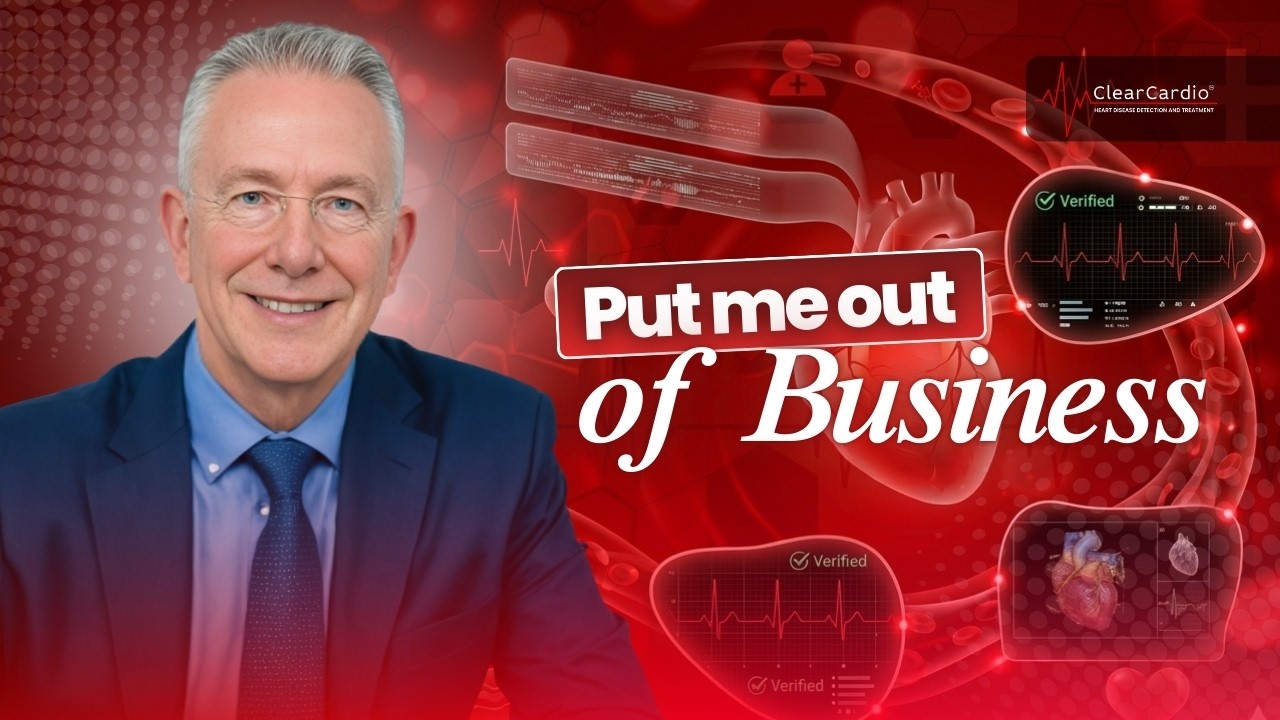
In this 2025 interview, host Eric Sardina talks with Dr. John Osborne, a Harvard‑trained cardiologist, PhD in cardiovascular physiology, and Chief Medical Officer of Clear Cardio. Osborne recounts his nomadic childhood, accelerated combined BS/MD/PhD program, and early decision to specialize in cardiology. He describes the historical reliance on invasive heart catheterizations and stress tests, then traces the emergence of cardiac CT—from early rotary‑phone‑level scanners to today’s 640‑slice machines—and how calcium scoring and CT angiography provide a non‑invasive “cardiac colonoscopy” that visualizes plaque in the vessel wall. Osborne explains how AI analyzes millions of voxels to quantify total plaque volume, differentiate soft (lipid‑rich) from calcified plaque, and track changes over time, enabling truly personalized treatment. He outlines a five‑step preventive plan: (1) recognize age‑related risk, (2) obtain a binary scan (calcium score or CT angiogram), (3) apply lifestyle and risk‑factor modifications, (4) treat with evidence‑based drugs and interventions, and (5) re‑scan to verify plaque regression. The conversation also covers myths about nicotine, starch, resistant starch, alcohol, and diet, and critiques the current insurance‑driven model of stress tests and cath labs. Osborne argues that Clear Cardio’s model—direct‑pay, extensive patient education, and AI‑driven imaging—will make traditional cardiology practices obsolete, aiming to eliminate preventable heart disease by 2040. The interview concludes with a light‑hearted discussion about bourbon moderation (1.5 oz for men, 1 oz for women) and a final call‑to‑action directing listeners to www.clearcardio.com.
Chapters
Welcome to the show, everyone. Today's guest is Dr. John Osborne. Dr. Osborne is a Harvard-trained, world-renowned cardiologist with a PhD in cardiovascular physiology. He is a preventive heart health pioneer with over 30 years at the forefront of cutting-edge heart disease prevention as a lifesaver, disruptor, and visionary on a mission to eradicate preventable heart disease by 2040. Dr. Osborne is currently Chief Medical Officer of Clear Cardio LLC, a company leading the AI revolution in preventive cardiology by merging AI-driven diagnostics with science-based personalized medicine. I'm excited to have Dr. Osborne on the show today to share how his team is shifting the narrative to heart attacks don't have to happen and how can you eliminate your risk. And with that, Dr. John Osborne, welcome to the show.
Well, thank you so much, Jamie. It's such an honor and pleasure to be here.
Eric, I'll take that. So welcome Eric to the show. That's okay. I'll take it. It's all right.
Sorry, Eric.
I apologize. No worries.
Why was I thinking Jamie? Better than Hans?
It's a good question. Better than Hans. I don't know though. I think I'd like a Hans.
Eric, sorry about that.
That's good. You're good. No worries. So let's dive into it.
It's still a great pleasure.
And it is a great pleasure to see you again. Dr. Osborne and I had a chance to work together A few years back, back in the days of when I was at Low T Center on the marketing side of the house, helping to drive all the marketing advertising side of things. And Dr. Osborne came on as our, one of our chief medical officers and cardiology. A lot of our guys were, had to have cardiology clearances and checks and things as men over 40 that are on testosterone. You want to make sure their heart's in good shape. And so we brought Dr. Osborne on and he was fabulous.
Mm-hmm.
And he had such a following. I was amazed at all the patients that would come in going, oh my gosh, I can't believe Dr. Osborne's on this side of town now. I don't have to drive all the way to Dallas to see him. And so we got to work together for a few years there, and now our paths have crossed yet again, which is awesome.
It's fantastic.
So let's go to your childhood, man. I want to learn just a little bit about how you got into the world of medicine to begin with. What was childhood like growing up? Was your dad a doctor? Tell me about what childhood was like.
My dad was not. My dad was in the Air Force, so my dad ultimately retired Air Force. And so for most of my early years, I was an Air Force brat. So we moved a lot, lived all over the place— north, south. I was born in Alabama, but we lived in the north and the south and southeast and all of lots of different places because of his work. And then also during that time, this is this is. Kind of interesting, I think. My dad got a job to run the power plant in Saigon in 1967.
Oh, a lot of stuff going on in Saigon in 1967.
Yeah, a few things. Yeah, yeah, look that up in your Funk and Wagnalls. And so he went over there in '67. 18 months later, he was able to bring the rest of his family. So we moved to Saigon in 1968 after Tet of '68. And I still have pretty vivid memories. I mean, I was about 4 and a half or so. But I have very vivid memories of flying over there. It was a big, big trip, you know, in a 707 and Pan Am and blah, blah, blah, multiple stops along the way. And then getting off the airplane, the Boeing 707, in Saigon at Tan Son Nhut Airport, which is the Air Force base.
Mm-hmm.
And I remember walking down the steps there, and this is after Tet of '68, which is a big, Big battle back then. And there was this Jeep that had been hit by something and flipped over. And I'm looking at that going, huh, this is cool. We'd come from Florida and I said, this is clearly no longer Florida.
It's not Florida. Yeah.
So anyway, we spent 2 and a half years there, moved back to the States in '61.
'71.
'71 rather. Yeah. There was a check you passed.
That's okay.
Yeah. Moved back in '71. So that was kind of interesting growing up in Saigon.
So when did— I mean, Saigon fell in '69?
We pulled out in '73, in the spring of '73, and then fell in '75.
Okay.
Yeah.
So, and you left in '71, so things were pretty sketchy.
It was kind of the peak of the war, and then kind of from that sort of decline.
Downhill slide.
Yeah.
And then shoving helicopters off aircraft carrier decks. Yeah, yeah.
I can't tell you how many times I've said, last helicopter out of Saigon.
That's right.
Wow.
Man, that's intense.
Anyway, so that was pretty crazy. We get back to the States and with my dad being in the Air Force, maybe perhaps even being Vietnam as I think about it, my Plan A career goal was I wanted to be a fighter pilot.
Okay.
So that was Plan A.
Yep.
4th or 5th grade, once we got back to the States, I found out I needed glasses and I knew already at that point that Ain't going to happen.
It's not going to happen. Not going to happen.
So I had to go to plan B. Now, as it turns out, my mom was a nurse. So that's kind of where I get the medical side and interest. And she certainly fanned those flames. But from about 4th, 5th grade, I went to plan B and that was—
Plan B was medicine.
Medicine.
Yeah. So that's what I wanted to do. Right. 4th or 5th grade. So you're like, I'm going to be a doctor.
Okay.
Right on.
So that was the plan. And a few other interesting, I think, Maybe interesting things occurred. Your audience can figure this out. So I knew I wanted to do medicine, right? I knew it's a long path, right? 4 years undergrad, 4 years of medical school, multiple years of training afterwards. So in my particular career as a cardiologist, from high school until I can hang a shingle as a cardiologist is a 15-year journey.
Yeah.
Okay? So I knew I wanted to go to medical school. So in high school, I began to look, what are the options? Any tricks? Anything I can do to shorten that pathway? So as it turns out, by this point we're living in Pennsylvania. And as it turns out, one of the— Penn State that you may have heard of.
Yeah.
And a medical school in Philadelphia called Jefferson Medical College had a unique program. It was the only program like it where it was a combined undergrad MD program and If you met the criteria, got accepted, you started Penn State the summer you graduated from high school. You did basically a full complete year. You took the MCATs as a freshman in college.
Wow.
And in one year from Penn State, in one year, the next year you could be starting medical school. So I started medical school at 19. Wow.
So what happens to your undergrad program? Is it—
It was about $1,000 and I was very busy and yeah, that was pretty much it.
You blew through it in a year?
Yeah.
One-year undergraduate. Wow. Is it like, are you taking massive numbers of courses? Yeah.
So what the trick with this is, all of those medical school requirement courses, all the math, all the physics, all the chemistry, all the biochemistry, all the labs, all the big Heavy stuff. Heavy stuff. The classes that they use to discriminate who goes to medical school. I did all that first year as a freshman.
Wow. Incredible. So you were a star student, would you say?
I was good. I mean, yeah. I mean, I got through that. Yeah, whatever.
How many kids in that program?
Per year, they're about 30.
30?
Yeah.
In all of this Penn State?
30 that start.
Okay.
And I'd say probably about 2/3 made it through.
Finish.
Yeah.
So 20 kids in all of Penn State in this medical program that aren't going to get a 4-year degree and then go to medical school.
Right.
Okay.
So in 5 years, you can get your undergrad and MD degree.
Wow.
Saves a lot of time. So you're 3 years ahead of the game and frankly a lot of money, which is cool.
Yeah.
So I get to medical school and I'm 19. I can't drink. Most of my other classmates can. Not a big deal, but clearly young. And so I thought, I got time on my side, right? I'm young. Maybe do some research for a year. So I talked to some of my mentors in medical school and they said, yeah, if you want to, that's great. But honestly, we have this PhD-MD program. So you get in that program. You do your 2 or 3 years in doing your PhD work, which is right in the middle of medical school, right between years 2 and 3. You do that. During that time, the PhD is free and we pay you a stipend.
Wow. Okay.
And your last 2 years of medical school, we pick up half the price of tuition. So I said, Where's the paper?
Sign me up.
Oh yeah. So then I went into that program. So by 1990, after 8 years, I got my BS, my MD, and my PhD.
In 8 years of school?
Yeah. Wow.
That's amazing.
Yeah, it's pretty cool.
Yeah. And so at that point, have you decided you're going into cardiology or?
Yeah. So year 1, you do anatomy, physiology, and all that. So the guy that taught cardiac physiology was great. He happened to be the head of the Department of Physiology there. And I said, I want to do my PhD with you. And because that's what he did, well, I'm going to do cardiovascular physiology. So as I went through medical school, because I had this PhD in cardiovascular physiology, it really meant my career potentials were then pretty constrained and limited. I'm either going to be a surgeon, be a cardiothoracic surgeon and do bypasses and valves and all those kind of things, or I'm going to be a cardiologist, right? So the surgical side, the medical side. So then after I did all my PhD work, survived 2 brain tumors, by the way, along the way, but got through all that.
Really?
Yeah.
Surgeries and all this?
Oh yeah, yeah, yeah.
Crack the skull?
2 craniotomies.
Oh, wow.
Yeah. I was going to try to do my PhD in 2 years, but because of that, I had to throw in an extra year.
Extra year. Yeah.
I was kind of disappointed.
Benign tumors?
Yeah, fortunately. But I mean, it was benign, but it came back. So I had to have another surgery about 3 years later.
Oh, wow.
So anyway, persevered through that. Got through that. Neither rain nor snow nor sleet nor brain tumors will keep me from my pointed rounds. So in the last 2 years of medical school, you do your clinical rotations. So I rotated through cardiac surgery. I rotated through rotated through cardiology, and I realized cardiology is definitely my interest, right? Surgery, not to dismiss my excellent and most esteemed surgical colleagues.
Of course.
You're standing on your feet for 6 hours, you're staring into a bloody hole, people show up, you fix them, hopefully no problems, issues, then they disappear. That's not— I like continuity of care, I like to educate my patients, I like longstanding relationships. So that became Very, very easy decision.
The surgery thing, and I know very little of it, but what I do know just from observation seems to be if you can be a good surgeon, you're probably a pretty good auto mechanic too, because it seems very similar. It's like they get in there, they're moving levers. They're, okay, I'm just going to move this out of the way and I'm going to fix this part and then I'm going to put this part back. And it seems very mechanically minded.
I'd actually say plumbers.
Plumbers.
Okay.
Plumbers. Right. A lot of water.
I got a leakage, I got a blockage.
Yeah. That's probably a good— it's a better analogy.
Yeah.
Right. Sometimes you got to solder some things.
Yeah.
Fire up the blowtorch.
But every time you go to fix the plumbing, someone could die.
Yeah. That's a rough one.
Yeah.
A little stressful.
A little stressful.
I think that's where they wear the happy hats, those kind of fun colors, because they got to inject a little levity into that.
Exactly.
Into a stressful environment.
So that was a major career point. And I said, okay, cardiology is going to be it. And so being the competitive guy that I am, and I'm always looking to the future, I said, okay, I got this great background pedigree, blah, blah, blah, pieces of paper. What is the very best cardiology program in the world? We'll say the US. So that place, and I think it still is, this is an arguable point, is Brigham and Women's Hospital in Boston. It's one of the Harvard hospitals, right?
Fabulous.
Phenomenal place, right? All the, not all, but I mean, an unbelievable amount of incredibly bright people, Way ahead of their— with incredible vision, unbelievable publications. All the science comes out— much of the cardiovascular science comes out of there. Unbelievable credibility and training. So that's where I want to go. So what's the best way to get a fellowship, which occurs after internship and residency? What's the best way to get a fellowship at a given place and institution? Will you do your internship and residency there? So I go, I'm going to become an intern and resident at the Brigham, as we call it.
Yes.
And because that's going to give me the single best shot at becoming a fellow at the Brigham and training in cardiology. So that's what I did. So finished up in Philly, spent the next 7 years in Boston at the Brigham, did my internship residency. I also did a research residency, so I kind of split the time between research and clinical stuff, which is very cool. Kept my research going, and then did the next 4 years in cardiology. 2 of those years were in the Department of Genetics at Harvard Medical School doing molecular genetics, and then 2 years with the clinical stuff. Most of my clinical training and all that focused on non-invasive techniques, so echocardiography, stress testing, vascular stuff, vascular medicine, medicine, ultrasound, all that. Cardiac CT, which is just absolutely critical to what I do now in 2025 and has been for 25 years, did not exist. It wasn't— back then in the mid-'90s, there really wasn't even the concept of that.
Okay.
But the other critical thing that occurred in my training is we would do heart cath and angiograms, and being the Brigham and We get people coming from all over New England, all over the states, other countries. I remember taking care of one of the relatives of the King of Jordan, so very interesting people. And they'd come for us to do their heart cath. So we'd do their heart cath, put catheters in their heart, inject dye, see if they have blockages. And what was fascinating is we'd find blockages and then they'd go to my colleagues that did stents and balloons and surgery and— Fix them up. But a lot of the people, we cath them and they look fine, or else what we'd see is what we call lumpy bumpy, right? So the vessels aren't nice and clean and smooth. You can see some little lumpy bumpy stuff, no blockages, right? And I remember some of my colleagues and fellows and all, yeah, lumpy bumpy, all good. Off with you. Fare thee well. I'm going, but wait a minute, that lumpy bumpy stuff is really important. Because that's the disease. It hasn't grown to the point where it's causing a blockage, but that's—
Starting to.
Yeah. Or if you think about colonoscopies and why we do colonoscopies, those were polyps. So we're saying to them, yeah, you got polyps. Fare thee well.
Good luck.
Have a nice life. And I'm going, there's something really wrong about this, right? I mean, isn't early detection a really good thing?
Yep.
And we were just kind of blowing it away, but we didn't have tools to really be able to see that because the plaque that we see on a heart cath, just looking at the tube, I call it the donut hole, really tells you very little about what's happening in the wall of the vessel. So think of a donut. Plaque always starts out in the donut itself.
Okay.
And you can have a completely normal channel, Lumen, as we call it. And early on when that plaque grows, it grows outward, not inward. And it will not start growing inward, that is causing a blockage or narrowing, up until that vessel has expanded over twofold.
Oh, wow.
So you can put a huge amount of plaque and have a huge amount of plaque in the walls of the vessel and your channel be completely normal.
So you're looking in there, it looks clear, but the rest is closed.
Yeah, you do a $20,000 invasive heart cath, it looks fine. Well, did you look at the wall? No, because we couldn't. The only way we could look at the wall of the vessel in the mid-'90s was an autopsy, and most people declined that.
Yes, I would think so. Right. Yeah. For obvious reasons. Right.
So that's kind of where I came up or had this flash of, we're missing stuff. There's important stuff going on. We don't really have good tools short of the autopsy to find it or see it or visualize it or understand it. But I said, there's got to be a way to detect this disease early. So I really then, after I finished my fellowship, I moved from Boston down to Texas here, been here 28 years since then in North Texas. But I began to train myself really to some degree unconsciously in what I will say are the key core principles of what you need to do preventive cardiology, right? So the 2 key principles, one, imaging. And as it turns out, a few years after I got out of my fellowship, they began to come out with very, very early, crude, rough, as far as hardware and software, what we now call cardiac CT. Okay, this is 25 years ago. Yeah. I went out to one of those places that was playing around with it, a guy named Matt Budoff, who's a good friend of mine, back in about 2001, and spent 3 days with him. He showed me what he was doing. I go, okay, I got it. Went back home and said, okay, one of my buddies had bought one of these very, very early crude CT machines. And I said, okay, let's give it a whirl. So over the next few years, we did about 700 or so Very crude, again, software, hardware, etc. If, you know, to use an analogy, this is probably the rotary phone at best.
Okay, so not a Commodore 64 or TRS-80?
No, this is a rotary phone.
Rotary phone, okay.
But I played with the rotary phone, got very comfortable with it, and so by 2005, they came out with what I'll call the iPhone 1 equivalent. Right? This was a 64-slice cardiac CT machine. Now, with better hardware, better software, still rough compared to what we have 20 years later. But this was now the tool that allowed me to see the entire donut. I could see the plaque, I could see the blockages, I could see what's happening in the wall. Furthermore, we could see the different kinds of plaque. You can have really active, growing, nasty plaque, the kind that causes heart attacks. We call that soft or lipid-rich plaque. And then you can also see older plaque, calcified plaque, hard plaque, that's really no longer active. But none of that you could see even with an invasive $20,000 heart cath. With cardiac CT, I could begin to see that. So by 2005, before then, I did stress tests, which frankly, I'm going to say are not useful. I did heart caths, which have now been replaced with cardiac CT in my practice. But all that occurred by 2005. So by 2005, knowing what technology existed, like heart caths and angiograms, I said, oh my gosh, I can see better, cheaper, safer, simpler, easier for 5% of the cost and none of the risk of complications. So 2005, I did my last heart cath, has been replaced with CT angiography or cardiac CT angiograms, all synonyms. And that happened This year, 20 years ago.
20 years ago. And this is effectively like an MRI for the heart or an X-ray, would you say? The process, you get in the machine.
Yeah, it's basically a CAT scanner. A lot of people, we do about 20 million CAT scans a year. So if you've ever had a CAT scan, it's the big donut, right? I call it the MRI is more the coffin, right? Where you're the—
Yes. Yeah.
Okay. But the MRI is just a big donut. I call it the donut of destiny.
Yeah.
And that's the tool now that we use. Takes a few minutes, completely non-invasive, very, very little risk of anything, as opposed to a heart cath, and 5% of the cost, and better, more accurate data.
Right on. And so back in, this would've been probably 2018, '19, when you joined Loti.
Yep.
I remember you were a fan of cardiac calcium scoring.
Exactly, yeah.
And we went and got a scan done, the leadership team and the medical team, just to see like, what are we gonna learn here? And I remember it being slightly terrifying because the practitioner that gave the test and then was going to tell you the result, tell me my result, said, oh yeah, well, I had a gentleman in here just the other day and he was an Ironman triathlete, super fit, and he just looked like a nail and just really healthy, and you'd think he's just healthy as could be. And he was just loaded with calcium, right? Calcium plaque all inside of his heart. He's a disaster immediately. And I'm thinking, he's preparing me for what is going to be horrible news. 'Cause I was, I was training a lot at the time and running a lot of marathons and things. And I thought, this is going to be bad. And he did this probably 5-minute preamble. And then he goes, your scores are 0.0. You're good. And I was thinking, man, you sure buried the lead on that one. Right. But, but that was a test I know you were a big fan of at the time.
Yeah.
Yeah. 7, 8 years ago. Talk a little bit about that, because at the time I didn't have any awareness of it. I was thinking of what I think probably my primary care doctor was saying, which is your cholesterol is in great shape, you have a nice low cholesterol number, you're good to go. No one ever had mentioned to me this idea of having a calcium score done until I met you, and you're like, well, it's the only thing that— you could have high cholesterol numbers and a 0.0 calcium score, and you're really good to go.
Yeah.
But you could also have low cholesterol And any number really of a calcium score is a bad number, and you'd want to potentially be on a statin or some other sort of therapy to help that situation. And I was thinking, I'd never heard that before until I met you. So maybe talk a bit about that.
Well, and first of all, Eric, I got to say, I'm really, really happy you're a zero.
Yeah. Thanks. Appreciate that.
No problem.
First time ever.
I've always threatened, I've got to come up with a t-shirt that says, I'm a zero.
I'm a zero and proud of it.
Right.
Proud of it.
So I'm happy you were a zero. Right. So let me go through a little bit on— well, one thing I'll cover, right? So historically, we have tried to assess people and guess what's in their blood vessels, right, by never looking at their blood vessels, right?
Mm-hmm.
We use risk factors, right? Age, sex, smoking, diabetes, high blood pressure, cholesterol, a variety of things, right? All those things are population-based, right? So what it's saying is, if I look at those risk factors, and we have fancy tools to be able to understand your risk over the next 10 years and all that, but if I look at that, what that tells me is it says, someone that looks like you is at X percent of risk over the next 10 years of having a cardiac event. But what about me? Well, I can't tell you anything about you, because we never looked at your blood vessels.
Right.
Imagine you went to a GI doc and you're worried because everybody in your family has polyps and colon cancer. And he does this, gets out this piece of paper, does some calculation assessment and says, your risk of colon cancer is very high. Well, tell me something I didn't know. I just told you my whole family has it. But because your risk is so high, based on the fact that your risk is so high, I'm going to recommend 6 months of chemotherapy. That's pretty insane.
Pretty intense. That's crazy.
You'd run out of that office. You'd go, you're insane.
You're crazy.
You never looked at my colon.
Right.
That's what we've done wrong in cardiology. We've said, you look like someone who has heart disease, and we honestly overtreat a lot of people who have high cholesterol that don't need it. More importantly, I mean, they're going to be fine taking a pill, getting side effects, paying for something. They're going to be fine. More importantly, there's lots of people who look to be low risk, like the first person you were talking about, who actually have tons of plaque that they look like someone that's low risk, but in fact, when we actually look at the organ, look at the tissue, look at the vessels, they have a lot.
Yeah.
So a really fantastic tool for everybody, right? So I always think of this as a mammogram versus a biopsy. So let me explain what that means. So mammogram, right? Women should do it between X ages and X ages, maybe every year or 2, blah, blah, blah, in order to detect early breast cancer and hopefully save lives, right? Everybody gets that, understands that. Same thing with colonoscopy, right? Get your colonoscopy, find the polyp, take care of the polyp, you don't get the cancer. Yeah, we've never had that for heart disease.
Hmm.
Okay? By the way, and I'm not— I want to be careful, I'm not here to say my disease is more important than anyone else's. I don't want anyone to have any disease. However, I will point out, because of the incidence of heart disease, of all the women diagnosed with breast cancer, who have a diagnosis of breast cancer, their risk of dying from heart disease is higher than dying of the breast cancer.
So if the women that have been diagnosed with breast cancer still have a higher risk of dying of heart disease than breast cancer, how is that possible? That's crazy.
That's because only 40% of us die of strokes and heart attacks.
40%.
Which, by the way, is tenfold greater than the number of women who die every year from breast cancer.
So cardiac issues kill far more than any other condition out there?
So strokes and heart attacks, fatal strokes and heart attacks, basically kill about 1 million people a year in the US, which is greater than the next 7 causes of death combined.
Including cancers, then, I would presume.
Oh yeah. Cancer's number 2. But there's motor vehicle accidents and—
2, 3, 4, 5, 6, 7.
Stroke rates and all that.
Roll all that together, still less than heart. Exactly.
Yeah. Yeah. So calcium scoring is great. We've been doing these since the '80s. I can't say it's new. Only now are, unfortunately— well, fortunately, I won't say unfortunately, but only now are a lot of— is it beginning, are a lot of docs and providers realizing, hey, this is a really fantastic tool to tell us not what your risk is, but do you have the disease? Right? That's a big difference, disease and risk. So a CAT scan, a calcium score is done with a CAT scanner. We call it a non-contrast study. So there's no IV, no prep. We're not giving you anything. You come fasting or non-fasting, easy, simple to do. It takes a few minutes. We put you in our CAT scanner. And what we're doing with the calcium scores is just looking for calcifications in the blood vessels, right?
Yeah.
Our CAT scanners are really sensitive to detect that. And if I see any calcification, that tells me you have plaque. Unequivocally.
Yeah.
It's there, it started, right? However, the problem with the calcium score is I can't see if there's blockages. All I can see is the old, hard calcified plaque, the inactive plaque. So I can't see blockages in the vessels, nor can I see the lipid cholesterol soft plaque. I call that the lava. I can see the cinder cones. I can tell that there were eruptions. I can see the The cinder cones, the old volcanoes. I can't see the lava. Okay. But they're widely available. They're cheap. They're about $100. They're inexpensive. We passed a law, the cardiologists in Texas in 2009, became law by 2010, that insurers, private insurers in Texas have to pay for a calcium score. Now, they've been weasels.
They try not to.
Yeah. Don't go through that. It's just, Pay $100. Pay a CAT. It's great. If you plug in calcium score or coronary artery calcium score or something like that, which by the way, is not a blood test, it's imaging with a CAT scanner, and your zip code or city, it'll pop up all the local hospitals and imaging centers that do it. That is the mammogram, right? So it's a great place. If it's zero, prognostically very good. But remember, I can't see the lava.
Sure.
But if it's zero, prognostically very good. And if it's not zero, and here's where a lot of even my providers go wrong, they'll say, oh, it's a low score. It's a low score.
I've heard that.
So that's like— Right.
That's like you got a 3-point-something.
Yeah, right? That's like me telling you, you only have a little bit of lung cancer.
Right.
It's not a lot.
Yeah.
Just a little.
Yeah. Just a touch.
Yeah. So it's zero or not zero.
Yep.
Right? So by the way, for everybody out there, get a calcium score. It's a great place to start. We'll talk about other tools, et cetera, and how those work out. But do not let anyone tell you you have a low score. You're zero or you're not zero. Okay? If it's not zero, that is actionable. Okay? So calcium score, very cheap, simple, easy, great, low radiation, et cetera. What a CT angiogram is, is the next level. So if there's a mammogram, we'll call a CT angiogram the biopsy.
Yep.
When we do a CT angiogram, we use a much more sophisticated CAT scanner. We started out in 2004, 2005 with a 64-slice CT. We've now evolved to the iPhone 16 equivalent. It's a 640-slice cardiac CT. The machine we use, actually, thank you, Carleton Regional Medical Center, is the first install of this 640-slice machine in North America.
In North America.
In North America. So pretty cool. So that's, that's the— that's our— that's our—
Beat out the Brigham. How about that?
We did.
Yeah, we did. Nice.
So sorry, guys.
Feather in your cap.
Yeah, sorry, guys. But, you know, yeah.
Sometimes the alum just, you know, return for the, for the vengeance, right?
That's true. That's true. Yeah. So they come down here to get their scans.
Nice.
So anyway, so that's the equipment we have. I always think of that as the camera, right?
Yeah.
You got Kodaks. Well, maybe not anymore. Or you got Hasselblads or Leica, right? So we got a really good CAT scanner.
Large format, we got good stuff.
Exactly, right? And with a cardiac CT, a specialized CAT scanner, very high resolution, pull out all the stops. We then give you contrast. We give you IV in the vein. That allows us to get— if you've ever seen those 3D pictures of the heart with all the blood vessels and they look cool, And you can look like you can reach out and touch it. That is a CT angiogram.
Okay.
And with that, now we can— and the latest big breakthrough in the last few years is now we can take all that high-resolution 3D data, upload to the cloud, do this incredible AI analysis, which will output exactly how much plaque you have measured down to a 10th of a cubic millimeter. By the way, if you look at the period of endoscence, that if that were a sphere, That would be about a 10th of a cubic millimeter.
Hmm. A 10th of a cubic millimeter is what equivalent to?
Okay, so a period at the end of a sentence would be 1 cubic millimeter. Imagine taking 1/10 of that. That is a 10th of a cubic millimeter. So enormously small. So it can output exactly how much plaque you have in the whole heart, in every vessel, in every segment. So we know exactly where you stand. It'll obviously show any blockages or narrowings. But it'll capture all the plaque that's in the wall of the vessel.
Okay.
Not just causing blockages. And then furthermore, and all this just takes a few minutes, right? And then furthermore, when we can now quantify plaque, we can now do something we could never do before. Because I could take someone who has a score, score X, has plaque, treat them, and this is where it becomes personalized to every person. What are the targets in that person? What are the things causing the plaque? This is where it has to be personalized. And then after we do all that, put them back in the scanner and see not just are the numbers better and cholesterol's better and blood pressure's better and my weight is less and all those things, which are all very important, but most importantly, I can now say definitively, your plaque is better.
Hmm.
And we could never do that before we had AI. Plus, with the AI, when we get the CT data, We call that grayscale, right? So if you look at an X-ray or MR, CAT scanners, if you look at those images, right, there's shades of gray from black to white and all the shades of gray. Our eyes can see about 50 to 100 shades of gray.
Okay.
Every pixel encoded in those millions of pixels, actually voxels, in the CAT scanner, encoded in that electronically, are over 2,000 shades of gray.
Oh, wow.
So what the AI will do, will analyze every single one of the millions of pixels, voxels, and see and look at it across 2,000 shades of gray, not the 50 or 100 that we can see, and then output that data to know exactly how much plaque we have, where it's located, how much hard plaque we have, how much soft plaque we have, the volcano versus the lava, in the whole heart, in the vessels, in the segments. And then, of course, we also get data on blockages as well.
It's incredible. And so this AI is not predicting, it's not forecasting, it's showing the real.
I like to say, I mean, this is really digital data, right? It's binary, it's zeros and ones. When you do the scan, you're zero or one. You got it, you don't have it. If you have it, we know exactly where it is, how much plaque you have, if you have any blockages, plus we'll know Very critical to understand, is that active growing dangerous plaque, the lava, the softer lipid-rich plaque, or is it the hard calcified plaque that basically represents plaque that was active, that was an erupting volcano, but that's now a cinder cone?
Right.
But you can do all that with a test that takes just a few minutes, and that really is the state of the art as far as cardiovascular diagnostics. I can't tell you how frustrating it is to me. Even in 2025, I have this discussion daily. I went to a cardiologist, I was sent to a cardiologist, they did a stress test, they did an EKG, they patted me on my back and said, you look great. And I'm going, they have no idea.
No idea.
No idea.
Yeah, that was going to be a question I had, which is you see kind of the crazy stress tests and the, you know, we're going to hook you up to the face mask and the oxygen and really make you work and then give you that score. I have many friends that work at some of the local law firms, partners that tend to be like, we're going to give you this high-end physical day, or a partner at an accounting firm, high-end. This is one of the rewards of what you get. You get this full body checkup. And what's your take on some of that stuff?
I think, 30,000-foot view, it's kind of a little bit hilarious because I think it's a function of if you pay a lot of money for it and it's painful and uncomfortable to do, It must be a great test. Yeah. Completely untrue. Yeah. The comparison with stress testing, all that comes up all the time. So again, let me tell you a very deep dive into stress testing and why it is not a useful test. Okay?
Yep.
When we do a stress test, right, and I'm gonna say today we're talking about plumbing, You can have electrical problems with the heart. As a cardiologist, I like to kid, I'm just a general contractor. I do some plumbing and electrical, but today we're just plumbing.
Okay.
So when we do a stress test, and there's different kinds of stress tests and using different equipment and all that, but basically they're more alike than they are different. Dramatically different in cost. Some use radioisotopes and et cetera. But basically, the bottom line is all those stress tests, A, none of them show you the blood vessels. They're looking for blood flow problems. Some are more sensitive, some are less sensitive, but one will not have a blood flow problem on a stress test till you already have a 70% blockage.
Oh, wow.
So remember, this stuff started in the wall, grows outwards initially, all the while the channel's completely normal. Only very late into the disease will it begin to grow inward, let alone causing a 70% blockage. So the stuff that we detect with a stress test is never early. It's always late. By that point, you probably need some mechanical therapy. We call that balloons, stents, or bypass surgery, because that's not early detection. So not early detection. The threshold detection starts at 70%. Anything less than that, your stress test is great. You get patted on the back by a very nice, friendly cardiologist. He says, you've got the heart of an 18-year-old. And then next week you have a heart attack.
So it would almost seem that the stress test is like, we're going to test your health by killing you, or nearly.
Yeah. I mean, because we're looking for what we call ischemia, that is reduced blood flow. And we have to basically push you to the edge of the cliff, right? Run on a treadmill, you're sweating, you're putting it, you know, I mean, you're going to die, right? In order to see if you have this—
To recognize.
To recognize it, right? People can die on the treadmill. I've been successful last 30 years, but I mean, it does occur because you literally have to push them to the edge of their physical tolerance to try to provoke a reduction in blood flow, right? So that, first of all, is a bad idea. So I have to basically push your disease till I can almost kill you for the stress test to to really show anything. And even then, only detects late, late disease.
Seems like kind of like leeches, like a leeches type of therapy.
Yeah, again, you're precisely right, Eric. You know, it's— I say all the time, right, 20, 30 years ago when I was in my training, 30 years ago, you know, I tell people, I admit to them, I'm pretty transparent, that was the leeches and bloodletting era of cardiology. I mean, we thought we knew it. Yeah, but no, it's Leeches and bloodletting.
Yeah. Let's talk a little bit more about— I want to go back to the veins and to the arteries. So when you've got this goop in the wall, and you can detect that now with the scan, what's the therapy to reduce the goop or to keep it from poking into the channel itself?
Absolutely. So one myth that I want to bust right away without violating any copyrights on MythBusters.
Yeah, fire away, do it.
One myth, right, is that somehow people still think that plaque is a one-way street, right? Once you got it, you can't do anything about it, you can't reverse it, maybe stop it, but you can never reverse it. Completely untrue. We can stop plaque, we can reverse plaque, there's no question we can. Now, to answer your question, how to do it, that's where it has to be personalized, right? There's a lot of things on lifestyle, diet, exercise that are important as far as that goes. That has to be sort of personalized to the patient. Obviously, there's tools and drugs we use that can be very, very effective. And I will say, as a 30,000-foot view, that with respect to the disease, right, and plaque or atherosclerosis, which is what we're talking about—
Mm-hmm.
I call it plaque because atherosclerosis is too long a word.
It's a hard word.
Yeah, is that we really, really understand what causes it, what stops it, what reverses it. We have an incredible array of proven tools that have been shown to stop and arrest plaque. Cholesterol lowering is very, very important and central, but that's only the start of it. We have multiple tools that we can use separately or most commonly together. Again, this is a holistic approach, right? You got to attack, work on lifestyle, right? If you use tobacco, and I don't care whether you smoke it, chew it, snort it, inject it, rub it on your skin, use it as a colonic, it makes you form plaque.
No colonics, you said?
I'd avoid that.
Discourage it. Okay, fair enough.
But if you're using a caffeine, a nicotine colonic, stop now.
Stop now.
Exactly.
Fair enough.
But my joke is, no matter how nicotine gets in your body, and I don't care whether you're vaping it, smoking it, cigars, Yeah, that nicotine's going to get in your vessels. And literally on the surface of the vessels, the endothelium, that one cell lining, one layer cell lining of the vessel, are— when stimulated by nicotine, your vessels now become Velcro. They become incredibly sticky.
Sticky.
When exposed, there are nicotine receptors. When they get activated by nicotine, you turn your vessels from Teflon into Velcro, never a good idea.
Okay. So now you've kind of perked another question out, which is recently I've been hearing, and it surprised me because I grew up in an era that nicotine cigarettes were bad, right? My parents grew up when it was cool. My mother smoked until I was probably 5 and then she quit.
Glad to hear that.
But yeah, yeah. And, but certainly my era, cigarettes bad, nicotine bad. Now I'm hearing more of a younger generation saying, Tobacco bad, nicotine good.
Oh no, right?
Nicotine opens the brain, stimulates the thinking, gets you going.
Nicotine is great for one thing: to allow me to buy a Ferrari, an airplane, a lake house. Okay, it's right.
It's a stimulant.
It's you know for my business as cardiology.
Oh, it's sending you customers. It's allowing you to buy.
Cardiologist, it is great for my business.
Okay, sending you lots of patients.
So nicotine, great for my business, and I'm talking stents, balloons, bypass surgery, cardiac death. Yeah, it's great for cardiology. For the human being, it sucketh.
Not so good.
Okay.
Right? Sucketh the—
okay. Yeah, and it doesn't matter how you get that— Is that a medical term?
It is.
Okay.
Sucketh the—
We'll define sucketh later. But it doesn't matter how you get that nicotine into your body.
Yeah.
It's going to give you sticky vessels and you're on the path To plaque.
Okay. So if anyone listening is taking nicotine pills, which I think you can take just like a nicotine, maybe it's a gum or a chip.
Yeah. They have pouches. They have nicotine in crazy ways.
Right.
Because they go, oh, it's not smoking. Oh, smoking's bad, but I'll do it this way.
Terrible idea.
You're telling yourself a story. It's a lie.
Fair enough. Good. Good to know. Okay. Fair enough. All right. So I want to do a little bit of a word game, if you would.
Okay.
Where you say, To me, good or bad. Okay. All right. I'm ready. It's binary, right? It's either a good or a bad.
This is speed dating.
All right.
Speed dating. Cardiology speed dating.
We're going to have a little— this is going to be a little humor break here.
I like it.
Good or bad?
Great idea.
So Blue Bell ice cream.
Yummy.
Good or bad? It's binary.
In small amounts, okay.
All right. So you're not playing by the rules, but I'm okay with that. I'm okay with that. We're going to—
I mean, I like Blue Bell. You're a great guest. Right.
So not great for you.
I have to think, is that Blue Bell worth that I go on a pill?
Interesting question.
Most of the time I'm going to say no.
Right. Okay.
I'm sorry to be nuanced.
That's all right.
No worries. Sorry, we'll move on.
Häagen-Dazs ice cream?
Same answer.
Darn it. I thought we could find maybe a sneaking kind of backdoor answer. Okay. Butter or margarine?
Oh, butter.
Butter.
Okay. Oh yeah.
Yeah.
Margarine's toxic.
Okay, good. Right?
Yeah.
And I think that's been probably mainstream now.
I think so.
Even— okay, so let's do butter. Yes or no?
Yeah.
Okay. Butter.
Yeah.
Right on. Eggs.
Oh, health food.
Superfood now.
Superfood, right? Oh yeah.
And there was a time when grandparents ate eggs a lot. Then it was, this is going to kill you. Stop the eggs. Now it's back to eggs are good. Now I'm hearing superfood.
Oh yeah.
Eat them every day if you want. Yellow included.
Oh yeah.
In fact, yellow is good. Oh, no, no.
Enjoy your egg yolk, right? I love eggs. I love the yolk. It is health food, right? Fantastic source of protein. You can now buy them, it doesn't matter really, but you can now buy them with some omega-3s in them, right? DHA and EPA and all that. But that's not a big deal. That's more marketing. But really, eggs are great food. We now have fantastic data showing that a diet that has eggs in it lowers the risk of cardiovascular events. So if you like eggs, like your physician, you can have your physician, you can have your eggs. So eggs are not just neutral, they are superfood.
You should eat them.
Yeah, for heart. Yeah, they're great, great source of protein. Really, you know, there is some cholesterol, but also too, by the way, and I can't help but addressing this, dietary cholesterol, Right?
Yes.
Has nothing to do, almost nothing to do with the cholesterol that we measure in your bloodstream. Are they both cholesterol? Yes. Your cholesterol we measure in your bloodstream is made by you, more specifically your liver. Dietary cholesterol, and I'm quoting from the guidelines, and this has all been well, well researched, literally is, quote, not a nutrient of interest.
Interesting. This is new, right?
This is new thinking.
Because I mean, I grew up with the idea.
In the literature, with the science, yes. But again, another myth busted.
Busted myth. Right on.
So enjoy your eggs. Yeah, absolutely fantastic.
Enjoy your eggs.
Bacon.
Yes or no?
I'm going to say no.
No on bacon. So do I.
I love bacon. High in sodium. Sodium is never good for us. And there's a big debate. This is the keto carnivore kind of stuff. I think the issue there is we have very little good outcomes in science data. And I'm a scientist, right? I got my PhD, MD. I'm a scientist. I look at the data and the studies. Very little, few good outcomes data with that. Does it make you live longer? Does it prevent heart disease, cancer, et cetera? I think it's really hard to sustain that for any significant period of time. Is it sustainable? Can you really eat like that all the time to the exclusion of everything else?
Agreed.
Again, very little data. And I will tell you, there is a subset of patients clearly that kind of do the keto, carnivore, whatever. Those names really are more marketing names. They all describe high-fat, high-protein, particularly high-fat diets. And can you lose weight? Yeah, they can. But I can also tell you, some people, not everybody, The cholesterol levels, the LDL, the bad stuff, the lethal lousy stuff, can rocket up dramatically. I mean, to 400, 500, 600 milligrams per deciliter, 600 points. I mean, just amazing.
Yeah.
So for all those reasons, I'm going to say, I love bacon. I love junk food like everybody else, but I go, do I want to take a pill To have bacon every day. No, I'll have a little bacon once in a while. Think of it as the rare dessert, but I'm going to say no.
How about once a weekend, 2 pieces?
I'll let you slide.
All right. I like that.
Life is meant to be enjoyed.
I knew I liked you, man. You're a good man.
I could.
Appreciate that. No problem. All right.
So—
Mazel tov. Yeah. Appreciate that. Okay. So, and feel free to say, I have no opinion on this.
Right?
Okay. All right. All right. So relative to, so scientifically, your scientist, scientist, opinion upon this, right?
Okay.
The recent vaccine kind of drama that's gone around.
Yeah.
Heart healthy, heart not healthy, anything to be concerned about relative to heart? You hear about the myocarditis and some of the shots, these things. What's your take on that? Any opinion there? Good, bad?
Yeah. So there clearly is, there's no question, there is a rate, a risk of myocarditis, that is The vaccine itself causing heart failure, causing the heart to not be well, everything from heart failure to even killing people, right? So myocarditis, inflammation of the heart, and pericarditis, the sac around the heart. Unequivocally, that risk is higher in people who get the vaccine. I will tell you myocarditis and pericarditis also occur in people who get COVID, okay?
Okay.
Interestingly, the people, individuals most likely to get myocarditis and pericarditis, basically inflammation involving the heart after the vaccine, are really guys.
Yeah.
Less than women, and young guys, right? So we're talking in the range in their 20s, teens to 20s. That's where we really see it peak. As we get older, that risk is much, much less.
Interesting.
So, and it's complicated. There's so much mythology and frankly, a lot of passion about this. I think if you looked at the risk of young people getting COVID that turns out to be fatal, that risk was enormously low and always was. In which case, then you're basically pitting the risk of getting COVID and having a bad outcome, which is very, very low, against what is the risk of getting the vaccine? Now, I admit myocarditis and pericarditis, low, but not zero. And I think it's kind of a wash in young people. As we get older and older, particularly looking at people well into their 70s and their 80s, if they got COVID, of course COVID has changed and evolved over the last several years too. It's become much more like a, frankly, a cold.
Right.
But early on when people had never been exposed to COVID before, particularly older people, could be quite lethal. We certainly saw that.
Sure.
Which case, although the vaccine wasn't that effective and that powerful, and it didn't prevent transmission, and it certainly didn't completely prevent death like measles vaccines and lots of other vaccines we use, if you're older and your risk was very high of dying from COVID fortunately, the risk of the heart stuff was much less than that risk, that analysis of risk versus benefit, Yeah. I mean, get your COVID vaccine. But also, this is back then. Nowadays, the virus has changed and mutated. We've all become exposed to it. So—
Risks are lower.
Yeah.
Gotcha. Okay. Good to know. Interesting. I'm just, again, like you said, there's probably a lot of reason and nuance to why a young, healthy male would be more predisposed to get it. Yeah.
We don't fully know or understand that, but it does occur.
Yeah. Okay. Very good. All right. So Let's talk a bit about a couple things. One, I want to ask about your 5-step formula for detecting and reversing heart disease before symptoms start. You have a formula, which I'm intrigued by this formula. You have Dr. Osborne's 5-step plan.
Yeah. So in essence, right, because the— I'll use the fancy term penetrance, right? Meaning your risk of developing heart disease is enormously high. Again, mortality hovers around 40% from fatal strokes and heart attacks, But remember, there's lots of people that have a heart attack, stent, balloon, or surgery, and something else gets them. So if you look at our lifetime, about 75% of us will develop heart disease. About 40% of us will die from it. So we're not talking 100%, but 75% is a large, large number.
Big number.
Right? So really, if you're 40 or above, it should be on your radar.
Yeah.
Because your likelihood of getting it is pretty darn high.
Yeah.
Right? I'm hoping everybody's in the 25% that doesn't, but those are the odds. So, first of all, understanding age, right? And don't think necessarily that just because I've done everything perfect and I exercise every day or most days of the week, as we recommend to people, I've never smoked, as we recommend to people, I watch and control my blood pressure, I try to do my best to stay height-weight proportionate. I eat a good Mediterranean diet, which is the scientific diet best proven to lower the risk of cardiovascular disease, diabetes, mortality. I love to see Italians eating the Greeks. Exactly, right? But age is the greatest risk factor for heart disease. You heard it here first. We've known this for years, right? It's not new news. We never discuss it or bring it up, because I can't fix birthdays.
Yes.
But I can fix plaque. So understand, age is the greatest risk factor. If you're 40 or above, we need to look under the hood.
Yeah.
So, you know, because people always say, well, who should get scanned and at what age or why or risk factors or whatever? I'm going to say 40 and above, get in the scanner. We need to look, right?
Yeah.
Because the population risk is so enormously high. Number 2, Look under the hood, get your scan, right? I think a calcium score is a good, easy way. It's cheap, widely accessible, takes a few minutes. But also too, you can't completely take it to the bank, because I can't see blockages and I can't see the LAVA, the lipid-rich soft plaque, okay?
Yep.
If you really want to know, you want a binary answer, have it or not, A cardiac CT scan done with an excellent machine, with a great tech, where we get great images interpreted by someone who knows what he or she is doing.
Yep.
And then now using AI, right?
Okay.
So I'd say point number 2 is we got to look under the hood, right? You got to do, as I call it, the cardiac colonoscopy.
Yep.
Right?
Okay.
Got polyps, don't have polyps, whatever. Number 3, depending upon that, don't— you have nothing, yahoo, right? Eat right, exercise, don't start smoking, vaping, using nicotine, etc. Stay height, weight proportionate. We'll see in a few years.
A few years, or how long do you think?
You know, the data says probably 5 years. We'll give it a good warranty for 5 years, right? If we have plaque, okay, no problem. We have incredibly effective tools to stop and reverse it. A lot of this has to be personalized to you, right? There's a lot of factors that can cause plaque. There's a lot of things and targets that we can go after, but this has to be kind of personalized for you.
Sure.
But you see that person that has that data, knowledge, experience on what we need to target. The next step is, we'll say we find some plaque, we do all the right stuff to target the plaque, right? Diet, exercise, weight loss, don't smoke, treat your cholesterol, whatever might be appropriate for that person. The next step is, and this is really what's markedly new and where we're headed. We do it already, but this is where we're headed. With the ability of AI to absolutely reliably, in an incredibly sensitive way, detect and measure plaque. So I know exactly how much plaque you have as of the 13th of February, 2025.
Right.
We treat all the things we should treat, right? Get the cholesterol down, blood pressure, diabetes, whatever might be appropriate for that person. Then we put you back in the scanner to see not are the numbers better, but for the first time ever, with the ability to quantify plaque, we can put you back in the scanner and go, the numbers look great, but is the plaque better? We can now do that. I could not do that before we had AI.
So you can see now the impact it's making on the plaque itself. Absolutely.
We can literally watch that plaque reverse. And sometimes, interestingly, you know, we'll have all the numbers great, And the plaque is not responding. It says, we got to keep tweaking things, right? Or more likely than not, which is great, we see, we put you back in the scanner, and yeah, look at that plaque. We're down a third in a few years.
Interesting.
Because the numbers are the numbers, right? Those are the things that can affect plaque, but we can now look and compare plaque to where you started and where Where you are now. And that's a huge breakthrough. That cannot be done with any other tool other than cardiac CT combined with this cutting-edge AI. And that's really what we do at Clear Cardio.
So that's where I was going next, which is, so is this the thing that you are doing at this point?
Yeah, so Clear Cardio really is putting together all of these pieces, right? Using the best equipment, the best technology, using that technology with AI, to be able to do stuff that we literally couldn't do, see plaque that I could not see before, to be able to incredibly accurately measure that plaque, break it down into the different kinds of plaque. Then the third big component of this is the knowledge applied to a person with all of the incredible data studies tools that target and stop and arrest and reverse plaque. So as I like to say, I have my feet firmly planted in 2 continents. One continent is imaging. Let's detect plaque, assess plaque, quantify plaque. That's cardiac CT and AI. The other foot is firmly planted in a knowledge of all of the tools, the strategies, things that work, also knowing things that don't work, that literally stop and arrest and reverse plaque. Got you, sir. And we put together All of those parts, the imaging, the technology, and the knowledge of how to fix plaque. And this is the big revolution in cardiology.
So finding it, detecting it, and then treating the patients, taking them on that longitudinal path toward health, watching them, monitoring them, all the things that a physician's office would do, or cardiology office would do, with—
Or should do.
Should do, right, in maybe in If you flash forward 25 years, maybe all are doing, but certainly you all are doing it now as a leading-edge analysis of the AI piece on the front end and then putting them on appropriate medallions.
And really what I'm describing, I'm sure if you're listening to this, you've never heard of any of this. But I'm going to tell you, mark my words, a few years from now, I hope sooner rather than later, this will be the cardiac colonoscopy. This is, well, yeah, of course you do this. You don't do an EKG, you don't do a stress test, you don't do a heart cath. Not helpful. False negatives, false positives, inaccurate, insensitive. No, you get in the scanner, we do the AI analysis, we see where you're at. From that, we determine what we need to do to keep you healthy, happy, and above ground. And that is how we're going to eliminate heart disease. So my ultimate professional goal, Eric, is I want to eliminate heart disease. And if we do that, and here is why I'm here with Eric, why you're listening to the podcast, and I'm going to be transparent about this. My ultimate goal is I want everyone out here listening to this, incorporate this, take knowledge from this, act upon this, to help me, because I'm just one small preventative cardiologist, to eliminate heart disease. And ultimately, and here's the big ask, right?
Yeah.
Eric, I'm going to ask you, your audience, Please put me out of business.
Yeah.
Okay? Because we could do that. We can put people out of business. I know already in 2025, you get sent to a cardiologist, you do the stress test, they do the EKGs, they pat you on the back. We don't do that. We put you in the machine. You got it, you don't have it. Absolute black and white, zeros and ones. No risk, no, you look okay. That's going to be the standard of care. William Gibson, the sci-fi writer, came up with the word cyber, right? My favorite quote, and I think it's so relevant to what we're talking about today, is, the future's already here. It's just not equally distributed.
Meaning, and I'll take that as you got your elite—
We are doing millions of stress tests every year, a million heart catheterizations every year, tens of millions of EKGs every year. There are very few people Putting together all the parts we've put together. We are not going to eliminate heart disease via stress tests, EKGs, heart cath, because we've been doing that for over 50 years. And by far, heart disease, cardiovascular disease, still after throwing those tools at it, is still by far the leading cause of death. So those are not working.
Right. Yep. And so, yeah, if you want the same thing, keep doing the same thing, right?
Yeah. I think Einstein said that, right?
I think so. He and I, we think alike in so many ways. So is this solution, the Clear Cardio solution, I would presume that you've got CEOs, athletes, you've got some people that are dialed into high performance, making sure their health is dialed in, trying to strive and grow and all this stuff. I would also presume, knowing the way insurance works, that maybe insurance isn't necessarily on board with all of the leading-edge things. And so is this more of a self-pay type of a model?
Yeah, so our model right now is— another thing which I didn't talk about is when we go through this and go through the data and the images and all that, we spend a lot of time, right? Because I really think education is absolutely so incredible. My goal is for my patient As I kid them, I want to turn you into a junior cardiologist. So if I explain everything, explain what all this means, both what we found and here's the tools that I'm going to suggest, and I do a good enough job explaining, not just do this, take this, but why we do this, what's the data, right? That takes time.
Yep.
Right? That is what really most all physicians do not have. That is what we have, right? So I have a secret tool called time where I'm going to walk you through this, explain it to you, And you're going to spend more time with me than you probably have just about any other doc.
Sure.
Right? So we're no longer on the insurance hamster wheel anymore. That really doesn't contribute to really good health.
In fact, you're being kind. It contributes really to a bad patient-doctor experience.
It does. It's bad for us on the provider side. We don't like it. Patients obviously are unhappy. And what you have to do is you got to keep running, running faster and faster on that treadmill. It does not promote good health or good practice of medicine. I said, no, that's not acceptable. I don't want to do a test or not do a test because your insurance company said yes or no. I don't want to give you a drug or not give you a drug because the insurance company said yes or no. So yeah, we eliminate all that.
Right.
So it really makes it much more simple and transparent. There's the great relationship, which I love and why I went into medicine, Myself as your doctor, your advisor, right?
Yep.
Point things out, help you, educate you, and the patient. We completely eliminate all the other bullcrap in medicine.
Love it. All right, I'm going to go a few more. We're going to wrap up here, but I want to lob in a softball, and then we're going to go with a few really important questions. Going back to the binary. Okay. All right.
I'll try to be better on that.
Try to be better on this one. If you can help me out, this is an easy one. White potatoes. Yes or no?
No.
No, no, they're bad. Too much sugar.
Yeah, a lot of starch. Now I will tell you, the whole potato, including the skin—
Like the skin.
Skin's good. It's got fiber, potassium, lots of good chemicals in there. Um, so if you're gonna have potato, eat a whole potato, skin on. Okay, skin off, we take out the, the healthy part of the potato. We're left just with the starch. And I tell people all this time, French fries, potato chips clearly must have been invented by an evil cardiologist because I take pure starch, which is not good for us. We don't need any more starch in our diet. We then fry it. And if that's not bad enough, then we're going to salt it. Clearly invented by an evil cardiologist. Absolutely. I love my chips. I love my fries.
But yeah.
Yeah.
I'm with you there. What about a fried—
And corn, right? Corn. Corn is all starch.
Yeah, I love some corn.
I know, I know.
Sweet potato fries.
Good, better, best, right? You do have more fiber in sweet potatoes. It's not really a potato actually, but it does have more fiber in it and all that. So I like to give people options, right? I can't not give up potatoes. Okay, switch over to sweet potatoes. Sweet potatoes.
All right, fair enough.
White rice, brown rice, same kind of concept.
Brown rice better than white rice?
Yeah.
Okay. Fair. Pasta?
Now, protein-enhanced or whole wheat pasta? I'm going to tell you, admittedly, whole wheat pasta sucks. I think it's awful. I'd rather not eat pasta at all. But I will tell you here, you actually, a quick little thing. This is really new and important. There's something called resistant starch. So you take your pasta, you take your rice, you cook it and do not eat it. And this is not a joke. Cook it, eat it, throw it out. Okay, no. You cook it, right?
Right.
You then chill it. You put it in the fridge overnight. It literally will change the chemistry of the starch molecules from things that are rapidly broken down into sugar, which is why starch is bad. It will literally change the chemistry of the starch into— from starch to resistant starch, that resistant starch is not well absorbed by the body and the gut. So if you eat the now cooled, but you can heat it back up, pasta or rice, it actually is much more favorable to you. It acts much more like fiber than starch. So yes, you can have your starch. You can have your rice, you can have your potatoes, or your pasta, right? Heat it up, put it in the fridge, eat it the next day.
And even heat it up the next day and eat it, and it's better for you.
Oh yeah, absolutely. Yeah.
Fantastic.
Yeah, isn't that cool?
That is a major nugget there. Save it towards the end of the show.
Yes, resistant starch. So look it up. It's really fascinating science out there, fairly new, but this is great, right? I want people to have a great life, enjoy life. It's not meant to be miserable and rinse, lather, repeat.
Body torture.
Time to make the donuts. I just made the donuts. They're good donuts. No, I mean, that's not the goal of all this.
Got to live.
Resistant starch.
You raised this great question in my mind here, which is why are, when you go to Europe, European cultures, why do Italians who eat a lot of pasta seem to be much thinner and healthier Yeah, there's a lot of things, right?
Much more activity, right? Now, remember, I moved 28 years ago from Boston to Texas. Why is that? Well, they needed me a lot more in Texas, the land of smoking, brisket, and no sidewalks.
Yes.
Right? You go to Europe, different culture. You're going to move a lot more. You're going to walk a lot more, right? Their food supply is better. It's simpler, not nearly the processed foods that we have. Portion sizes, dramatically less as well. They get a lot more fiber. And fiber is like the nutritional hall pass, which basically we take starch, chill it, resistant starch, which kind of acts like fiber.
Right.
So I think for all of those cultural things, I mean, you take Italians, they come to the US, yeah, they get heart disease like everybody else. You take Asians, who have very low rates of heart disease, right? You bring them to the US.
In Japan, everybody's smoking too.
Exactly, right?
What's going on there?
Well, all of those things, cultural things, dietary things, better food supply, less processed, all that stuff, less ultra-processed. Another thing too, particularly in Japan, right? Lots of fish, right? They get lots of omega-3 fatty acids. That's probably part of the secret sauce there as well. In fact, beautiful studies have been done where you take Japanese, you take Japanese who move to Hawaii, then you take the Japanese that move to the mainland. The closer you get to the mainland, it's all still the same genes.
Yeah.
By the time they make it to the mainland, The health is gone. All the benefit is gone.
Yeah. Interesting.
The genes stay the same. And you see the intermediate picture—
Food supply.
In Hawaii.
Yeah. Oh, right. So it's coming across. So it's getting worse when you get to California.
And then you start becoming an American and—
Give me a pizza, supersize the Pepsi.
Exactly.
Yeah. Right on. All right. So final couple questions. Beer, yes or no?
I'm gonna say no.
Even like one?
A big controversy in alcohol in general. Okay. I'm more of a wine guy. I do like beers. I like craft beers. I was gonna ask that. I like Belgian beers and ales.
So good.
So I'm gonna say okay in small amounts. In moderation. Right. In moderation. Right. If you're a woman, that is one beer, 5 ounces of wine, that's a serving, or 1.5 ounces of spirits. Okay? That's a unit of alcohol. So one of those per day for a woman. Guys can get away with 2.
Per day?
Per day.
I love this. I'm way under that.
So yeah. Now, so I'll say in general, just be careful with beer, particularly if you have any family history of beer And stuff like that. Of course, if you have a history of gout, beer is really, really bad. So don't do it. But again, within those gutters.
Sure.
All right.
So final food question, bourbon. This one could get you tossed out of here.
So be careful. Yeah, bourbon, right? No carbs.
Oh, so it's good.
Well, again—
Small moderation.
A can of beer, 12 ounces, 5 ounces of wine, 1.5 ounces of bourbon.
Perfect.
1 if you're a woman, 2 if you're a guy. Yeah, I love bourbon. But yeah, I can drink it. Again, no carbs. Now it's got lots of alcohol in it and calories from that.
Of course.
But—
Moderation.
Yeah, moderation.
A cocktail once a week, end the week.
Yeah.
Yeah. Fantastic. Dr. Osborne, it's been a great conversation, man. I so love rapping with you. It's just fun. You got a great sense of humor. Love what you're doing at Clear Cardio. Where can people find you? Where can they learn more? Real simple.
Yep. www.clearcardio.com. And let us save your life.
Man, I love that. Thank you so much. An honor to be together with you. I love being at these studios here. You got me here in this— I'm on the road today, man. It's a fantastic time. So you brought me to your studio. It's awesome. Appreciate you having me as a guest host here. And so we'll definitely get those links in the show notes so people can connect with you. Again, thank you so much.
My pleasure. Thanks so much for having me on Return to Authenticity.
You have been an authentic man.
I hope I have been authentic. I hope I live up to the title of your show.
100%.
It's been an absolute pleasure. Thanks so much, Eric.
I really appreciate it. Absolute authentic warrior for the heart from the time that you were a teenager. So I appreciate you staying true to that. And to our audience, thank you for taking time to listen to the show. Always appreciate that you do that. If you would give us a like, write us a review, Share the program with a friend. It helps us reach a broader audience. Until next time, friends, I'm Eric Sardina. You've been listening to the Return to Authenticity podcast, and bye for now.









