At 68, Doctors Said I Needed a Heart Surgery. I Chose a Different Path \ Mark Cozart Part. 1
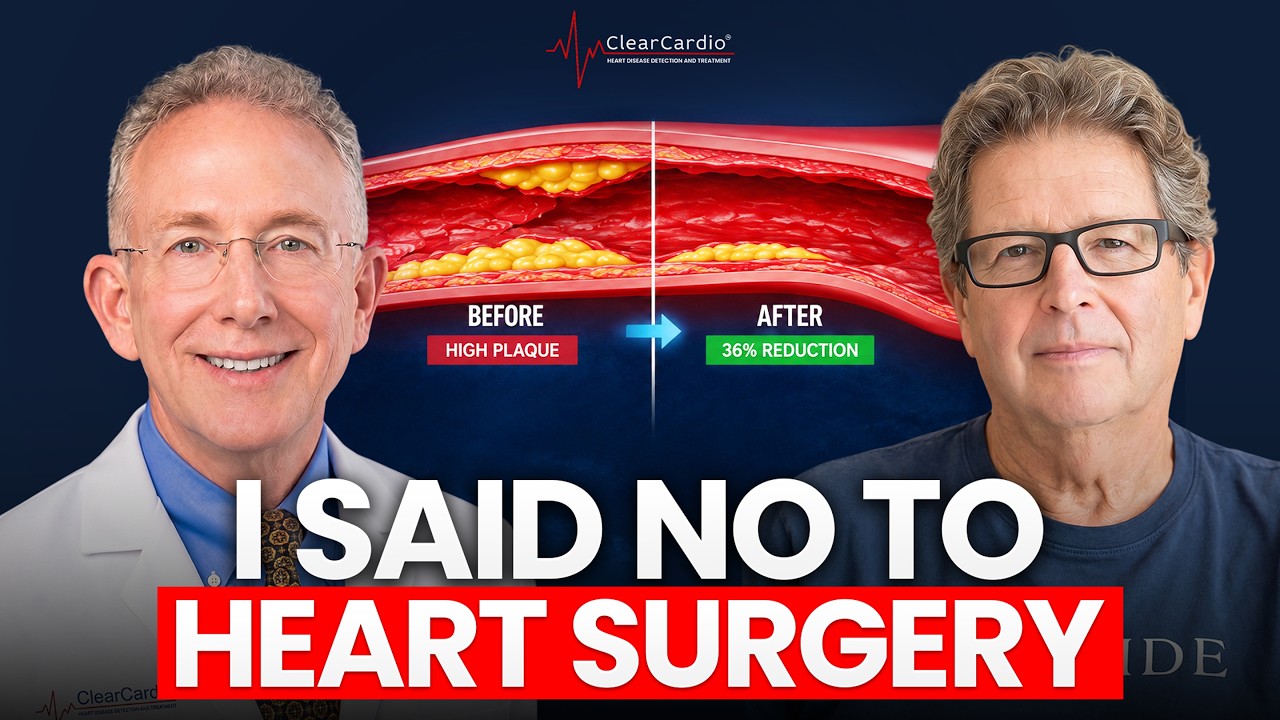
In this interview‑style YouTube video, patient Mark Cozart recounts his experience after being told at age 66 that he needed heart surgery. After receiving four separate medical opinions that all recommended invasive procedures, Mark sought a different approach and connected with Dr. John Osborne of the Clear Cardio program. The conversation covers Mark’s initial diagnosis, the discovery of coronary plaque via cardiac CT, and the program’s unique ability to stage cardiovascular disease (he was classified as stage 3, a relatively severe level). Dr. Osborne explains the distinction between mechanical fixes (stents, bypass surgery) that only relieve symptoms and medical fixes—diet, exercise, smoking cessation, and targeted lipid‑lowering therapy—that address the root cause and can alter disease trajectory. The discussion highlights the use of advanced cardiac CT combined with quantitative AI to measure soft and calcified plaque, a capability the speakers claim is rare worldwide. Mark describes his year‑long regimen: daily workouts, a heart‑healthy diet, and the prescription medication Nexlizet (a high‑intensity statin/PCSK9 inhibitor combo). He reports improved metrics—cholesterol under 50 mg/dL, blood pressure consistently around 116/72 mmHg—and a subjective feeling of being healthier than at age 40. The video also includes promotional calls to action for the Clear Cardio assessment service. Throughout, the tone is conversational and persuasive, with a hopeful, optimistic sentiment toward non‑surgical management of coronary disease.
Chapters
There's real consistency in the real medical world, and that is if you're sick, we're going to cut you. I may be a little overweight. I'm only at that time 66 years old, and I feel pretty dang good, but you're telling me I'm about to die. And then the fourth one was, man, you're wasting time. You, you've already talked to 3 or 4 people. You're still alive? You're still alive. I said, yes, sir, I'm still alive, but I'm just not buying it.
So, Mark, I remember, I distinctly remember when we first met and You had kind of come through, I think, second, third, maybe even fourth opinions. So, tell me about all that journey. I found it very, very interesting. And that's the first time we met.
100%. First opinion, second opinion, third, and fourth. And there's real consistency in the real medical world, and that is if you're sick, we're going to cut you. And depending on the kind of doctor, it's only a matter of How quickly I can get in for them to save my life. And I look at those people and I'm thinking, I may be a little overweight. I'm only 60, at that time, 66 years old, and I feel pretty dang good and I can outwork anybody on my crew. But you're telling me I'm about to die. So I think I'll get another opinion. So after 1 and then 2, same thing, and then 3 again, and then the 4th one was, man, you're wasting time. You, you've already talked it through your feet.
You're still alive.
You're still alive. I said, yes, sir, I'm still alive, but I'm just not buying it. So a buddy of mine told me about Dr. Osborne, and I went to see him. And this, this was the new approach that I needed. I know that I'm not going to die tomorrow. I know that I'm not going to die in 5, and I know I'm not going to die in 10 years, 15, 20 years.
As long as you don't fall off a ladder.
As long as I don't fall off a ladder or not volunteer for that or whatever.
So you're not going to die from heart disease, heart attacks, or strokes. But you might get hit by a bus. We don't want that to happen. Right.
And I think the odds are better with all of those, all of those above than with a heart attack. Yeah. So I'm grateful. I'm looking forward to the results of my, my yearly scan. I know they're going to improve, and I can't wait to tell everybody how much they've improved.
So you just had your scan this morning? Yep. About an hour ago. Now we're still waiting for the results. So we're going to— we will do some production room editing and magic and, and bring those to you later. But really wanted to focus on kind of your journey here before you saw your first cardiologist. How was it that this issue got uncovered?
I have to think back. I think the issue got uncovered because I went to get a checkup and the doctor, my primary care doctor, asked me if I'd had my heart checked. And I said, no. He said, well, let's do that. So that really kind of started the boulder. I'm not going to say the pebbles falling from the mountain, but the boulder falling from the mountain. And before I knew it, you know, I'm near death.
And then next thing you know, they're saying, We got to cut you.
Yeah, absolutely. And sooner, sooner better than later. And I can't tell you how mentally disturbing that is. That was for me because once I found out that I was sick, I started feeling bad.
Well, once we tell you you're sick, you better behave like you're sick.
Exactly.
Yeah, that's not being kind or polite. Yeah, exactly.
Yeah. So it was, you know, that kind of slowed my entire lap down, you know. Finding out this news. And that's another reason that I just wasn't going to buy this diagnosis.
Well, so what we found, so we put him in our scanner about a year ago or so, and we found, yeah, there definitely was some plaque buildup. There were some narrowed vessels, but when you looked at it, there was nothing critical. And I think one important lesson from this is that when we talk about mechanical fixing, right, as opposed to medical, The role for mechanical fixing, and I'll put that into that category of balloons and stents and bypass surgery, is chiefly for symptom relief. Now, what's fascinating is Mark never had symptoms. Right?
Zero.
So, the role for stents and balloons and surgery, I'll say balloons to be comprehensive, we don't really do balloons anymore, but for elective stents and surgery and things like that is really you're having chest pain, you're having angina, I can't do what I normally do, I can't crawl up 15, 20-foot ladders and I'm getting symptoms and I'm taking nitroglycerin, in which case stents and surgery can be very effective for symptom relief. But what's interesting is we know from a variety of studies and very consistent studies really over the last 30 years that stents and surgery are useful for symptom relief. They do not change the trajectory with respect to are you going to have a heart attack or are you going to die of a stroke or heart attack? What does change the trajectory as far as whether we have a heart attack, die from a heart attack, or have a stroke really has everything to do not with the mechanical fixes, but with the medical fixes. Diet, exercise, not smoking. You know, along the way we, we got you lifting weights, went through some of our programs where we got you working out and working and working with weights and got some muscle back as well. We also got some fat off too with some of the strategies we used. And of course, other things that we do, cholesterol lowering, That all of those things treat the disease. They treat the plaque mechanically. If we do a stent, we're literally just using a snowplow to push the plaque off to the side. We're not making the plaque disappear. We're not changing the plaque. We're not reversing the plaque. We're literally just snowplowing it off the side, which is fine. You're going to have better blood flow and presumably less symptoms. Although that's not always what happens even with these interventions. But we're not really treating the disease. And with surgery, all we're doing is laying down new pipe, new conduit around the blockages. So that we have better flow, but in no way are we treating the disease.
The problem.
The problem, right?
And I've always been, let's treat the root cause, the problem, in which case then we probably don't need mechanical fixes.
That's right.
Yeah. So, we brought you in and we found that you do have a level of disease, cardiovascular disease, i.e., plaque, soft plaque, as well as calcified plaque building up in your arterial wall. And so, as a result of that, and Dr. Osborne's expertise in that space, using the tools that Dr. Osborne uses, we were able to diagnose you. And we diagnosed you with what stage? Do you recall what stage that was?
I think it was stage 3.
Stage 3. Okay. Stage 3, which is, for those of you who don't know in the audience or reviewing, we are one of the only ones in the world that can actually stage cardiovascular disease now, like oncology and cancer. We can actually stage disease of cardiovascular disease. There's 4 stages. There's 0, being you have 0 plaque, i.e., no calcified plaque and no soft plaque, that's dangerous plaque that ruptures and causes heart attacks and strokes. And then, there's 1, 2, and 3. 1 being mild, 2 being moderate, and then 3 being relatively severe. Now, regardless of what stage you're in, the beautiful thing about Dr. Osborne and the Clear Cardio Program is we can treat you no matter what stage you are. So, the important thing is knowing, right? Well, you wanted to know, right? You didn't want to just go in and have open-heart surgery, bypass surgery, stents, balloons, as Dr. Osborne puts it.
But, I didn't feel like I was getting anywhere doing that. So I started doing more. I made myself do more. I didn't want to, let me tell you, because this is the long fix, people. I mean, the quick fix is with the stents and the surgery, but you're not fixing anything. You have to be proactive. You have to get up, you have to work out, you have to eat right, and you have to educate yourself. And you have to be with someone who understands this disease like Clear Cardio does. And in the year that I've been here, I can honestly tell you that I feel better today than I did a year ago. And I feel better today than I did when I was 40 years old. And it's a combination of taking care of yourself and understanding what's going on with yourself.
Yeah, it's really important.
Fourth question, is my plaque better? That was unanswerable. Yeah, that was completely an unanswerable question.
Yeah.
Until we had cardiac CT.
Yeah.
And now coupled with quantitative AI, as in Mark's case, is a year later, I've done the program, I'm feeling great, I got more muscle, I got less fat, cholesterol looks great, all those things.
Want clarity on your arterial risk? Click now the link in the description to schedule your Clear Cardio patient assessment call. We'll review your risk factors, see if our advanced program fits you or points you in the right direction.
You know, your journey here thus far with us is really just beginning.
Hope.
Your journey into wellness, has begun. And so, you know, you went through all of this process, you came to see us, you have stage 3, which is on the severity side of it. That said, we can treat that. Dr. Osborne is treating that. And what you're here today to talk about is your journey between when you were initially diagnosed roughly a year ago or so, maybe 18 months ago, I guess, and where you stand today. So today you came and saw what Dr.— met with Dr. Osborne, you met with our staff here, At the, at our, at our hospital here, Clare Cardio at Carrollton Regional Medical Center. You had another assessment that we provided to you through the CCTA and blood work and so on. And, and today everyone here who's watching, you're going to see the results of that. Those results are coming, but we're going to mix that into the video as you heard Dr. Osborne say. So you're going to see that if you're watching this, you're going to see it as part of this podcast, although it's going to be a few days from today when we'll actually have that data. And we will show you. And this is the key, right? Because one thing that I learned so much from Dr. Osborne in all his experience, 30-plus years treating patients, saving people's lives, and changing their lives, not just saving their lives but changing their lives for the better, is that when you go to your cardiologist and your normal cardiologist and you ask them, and we have patients asking me all the time, JD, when I go to talk to my normal cardiologist, what questions should I ask them? I said, really, There's only 3 questions you ask is, is do I have soft plaque? How much soft plaque do I have? And where is it?
Right. They can't answer that, JD.
They can't. Because if we know, which we do know, and they know that soft plaque is the number one cause of all heart attacks and strokes, which is heart attacks and strokes is the number one killer of all humans on the planet. But ask your doctor, do I have soft plaque in my arteries? Where is that soft plaque? And how much of it do I have?
And, and, and the other thing, as in Mark's case, is a year later, I've done the program, I'm feeling great, I got more muscle, I got less fat, cholesterol looks great, all those things. Fourth question now, is my plaque better?
Right.
Right?
Right.
That was unanswerable.
Yeah.
That was completely an unanswerable question.
Yeah.
Until we had cardiac CT.
Yeah.
And now coupled with quantitative AI.
Yeah.
Right.
So that's why you're here.
Yes, sir.
You're here to answer that 4th question.
Yep. And I'll say for the audience at home that we talk about those stages because that's the difference.
So you're in a wonderful position right now.
I am. Yeah.
And you're feeling the best you've ever felt?
Absolutely.
So what's your regimen? Like, tell the viewers, like, what's your daily regimen?
My daily regimen is up early, work out, try to eat right, go to work, come home, go to bed disengaging from my body. You know, I feel great. I feel like I have— I feel like I can live to be 100 years old when a year and a half ago, I might not see 68.
And you've had no surgeries at all?
None.
Great. That's exactly why, you know, you hear Clear Cardio exists is to prevent that. If you don't need it, don't get it. And often, way too often, too many people are getting surgeries, interventional surgeries when they don't need it.
So, on another project, we were just working on last week. Won't give you details, but anyway, on another project, they were asking, well, so of the people you scan, how many go on for stents and bypass surgery? And then what are their complications afterwards? And we said, well, almost zero because the vast majority of people with early detection, we can detect it early.
Right.
And you don't need the things that we associate with Undiscovered diseases that have festered for decades and decades. And then you need to resort to mechanical approaches of stents and surgeries and such. And it was kind of interesting. I think they're almost gobsmacked that, oh, you mean you don't just send everybody off to surgery or stents? No.
No.
I mean, there's certainly a role for that in a very small select group of people. But unfortunately, we use that cudgel on a daily basis, right? If you're a hammer, you look like a nail.
That's right. Unfortunately, people fear the unknown. And if you educate yourself or you question everyone else's direction to what your problem is, if you don't educate and you just agree with them, then you're going to be that person that has those stents and that bypass. 6 months of downtime in your life, you don't change your eating habits, you don't change your exercise habits, and you never address the disease.
Right.
You know, so that's just going to be a vicious circle.
Well, it's a beautiful scenario because you're the revolving door.
That's right.
You know, I still hear people who've had bypass surgery, as an example, say, well, yeah, but the surgeon said, I'll see you back in 7 to 10.
Yeah.
Right?
Well, yeah, if you do nothing about the disease, Well, it's going to clog up the vessels that they just put in. Sure, you'll be back in 7 to 10.
Absolutely.
Well, why wouldn't you also, if you needed surgery, get surgery, heaven forbid, but if you have to, that's fine. But then fix the underlying problem that caused you to need the surgery in the first place. Wow, what a brilliant idea.
Yeah.
Why don't you just address disease to see if you can eliminate future surgery?
Well, or we pick it up early. So discussions of You know, quickly, you know, running you off to the OR or to the cath lab and in emergent scenarios. But let's not just— let's not do that anymore.
Yeah.
So, we're going to move over now to the results of the second scan. It's been, what, a year and a half-ish since your scan? And so, you know, now with your knowing that— knowing what you have stage 3, the diagnosis, the medications, what medications have you been taking as well as the diet and exercise and things like that?
One statin drug and one state-of-the-art statin drug.
Okay. So, to get that cholesterol down, what's your current cholesterol level?
Oh, it's below, it's below 50.
Below 50.
Okay.
And blood pressure?
The blood pressure, I've always had great blood pressure. My, my average blood pressure is 116 over 72, and it, it rarely wavers.
Okay. That's fantastic. Yeah. So, we got it. Okay.
Back up a moment here.
No worries. Okay. So, um, so, uh, you've been diet, exercise, you're on, you're taking some medications, you're on 2 statins as I understand. So, that's new state of the art. Is that Repatha?
He's actually on Nexlizet.
Yeah, Nexlizet. Oh, that's a phenomenal drug. Yeah, that's a phenomenal product. And the goal is not to— is to get you off of them, right? The goal is— that's our point, not to keep you on them. We're doing that now. Dr. Osborne's doing it now because it's the right thing to do because you're stage 3. But the goal is to get you off of those. So you're taking those 2, diet and exercise. You're feeling the best you've ever felt before. Okay. And so now we're going to— and your blood pressure is normal. Normal.
It's better than normal. You know what? 120/80 used to be normal, but I think they've They've lowered that. Yeah. And now I am the normal. I'm 115, 116 over 72, 73. Fantastic. All the time.
All right. And how old are you?
Do you mind? 68.
68. You don't look 68.
Yeah, thank you.
Fantastic.
Don't miss this other episode right here on screen where we will reveal the missing answers you need to know about true cardiovascular prevention. And if you're ready for absolute clarity on your arterial risk, click the link in the description to schedule your Clear Cardio patient assessment. We'll look at your specific risk factors and see if our advanced program can help you.









