He Reversed 36% of His ARTERIAL PLAQUE With ClearCardio \ Mark Cozart Part 2
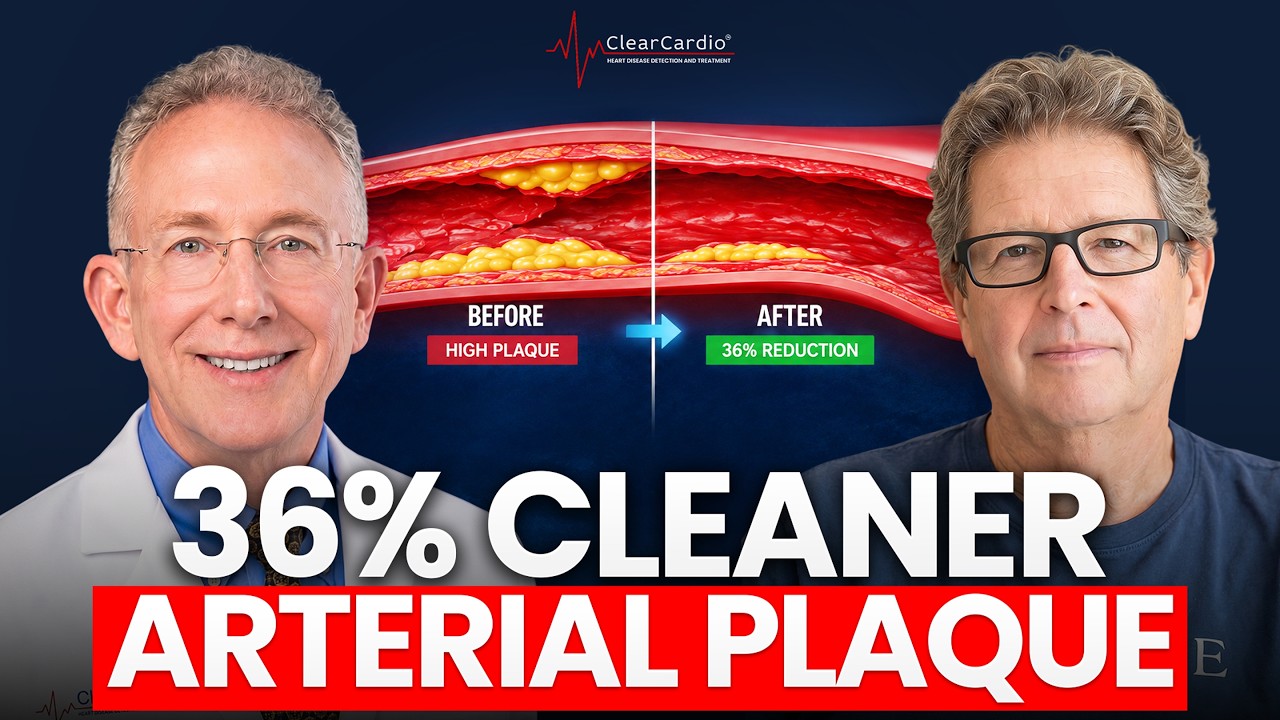
In this episode of the Prevention is Power podcast, Clear Cardio CEO JD Enright interviews patient Mark Cozart and Clear Cardio Chief Medical Officer Dr. John Osborne about Mark’s dramatic cardiovascular turnaround. After a series of conventional cardiology visits that pushed him toward open‑heart bypass surgery with cadaver veins, Mark was referred to Dr. Osborne, who introduced him to Clear Cardio’s plaque‑centric prevention program. The program combines high‑resolution 640‑slice cardiac CT scans analyzed with artificial intelligence, aggressive lipid‑lowering medication (rosuvastatin plus a novel agent, Nexlizet), and lifestyle coaching (diet, exercise, accountability). Over 12 months, Mark’s soft, lipid‑rich (non‑calcified) plaque volume fell 36.4%, while calcified plaque increased, indicating a conversion to a more stable form. The hosts use the case to critique the traditional focus on mechanical revascularization (stents, bypass) and to promote early screening, family‑history awareness, and the superiority of cardiac CT with AI over simple calcium scores. Mark also shares his personal experience with nutrition coaching, the mental and physical benefits of avoiding surgery, and urges listeners to consider Clear Cardio’s approach for “life‑adding” health.
Chapters
They had me convinced I was about to die.
From general checkup to in 90 days you're gonna die, you need to have bypass surgery, open-heart surgery, and now here you sit one year later.
Yes.
Being introduced to Dr. Osborne, having a come-to-Jesus moment, as it were.
It's not the blockages that get you, it's the plaque.
36.4% reduction of the dangerous arterial soft plaque. That's what we here at Clear Cardio have helped Mark Kozak, achieve in just 12 months. You see, results like this are crucial, critical milestones which significantly reduce Mark's risk of having a heart attack or stroke. Hi, I'm JD Enright, CEO of Clear Cardio, and today on the Prevention is Power podcast, we'll be speaking with Mark about his Clear Cardio journey and taking a deep dive into how together we changed his outlook on life. Also joining us is Dr. John Osborne, Clear Cardio's Chief Medical Officer, a Harvard-trained cardiologist, and the driving force Behind the Clear Cardio Program. So, uh, Dr. Osborne, we're gonna be going over, um, Mark's, um, follow-up results. Yeah. Uh, after just 12 months, 36.4%. Did I get that right?
Absolutely. And we got the numbers to prove it.
Wow.
We'll, we'll show everybody that.
36.4%.
Yeah.
Of course, he's, he's pretty good evidence of this.
Yeah.
As well. The fact he's here and yes, doing well and—
Yeah, absolutely. So, you know, I know our, our viewers are really interested in hearing about your journey. Uh, I am for sure. Why don't you tell us a little bit about what brought you to Dr. Osborne and the Clear Cardio team?
Well, let me tell you, the journey began with cardiologists who, the first thing they want to do is herd me through the cattle chute, get all of the data that they could possibly get to make sure that my surgery is going to go as well as can possibly be.
Your surgery?
My surgery.
Yeah, so the end result is they want surgery.
That's right. And I said, hold on a minute, what are we talking— what do you mean?
This sounds Stalinist, right? Tell me the surgery and I'll find you the patient.
Yes, right, that is exactly right. So my first cardiologist, uh, skeptical. The second one, I was more skeptical. And as I continued the tests, there are so many people that go through these places. I'll continue that part of the story before I get to Dr. Osborne. When, when, when they successfully changed my attitude about that I'm about to die. Then my third cardiologist, we went to have tests to see if my veins were good, you know, good enough for a bypass and all that stuff. And they were ready.
You were ready for a bypass?
I was ready to go. 72 hours. In 72 hours, I was ready to go because they had me convinced I was about to die.
Oh my goodness.
Yeah. So the first test that was performed on my veins came back, well, your veins are a little small. We may have to use cadaver veins. So now I'm thinking, okay, no, this— we are— I am not going to go this direction.
Is that— that's a thing, John, using cadaver veins? I didn't know that was a thing.
So they did another test and they positioned me differently on the table so I could have better blood flow. And then bam, I passed the test. I'm ready to go. Now I've got 48 hours. Yeah.
Okay.
Yeah, we're ready to go. And, you know, through some difficult hours of my thought process about all this, I decided, no, I'm not going back there.
What was going through your head? Like, I'm just curious.
Like, what was going through my head was, how can somebody feel the way that I feel? Because I felt pretty good then. I feel way better now, you know, as I'm going through this program. But I know that I'm not about to die. And Dr. Osborne, he convinced me that I'm not gonna die. And that was a hard sell.
You're not gonna die.
That was a hard sell.
Not today anyway, or in the near term.
Yeah, in the near term.
Or the moderate term.
He said, you're gonna die, but you're not gonna die from, from this. You know?
Wow.
So that's, that's what started the journey. The journey.
Oh, got it.
Okay.
Well, and, and I think, Mark, too, through all your cardiology journeys and all that, you know, I think you had multiple procedures.
Yes.
You had at least one, maybe 2 heart casts. I'm trying to remember now. Yeah. He had a cardiac CT, right? Okay. So he had all of these tests done.
Mm-hmm.
And, and every time he saw one of these people, cardiologists, could be males, females, doesn't matter. They all basically said, oh, well, we, we need to fix it. Right? I think.
Yep.
Some said surgery, some said stents, but All of them said, you need mechanical fixes.
Mechanical intervention.
Yeah.
Okay.
And I don't think anyone actually ever really spent much time talking about the medical side of it. What are we going to do to treat the disease? It was all about treating the blockages or the concern about blockages and—
And the symptoms associated with them.
Well, right. And although you had some symptoms initially, we basically, with a little tweak of medication, it went away.
Well, what were some of the symptoms?
Well, they were really just very slight. You know, I'd have a little bit of fatigue, a little bit of angina.
What does that feel like? For those of us who don't know, what is angina?
That's where I was going to go. I still don't think I have angina. I think that it was a function of how hard I work and how hard I work out, and I'm an extremely active person. A typical day when I'm out on the job, I'll be up and down a 20-foot ladder.
Got it.
200 times.
Got it. And so you've got these—
And never get winded.
So you've got these mild— yeah, so you're not showing a lot of symptoms, right? But yet you've gone to see— what brought you to this cardiologist in the first place? Like, why did you walk in the first cardiologist's door?
Checkup.
Just a checkup?
A checkup.
Wow. And so you went from checkup to open heart bypass surgery with cadaver veins.
That's exactly right.
Wow. How long did it take to go down that rabbit hole?
About 90 days.
In 90 days you went from climbing up ladders, no symptoms, a normal checkup, We're gonna use cadaver veins. Scared for his life.
Open heart surgery. Open heart surgery, and we're gonna put dead things in you.
That's right.
Wow.
Okay, exactly. And we hope they're not clogged.
Yeah.
That's pretty bad. Whoa.
Wow, that's scary.
Oh, it gets better.
Yeah.
I want to tell you a story of the cardiologist that I visited last. He was too busy for me, so he had his PA tell me that I needed open heart surgery right away.
His personal assistant.
It's so important, I need to have someone else tell you the news. Yes. Yeah.
Red flags everywhere.
Yes.
Got it.
So, all right. So now, so now you're, you're, you get introduced. So you're thinking, I'm not going down that road, right?
That's exactly right.
When his personal assistant tells you that you need open heart surgery and they're gonna use cadaver veins and all this other stuff in 90 days, you decide, probably not where I'm gonna go. But you're still, you're still convinced you're gonna die.
Yes.
Okay. So you reach out, your pilot friend says, Stop. Let me introduce you to this really weird dude named Dr. John Osborne.
Dr. John.
Right. He's been yelping from the rooftops about preventive cardiology for 30 years now. Right. Meet him. Okay. So let's start there. What happens?
That is a very good analogy of the way he presented Dr. John.
Yeah, exactly.
So I called Dr. John up and it was almost immediately that he would see me. I believe it was the next day, if I'm not mistaken.
Well, I'm sorry. I'm sorry it took that long.
Yeah. Yeah. And so I went to visit. You looked at the cardiac CT that I had done, explained it to me, convinced me that I'm not going to be dying anytime soon. And by the way, on these heart caths that was performed and the cardiac CT—
Yeah, they're all the same. You don't need surgery.
Yeah, you don't need surgery.
Well, and I think it was kind of crazy, the pathway that you were put upon. I don't think you chose, but I think you had a heart cath Then they did a cardiac CT, right?
That's right.
Which was like— and I remember hearing the story going, wow.
Backing into the situation.
Yeah.
Why did you have an angiogram and, and then a cardiac CT?
Yeah.
I mean, it was just very weird.
Very strange.
It was very weird.
Yeah. And something that I haven't told either one of you, but only 90 days before this, I was doing a stress test, you know, to see, to see how I was, you know, reacting.
Right.
And this didn't have anything to do with the journey that I was about to start. This was just, you know, part of my FAA, you know, to keep my pilot's license.
So this is a pilot's license requirement?
It's not really a requirement, but I did it.
Yeah. Okay. Being proactive.
Yeah. And I went 21 minutes on the treadmill.
That's like—
Yeah. But we add on the incline.
Yeah.
Oh, it'll really saturate you.
You crushed it in the best possible way.
I would have been going Even more if I hadn't broken my foot 90 days before.
So you did it with a broken foot?
Yeah.
But yet you find yourself in the cath lab.
Yes.
Okay. See, that's why y'all gotta come reach out to us here at Clear Cardio before that all happens.
Yeah, absolutely.
Yeah. Okay. So, so now you've met, you've met with Dr. Osborne. Yes. You were able to extract like wisdom teeth out of those prior cardiologists, your results.
Yes.
You got them over to, to Dr. Osborne and, and then he proceeded to tell you what?
He told me that I'm not going to die anytime soon.
Is that how you said it, John? Was it exactly like that?
Oh, well, yeah, usually I'll say, you're not going to die anytime soon, and it won't be of heart disease, period. Yeah, right. Not on my watch.
Okay.
Right.
And people who know me probably realize that.
Yeah, yeah, fairly well.
Yeah.
So what was your knee-jerk reaction?
We won't talk about your girlfriends.
So how did— look, after all this, promise, this 90-day journey you just went through, right? And you were lucky enough to, to be referred to Dr. Osborne. How did you— what was your knee-jerk reaction to hearing Dr. Osborne tell you that? After all this?
It's finally— I finally heard something that I wanted to hear, what I felt was the truth.
Okay.
Yes.
So it rang honest and true.
It resonated in the way that I would— his reaction was what I feel. I know that I wasn't that sick. And I also know there's risk in this surgery. I mean, you are never the same. My father had it. There's a history of heart disease in my family.
I would say, yeah. So tell us a little bit about the history.
Yeah, well—
Because there's a lot of people watching today who likely have family history.
Yeah, and genetics are so, so critical.
Yeah, so, so you've history, right?
Well, that, that's interesting what you just said, because as much as I've grilled you, that, that, that's the first time you made that statement, and I, and I certainly believe that.
Yeah, yeah.
Well, one thing I always do, right, I think the family history, the genetics are really, really important understanding that. Um, but, you know, after I'm done with, you know, we talk about you, right, I always try to finish up, okay, Your brothers, your sisters, could be even your nieces, nephews, right? So all of those individuals, 'cause I'm talking about, you know, Mark, well, you got it. So I wanna make sure along my general plan to eliminate heart disease that anyone else in the family that could be at risk, that is also checked out, right?
Yeah.
Yeah. And so, you know, that's something I always make sure we take care of Mark first, but make sure anyone else in his family that he cares about and loves, right? That is, is checked out, right? Because with heart disease, you feel fine until you don't.
That's right.
Right?
That's right.
I mean, that's why we call it sudden cardiac death, right? You feel fine and then—
Until you don't.
An acute catastrophic event occurs that could be fatal.
So anyway, and, and that's a factor that, that, that was a factor in my decision.
Yeah.
And from, as, as I kept gaining, gaining knowledge from Dr. Osborne, I realized that even if you have the surgery, the disease is not repaired. Right. The symptoms are, yeah, or they're at least addressed. They may not ever be 100%, but you'll never be 100% after that surgery.
Yeah. So you said complications when your dad had it.
That's where we're going.
Absolutely. Yeah, yeah, yeah, that's right. And in fact, as I understand it, you just fail.
Wow.
It's just, you don't go forward.
That's good to know. Yeah, that's good to know that I didn't go forward on that.
Yeah, don't worry, it's not coming into you right now. So, okay, so you hear all of this and you're thinking, okay, I've got some light at the end of the tunnel.
And it's not a joke.
You survived, because a lot of people don't actually Come out on the other side, you were fortunate you didn't end up having all that surgeries and all those things and complications. So you should be thanking your good pilot friend there so much. If he's watching, thank you. Right. So now you're sitting there and you're going, okay, what's next? Right?
Right. Yeah.
So what was next, John?
So during my interview with Dr. Osborne, you know, we started going down a completely different track. You know, I felt comfortable. I was very comfortable with his knowledge.
He—
and, and again, nobody knows me better than me, and, and I knew that that course of open-heart surgery and all of that, all that, that, that it entails was not the way I needed to go because I knew that I wasn't going to die in 3 months like they're— like they're— like they were telling me that I was.
Yeah.
So we started, uh, we, we did some medicine changes. And by the way, the medicine— I'm 67 years old. I take— Wow, you look fantastic for 67. Thank you.
I had no idea.
Yep.
Wow.
Rosuvastatin and a drug called Nexilizet.
Okay.
And that compound has changed things dramatically. And that compound also does nothing to my psyche, my abilities. It's just something that works within my body.
Okay, so well tolerated. What do these drugs do, these medications?
Yeah, so all of the medicines ultimately lower LDL, if you wanna be really sophisticated, ApoB, we'll have to talk about that one of these days. When we treat plaque medically, Diet, exercise, lifestyle, don't smoke, all that good stuff. And then add on the medication. We're really— and it's so important— treating plaque, not just in your heart, not just in one vessel, but in the heart, in the carotid arteries.
Your whole body.
In your whole body, right? Or as I love to say it, we're treating plaque from the top of your head to the bottom of your toes.
That's great.
And the cool thing is with this cocktail, not only are we treating and removing the fertilizer, right, to plaque, which is the bad cholesterol, with 3 different drugs, which all work together beautifully. But in addition, these drugs also reduce inflammation. So think of a vessel like Teflon, which is what you want. Cholesterol hits, bounces off, it doesn't stick. A lot of people, because they chose the wrong ancestors like Mark, have vessels like Velcro, right? You do not want Velcro vessels, right? Even if your cholesterol is average or low.
Or low, yeah, should we say that?
That cholesterol's gonna stick like crazy, right? So that's kind of what that little cocktail does. And then of course, everything that Mark does, I mean, he stays active, he's busy, he's height-weight proportionate, As we like to say. So, I mean, on the non-pharmacologic stuff side, he's doing perfect. Unfortunately, because of his genetics, even if he had done everything perfect, right? And he pretty much has, right? He will, he still would've ended up with the plaque because there's so much genetics. Yeah.
Because we've seen people who are athletes, you look in the mirror and you go, wow, that's a special specimen, men and women alike. And their diet and exercise is fantastic. Their resting heart rate's all great. And then we look under the hood, which is what Clear Cardio does. And we've seen that their genetics were fooling them, right? They had lots of soft plaque. And so it was just interesting. So, okay, that's a great place to stay there and say, okay, so you've gone through this journey, right? You were fortunate enough to get together with Dr. Osborne and become part of the Clear Cardio patient family. We've baselined you, right? And now we're going to take a minute and we're going to go through what everybody's been waiting to see is—
Right.
When I started the podcast, I said, 36.4% reduction in 1 year. That's a massive amount of reduction in soft plaque, which correlates to significant risk reduction of heart attacks and strokes. Absolutely, huge.
Yeah, huge, right?
Right.
So we're gonna see that in real time.
And the other thing too that's so important to understand, and this is really what makes Clear Cardio different, is that, you know, in Mark's case, right, I had numbers, right? I got cholesterol numbers, I knew where he was starting from, we put him on the right cocktail, you know, his aspirin, make sure the blood pressure's perfect, get the cholesterol perfect. So I always think of this as getting all the gauges in the green, right? Cholesterol, blood pressure, if there's any blood sugar issues, aspirin, exercise, diet, all of those things, right? So all the gauges were in the green. However, in the past, I never could say, is the plaque better? I would hope it would be. I would say statistically, it should be.
A comparative tool.
Right.
A tool that you can compare before and now.
But now, with cardiac CT coupled with AI, and the ability to absolutely accurately detect and quantify plaque, which is a huge breakthrough, we could never ever do that before, we could now say, okay, You had a cardiac CT. So we took his cardiac CT that he'd had before I met him.
Yeah.
Right, elsewhere. We finally got the disc.
Yeah, after you beat the administrative— Give me my stuff.
Yeah, administrative hassles. We finally got that disc. We then repeated his cardiac CT on our fancy 640-slice cardiac CT machine.
Right here at ClickCardio.
Exactly. And then we could then say, okay, here's all the numbers. Numbers are all great, this bodes well, but let's actually check the proof, right? And the proof was to be able to compare the 2 scans, and they were about a year or so apart. But we're going to show you that now. We'll show you. So not only did all the numbers look good, but actually the remaining question is, was the plaque better?
Yeah.
At 67 years old, I don't think I have felt this good even when I was 40 or 30, maybe 20. Something that I haven't told you.
So you did it with a broken foot?
Yeah.
But yet you find yourself in the cath lab?
Yes.
Okay. See, that's why y'all got to come reach out to us here at Clear Cardio.
If you want to know your real risk, click now the link in the description to schedule your Clear Cardio patient assessment call. We'll review your risk factors, see if our advanced program fits you or points you in the right direction.
So, so for all of you out there, you know, there's a lot of people saying a lot of things that, you know, they can accomplish. And we here at Clear Cardio are all about showing you, looking under the hood, the imaging, the analysis using the AI. And also, you know, the proof is in the doing. So this is a special episode whereby I think this is the first episode we've had an opportunity to do this.
Mm-hmm.
Thanks to Mark for coming in and allowing us to do this live and actually show you that the Clear Cardio program, it's not just about disease detection. There's a lot of companies out there that are doing total body scans, MRIs and CTs, right? And you go in, you spend a whole bunch of money to go in there, and we're not suggesting you don't do that. I mean, there's value in some of that. However, it's not just about that. Then what do you do? Once you've detected the disease, which we're the best in the world at doing, I'm going to shamelessly say, but what do you do then? And that's where we step up. That's where we differentiate not only from our technology on the front end, but also on the back end where now we treat you. And here's this episode that we're going to be presenting to you today, which is actually going to show you how we go from one stage. And what stage was he initially?
Stage 3.
Stage 3. So if those of you—
Of 3.
Yeah, of 3. So We are able to now, for the first time, like cancer, unfortunately you've got stage 1 through 4, 4 being the worst as I understand it. We are able to stage disease, cardiovascular disease. There's 4 stages, 0 being you have no cardiac disease, cardiovascular disease, i.e., no plaque in your arterial walls, and therefore very, no risk of plaque rupture and heart attacks and strokes. So that goes to 0. But then there's 1, 2, and 3, 3 being the worst. Think of it as stage 4 cancer, right? You have lots and lots of low-density, high-lipid plaque. Up and down the arteries, right? And so higher risk, much higher risk of heart attack and strokes than you would face if you were stage 2 or stage 1. Well, Mark here had a stage 3, and so that's a significant amount of soft plaque. And what we're going to see here is what he was, his baseline before Clear Cardio, and now a year after being in the Clear Cardio program with Dr. Osborne, how we treat you. And that's the differentiation, not just identifying the disease but treating you. Yes.
And I think 3 points. One, whomever you see for your cardiovascular care, right? Whoever that is, whomever, ask them if you have known heart disease plaque, right? No matter how they diagnosed, whether you had stents, balloon surgeries, or maybe they diagnosed with cardiac CT or calcium score, right? Ask them, how is my plaque now? Right? Another thing, just to underscore how much plaque there is, right? How common this condition is. We talk about that stage 0, right? No plaque whatsoever. Of the people that we scan. So we're scanning generally, well, I mean, we've scanned people, I think maybe in their, maybe in their 20s, I don't know, but certainly in their 30s and older, but all comers. And these are generally people, no symptoms, feel fine, normal stress tests like, like Mark, both, you know, in a, in a stress test lab, but also your daily stress test climbing 20-foot ladders every day.
So we gotta get people earlier.
Right.
That's the key, guys. Come in earlier. Be proactive about your heart health.
So that, that's kind of the bad news, but let's move on to the good news.
Yes.
Which is Mark's news. Yes.
So, That's a perfect segue into— we're going to take a quick break here. We're going to jump on, get the stuff up on the screen and show you. All right, well, welcome back. Now we have the results here of Mark's— well, it's a comparison between Mark's initial pre-Clear Cardio CT and testing. And then 1 year later, here we are with Dr. Osborne and Mark in our podcast studio. And we're about to see the results of this 36— the proof, actually, of the 36.4% reduction in And dangerous soft plaque. Yep.
So here we go. Okay, so stand back, watch, and be amazed. So let me take you through. This is the study that we did. So this is the second study. This is November of '24, so just a few months ago from now. And so when we look at this, this gives us the total amount of plaque. So it's a stage 3. So anything above 750, anything above 750 is stage 3. So he's stage 3, but that's okay. There's the different amounts of the plaque in the 3 different blood vessels of the heart. This is the low-density non-calcified plaque. Had a little bit of that non-calcified, the soft plaque. This is the dangerous lava, I like to think of it. This is the old extinct volcano, right? So a lot of calcified plaques. So this process has been going on for a long, long time, right?
That's a lot of plaque.
That's a lot of plaque, right? The net of that is a lot of plaque. There's stage 3 above 750, okay? Now, the other thing I'm going to note is The other analytics that we get out of that is that we'll look at all the blood vessels and then assign a degree of narrowing, right? So you can see 70%, which is into the pink here, has historically been the number, right? So that's where the narrowing might get severe enough where it might cause symptoms, angina, shortness of breath, whatever. So he does have a couple of areas where it rises above 70%, okay? Now, interestingly, Mark has had stress tests, You're climbing 20-foot ladders. In the meantime, since we met, you lost 30 pounds. Or as I love to say, it's wonderful to see less and less of you, Mark. And here, really, Mark's scenario really illustrates a whole nother lesson, is that it's not the blockages that get you, right? It's the plaque.
Right.
And particularly this plaque right here, the soft plaque, the lava, the lipid-rich plaque. So you could have narrowings, right? But guess what? Your body will figure it out.
That's right.
You did your own auto bypass. A lot cheaper, a lot simpler, and you're not using cadaver.
And less risk.
Right?
And a lot less cost.
Yeah, right? So all he needed was good medical therapy, right? Doing all the stuff that you've done since we met. So even with a couple of vessels, now this is a little branch vessel, that's more of a major one here, but even with these narrowings, you know, the first thing I'm gonna ask you is how do you feel?
Great.
Feel good?
Yep.
Can you climb the ladders like you always do without a problem?
Absolutely.
Chest pain, shortness of breath, whatever, right?
Perfect.
Then I don't really care about the narrowings. And from the cardiology literature here, this is a major gem and pearl, okay? And it's been very clear literally for 2 to 3 decades. It's not the blockages that get you. In fact, in the world of cardiology, and unfortunately you're a great illustration of this, but on the good side of things, in the world of cardiology, we have been ballooning and stenting and bypassing like crazy to the point where The sofas and the chairs in our waiting rooms are ripped and torn.
And.
Right. I mean.
Right.
Thousands and hundreds of thousands, millions of people have gone through the cattle chute.
What a visual.
As we ballooned and stented and bypassed. And none of that made people live longer or prevented the event because we were treating the wrong aspect of the disease. It's not the blockages. What actually does predict mortality in heart attacks is actually total plaque volume.
Right.
You treat the symptom. People historically, the symptoms have been treated and not the cause.
Precisely. We're about, we'll detect all of this stuff, and I'm not anti-stent. If you have bad symptoms that I can't fix with medications, then fine. I mean, it's the knee replacement of cardiology, right? I mean, no one should be limited. But with excellent medical therapy, we have great drugs that'll treat angina, by the way. Very, very, very few people, and JD, as the layperson can testify to this, of all of the people now, which are a lot, that we've treated in Clear Cardio, how many have needed balloons, stents, or bypass surgery?
Not a single one.
Exactly.
Not one.
Right? And not to say they don't have disease and plaque and lots of—
Lots of disease and plaque.
But none of them have needed what we call revascularization, balloons, stents, and bypass surgery.
Hundreds and hundreds of patients.
Right?
Yeah. Because we're really treating the root cause, not the symptoms. Now, if you have symptoms, we'll take care of that. But even with some of the medications we have, I actually call them oral stents because they work so well to relieve angina that you could take a couple pills that are generic and get the same result as a $50,000 piece of steel in your left anterior descending coronary artery.
Yeah.
Most people say, I'll take the pills.
Yeah.
And then blood thinners, risk of complications, heart attacks, strokes, kidney failure, infection, bleeding around the time of the procedure. And then if you stop the blood thinning medications that keep that stent open, If you do, and I've seen it happen, that stent could immediately clot off. The mortality rate is 45%.
Whoa.
So avoid all of that with a couple of pills, right?
Exactly.
For the right patient.
So Mark's a great example, right? He had narrowings, no worries. That's where he was, or where— this is the data when we did his scan. But more importantly, we were able to finagle his old study. So that was done in 7/23. That was before I came on the scene. And Well, let me show you what happened. So, you know what, okay. So if you do the math, right, so this is important, right? The total plaque volume, which includes the LAVA, the LAVA plus the calcified, went up, okay?
Mm-hmm.
But that's okay, because really what matters is this line right here. So this line right here, he, the LAVA, the lipid-rich soft plaque, the dangerous plaque, the rupture-prone plaque, right, was nearly 300. Right? From 723 to 1124 with the right medications, diet, exercise, doing all the great stuff Mark did, we lower that. This actually turns out to be 36.4%.
Wow.
Right? So it is nearly 300 to less than 200.
So that's— so yeah, for those people watching today, that is, that is proof, fact positive, that the process that we follow, that you can in fact reverse heart disease. Because heart disease is really plaque-based and what creates dangerous conditions is soft plaque, which is the rupturing plaque, which causes the heart attacks and strokes. And by converting that soft plaque to calcified plaque, you are effectively reducing significantly and eventually eliminating your risk of heart attack or stroke. Right.
Now, here, look at the hard plaque, the calcified plaque, the, as I call it, the extinct volcano, right? The cinder cone, it went up. And that's exactly what I want to see, right? It's no longer active. It's not going to rupture. It's not going to cause a heart attack. It's a scar. But we converted the active plaque, the LAVA, the lipid-rich soft plaque, dramatic reduction, over 32%. And that's in just 1 year.
Yeah.
Right? And then we saw the increase in the calcified plaque, which is exactly what I want to see.
And that's a point that I'm not sure that everyone can understand. We have soft plaque in our heart. We want that soft plaque to become completely stagnant. We want it hardened. We don't want it moving.
Calcifying it.
Yes. So, and eliminate the soft plaque. That hard stuff is exactly where it needs to be, hard, not moving. And we take care of what is moving.
It's cured.
It's cured.
You're a builder, right?
It's cured. It's cured.
It's stuck on the wall.
All the bricks are on that wall. Exactly.
The other thing, another message, and unfortunately this happens again and again, So I'll caution the audience too. Somebody gets a calcium score, okay? It's a non-zero number, right? There's usually some degree of panic, blah, blah, blah. Maybe get referred to cardiology or whatever. Things can happen. Get a stress test, which is kind of worthless, frankly, or whatever. So they get a calcium score, things happen, and then down the road, a year, 2, 3 years, whatever, down the road, they repeat the calcium score. That is the wrong answer, right? Once you have a positive calcium score, You got plaque done. Not risk, not could be, maybe, possibly. You got plaque. The next step should be cardiac CT with AI, basically, clearly, right? Because then we can understand how much hard plaque you have, soft plaque. And then there is value to repeating as we did here to show not only were the numbers good, all the numbers were in the green, if you will, the gauge in the green. But more importantly, and most importantly, we have the plaque on the run. Right?
Mm-hmm.
If you repeat a calcium score, particularly if you do a great job, right? All the right tools, diet, exercise, medication, whatever, you will see the calcium score go up. And then people really panic because they're saying, I'm taking medications, I'm exercising, I lost 30 pounds, I did all the right stuff, I quit smoking, and my calcium scoring is going up. Because the problem is you're looking at the wrong number. Because on a calcium score, all you can see is the hard extinct cinder cone cement, right? You can't see what really matters, which is the lipid-rich plaque. And that's only going to be seen with a cardiac CT coupled and then quantified with AI. So once you've had a positive calcium score, never get another one. There's no value. Cardiac CT with AI, absolutely. That's what we do at Clear Cardio, obviously. But don't repeat the calcium score because it just doesn't mean anything.
So once you have plaque, your calcium score is going to be a positive score.
Yeah.
It doesn't matter if it's 10% or it's 90%.
Remember, the calcified plaque is always the secondary plaque. It's the plaque I really don't care about. the hard stable plaque, right? But if you have it, then I know you have plaque. Okay, that's useful information, but it doesn't tell me anything about the active plaque, the lava, right? That's where we have to do cardiac CT and AI.
In fact, as I understand it, Dr. Osborne, calcium scores in general, not a lot of value, only because there's value if you have a calcium score done and you show that you have a calcium score that isn't zero, that you do have plaque. Okay, that means you need to figure out what kind of disease you have and how significant the disease is. And that's where you come in.
The calcium score is a starting place.
Right.
It's the beginning of the beginning.
But you can have a zero calcium score and have lots of soft plaque.
Sure.
It just hasn't calcified.
10 to 30%. Now, the flip side of that is, right, don't repeat a positive calcium score. We already know you got the disease, right? Let's just do the proper workup, which would be basically what we do. A zero calcium score prognostically is pretty good. However, be careful. 10 to 30% of those people with a zero calcium score will have plaque. In fact, that plaque will be the lipid-rich invisible plaque on a calcium score. That is the most dangerous plaque. So be very wary about even a zero score, because I've seen people with a zero calcium score come back a year later with a heart attack because all they had was lipid-rich plaque. Yeah. So there you have it. If you really want to know, you got to look under the hood and you got to look under the hood with CleerCardio.
Yeah.
So when you look at this, what do you think, Mark? When you look at this, how does that make you feel? Having gone through this journey, having taken the viewers of today's podcast through your personal journey, you know, from a general checkup to in 90 days you're going to die, you need to have bypass surgery, open heart surgery, breaking open the sternum, all that stuff, and then being introduced to Dr. Osborne, having a come-to-Jesus moment, as it were, with Dr. Osborne and him diagnosing you, going through this process, and now here you sit one year later.
Yes.
With us, sharing your story with our viewers. What do you say to this?
I can tell you that this substantiates the way that I think that I feel. And secondly, at 67 years old, I don't think I have felt this good even when I was 40 or 30, maybe 20.
Wow.
Yeah, so I think right now I'm in the absolute best shape of my life. I feel better. I'm more active. I can do more. Maybe maybe I can't sustain you know hard you know hard physical labor and you know and and and a lot of activity for 24 hours like I used to.
We're still aging when I was 18. We're still getting we're still aging right?
I have to have my sleep now.
Yeah yeah.
But no no this this is this has been a life changing thing for me Clear Cardio has and Dr. Osborne.
By the way we're not paying you anything for this.
Absolutely not.
This is completely voluntary.
Absolutely. I want to I would like everybody to know that this is the real deal. This Clear Cardio. And Dr. Osborne is the real deal. It can significantly change your life if you let it.
Yeah.
And you believe it.
Yeah.
And you know yourself and, and, and you know that you can change.
Yeah. You've been working with, uh, also one of our staff members, uh, Sherry Thacker.
Yes.
Um, on the non-medicated stuff.
Yes.
Uh, can you, can you help us understand a little bit about that?
The, uh, the, the nutrition part of Clear Cardio, you know, through Sherry has also been significant.
Mm-hmm.
And she's pretty tough, by the way. She, she, you know.
She's, she's a good accountability partner.
She, she absolutely is. Oh yeah.
She, she won't put up with, Yeah. Yeah.
Yeah, and you know, sometimes it hurts my feelings.
So what kind of things? Like, is it diet? Is it exercise?
It's diet mostly.
Okay.
And she also, well, Sherri's part is diet. And of course, along with diet comes exercise. 'Cause you know, you have to keep that, you have to keep this machine going.
Yeah. Sounds like you're pretty active anyways.
You're climbing up and down the back seat. I'm active anyway.
You're getting 10,000 steps a day, no problem.
Easily.
Yeah, got it.
Easily.
Yeah, so you got that covered.
Yeah. As a matter of fact, when I have a new employee come to work, there's only one rule. to keep their job and that's to stay up with me.
Awesome.
And it doesn't matter, you know, they could be 18, 19.
They're not 67, I assume.
That's right.
Yeah.
They're not 67.
Yeah.
Wow. And you'd be surprised at how many who can't. There's a lot of people coming up.
Kudos to you for that. Yeah.
Yeah. A lot of people coming up who are sick. They're gonna be sick. You know, it's— this country needs to change the whole outlook on health and nutrition.
Yeah.
So with that said, Cherie has helped me significantly with my nutrition and she does hold me accountable. You know what? I take pictures of what I eat. She shows me those pictures back and I look at that through the course of the week and I'm going, it's a wonder that I'm still alive. I made it through a week. So we're seeing a change in what I'm putting into my body and I'm starting to feel that change. So it's real and it's slow and it's hard.
Yeah.
You know, you have to be dedicated to wanting to be around in this world, you know. For your friends, your kids, your family. So you have to have that emotional connection to making yourself feel better.
Mm-hmm.
And when you have that combined with diet and exercise, things get easy. It's really hard in the beginning because it's a slow process. It's not an overnight thing.
Mm-hmm.
I didn't start to feel any change in me with the nutrition and the exercise that I do. It's a lifestyle change and you have to be dedicated to it. But let's say that you had— that I had open-heart surgery. I don't think I would be capable after that surgery to do what I'm doing right now. I think that would have been an impediment to my health, and I think I would have had a decline instead of an escalation in the way that I feel.
Wow, that's pretty profound. That's pretty profound, you know, and that's often the case. You know, a lot of times surgeries, you know, serious surgeries like that— we're not talking about like plastic surgery, we're talking about major open-heart surgery—
That's right.
Surgeries that, you know, affect you and And, you know, so, you know, thank you for sharing.
And it's not just physical, it's mental too.
Yeah.
You know, you're getting a right and a left once you have to endure that.
Yeah. Boxing analogy there.
So kudos to Clear Cardio and kudos to Dr. Osborne. And I urge everyone to at least investigate these guys because they're real and it works.
It's really not just adding years to your life, but life to your years. And you're just a great example of that, Mark. So thank you for sharing today.
I believe in you guys.
Well, thank you, Mark. And Dr. Osborne, always a pleasure. Thank you very much. For those of you who hung in there through this fantastic Fantastic podcast of, uh, the Prevention is Power podcast by Clear Cardio. I want to thank you. If you have any concerns at all, have any questions, feel free to comment. Click this like and subscribe button here on our YouTube channel. It helps us a lot get the word out. Reach out to us at clearcardio.com and schedule your session with Dr. Osborne and the Clear Cardio team and let us look under the hood.
Don't miss this other episode right here on the screen where we will reveal the missing answers you need to know about true cardiovascular prevention. And if you're ready for absolute clarity on your arterial risk, click the link in the description to schedule your Clear Cardio patient assessment. We'll look at your specific risk factors and see if our advanced program can help you.









