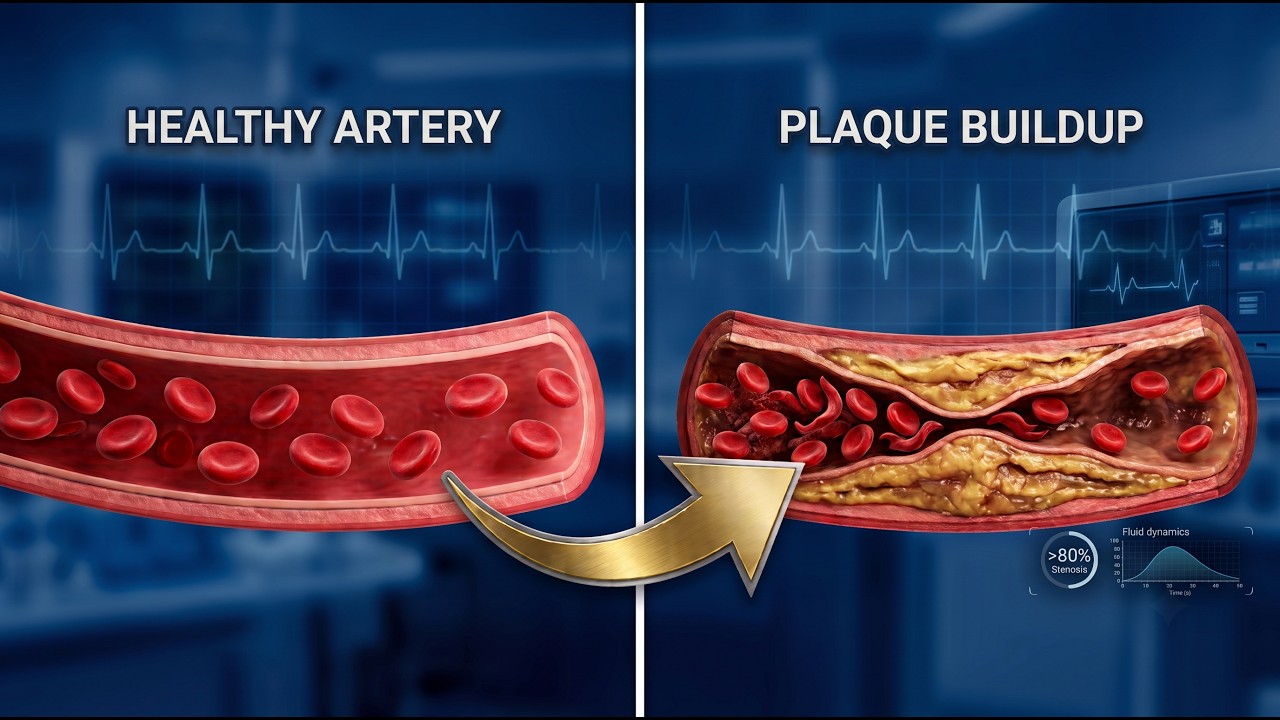
In this presentation JD Enright, co‑founder and CEO of ClearCardio, explains why the common belief that heart attacks are caused by gradual narrowing of arteries is wrong. He describes how most heart attacks and strokes (80‑90%) result from rupture of soft, high‑lipid plaque that forms in the arterial wall after the inner endothelial lining is damaged by age, genetics, lifestyle, diabetes, high visceral fat, hypertension, smoking, alcohol, or drug use. Enright walks through a visual model of a healthy artery, the process of cholesterol depositing into a damaged lining, the formation of three plaque types—calcified (stable, shown by calcium scores), medium‑density yellow plaque, and low‑density red plaque (both unstable). He likens plaque to a pimple that can burst, releasing lipid‑rich material into the bloodstream, which triggers a rapid clotting response that blocks blood flow, causing a heart attack or stroke. He critiques standard diagnostics (calcium scoring, catheter angiography, stress tests) and interventions (stents, balloons) for only detecting lumen narrowing or treating symptoms, not the underlying vulnerable plaque. Enright then introduces ClearCardio’s high‑definition, AI‑assisted cardiac CT angiography and proprietary plaque‑analysis tools that visualize and quantify plaque composition within the arterial wall, identifying the dangerous “lava” plaque before it ruptures. Finally, he emphasizes prevention through metabolic management, diet, exercise, and personalized medication, noting that treating the root causes—not just the symptoms—offers true protection against heart attacks and strokes.
Chapters
Hi guys, this is JD Enright. I'm one of the co-founders and CEO of CleerCardio. What we do is we detect and then ideally prevent heart attacks and strokes, primarily through advanced imaging and cutting-edge medical procedures. So I wanted to tell everybody a little bit about, you know, the truth, what really causes heart attacks. I think a lot of people have a misunderstanding of how heart attacks happen, or most heart attacks. There's the electrical-related things that cause heart attacks, like atrial fibrillation, where, you know, the electrical system in the heart causes issues, and that can cause heart attacks. And that's, you know, roughly 10%-ish of heart attacks that happen. But heart attacks and strokes, as we know, is the number one killer of all human beings on the planet. So that's more than all cancers, all Infectious diseases combined, heart attacks kill more people every year than all of them. So how do heart attacks happen? Well, that's a great question. So I'm here to answer that question definitively. So most heart attacks are due to something called plaque rupture. That's right, plaque rupture. So what does that mean? So first, I've got a model here. This model is, is a replica Of what your arteries look like. So when you're born, your arteries are typically, for the most part, beautiful and clean. And your artery is made up of different layers, right? Whether it's artery in your heart, artery in your neck, carotid artery or something like that. And so you've got different layers. And one, one of the things that you have is a very thin membrane on the inside of your artery. So when you're born, you've got a beautiful clean artery, All the blood and hemoglobin, all of the minerals and all of the oxygen and cholesterols are flowing, that are in the blood, are flowing through the artery, and the artery is just supporting all of that like a hose. And nothing sticks to the inside of the artery because it's like from the 1980s, there was a toy called, or a game called Slip 'N Slide. Super slippery, like Teflon. Think of it like Teflon. So that little lining there, that's only one cell thick, it's very thin, is very slippery. So all of that stuff just flows through. And that's what happens when you have a natural, healthy artery. Over the years, either through genetics or your lifestyle or other types of things like diabetes, high visceral fat, Fatty liver, high blood pressure, things like that can cause that lining to become damaged, that lining on the inside, right on the wall here. And as that gets— and age, age is a big contributor to that as well. As you age or as your lifestyle changes, you're a heavy smoker, heavy drinker, drug abuse, or just genetics, that becomes damaged. And what happens is, as all of that stuff is flowing through the blood, That contains the cholesterol in particular, it sticks to the inside of that. Instead of becoming Teflon and slippery, it becomes more like Velcro. As that cholesterol flows through the bloodstream, it attaches itself, and it's randomized. It just depends on where that lining is damaged most, because the lining doesn't always wear down in the same way all throughout the artery. So you may have areas where the lining is still very slippery, And in good condition, and then you may have areas where it's not so in good condition and it's damaged, and so that cholesterol adheres to that section. Sometimes it could be in your LAD, what they call the widowmaker. It can be in other arteries around the heart, can be in the carotid in your neck. And if, by the way, if you have a, what we call plaque rupture here in the carotid, that's called a stroke. So the physiology is the same as a regular heart attack, It's just, it's happening in a different side. It's above the heart versus if you're having it around the heart, that's a heart attack. So strokes, heart attacks due to plaque rupture, same mechanism, same physiology, basically plaque rupturing into the artery. So, so how does that happen? So as that membrane becomes damaged through all the reasons we just discussed, cholesterol adheres to the inside of that lining, onto that lining, but it doesn't stick to the inside of the lining. So if you were to put a camera down here, someone who has severe disease, arteriosclerosis, you would put a camera down here like when they do heart catheterizations. You're not going to see plaque building up on the inside of the artery. You may see stenosis, which is the narrowing of the artery, but you won't see actual plaque. So what happens is that cholesterol adheres to the, that lining, it gets absorbed into the wall, this part here of the artery, and it looks like This, which is very different than this. So this is nice, open, no stenosis or narrowing of the artery. There's very little ischemia, and you've got a nice clean artery, so lots of blood flow flowing through there. However, through age and lifestyle and in disease like, you know, diabetes, and if you're obese, high visceral fat issues, Affecting the liver, building up cholesterol, high cholesterol issues. What happens is that same clean, open, you know, artery becomes— looks like this. Now you'll notice if you still put a camera down into the middle of the artery, you're not going to see the cholesterol because the cholesterol is out here in the wall. So you can actually see this here. So you see this is a normal artery circumference, right? What happens is as that cholesterol gets absorbed, it expands outward into the artery, expanding out the artery on the outward, and but when it does that, expands this way, okay, not inside the artery, outside in the wall of the artery, and it pushes down and causes what we call narrowing or stenosis, and that can cause high blood pressure, it can cause shortness of breath, symptomatics. Things like that, maybe stents and balloons, heart casts, that's what those are good for. So what happens is as that lining gets damaged, right, goes from this to this, the cholesterol gets absorbed into the wall of the artery. There's really 3 different types of plaque there. The blue plaque here is calcified plaque. Calcified plaque is stable plaque. So when you get a calcium score, those of you who've had a calcium score, that's what it's telling you. It's telling you you've had soft plaque at one One point, which is the yellow and the red stuff here, the really nasty stuff, but it's aged to the point— didn't rupture, you're lucky— it's aged and it's turned into calcium. So we color-coded it blue so you could understand, you could see where the calcified plaque is. So that is calcified plaque, that doesn't rupture, that's stable plaque, we don't necessarily care about that. It is, again, it's only an indicator on a calcium score, which is why we don't do calcium scores at all. Uh, at Clear Cardio, because we don't care about your calcified plaque. We care about the other stuff. We care about the yellow plaque, which is the low density or medium density, high lipid plaque. When I say high lipids, it's like fat, like butter, if you think about like butter. And then the red stuff, which is a really nasty— that's a low density, which means it flows very easily, um, and, um, high lipid plaque. And these are the plaques that are dangerous, the yellows and the reds. And that's what ruptures through that lining. So if you came back here, right, this is a normal healthy artery with no plaque buildup, right? Then over the time that cholesterol gets absorbed into here, it creates something called cell foam. Now cell foam, think of, think of plaque like pus. And I know it's getting a little graphic here, but it's important to understand. So like on your skin, You have bacteria that gets into the pores of your skin, and that bacteria gets into the pore, and then if you're not cleaning that out, eventually what happens, that bacteria gets attacked by your own immune system, and your immune system creates those white blood cells, attack the plaque because it's not supposed to be there, and creates pus as those white blood cells die, and it's that pus that creates that pimple like the little volcano there. Now, if you never pop the pimple or it doesn't pop by itself, eventually that gets really hard, right? That gets really— that pimple gets really hard. You can feel it underneath the skin like an ingrown, you know, pimple. And sometimes it could get blackheads or it gets really hard. That is considered to like the calcified plaque, right? And it's that soft stuff, the stuff that hasn't hardened yet, that it's in the pimple that is like the soft plaque. And it's that soft plaque That ruptures. And so when it ruptures, like a pimple, if you squeeze the pimple, it squirts out, it ruptures in. Well, it's the same way if you have plaque inside the artery wall. If you have a tear in that artery, that thin membrane, which is very thin, remember, what happens is it leaks in that soft plaque, that red and yellow here, that low-density, high-lipid plaque that squirts into the blood flow here into the artery. It tears that, and it's your own body's response, its own immune response to that bleeding, to that injection of the foreign matter, in this case the plaque, into the bloodstream. It signals your body to react very quickly, and sometimes seconds to minutes, and it creates basically a scab or a clot. Like, think about you cutting your hand and you're bleeding. The body reacts very quickly and it wants to stop that bleeding. It creates a clot. Well, it's the same mechanism. So, you know, you're born like this, nice and clean, no problems here. Even if you put a camera down here, it looks nice and clean. Then over time, you can see how it expands out, grows, the plaque gets absorbed through the damaged membrane, it goes into the wall of the artery. Those of us who are lucky enough who have the disease, which is About 50% of the population over the age of 40 or more will have some form of disease, some significantly, depending on your genetics. That cholesterol will get absorbed through the lining, that damaged lining of the artery, into the wall of the artery. The body attacks that foreign matter, that cholesterol, creates something called cell foam, which converts into plaque, and it's that plaque that when it's in its liquid form or high fatty lipid form that is very dangerous that can rupture into— you can— so you can have zero ischemia, you can have zero stenosis and have lots of plaque out here and not know it, have no symptoms at all, but yet that plaque can still rupture and cause that clot and still kill you. Or if it's here, cause a stroke. And we all know nobody wants strokes or heart attacks because of the And all the issues that can happen from that. But so what we want to do, what we do here at Clear Cardio, is we identify this— things that heart catheterizations and calcified calcium scores and stress tests and all of those things will never tell you or never show you what's happening in the wall of the artery. Okay, they're only looking down this little piece here. They're not looking at what's in the wall of the artery. So through our technologies using CT, what we call cardio CT angiogram, which is really high-definition AI-assisted imaging, along with our plaque analysis tools, AI tools, we can actually show you what's going on inside the arterial wall, how much of that is calcified, how much of that is medium and low-density, high-lipid plaque, the dangerous stuff, what we call the lava, that can rupture into the artery through that membrane And cause a heart attack and stroke. Basically, your own body's response to that tear, that then it wants to clot and stop that bleed, which unfortunately closes off the blood flow, stops the oxygen to the heart or to the brain, and causes either a stroke or heart attack. So that's how it happens. That's how about 80 to 90% of all heart attacks are through plaque rupture. So again, real quick, you're born like this, beautiful arterial wall. Nice, open, clean flow, lots of air, blood flow flowing through, lots of oxygen, beautiful oxygen-rich blood. There's no narrowing of the artery. You can see it's nice and clear all the way through there. And then over time, it converts to this through lifestyle, weight issues, blood pressure, drugs, alcohol, too much smoking, genetics, and age, just arterial aging, hardening of the arteries, things like that. And so, you know, diet and exercise, things like that, or lack of exercise and poor diet, all of this contribute to the damaging of the lining, which allows for cholesterol to be absorbed into the arterial wall, creating this nightmare. And it's the plaque rupture into the artery. Now, of course, over time, whether you have a plaque rupture or not, that's just inevitable. But Before you have the actual plaque rupture, you can get significant what we call stenosis, or narrowing of the artery. So beautiful, lots of blood flow, no shortness of breath, no pain in the arms or in the chest or in the back, you know, you're getting lots of flow there, to this, which is, you know, a 70 to 80% blockage, or what we call stenosis, or narrowing of the artery. Now, you won't have a stent or balloon, which is where stents and balloons really only affect So stents and balloons, what they do is they put them down the artery here and they expand them out, pushing against the arterial wall to open up the blood flow. That's what they're doing. But they don't actually address the underlying disease. They don't address the plaque. All they're doing is opening it up. So stents and balloons don't prevent heart attacks and strokes. In fact, you know, they are necessary when you have highly symptomatic, it can relieve those symptoms. But it's— they don't prevent heart attack and stroke. So even if you have stents and balloons, you could still have a high risk of plaque rupture even in and around those stents and balloons and have a heart attack or stroke and potentially die from those things. So they do have— stents and balloons have a place in the world when you're highly symptomatic, but they don't cure heart attacks and strokes. They don't address the underlying disease. The only thing that addresses the underlying disease is dealing with the issues that cause the disease, getting your cholesterol under control, dealing with fatty liver, dealing with basically high visceral fat, blood pressure issues, diabetes issues, all of those things, diet, exercise, all of those things, and sometimes that requires medications. Now, we don't treat everybody the same way. We treat you as an individual, but that's how heart attacks and strokes happen. It is not what people think, that you get a bunch of plaque building up on the inside of the artery and it slowly closes off and blocks the blood flow. That's very, very, very rare. It's usually— it's 99% of the time it's like this, and you'll see where this— it gets absorbed into the bloodstream. So that's how heart attacks and strokes happen. This— I'm JD Enright. I'm a co-founder of Clear Cardio and wanted everybody to know the facts behind what causes heart attacks and strokes. So until next time, have a great day, be safe, and be healthy.