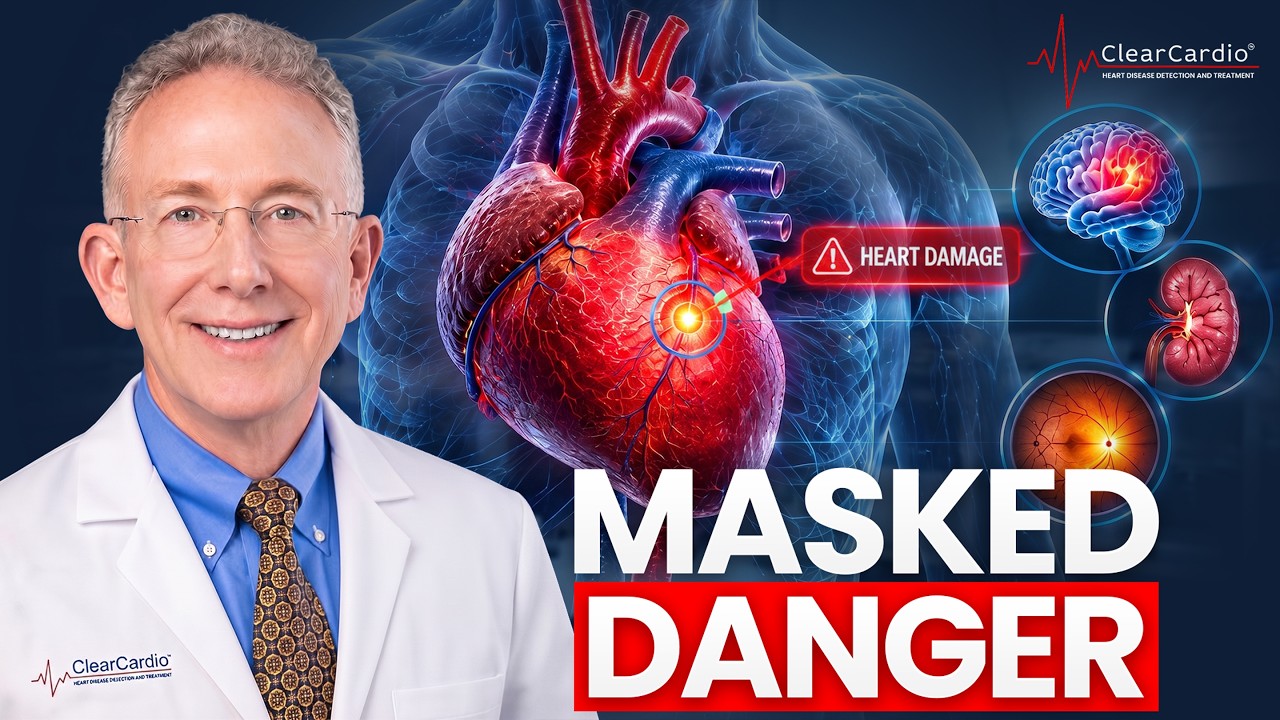
In this educational video, Dr. John Osborne, Chief Medical and Scientific Officer at Clear Cardio, explains masked hypertension – a condition where a patient’s blood pressure is normal in the clinic but elevated in everyday life, the opposite of white‑coat hypertension. He emphasizes that office (seated cuff) measurements miss both white‑coat and masked hypertension, making home blood‑pressure monitoring essential. Osborne recommends digital upper‑arm cuffs (especially Omron models) that sync to smartphones for frequent, trend‑based readings. He introduces a newly released wearable system called Hilo/Hylo, which combines a calibrated wrist band with a standard cuff to provide continuous, ambulatory‑grade blood‑pressure data without the discomfort of traditional ambulatory monitors. The video presents striking epidemiologic data: about 50 % of U.S. adults have hypertension, the lifetime risk after age 40 is 90 %, and only ~25 % of treated patients achieve control. He outlines the clinical sequelae of undetected hypertension—left‑ventricular hypertrophy, heart failure, kidney damage, retinal changes, and stroke—highlighting that target‑organ damage in the presence of normal office readings should raise suspicion for masked hypertension. Osborne reviews common risk factors (age, weight, diet, salt, sedentary lifestyle, smoking, genetics) and stresses non‑pharmacologic management: the DASH diet, weight loss, exercise, stress reduction, and sodium restriction, noting that DASH can lower blood pressure as effectively as medication. Finally, he promotes Clear Cardio’s Pulse program and invites viewers to schedule a personalized arterial‑risk assessment.
Chapters
Your blood pressure's fine when you check it at home, and you go to the doctor's office and you get excited and upset or anxious or whatever, and your blood pressure's much better. Masked hypertension is exactly the opposite. So there are people that their blood pressure really is high, they go to the doctor's office or clinic or hospital, they're chilling, they're relaxed, they feel good, and their blood pressure looks— So it's really the opposite of white coat hypertension. So I always tell people, all of our patients, everybody should have a blood pressure cuff at home. Hi, and welcome back, everybody. This is Dr. John Osborne, the Chief Medical and Scientific Officer at Clear Cardio. And today we got to talk about one of my favorite topics, about what we call masked hypertension. So masked hypertension, what is that? So let me tell you about masked hypertension. Now, many of you, maybe not everybody, but many of you have heard of white coat hypertension. So that's the concept where your blood pressure's fine when you check it at home, and you go to the doctor's office and you get excited and upset or anxious or whatever, and your blood pressure's much better. Masked hypertension is exactly the opposite. So there are people that their blood pressure really is high, they go to the doctor's office or clinic or hospital, they're chilling, they're relaxed, they feel good, and their blood pressure looks great. So it's really the opposite of white coat hypertension. So I always tell people, all of our patients, everybody should have a blood pressure cuff at home. I will tell you, here's a little hook for you, we'll be talking about some new technology that just came out a couple weeks ago, hot off the press, that'll be really incredible to look at both masked hypertension and white coat hypertension. We'll save that for the end here. But Really critical to do home blood pressure monitoring. In fact, we know that compared to what we call seated cuff blood pressure monitoring, so you're at the office or hospital or doctor's office or whatever, and you're seated, they put the blood pressure cuff on you, they measure the blood pressure, you shouldn't be talking, it should be in a quiet room, they shouldn't be talking to you, and ideally we actually measure it 3 times and take an average. And if we're really slick, we'll check it at both arms to make sure the blood pressures are normal. But the seated cuff blood pressure is not nearly as good to really understand what the blood pressure is compared to, and we've done studies to show this, Compared to measuring blood pressure with a cuff upper arm blood pressure monitor, not a wrist monitor, by the way, that seated cuff blood pressure monitoring is inferior. It's not as accurate. It both can overcall high blood pressure, that would be the white coat hypertension, or miss high blood pressure, that would be the masked hypertension, that is much easier, cheaper, better, and more accurately picked up by doing home blood pressure monitoring. Home blood pressure monitoring is phenomenal. It's great, it's cheap, it's easy. I will tell you my favorite blood pressure cuff. The digital ones are all quite good, they're all pretty accurate, but I will tell you, Omron makes a bunch of these different monitors and cuffs, all kinds, both professional as well as for the public. You put it on your upper arm, it's got a little display, you hit the button, it's got the display, it'll give you all the numbers here, and you can easily link it up to your phone, Android or iPhone, and with an app, and it'll record all the data. It'll tell you, is it good, bad, ugly? It'll give you a little chart that'll record all the numbers. You can actually look at the heart rate as well. You can look at the blood pressure. You can graph those, track them over time, and also very, very easy to send that and share that with us at Clear Cardio. However, even if you don't get that one, home blood pressure cuffs, again, the digital upper arm, Not wrist monitors, are really great. And that's really a much better, more accurate way of really understanding your blood pressure. And really what happens is we'll get a lot more numbers, right? So it's not just you go to the office once every 6 months, they check it once. What does that mean? Checking at home, we'll get a lot more numbers. We'll get daytime and evening and nighttime. We'll see after eating, before eating, all those numbers. So you get lots and lots of numbers so we can really begin to see what is the average, what is the trend of the blood pressure, because there can be a lot of variability, right? What you ate, when you ate, how much you ate, salt in the diet, exercise, diet, all of those variables, stress. Stress. Medications can either raise it or lower it. So there's a huge number of variables, and I just rolled off a few of them, that can affect blood pressure. So checking it at home in the real world is much, much more accurate and meaningful than the cuff blood pressures we do at the office, because we're going to get a lot more numbers and really be able to see the trend and the average of those numbers. So that's masked hypertension for everybody. I will tell you, exciting new technology just got approved— well, actually, it was approved last year, uh, but the company Didn't start shipping the product until just a couple weeks ago. The product is called Hilo, H-I-L-O. You can find it on the web. This has nothing to do with that beautiful tropical paradise on Hawaii and the Big Island, Hilo. It is a two parts. It has a blood pressure cuff, a standard digital blood pressure cuff that we then calibrate with a little device, a little band that you wear on your wrist. You calibrate it over several days to make sure that those numbers off the wrist are accurate, and then once every month you calibrate with the blood pressure cuff, which is all included in the kit. You calibrate that. With your little band blood pressure monitoring. So once you calibrate it, you can wear this little band and it will monitor your blood pressure throughout the whole day. Quite accurate compared to what we call ambulatory blood pressure monitoring, which is a great tool. It's sort of the gold standard of how we measure blood pressure for research, but it's pretty tedious. The devices are expensive. It basically is a cuff you wear on the upper arm. It's got chips in it and batteries, and it'll repeatedly go off multiple times over the day, even at night, which can wake you up. And that will give us multiple numbers over 24 hours, even 48 hours, So we can really see what's the blood pressure during the day, what's it at night. Those do vary. Want clarity on your arterial risk? Click now the link in the description to schedule your Clear Cardio patient assessment call. We'll review your risk factors, see if our advanced program fits you, or point you in the right direction. But the devices are expensive, they're tedious, they'll blow up all day long, you know, they'll inflate all day long, and at night can wake you up. With this device, you put on this little band, it doesn't— nothing to blow up, it doesn't have a little— it doesn't inflate, and you can wear it 24 hours a day. It's got a pretty good battery life as well. And I think it's going to be a really, really big advance in really understanding what your blood pressure is over 24 hours and 48 hours and really over throughout the day, so we can more, even better understand people who have white coat hypertension and also masked hypertension. So another question about masked hypertension. Hopefully you have a better sense of what that is, what it means, and how we detect it. At-home monitoring is critical, and I think this Hylo device will be phenomenal too. But at-home blood pressure monitoring, really to see what your blood pressure is at home, can help us understand maybe you have high blood pressure out in the real world, Just not when you're chilling at the office. So, it is important to understand, and a lot of times we'll see people where they look like they have high blood pressure, they've got thick hearts, which is what high blood pressure can cause. They have thick hearts, we call it left ventricular hypertrophy. They can have heart failure even. They can have kidney damage. They can have protein in the urine. So, they can even have changes in the eyes because high blood pressure can cause changes and even bleeding and damage to the blood vessels in the eyes. So, when we see someone whose blood pressure appears in the office to be normal, but they have what we call target organ damage from high blood pressure, which is eyes, strokes, the brain, heart failure, thick hearts because of high blood pressure, or kidney damage, or protein in the urine, any of those things. When we see that and the blood pressure is normal, we got to go, wait a minute, maybe you do have high blood pressure out in the real world and it just happens to be normal in the office. So this masked hypertension is a little trickier because, again, in the office it's fine, but, uh, that's why if we see evidence of Organ damage— kidneys, brain, eyes— but the blood pressure in the office is normal, you could have masked hypertension. So, very important to find out, and the trick is check your blood pressure at home, as I'm going to tell everybody. As far as the causes of masked hypertension, it's the same cause as all forms of high blood pressure, all forms of arterial hypertension, or just high blood pressure. So, age, alas. So, as we have birthdays, blood pressure definitely goes up. Weight, diabetes, weight, all can drive high blood pressure. Sedentary activities, smoking, too much salt in our diet kind of rounds out lots of the typical suspects, although There are even other things that can cause high blood pressure, genetic factors. So if mom or dad had it, brothers or sisters have it, you're probably more likely to have it. And I'll quote a statistic that I mention a lot just to underscore how common high blood pressure is. 2 statistics. One, half of US adults, and I'm just talking anyone over 18, half of US adults has high blood pressure. Many of them don't know it, not diagnosed, certainly not treated and not controlled. Half of us, one half of us has high blood pressure. Many of us do not know it because many times we're not checking it. Or maybe you have masked hypertension. You go to the office, the clinic, whatever, they check your blood pressure, And they say it's great, but it could be high, and that's why checking at home is really critical, using some of the tools and technologies we talked about. But as far as the causes of it, genetics, birthdays, as I like to say, getting older. And the other stat that I think is really shocking, to be honest, is that from the age of 40, the lifetime risk of developing high blood pressure in the US is 90%. Not 19%, it's 90%. Now, I always tell my patients, I'm hoping and praying that you end up on the 10%, you stay there. However, the statistics are 90% of us past the age of 40 will go on to develop high blood pressure. Wow. It is truly epidemic. And again, because of that, although it is epidemic, not as well diagnosed, treated, and only about 25% of people with high blood pressure, even on treatment, are actually controlled. And the other great thing about high blood pressure, although it is epidemic, it is a killer. Kills about half a million people, or half a million deaths every year are related to high blood pressure. However, we have lots and lots of tools to take care of it. We have lots of non-pharmacologic tools, and this is where Clear Cardio and the Pulse Program and our Our functional people really are phenomenal, working with diet, exercise, lifestyle, ways that we can help to lower blood pressure. Another tool that is proven from the people at the NIH and Harvard is the DASH diet. DASH stands for Dietary Approaches to Stop Hypertension, a very simple, sustainable diet, low in sodium, high in low-fat dairy. By the way, dairy actually lowers blood pressure. And doing that DASH diet has been shown to be as effective in lowering blood pressure as taking a pill. So my joke is, when we're talking about non-pharmacologic ways to lower blood pressure, I always like to say, let's start with the DASH pill. Which is a diet and exercise approach that has been proven to lower blood pressure. And again, can lower blood pressure by about the same as my giving you a pill. So that's always where I want to start. But diet, exercise, stress reduction, sodium restriction, not smoking, exercise, all of those things and other things that we cover in our lifestyle program and Pulse program can be very, very helpful non-pharmacologically to lower blood pressure. And also losing weight. Gaining weight very typically raises blood pressure. Losing weight— Very typically helps with that blood pressure. In fact, a lot of our patients, as they're losing weight, I always remind them and caution them, make sure you're watching that blood pressure carefully, 'cause many of them may be on blood pressure medicines already, but as they lose weight, we've got to really watch that blood pressure carefully, 'cause we may need to back off, or maybe even, and I love this, get rid of the blood pressure medication, because the weight loss and diet and exercise and training have so improved the blood pressure that they don't need meds anymore, and that's phenomenal. And that's, again, why plan A for high blood pressure is always lifestyle, diet, exercise, DASH diet, watching the salt, Reducing weight, all of those things, exercise, etc. But the same factors that contribute to high blood pressure that we historically know of, that we measure in the office, we say it's high, are really the same factors that contribute to masked hypertension as well. Don't miss this other episode right here on the screen where we will reveal the missing answers you need to know about true cardiovascular prevention. And if you're ready for absolute clarity on your arterial risk, click the link in the description to schedule your Cleer Cardio patient assessment. We'll look at your specific risk factors and see if our advanced program can help you.