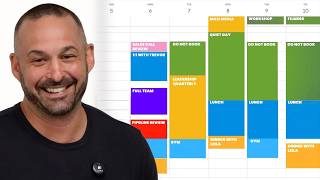
In this monologue, a life‑insurance agent explains how he transformed a chaotic, part‑time approach into a disciplined, 11‑day‑per‑month selling schedule that generated $460 K in a single year. He starts by identifying non‑negotiable family commitments (kids’ dinner nights, weekend custody arrangements) as "big rocks" that cannot be moved. Using those constraints, he builds a weekly routine: dial from 7:30 AM on Mondays, Tuesdays, Wednesdays, and alternating Fridays, with occasional Saturday work, while keeping Sundays and designated family days free. He backs his revenue goal ($250 K) with concrete appointment math—250 applications at $1 000 each require 1 500 scheduled contacts, which translates to 120 appointments per month, or 11 per selling day. He details how he fills those slots through intensive morning dialing, night work when needed, and flexible adjustments around holidays. The speaker stresses the importance of an office‑only work environment to avoid home distractions, the need for family buy‑in, and the "big‑rocks" scheduling metaphor (large, immovable priorities first, then smaller tasks). He also reflects on the mental toll of the schedule, the temporary nature of his sales career, and the overall results: $460 K in one year and $1.2 M over a two‑year period, achieved without selling complex products, only basic final‑expense and mortgage‑protection policies.
Chapters
What I wanted to do was like build an ideal schedule, right? Like what I— in the perfect world, here's what I do day in and day out. And so for me, what I put in first is the things I didn't want to move. Preferred not to. I was willing to, but the things I— if I could in the ideal world, I didn't have to move certain things. And really the only things, the main things for, for that was my kids. So I would get my kids for dinner Thursday nights every week, so ideally I didn't work there. Right? Prior to this, some days I'd work, some days I didn't. Some days I dial, some days I didn't. Some day, you know what I mean? It's like some days I did at 9, some days I did at 2, some days I did at 6, some day it just was like whatever the hell happened that day happened. Prior to that, I made like $60K first year in insurance. My second year, I might have grossed $100K, I probably netted like $70K. This year I was— this is the first year I was full-time. But after 5 kids and all the bills, it wasn't a ton of money. When— after I did this, I went to $460K from literally this one change. Same carrier, same product, same lead, same IMO, same people, same— everything was the same minus this piece. So I said, all right, I get my kids here Remember, the 4 were from previous marriage, so I would get them every other weekend. So I'd have the kids here, and then it'd wrap over this Sunday, and then I would get the kids here, kids there, and it would wrap, which would really be this Sunday the 1st. Yeah, I mean, wrap over the first week. So I would have had them this Friday, Saturday prior to You know what I'm saying? If this were the first week. So it's kind of how it would work. And I'd have the kids here. Then that left me— obviously you can see what's left, right? I preferred not to work here, was the idea. When I was part-time this year, I used to dial every Sunday. So I'm a big believer in you can make money on Sundays. There's plenty of people willing to do business on Sundays. We did church still, I just did it after. If you don't want to work Sundays, don't work Sundays. If you want to, you can. It's definitely wide open to be able to. But in the ideal world, let's have a day off, right? So this is kind of what I was left with. So now keep in mind, I— when I did the sales side, I was direct mail, all in-home. I didn't do anything virtual. I didn't do telesales. I didn't do any of that stuff. So I'm just going to give you what I did, apply the concept to what y'all do today. Does that make sense? So for me, I had database. I didn't like do one-call closes, and you know what I mean? I wasn't in that world. The technology wasn't there yet. So I decided I was going to dial every Monday and I was going to start no later than 7:30 AM. That was just what I was going to do, right? I'm just going to put like run business. So that meant I could every And you can take a picture of mine and copy it. What I really want you to do is yaws when you do them. So I decided I was going to run business those days. OK? Then I would run business every other Friday when I didn't have the kids. And that left 2 Saturdays also. I decided one, I was going to be off. And the other I would run business. So here I was with all the kids, here I'd be just Stephanie and Maddox 'cause this is the one kid we had together, and then there I was gonna run business, right? So we got 1, 2, 3 days that week I'm selling clients. That make sense? And we got 2 days that week, it's 4 and 5, 6, 7, 8, I did 4 days that week and 2 days that week. So for me, that was only 11 days a month, right? So 1, 2, 3, 4, 5, 6, 7, 8, 9, 10, 11 days a month I sold insurance. And I sold $460K. I ain't won, but I was pretty good. And I didn't sell IULs, I didn't sell— I sold final expense, mortgage protection, the most basic shit you can sell. 11 days a month. That was it. For me, the way I went about it, and there was an exercise to this for me as well, you're kind of too new to know both, to the life side, to understand your numbers in depth. But what I knew, my goal, that's what I wanted that year. And I didn't— I don't think I was an amazing, like, high-level closer. I was going to work hard, and I knew I was making like $1,000 an app, roughly. So I knew, I knew I needed to have 250 applications. That year. Does that make sense? I thought if I sit with 1,000 people and close 25% of them only, which is really low, I could get my $250K. But to sit with 1,000, I probably had to schedule 1,500 because they were going to no-show me and cancel and all the shit. Does that make sense? So I kind of backed into everything. So when I want to make $250K, $1,000 a pop, 250 apps. I need to sit, make 1,000 presentations that year. To do that, I had to schedule 1,500 people. Does that make sense? That was, that was the goal going in. So if I need to do 1,500 appointments in a year, right, if you divide that by 12, it's 120 a month. That make sense? I had to— so I had to figure out how to schedule 120 people a month for my math to work. Okay, now I have 11 days to do that, so I had to schedule 11 a day. That was it. So I just put 11, 11, 11, 11, 11, 11. That was my goal. Every day I ran 11 appointments. So I spent all day Monday. Like this week, I would spend all day booking Tuesday and Wednesday. Then when I ran that Friday, I would dial this morning. That make sense? Same thing, 7:30. Now here, to book 2 days, I might have to dial all night. Who the fuck knows? I got really good eventually. I was done by lunch, but that took, that took some time. Then when I book, when I run this week, I had to really get it in because I was getting my kids at 3 o'clock from school, but I still had to book 2 days up, you know what I mean? Thursday. So I would dial here also if I had to. When I was in the field here, I would finish booking Saturday in between appointments if I had to. Just because I only had half a day really here because I wanted to get my kids, you know what I mean? And they— I picked them up at school at 3, so I had to leave the office by like 2, 2:30. Does that make sense? So I'd go 7:30, let's call it 2:30, and here I'd go 7:30 AM till whenever the hell I was done. Again, some days I was done at noon, some days I was done at 10 PM. It just is what it is. And so My entire family knew the schedule. Does that make sense? And no one could— I would like, dude, am I allowed to work 11 days a month? Because on my accounting job, when I was making $40K, when did I have to work? Monday through Friday. And I had to work 7 to 4. So I had to leave my house at 5:30 to get there at 7 to 4. And I would get home at like 6:00 because it was like an hour and a half there and it was like 2 hours home. So I had to do that Monday through Friday as my alternative. And a lot of times I've had 2 jobs just to pay the bills because $40K definitely didn't cut it with the kid, you know what I mean? So then I'm like, sometimes I have to work nights, maybe I'd have to work weekends. You mean like I had to look at my alternative and I sure as shit didn't want that. So when I sat down and started looking at— again, the goal was $250K. What could that do for me and my family? I'm like, dude, that'd be everything I'd ever need in life. Now it's funny, you make it and you go like, you figure out how to spend it, I promise. But remember, six figures used to be like, yes, I'm gonna make six figures, and Yeah. Oh, I would. Yeah, I mean, yeah, it goes fast. I couldn't function on it today, which is insane to say out loud, because here I'd have been fired up out of my fucking mind to make 70. You know what I mean? So it's like, now long-term goal for me is I didn't want to sell forever. I knew that here. I knew I didn't want to sell for a living. Does that make sense? For me, selling was getting out of my current situation. So this was going to be short-term for me. If this— if your vision is to sell insurance forever, I don't know, I'm probably not the best guy for advice, you know what I mean? Because it's— I think selling anything— like, I have friends that are in real estate and they do really well, but anytime we spend time with them, they have to take 900 client calls. They've been doing like 15 years. And they still have to take the same amount of calls. They still have to do showings on Saturdays and Sundays and at night. And you know what I mean? Like, why don't you build a team? You're like, it's a pain in the ass. It's inconvenient. I'm like, you're leaving dinner to go for a showing that statistically they're not gonna buy that house. Isn't that a pain in the ass and inconvenient too? I mean, and that, that happens in the sales side. So for me, I know if I did this like a maniac And it's, again, when you say it out loud, 11 days a month, it's not really made— but again, I was all day dialing. Mentally, mentally, I was gone from my family completely. Monday, Tuesday, Wednesday, it was like I wasn't married or had kids. I was gone. You know, again, to get— start dialing at the office. I didn't dial in the house. I'm not, I'm not a fan of that still. To this day. I think about that as well, because I think that was a mindset I had to take my computer— 100%. It will change your world. I just— there's too many distractions, you know what I mean? So for me, I was going to an office, and I couldn't afford an office then, and I went to an office. Um, you know, I still to this day can't stay home. I go home and I'm like, I gotta go. You know, both sides. Hell, they don't want me there either in many ways, because it's like interrupting, you know what I mean? Like, we all understand our schedule. So everyone agreed to this. My wife, the kids, and that's really all that mattered, you know. And so they knew on Tuesdays and Wednesdays there was no movies, there was no dinner, there was no we got to go to Aunt Susie's, there was no can you take the kids to school, can you go shopping, can we do, can we go on— no, the, it was, this was non-negotiable for family. And as a family, we understood that because there was a mission to it. Now, could I have some flexibility in life? Sure. If we want to go on vacation, Christmas— like Christmas week, I would take off. But then what I would have to do is I'd have to adjust, and I'd be like, all right, if you want me off this week, that means here I have to run instead. Does that make sense? Like, I'll do it, but I'm replacing it here. I'm not just going to get rid of this and not fill it in somewhere else. Thanksgiving, I'd have to front load it. So I'd be like, all right, maybe I dial on Sunday this week, I run Monday, Tuesday, Wednesday. Or if a holiday was on Tuesday, I didn't get that extra day off. Does that make sense? Maybe I'd run more appointments on Wednesday, Thursday that week, stack it. I'd run 14 instead of 11, you know what I mean? Like, I, I was hitting the 120 a month no matter what. That was happening no matter what, because I couldn't hit that number if I didn't do that number. You know what I mean? And I can't hit that number if I don't do that number. So I broke it down into very micro, really simple everyday actions. And I just— simple as like, I remember when we were— there were a bunch of people in the office dialing. At the time, there'd be 20, 30 people dialing. And everyone would go to lunch, a lot of them together. If I wasn't booked, I'm like, I'm eating the peanut butter and jelly sandwich. I'll go to lunch. I mean, I just— I wouldn't do it. And everyone knew. And they would ask, you coming in this week? Nope, I'm out. I didn't care. Now, I wanted to go to lunch because there was a dude I wanted to learn from there. And I ain't mad at a little bit of social stuff, but I can live without any of that too. I don't give two shits. But I wanted to get there to learn from the dude who owned— whose office it was. And so I was like, all right, if I— as I got better, my goal was to be, if not fully done, done enough that I knew if I went to lunch with him, I could finish booking no problem when I got back. You mean if I'm 80% of the way there and it's noon. I'm like, all right, I've knocked it out. I can adjust a little bit. You know what I mean? So I allowed myself a little bit of flexibility and grace. But this is where you got to decide. Like, when you don't feel like it, you're going to get the fuck out of bed. You know what I mean? Like, you have to figure that out. So that's all I did. It's a relatively easy exercise, you know. Maybe you got different things in life, but start with the things you can't move. Some— there's a book, I don't remember the name of it, but they call them like big rocks, like big rocks. And then they— it's like there's this whole concept of like filling a jar, and you fill it with big rocks, and they go, is it full? And people go, yeah. And then they put little rocks in it, and it's like it fills more. Like, is it full now? Oh yeah. And then they put sand in it, and it fills more. And then they put water, you know what I mean? It just So like the concept to start with the big shit you don't want to or can't move. Everybody's is different. So I'll just give an example of mine. That's how we made it work. And I started this in probably like March of 2015. And I ran it till March of 2017. That's when I got out of the field. I started selling full-time in— like March of '14. In that period, I sold $1.2 million.