
Watch Me Close A $30,000 Sales Call: Life Insurance & Annuity Selling
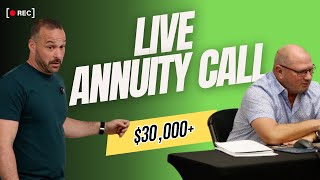
In this two‑hour YouTube training, host John Wetmore and trainer John Gavin walk viewers through a live $30,000 fixed‑index annuity (FIA) illustration and sale. The video begins with a step‑by‑step walkthrough of the FIA product – guarantees, index‑crediting methods, premium bonuses, fees, surrender periods, tax deferral, and withdrawal options – and explains how to assess suitability for a prospect. Throughout the call, Gavin demonstrates a scripted yet conversational sales approach: he asks simple, 5th‑grade‑math style questions to gauge a client’s 401(k) risk tolerance, uses concise language to keep the conversation focused, and strategically transitions the prospect to a “team of retirement specialists” for a deeper risk‑elimination presentation. The session also covers practical business operations, such as handling objections, scheduling follow‑ups, and leveraging multiple independent marketing organizations (IMOs). Gavin shares personal background (junior‑college dropout, past bankruptcies) to build relatability, emphasizes that the compensation (overrides) is minimal, and explains that agents can split business or add annuity contracts across carriers without friction. The video concludes with a brief Q&A, reinforcing the importance of keeping the pitch simple, using a support team, and maintaining flexibility across IMOs. The content serves as both a product education module and a sales‑technique masterclass for insurance agents seeking to close high‑ticket annuity deals.
Chapters
What's up, y'all? So this video you're going to watch is a live annuity presentation from my buddy John Gavin. We had a workshop out here, we did some annuity training, and he took a live client annuity call with an agent that was seeking some help. If you're interested in following our boot camp, you can always go to JohnWetmore.com/annuity, check out all the previous trainings and access all the future ones. You can register. We do it every 2 weeks, teach people how to make more money selling annuities. Check this one out. It was live and they sold it.
All right, everybody. Um, so everyone here heard my introduction. My name is John Gavin. Um, John asked me to touch on annuities here, and annuities is kind of a— it's a funky thing. You know, if you're licensed to sell life insurance, you're licensed to sell fixed index annuities. And, um, the company that I'm with has 15,000 writing agents and 4% of them have written annuities. So 96% have not. They're the most profitable product that we have. They're so stinking easy. And my career started off when I came to this business flat broke. I just lost everything in the mortgage business, went through a divorce, made some really bad financial decisions. And when I came into this industry, I had negative $1,700 in my bank account. So when I saw somebody sit next to me and they just got a deposit for $60,000, I'm like, I want to do that. I want to do half of that. I want to do a quarter. I'll do something like that. Tell me what that is. And so he said he just closed a big annuity, right? And I said, can I do that? Are we licensed to that? Yep, absolutely. So, um, I started writing annuities early on. I started presenting them real early, and I was terrible. That was awful. And oh, for my first 9 appointments, I just took all this different training from all over the place and Frankensteined it into one awful presentation. And so my first 9, the people just stared at me, had no idea what I just talked about for the last 30 minutes, and I got up and left. And but I saw other people doing it, I figured if they can do it, I can, and I kind of need to because I am still broke, right? So what I found was rather than trying to sell these products to some to people, find out what they're looking for, what they need, what are they concerned with. And so out of a 25-page illustration, I narrowed it down to 4 pages. And when I did that, I eliminated covering things that they didn't care about. I got more buying. And I— when I started asking more questions, I got even more buying. And the questions are always the same, the answer was the same. So I condensed it down to something that's really, really simple. And so who in here either writes annuities or has an agency that writes annuities now? Okay, so just a handful. So annuities are really good for the agent because they're incredibly profitable. I just did a training where we had 600 people there, and the people who had recently closed annuities, the average commission was about $8,200. The average length of time it took to get there was about 40 minutes. So for agents, it's really profitable. For people that are building and growing agencies, I mean, we're here to learn how to be profitable. I can tell you, in all the years that I've built my agency up, I've never had anybody roll debt to me that had written an annuity. They just don't. They're profitable. They don't, they don't roll that. So if you want to remain profitable and not have debt rolled to you, have your agency roll it, write annuities. Okay, not the biggest override product out there, but the more agents that you have writing them, the less turnover you have, and the, uh, the more profitable you're going to be. Okay, so I I started training my agents when I started building my agency up to write annuities just from the get-go. And per agent, we wrote the most in the business. I sold the business a little over 3 years ago. And when, you know, our— I was with Family First Life, and I still am. But when Integrity came on board, they were looking at different agencies on who they want to partner with, who they want to buy out. You know, there's a lot of agents, agencies that had a lot higher production. Than I had. But when I sent my financials in, my profitability was higher than just about everybody there. I have about an 80% profit margin. So you figure they were looking for anybody 34 and above and I was at 80. So when I sent my stuff in, they were like, we want to talk to you. And so now I train not just my agents, but I'm in charge of training all of FFL agents, about 15,000 in that group there. And this month alone, the commission that we're— the agents that I'm working with, they should get about $400,000 commission this month alone.
Yeah.
So, so it's incredibly profitable product. But why do only 4% of our writing agents write it? And there's so many misunderstandings. I mean, people think it's a really difficult product. It's really not. It's so simple. You know, I, I do a lot of growth annuities, which are just protecting assets and letting them grow safely. When you just have something that your money can only go 3 ways: up, down, or over. We eliminate the down. And so my training method has always been keeping it really simple so it's easy for the agents to understand and it's easy for the agents to explain to the clients that they're, they're meeting with. And so today we're going to go through— I'm going to do live. I could shit the bed on it. It's a small one, it's $30,000, but I also have one for $1.5 million at 3:30 that's going to be the same exact process. So you guys will see me interact with the client. I've already had a brief conversation with them over the phone. They understand kind of what the product is. I'm going to go through the illustration here so you guys will learn how easy and simple these products really are. And you get to see me interact with the clients, see what kind of questions they come up with, see what the answers are. And I'm not going to write it today just because I can't— I can't get personal information in front of everybody, and also for time purposes. Okay, um, so any questions to start off with here before we get started? How do you get— how did you get—
how do you attract these leads? Or was it—
I just told— I didn't— you know how much I've written about? I did the math. I did about— I've written about $40 million in annuities. And you know how much I spent on leads? Zero. Okay, just current clients, life leads, referrals. I mean, it's like annuities are a great referral product because they're geared for— you think of who our target audience is, it's people 50s, 60s, 70s. So who do people in that age group, who do they hang around? They're not down at your basketball court saying, "I got next," you know. They're playing bingo, they're doing all kinds of stuff. They're hanging out with other people just like that. So it's a great referral source, especially with them if you understand where the markets have gone. And if you talk to somebody who is 50s or 60s, they're all here in 2008. When you ask them what their account did in 2008, they act like they lost it yesterday and they act like they didn't get it back. But the reality is, you know, it's 17 years ago, a little bit in the past. But when I talk to those, those clients, I tell them, I said, hey, thankfully, you know, in 2008 you lost half your retirement account and it sucks to lose that much money. But if you're not actually retired, then it doesn't financially impact you yet. It just sucked to lose it all, but, or half of it. But it took 6 and a half years to come back. And when you talk to the clients today, it's like, okay, so you remember in 2008, they're like, oh my God, I lost half my money. Like, yeah, how would that feel if that happened today? And I don't believe in, you know, sky is falling, Chicken Little, oh my God, you're gonna lose all your money. But it's like, we have these products that are so strong today that we can remove that risk. We don't have to worry about losing any money. We have bonus products that give you a jump start from where you're currently at now. The fees that we have on fixed index annuities are little to none, and you still get a fair return. So when you're talking to people who are retired or retiring, what more do you want out of your retirement than something like that? They say nothing. So the one today is a cash account. It's just got some money sitting in her bank account. So it's not a matter of fear of loss. She's not going to lose any money in a checking account, but it's— she's losing every day she has it there. Yeah, she's getting— she's losing money to inflation. So same deal. So this is $30,000. The one I have later is $1.5 million, and that's still in a savings account. $1.5 million in savings account. She's losing money every day to inflation, you know. And so the, the reason why we don't sell more annuities is we don't have more people bringing it up, looking for the money, that sort of thing. Um, and when I talk to clients, the number one comment I get is, why isn't more people doing this? Well, if we did our job as agents, we brought it up to more people, more people would be doing it. Because they used to be super conservative products, and annuity was You roll your funds over, you get paid a certain amount over a certain period of time. Then they give you interest at a fixed rate, 1.4 to 1.6%. Nothing sexy, just meant for the super conservative minded. Then they had caps where you can get up to 3% or maybe 4%. But now these uncapped strategies— I've got clients right now because of the, the losses in 2021 and 2022. I've got clients right now that are getting 40%. And I'm not going to promise that. I'm not going to tell them they're going to get that. What I showed— when I show them, I'll show a current client statement with all the information redacted from it, but I show them that to legitimize the 8% that I'm illustrating. All right, I'm not saying you're gonna get 40%. I'm saying, how would you like to save, to preserve your money, get a bonus, reduce your fees, and get 8% over time? Oh, by the way, in a good year you can get something like this. Yeah, so let me get logged on here.
If y'all will— obviously he's going live. Um, I know John well enough to know he's going to say something really dry, something hilarious. So let's not freak out the client, you know what I mean? Like, it is live, they can't hear you, so I— it's just do your best to—
I'll be like a robot.
Yeah, I mean, do you, bro. Yeah, but you know, if y'all can just respect that piece, and if you want to have conversations, nobody should love movies, do it outside. But it would be fun to watch. Do you have Time to answer a question while you do that. Yeah, if I ask you something, it might get deeper, so you might have to push it off. Yeah, I'm gonna ask Rufus a question for you, Rob, since you didn't raise your hand when he gave you the chance to. Um, so he's, he's, he's running a decent amount of appointments, say 20 a week, says he's asking the question, golden question, but isn't getting opportunities. So I'm challenging him in like he's doing something, he's missing something. He's like, I asked her a financial inventory. Somehow no one goes like, yes, I have. What advice?
I would say it might be— without hearing it, I'd say it might be how you're asking, you know, because if you run that many appointments, Rufus, and I know you do run a lot, there's money out there. You know, it's— you're running final expense. There's— there's— we have people that are writing $2 or $3 million a year in my group that run final expense. So I think it might be just how you're asking it.
Um, what do you see in terms of like how people ask it wrong versus the way they— when they say like, I'm doing it, where do you see they're off?
Can you give some examples? I can't see where they're going wrong, but I can see if they don't have— if they're not finding money, they're doing something wrong. My whole approach has been, I don't care, I have one foot out the door, by the way, in regards to this. 120— or you're not just finding the money, so it's like I always ask them, do you ask them, you know, what else you have that would act like life insurance that would be transferable upon your death? Right. So I ask it right after if they have life insurance, life insurance in place. And then I ask, you know, do you have anything that acts like life insurance that will pay out to your beneficiaries when you pass away, such as a 401 or IRA? And then they give me a yes or no because I can't really make a recommendation for coverage. 100%. Yeah. And every single person saying no? Um, not every person. The last couple that I found, they're active IRAs, so they're still working in their current— Okay, so that's different. I mean, that's— there's difference between never finding money and then finding money that you can't move. Okay. So if you find an active 401, you just keep asking the question until you— maybe they have a dormant 401. You know, people change jobs 7 times in their career. So if they're still contributing to their active 401 right now, Do you— how long have you been at your job for? Oh, 5 years. Okay. You're 59 years old. What did you do for the last 30 years? So they might have a dormant 401 that they can move because if they've separated from their, you know, if someone's an engineer or whatever it might be, they worked at this firm for 13 years, they worked at this one for 20, but they got the 13-year one still sitting out there somewhere. So I would just start looking for seeing how long they've been at their current employer for. And then see if they have any dormant 401s in those we can move. That makes sense. I've never done this before. This would be interesting.
There's a little sweat on your forehead right now.
I'm so cold, I guarantee you there's no sweat. We almost had an Encino Man situation here where I almost had to be defrosted. All right, so we're going live right now. Okay. Can you hear me?
Yes, can you hear me?
I can. Hold on just one second real quick. I'm in an office, so I might have a little bit of background noise here, okay? So just forgive me for that.
That's no problem.
You do sound far. I've got my speaker up all the way. Do you How close are you to your computer?
Oh, it's sitting right in my lap.
Really?
Okay, I need to turn it up more.
Well, it's not— it's not your volume, it's your sound. Like, I can— it just sounds so far away.
Well, I'm not talking loud because I'm in a hotel room. When we say Thursday, I was thinking it was next Thursday.
Gotcha. Okay, yeah, okay, I got you. All right, so, so we had the conversation earlier in the week. We talked about how these products work, kind of overview. I told you today we'd go over an illustration to show you exactly how it works. And so what we'll do today is, is I'll go over this with you. I'll go over the illustration. I'm going to highlight it up so you can, you can see it, and I'm going to send it to you. And so then you'll see, you know, the highlighted parts, you know, what we discussed, and then you can come up some really good questions, and we'll talk in a couple days to to answer those questions for you. That sound good?
That was great.
Awesome. All right. Hey, how you doing? I'm good. How are you doing? Doing really good.
Hi, how are you?
I'm good, thanks. I'm doing all right.
Let me share this real quick here, make sure it's the right one. All right, here we go. All right, can you see that, Diane?
I can.
Yes. All right, awesome. So what this is— oh, let me hold on a second. I want to share a different one because I gotta I have one that I can highlight up a little bit. All right, here we go. Can you see the swimmer there?
Sure. Yes.
All right, cool. All right. So this is an illustration. This is like we said, this is going to be a fixed index annuity. Okay. It's with a company called Athene. Athene is number one in their space for fixed index annuities by volume. They've got about $300 billion in assets. And they have very little debt. They're rated A+ by all the carriers or the companies that rate insurance companies for their financial strength. And I have about 100— my agency has about $137 million with them. So I've got a pretty good track record of doing some business with them. On a personal side, my dad rolled his retirement into this. So I got to see, you know, my dad rolling it in. I got to see on the years when the market lost, he didn't lose anything. When the market gained, it gained. And then ultimately, when he passed away, I got to see how this was passed on to his beneficiary, which was his favorite child, my sister. So, so I got to see it on a personal side. I could see it full circle and on a personal side as well, too. So this is geared for, for protected growth. Okay. So I know that you got your money in the checking or savings there. And what this is, is a great way to start accumulating interest because the longer your money is left in the account where it's at, You're actually being— you're losing buying power by being outpaced by inflation. Does that make sense?
Yes.
Okay, perfect. All right. So I'm going to highlight some areas here. If I go over anything too fast, I do tend to talk fast sometimes. Please just throw up a hand. Let me know you want me to cover something again, but I'm going to stop along the way just to see if you have any questions on this. Okay? Okay. And I'm going to highlight this too, so you can see the different areas that we cover. And so you see here on page 2, it says it right here. It says Athene Performance Elite Fixed Index Annuity might be right for you if you want... And so they show different aspects of the annuity. And the first one here is going to be guarantees. So what these guarantees are is if you choose, you can get a fixed rate and you know each year what your fixed rate is going to be, how much interest is going to be applied to your account. And so it takes all the guesswork out of it. So this is built off a foundation of safety. So you're not going to worry about losing any money. If you just wanted to say, hey, John, I don't really— I don't need to shoot for the moon. I just want to get a fixed rate so I know what I'm getting. I would actually talk you out of it, but you can get a fixed rate if you want to. I think that's too conservative a way to go. I think the second section here is the growth potential. And I think that this is a lot better way to accumulate interest. And so what the growth potential is, is they're going to apply interest to your account based off of how certain indexes perform. Okay. Your money's not in the index. So if those indexes happen to go down, you don't lose any money at all. But when those indexes go up, you gain a certain percentage of that growth. Does that make sense?
It does.
Okay. So, and it's done on an annual basis. So there's not going to be any change to your account throughout the next 364 days. But on day 365, they see what the indexes have done over the last year. And if they've gone up, you get a percentage of those gains. And like I said, if they've gone down, you don't lose anything at all. Okay. Okay.
We—
this product does have a premium bonus that gets applied on day 1. And the bonus on this in Louisiana is going to be 18%. And so if you figure, you know, your money's in a savings account, you're not really getting any interest that's meaningful. You know, they're going to add 18% to your account on day one. Okay. And then here's the protection. I know your money's safe right now, but this is just as safe as your savings account. You can't lose any money in a down market. So if the markets were to go down 5, 10, 20, 30%, you lose zero. So it's just as safe as where it's coming from. The, the gains are tax-deferred. So you do get taxed on the gains, but you don't get taxed until you start making those withdrawals later on. Okay.
Okay. That was my question. So you just said it. I was wondering about how you taxed on that money.
So the taxes— so you get taxed on the gains. So your cost basis, we're looking at $30,000 here. So your cost basis is $30,000. So you don't get taxed on that at all, but you do get taxed on the gains and that's based off of whatever tax bracket you're in. Okay. All right. You can turn it into income at any time. So you can take withdrawals from this if you'd like to. You can take up to 10% per year of the accumulated value. So that's going to be that $30,000 plus the 18%, or you can annuitize it later on and just get a steady stream of income.
Okay.
All right. Awesome. Any questions yet?
No, no. But I like that when you said steady stream of income, do you do it over a number of years? Like Once you retire, over 10 years.
Yep.
Whatever.
Absolutely. Whatever you want to do. So you just take a look at where it's at and then you can just set up, you know, where the accumulated value is at. And then you can just set up withdrawals from that and you can get them automatically deposited into your account on a monthly or annual basis, however you want it.
Oh, okay.
Okay. Awesome. All right. So here is— here's the bonus here. So like I said, it's going to be 18%. The only charge on this is 0.95%. So it's less than 1%. We do have this in a free version, um, and the bonus is about 13% on that, but this gives you, uh, a higher percentage of free withdrawals. So you can have— you have access to, to more your funds with this version. That's kind of why I like the 0.95%, because the standard version you only have access to 5% per year. This will give you 10% per year, or 20% if you haven't taken any money out the previous year. Okay, so a little bit more flexibility there.
Okay.
Okay. All right. Here, the second half here is— now these are the different indexes. So this product does have 6 different indexes that's available. We do like a preset allocation. They do it. They have an algorithm that they have that figures out the best chance of getting consistent returns and then the highest returns based off of that consistency as well, too. Now, I don't go too deep into the indexes because it's kind of like— the way I look at it is if somebody came up to me and says, "Hey, John, do you want a cup of sugar, a cup of flour, 2 eggs, and some vanilla extract?" I would just say, "No, that sounds awful." But if they said, "John, we'd like some cake." Yeah, John likes cake. Okay, so figure this is like the ingredients. This is what's going to make your average rater turn on. That's going to be the cake, and I'll get into that in a second. If you want me to cover this stuff, I can, but most people just want to get to the cake and not the ingredients.
Yeah, that's fine.
You good there?
Yeah.
Awesome. All right, again, this just shows the average rate of return and the highest rate of return that those indexes have had. I don't bore people with that information, and I just get to here. Okay, so what this is, is this is going to be a guaranteed section. This is worst-case scenario. This is if the markets went down for the next 30 years or didn't grow for 30 years, what would your account look like? So we're not projecting any growth here. We're just showing the guarantees. So you've got that $30,000 rolled into it. You get a bonus added of $5,400. So you're starting with $35,400. Okay. So after the first year, if the markets go down, what's worst-case scenario? So all they're going to do is take you off that 0.95% rider charge. So worst-case scenario, you can have $35,064, right? Okay, so if that market goes down for 10 years straight or doesn't grow for 10 years straight, then we fast forward down here a little bit. So then they just subtract that 0.95% rider charge that happens to fall off after the 10th year, and you've got $32,177. Okay, so if the markets were to go down for 10 years straight or not grow for 10 years straight, you still come out ahead of where you're at right now and probably ahead of where it would be just sitting in your savings account.
Okay, gotcha.
But that's not realistic. The markets have never gone down for 10 years or never not grown for 10 years. So let's look at something that's a little bit more realistic here. Okay, so what this is— so this page is going to— because we don't know what's going to happen next week, next month, or next year, but we do know what happened over the last 10 years, right? So what this is, is this is projecting your account moving forward based off of the last 10 years' actual returns with those participation rates and those indexes.
Okay.
So will your account look exactly like this? Absolutely not. But this gives you a pretty good sample size because from 2014 to 2019, the markets were all growing. Then we saw a little bit of volatility. We saw some losses in '21 and '22, then it bounced back in '23 and '24. So you have a pretty good sample size. Okay, but your account won't look exactly like this because no way the 10 years are going to repeat exactly like they did, um, the previous 10 years. But this gives you a pretty good idea of how it should look. So now, now after the first year, now we're starting to see some growth. And now this column here is showing the actual returns that we've gotten over the last 10 years based off of those indexes and those participation rates. So now after 10 years, you don't have $32,000. Now, after 10 years, your $30,000 has grown into about $83,000.
Okay.
Okay.
So that sounds a lot better than where it's at in a savings account, doesn't it?
Oh, yeah.
Okay. Yeah. And I can show you current— I'm not going to do it today for time purposes, but I can show you current client statements of mine that have gotten these returns so we can project anything we want to. But I can show you my clients that have actually gotten these returns, and that just shows You know, it brings things to life when you get to see an actual statement with real dollars being deposited. And so this next section here is what I really like. And what this is here, Diane, is this is now they're looking back 20 years. They're going back to 2003 because 2003 to 2023, we don't have '24 data yet, but they're going back 20 years and they're cutting it into 3 10-year segments. So this box on the left is showing the most recent 10-year stretch, and those are the numbers we just went over, and it had a net return of 8.9%. Okay. This middle section here is the highest 10-year stretch that it had. I don't even go into that because it only happened once, and I'm not going to— I don't want to kind of lead you along thinking that could happen again. But let's focus on the lowest 10-year stretch. So the lowest 10-year stretch, this is Anybody bringing us $30,000 over the last 20 years with those participation rates and those indexes, what's the worst they came out with after 10 years? And that's $76,000. Okay. Okay. Or a net return of 8%. So if you think of something that is just as safe as where you have it right now is going to give you a bump up of 18% on day one. Has a less than 1% annual fee, and that fee is only for 10 years, and then it falls off, and then provides you with an average rate of return about 8%. What else would you like to see happen with your money that we can't cover here, this one product?
Uh, I don't know, because I'm thinking this is really great.
It is really great, but I'll tell you what, it's not for everybody, because anything that sounds too good to be true is, right?
Right. I heard that saying as well.
Got it. So who's it— who does this not meant for? It's not meant for people who, who like to see the excitement of day trading on an— on a daily basis, seeing their accounts go up and down, because your account value is not going to change for the first year.
Okay.
Um, it's not meant for people who like to drop a bunch of money in and then pull it out a year or two later, because we only have free access to 10% or 20% of the, of the accumulated value. And actually, you have to qualify for this by having some funds outside the annuity. We— the companies don't take all of people's money because what they don't want is to put somebody in a position where they have to take more than 10% out and subject themselves to those surrender charges on their own money. Does that make sense?
Yeah, it makes a lot of sense.
Okay. And so that's why we looked at this way. So you've got $50,000 in your savings account, you leave $20,000 of it out. You move $30,000 over, get that bonus, and then let that money grow. And you can pull out 10% of that per year. And if you need more than that, you can go over to your savings account, pull from there. And then after 10 years, and this is a wide open account. Okay.
Gotcha.
Okay.
So otherwise it has to be saved in there for 10 years unless you withdraw it and do a penalty.
Yeah. No, you can, you can take 10%. Okay. So look at this. So if you look at this box to the right here, okay. So you can pull out, say, in year 3, it grows to $42,000. So you can take out $4,275 free of charge, right?
Right.
If you haven't taken any money out in any of the years, you can take out 20%. So if you haven't taken any money out in the second year, you can take out $8,400 in the third year. You get that?
I got it.
Yeah. So if you take out funds every year, you can take out 10% every year. Or if you haven't taken any money out in any given year, you can take out 20% the following year. Okay.
Okay.
And you can actually, you can withdraw more than that if you need to. If you get in a pinch, you need money, you can actually pull more from it. But if you see here, can you see these numbers here in the middle of the page?
Uh-huh. Withdrawal charge.
Yeah. These are the surrender charges on the amount above the free withdrawal period. And to be honest with you, if you do the math on it, they're not that high. So if we look back at, at this number here and say in year 3, your account value is $42,000 and you've taken money out in year 2, so you have access to $4,275. Say you need to take $10,000 out, right? So you'll have about $50,000, say just for simple math, $5,800 that's subject to the surrender charge. If we go down here and look at year 4, let me do the math on this real quick. So if you had to take out $10,000, your surrender charge is only going to be $322. So, you know, we don't want you to get in a situation where you have to pay to access your own money. That's why we leave some money outside of it. But if you get into a pinch and you need to pull the money out, it's, it's a small $300 charge. I mean, if you, if your money was in an account where it could lose money, you know, the chance of losing that much is a lot bigger than, or a lot, you could lose a lot more than that than just having a little small surrender charge.
Gotcha.
Does that make sense? I know it kind of fumbled out a little bit.
Yeah, but I guess I was talking about the whole long term. Yeah, if you close the account, I guess, and really you just keep it just like, you know, I guess you just keep it just like a savings or whatever.
Yeah.
Okay, I got you.
Yep. So it's just like a savings. If you need money there, you can pull out 10% per year. Um, if you don't need it, you just leave it there, let it sit, and let it grow.
Gotcha.
Okay.
Okay.
So, so let's do this. So what I'm going to do is I'm going to, I'm going to put some notes in here on some of the stuff that we talked about today. Okay. And then I'm going to email this to you to review and then come up some really good questions and then we can talk again. And if, and if you do decide to move forward, the process is really simple. Um, the application takes about 10 minutes to do, um, over the phone or on Zoom. It's really easy. And then you have a couple of different layers of protection there for you. So, so if you do want to move forward later on, we just submit the application. It takes about 24 to 48 hours for it to get approved. Then it's just a matter of you sending the check into Athene. They're going to issue the policy, they're going to send it out to you, and then we'll get on here again, go over it, make sure it's exactly how you wanted it. And if there's anything that doesn't line up with what I said, you can actually reverse the whole thing with a phone call.
Gotcha.
Okay, that makes sense.
It makes sense.
Okay, so do you have any questions at all right now?
No, not at the moment.
Awesome.
You kind of answered everything I needed.
Good. So I'll get this sent out to you tonight, and then when, when do you think, um, you might be able to sit down and go over everything and come up with some good questions?
Uh, probably anytime after Tuesday of next week.
After Tuesday of next week? Uh-huh. Okay. All right. Awesome. I don't know what my schedule is for next week, but I'll know Monday-ish. So we will be fine. So what I'll do is I'm traveling, but I'll have some downtime. So what I'll do on Monday is I'll reach out to, um, let him know my schedule and then he'll get with you and then we can, we can get you on there to answer any questions. I don't like to go too long just because a lot of stuff gets forgotten, um, in that downtime. So we'll go ahead and get together next week to answer anything you come up with.
Okay, that sounds good.
All right, well, I'll get this out to you tonight. My contact info will be on the email, so if you are going through it and you want something clarified right then and there, just shoot me a text. Hey John, going through the illustration, what did this mean again? Or make this make sense to me. You can text me or call me if you need to, and if I don't hear from you, then we'll get together next week.
Sounds great.
Okay, awesome. Great talking to you again, and I'll get this out to you tonight.
Thank you. Have a good day.
You betcha. You too. Thank you.
Thank you, John.
All right. Thanks. We'll talk to you soon.
Okay.
All right. Have a good day. Okay. Bye-bye. Bye-bye. That's it.
Boom.
And it doesn't matter if it's $30,300 or $1.5 million. That process is the same every single time. And so that woman had her money in a savings account where, you know, it's— that's probably 5% of the business I do. Most of the stuff is retirement accounts. So we talk about the fear of loss and the volatility a lot more. But with her, she just— I mean, it's just sitting in savings account. It's not going to grow. But the buy-in is always the same. The buy-in is even stronger when we're talking about retirement accounts, because the last thing people want to do is start planning their retirement. And lose 20% because people who are retiring and they're planning their retirement out, they, they plan it for their income and everything else based off of their 401 at its highest point. So if they've got $400,000 in there right now and they're retiring even in another year, or if they just retired, they're mapping out their retirement based off of having $400,000 here. If the market tanks and they have $320,000, now they've got to— that's a loss to them. They have to cut out this, have to cut out this, that, that change the way they spend money. And so when we show our products and that's literally exactly what I go through, it's such a simple thing. I mean, I would— most people, you're probably sitting there going, that's it? I'm like, yeah, that's it. And I don't care who someone is. That's, that's the only thing I need to cover because it shows the strength of what we have. And we as licensed agents are the only people that have that. People say, well, how do you overcome financial advisors? I don't. They don't have anything that's 100% safe, don't have anything that, that has little or no fees involved. If I show them something with no fees and 100% safety, if you took all of the retirement products out there and wrote them on a sticky note and put them on a wall and said, okay, take off all the products that are not 100% safe, you're taking off a bunch of them. Take off the ones that have no fees, you're taking on almost all of them. Take off the ones that have a bonus involved, and when you're done, the only thing left there is going to be a fixed index annuity. And so were these products as strong as they are now 5 years ago? No. 10 years ago? Definitely not. But in today's market, with the cost of options being so low and they can get higher participation rates and, and I've never been someone that sells off bonus, but when someone's looking to, to retire and you can give them a jump start on retirement and still show them a pretty good return over time, you know, I do talk about the bonus a little bit more than I used to. Because if you think of where the market would have to get to in order for them to securely get 18%, you're putting a lot at risk. I mean, you're, you're, you're riding it out, you know, the market's out pretty long trying to squeeze out 18%, which I got 2% on my account a couple of weeks ago and I was ecstatic and then I lost 8% this week. And so, but I'm not retiring anytime soon. When somebody is retiring and they know what happened in 2008, They felt that, they lost half their money. But thankfully they weren't using it then. So if that same thing were to happen to them now, and they know it can happen now because if it happened then, it could happen now. And most people, you know, unless you have $1 million, you don't have a financial advisor. You might have a name on a statement, but a lot of people think that because they have a name on a statement, if the markets are gonna turn, they're gonna get a phone call saying, "Hey Bob, you know, this is Steve, your advisor. Your $127,000 is at risk. We might think of moving it someplace safe." they're not going to get that call. And so they're just going to go down, go down. And then Steve, their advisor, when they call him up and say, buy and hold, the market always comes back. Is that technically true? It is. Right. But is it going to come back tomorrow, next week, next year? We don't know. The last two big corrections took 6.5 years. Who does not have 6.5 years? Somebody who's 62 years old. Somebody who's 30 does. Somebody who's 40 does. Somebody who's retiring does not, because we put away for retirement to use as income later on. And when we can't use the income from it because we left it in the market too long and the market dipped, you know, quality of life suffers. So go ahead.
If you're in the insurance space and trying to build an agency or you're trying to like break records in sales, just hit new levels, new heights, click the link below to apply to my consulting and coaching program that I have out there. I'm helping tons of people get to new levels, get to new income heights. Help them build their teams, put systems in place, staffing stuff, recruiting processes, automations, and just teaching people how to get to a point where they're selling on their own pen 30, 40, 50 grand a month. And if they're building a team, teaching how to have an effective structure to your insurance agency for the most profitability you can. There is an application process. I'm only looking to work with like high-end people who really want to make big things happen. A couple of recent clients that we've had in the, in the coaching program program. One dude as an individual went from selling like $8,000 a month, barely getting by, about to quit the industry, found the book, hit me up direct, started the coaching program, went to $35,000 his first month, has issued like $150,000 in the last 90 days, and has changed the trajectory of his career. Working with another agency builder, very first month went from doing like $800,000 a month to almost $1.1 million. We added like 10 or 15% production in in 30 days and continue to work on things there. So if you're interested, click the link, apply, and if you're a fit, I'll reach out.
I'm scared.
And I've done a pretty good job of these, but what I found that was— that I felt was complex was deciding the index, which product was best, how to get better, and which index is better to put this individual, because I know it's customized. Yeah, based on your complaint, but really figuring out and getting better at determining what product and what index. Because I've seen people fluctuate with, I'll put it in here like you did with this one about, you said it could be in the free one, but it's better with no charge or something like that. Yeah, we did no charge ones, and, and there's, there's several reasons why I like the theme. I love F&G, um, I'm actually working with F&G right now to change their illustrations because they're awful. I had a Zoom with the vice president yet 2 days ago, and I said, let me walk you through an illustration because I don't think you've seen one of these in 10 years. And I started showing him. He just covered his head like, you've got to be kidding me. I said, no. So you want more of our business? Make this cleaner. The Athene illustration is like a children's book. Yeah, it literally says on page 2, hey, this might be good for you if you want... These these things in a very simple way. So Athene's got great products. The illustrations need a little bit of help, but as far as the indexing goes, it's just really easy to do the preset version. And I'm fortunate I have a pretty good-sized book of business, so I can look at statements and see what's performing and what hasn't. And what I like about Athene's preset selections now— their, their AI, um, indexes stunk when they first came out, but they're starting to to give a pretty good return. And with the high participation rates, it doesn't take a lot of growth to provide some good interest to your clients.
I have two questions, actually. So for annuities, do you always push a bonus?
Because I know the participation rate for someone's money, it can change a little bit. And I don't technically— I do sell a lot of bonus products just because of the fact that the bonus are so large right now. And here's the thing is, is if the clients are okay with it and it still illustrates at 8% and it gives them like— we don't know where the markets are going right now. They could be flat for 2 years. So what does a participation rate mean on a flat market? Nothing. You know, so you might get 180% versus 140, but you get 180% of zero versus 140% of zero. If the markets would change a little bit, and start shifting over time, I might go more towards the free product, but I don't sell this one based off the bonus. I sell this one based off the accessibility because— You can liquidate. Yeah, because a 5%, especially on $30,000, 5% of that's nothing. So 10 or 20% actually means something.
Yeah.
So a lot of it is just the accessibility. Is it for marketing?
Once it closes.
Never, never, never. Because if— how often do I do once it closes? I just don't. Because I think if I sit down and do a presentation with somebody who's never actually met me and they didn't want to roll their retirement into me, they're crazy. So I need to get off the call with them because they're crazy. So I need them to vet me, figure out who I am. They need to look the product over, they look at the illustration, they come up some good questions, and we'll talk again. Anybody that wants to roll $400,000 on somebody they just met is a super irrational person. I figured this out because I used to do all one-sit closes, and I had all one-sit cancellations. Because I sometimes I didn't even get back to the office yet, I'm getting these calls going, hey, stop that application, don't do it, don't ever call me again. I'm like, oh my God, but it was so awesome. But yeah, I was a crazy person, right? So I always, hey, this is, you know, this is a big decision, even $30,000, this is This is the big decision. We'll do the application later on. And so I don't ever do once they close, but not with annuities.
So going back to the— okay, so like she didn't have like hardly any objections for you. What kind of objections do you typically get and how do you handle those?
That is how 90% of them go. Okay. Yeah, that's just that.
And like, does like anybody ever like say, hey, so like I know who Chase is, I know who Wells Fargo is, I know who Theen is, something like that. Have you ever had it?
The only, the only thing that I've had is people read reviews on, on Theen because online they do have some negative reviews because they actually bought other companies up and they got— they absorbed their customer service, which sucks ass. Yeah. So I kind of, I tell them I am your customer service and I'm forward. Like I said, I have clients and what I'll do is when A client calls up, because they call me to do their withdrawals. So, hey John, or they'll text me nowadays, but they'll, hey, I need to get some money out of the account. I say, great, what time are you available tomorrow? I'll call Athene and I'll get you on the line. So I call Athene, I add him in, her in, and say, I've got so-and-so here, we're doing the withdrawal, how much you want, boom, boom, boom, get it all done. The next day I'll text them and say, hey, did you get that withdrawal done? Or 2 days later, did you get that withdrawal? Did you get your money? Great, thanks, screenshot. Customer service, my ass. Here we go. Here's real people getting their money out. So what does that cost to text somebody? No, it's, um, it doesn't cost anything. It's their money, so it doesn't cost— yeah, it doesn't cost anything at all. Yeah. Well, if they, if they don't— if they stay within the free withdrawal amount, then it doesn't cost anything at all. Yeah.
So I, I have one that I'm closing next week, but the one that I did yesterday, the The guy that I'm closing, I spoke to him yesterday. The question he had was, because there's a tax-deferred product, is there a set tax that he's going to pay on the gains when he annuitizes the annuity? And what is that?
We don't know.
Okay.
We don't know. Yeah. And then the thing about tax questions outside of if they have a tax-deferred account, we roll into another tax-deferred account, there's no taxes now. I don't ever answer a tax question.
Okay.
Like they could ask me 11 and the record is 11 times. The guy asked me 11 times in a row about taxes, and my question— my answer was the same 11 times. I don't know, I'm not a CPA. I'd recommend calling your CPA. I don't know, I'm not a CPA. I'd recommend calling your CPA. And he wanted me to get an answer for him, but we can't answer tax questions. So the taxation doesn't change. Gotcha. Can they add the annuity after they— not on this one. There are some they can. F&G has one, Performance Pro, that you can add lump sums to it afterwards. Yeah. And so, you know, I wanted to do it live to just show you guys that a lot of people think these are really complicated products. They think they're going to get a lot of objections. They think they're going to get, you know, questions asked them that they don't know the answer to. I don't. Yeah, I think there's somebody here.
Yeah, they think it was cool because it was like not even— it was a sale, but you're just covering illustration.
That's it. You'd have to ask any need-building questions or anything.
It's just like, here's the illustration.
Really, the illustration sells itself. It's like, what else is there? A sale where the client leaves with more money they came with. What are you buying, you know? Yeah, go ahead.
I missed the first part. Question about taxes, if it's the same thing.
I don't know, I'm not a CPA, I can't answer that, but I'd recommend calling your CPA.
Yeah, no, talking about Roth IRAs though, or I don't know.
I'm not a CPA. I'd recommend calling a CPA. So you said about— you'll ask you how do you get past financial advisors? Yeah. So just in my head, I'm just wondering, you know, wouldn't it be beneficial to have the financial advisor there, especially once you're good and they see how clearly you can lay something out? I mean, don't they— that has never worked for me. You know why that's never worked for me? It's because as soon as you get off the phone, the advisor looks at them and says, I can do the same thing. Stick with me. Yeah, yeah, yeah. 100%. They have no reason to refer other people to you. No, God, no. And they won't. And they— and I've had some advisors outright lie to the clients. I have gotten on calls with clients because the advisor lied to them and I'd say, hey, let's just get on a 3-way call so we can clear this up. And the advisor wouldn't say the same thing with me on the line. But they have— and don't get me wrong, some of my best friends are advisors. They're great people. And I tell clients this, it's a different look, slightly different presentation when it's qualified money because, you know, it's fluctuating with the market and everything like that. There's a few things I add into there, but I don't get the pushback from the advisor because I let them know that this is a fixed index annuity and the only person that can provide this is me or another licensed insurance agent. And so when they know their advisor doesn't have it, We don't even talk about it, to be honest with you. And if they have that strong a bond with their advisor, sometimes they just don't want to move their money. That's fine. And we want somebody that does want it. You know, I used to, when I was younger, I used to be fired. I used to get pissy and I'd say, well, you know, as long as your advisor is going to write you a check for the amount that he loses you, then cool, stick with him, you know. But I'm not pissy anymore. I don't have to do that. In your presentation, you mentioned that Louisiana, the bonus is 18%. Yeah. Is it every state that's different? Every— a little bit different. And then it's, it's banded, so most of them are 8 in that product, 18 to 20 depending on the state. Yeah, but that does impact the surrender charge a little bit there too. That's why you want to make sure you cover that. Anybody else? The bonus is good for— that's a good question. There's a vesting period for the bonus. Who asked that? Okay, so the— is there's a vesting period So if they withdraw the full amount, depending on the vesting period, on when they— if they were to take the whole full amount out and go home with it. Yeah. So some start vesting the first year, some are heavily loaded on the back end in the last 4 years. Yeah. John, that FNG product you mentioned, we talked about it. What is the lowest you could put it in and add to it as the— It's $10,000 and you can add 2— you have to add 2 $10,000, add $2,000 per year. Yeah, the minimum is $10,000, you can add $2,000 per year. So you have— what's that? Do you sell a lot of those? That product? I do, yeah, yeah. But that's, I mean, that's a growth annuity. It's right, yeah. And but it has a feature where you can actually add to it later on. Yeah, we have to run a book for, um, for, um You find some elderly folks who are sitting on their money, small. Is that something that you sell them? Every situation is different, you know. So if somebody had— I don't sell annuities to $10,000 personally. I just don't because I look at— I don't look at the amount, I look at the withdrawal. So if you think of somebody rolling $10,000 into annuity and they have access to 10% of it, that's $1,000. What doesn't cost more than $1,000 nowadays? Everything. So I— my minimum is $20,000 because at least if hot water tank goes out, they can pay for that, you know. So I don't do the $10,000 ones just because I don't want to handcuff them that. And if, you know, if the market fluctuates a little bit on $10,000, it's not going to impact them that much. But it's that limited withdrawal that, that could hurt. But what if— but to add another— you find a client who is 60 years old, they don't have much money, but they could do that $10,000 and the $2,000 every month. Um, 60 years, 10 years, 270, just even themselves a little leeway to add a little bit more money to their pocket. Yeah, that might— if it— but I would wonder why someone is 60-something years old and only has 10, but they can still contribute $2,000 after that. Yeah, yeah, it could happen.
Here's some of like what we've learned with these annuities. And well, first of all, any old not been on or know about the boot camp training that we're doing on these? Is everyone familiar? Everyone's on it.
Cool.
If you're on our email list, you get— if you don't know, just JohnWetmore.com/annuity. Go JohnWetmore.com/annuity. We've done, I think, 3 trainings so far, and I did a podcast that we focused on this, and he goes through detail on all of them. You can steal all the training, you can get on them. Our next one is March 3rd, I think. Yeah, but Tiffany's getting on that one. Um, so we're gonna do these every 2 weeks, trainings. We're gonna dive in and get deeper and continue to show stuff, right? But what we, what we've started to notice, like, over the years is, like, the questions are great, but they're very much outlier questions, right? Does that make sense? And a lot of y'all won't take the discipline of finding the money or talking about it because you want to be able to answer all the outlier questions before you start talking about it. Check this out, uh, he's been on every freaking boot camp. We've done this, dude. Nathan, I'm gonna call your ass out right now live on this video. It's gonna be recorded for you. I want you to send this to him. He sends me a text yesterday. Hold on, let me find it.
Send me a DM.
Hold on, I love shit like this. Where is Nathan? He sent me a DM. He's, he's trying to find— he said, uh, so today I was on the phone with a client And we started to discuss an old 401 that they have. We discussed moving it into a safer vehicle annuity. They had questions that I did not have the answer to. Say we put them in a 10-year annuity. What happens after 10 years? Do we have to put them in another term or do they just get a check for the amount after the 10 years? So I said, you were on the training, bro. The card that says, do you have anything that acts like life insurance, like 401, IRA, whatever? You asked that. What'd you do wrong after that? You kept talking.
Yes.
The card does not say, say anything else. There's literally a period. God. And the period means stop talking.
Wow.
And then at the end, when they ask a question, why did you not go like we trained you? Great question. We actually have a team of experts at the office that handle all that. They can put together all the information for you and I can bring it out to you next Tuesday at 5. Yeah, why did you not do that? He said, yeah, I fucked that up.
But you know the reason why? The reason why, at least in my opinion as an observer of the situation, like, he didn't get any objections because, hey, the data was right in front of her, and B, because he controlled the whole call. So even though he's skipping past stuff. He's saying, just like when you go to buy the car, you sign— sir, they tell you what's on it. Hey, you can read it if you want, but here's what it says. Yeah, yeah, you can do it if you want, but here's what it says. So when he gave the cake analogy about the indexes and he went with the ingredients first, I'm like, where's he going with this? Yeah, they're like, oh, he probably is talking about a cake. I'm like, I've never made a cake myself, so I'm not sure exactly, but it's probably a cake. Then when he said that, I was like, boom, connect all the dots, connected. And now I'm like, let's move on. Yeah, I want the cake, bro.
Let's get the cake.
Not one person's ever asked me to stop and go over that.
That is strategy, and there's intentional ways to do things. And I promise you, it's not what you think the overwhelming majority of the time, because we all go, what if? And then we fill in the blanks with some bullshit. Yeah, we all do it. Every day in life. So now when I say what if and I say something negative, I try to catch it first and go like, dude, what if they say yes?
What if positive?
What if positive? Most people, what if negative comes out of their mouth right after that. You change that piece in your entire— your whole life will change the way you view things. And for me, I was like, I don't I literally don't care that I don't know everything about anything. I don't care at all. I'm dumb as a box of rocks with some stuff, and I don't care at all. And I found out you can make a bunch of money selling annuities by asking that question and saying, hey, someone else is going to be better at it, and I'll show you next week.
I was like, I'm in. For—
I was 5 years in the industry, didn't sell any. First year I started doing it, $1.5 million. First year made another $100-something grand. And I knew, I still know, I run an annuity boot camp. I know nothing about annuities, and 100 people get on every other week. I don't have to know, you know. I have to know how to move the money, right? That's a different skill set than knowing the annuity. I know the people who know annuities know what it is, but I'm never going to harm anybody. But I'm also okay going, I don't know the answer, let's find out.
I think the biggest mistake is people think that writing an annuity is showing the client how much you know about the product, and it's not. It's understanding where they're at, what the concerns are, what they want out of their funds, and showing them a solution to that. And that's it. Yeah, that's all sales.
Y'all that sell a lot of life insurance, $30,000, $40,000, $50,000, $60,000, y'all figure that out. Correct. That's all it is. Identify problem, solve problem, right?
Overcome objection.
Now let's prevent it. It's the same in recruiting. Oh, the agent did all this stuff. Why didn't you deal with it earlier? It's always let's deal with it up front and avoid it. You know, all this stuff they asked of it. I'd be like, dang, you're the first person in history of time ever asked that question. I don't know. Let's find out. I'd approach it like that. What if my advisor had— oh, your advisor? I never had nobody say that.
I just don't like it.
That's weird. Hold on, let's get John Wetmore on the phone. He's great. He'll explain.
And I have people say, well, I've got an advisor. And I'm like, well, that's great. My kids have a ski instructor, and their ski instructor was actually in the Olympics. But just because she was in the Olympics doesn't mean that she can save my kids from an avalanche. Your advisor might be great, but 2008 happened. See how many people he protected.
Yeah, you know, it's no different, dude, than going, I already got life insurance. How easy is that to overcome? You go to make a presentation about selling life insurance or any other product, I already got some. I was like, y'all know how to overcome that, right? Oh, that's for like income replacement, right? Yep. I move on. Just squash in one sentence. And so some people are like, yeah, but the A rating of that company is— Google this, Google that. The thing where they say about Google and stuff, when people go, I Googled it and said this, like, my answer still to this day, do you ever Google your religion? They say a lot of bad stuff about a lot of them on the internet. No one's ever given me pushback after that when they say they Googled 'Hey, your company, I Googled it and it says...' You ever Google Amazon? Read all the stuff negative there. Pick a place you do business. 'Your company's in a lawsuit.' So is Walmart, Target, every other company you deal with. Microsoft, Apple, they all are. What's that have to do with anything? And so it's learning how to squash nonsense is a really big piece of doing well.
And these products are so— they're so profitable. I mean, first and foremost, they're great for the clients, and I love that part of it. I can't sell anything that's not good for the clients. But that small little phone call will be about $2,400 in commission, and that's no different than moving $300,000, which would be $24,000 in commission. And the next one I'm doing next will be $80,000 in commission. And so the numbers— that the process is still the same regardless of the dollar amount. Just the dollar amount fluctuates and they don't charge back. So in all my life, I've had one annuity charge back and that guy was a moron. So I've never had an annuity charge back that was not a moron. He actually came to me a year later, wanted me to rewrite it. I just said no. Yeah, so I know you're a moron.
We're not doing this again.
Yeah. So out of all the number of written, one charge back. That's it. How do we get Contracted.
So if you, um, go through the— again, if you have that website, johnwetmore.com, first of all, wherever you work, if they have the carriers, keep them, right? So your company might find out if you need help with them, great. One of the things that John's doing with that, that I'm kind of helping him grow with, is like, how do we help more people get paid and teach people? So we're doing the boot camp, great, but a decent amount of people are like, that's great, I'm still uncomfortable. I'm still not ready to go full. We have all these things that slow us down. So we've created this process, and John's been doing it for a long time. And in our group, um, specifically in one agency in our group, they were doing— what were the numbers? They were doing like, I think they did like $5 million for the year.
They had $5 million from like the first 8 months or something, right? So August, year-to-date at $5 million. And it was through August. I started working with them in August. They finished the year at $30 million. So first 8 months they did $5, last 4 months they did $25 million. And it's literally— and now we have people inside there that are training the other groups using this process with—
so like, I wanted to like get that more out there and the things I was doing. I literally called him for help. I'm like, dude, I haven't done one in a long time. I know you're killing it at it. I want to do the same thing with people I got I'm working with, whatever. And so he spends an hour with me, goes through everything on Zoom, walks through everything, and he's trying to convince me I'm great at this. And I'm like, dude, you're really good at this. And I've sold enough to be dangerous, I guess. I know enough. I'm not dumb with them. But, you know, and at the end I was like, can— how about I just get people on and tell them, get them excited about it, train them, and you close them, right? And I just get out of the way and he'll make money. I'll get paid a little bit, y'all get paid a bunch, everybody wins. And so that's why we put the boot camp together. And so some people that are still a little bit timid, you have the option to go on the website, fill out a little form, and johnwetmore.com/anuity, fill out a little form like, hey, I got a client, I want some help. You fill out the little thing, and him, or now Tiffany, and we're going to continue to add some people as this thing grows, will literally get— you saw another agent on that call, right?
He's the one that brought the car.
Yes. So the other agent brings he needs help. He gets to watch John do what he does live with the client on the phone, builds rapport for him. He— so it's like he edifies John coming in. So John's like the expert coming in, which the client appreciates. It's almost like in the back, like, oh God, you don't know what you're doing, thank you for bringing someone else. Yeah, this makes sense. They're so appreciative of it.
Can we do that every time?
Yes. So if I just was like, yes, dude, some people don't want to touch nothing. Dude, he would let you do it and you don't have to show up, bro. If you don't— if you're like, I just don't give a rip, does it make sense?
And he'll give you—
hey, and he'll give you half the commission. I was going to do that, and then I mean, because I did one last year and then I just struck out the rest of the year, and I started doing that this year. So imagine every time you're like, hey, I want help, the form, fill it out, we get an email. And we schedule calls. Yeah, I got a quick question though for the, uh, I mean, the way I do it is bam bam, right?
Yeah.
So I was asking, like, I mean, if a person is not— say a person wants you to call them back about the life insurance, right? Because the way I do it is I'm selling life insurance, that's what they're interested in, right? And then I go back because I asked that question. I mean, if, if I didn't get back to them, like, in a few days, do you still go ahead and try to do this You always finish what you're there for.
If it's life, it's IULs, whatever is there, you finish that up because it's weird to shift gears in the middle of it. Yeah. So finish what you're there for. And then almost like with one foot out the door, just saying, hey, in regards to this $127,000 you got in your 401, you know, how much of this could you afford to lose if the market were to take a turn? And you leave it at that. Okay, great. I don't have time right now, but are you available on Tuesday? I can set you up with an expert that works on safe retirement products and set up all the products.
Yeah, this, this is one of those things where people are going to follow your lead in the sense of if you make it sound like it's complicated, they're now going to fear it's complicated. There's a real big strategy in teaching people how to move. I do it to y'all all the time. It's like keep things as simple as possible. So remember old school, like 5th grade math, like the simplest form of what whatever big number, and you had to narrow it down to the simplest fact, whatever it was called. Like, that's this. How can I make it simple, right? Because everything is really simple at its core.
It had to be, because even though I might look like a science teacher, I'm a junior college dropout. I went broke twice. I'm afraid to get my IQ tested because I might qualify for some kind of government funding. I want my kids to respect me. So I had to simplify this and it worked out. Well, Rufus had a question. Yeah. Can you say we're trying to get it for our company? It's so funny because, yeah, so it's, it's, you can make it your own, but it's like during a life sale, I was asked, what life insurance do you have in place now? And they tell me, and then what else do you have that would act like life insurance that would be transferable upon your death? Any IRAs, 401s, and this annuity, stop-loss, anything like that. And then you just write it down and park it. And then you finish what you're there for, you've got a lifestyle, whatever it might be. And then on when you're closing out, say, hey, I don't— in regards to $127,000, you've got your 401k, how much of this can you afford to lose if the markets continue to go down? So, you know, understand what the markets are right now, but the markets are losing. And say, how much is this? How much more of this could you afford to lose if the markets continue to go down? Or if their markets are going up, how much is afford to lose the market? Take a turn, something like that. And then you just like, I don't have any time right now, but would you be available, you know, a day or two out? Hey, at 6:00 on Tuesday, we have a whole team of retirement specialists and show you how to eliminate all the risk, lower or eliminate the fees you're currently paying right now and still get a pretty good return over time. That sounds good. And you said it. And like you said, just get off the phone. I have so many people calling me now. I was like, yeah, I was talking to them and I told them this and this. Just like that, same exact as I text. And we're covering this, I couldn't— I'm like, you shouldn't be talking about anything, right? You just said the point, get off the phone, ask for help, and then you can learn as you go. Good question, John. Um, how does that work with your— the program you have going on right now with someone in a different IMO?
Oh yeah, I started to answer that. Sorry, I get sidetracked. Um, if you have the same carrier, like if you have Dean or you have F&G, You can split business and be at different companies. Yeah, no one cares. I don't care, you stay where you're at, you stay where we're at, everybody's happy. If you're somewhere else and they don't have it available and it doesn't cause you any headache to add a contract somewhere else, we can add an annuity contract. And as he said, it doesn't pay us shit.
You get a little baby—
the overrides are nothing in this. But if you need help with contracted and you have a client ready, we can help you contract with them as well. Yeah, but most people have— those are two really popular ones. Most IMO's have one. And you can split business no matter what.
Yeah. Good?
I'm good if you are. Anything else?
I'll leave. I'm here for whatever you want.
Go eat.
We got you.
Thank you, bud.
Appreciate it.
Hi guys, hope you enjoyed the video. If you did not attend the previous one. The next event I'm having is early June. If you want to make it to that one, you can use the coupon code YouTube for 15% off. If this happens to be after June when you watch it, JohnWetmore.com/workshop, you can always register for the next one. See you guys there.
More from John







How YOU Can Make $15,000 Per Week from ANYWHERE ft. Keenan Stockling Jr | Ep112



