A Prescription for Happiness Written by Katie Wee, Wellness Leader
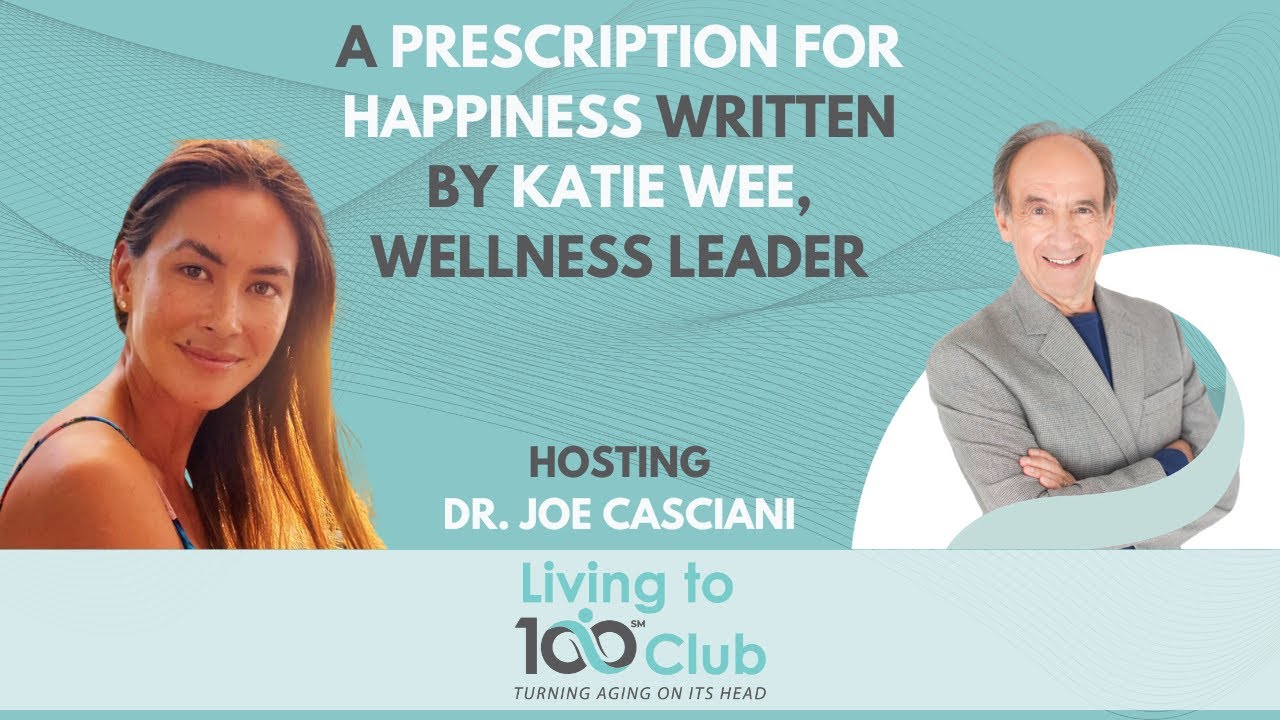
In this Living to 100 Club podcast episode, host Joseph Casciani interviews wellness retreat leader and mindset coach Katie Wee. The conversation traces Katie’s personal history—from a childhood of ballet training and a traumatic abuse experience, through a high‑profile acting career, divorce, and a protracted legal battle—to her eventual transformation into a wellness practitioner. Katie explains how she moved from external validation to self‑love, describing the development of her "Happy Camp" retreats, which blend mindset coaching, yoga, meditation, sound healing, and experiential workshops for primarily women aged 30‑60. She outlines the mechanics of self‑limiting beliefs, how they create a feedback loop with behavior, and introduces tools such as Byron Katie’s inquiry questions and the concept of the "upper‑limit problem" (the tendency to self‑sabotage when happiness rises). Katie shares her daily routine (meditation, yoga, coaching sessions, intentional breaks) and offers a concise, actionable prescription for listeners: a brief breathing‑presence exercise and the practice of choosing a second, more positive thought after the first automatic reaction. The episode concludes with practical take‑aways for seniors and senior‑living communities, emphasizing mind‑body integration via yoga, the vagus nerve, and the importance of cultivating a positive internal narrative. Contact information for Katie’s website and upcoming retreats is provided.
Chapters
Welcome to the Living to 100 Club Podcast. Well, hello to everyone joining us today on our podcast. You're listening to one of our Successful Aging episodes this month on the Living to 100 Club program, and I'm your host, Joe Casciani. Each week, our conversations educate and inspire, helping you get the best out of all the years we're given, regardless of what obstacles come our way. You can learn more about our club at our website, Be sure to take a look at our new training and activities manual titled Better, Longer, and Happier: A Guide to Aging with Purpose and Positivity. This is a series of 12 modules in a card deck format developed for life enhancement directors at senior living communities. We teach more about the principles of psychologically healthy aging and how to engage senior residents in activities that are cognitively challenging and foster a positive mindset. Module 1 is on sale now. Visit our website, livingto100.club/blh, for a description of this module. Now on to our podcast. Our guest for our podcast is Katie Wee. She shares her prescription for liberating ourselves of our inner critic and moving toward getting happy and staying happy. Katie is a wellness retreat leader who helps individuals visualize their wants in the areas of home life, health, finances, relationships, and career. From here, she helps to create a path to not only reach these desires, but also to bring these realized desires into one's current life. The adage, "Be it till you see it," comes to mind. Our guest shares this during our program. What thoughts promote this process and what thoughts interfere with it? We'll learn more in today's conversation. First, a little background. Katie Wee is a wellness retreat leader, mindset coach, actress, writer, and public speaker. Katie breathes yoga. She grew up with parents who owned 3 yoga studios and practiced alongside her father, a yoga instructor. After graduating from UCLA, she began her professional acting career and has appeared in television shows like Modern Family, New Girl, and Hawaii Five-O. Katie's been teaching meditation and yoga since 2015, and she has been a private yoga instructor for celebrities and professional athletes for most of her teaching career. She loves helping others deepen their relationship with themselves through these practices. Katie, welcome to our program today.
Thank you so much for having me. It's so good to be here.
Oh, you're so welcome. I'm glad to have you with us, and we're looking forward to our conversation. I always open by asking our guests to share a little bit about the journey that brought you to where you are today. I know I went through your history briefly, but what landed you where you are today?
Great question. So mindset coaching is at the forefront of what I'm most passionate about right now. And so much of what I'm excited about teaching people is how to overcome circumstances and create a happy mindset. Regardless of what's happened to them. So that brings me back into my past a little bit. I grew up with a great family in the Bay Area, and I was a dancer and training professionally to be— training to be a professional ballerina. That was my goal, my dream. And I loved it. And I was very intensely working and, you know, on pointe shoes at age 10 and taking all these private lessons. But unfortunately, when I was 12, my private ballet teacher started sexually abusing me, and that went on until I was 16. I didn't tell anyone.. And as a psychologist, I'm sure you can understand the kind of normal pattern of repressing emotion.
Sure.
Pretending like it didn't happen. And I just went on trying to be really perfect. It was like the perfectionism that was already sort of part of my nature became overpowering. And, um, I just tried to be really perfect. I became the captain of the UCLA dance team. I was on TV every week. I was on magazine covers. Um, I became an actress. I was on TV and I thought all these accomplishments would make me feel happy. Um, that if I could make my life look really happy on the outside, I would start to feel happy on the inside. But really my inner state was just like I was pretending all the time, just pretending to be happy. And at a certain point I got kind of all the things that were on my vision board. I was a series regular on TV. I was in every episode of this show, going to set every day. I was married. I had all the things I thought I wanted and I was so unhappy. And it was like a dam just broke within me. And the trauma that I hadn't processed came up, needed to be healed. And I spent some really intense years in a healing journey where I wasn't just pursuing my own emotional healing. I was also involved in a court case bringing the man who abused me to justice, which took 4 years with the criminal justice system. And it was a nightmare. You know, it was—
Yeah, Texas tall.
It was a tough one. And then after coming out of that period of time, I had gotten divorced during that period of time. The court case had ended in a mistrial and then later became a conviction a few years after that. My mental health went from struggling to deeply depressed to deeply depressed and highly anxious to just anxious with bouts of depression to feeling very destabilized and just like, how am I going to have a successful, happy life? Like, how is that going to be possible?. And I started doing lots of reading, learning, growing, and in that process came to understand that I had to be the creator of my own fate, that I was going to be the one that was going to need to change my mindset around, that I had all the information psychology and therapy was going to give me for the time being. And it was up to me to actualize what I knew and to add to that with what I learned in my spiritual journey and to move forward in a way that would create positive change for myself. And in doing that, I became way happier. And I created a career that I love, which was not part of my life a few years ago with Happy Camp. I'm now engaged to an incredible person who I'm so excited to keep creating a future with. And the most important thing of all those is really just the first one, that it created a level of wellbeing within myself that feels good, where I love myself for the first time in my life, where I enjoy being with myself. And after going through that process, I realized a lot more people need this learning, the same teaching. They need to be shown the way of how to love themselves and how to create more happiness for themselves. So that's how I got to where I am now, is through a big path of, of beauty and also struggle and happiness and heartbreak and remembering the power within myself to create the future I wanted.
Well, that's quite a journey, but you've landed on your feet, it sounds like. And yes, you know, we can be in therapy and we get a lot of insights, but as you know, you have to put these into action. You have to implement what we've learned. So it sounds like that's been your, your learning, your learning process and how to actualize, as you said, uh, all that you learned and how to put it into your life. And, uh, landing on your feet is probably an understatement that you accomplished a lot through all that, and you're in a good place, and you're, you're opening up the future for yourself and for others, it sounds like.
Yeah, thank you.
Yeah, so you're doing a lot. You have a yoga studio, you do the retreats. Can you give us, um, just an idea of what a typical day is like for you? Yes, I'm sure they're all different, but what's an average look like?
An average day for me looks like meditating as soon as I wake up. I try to put as few things between me and meditation as possible to do my best to quiet my mind, relax, and then have my coffee. And then I love to get into a yoga class. Those are my favorite things to try to do first thing in the morning. Meditation and yoga gets me out of my mind, into my body. And then I come home and I have mindset coaching sessions on Zoom, like where we are right now. In the afternoon, I try to leave some nice pockets in there so that I can take a walk, can make myself a good lunch. I try not to stack my schedule so that there's plenty of breathing room in between things. I I also love to take Fridays off. Um, it's the beauty of being self-employed. I always thought I want to have a 3-day weekend every weekend, and I do, and I love that. Um, and then at night I try to close the laptop and be done with, you know, marketing, promoting, whatever else I'm doing for my business. Um, by the time I close that laptop around 5:30, and I light the candles, uh, which signifies welcoming in of the evening, the relaxation time, a wind-down schedule. Um, I try to keep myself off of my phone, off of my email for the rest of the night. And I used to not cook dinner, but now I'm a, I'm a new cook. So I start usually cooking around 5:30 or 6. I'm a novice, so I can't say that I'm cooking anything really exciting, but mixing ingredients. And then my fiancé and I will have dinner. Sometimes we watch a show after dinner and then try to get to bed and leave myself lots of time to read before bed. I really love reading.
What a rich day.
Wow, it is.
Yeah, fulfilling, I'm sure. Yes. Wow. So, um, thank you. We mentioned the, uh, in the opening, you do these retreats, the Happy Camp retreats. Tell us about them. Who, who attends? I, I can appreciate the fact that what you're wanting to do is kind of extend your reach, kind of, uh, put into practice in your retreats everything that you've learned and how you developed and help people get over some of those same hurdles. So, um, I think that's a beautiful concept. Who attends these retreats and what goes on? How long do they last?
They go from a Thursday evening until a Sunday morning, and most of my clients tend to be women, but we have had some men, my dad included, which is really cool. My parents came to my last one. Um, mostly women, and between the ages of maybe, let's say, 30 to 60 tends to be the— my last retreat in Sedona was mostly women between 40 and 60. And a lot of the people that come feel compelled by the language they hear in the marketing, things like learn to love yourself, things like take a break from your life and pour into yourself, give yourself some of your own love, learn how to create the results you want in your life with ease, learn how to love your life more. People craving this type of feeling of going, you know, yeah, some of the components of my life are what I wanted, but the quality of my life is not exactly where I want it to be. I don't feel super happy, or I thought I'd be happier at this stage of life, or I can't seem to quite get where I want to be in certain ways. I don't know why I'm sabotaging myself. I don't even really know why I'm stuck in this loop of what feels like different circumstances creating the same feeling over and over and over again, which I've been there. And what we do is mindset coaching with the group, as well as yoga and meditation, sound healing, hiking, ocean paddleboarding for the one in Mexico, and paint your feelings workshop. All things aimed to fill the soul up. I believe that the soul needs connection. The soul needs relaxation. The soul needs connection to itself. And it needs to be in the opportunity for itself to be expressed. And not everyone likes to share in the group coaching sessions, and not everyone needs to share. But those who do often feel a huge sense of relief from just being heard, seen, and felt by a group, being able to speak authentically about how they're feeling and what they're processing, and to have others receive that and feel that on a certain level. And I found that there's an incredible healing quality that takes place in a group when people can have their pain witnessed, or have their joy witnessed, their and it's inspirational to other people when people go, oh, you're right, I don't need to think that way anymore. That's a negative way of thinking that doesn't serve me. And I didn't even realize I was doing that and I don't need to keep doing that. And other people go, oh, me too, in their own way, you know, with their own specific set of circumstances. And so at Happy Camp, it's the most luxurious and fun way to put a healing crash course into a weekend. So wake up in a lovely hotel, you know, you get surrounded by nature the whole time, you're gonna have delicious meals, you're gonna meet wonderful people and do fun things. But packaged into those mindset coaching sessions, I help people look at what they really want in life, really get honest about dreaming big, going for it. What are you scared to admit to yourself that you want? What do you still really want? And then look at the limiting beliefs that they have, that are keeping them from making that a reality and give themselves the opportunity to question those limiting beliefs so that they can start actually living a life they really are excited about.
Wow. Yeah, uplifting, inspiring, enriching. I think I should add my name to your list.
Let me know.
Yes, sounds great. Yeah, um, and you know, the whole idea of, um, helping people uncover their limiting beliefs, self-limiting beliefs. I came across a really interesting article. Somebody wrote this, um, blog about, um, forever, um, being someone who never finished things. He just would start things and would never finish them, and time and again, year after year. So he said, you know, that's a, that's a way I'm defining myself. That's a script I write. I'm going to write a new script for myself. I'm going to describe myself as somebody who finishes things, and I'm going to give myself a week to follow this new script. I mean, I love that concept. I love that. That's what you're talking about. And let's let go of some of these limiting beliefs. And by the way, he, he did change that script, and he did find himself as somebody who finished things. And it's kind of our self-talk, as you know, what goes on between our ears that kind of drives our behavior. So yeah, so what is it about these self-limiting beliefs? Why do we hang on to them? Why do we Why do we, uh, have these negative attitudes and kind of limitations? What do you think?
I think one of the biggest reasons is because we just don't even realize they're there. That sometimes we gain a limiting belief, a self-limiting belief, because something happened and the way we summarized it subconsciously was we made it about us. We made it our fault. For example, with me, the abuse that I endured was not my fault. But at the time I was only 12 and I didn't have the same level of consciousness that I have now. So the level of consciousness I had then, I thought, well, this must have happened to me because I'm bad. This must be because I'm, I'm bad. And so bad things happen to me and it just gave me the belief that I was bad and that manifested in my life in so many different ways. It— believing that you're bad will make you try to be so good to make up for it. Like, look, I'm so good.. And that caused an exhausting, you know, onslaught of looking for validation from everyone else that I was good. I always felt like I wasn't enough and was just hustling for that self-worth. It's still something I work on and try to check and make sure I'm not living in the belief of I'm bad. But I didn't realize it was there. I didn't realize that was a limiting belief until my therapist helped me get attention on that and start to look at that and examine that. And it wasn't until later when I read a book by Byron Katie, where she talks about doing the work and the questions that we can ask those limiting beliefs. Is this true? Do I absolutely know this is true? And some other questions I've gotten from other teachers along the years are, what happens when I believe this belief? For most people at Happy Camp, when they get to the limiting belief they have, like I'm bad or I'm not worthy of good things, or I'm a failure, or I can't finish things. When they're believing that belief, they're usually doing things like, oh, then I'm bingeing, I'm watching Netflix for 3 hours, I'm not texting people back, I'm not following through on the plans that I said I was going to make. They're self-sabotaging in some way, shape, or form, or numbing. And when they look at what they do when they're under the influence of that belief, most of them are like, oh my gosh, this is the laundry list of things that I'm trying to stop doing. This is all the stuff that is creating the negative results in my life that I'm trying to escape. And then you go, okay, and Who would you be without this belief? And people start writing and you see the wheels turning. And when people share, they're like, happy. I'd be grateful. I'd be someone who has what they want. Um, and I just think that a lot of the reason why they're there is because we don't know that they're there. Truly.
Sure. Now I think you're right. So what do you think comes first? The, the behavior, the kind of, you know, obsessing about the emails or being a potato couch? Couch potato, or the self-limiting beliefs. You said they happen at the same time. Does the behavior trigger those beliefs, or do the beliefs trigger the behavior?
I believe that it goes both ways, but mostly the belief triggers the behavior, and then the behavior re-triggers the belief. So you get into this cycle of you believe you're bad, so instead of doing, you know, the project that you set out to do today, you watch TV all day long. And then you realize you did that, and you go, I watched TV all day long instead of doing that project I said I was going to do. I'm bad. And so you reinforce it with the behavior, and then that becomes a really challenging loop to break out of for people, and they start to get frustrated.
Yeah, yeah, yeah. That's a real nugget, I think, what you just said, that a cycle and one contributes to the other, and just stopping long enough to understand that cycle, that's, that's a huge breakthrough, isn't it?
Yeah, yeah.
So, um, I heard someone say once that— I know you've done a lot of work with happiness and understanding happiness— this person said we do not need a reason to be happy, we need a reason to be unhappy. Like, happiness is the default that just is there, but when we're unhappy, there's something that's clouding over it. What do you think of that?
I love that quote. And I also think it, it applies more to a different time. I think of someone in the era of Lao Tzu or Socrates or Confucius saying that, because I think our, our nature is happiness. You meet a baby and they're just pure joy. I think it's our nature. And I think that the path to happiness is the path to coming back to who we are. But that in our modern day times with things being the way they are in terms of people being very separated from one another. You know, depression rates are at an all-time high according to the most recent Gallup poll, and they're 10 percentage points higher than in 2015. So a big spike. And I think that that has to do a lot with people being separated and used to isolation from the pandemic and not exactly having, you know, ice— like the ice hasn't melted from that totally. And I think more people than ever are sedentary and cut off from communication, sunlight, exercise. And then I think that there are societal influences like 24-hour news cycles that contribute to people getting constant programming and messaging that the world is in a state of atrocious disrepair. That's a horrific time to be alive, that everything is, you know, as bad as it's ever been. And I think that as long as we're being fed those narratives and given very few outlets for nourishing the natural happiness within us, like sunlight and communication and laughter and sweat, that more people than ever go, no, no, no, I need a reason to be happy, not a reason to be unhappy. I'm naturally unhappy. I am. I need a reason to be happy. I think that that's why my work feels to me especially pertinent right now, because I think it's a bit of a challenging time to be happy for a lot of people.
Yeah, yeah. And how to rip ourselves away from a lot of that negative environmental atmospheric, uh, craziness and not let that kind of color our day-to-day existence. So, um, in your retreats, as you're helping people with this introspection and kind of uncovering these negative beliefs, how do you How do you help people move beyond them? What's your, what's your prescription? How do you help people? Yeah, you examine those self-beliefs, and as you said, the books gave you some ideas, but, um, can you say in a nutshell what you do to help people move beyond them?
I help people understand the problematic nature of them first. You really have to help people understand how miserable that belief is making them and how it's playing out into effects in their life that create more misery for them, more unhappiness. And when they start to see how problematic it is, you lead them to, who would you be without this belief? But then next, what's the opposite of this belief? If this belief didn't exist, what belief could exist? And people who might have previously said if their limiting belief was, I'm a failure, the new belief could be, I'm a success. And then we say, okay, how could you create a narrative for your life that says this is true? Just take the facts of your life. And you're on a Model UN team. And your job is to create a story from the existing information in your life of how this new belief is true. And you put on some music and you just let people go pen to paper for 10 minutes. And they're kind of— wheels are turning like, I don't know. And then they start going and they go, oh, you know what, if I was choosing to see myself as a success, I would say, no, I'm the person who overcame that circumstance. And helping people realize that you know, things that they've been through that are challenging are not knocks on their resume. They're not blurs and, you know, smudges on their perfect record. They are things that they have overcome. And asking them, who did they become in the process of overcoming that thing? What did they gain? What wisdom did they gain? How did they become more than they were before through overcoming those circumstances? What have they overcome? And helping them build a new empowered narrative based on overcoming and creating actual genuine positive self-concept, a positive self-concept based on a new belief. It's just shifting the lens a little bit, going, okay, I've been used to seeing myself as a failure. I've been used to seeing myself as somebody who doesn't deserve good things. What if I did deserve good things? Oh, well, that explains my husband. They're saying, oh, well, that explains how this job just fell into my lap and I love it. And that explains how I got pregnant the third time without even trying. I wasn't even trying and my child is such a blessing. But helping people just go, okay, if I were to apply the opposite of my limiting belief to my life currently, how would— how could I make a case for that being true? And then going, if I were to apply that belief to my future, how would I act? So if I believed that, how does my day start? If I believe that I'm a failure, then maybe you snooze your alarm 5 times. If you believe that you're a success, what do you do? You set the alarm for a realistic time to wake up, and you get out of bed when you hear it, and you get straight onto your yoga mat to do your meditation if that's your first thing in the morning, or you get your coffee, you sit in the sunshine. Um, but if you start believing that you are the empowered belief, you believe that about yourself, how do you act differently? And we go through the entire day. And then we say, what things would be actually things that you're shooting for in your life now? And people will say things like, oh, yeah, I would actually start trying for that promotion. Or I would actually be willing to put myself out there and start dating. And it's really exciting to see people get excited and empowered at realizing that they can shift their own belief system.
Mm, what great information. Yeah, we're really talking about helping people redefine themselves, reinvent themselves, and, um, not let those old beliefs still control us. But we're seeing the power, we're seeing how we can be empowered with these new beliefs and letting go of those old, uh, definitions. You know, I love to talk about this with seniors because so many times they're going through a lot of changes after retirement, or maybe a move, or maybe even a separation or divorce, or, you know, loss of a spouse. So how do they define themselves now? How do they let go of some of those old definitions and see themselves in a new way without it being limiting, without it being restricting? And I call it opening new doors. So I think we're working, um, kind of on the same, maybe different channels, but with the same, uh, same goals.
Yeah, sounds like it.
Couple different age groups.
Yeah.
Yeah. That's great. That's great. So, um, the people that hold on to this unhappiness and, and don't want to move out of their comfort zone, what do you think? I mean, there are people that use that kind of as a, um, it's almost a buffer, almost like a protection. I don't want to leave this place. What do you think?
I read a book called The Big Leap by Gay Hendricks, who's a psychologist, and this defined what you're talking about so well to me. He talks about something called the upper limit problem, where people, myself included— I have found myself in this predicament many a times— get accustomed to a certain range of happiness. So imagining a thermostat set between 68 and 72, and that's your comfort zone. And if the thermostat— if you get happier than that, the heating system is going to kick on and bring it back down, or the cooling system, whatever is going to happen, or bring it up or down. And what happens is the body, he explains, has a memorized, familiarized comfort with how happy you're used to being. So let's say somebody is used to being 60% happy. Like, let's take it as a D. That's not very happy. That was me for a while. I was going through a divorce, a trial, a surgery, and depression all at once. And I was, I was at a D for like 3 or 4 years. And then I would book a job and I'd go be on set with Alec Baldwin and I'd be on this set having a great time, feeling like a total star, having a blast. And it was like great for 3 or 4 days. But then as soon as that job was done, I came home and I, I felt uncomfortable in that happiness and subconsciously would do something to sabotage it, like would order a whole pizza and eat a gallon of ice cream and feel terrible and then start beating myself up about having done that and then enter a shame cycle for a few days. Or would pick a fight with my brother, or would, you know, when I was single, I was on dating apps and sometimes I would go scrolling through them and starting conversations with people who didn't even interest me at all. And it would make me feel more depressed than anything at the end. I was like, why would I even do that? And I think what happens, what Gay Hendricks talks about, is that the body feels unsafe in more happiness than we're used to. And so we have to be willing to be brave enough to push that upper limit of happiness, that when things get better, like everything's going well in your life at the same time, your job's great, your relationship's great, your health is great, things are going really well all at the same time. Instead of going, okay, now what's wrong? Let me create a problem, or even just think a stressful thought to create a problem so that I can go back to my comfort zone. We go, no, no, no, no, no, I'm going to be brave enough to stay. I'm going to be brave enough to just breathe here, to just be here, to just take it all in, to maybe put my, you know, pen into my journal and start writing about how grateful I am to be here, to hold on to this level, to this moment, to be willing to go, oh, things are going so and I'm going to go meet my friend for a glass of wine tonight. I'm going to make it even greater. I'm just going to— I'm going to stay here. I'm not going to start complaining. I'm not going to start focusing on my problems. I'm not going to start focusing on things that make me unhappy just because this is unfamiliar to me. I'm going to push it. And that process for me of just pushing my happiness level a little bit at a time, a little bit at a time, and just noticing when I'm wanting to self-sabotage, wanting to find a problem, wanting to start a project that doesn't need to be started right now that I think would be really challenging. And I want to just do it so that I feel, you know, customarily miserable. I go, no, no, not doing it today, Katie. And for me, that's showing up for myself. That's leveling up my happiness and stepping into my highest level of empowerment, of utilizing metacognition to go, okay, I'm aware this thought process is taking place within me of, you know, when does the other shoe drop? And I'm not going to go, okay, let's just make a shoe drop so that we don't have to wonder what the next shoe dropping is. I'm going to go, no, no, no, I'm just going to accept this level of deservingness. I deserve this happiness. I can sit in this peace. I can sit in this comfort. Discomfort and allow it in.
Yeah, yeah, experiencing that tension, that dissonance, is really a good thing because that eventually dissolves and goes away. It evaporates, doesn't it? And that's where we're at, this place of contentment. We have to go through that tension. We can't just run away from— we have to go, and it eventually leaves, and we come to that place of no limits on our— there's no upper limit on the thermostat anymore.
Yeah, that's what I'm working on now. This place of just, you know what, I am welcome. I'm welcoming in as much joy into this life experience of mine that can possibly manifest. I welcome it. As much abundance as can possibly manifest, I welcome it. Just allowing well-being to come into my life more.
And we're entitled to that. We're allowed to have that, right?
Yes, yes, 100%.
So, um, I know you practice yoga on your daily routine and you do a lot of yoga on your retreats. How does yoga come into the picture? How does it complement what we're talking about here?
Yoga is so special to me, and the way that I feel it complements what we're talking about the most is that, as you know, the body becomes the subconscious mind. And our body and mind are not separate. They are one and the same. And the vagus nerve has a huge role in connecting the body to the mind. And when we, when we put our breathing with our movement and we're intentionally breathing for an hour and linking our movement with that breath, we help to tone the vagus nerve. We help to strengthen that mind-body connection. So even if your yoga poses barely look like poses, even if you're a total novice, even if you don't know how to do a downward dog properly and you can't hold any pose for longer than a few seconds, if you're breathing in your yoga room on a daily basis or even a weekly basis, even once a month, better than nothing. You are strengthening that mind-body connection and empowering your body to become a safe space for you. And for so many of us who've been through trauma, our body is not a safe space. And trauma can be big T trauma, or it can be small t trauma of just a lifetime of feeling anxious, a lifetime of feeling chronic stress, or acute stress. And when our body feels unsafe for us, it's pretty hard, no matter how relaxing your thoughts get, to create well-being in your entire being. The body has to start working with the mind. So I find that spending an hour just dedicated to breathing and movement, no matter how vigorous or relaxed it is, is one of the best things anyone can do to start creating an environment of peace for themselves, um, that, that circulates beyond the mind and into the heart. The electromagnetic field of the heart is 25 times greater than the electromagnetic field of the head. And this beautiful field that we're living in of energy, you know, we have the opportunity and the ability to change the energy of our field at all times with the thoughts we're thinking. But the thoughts can only go so far if the body is not a willing participant. So yoga helps the body come along with the mind, so that we can improve our level of well-being on a felt sense. It doesn't just— it's not just an intellectual concept. It is a feeling, an ahh feeling. And that is just my favorite thing to deliver to people on retreats is, hey, if you've never done yoga before, no problem. You're going to enjoy this process and you're going to leave feeling like, I love that snuggly feeling I get in my body from yoga.
Well, you know, I was going to ask the next question, but you've just answered it. I was going to say, how can you kind of advise our listeners come to a state of this contentment and happiness if you had to give them some, um, some medicine right now? What would you tell our listeners? How can they reach this place of greater happiness?
You can do this with me right now as you're listening. If you just close your eyes, take a deep breath in through the nose, Out through the nose, letting go of any tension in your shoulders, in your jaw, allowing your body to let go of any story you've been telling it today, to relax. Allow your mind to soften. Just noticing the inclination to think, the thoughts that might be coming through without judgment, just allowing them to keep flowing through like passing clouds. And take 3 breaths here, releasing tension. And allowing well-being into your body, relaxing deeper and enjoying this moment of presence, of just being here as the observer of your thoughts. As the observer of your physical sensations in the body, knowing that you are this loving presence, this loving awareness. Gently open your eyes, feeling present and joyful. The simple act of just becoming present is one of the most joy-inducing activities one can do. You can do it with your eyes open, you can do it with your eyes closed, but just bringing yourself into presence and remembering that you are not your thoughts, you are not your body, You are the loving awareness that is present within this organism that you call Joe or Jackie or Kevin. And when you remember that, everything gets a little bit sunnier, a little bit more beautiful.
Our host just left his body. He'll be back in a second. Thank you, thank you, Katie. Yeah, you know, um, that's so true. We are not our bodies. I, I talk about that a lot with people who have had some physical losses and maybe an amputation. And no matter what goes on with our bodies, we're still— we still have our mind, we still have the I or me in there. That can stay positive. So thanks for affirming that. Yeah, what a, what a wonderful conversation. What's the, what's the takeaway for our audience? What would you like people to remember?
Would just love people to remember that you're only one thought away from a better feeling, that when you take responsibility for the thoughts you're thinking— maybe not the first thought thought. First thought sometimes is just a reaction, but what's the second thought? Maybe you go, oh, that's ugly, and you go, okay, well, could we change that? That's not for me. Or, oh, this day is going to be awful. No, that's the first thought. Second thought could be, I'm gonna make the most of this day. Choosing a more positive thought. And every time we do that, we create a better emotional environment for us to live in. Because how do you feel when you go, this is going to be an awful day? Bummed. Oh, hopeless, helpless. How do you feel when you say, I'm going to make the most of today? You feel inspired, you feel open, you feel happy. So choosing a thought that feels good is always up to you. And the more frequently you do this, the more you give yourself a happy feeling to live in, which is so deeply self-loving. So be positive, not because that makes you more fun to be around, which it does. Be positive because it creates a better reality for you to live in.. And you deserve that.
Wow. That's wonderful. That's wonderful. That was priceless. Uh, priceless conversation.
This was so fun.
So much good. Yeah. I'm sorry to say it looks like we're out of time, but, uh, I just wanna remind my listeners to visit my website, livingto100.club, sign up for my email list and download a free copy of my 9 Tips to Make Living Longer Enjoyable. Available. And if you are affiliated with a senior living setting or community, be sure to look for my new training manual and activity guide, Better, Longer, and Happier. It's available on the website. Katie, thanks so much for being a guest on our show. This was priceless. As I said, for those who might want to contact you, how can they do that?
My website is katiwee.com, and you can see all information about how to get in touch with me there. You can also see Happy Camp retreats that are coming up and links to coaching. I'm here to support you in any way that I can in your happiness journey. Thank you for having me. This is such a delight.
Oh, uh, you're most welcome. This was a lovely conversation. Thanks so much, and thanks to our listeners for tuning in. Hope to see you next time.
More from Joseph

The Hidden Cause of Aging? How Chronic Inflammation Affects Your Health with Joel Brind








