ADHD in Adults & Older Adults: Executive Function, Emotional Regulation & Life Transitions
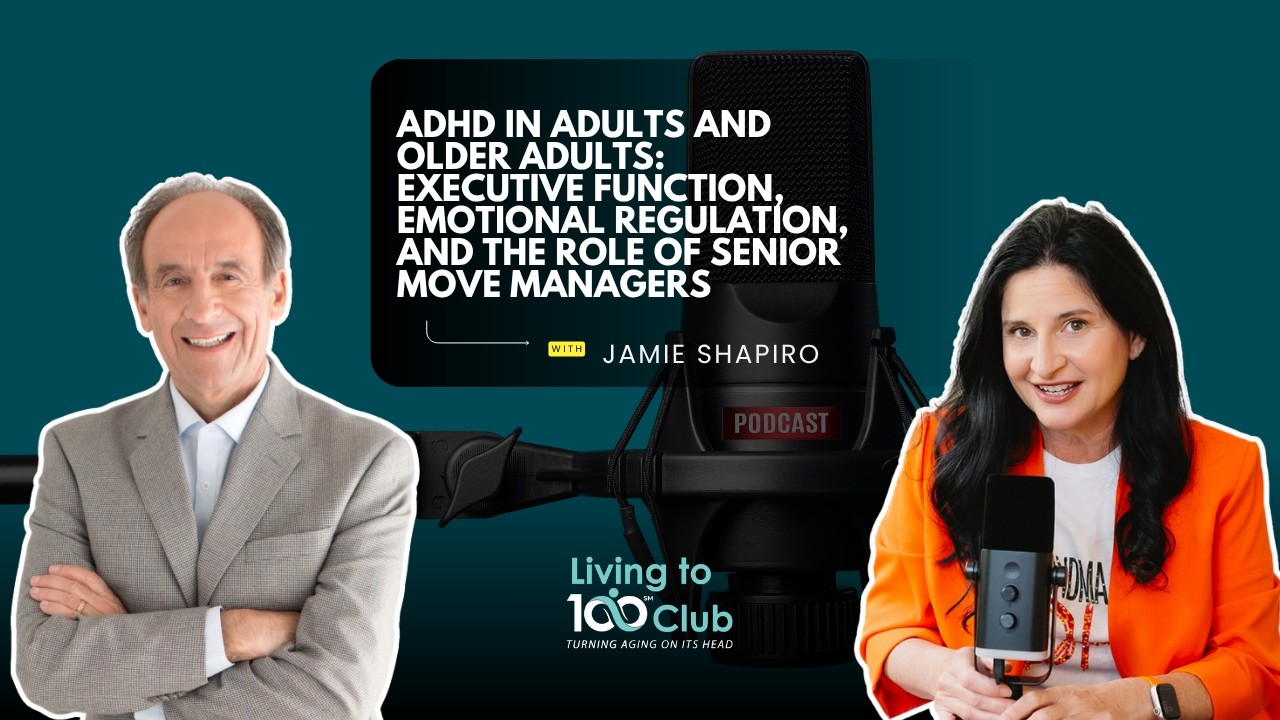
In this Living to 100 Club podcast episode, Dr. Joseph Casciani interviews Jamie Shapiro, founder of Silver Linings Transitions and incoming president of the National Association of Senior Move Managers, about the often‑overlooked presence of ADHD in adulthood and later life. Jamie shares how her own late‑life ADHD diagnosis—triggered by her child's evaluation and her own struggles with chronic disorganization—led her to recognize a pattern among senior‑move clients who exhibit undiagnosed ADHD. The conversation covers how ADHD symptoms evolve from childhood hyperactivity to adult executive‑function deficits, emotional dysregulation, and impulsivity; how to distinguish lifelong ADHD from stress‑related disorganization; why ADHD remains under‑diagnosed in adults, especially women; the four core executive‑function domains (cognitive flexibility, inhibition, planning/organization, working memory) and their emotional counterparts such as rejection sensitivity. They discuss how retirement removes external structure, creating decision‑overload for people with ADHD, and how family dynamics are strained by masking and emotional reactivity. Jamie explains how ADHD complicates downsizing or “right‑sizing” for older adults, leading to clutter, impulsive purchases, and overwhelm, and why professional senior‑move managers with ADHD expertise can provide both practical and emotional support. Practical steps for seeking diagnosis—primary‑care physicians, ADHD‑trained doctors, ADHD coaches, occupational therapists—are outlined, along with resources like Jamie’s podcast “Grandma Has ADHD,” her books (This Explains So Much, This Explains So Much Too), the Sparkler Society community, and her website. The episode emphasizes destigmatization, the value of understanding one’s neurotype, and the potential for richer, more intentional aging.
Chapters
Welcome to the Living to 100 Club Podcast. Here's our host, Dr. Joseph Casciani. Hello and welcome. You're listening to the Living to 100 Club Podcast where we explore the psychological and practical sides of aging well. I'm your host, Dr. Joe Casciani. This podcast is part of a broader Living to 100 mission, helping individuals, families, and professionals approach longevity with clarity and confidence. After all, aging well isn't accidental, it's practiced. And that's what this podcast is all about. Now let's get started with today's program. ADHD is often thought of as a childhood condition, but for many people it doesn't disappear. It follows them into adulthood and later life, shaping how they organize their lives, manage relationships, and navigate major transitions. Today I'm speaking with Jamie Shapiro, founder of Silver Linings Transitions and incoming president of the National Association of Senior Move Managers. Through her work helping older adults downsize and relocate, Jamie began noticing a pattern. Many clients struggling with chronic disorganization weren't simply overwhelmed, they were living with undiagnosed ADHD. In our conversation, we explore how ADHD shows up in adulthood and later life, why many people receive a diagnosis decades after childhood, and how executive functioning challenges can complicate life transitions such as downsizing, planning, and decision-making. Jamie, welcome to our program.
Thank you. Thank you so much for having me, and I, I have to say that yours is one of my absolute favorite podcast titles.
Oh, how nice. Thank you. Thank you very much. Yeah, yeah, we work at it a long time. Uh, before we talk about ADHD and later life, tell us a little bit more about what led you to first notice this pattern among your clients.
Okay, so I'd like to share a story if I can, because it'll help everybody to, to set the stage for how I got here. So I started Silver Linings Transitions, and that is a senior move management and now Specialty Move Management Company in San Diego a little over, um, about 12 years ago. Um, and after starting the business, my oldest child came to me. Uh, they were around the age of 14. I use they/them pronouns because they're non-binary, and they asked to be evaluated for ADHD. And I looked at my child and I said, you don't have ADHD, you've been reading since you were because like everybody else, I had the impression that ADHD was the hyperactive little boy like my half-brother who had to be put on Ritalin in the 1980s, was disruptive in the classroom, and that was ADHD. And my child, you know, could sit still and read books for hours, and they did not have ADHD. Well, when you have ADHD, one of the things that they like to do is they like to bring in another person to evaluate your behavior because sometimes you're not as observant of your own behavior, and then you need another person there. And that's whether it's a child or an adult. And so, as I was sitting in the psychiatrist's office asking, you know, answering these questions, I looked at the psychiatrist and I said, "I'm answering more yeses for me. Do I have ADHD?" And of course, you probably know the answer was yes. But truthfully, at that moment, I am the mom of 3 children, I'm starting a business, and then I'm going through a divorce. And so, ADHD was put on the shelf. And that was it. Fast forward, and I do a lot of presentations in San Diego and other areas as well, sometimes called "Do You Own Your Stuff?" or "Does Your Stuff Own You?" And I would start my presentation and I would stand up in front of the audience and tell people I come from a family with hoarding disorder. Because if you had seen my mom's home, you would have seen piles of stuff everywhere taking over furniture, taking over rooms, and what I thought was hoarding disorder. Based on the description of, you know, the— when, when the stuff starts to, um, impact the way that you're able to live in your home, right? So, and then I would even get into some people's homes where they would be, you know, a little bit nervous about having me in, or a little shameful, but they, they knew that they needed help moving or organizing, and they needed to call somebody in. And, you know, a lot of times they would call me on the phone and they would say, you know, I have a lot of stuff, or I have hoard— or I'm a hoarder, which by the way, we should never call anybody a hoarder. They have hoarding disorder. And I would say, don't even worry about it, you should see my mom's house. And so I, you know, started to notice not all of my clients clearly had this issue, but I definitely saw it. And then fast forward, I was listening to a podcast. I was becoming an ADHD specialist, not because I needed any attention for my ADHD, but in my line of work as a senior move manager, we have our slow times. And I wanted to gain more organizing skills. And so I discovered the ICD, which is the Institute for Challenging Disorganization, and they had a special area of ADHD. So as I was studying to become an ADHD specialist, I had to read books, and then I started listening to podcasts. So I heard a podcast, um, where they were discussing fibromyalgia and migraine headaches being very common, a common link with ADHD. So I'm not saying that everybody with fibromyalgia and ha— has— and migraine headaches have ADHD. I'm saying there's a strong correlation. If you, if you test, I believe, and I don't remember the exact quote, but I did have Dr. Michael Lenz on my podcast, and I believe it's around 70%. So I called my mom and I said, Mom, I don't think you have hoarding disorder. I think you have ADHD. And that is how this whole new journey and my podcast, Grandma Has ADHD, began. It was not something I went looking for, but it found me.
Yeah. So in terms of understanding it in your clients, you were also going through this self-awareness process yourself and you were identifying your own symptoms. So ADHD is usually associated with children. How do the symptoms present differently in adults and especially older adults?
So they used to believe that ADHD was only— it only impacted the hyperactive little boy and he would outgrow it. And so the thought was, why even pay attention to it? And now what we understand is that ADHD's symptoms, you know, wax and wane throughout our lifestyle, our lifetimes. And there are some times in our life where our ADHD isn't such a big challenge for us and you might not even see it because the hyperactive little boy slows down and all of a sudden it could be his brain that's hyperactive and, you know, he's constantly thinking of things and he's, you know, he's maybe impulsively speaking out of turn or, you know, it's impulsivity. It could be clutter, it could be accumulation. But so it doesn't necessarily go away, we just don't always recognize it the same way because they defined ADHD in the DSM-5 based on the criteria of children. Everyone has said that the criteria needs to change because we now know that it isn't something that you outgrow. It's just something that you learn to manage. You build scaffolding, you know, for yourself. You figure out what works and what doesn't work. For instance, I know that I'm always losing my car. Every— I have, I have the ability, my working memory, my short-term memory isn't good, so I might be distracted as I'm parking the car, but I don't retain that. So now I am aware of the fact that I never remember where I am going to park my car. And so I will either take a picture of where my car was so that I can, you know, use those landmarks, or I will stop, you know, really pause and pay attention to my surroundings. Where I— when I didn't know that, I wouldn't have stopped to do all of that.
Yeah. Or try an Apple Tag and put that on your phone. For sure.
Exactly.
Yeah. So the symptoms that we see in children, the hyperactivity, impulsivity, they kind of, um, not only evolve, but they become more polished, more sophisticated, more socially appropriate. Is that fair to say?
No, that wasn't what I said. So I would have—
I know, I was trying to—
yeah, what I probably should have said is, you know, we recognize hyperactivity in the body. So, and what ended up happening for— and why I'm so passionate about this is that you have generations of women like me, who didn't think that ADHD was anything other than hyperactivity in the body. And now what we know is that that hyperactivity can be our brains that just won't stop. And so they were the little girl in the classroom who was super sensitive, who was daydreaming, who wasn't turning in her homework, um, you know, who was, um, you know, talking to everybody and disruptive. And she could have also been the Type A very driven, you know, overcompensating because she, she was aware of the fact that she had issues that she had to compensate for. And so maybe she was like taking extra notes and going over them like I used to. I would take notes and then I would rewrite the notes. And, you know, so they also had compensatory strategies. So we, we're looking at, you know, what I like to say is that I don't— I didn't call it grandpa has ADHD, but because a lot of even men that were my mom's generation and older, like my father who was Silent Generation, he knew that he had it. I mean, you could see it in videos of him as a child. Not necessarily that he had to be on Ritalin, but his son had to be put on Ritalin. We didn't recognize it. My generation wasn't diagnosed, so our mothers weren't paying attention to it. And now all of a sudden our children, so I am, you know, 56 years old, I'm, you know, middle-aged, my child is being diagnosed. As I'm learning about it, I'm realizing, oh, that's me too. And now we also have to look back at our mothers.
Yeah. So how do you differentiate— and I know we've had these conversations before— but how do you distinguish between ADHD and stress-related disorganization? Is there a difference?
Yes, there is. So, you know, everyone can have periods of their life where they're forgetful, where they're messy. I mean, you, after you have a baby, you know, you're probably have brain fog. You know, you may not be cleaning up after yourself. The difference between ADHD and something else is that it has to have persisted over a lifetime, and it, and it needs to be in more than one place. So maybe it's at home and at the office, and, you know, so you see the pattern in other places. You also can see inconsistencies. So we have the ability to hyperfocus on something, right?
Anyway, all right, so that's helpful. So for, uh, to be stress-related, it's more of, um, kind of an acute onset. It just comes, it's situational, and it's not lifelong. When it's lifelong, it's more of the attention deficit hyperactivity disorder.
Yeah, yeah. And a trauma response can mimic ADHD as well, but the difference is, did it persist? Has it persisted over a lifetime, or did something occur? It's sort of like what I've learned, the difference between anxiety and anxiety disorder. And anxiety, and normal anxiety, is I know that I have to fly on an airplane and I don't like to fly. And as soon as I've flown, then my anxiety goes away. It's done. Versus a friend of mine who, as a young child, couldn't sleep at night because she was afraid that someone was going to come get her. And there was never an ending period. That was an anxiety disorder. She couldn't sleep. She couldn't eat. It disrupted her life.
Yeah. So ADHD has that kind of pervasive, longstanding quality. Exactly. Yeah. So why is it so underdiagnosed or misunderstood in adults?
Well, I think a couple of reasons. Number one is, again, we have generations of people who didn't recognize that ADHD was anything other than the hyperactive little boy. And so that's why when, you know, when my ex-husband accused me of having ADHD, I was like, I don't have it because I didn't have that in my mind of what ADHD looked like. But I also think one of the problems is that we used to identify people who had ADHD as minimal brain dysfunction or hyperkinetic or, you know, disordered. And because there was such a negative connotation, and I also want to say, if you look at older generations, they were less likely to talk about issues. And so therefore, you know, there may be people who are struggling, but they don't want to share that there's a struggle. And, and another thing, um, that I, that I've sort of come up with my own theory is that women tend to— and again, I'm generalizing— but we tend to, uh, talk about our problems more than men do. And we talk about what's going on. And especially in, you know, women who are in their 50s, um, we, we tend to, um, like attracts like. And so I'm, as I'm looking at my own story and my ADHD, I'm realizing how many of the people in my life actually are very much like I am. And so then we start to talk about it, and that's how we're discovering it.
Yeah, sure. So I guess the— is this fair to say the prevailing belief about ADHD is that, um, we outgrew it, children outgrew it? And even though it was still there, it was never diagnosed or never really understood as a condition affecting adults. Is that fair to say?
That's fair to say. And it's also fair to say because girls didn't have behavior issues, there was no behavior that would've been called out. So there would be no attention. Like a little girl is a perfectionist. No one's gonna, you know, send her to the principal's office because she's, you know, fretting over a test or she's overcompensating, you know, by doing extra work, you know, to compensate for poor working memory.
Yeah. You know, I'm thinking some of my listeners might not be all that familiar with the whole symptomology of ADHD, especially in adults. Maybe you could give us some of the leading traits and behaviors and styles that we see in this condition.
Sure. I like to— I'm hearing consistently that a lot of people feel that attention deficit hyperactivity disorder is really not a good name for ADHD because we actually have variable attention. And that is that if there's something that interests us, we have the ability to accomplish it. I like to say that people with ADHD— for people with ADHD, boredom is a kryptonite. We don't like to do small talk. We like to have real intense conversation. We don't like to fill out the forms. We, we don't maybe like to do our taxes. We don't like to open our mail. Generalizing, by the way, you meet one person with ADHD, you meet one person with ADHD. But if we are really interested in something, then we have the ability to hyperfocus on it. And so you can see a lot of people with a lot of talent who have ADHD, and there's also a misconception that you can't be bright and have ADHD. And people will say, "Oh, you went to medical school, you must not have ADHD," or, you know, "You went to law school, you must not have." There's actually something called twice exceptional where somebody could be the gifted and talented and also have ADHD. But basically, ADHD is an executive function deficit disorder. So, executive— if you think of executive functioning, it is, you know, it is the controller of our brain. It is the one that says, "Okay, now we're going to do this, and now we're going to do this. So the 4 main categories of executive function are going to be cognitive flexibility, so the ability to like to change quickly. So I, I have plans to do something, and then you say, hey, let's do something else, and I've got to be adaptable. Um, inhibition— we tend to be impulsive, and that impulsive is, you know, is reacting versus pausing. And, and that can be, um, our bodies could be reactive For me, it's like the filter. I have a really hard time not saying anything that's on my mind, which can sometimes get me into trouble.
I'm sure.
That's my, that's my biggest downfall. Functional skills, planning, prioritizing, organizing, initiating tasks. Like for us, we may know what we need to do, but actually doing it, it could be a challenge for us. And then the working memory is a big one. That's another, like for instance, when I do the laundry, If I don't give myself a visual cue or set a timer, it's very likely that that laundry is going to sit in my washing machine, and then I'm going to pay what we call the ADHD tax because I'm now going to have to wash it again several times to get the smell out.
True.
So the other part that we need to talk more about, which is not even mentioned in the DSM-5, is the emotional dysregulation. And that's something that even for me, I didn't really include much of it in my book because, because we're suddenly realizing that the same thing that regulates our executive functioning is also part of our emotions, and that's rejection sensitivity. We feel things a lot more intensely than other people feel them, and so we will perceive rejection that may not be there. We tend to have social anxiety. Part of it is if you don't have a filter You may be worried that you're going to say something offensive. I'm not good at conversation because I have a hard time waiting my turn to end, or I'm afraid of what I'm going to say and therefore I'm going to blurt it out because— or I get super excited and I'm going to blurt it out. So it's really a lot of different things, but all relating to dopamine and how we process dopamine.
Okay. Yeah, no, that's very helpful. Thanks, Jamie. So as you observe this and in your clients and seniors. How does retirement affect someone with ADHD? I mean, you know, when we're working, we have structure and we have deadlines and we have performance requirements and all that. So a person gives up that kind of job or, you know, retires from something. How does it affect their performance post-retirement if they have ADHD?
That is a great question, and actually, we do very well with scaffolding. So, I think if you were to look at people in the military, you'd probably see a high incidence of people who have ADHD because we need that structure. We do really well with that structure, and that's why during COVID you saw a lot of people who were suddenly diagnosed with ADHD because that structure went away. Well, when somebody retires and they're looking at a blank canvas, uh, one of the other things that I should have mentioned that we struggle with is making decisions. And so, if I have too many decisions to make, I'm going to be overwhelmed by it. I jokingly say that Costco is my favorite store. It's choice A or choice B, and I can take it back if I don't like it. So, you give somebody an open canvas of their day with no structure and they will just kind of flood. It's just a lot of decisions to make. So, that's one. Another way, and I'm going to give credit to Jeff Copper, who is an ADHD coach and does a lot of work in this space. He says that one of the most important things that people with ADHD need is that ability to verbally process with another person. A lot of us tend to like think out— outside of our, you know, speak and think like this. And so I can, I can run ideas by you and, and, and then even kind of get to the answer. But if you all of a sudden have lost, you know, that someone that you're talking to on a regular basis, or you've lost your spouse you know, or that person who's compensating for you, that's going to be another way that aging is going to impact ADHD. And let's throw in some normal signs of aging, you know, normal cognitive decline.
Yeah, yeah, difficulty handling too much stimulation. But I could see where that difficulty with decision-making is going to come into play because there are a lot of decisions, and when we don't have everything laid out for us during the day, we have to juggle a lot of possibilities. So that's going to be difficult. I could see that. How about family dynamics? How does, how does this, uh, ADHD condition affect family dynamics? Um, you've observed it, you've experienced it. What, how do you, how can you share that with our audience?
So I'd like to share another story if I can. Just so, so I have struggled with my mom the majority of my life with her. And again, we didn't know that either of us had ADHD, you know, up until a couple of years ago. Um, and so because of the emotional dysregulation, for instance, uh, my mom would put a lot on me as a child. She would overreact to situations. She would need validation because she, she was extremely sensitive to rejection. And I'm a frustrated, you know, adult child and an adult child who's like Mom, can't you get it together? So, I'm not giving her any validation. I'm criticizing her constantly. Her clutter actually, and I should have mentioned that as part of this, not everybody with ADHD struggles with clutter or accumulation, but a lot of people do. And for me, that clutter was a big source of anxiety because I call it like visual pollution. It's a lot coming at us and we're already sensitive. So, It's harder when you're in a tight space that, you know, you feel confined. You have the, the raise in your cortisol, which is a stress hormone. So I was always battling my mom's clutter with her. And then when I realized that she had undiagnosed ADHD, it explained a lot of our relationship. It explained the sensitivity and how she would overreact to something. It explained why she struggled with the clutter and letting go of things. And, and then it also explained why I say, you know, that a lot of parents used their— especially single parents, because that happened to my generation, is that our parents were divorcing, and I became the sounding board for my mother, which at a young age put a lot of responsibility on me that I carried into, you know, adulthood. And so thankfully, we've been able to repair our relationship, and that's one of the things that I'm encouraging people to do when they realize that there is a family history of ADHD. It doesn't just go back to my mom, and then goes back to her parents and how she was parented and so on and so on. And so we have a lot of work to do around learning to have healthy relationships with each other.
Yeah. So, so clearly there's an impact on the relationships, the family dynamics, kind of becoming independent of one another and watching out for the stresses and the conflicts and the disagreements. Yeah. Um, so you, you talked about DSM. I think you mentioned DSM, the Diagnostic and Statistical Manual, diagnosis of ADHD. It doesn't really apply to adults, as I recall.
They need some—
5. Yeah, it's not, um, what's the latest on that? Are we closer to having a psychiatric terminology for adults?
From what I am learning, I attended the APSARD conference, which I can't tell you what it stands for, but I can tell you that it's medical professionals who are looking at ADHD and other— I hate to use the word "disordered," but autism and OCD and all the other things. They are looking at it and it is being evaluated. They're starting to do more research on medications because they don't have as much available. I mean, we didn't pay attention to the fact that this was this was actually happening. I actually had the good fortune of interviewing Dr. David Goodman, who is a Johns Hopkins psychiatrist, and he told— he has— the episode hasn't come out yet, but he told me that he's been talking about this for 40 years and that his colleagues basically told him he was crazy. You know, why are you doing this? And, and now I said, aren't they all laughing at you, you know, with you now? Like, you knew what you were talking about. It isn't something that goes away.. And in fact, I think we're going to see more impact, but also more understanding in our aging population.
Yeah. So it may not be more prevalent necessarily. It's just being understood, recognized, acknowledged. People are actually owning some of these conditions or disorders or dysregulation that they've experienced. Yeah. So how would that destigmatization, if that's the word, allow people to seek more help, more support, more care?
I love that question. First of all, I want to mention, especially for your audience, one of my absolute favorite terms is gerotranscendence. And that is Erik Erikson, when he was in his 80s, and he did the 8 stages of life. He's a famous sociologist. And he and his wife and their contemporaries were approaching their 80s, he realized that he had not really defined all of the life stages. And so, he discovered gerotranscendence, which is— he didn't coin the term, but he added it to the work that he did. And he said that basically, gerotranscendence is that opportunity to look back on your life and reflect and make peace with the decisions that you've made and make peace with your relationships and make peace with your death. And I think when you understand that you've had ADHD the whole time, and you know, a lot of people like my mom, for instance, who's super bright, didn't finish college. She couldn't hold down consistent jobs. She struggled family relationships, a lot of divorce rate, a lot of depression and anxiety. And you blame yourself. There's a lot of also a lot of shame in having ADHD. Well, again, you didn't know you had ADHD. It was just Why can't I get it together?
What's wrong?
Lazy, stupid, right? And all of a sudden, there was never anything wrong with you. Your brain is wired differently. And I think that when people come to understand that this impacts— I, I, let me just say that no one has consistently given me a number, uh, and no one can agree on the percentage. I've heard, I've heard 4% to 25%. I don't believe it's 25%. I don't know. We really don't know because the reality is 80% of people who have ADHD don't know they have it. So, I mean, this is a very early conversation, but I think as we start to look at it as a brain wiring, just like if somebody needs insulin for diabetes, you're not embarrassed about the fact that you have to take, you know, that I— we need— or I need corrective lenses because I don't see the same, you know. That's ADHD. If we, you know, some people do really well with medication, some people do really well with behavior modification, but the awareness makes a difference. Just like that example that I gave you of parking the car. I don't beat myself up anymore because I have forgotten where my car is. I'm just like, okay, this is, this is the way my brain works. But I also can do all of these amazing, wonderful things.
Of course.
Sparkly brain.
Of course. Yeah. So you're owner of, you are the owner of Silver Linings Transition, a major move management company. How does this condition, I'm sure you've observed it, but how does it complicate downsizing or moving for an individual or for a couple, one of whom has ADHD? How does that come into the picture?
So if I may correct you, I'm a member of NASM, which is the National Association of Senior and Specialty Move Managers. There are a lot of people who throw around the term senior mover. They are not part of our association. They are playing towards or preying towards vulnerable seniors who don't know the difference. And so, to me, it's really important that I spread awareness of the industry because we have a code of ethics, we have training, and for anybody going through your belongings, and I like the term right-sizing rather than downsizing because I'd rather focus on, you know, what's in our next chapter versus what are we letting go of. I think it's more positive. But for anybody, that's going to be a very, you know, could be, not everybody, but emotional and stressful to visit the museum of your life and, you know, who you've been and what you've done and what you haven't done. When you have ADHD, it's going to be compounded because we do have those out of sight, out of mind brains. And so, a lot of times if we don't have that visual cue, we don't remember that we have something, so we tend to have more clutter. A lot of people with ADHD have impulsivity and they buy a little too much. They will go out and shop to kind of curb that dopamine hit that they need. They may forget that they have something and go out and buy it. And I think one of the biggest reasons that we have a challenge is that we're looking at a lifetime of disappointment in ourselves. A lot of times, you know, we'll go out, we'll buy all the crafts or we'll buy the exercise equipment or we'll buy the textbooks thinking that we're going to go to school or, you know, whatever. And then we lose interest in it. And so it's also confronting the things that you thought you were going to do that you haven't done. And so working with— and one more thing, here's my ADHD playing for you— task, you know, and prioritizing. And so moving is a big task, and having to take that on is overwhelming again for, for most people, but especially people with ADHD when we have a deficit of executive functioning.
I'm guessing that a lot of people who are struggling with these decisions are maybe solo agers as opposed to being couples. I mean, if they are a couple, one of whom may have ADHD and the other one doesn't, I don't know how that complicates the decision to right-size or to move. But even for the solo ager, does it delay their making some appropriate steps? Do they put it off because they look around and they don't want to tackle this, these challenges?
So, yes. I mean, if you think about it, you just said it right there, decision. So, if I have to take a 4-bedroom home and go into a 1- or a 2-bedroom condominium or a senior community, I'm going to have to make decisions about what I'm going to keep and not keep. Well, I just said one of the struggles that we have is making decisions. So, there's one for you. And then the paperwork. That we're going to have to fill out to make that move. And a lot of times people will stay stuck with what they have to avoid the pain of the uncertainty. And then again, a lot of people have no idea that NASM even exists and that there's somebody that can help them because, you know, again, normal aging is that we're going to struggle, you know, with the packing and the physical part of moving. And they don't even know that this kind of help exists.
Well, how do people like yourself who have these, these skills and you have some extra training, how does that help the person who's struggling with this downsizing or rightsizing? And why is that better than the adult children if it is? Oh yeah.
So I, it's very, very rare that the adult child is going to be the right person to help with the decisions about rightsizing. You know, again, you're going to have the clash of the mom Mom, do you really need this? And what I, what I tell people is it's, it's best to have the relationship, to preserve the relationship, and don't have the adult child come in and parent like, Mom, you don't need this, you know, and, and guide them that way. And it's funny because we will have an adult child say something, but the parent won't listen until we say it as the professional. Um, and then I will also say, just in terms of working with a professional, you know, this is something that we do on a regular basis. I like to use the comparison. I had thyroid cancer 21 years ago. I, to me, 34 years old, finding out that I may have cancer is a very, very big deal. To my doctor who says thyroid cancer is no big deal, I see it all the time, you know, he's going to treat it very differently than the way that I perceived it. And so we, we do this every day and we understand that, that this is your move and it might be something we do all the time, but we understand that it's, you know, going to— you're going to need that emotional— not everybody, but a lot of people need that emotional support.
Yeah.
In addition to putting the stuff in boxes and making the decisions and then clearing the home, you know, figuring out what to do with everything they don't take.
Well, I, I like to talk about process and content. It sounds like— I mean, the content is getting the boxes and helping to pack and move, but the process is what's going on at the time, what psychological phases that the individual— so you're dealing with both, where the adult children may not recognize the need for both sides of this. So, I mean, you're trained, this is your background, this is your specialty. You know how to deal with some of that, some of that resistance, some of that hesitation, some of that reluctance that the person doesn't— wants to avoid.
Yeah, absolutely.
Yeah. Yeah. So if an older adult suspects they have ADHD, what's the practical step they should take to get some answers?
Okay, so I would recommend that you talk to your physician and see if he knows of somebody who understands ADHD in older adults. Most— I'm going to say this, and I can back this up with the doctors I've interviewed on my podcast. Dr. Michael Lenz said that if you meet a doctor who understands ADHD, it's likely that he's self-trained because they just aren't getting enough medical training on it. You can reach out to, to the ADHD Coach Association. I'll give you the letters to follow up. I know ADDCA, which is where I got my coach training, which is ADDCA. You can go to somebody who already is an ADHD coach and they can send you to people in your area. If your doctor doesn't know of a special— of a doctor who understands ADHD, because it is at this point still finding a needle in a haystack. So yeah, and also I will say that occupational therapists can work with ADHD as well.
Okay. So start with your primary care doc if that's possible, if that's available, he or she has some understanding. If not, there are some national sites, national organizations that can offer some information?
Just look for an ADHD coach, occupational therapy. Yeah.
Okay. Okay. That's helpful. So how do we help the individual who's been reluctant and maybe embarrassed or so distressed about discussing this? How do we help them get over that?
Well, I love that this, this program, and doing things like this where we're creating awareness. I like to talk about all of the positives of having ADHD. My podcast, Grandma Has ADHD, is very much about tell me your story and tell me how it's impacted your life and what now. And I think when other people hear these other really brilliant brains and they can identify with them, there is that community support that, oh, misery loves company. Not that I think it's miserable. In fact, a question I ask all of my guests who have ADHD. If you could press a button and not have it, you know, would you get rid of it? And I will tell you that since I started asking the question, which was around episode 10, I've had probably 80 guests and only one person with ADHD said they would press the button.
To get rid of it.
To get rid of it. Because I love Dr. Ned Hallowell's— he says that having ADHD is like having a Ferrari brain and bicycle brakes. And I think, you know, one of the reasons that people— I, I— people ask me, why does it even matter? You know, why? I've lived this long, why does it even matter? Um, and I think that when you know yourself and you understand yourself, it helps to make life easier. And, and it is that lens of looking at your whole life and realizing, oh, this is what that was. And I also think, you know, our elders— I mean, one of the things, and one of the reasons I appreciate you so much, is In our society, we want to brush off aging. We don't want to talk about it. We don't want to look at it. You know, we use the term anti-aging, and I think that we have— we've pushed aging too, too far aside rather than embracing it and honoring it. And, you know, so a grandparent that's suddenly realizing that they've had ADHD their whole life can then go to a grandchild and, and see, like, watch how I navigate this journey. Let's do this together.
Sure. Yeah, yeah, I like that. What you're saying is that that ability to add more definition to who we are really makes for a richer life, a richer personality, and really understanding all of the nuances, all the subtleties to who I am and what I do and what I've always done and why. That adds the richness to our life.
I had a guest say that she finally felt like she had permission to be herself. There's something in ADHD called masking, which is where you like hold it together for other people. And then when you are around other people where you can be yourself and you can sort of like take that mask down, it's very, very freeing.
Yeah. Yeah, I can see that. Wow, that's great information. Thanks. Thanks so much, Jamie. So you mentioned your new book. Tell us about your book and where can people buy it?
Oh, great. So I am coming out with the second edition. So my first book is called This Explains So Much, um, and you can find that on Amazon. Um, I'm coming out with This Explains So Much Too, which is going to add information about emotional dysregulation and something that I created since writing the book, which is called the Sparkler Society. And it's basically going to be a membership community for women who are discovering ADHD and it's helping them understand themselves and building a community that supports— I say getting your blank together together because when you have ADHD, it feels like you could just never get it all together. There's a word that I'm not using because I don't know your audience, but it starts with an S. Yeah, starts with an S and ends with a T. Go ahead. And then they can find the podcast on Grandma Has ADHD.
Is that the website people can go to?
Actually, the best website is, is going to be jamieshapiro.me. That's J-A-M-I-S-H-A-P-I-R-O dot me. And there they can find information about Silver Linings Transitions, um, they can find the podcast, and they can find the book, The Waiting List for the Sparkler Society. Sort of the catch-all of, of all the ADHD things I've got going on. And by the way, if you work with Silver Linings Transitions, You do not need to have ADHD. That's the one, like the one thing that I want to distinguish, you know, us because we're one of the only move managers that understands ADHD. But at the same time, I don't want people to think they have to have it or even be a senior to work with us.
Sure. Not a prerequisite to working with Silverlight. That's good. That's good. Yeah. Well, thanks so much. This has been a great conversation, Jamie, and thanks to our audience. Thank you for spending part of your day with us. If today's conversation resonated, I invite you to continue exploring the work at livingto100.club. Join my Living to 100 community at livingto100.community, or discover practical tools like my Better, Longer, and Happier card series at livingto100.solutions. Until next time. Stay curious, stay engaged, and keep shaping your next chapter.
More from Joseph

The Hidden Cause of Aging? How Chronic Inflammation Affects Your Health with Joel Brind








