Anti-Frailty Fitness & Brain-Body Training for Healthy Aging | J.J. Caruncho
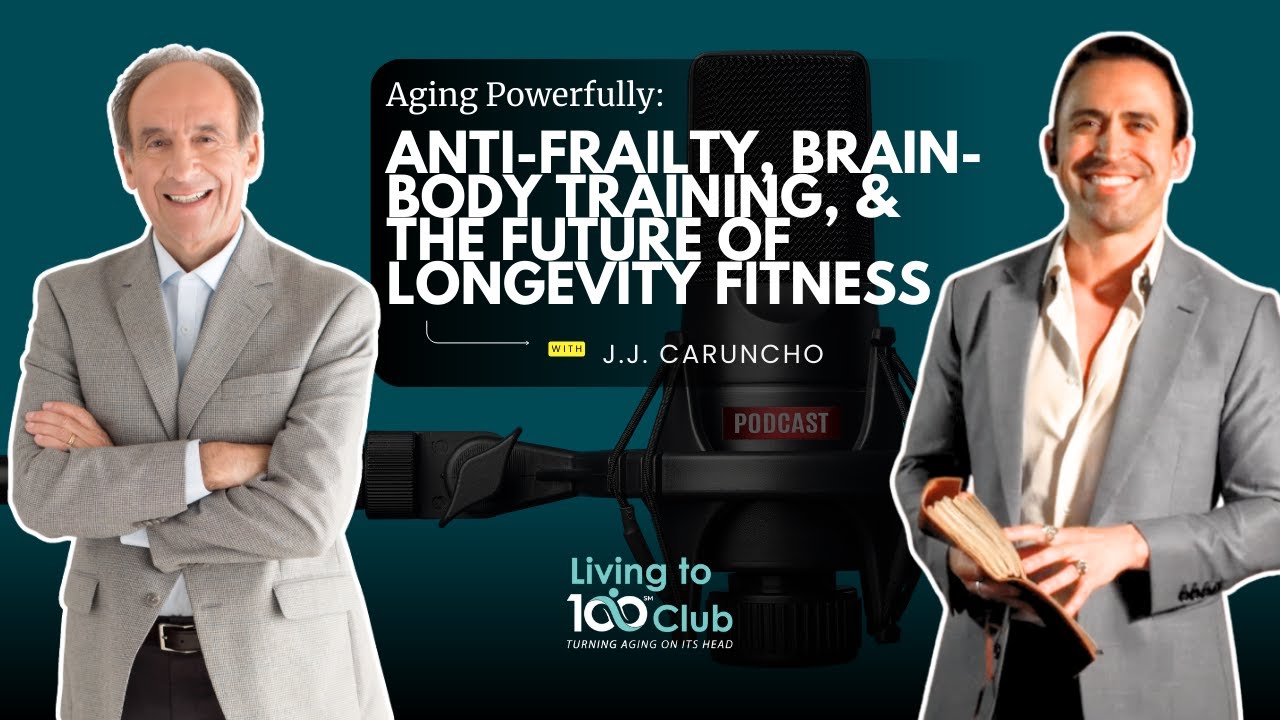
In this Living to 100 Club podcast episode, host Dr. Joseph Casciani interviews J.J. Caruncho, founder of Sancta Via, a longevity training system that blends dance, martial arts, and prevention‑focused healthcare into an anti‑frailty philosophy. Caruncho explains how his upbringing— a mother who taught ballet and a father who ran a senior health‑insurance company— shaped his belief that movement can prevent the frailty that typically accompanies aging. He distinguishes anti‑aging (which he calls discriminatory) from anti‑frailty, arguing that the goal is to keep bodies and minds functional rather than merely to delay death. The conversation details Sancta Via’s curriculum, organized into modular “doors”: the Art of Anti‑Falling (foundational footwork, rolling skills, predictive movement), BASE (body mechanics), Guardians of the Joints (upper‑body strength and stress‑resilience), Breath Training, Spiral Staircase, the Book of Breath (meditation, breathwork, CBT, memory training), and Lifestyle Equals Destiny (learning, fear, strategy, long‑term correction). Caruncho describes the online platform’s gamified design—a 3‑D circular room with doors, a choose‑your‑level video system, and a visual‑cue system that leverages mirror neurons and the reticular activation system to make movement patterns predictable for learners. He emphasizes the “Prove‑It Principle”: every technique must demonstrate measurable benefit, and he shares client success stories (e.g., a 50‑year‑old opera singer who avoided double knee replacement, a veteran who eliminated chronic back pain, and a 98‑year‑old who learned to roll safely). Caruncho also outlines a long‑term vision to partner with biological‑age testing firms for a 10‑15‑year study, and he provides pricing details: a lifetime‑locked $197 / year plan with promo code “100 Club” and a $20 / month entry option. The episode closes with a motivational message that individuals are the heroes of their own lives, that strength is an action, frailty a condition, and that it is never too late to choose to age powerfully.
Chapters
Welcome to the Living to 100 Club Podcast. Here's our host, Dr. Joseph Casciani.
Hello and welcome. You're listening to the Living to 100 Club Podcast where we explore the upside of aging. I'm your host, Dr. Joe Casciani. In my programs, I talk with experts and thought leaders about how to stay positive Resilient and purposeful, because growing older isn't just about adding years, it's about making those years count. This is part of my broader Living to 100 Network, which brings together 3 core pillars: these conversations, a growing collection of practical tools and resources, and my Living to 100 Community, a space to connect, share insights and support one another on the journey. You can explore it all at livingto100.club, livingto100.solutions, and livingto100.community. Thanks for joining me as we focus on living better, longer, and happier. Let's get started with today's guest. In today's episode, I speak with JJ Caroncho, founder of Sanktavia, an innovative longevity training system designed to help people move, think, and age more powerfully. Drawing from a background that spans dance, martial arts, and healthcare, JJ explores how prevention-focused upbringing shaped his approach to aging well, one centered on anti-frailty, functional movement, joint protection, and the brain-body connection. First, a little background. When JJ was a young boy, he remembers his father saying, "It takes the same amount of time to be world-class at something as it takes to waste your time." Beginning in music and the performing arts, JJ would eventually become a leading actor, learn 11 instruments, perform at Carnegie Hall, and conduct orchestras around the world. He studied over 10 martial arts and has the honor of training members of the U.S. military. The creation of Sanktavia is the culmination of over 15 years of development. He's deeply passionate about protecting others, empowering others, and helping them live as powerfully and passionately as they can so that they can get the most joy possible out of their lives. This is the way of the sanctuary. JJ, welcome to our program today.
Thank you so much. Thank you so much. This is the way of the sanctuary is kind of our catchphrase at the company we call Sancta Via. This is the way of the sanctuary is the way we sign off all the time because we think that really your body and your mind are your sanctuary. We are not our bodies. We are not our minds. We're really like the caretakers of these vehicles that take us through life. And so everything at Sancta Via is about giving people practical, functional tools to make sure that they can take care of their bodies and their brains so that their bodies and their brains can be something that allows them to experience more joy and empowerment in life rather than becoming a prison over time, which is not something that we need to experience.
Yeah, I share that same philosophy. I always, when I I speak to seniors, I talk about we are not our bodies. We are the me or the I in there that still has the ability to, you know, stay positive, stay passionate about things regardless of what's going on with our body, right? I mean, the bodies may decline, the bodies don't cooperate, but we still have the I in there or the me in there that can look at things and stay positive. So how did your background in dance, martial arts, and healthcare shape Sanktavia's longevity focus?
That's— that is a big question that could take the entire time. I'll try and say it quick. So really, that's what I grew up around. So my mother, who transitioned off to heaven about a year and a half ago, was a world-class instructor of dance. She was a ballet dancer, and she was the chair of the performing arts department at a dance school that she founded at a private, at a high school in Miami. And so I grew up in dance studios. Before that, she had dance studios. She danced in the company that became the Miami City Ballet. So I grew up around dance, surrounded by dance. And my mom really thought of dance as a means of giving people personal empowerment, that if she could teach them how to move better through the space of a dance room, she could empower them to move more powerfully and more freely and express themselves and take up space in their life. So that's what I saw by my mom, who I'm very, very close to. Then my dad, who I'm named after— JJ is Joe Jr. So I wear the junior at the beginning of my name. I'm so proud to be named after him. I love my dad. I was the best man at his wedding. He was the best man at my wedding. We're close. Um, and my dad ran a prevention-focused health insurance company called Preferred Care Partners in Florida, which became the largest private health insurance company for seniors. In Florida. He started out in as a health insurance attorney. He was representing doctors, but he had gone to school for business. And so he was seeing all the time that he was just getting frustrated with the industry he was taking part in because he thought it seems like we don't actually have a healthcare system. We have a sick care system. There is no healthcare. Everything's about trying to get people back to survival.
Sure.
But he didn't see an infrastructure for health care. So he partnered with doctors with the doctor-first approach. And the vision that he had there was if he could just get people to take healthier actions in order to prevent the decline and the frailty in the first place, because he had all of the data from the insurance companies of, well, here's what we're paying out for. So we already know what's most likely to happen statistically. We already know. Is there a way for us to prevent those outcomes?
Yeah.
And they wound up really revolutionizing healthcare. In Florida. They had the highest, uh, client and customer satisfaction rates in all of Florida. So I grew up seeing these two things as— from my earliest memories, I knew that you could teach people movement and that you could take the same movement class and empower everybody— male, female, all ages, all body types— and that you could get people to move with excellence through training with the same curriculum. And really, with this purpose of personal development.
Mm-hmm.
And then I saw from my dad that if somebody could take that and apply it to solving the movement problems that lead people to need the insurance payouts of predictable frailty and injury in age, that you could actually change people's future. So I thought, how can we get people to move better now in a way that actually completely changed them from being on a frailty trajectory to an antifragility trajectory? Can we put people on the path to age powerfully as early as possible by teaching people how to move powerfully so that they can age powerfully? And then martial arts was my practical area of study because I have always loved the idea. When I was a little kid, they said, what do you wanna do? I said, I wanna be either in the military or a police officer or a firefighter or a doctor, or as a little boy I said, or be Zorro or Batman. My, all of my goals were I want to help people. I want to protect people. It's, it's the only thing that ever interested me.
And be physically engaged. Sure.
And be physically engaged. And so for me, the study of martial arts was actually maybe different from how other people are studying it. Yes, I wound up getting to a high level of learning self-defense, but really what I wanted to study from a different perspective than fitness was how do you injure people so that I can know via movement and via body mechanics. What leads people to get what kind of injuries? And by understanding how to break the body, I could understand how to keep the body from being broken. That's why Sanktive is so good. Because the martial arts gave me the ability to move powerfully, to age powerfully, and to know exactly what the body does and exactly what causes the body to get injured. And the practice solves all of that.
Yeah. So, all of these contributions kind of led you to this place. And, it's a very powerful program and we'll talk more about it. You know, we love to hear about living longer and what contributes to longevity. I know you use the term anti-frailty instead of anti-aging.
Yes.
Tell us, what's the difference?
Oh, the world of difference.
Yeah.
If somebody, if somebody, I actually have a pretty big problem. People could see it on the video. If somebody just saw something get to me, I have a real big problem with being anti-aging. Like if somebody said that they were, that they were anti-Dr. Joe, they'd be saying they have a problem with you. When people say they have a problem with that, they're anti-aging, anti-aging, we're all gonna be aging. Yeah. That's really, I mean, I think it really sets up the anti-aging movement, I think is well-intentioned, but it sets up discrimination against aging. In the title. Yeah, I'm anti-aging is discriminatory against aging. And as we age is when we have the most wisdom and the most life experience to give. Aging is not a problem. Aging is a beautiful thing, and it is a gift, and it's a gift that not everybody gets. My mom lived healthily and passed when she was 66. Aging is a blessing. It's a blessing. There's enough— there's no reason to be anti-aging. The problem with aging is not aging. The problem is that it often comes with frailty if we don't kind of get in the way of entropy taking our freedom from us. So aging is not a problem. Frail aging is not the enemy. Frailty is the enemy. And that's what I think we all need to be focused on. I'm pro-aging. I'm anti-frailty.
Yeah. Yeah. I agree 100%. I mean, anti-frailty is more empowering. You know, we talk about the silver tsunami and I— that's, that has a very negative connotation to me because it suggests that with aging, we're going to have this onslaught of all, you know, people in their advanced senior years. And there's going to be a problem with that. And to me, aging means, as you say, unlocking opportunity, really looking at leveraging our wisdom, leveraging our tolerance, our humor, our, you know, our connection, our reflection. And using that to open more doors.
So I think that's, that's 100% right.
Yeah.
That's 100% right.
Yeah. So what does functional movement look like, you know, for someone in their senior years, 60s, 70s, or 80s? When we talk about functional independence and movement, what does that look like to you? How do you define that?
It's an amazing question.
Yeah.
I think that defining that clearly, the defining functional movement in relation to aging is actually almost the question. And the most important way that I like to think about it is relevant movement. Relevant. There's a lot of stuff that's functional, but functional— I think we see a lot of this in functional fitness. You see people throwing a ball up, up a wall, and then they catch it, and they're doing all kinds of advanced— and they're doing backflips and stuff. So, oh, you do a lot of backflips in your life? This is something you need to do? You need to throw a lot of balls over a— are you raiding a castle? I'm not sure that functionally, I think a lot of the functional movement is useless because function implies utility. So when we really are talking about that, I think the real primary question, and this is how Sangha TV is designed at its core, it's one of the things that makes Sangha TV different, is that that question What is functional movement for somebody in their 60s, 70s, 80s, and 90s? Mm-hmm. That's the only question that Sanctivias designed around. And the question is, what are the things, what are the movement problems that people are likely to start experiencing as they get older? It's posture, it's joint health, it's joint, joint stability. It's getting up and down off the ground safely. And it's being able to have full range of motion through all of their joints in a way that makes sense to them. While avoiding predictable injuries. And when we can solve for those things by design, then yes, it happens to mean that the earlier that people start, it does involve— when people see what we do, it involves moving very powerfully. It looks very martial or warrior-like, but that's not because there's some sort of youth or flash obsession. It's because we want people to build a superabundance of power, function, and capacity. As early as they can, and then to apply that in ways which leverage our ability to not— people focus a lot on balance as in saying, how do you not lose your balance? And it's an irrelevant question. The, the relevant question is, what are the patterns of frailty which lead somebody to have a lack of balance to begin with? Let me say, how do we regain our strength? Say, irrelevant question. What are the patterns of frailty and lack of proper movement and range of strength that leads frailty to develop to begin with? And can we nip that in the bud and solve it before it even begins? And the answer is yes. So it's really about solving all of the problems before they begin, not in reacting to them in post-production.
Yeah. So that, that whole notion of functional movement performance is unrelated to chronological age, right?
I mean, completely.
Because that's why we see 90-year-olds performing better than some 60-year-olds, right? So the—
Yes.
—whole notion of chronological age doesn't determine what we should or shouldn't be doing or can or cannot do. Correct. Yeah. Yes. Yeah.
Biological age. Biological age is the, is the primary thing. I actually have a big long-term vision of that. I do wanna partner with one of the companies that measures biological age and do a 10 to 15-year study with senior populations. Because I feel comfortable saying it on, on the video so people can look at this in 20 years. Yeah, people, uh, the biological age will drop. Yeah, I feel extremely confident about this because if you get people to start acting and moving and behaving in ways that make their brain healthier, their breath healthier, and their body healthier on every single level, that is what reduces biological age in relation to also stress reduction, which is another part of it.
Yeah. No, I, I agree because that's smart to be thinking about these metrics. We gotta be able to show that this makes a difference, right? If you can look at some of the kind of fundamental biomarkers or where you are today and then look at where we are after a year or 2 years or 5 years. That's, that's the science of all this.
Yeah. You can always see, you mean you can see it with people right away, practically speaking, they couldn't get up and down, now they can get up and down. They weren't strong, now they're strong. I have a principle that I'm pretty passionate about called the Prove It Principle. Yeah. Prove it, which is one of the core rules of Sangha Via is that if you can't demonstrate why something is useful, it's probably because it's useless. And so if there's a— a big core within Sangha Via is giving people demonstrable ability. I don't want to give people theoretical. Ability. So I'm always trying to find the balance between, you know, doing things that are science-supported. And yes, we want people to be reducing their biological age kind of on a biological cellular level, but much more interestingly, people should see a radical— if you're going to put in $1 of effort, I want you getting $5 of results back right away. We should see a dramatic improvement in people's demonstrable physical ability, and that means their physical and mental experience of life should change dramatically and drastically because they're putting in time, or the training is probably not good enough to be worthy of their time.
Wow. Yeah. Okay. So older adults sometimes have some reluctance to engage in technology and connect online with things. So if they're intimidated, how do you— How do you design Sanktavia to help people make them feel more intuitive?
I, you've done so much research and I cannot tell you how much I appreciate it. Yeah. I really, really appreciate it. The, it's really, I think, necessary for everything to be intuitive. So the entire design of the website is designed to mirror the experience of the best in-person training day that is possible. Wow. One of the problems that we had, so I really think of myself kind of like a systems-based engineer. That's kind of how my brain works. It's why I've been able to learn many things. Mm-hmm. Um, and so when looking at how to deliver these solutions to people online, I don't think that the common design of websites is very intuitive or very good.
Mm-hmm.
When you, you go to a website and then you log in and then you find something in a little corner and then it says find your courses and then where's the course? And then something tells you, what the form is, and then you find one of 30,000 videos and then you put— it's terrible. The design is just incredibly mediocre. Mm-hmm. And so one thing that we've done is we've essentially borrowed quite a lot from the world of video games and cinema. So we know that every single person who's gonna be taking this course at some point has been through school. Everybody remembers How to go to school and they say, well, your PE class is over there. And if you say, and how did you get to your English room? And you say, well, it's room 302. And then you go there and they say, and how do you get to the art room? And the art room is, is over in the art room. So everybody understands the idea of there a place where there's classrooms. Yeah. So the design, everybody remembers this. Mm-hmm. So the design of the website, once you log in, you're gonna see it looks 3D. This works either on a mobile device or it works on the computer and it looks like you're in the center of a circular room. Where there's a bunch of doors around you and the door's your classroom. And then so with a mouse or with your finger, you tap on the door, it has you walk up to the door, which is also fun. And fun is one of the things that allows people to succeed functionally. Sure. Like fun is the beginning of the word function. So it takes people up to the door. The door is where the training is. And then, so that's part one. It's easy to navigate. Part two is, all right, but is the training easy to follow along with? Yes. And to do that, we have two things that work together: a choose-your-own-level, choose-your-own-adventure system, and a visual cue system. So the first thing is that you never need to navigate 1,000 videos. If you're doing— there's a day of training called Foundational Footwork. It teaches you the foundational footwork that makes you less likely to trip or slip to begin with, while giving you the movement patterns and the foot speed and the skills to catch your— to be most able and most likely to catch your footing if there's an accidental trip, slip, or fall. So we want— if somebody trips or slips, we want it to be due to an accidental trip or slip, not to what I call a frailty-induced trip or slip. So that's that day of training. On that day of training, it's literally one video, like watching a movie, and you click play. But inside of that video, and it looks— your experience of it is it goes from top to bottom. Then let's say the first form is something called the belt turn. The belt turn is learning the body mechanics of getting up and down. So when people are learning the belt turn, the first thing that happens is it says, "Choose your level," and you see 4 videos pop on screen that say level 1, 2, 3, 4, and you see me demonstrating them. What we're trying to build is for it to be intuitive for people to just go ahead and tap. Which one looks like you? Which one looks like where you are right now? Sure. And if you say I'm at level 1, if you touch level 1, the video just continues playing with level 1 as if that was the video you watched from the beginning. If you click level 3, it just keeps playing exactly where you are. Mm-hmm. But you'll see me demonstrate level 3. And because of that, in this one video on the one day of training, there's another day of training called Movement Shapes that as of right now has over 15,000 variations of that day so that every single level, every single form is always at the exact level that you need it to be in relation to where you are on your learning journey and your aging journey, so that it's always the perfect day of training. That's part 1. And part 2 is what's— okay, so I understand that it's always going to be one video. I'm going to click it. It's always going to be the right level. I'm never going to be left behind. But the other thing is, well, how do you know that you're actually going to learn? This is the next thing we needed to solve. Okay, the curriculum is world-class. The curriculum is best in class, not just world-class, it's best in class. I'll say that without hesitation because if there was somebody better in the space, they would be my teacher. And we're best in class at what we do.
You can say that.
And yeah, it's true. And it's demonstrable. If somebody says, prove it, I'd say, Oh, we can't. So the next thing, the next thing we needed to solve is how can we make it that we know people are likely to learn? And it's a brain-based cue system. So essentially what happens is if you're about to see me move from this position, from standing up to going down to one side, before I do it, you see basically like a ghost, the ghost of like future future to come, like in Christmas Carol. You see this ghost appear and you see me look at it and you say, all right, now— and then you see arrows that say, look how we're going to move in this direction. And then you see me in the video go and lock into that future ghost. Then I point over to the side and I say, now we're going to move over there. And you see me in the future. And then the two of them merge. And because of this, essentially what we're taking advantage of is something that I learned from my mom in dance and from the martial arts, which is Uh, which is the neuroscience concept of mirror neurons, the reticular activation system. Mirror neurons is why if somebody says you can play the game with somebody, sometimes you could see kids play it where you could try this, where somebody could play the mirror game where they're quiet and they say, do what I'm doing. And you hold up a hand and they'll hold up the same hand. You hold up the other hand, you hold up the same hand, you turn it and they'll turn that one. It's how you can copy what somebody's doing. Sure. Sure. Without them saying it. So that's mirror neurons. Yeah. Reticular activation system is your predictive system. It's how to say, hey, by the way, when you walk in the room, you're gonna look for the red dress and you say, copy that. And you walk in the room and the red dress, you say, that's where we're going. Hmm. We apply that to movement. So it allows you to think like what we call, we turn people into what we call a chess master of movement. You're gonna start seeing 3 moves ahead. And so because you're seeing 3 moves ahead, right? Other people are saying, I don't know how to move my body. You're saying checkmate in 3. And they're saying, how? And you say, because I'm going to move from here to here, here to here, and here to here. And so we are literally going to train people's brains to be chess masters of movement. And that's why we have people following along with these training programs that are 22-year-old Broadway dancers, people that are 40-year-old tier 1 special forces, but also people that are 97. And they're all following along with the identical training with the same exact outcomes and levels of success.
Yeah. Yeah. Just to back up a minute, when you log in and enter this room, you said you pick a door. What are the choices? What are the different doors? I love it.
So there are a few different ways for people to interact with Sanctivia, and it depends. So they can also choose really if you think about Sainte Devia as if it was a— as if you thought of it as like the school for longevity, if you thought about it like going to a place where you're going to go and study longevity, we kind of allow people to pick their major. So, there are many different doors, but you don't have to do all of them. All of them interlock together. Okay. But so, there's a few ways that you can major. We could think about the first area of study being the art of antifalling. The art of antifalling is one door. Inside The Art of Anti-Falling, there are 4 days of training that are going to be there because we're expanding 2 more days. Right now there are 2 on there. It's that you train 4 days a week. Day 1, you train foundational footwork. You learn how to develop your athleticism and your movement skills by learning footwork patterns that make you less likely to trip or slip to begin with and more likely to be able to be— to catch your feet if something goes down. That's day 1. It's your movement skills. You could think about that like, like as if you're going to a salsa class so that you can go out and do partner dancing. It doesn't feel like strength training. It feels like learning to move. What's the footwork? How do you move? Well, the next day is the opposite day. It's the strength training. And it's what we talked about before about, well, what's functional movement? More like relevant movement. So we have a day called Movement Shapes where you learn how to get relevant movement and strength throughout the relevant movement. So that's 2 days of training. The expanded days are going to be rolling skills. We call France the floor that if somebody falls down, can they learn how to tuck and roll so that they fall like a ball instead of going splat like a pancake? And the 4th day is a day that is the most advanced version of that day that's about training the predictive processing, the Chess Master of Movement day, which is all of it put together. The Art of Anti-Falling. If somebody's main focus is, you know what, what I want to do is I want to make sure how can I get my fall risk to the absolute lowest, that's what I want to do. I'd say you're looking for The Art of Anti-Falling. It's the first door to the right. Yeah, yeah. There's an Advanced Longevity Training Program that's also 4 days, which the first day, which is behind the same door as Anti-Falling, is BASE. BASE is the Art of Body Mechanics. It's everything from The Art of Anti-Falling put together into one day. So if you graduate from Anti-Falling, you're ready. That was just like kind of like movement, what, Body Mechanics 101. You would go to Body Mechanics basically 201. That's base. So you graduate. The next level of training is called Guardians of the Joints. It's an upper body day of training which trains also stress resilience skill that we call Source of the Force, which is remembering you happen to your life. Your life doesn't happen to you. You happen to your life. And it trains that stress resilience skill along with your upper body strength. And that's mainly about making sure that we're protecting all of our joints and our ability to generate power through our upper body. Mm-hmm. The third day of movement is called breath training. And it's basically making sure that your lungs and your breathing system is strong enough to blow out all 100 birthday candles within 1 or 2 blows. Mm-hmm. I don't want it to take 100 blows. I want only 1 or 2 because that birthday candle test is actually relevant to checking people's level of frailty. Sure. And we all know that if you meet somebody older, they kind of are talking like this, as opposed to if you meet somebody 100 and they say, hey, great to see you, how are you doing? You'd say, wow, you're doing well. So the breath day is making sure that we remember that breathing is the first thing we do as we come into this life. It's the last thing we do as we leave this life. You better train it. And then the fourth day is called the Spiral Staircase. It's just like the Art of Antifalling. Put it all together, put it all together, put it all together. And then there's two days that are optional days for people, but we highly recommend them. One of them is called the Book of Breath. What is it? It's a cookbook. Basically, it's a recipe book. It's five different kinds of meditation, five different kinds of breathwork, five different kinds of training your breathing system, a bit of cognitive behavioral therapy. Advanced memory training, training in order to, for people to think about how to maintain their mental health through hard times, visualization skills, affirmation skills. Mm-hmm. That's 15 hours of training in a neuroscience course about an called Ancient Brain, Modern World. How is it that our brains and our bodies came to be this way? And how does knowing that our evolutionary design stopped 400,000 years ago and is not well Designed for the modern day. How does that help us survive and train? Mm-hmm. And a peak performance masterclass by my wife who's starred in 5 Broadway shows. So she knows a thing or two about how to perform on demand. Sure. And then the last thing is a course about achieving your goals. It's called Lifestyle Equals Destiny. It's something, it's actually a short course. You could do it in one afternoon and it's 4 modules. The art of learning, cuz if you can't learn skills consistently, you're not gonna achieve your goals. It's the art of fear because if you can't overcome fear and procrastination and hesitation and self-doubt, you're not going to achieve your goals. It's the art of strategy because if you can't tell what's the next relevant action to take, you are not going to achieve your goals. And it's the art of long-term course correction because if you can't tell when you've drifted off course, you're going to find out when it's 10 years later and you say, "Where the heck did my life go?" So, those 4 things together, we can teach people that in 1 day. That's the course Lifestyle Equals Destiny. And if people have New Year's resolutions and they don't know the art of learning, the art of fear, the art of strategy, and the art part of long-term goal course correction, they're not going to achieve any of those goals. And our goals never stop throughout entire life. And that's why it is a part of longevity. It's not just a part of peak performance. Keeping powerful goals ahead— when you're 95, I want to know what your New Year's resolutions are, and I want to make sure that you have the skills to be learning new things through your entire life. And that's what allows us to age powerfully, because we live powerfully.
Well, that is a superior program, and it far surpasses any other physical training program because it goes beyond the physical training, as you said. And I— yes, you know, we talked about this a little bit earlier when we spoke, but the idea that, um, yes, physical functioning is, is really critical, but it's the mental and it's the breathing and it's the ability to reflect and look at goals, and it goes way beyond the physical. And I think that's— yes, that's a beautiful program. That's a beautiful— thank you. Yeah, thank you very much. Yeah, yeah. So, um, tell us a little bit about the cost of your, your program. I know you have several levels. I think it's a great program, by the way, and I think it's all-inclusive. And as I said, it goes way beyond the physical training. So what What, uh, what does a user face when he or she, uh, goes into your website?
Absolutely. I love that question. So it depends on what major they're picking. So obviously if somebody wants to major in just doing the breathing work or just doing Lifestyle Equals Destiny or about their goals or just doing anti-falling or if they want everything all together, there's different price points for all of those things because if you're going to take 7 courses, that's 7 times more than one. But maybe the more relevant question is that the normal bundle— so we have for all of those a single lifetime payment, we have an annual payment, and we have a monthly payment. Perhaps the most important question is that if anybody listening to this goes to the website and checks out and uses the discount code 100 Club, we will permanently lifetime, no matter what, it doesn't matter if you listen to this 15 years after we record it, it'll be $197 per year for every single course inside of Sancta Via forever. The goal will never change. It won't change with inflation. It won't change. $197 is $197. So we will lock that in. Usually it's $200 per year for one of the training programs. This will be all of them and it's $197. So for everybody listening to this, you type in 100 Club. And that's just for everybody in Dr. Joe's community. Yeah. For you, it's $197 now and for the rest of your life. And that price will never go up for you ever.
Oh yeah. Yeah. That's very generous. That's very generous, JJ. So, uh, the code is 100 Club. 100 Club. When you sign up and you're, uh, you're offered that same fixed annual fee.
Yeah. Permanently. It'll never go up with inflation. It'll never go up. We will never change it. Yeah.
So the base, if someone just wants to do month to month and they just wanted to select maybe the entry level, what's the cost of that? $20. $20 a month? Mm-hmm. Okay. And then it goes up based on how many other options you want to become proficient in. Yeah. Okay.
So right now, if somebody wants to go month to month, that'll be $20 a month. That's in the year of recording this. So in this year, it's $20 per month. That might go up with time. Of course. So if, if anybody's interested, um, at all, the reason we said $197 is practically speaking, if you want to do one door, you'll be paying $200 within 10 months, or you could do $197 for all of the courses. Um, so we've, we're just trying to make that as easy as possible for, for everybody. But of course there is a $20 per month option if people want to do it. Yeah. There's not a discount code attached to that. Mm-hmm. But it's there if they want it.
Well, thank you for that, and I'll be sure to get that word out to our audience and our listeners.
Absolutely.
So what, um, what changes have you seen? Have you, um, I'm sure you have seen a lot of, um, positive outcomes in some of your clients. Um, can you describe a, a case or two where you've seen that improvement, confidence and physical improvement and everything else that comes with it? Yeah.
Yes, I can. Yeah. So the, um, we could send, we can send you if you'd like to see just testimonials from people. We have my favorite testimonials I've ever seen. We can include you a page that's just case studies so that you can hear, you can hear people talking about it from their own experience and also see their transformation. So we'll send that. But what are some of my favorite things that I've seen? We had a student, you can see if you on that testimonial page, which we will give to Dr. Joe, if you see Byron. So Byron is a long-term 6-year practitioner of Sanctivia at the time of this recording. When he came into Sainte-Thérèse, he was on the path towards getting a double knee replacement. He could barely walk. He's a Metropolitan Opera singer. He's a very intelligent man. This is a very powerful man. Because of his long-term knee damage that he got from a— he was doing competitive fencing in college, injured his knee, never recovered. At the time of his— of the testimonial of the case study, he is in his 50s at that time as of this recording. Yeah, but what wound up happening was he was on this path, and so he started doing Sainte Devia. He lost about 80 pounds without any restrictive diet kind of lifestyle. Uh, he trains every single day. He and his wife train from home, and not only did he not need the double knee replacement, but of every single practitioner in Sainte Devia, his lower body is the strongest of any practitioner globally. His lower body is stronger than mine now. And he wakes up with no pain. We have so many people that have had lower back pain and they say, what do I do about pain? I say, that's, uh, I don't know, that's kind of an ethereal question. I could tell you what to do about strength, and strength can pull pressure off of your joints. Uh, if you're interested in that, I can help you with that. I can help you in aging powerfully. And so we have all of these people that have— if you look at George on the testimonials and the case studies page we have George, uh, was a veteran of the Navy, is a lawyer, is a very intelligent man, is a good man. Severe back pain, waking up every single day with low back pain. Doing Sancta Via, uh, he has had no back pain for multiple years now. We have Tier 1 Special Forces people that have used our training, um, and situations which I'm not at liberty to discuss on the camera, but it— where it's saved lives, learning how to role if jumping out, if trying to leave a place from a great height. And we've had several practitioners that you can see testimonials of. If you look at a second one from Byron and the testimonial from Patrick on that page where they learn the art of anti-falling, they studied BASE, they learn how to become friends with the floor, they learn how to fall like a ball. And where both of them, they were out, one of them going on a brick staircase and Patrick out for a jog. And where they suffered not a frailty-induced fall, but an accidental trip on a raised ledge. Both of them— and you can notice this inside of their recordings— both of them survived with only a scratch because both of them naturally executed the skill called the happy baby, which is the first groundwork skill that you learn in Sainte Devia because it is the most functional. It saved both of their lives. One of them 52 when they fell, the other one 66. And I've had a— I have a person that I've trained who is about to turn 98 who I taught the rolling skills to. In her condition, she was not willing to learn the footwork skills or the movement strength skills, but she said, you teach me how to roll and I'll do that. So she actually has suffered from falls fairly frequently that are frailty-induced falls. At somebody with her age, you would expect that she'd be in a home. From those, because you'd expect that she'd have severe injury. She started having frailty-induced falls 6 years ago. She's barely ever had a bruise, and she thinks it's like a funny thing because she refuses to do the footwork. She refuses to do the strength. She's like, I'm not going to start exercising, but if you teach me how to roll, I'll roll. Yeah. And because of that, she has these frailty-induced falls. She falls, she rolls, and she stands back up, and she goes, yeah, that thing happens. But she enjoys her rolling skills. So no factor, no threat. She's never been injured. Amazing. So I could, I could literally do this. I could do this till the cows come home. Yeah. Yeah.
Yeah. And you have a lot of train thousands of people.
So, sorry. Yeah. We've trained thousands and thousands of people. So yeah, a lot.
I looked at your website and people can go to your website and see these testimonials and they're very powerful. Very powerful. Yeah, yeah. So we're just about out of time, JJ. What's the takeaway you'd like our audience to remember from this conversation?
Hmm. If let's say that somebody hears this conversation, you're listening to this conversation right now, whether you do Sangha via or not, if you said, what's something that JJ wants you to remember as time goes on? And that's to remember that you are the hero of your life story. I'll get emotional. I'm an emotional guy. I get emotional about— I really don't like people who feel bullied. I think quite often people tend to lose their sense of self very easily. Maybe they fell one time and they got injured and they were never the same. Maybe they got a knee injury. And afterwards, they weren't taught how to recover. They say, that's it for me. Maybe they think, I was so athletic when I was young, that time is done for me. My advice for you is that if somebody says to you that you're done, that you're out, that you're over, that your time is done, they're probably a well-intentioned idiot, and I would not listen to them any further. And they're probably not experienced enough in what they're talking about. I've trained thousands and thousands and thousands and thousands of people over a 20-year window. I can tell you for a fact, you're never out of the game. You're never out of the game. And you are always the hero of your life story. You are never done. It is never too late for you. You are always able to age powerfully. You can always turn the tide. It is always your day. It is not one day. It's that today is day one, and you can always choose for it to be day one again and again and again and again. And I would want them to remember that strength is not something that you have. Strength is something you do. Frailty is something that happens to you. Strength is something that you do. Fear is something that happens to you. Courage is something that you do. Hard things in life are things that happen to you. Yeah. But deciding that you're the one who happens to your life, not your life happening to you, that's a choice. And the only thing in our life is that we are the sum of our choices. Every one of our choices is directional. And every single one of our choices is leading us towards a life that's more like what we want want to live or more like what we don't. And at the end of your life, you will meet some future version of you who will either say thank you or where the heck were you when we needed you? Well, and the choice is yours. And Sainte-Thérèse's only mission is to empower people to make choices and to have the skills that when they say, I choose to age powerfully, that we can say, if you've got the will, we can give you the skill. And you show up and you do the training and you can change your life and decide to age powerfully.
That's a powerful, beautiful message. We always have that. I'm on the same page. I agree 1,000%. We always have that fire inside of us, that resilience, that determination that nobody can take away. We feel like we're done. I saw that in nursing homes so many times. People say, I can't do it anymore. And yeah, we get knocked down, but we can always get back up. Look at Stephen. Always get back up. What he was able to do with ALS. Totally paralyzed, he was still able to write a book using the cheek muscles. And, you know, so we always have that fire inside of us as long as we're taking a breath. So I thank you so much for sharing this, and I think it's a great opportunity for our— my audience. And I'll be sure to share with everyone. Um, and again, the code is 100 Club.
I wrote it down.
100 Club. I wrote it down. So, yeah. Yeah, thank you, JJ. So looks like we're out of time though, and time has flown by, but thank you for sharing your insights and expertise. And your website is sanctavia.com.
S-A-N-C-T-A-V-I-A. S-A-N-C-T-A-V-I-A. Sanctavia means the way of the sanctuary. Sancta as in sanctuary, via as in way. Sanctavia is the way to take care of your body and your mind because they're your sanctuary. You take care of them, they can take care of you. Yeah. Well, that works.
So thanks for listening, my audience. And if you'd like to continue exploring the upsides of aging, visit my 3 websites: livingto100.club for my blogs and podcasts, .community for access to live events and sharing and interacting with others, and my, uh, online store, livingto100.solutions, where you'll find a bunch of resources. Thanks again for listening. Until next time, stay positive, stay inspired, and keep thriving.
More from Joseph

The Hidden Cause of Aging? How Chronic Inflammation Affects Your Health with Joel Brind








