Bringing Compassion to the Table: Senior Meal Delivery with Heart to Home Meals
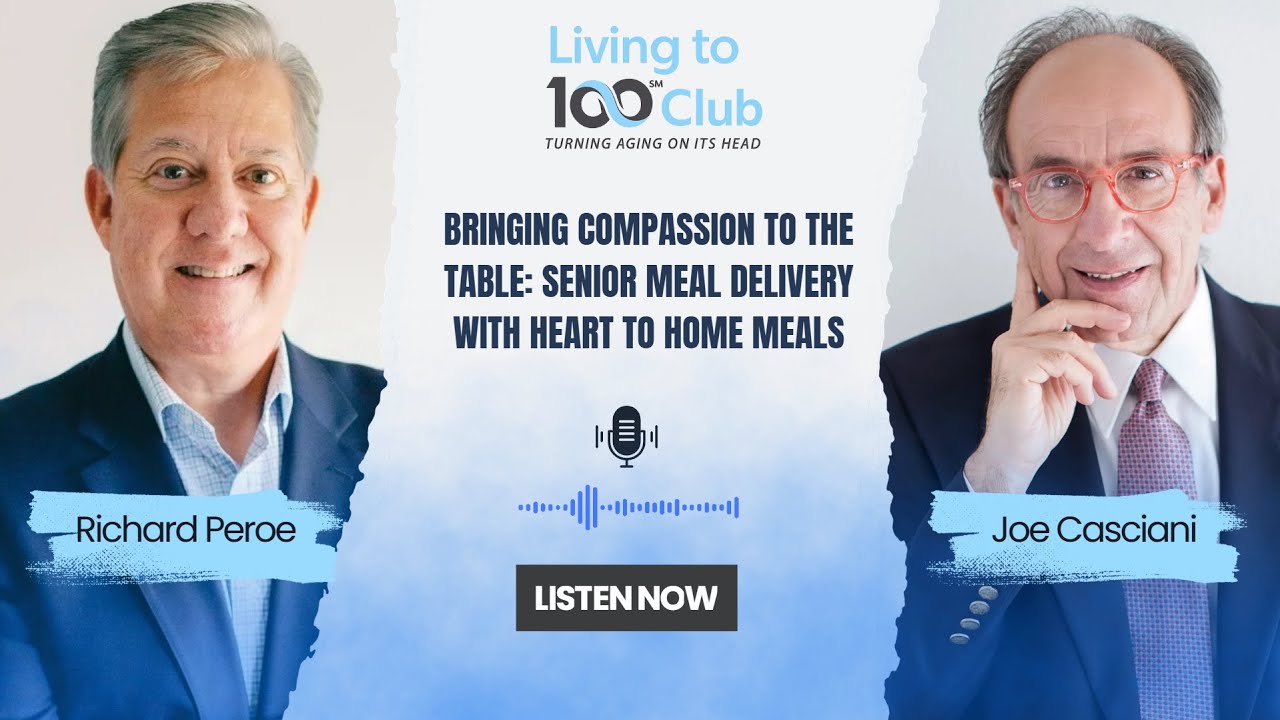
Richard Perot of Heart2Home Meals explains how the company delivers frozen meals directly to seniors' freezers with drivers who know them personally, reducing isolation. The senior population will hit 80 million by 2040. A $22 million fast-freeze technology preserves nutrition in meals made by two chefs and nutritionists.
Chapters
Welcome to the Living to 100 Club Podcast. Here's our host, Dr. Joseph Casciani.
Well, hello to everyone joining us today. You're listening to the Living to 100 Club Podcast, and I'm your host, Joe Casciani. I'm passionate about helping people embrace psychologically healthy aging, staying positive, finding purpose, and making the most of all the years we're given, no matter what challenges come along. This podcast is part of a larger mission I call the Living to 100 Network, which brings together 3 powerful tools. One is my podcasts and blogs. Second is a Better, Longer, and Happier card deck series for senior communities. And 3, the Living to 100 Community, a place for connecting, learning, and thriving together. To learn more, visit Living to 100 Club for podcasts and blogs. Join our group forum at livingto100.community. And for the card decks, go to Living to 100 Solutions. Thanks for being part of this journey. Now let's dive into today's conversation. In today's episode, I sit down with Richard Perot, a leader at Heart to Home Meals, a company dedicated to delivering nutritious homestyle meals to older adults. We explore how the service is transforming the aging experience by offering more than just food. It provides dignity, convenience, and social connection. Richard shares insights about Heart2Home's community-driven franchise model and the benefits for franchise owners. First, a little background on Richard. Richard Perot is a seasoned franchise development and operations leader with over 30 years of experience driving growth, profitability, and strategic partnerships across national brands. Since February 2025, he served as the senior director of franchise development at Heart2Home Meals, where he focuses on expanding the brand's reach and supporting franchise success. He's responsible for the brand's initial launch into the US market. Previously, Richard held multiple executive roles at Jackson Hewitt Tax Service, where he secured key partnerships with Walmart, H-E-B, and Family Dollar. His deep expertise in market development, franchisee relations, and operational excellence positions him as a trusted partner for entrepreneurs looking to grow with Heart2Home Meals. Richard, welcome to our program. Hi, Joe.
Thank you so much for inviting me today. I'm looking forward to this. Good afternoon.
Yeah, you're very welcome. I'm looking forward to it as well. Let's start at the beginning. What inspired the creation of Heart2Home Meals and how has the company evolved over time?
Yeah, that's a long, deep, rich story. Yeah. You know, Heart2Home Meals that we know of today is completely different from the legacy of really where we started. You know, our parent company, Appetito, is based out of Rhine, Germany. And it's a family-run business and has been since the '50s. And actually, our roots go to Europe and into the United Kingdom, where actually Wilshire Farm Foods back in 1958 actually kicked this off and started our programs. And Appetito was a company that provided healthy nutritional meals. They provided frozen meals and actually kind of developed the meals-on-wheels program in the UK. And so we've had over 60 years of experience out there in the UK. And, you know, if you stop anyone on the streets, you know, they know exactly who, you know, Wilshire Farm Foods is. So that really is where we've gotten our roots. We're in about 10 different countries across the world. You know, we're in Netherlands, we're in in Germany, we're in Canada now, recently in Denmark, and I think really the, the Heart to Home Meals that I've come to know really started out in Canada, and Heart to Home Meals, as I said, has been extremely successful. They serve about 1.3 million people a day, and so we expanded into Canada with HFS, which was a healthcare food Services. It started to expand there and really brought the senior meal delivery service to Canada. Uh, Wilshire, uh, Wilshire Farm Foods, uh, being a province there in the UK really meant nothing to, to the Canadians. So we rebranded, uh, and, and became Heart to Home Meals. And that's really where all of this started. And Heart to Home Meals right now in In about 2010, started franchising in Canada. We've completely developed that market and have about 20 franchisees that own that. Just recently, we're getting into, uh, to the French Canadian speaking side, uh, into Quebec. So we're looking forward to that. And we just recently in 2019 came aboard here in the United States. And so, crazy as it may seem, in 2019, at the height of the pandemic, we launched a business that was delivering senior meals into the homes of seniors when people weren't even supposed to be 3 feet away. So, the big concept there with Heart2Home in 2019 was to making sure that there was a, what I call, a proof of concept. Making sure that the business really worked in the United States as it did in the United Kingdom and in Canada. And so it has been extremely successful, a very heartfelt mission. Just recently opened up our first franchise in Raleigh, North Carolina.
Oh boy.
So the history and evolving has been pretty exciting.
Well, that's a prestigious history, Richard. I mean, you have evolved and really grown, as you said, from early '50s, starting out in Europe and Germany. And now you're, you're in all these countries, 10 countries, and in the US, how many states in the US?
Yeah, well, right now our parent company, Heart to Home Meals, uh, in Boston, what I call the proof of concept, uh, started out in 2019 in Boston, actually Marlborough, Massachusetts. And it now has expanded to servicing, uh, New Hampshire, Massachusetts, Connecticut, Rhode Island, and with our additional franchise now in, uh, in Raleigh, North Carolina, uh, we're in North Carolina. So hopefully in the next 60 days we'll be bringing on a franchisee in Naperville, Illinois. So we'll have Illinois open up, and we're, we're pretty close to having gentleman, a team come and join us there in New Jersey. Yeah, so, so the expansion's been great.
Well, that's great. You must be proud of that growth and expansion. But as you and I spoke earlier, I know we, we talked a while ago, and you're very proud, and you have a right to be proud of the growth and, and the control, the quality controls that you manage. And I know I was curious about, um, how is Heart2Home Meals different? There's so many meal providers out there now. How do you distinguish yourself from the others in the industry?
Yeah, you know, Chris Weber, our president, always says to me, Rick, people weren't starving before Heart2Home Meals came to town. And that's right, they weren't. You know, they have other options out there, you know, grocery stores and things of of that nature. You talk about meal delivery services, you know, I can just name a few of them. You know, you have Factor Meal, you have Cook United, you have food prep companies like Blue Apron, you may have heard of HelloFresh, you know, and kind of the list goes on and on. But, you know, their businesses are a lot different than ours. You know, our business really caters to the senior. We're Joe at every Every touchpoint that we have, you know, we're thinking about the senior and the involvement. You're not logging onto your phone, you're not logging into some special app that lets you order food, you know, from somewhere. This isn't like Uber Eats or, you know, DoorDash or something of that nature. With a lot of the meal services out there that you'll see, a lot of them really, have a centralized ordering center somewhere in the United States, and the meals are typically delivered chilled, and they're delivered through Federal Express or UPS or something of that nature. So, you know, as a senior, I'm just waiting for some day for Federal Express or UPS to chuck a box at my front doorstep, you know, and hopefully I get there before, you know, it defrosts dust on the front porch, uh, you know. But after that, I just, uh, you know, imagine my senior— I've seen so many pictures, these huge boxes, you know. These are— if you've never unloaded one, they're— it's like they, they ship a banana crate to you, banana box, and you've got a small, you know, 4 or 5 meals, but you've got 30 pounds of refrigerated material that, that you're dealing with. And for a senior to be able to handle that and bring that into home and then, uh, you know, be faced with, you know, putting that away and storing that and getting that in the freezer, and then you're left with 30 pounds worth of material to discard. You know, we've kind of caused problems with, uh, you know, with that. So with Heart to Home Meals, you know, our, our claim to fame really is it's a much more personalized service. We get to know our seniors, we take a personal interest in them. You know, we get to know Joe, we talk to him about the pictures on the wall, we ask about the piano that's sitting in the corner. We bring the meals in and we, we actually put them in the freezer for the senior. So it really is a concierge service of delivering food into the seniors' homes as opposed to just, you know, somebody that ships you a box of food. So all along the way we We try to create relationships with the senior, make those types of connections.
More than just dropping off a box on the doorstep and walking away. Yeah, I was really impressed when we talked about that, that your delivery people not only deliver the food but also have that connection. As you said, they make that social connection.
Absolutely. You know, as seniors, you know, one of the things that we, that we deal with, you know, is just uncertainty. You know, I've got somebody strange knocking on my door, you know, that shows up unannounced. You know, with Heart to Home Meals, you know, it's not a new delivery driver. It's not a new person every day or every week. I get to know Mike, who is my delivery driver. And Mike shows up on Monday or Tuesdays, or I know his day is on Thursday. And with Heart to Home, you know, we reach out to the senior and let them know, you know, we'll be to your home today, we'll be there in a half hour, we'll be there in 15 minutes, and kind of keep them up to speed. I know my hearing isn't as good as it used to be, and you could bang on my door all day and I probably wouldn't hear you. You know, it's nice for a senior to be able to be prepared for somebody to come into their home, you know, when they're, when they're bringing meals. Sure, sure.
Yeah, yeah. So let's talk about the franchise model. That's, that's another differentiator, right? I mean, tell us what the franchise model is like and what makes for a successful franchise.
Yeah, um, you know, I think the core really, Joe, is every franchisee I've met, you know, I met all the franchisees in Canada You know, these are people that are all mission-driven. You know, they, they are all in this for the, uh, for the right reason, uh, you know, as far as giving back to the, to the community and being able to get involved. Um, everyone that I speak with, they had their own story. You know, I came to Heart to Home, I was introduced to Heart to Home, I found you when, when my loved one was faced with these challenges, and I realized, wow, there aren't many opportunities and aren't many people out there to support. And so in all instances, you know, people come to Heart to Home as a franchisee with the thought of, yes, I'm looking to make money and I want to grow and expand the business. But there's so much more behind this than just the, just the profit and making money. And that really is the key to the individual that I'm looking looking for. It's not somebody that wants to manage this by the metrics and say, okay, you've only got, you know, 4 minutes at this stop, and if I can cut 2 minutes off for this light, if I do this here and that here, I'll be able to squeeze another dollar out of it. One of my franchisees, Fred, I spoke with in Canada said, you know, Rick, I really looked at ways to manage this business and tighten levers and what triggers could I pull to be more successful. And he said, and nothing really seemed to, seemed to work. He said, and I stopped that. And he said, I got involved in the business. He said, I got to know the customers on my route. I got to know the people in my business. He said, all of a sudden things just started taking care of themselves. It's much more about getting involved, uh, and, and doing the outreach and being involved in the community. And then that really is the, the franchisee I think is going to be most successful.
Yeah, that's really good. It's more than just mechanics and statistics. It's really that connection and really engagement with the community. That's where the growth comes from. I can see that.
Yeah, yeah. And you're also looking for an individual that is entrepreneurial, but not too entrepreneurial. You know, the most successful way to achieve a franchise system is to follow the system. You know, there is a recommended way, there's a structured way in order for you to be successful. And it gets back to not reinventing the wheel, right? Uh, you know, somebody joins a franchise system because they're paying for the mistakes that the people before them have made. And I guarantee you, you know, if you come to me as a new franchisee, you you've got the best idea out there that no one has thought of. Yeah, somebody has, and they can probably tell you, um, you know, why that idea works and what you need to consider and change. Or they can tell you why it didn't work, uh, and you know what, what the outcome is. So, you know, when you ask about the franchisees and the system, what I'm looking for, I'm looking for somebody that, that, uh, is looking to give back, uh, that is willing to get involved in the community and is looking for a proven system to follow. We can help you get there.
Are there exclusive territories once you establish your franchise?
That is a great question. So, um, the way we develop territories is we look at a population base of about 70,000 seniors over the age, uh, of, of 70. That kind of gives you a territory to, to give to be an understanding, uh, you know, the state of New Jersey will probably have less than 15 territories. So it's not like, you know, one of these, uh, you know, franchise systems that we've all heard of, uh, you know, that have sold, sold, oversold. Yeah, yeah. So got to be careful about naming people, but, but the point is, you know, we want to give you an area so you can be successful in a territory. Likewise, I don't want you to have to manage a territory that's too large, uh, where you're driving, you know, an hour or 2 hours to make deliveries. The reason the franchise is successful is because of the local involvement. You know, we could go out and we could, um, you know, take Dallas, or we could take Denver, we could take Atlanta, and we could put a corporate operation in there and be able to develop and grow that business, but we'd never be able to get somebody to be able to connect locally with all the people that we need to, need to connect with. So we want to make sure that our franchisees have territories that are large enough for them to develop, be profitable, and be successful. But we also want to make sure that the territories aren't so large that there are seniors out there that, that aren't and service correctly, um, because the distance.
Sure.
Yeah.
So does a typical franchise have one delivery truck and team or more than one?
Yeah, so, so it all grows to, to what you want it to be and how you developed your business. I definitely would say that most franchisees will start out with one delivery truck, and a lot of times it's a husband and wife team, and You know, the husband's driving the truck and we stick him in the freezer pulling the meals, uh, you know, and the wife's on the other end managing the people, taking care of the people.
I could see that. Yeah.
And you typically will start out, you know, delivering 1 or 2 days a week, and as the business grows, you'll, you'll be delivering 5 days a week. And typically the routes, you know, we can, you know, once I have about 60 or 70 stops, on a van. I've kind of got too big for that. Sure, sure. So then all of a sudden, that's when I get into my second and my third. I would say that our successful franchisees in Canada, you know, probably average 2 to 3 trucks, and maybe the largest one will have 4. Ninja, I'll let you in on a secret. We started out in Boston, in Massachusetts, with one truck, uh, and we've got one depot. We're actually, uh, We're running 9 routes every day now, and we've got 12 trucks, but we're delivering a lot of food across New Hampshire, Massachusetts, Connecticut.
That's great, that's great. Yeah, so with all of these systems, um, local systems, how do you guarantee the quality, the nutritious quality of the food? You mentioned Depot. Is that where your, your base is?
Yeah, that's That's where our franchisees' home base will be. That's where the food will get shipped to and they'll deliver. But as far as the quality and nutrition, you know, that's one of the things Appetito and Heart to Home Meals really has prided themselves on. So, you know, for the last, you know, 60 years, you know, we've been involved in health and nutrition through every life cycle. You know, as we said, from the grade school children, you know, delivering meals to large large cafeterias to institutions, nursing homes, uh, you know, to individual homes. And, uh, uh, you know, in the United Kingdom, you know, it's been at the forefront of what we do is health and nutrition, quality food. Our facility in Canada, we can produce about 50,000 meals a day in that, in that facility. Okay, we have two chefs. Chef Mark, who's a fabulous guy, uh, controls all of our menus and all the new offerings, actually makes all the sauces, comes up with the recipes for all the sauces and all the gravies and things of that nature. We have two nutritionists that work with us as well, making sure that we have the balanced diet that's, that's needed. You know, when you're looking at someone that has, uh, you know, recovering from, uh, you know heart surgeries or people that have challenges with dementia or people that have challenges with Alzheimer's, you know, there's certain things that, that you need to be conscious of as far as making sure they're eating the right proteins and the right fats and those types of things. And so our, our nutritionists will help us design meals that specifically cater to those. Mm-hmm.
Yeah.
So it's at the forefront of what we do, making sure that the quality is there, making sure that the nutrition is there. You know, you, you, you don't understand how much really goes into it until you start a tour and see what goes on. We just put $22 million into a new freezer, a new freezing system that allows us to freeze food within like 45 minutes of when it's plated. Prior to that, we had to let the food get to room temperature and then freeze, and it would take a day or two to actually freeze the food. Our food now, we can freeze within 2 hours. Yeah, what that means to you and I is the fast freeze— the, the ice crystals are much smaller, my mashed potatoes are much fluffier, my vegetables taste fresher. So it's just that little technology that goes in and makes a huge huge, huge difference.
Yeah, yeah, those are the important details to continue to maintain the nutrition, maintain the quality, maintain the kind of customization for your, for your members, for your clients. That's great, that's great. So, um, in this landscape of home meal delivery services, what, what's, uh, what do you see in the future? What, what kind of changes will we see? More or less, or what?
Yeah, what keeps me awake at night? You know, I think you'll see, we continue to see, you know, I was just at a Food is Medicine convention in Chicago, and I see a lot of startups, a lot of small operators that are taking out regional food and things of that nature, and the consumers The concerning thing there is just the ability to scale. You know, I think you're going to see a lot of individuals that start up that maybe aren't able to scale like they would like to. You certainly are going to continue to see larger operators like the Factory Meals and HelloFresh and people like that be successful, you know, at taking, you know, market share in the grocery space. And I certainly think that, you know, as grocery stores, you know, start expanding, you know, you can already do it now. You can already order groceries to be delivered to your home. So we'd be crazy not to think that there's going to be expansion in those areas. But I think really in my market, Joe, what this is, as much as it is the health, nutrition, the food, it's the relationship. You know, it's getting to know the senior. It's It's putting the time in. It's, it's being someone that they can trust and someone that's relatable, being relatable. And, you know, as we've, we've started to, to see the breakdown of the family unit and families are scattered all throughout the countries, uh, you know, my, my mom lives in Miami, uh, you know, my dad lives some, some distance away, you know, it's hard for us to be able keep track and keep eyes on people. And as a consumer, I'm going to want to go to somebody nationally that I can trust. I'm going to want to go to a brand that I know that there are people behind there that are, that are making sure that things are done, uh, done correctly. And I think that Heart2Home wins because we're locally owned and locally operated. You just can't get a, a a corporate employee to care as much as a franchisee does. Yeah, you know, the franchisees locally have their heart and soul in the business. Uh, and so as much as I see that there'll be encroachment and market share, I know that the other companies will get— I just see is this, uh, I think they call it the silver tsunami. Uh, I just see is, is the senior market continues to grow and continues to expand. There's going to be a huge opportunity for us to provide that personal service.
Yeah, yeah, I can see almost the adult children saying, you know, I'd like somebody to check in on my mom or dad living alone. Oh, by the way, can you bring some meals to them? I mean, it's almost the emphasis this pilot could be on that social connection. Well, we can also bring in the meals for nutrition and support. I can see the emphasis being on the connection.
I certainly see the expansion there. You know, we are, you know, we go to hospitals and we're working with discharge departments, we're working with case managers and things of that nature. And a lot of them are on, you know, products like Meals on Wheels and things of that nature. And when the case managers hear that, you know, they, they've got a lot of work on themselves and they, they are burdened, they have a tremendous workload, they have a hard time managing all the patients that they have. And when they hear that we're actually going into the home and, you know, checking to make sure meals are being eaten, and we can let them know, let a case manager know, hey, just checked on Joe, you know, all the meals from last week are still there. Are, hey, you know, let me tell you what I'm seeing, you know, and what's going on. So the huge opportunity on both ends, you know, being commercial, being able to, to expand currently what we're doing, but also just the, the ability to help people, you know, to be able to, to notify that case manager something's going wrong in a home. So, so absolutely, 100%.
Do you do that then that you have that connection with maybe the case manager or maybe the referral?
We do. We locally try to make those connections because that's where a lot of our referrals come to. You know, when we're working with case managers and people are getting discharged and saying, what do you mean you can get food to somebody in 24 hours? You know, that's just amazing to us.. And so when I'm used to a case manager, you know, not having that visibility and going in and seeing meals from other services that aren't eaten, you know, now I've got somebody that's, you know, can respond to me with 24, 48 hours, you know, can be delivering meals and is willing to create that relationship to report on that senior. It's just phenomenal.
Yeah, that's huge. I think that's huge. It's so much more than— I mean, the meals are important. I don't mean to, you know, we're not minimizing that, but the fact that you can put another pair of eyes on the individual and you can spot decline, or you can spot somebody who's not getting out of bed, or you can spot confusion, or something acute happens, um, that's huge. That's huge.
Yeah.
And it comes with the territory. It comes with providing that, that nutrition for the person. Yeah, yeah. Wow, I love that. So what advice would you have for, um, maybe, uh, some individuals or someone who wants to look at this franchise? What, what kind of questions should they be asking themselves?
Um, you know, I, I think the, the first one, like we talked about, you know, do you have the heart for it? Uh, you know, is this really something that, that it gets you up and makes you excited. You know, I'm really starting to see a lot of mid-level management come my way. You know, people have invested 20 or 30 years with a company that are now no longer there. And they're saying, you know, the next time I do it, you know, it's going to be because I'm making a difference. And that's really what I'm looking for, is that person that truly is looking to make a difference. Difference. Uh, from there, I say to, to get actively involved in investigating the franchise system. I think whether you're, you're looking at Heart to Home Meals or any other franchise systems, one of the most important things you need to do is speak with franchisees that are in the system. There's a lot of legal documentation, a lot of information to, to, to, to share with someone, but the most important thing is truly the relationships that the franchisor or creates with a franchisee. So, as somebody looking into this, I think one of the first things you need to do, you know, get some information. We'll have some conversations, but get involved with the franchisees. Pick up the phone, ask them a little bit about their story, ask them about their experience. I think also you need to come in, you know, with your eyes open and realistic expectations. You know, it's not a situation you're going to invest invest $150,000, $200,000 and start making $100,000 right away. It's going to take a little bit of time to build the business, but as the business grows, it's just tremendous, tremendous rewards along the way. I say catch up on some vacation time because, you know, once you own a business, it's like your baby, you know, you're You're going to want to make sure that you're there to make sure the thing launches successfully. I think an important thing is to do a self-evaluation, you know, figure out where your strengths and where your weaknesses are. You know, obviously, you know, with this type of business, I need somebody that's willing to get out there and market, promote, get involved in the community. That's not saying if that's not your skill set, you can't be successful, but understand that you're going to have to have somebody that plays that, plays that role. So really just understanding again where your strengths are and where your weaknesses are and where other people can fill in along the way. This really is a tremendous family-owned business. I have a lot of families, husband and wives, children that have gotten involved in the business. And as I say, as, as we start getting rid of middle management, as people start dealing getting a little bit older and saying, you know, I want to have purpose, uh, you know, working in a family business that has everyone involved is tremendous.
Yeah, you know, I, um, traveled to Florida periodically, and, um, I look at the local papers and I see, um, this flood of people starting the businesses for supplying wheelchairs and walkers and canes and beds. And I think that's be a tremendous growth opportunity for communities where there are a lot of 80-plus, 90-plus-year-olds. But second, I can see the meal delivery service is really just as important, just as necessary. It's not that, yeah, um, can't get out, they can still get out, but the convenience of having that regular, consistent, trusted person come into their home, that's That's huge. That's huge.
Yeah, Joey, and I get excited every time I think about the industry. You know, we have what, 360 million people that live in the United States, 350 million people, and there's— they're projecting that by 2040 that 80 million of them are going to be over the age of 65. You know, just all of that coming our way. And I don't know if you've tried to schedule an appointment with a doctor or physician these days. Exactly what you're saying. Our healthcare system is just overworked, uh, and, uh, it's just going to be more strenuous over the next 10 to 15 years, which is a huge opportunity, um, you know, also considering that, you know, no one says sign me up for the, uh, you know, for the old age home. Uh, everybody says, I want to age here in place, you know, I want to grow old, my golden years where I raised the kids. Um, and a lot of times the health nutrition is what stands between them and having to make other decisions, you know. And, and there are some seniors out there that, you know, as you say, they still get around, uh, but, you know, some days are better than others. And, and we do have seniors that, uh, you know are great customers of ours, and, you know, they don't need meals every day, you know, but there are days that they can't stand and cook like they would like to. There are days when the dexterity in their fingers won't let them cut onions like they used to. So, so I just see, you know, the tremendous opportunity as a business, not to mention again giving back to the community and taking care of seniors.
How can people learn more about the Free franchise opportunities there with Heart to Home.
Yeah, yeah, I'd love for them to reach out and contact me. Uh, you know, my name is Rick Perot, and, uh, my phone number, cell phone, is 757-818-5088. Um, be happy to, to send information, have discussions. They can reach us online at hearttohome.mealsfranchiseusa.com. And our, uh, our website, our commercial website, uh, is heart2home meals.com. So yeah, look us up on the web, give me a call. I would love to connect with you. If you got a senior in your life that you love, call and request one of our catalogs. We'd love to send a catalog out to them for meals that might be available.
Yeah. Well, well, that's very generous of you, Rick. Um, the cell number, just to repeat it, 757-818-5088. And the franchise URL is heart2home-meals-franchise-usa.com.
Yes, sir, you're absolutely right.
Your main website is heart2home-meals.com. Uh, this is great information. I've, I've been been impressed with your story. You're a great spokesperson for your company.
I certainly appreciate it. Well, you know, it's easy to talk about a company like this. Yeah, you know, as they say, it's family-run, uh, has been for 4 generations. Uh, you know, it's not a company that's, that's being run by shareholders or private equities. Uh, they truly are in this for the, for the right reasons. And Makes all the difference.
Yeah, the mission-driven is really the qualifier here. It's not just opening another coffee shop or a mail PO box place. It's really a mission-driven that you want to provide this care and service and attention to the segment of our society. That's great. So what's the final takeaway? What would you hope our listeners take away from this conversation?
I would love them to take away, you know, watch out after your loved ones. Take care of the seniors that are close to you.
Yeah.
Um, if you need help along the ways, you know, if there are meal plans out there that we can help you with, let us know. If you're interested in a great franchise system with, uh, with a lot of support and people that'll be behind you, uh, we'd love to connect with you. And, uh, be safe.
Great. Thank you, Rick. That's great advice. Well, it looks like we're out of time for today, but before we wrap up, I just want to remind my listeners to visit my website for blogs and podcasts. That's livingto100.club. Visit my new community for connection and experiences, livingto100.community. And if you're part of a senior living setting, don't miss my Better, Longer, and Happier Cardiac series. That's livingto100.solutions. 3 URLs all start with Living to 100. .club.community.solutions. Rick, thanks again for joining us today. I really appreciate the information, and I know our listeners will get a lot out of it. And I'll be sure to put the contact information when it goes out on our website. So hope you get some follow-ups for it.
Absolutely wonderful. And thanks so much for letting me be a guest on your show.
You're really welcome. Thanks to all of our listeners for tuning in. Until next time, stay positive, stay inspired, and Keep thriving.
More from Joseph

The Hidden Cause of Aging? How Chronic Inflammation Affects Your Health with Joel Brind








