Empowering Midlife Health: A Conversation with Heike Yates
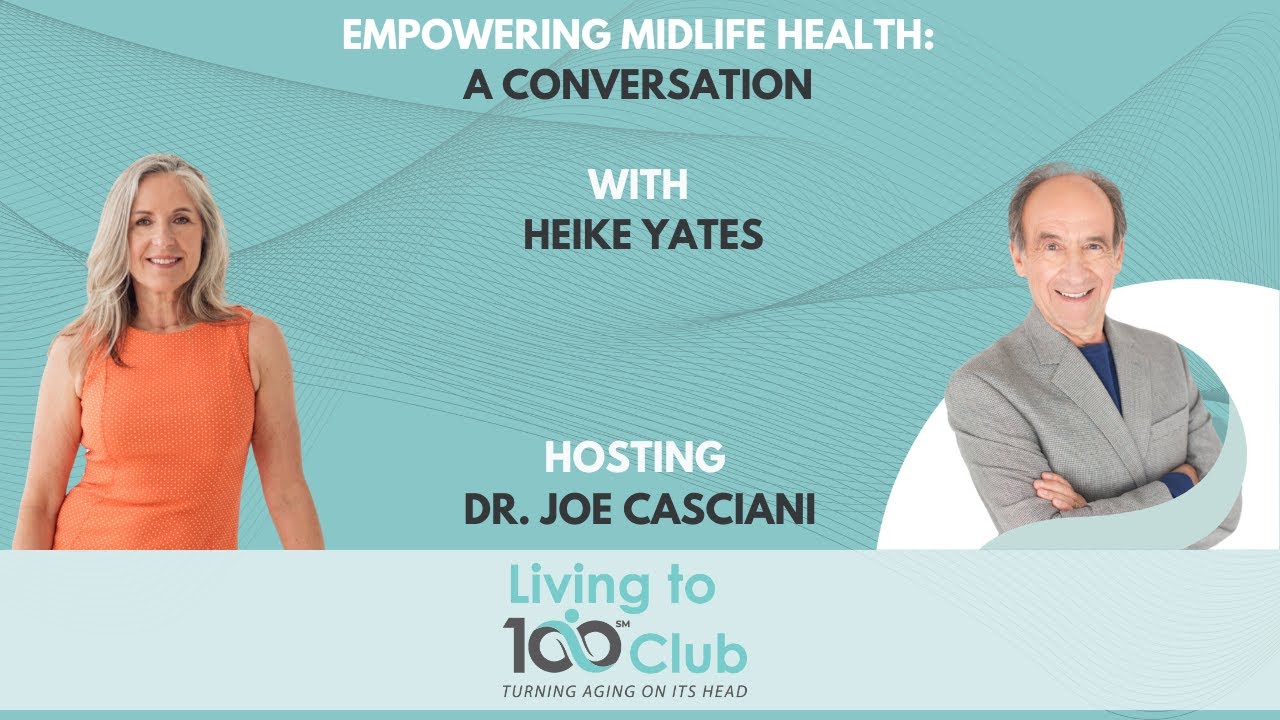
Heike Yates, founder of Pursue Your Spark, works with midlife women on fitness and mindset. Her program combines Pilates, strength training, and intermittent fasting to help women overcome self-doubt and build confidence through small, incremental steps. She offers in-person classes in Maryland, virtual coaching, and free resources at HeikeYates.com.
Chapters
Welcome to the Living to 100 Club Podcast. Here's our host, Dr. Joseph Casciani.
Well, hello to all of our listeners joining us today on our podcast. You're listening to one of our Successful Aging episodes this month on the Living to 100 Club program, and I'm your host, Joe Casciani. On each program, our conversations educate and inspire, helping you get the best out of all the years we're given, regardless of what obstacles come our way. You can learn more about my club at my website. Be sure to take a look at my new training and activities manual, Better, Longer, and Happier: A Guide to Aging with Purpose and Positivity. It's a series of 12 modules in a card deck format developed for activities directors at senior living communities and related organizations. Visit my website livingto100.club blh. Now on to our program. In this episode of the Living to Another Cup podcast, we welcome Heike Yates, founder of Pursue Your Spark and a leading expert in fitness and wellness for women in midlife. Our conversation delves into Heike's personal training methods, which focus on individual needs, and small group classes that inspire and motivate. We discuss her Pursue Your Spark program, designed to help women build strength, boost confidence, and live vibrant, active lives. First, a little background. Heike Yates is a dynamic fitness expert and the founder of Pursue Your Spark, a transformative program designed to empower women in midlife to take control of their health and well-being. With over 30 years of experience in the fitness industry, Aika specializes in strength training, Pilates, and intermittent fasting, offering personalized training that meets the unique needs of each individual. Her passion for helping women build strength, boost confidence, and embrace a vibrant lifestyle is evident in her one-on-one sessions, small group classes, and online coaching programs. Heike's holistic approach inspires women to achieve their health goals and live life with energy and purpose. Great programs. Welcome, Heike. Glad to have you with us today.
Thank you so much for having me, Joe. I'm super excited about our conversation today.
Great. I'm looking forward to it as well. I know I was on your program a while back, and I'm glad to have you back on mine. So looking forward to it. I always like to open by asking our guests, tell us a little bit about the journey that brought you to where you are today. I mean, you've covered a lot of ground, of course, and done a lot of different things in the health and fitness industry. But maybe what are the highlights that stand out that kind of shifted you to where you are today?
You know, when I think about, like you said, I did so many things in the past, but that was always sparked by curiosity. And my sense of freedom to do something different, to do something new, or even experience something. And, um, I'm originally from Germany, and, uh, I came to the United States, uh, 40 years ago with my desire for adventure and freedom. And, and I wanted to travel the world. That's what I wanted. I got this job at the Foreign Service. I wanted to travel the world. Well, I only made it to Washington, D.C., and I traveled on my own afterwards. And so I became, you know, I started here and I be— I met my then-husband and I became a mom of two amazing grown, now grown kids, and I'm a grandma of almost 3-year-old by now. But what, what started the journey was really my desire to get break free, get out of Germany and do something different, something maybe interesting, adventurous. I thought I was the cool cat on the block when I was like, I'm the only one in the family to move abroad. My whole family still lives in Germany.
Yeah.
And none of them has the desire to adventure. And when I got here, of course, I met my then husband and we became pregnant and I had a son and I gained a lot of weight. During my pregnancy. But I also, I had no idea of what to do when it comes to exercise. Exercise is always built in or has been built in, in the German culture that you do a lot of things on foot or you bicycle to the store. It's not a lot of driving around. And that in itself keeps you relatively good in good shape. And that's great. Also, as we're aging, a lot of older people And I'm not a young chicken. I'm 63, so I'm not a young chicken. Walking is a great activity, or people bicycle to the beer garden. So the environment was there. So once I gained those 50 pounds, I had no idea how to lose them. And then my OB-GYN said, oh, you're pregnant. Just rest, eat bonbons, let your husband spoil you, do nothing, which is completely different than what we recommend for women to do now.
Yeah, of course.
And so a girlfriend of mine said, let's take a class at the YMCA where they work on our belly fat. They get us in shape. They have a place to put our kids so we don't have to worry about a babysitting situation. They're in what's called childcare. And so the two of us went to this class and it was what's probably known as Jazzercise. It was back then known as Dancer Size.
I remember.
Yeah, exercise, grapevine, right, left, and mambo, cha-cha, all these things. And it was so much fun. And we were in the church basement. So nothing fancy, not a club. And people were really down to earth and people just wanted to have a community exercise together. And I remember, because I ended up teaching, that you would show up with a boombox, like you see back in the days. And you show up with your boombox, a little tape with music. That you recorded yourself, right? You popped it in and you taught the class. I mean, it was so organic and so, so much fun that eventually I was hired to become a teacher. And that's basically set off my journey. I had quit my job at the Foreign Service and I had no purpose. I didn't know what to do. I didn't see fulfillment in being a mother. Although I love my children, but it was not a moment where I said, I drop everything and I will be a mom. I go to PTA meetings and do all these things. I was like, that's not my jam. So fitness gave me that outlet to number one, make even, okay, we made $8 an hour back then for teaching a class, which took us, I don't know how long to prepare because we had to learn the routines, had to memorize them, bring the mix the tapes together and the time. So there was a lot of investment involved. But it was, again, a great community of people that just wanted to get healthier and fitter. And when I saw what I could do with just teaching Dancersize, I was on fire and wanted to learn more. What, what else can I do? Oh, women need more muscles. They need to get stronger. Oh, let's become a personal trainer. Oh, what's the next thing on the fitness market? Back then, step aerobics was big. And so I learned how to teach that. So I literally added on one thing after another and said, okay, I mastered this. Oh, let's try the slide. Or kickboxing. So I build on what I've learned to broaden my knowledge to help more people. Be healthier with different things, not just the one thing, which was super important to me.
Adding more layers, more levels to your skills, to your repertoire, so to speak. So you could, I guess, personalize all approaches based on what your clients were looking for. And you decided to focus on women in midlife. Is there any particular reason? I mean, You went through your own evolution, but why that niche? Why that target group?
I found that there's a really big need for community and conversation. That yes, we talk amongst each other, but we're also hiding a lot of what's really going on. The transitions we're going through, whether it is a divorce late in life, not even mentioning menopause, but there's all these changes we go through that sometimes leave us in the dust, so to speak. Men deal with this transition much easier than women. We have way more self-doubt, whether it's started as a child that, you know, we should feel guilty about not taking care of our parents. We need— we should feel guilty about not caring for our kids. We should feel guilty not being a full-time grandma. And so you have these roles that you've been destined almost to fulfill, but that may not be your dream.
Yeah.
That may not be where you are. And so I said, let's create programs around health and fitness that help women create a different mindset. Because I believe that if I teach you 100 strength training classes and you're not in the right mindset, it will never make a difference in what your goals are. When you think about that, if you're committed to your goals, if you are confident in the goals that you've set for yourself, it's a way more positive outcome than if I just throw a couple exercises your way and say, hey, you can do this. And so changing how we feel and how we perceive ourselves especially in midlife— and I know that's a big range— is important.
Okay, so you're talking about having the person become really integrated with the whole kind of set of goals and not just hearing them from the teacher but really helping the person be ready and kind of receptive to making that connection with you. So that's how it changes the inner thinking, inner behavior, motivation. Was— is that part of that? More than just one-way learning, one-way teaching.
Yeah, exactly. It's not just I shout out information and you hopefully absorb it. And as women, we're so fearful, so guilty, and we are having the hardest time of breaking out of those molds that we're in, uh, those cages that were held by society in that it is really tough at times. And I heard more than once, "Heike, I can't do this. I'm not confident enough. How would I even start? What should I do? But why me? Oh, I'm not good enough." There's a lot of that old habit conversation that we, that I hear. And I said, let's take what I know take it from my brick-and-mortar studio, which I still have here in Maryland, my Pilates brick-and-mortar studio where I see people in person, also virtually, and put it online, put it out to a larger audience so more women have access to me because I only have one 8:00 AM slot on a Tuesday and not 10.
Sure. So what are the— I guess what, just to before we change topics or go to the next question. I think you're talking about people find themselves in these default roles and just kind of go on with life and, you know, take on new responsibilities and new directions. But it's not necessarily that choice, that direct active choice to pursue something like this, to pursue fitness. We kind of, I won't say blown by the wind, but we fall into these default positions. And you're really helping people step out of that place and be more oriented toward pursuing some goals. And that's Pursue Your Spark, right? That's Pursue Your Spark. Yeah.
Yeah. It's first you have to ignite your spark. That means you have to find what sparks— I know it sounds like Maria Kondo, but what sparks joy? What is it that lights you up?. But then once you say, oh, I know my spark, then you have to take action to ignite that spark and pursue. Once you ignited it, pursue that spark as you go along. And it can be sometimes really difficult to figure out what it is that, that's your spark. And I recently discussed this, uh, with somebody and Everyone, male or female, we all have dreams. Like, my dream was to travel the world, have lots of adventures. So my kids are grown. I built my career through that. I built two businesses. I raised my kids. They are gone. They are doing their own thing. I don't have to worry about them unless they need babysitting services or other things. But But what is my dream? My dream is still to travel, to have a lot of freedom in my choices. And so I always feel we need to go back to before, before we had to take care of our parents, before we got married, before we had kids, before we started a big career. What is it that we really were dreaming of? And revisit that. So a lot of why questions. Why do I want this? Where do I want to go? How do I want to do this eventually? But it's really being honest with yourself and your inner child almost. What is it that I really wanted?
That's how we reignite the spark. Is that what you're saying?
That's what I'm saying.
Yeah. So what are the core principles of Pursue Your Spark? How does it fit into our need for health and fitness?
What Pursue Your Spark is helping women in midlife to, to start with their why, really do some deep work figuring out why do I want to lose weight? Why do I want to eat differently? Is there really a reason? Is, is there a health reason or is it because social media told us to? Or social media said we need to lose weight, which is something I don't talk about on the podcast much, if any at all, because I feel that this is not about us. Weight loss can feel good, but it's not about the inner transformation that we— I think we don't even know we are looking for. And so that's what Pursue Your Spark is helping, finding who you are, What is it that you really want? You, not somebody else, not your husband, not your girlfriend or your kids. And then build, I like to call baby steps to where they want to go. And I feel that nutrition and exercise are a great gateway to reaching that spark, to pursuing that spark. 'Cause how great does it feel, Joe, when you go out and you go for, especially now it's fall, go out for a vigorous walk, the sun's shining, the wind's blowing a little bit, the fall leaves are out, you're bundled up and off you go, maybe listening to your favorite podcast. And how great do you feel when you come back? How much, I always said when I used to run, I solved the world's problems during a run.
Yeah, yeah. Just that nobody wants to listen to you, right?
Yeah, that's good. But you're just to yourself, so you can sort it out in your brain. And you can say, okay, I sorted it out. Now I feel better. Now I have clarity, which is then getting clarity on what we want. And with the goals, we've touched a little bit on goals. Goals can change. Goals are variable. And when sometimes we set a goal, we are so disappointed when we don't reach that specific goal we set for ourselves. But we don't understand the journey. We don't see why maybe the goal changed or why that is no longer— whatever the goal is, is no longer the goal. And we discovered something completely different along the way.
Yeah, I agree. I always call that process is more important than than the content or the outcome. What we learn along the way is much more educational than where we are at the end of that. And I think what you— when you talk about small steps, I think that's so important. I agree 100% because we can set a goal for 6 months from now, but I think the point is, what, what can I do tomorrow that I'm not doing today that'll move me toward that goal? We We'd love to lose 50 pounds, but what am I going to do tomorrow that I'm not doing today that's going to get me there? So it is these small turtle steps. That's great. Yeah.
Yeah. Because otherwise we feel overwhelmed. And when we feel overwhelmed, we are like frozen in space. We're not taking action because we don't even know where to go and what to turn to. One of the questions I get so often is like, Heike, what's the best exercise for women in midlife? Well, the simple answer, Joe, is do whatever lights you up. I don't care what you do, but just do.
Sure, sure. What are some of the— um, how do you help women overcome some of the challenges that they face when they're embarking on this transition, or, you know, igniting their spark? What are, what are some of the barriers that they encounter, and how do you help women get over those barriers?
Barriers. Like, one of the big barriers that many women have is they don't get support from their spouses, their wives, uh, whatever, their significant others, or their community. So how do I deal with this? Because a supportive community has proven to be way more beneficial for anybody pursuing any goal or any spark to to reach that goal successfully. And so supporting yourself or creating a supportive community around yourself, even if it's just one person, is an obstacle we can tackle. That we say, okay, I'm your support system. Don't listen to anybody else. I'm here for you. Tell me what's going on, what's really going on. And I see this oftentimes in my private studio when my clients come in for their session and I say, how are you? How is your body? And the answer is, I'm fine. I'm good. And I can sense they're not fine. They're not good.
Yeah.
But they don't wanna quite tell me just yet what's going on. And so I get them started in the exercise and then I ask some couple of little questions here and there. And, uh, I don't know if I've shared this with you, but when I teach my groups or any person before me, I'm a very intuitive teacher. I go by what's presented to me in front of me, even though, you know, with my podcast, Pursue Your Spark, I let it go. And when I see my guest and I get the vibe of where is this going, and usually what happens, just happened yesterday, after a couple of exercises, my client's like, well, you know, my daughter and you know, this and that and the other. And I was like, ah, now we're getting closer to what's going on, what's holding you back and why your breathing is stuck in your throat. Because there is an issue that now through exercise and my support, because I hear you, you can trust, uh, I'm not going out around the world and blabbing out what you just shared with me. But it's that one person that you can trust is a really big one to begin with. And the second one is confidence in your ability to do something, whether it's to cook a great meal, whether it's to knit a scarf. But I think confidence, building that confidence that you stop doubting yourself every 5 seconds. Can I do this? Did I do this right? Oh, maybe I shouldn't even do this. Oh, nobody should know about this is a hurdle. Well, we're definitely tackling in the courses and in the classes and the one-on-one sessions is the confidence in your ability to change your life. What does it take? Where are we going with this? How can you let go of these cages? And these traps that we've been held back by, because it comes from somewhere. We're not a baby and suddenly we have self-doubt. It's coming from all around us. And, and that is a big, big hindrance for many women. So we talk about this and we'll talk about what's the best way to let go, not to listen to somebody, get off a certain social media where they feel more down than up. Is another one. Or get rid of negative people. You know, you have no business in my life. If you're negative, you're gone. I don't care how long of a, air quotes, friend you are. But if I realize that all you bring to the table is negativity and not support, you're gone. And so my circle of friends is very small, and that's okay.
But supportive and encouraging.
Yep.
As you talk about confidence, the other advantage to these small steps, these small turtle steps, is that each time we take that step, we build that confidence, we build that feeling of success and reward. Yeah, we haven't lost 50 pounds yet, but I did something today when I chose what meals I'm going to eat. That builds confidence and that it builds that momentum, and we keep moving forward with that momentum.
Yeah, absolutely.
That's good. So tell us about Pilates. How are your Pilates programs different from other programs, or are they so similar?
Yeah, I love Pilates.
Yeah.
Can I just say that?
Of course you can.
I've been teaching Pilates for 20 years, and I've been a fitness coach for 40 in fitness and nutrition. So I started Pilates when I didn't have any of my aging, age-related issues. And so one of the neat things about Pilates is it ages with you. So as you, you know, 20 years ago, so I'm 63. So when I started, I had no problem with my knee. I had no problem with my neck and my lower back, which just crept up in the last couple of years. And I continue to do Pilates. I continue to strengthen my body as I age. It's low impact. It improves breathing, which is something so many of us need, the deep breathing. It is the mind-body connection through Pilates, the movement, the sense of being in control. And one of the 3 C's in Pilates is centering, circulation, and control. And centering means we're centering the mind and body. So we're not, we may have conversations, of course, but it's not just a whole hour, blah, blah, blah, blah, blah, blah, blah. No. Focus on your core. Focus on your breathing. Focus on mindful movement, which goes then into the concentration part. So concentrate on what it is you're doing. Are you in the moment? Are you focusing on what's good for the body? Are you listening into your body? And then of course, circulation refers to, uh, Partially breathing, as every movement has a breath. Many people refer to yoga as very meditative and Pilates more as like the workout. It depends on how you teach it. And I teach both versions and depending on what my clients' need is at the moment, it could be powerful. Like this week, everybody's getting a powerful workout. I think everyone needs a little support. We're in difficult times right now. But we also breathe. We also let go. And so it, it ages with you. And when you look at some of the Pilates first generation teachers, they're in their 90s now. They are in great shape. They are strong. They have good posture, right? They breathe and they're feeling vibrant and strong. So that's another benefit of Pilates. So even if I let everything else go, which I'm not, uh, like strength training, because that's also super important. Pilates gives me partially of that strength training because it works with resistance springs, basically. And I don't know, Pilates is just awesome.
Are there times that you would recommend Pilates for a client and other times when you would not recommend it? I mean, are there different indications, indicators for one approach?
If some, especially with Pilates, Joe, we get a lot of people that think we can heal them. Pilates is sold as the core strengthener. It fixes your back because it's alignment. Now people think we can fix them. And some teachers act as if they could fix people, but we're not. We're, we're teaching a form of exercise. A lot of us have learned to deal with orthopedic needs as we are ourselves getting older. We learn from physical therapies, we hear from doctors of how to treat certain conditions. And that's when it comes down to when you get somebody who has not seen a doctor for maybe back pain or severe hip pain, they have no business going to Pilates. They need to see the medical community first. And that's what I always say. Go to the doctor, get diagnosed, come back, then we'll talk. That's really the reason why it's not about that you've never done Pilates. It's not about that you may be unusually large, but it is about what you, what you expect from it and what your current condition is.
So you would, in a sense, rule out Pilates for someone who wants a quick fix for some medical condition that has not been treated yet. If somebody's coming in, hey, fix this, that's not the candidate for Pilates.
Yeah, it just doesn't work. Because I did have just one gentleman came to mind. He said, wow, my back's really bad and my doctor said I need surgery, but I want to avoid surgery and everything we did. And I said, okay, give it a, let's give it a try, see what we can do. I have an idea, but every movement hurt. And I said, you have no business being here with me. Get the surgery, come back afterwards.
What about, what about the clients of yours who are also caregivers and maybe facing stress managing a spouse or a sibling or a parent? How, how does that affect your work with them? That that are also dealing with the stresses of caregiving.
I feel like I become the expert in caregiving. Yeah. I have several clients that are not directly caregivers, but because their parents live with them or their in-laws are still living at home or along those lines. So we have these conversations and they say, "Heike, this is what happened. What do you think?" I'm like, "I don't know. I don't know about the situations." But a good thing is that women share a lot of information. So you can come to me and tell me, and I may know a caregiving company that can help you out. And I've also been on a podcast that deals with caregiving. And how to, to find people that are qualified. But it is a huge task to take on. And when somebody comes, they are so happy as a child, most of the time, to be within class with me and have the time for themselves to take care of their own health. Because as, as I keep seeing this, and my parents both live in Germany, so my brother does most of that helping out, overseeing, you know, filling out forms and whatnot needs to be done is it's such a stressful situation that as a caregiver yourself, you let go of your own health. And if you let go of your own health as a caregiver, you cannot support the people that need the care because you just, you just don't have energy. You don't have the strength. You have, don't have the brainpower anymore because you're so overwhelmed by all of this. And, you know, I never name names, but one of my clients texted me this morning and said, "Heike, I can't come because of my in-laws." And I know the whole situation in that household. And I was like, I'm so sorry. Because I said, you know, you're my once a week outlet. You're my once a week, I can share things with you and I get my own exercise. But on the other hand, too, Joe, I don't think I shared this with you yet. Maybe I did. My oldest client that currently takes Pilates is 98, and he comes to the studio driven by his 94-year-old wife. And I can only take one person at a time with balance issues, hearing loss, visual. So it's—
you can't have a group. You cannot do it.
I can't do a group. I can only make sure that one person doesn't fall. But yeah, so that's my— don't let go of yourself. Don't let go of your health. Figure out a way that you can get away from the situation and take care of your own health to be a better caregiver.
Yeah, it gives us the energy, it gives us the endurance, it gives us the resilience. Kind of like taking a nice vacation to the Far East. Um, any type of vacation where you're away from all the usual day-to-day responsibilities. Yeah, coming in for the respite, the hour of class or whatever, and having that feeling of getting, you know, rejuvenated, getting— releasing some of those fears and blocks and getting stronger and more determined. Yeah, that's crucial. Sure. Yeah. Are there, um— can you, can you share a story of resilience, a success story that somebody was really maybe discouraged and was not hopeful. Can you think of anyone who, you know, just dug deep and found that, found that inner drive?
Hopeful in what sense?
Well, uh, that they were going to make it through all of their fitness problems and feeling discouraged about their, their health and well-being. Yeah.
Oh man, I have several of those cases.
Yeah.
Oh, my, my, one of my clients is currently, she is 78, and she has scoliosis. And she originally started out with scoliosis with a different teacher. And it was further away from home. And then she found me. And she said, you know, can I try out a session with you? And we started this one session. And she says, you're doing things very different than the other lady. And I said, well, how? She says, Nothing is hurting. I said, well, what do you mean nothing is hurting? And she says, well, when I do Pilates with the other lady, stuff always hurts. And she's like, that's fine. I was like, we are not going for pain. Pilates is a completely pain-free exercise. It's strenuous. It can be challenging, but it's no— by no means is it painful. And so we started working with her scoliosis and achieved great core strength. She's going to the gym aside from that. And over the years, we've been together now for 4, 6 years, maybe.
Wow.
So my, my longest client has been with me for 20 years. So from the moment I started.
Yeah.
And she developed hypermobility in her joints. And so everything is hypermobile. The elbows, the hands, the feet, the spine has become more floppy, as I like to call it. And that's a condition that continues to worsen as she ages. And so we're trying to keep her as strong as possible. And I've taken several courses on her condition, Ehlers-Danlos syndrome.
ADS.
And it's, it's like literally your joints become pudding eventually over time. And so she, she's working on not getting frustrated that, that her joints are hurting all the time, that we need to do things differently. Talk about being adaptable. And I have to see, you know, what exercises work today. Then she goes to the YMCA where she takes classes and she comes back and she says, like, am I doing this right?
Yeah.
So we go through that. And recently she was diagnosed with tinnitus in her ear. So she hears chirping in her ear. And so it's like the aging progress keeps beating her down or trying to, but we're not.
Sure.
Let's say over those 6 years, we're like, okay, we're changing strategy. Now we need to do this. Okay, you can't do this exercise anymore. Let's try water aerobics. See how that feels. Come to Pilates, do water aerobics, do strength training, and see how we can repackage your help, your health to help you better. And it's sometimes, Joe, it's really tough. She's so frustrated. And it's not the, oh, what I used to be able to do, but it's more the, man, I'm working so hard. Why isn't it better?
And it's still hard. Yeah, well, it is all about adjusting, as you say, and maybe tweaking the approach you've adopted. And let's try a little bit of a twist here, and let's— because to me, we're always going to be facing these challenges, and we need to adjust. And sometimes we can overcome them, and sometimes it's not something we can overcome, and we go on to whatever we can do. So it is, it's a learning process. And I, I'm glad to hear that you are kind of persistent or persevering with your clients like this who feel a little bit discouraged, because I'm sure that's a big part of the picture. They don't feel like they're getting strong fast enough or soon enough, or yeah, or at all, or at all.
They're like, I'm pushing the rock up the hill, look what I'm doing, why isn't it changing?
Yeah.
And I'll always say, you showed up today. That's the most important thing.
That's where process over content comes into the picture. Here's what I'm doing. I haven't reached that goal yet, but I'm doing something and that's more important. Yeah. Great. Great.
Absolutely.
Are your programs available online or only in person, Heike?
I have both. So you can see me in Maryland.
Okay.
You can see me in Maryland in my studio if you're anywhere nearby. Washington, D.C. area, Virginia is probably a little far. But the Pursue Your Spark is also a one-on-one coaching program. So if you decide that you wanted to work just with me virtually and I design a program for you, you can do that. Or you join one of my group training programs where we have up to 10 women in the Pursue Your Spark Blueprint where we primarily talk about Pilates, not so much about the strength training aspect, but a heck of a lot of mindset. And we talk about intermittent fasting as a nutrition strategy as well. And we have people that are a little hesitant about intermittent fasting, and there's absolutely no pressure. They get a ton of nutrition information throughout the course and the support in the course because we're meeting every week. Or then we have the Lone Rangers who say, I don't— I just want a standalone course, which we also have where they can get a 14-video mini course that helps them with Pilates, intermittent fasting, or so. I have one course on belly bloating and gut health. So we can do that, or they just go for the cheapest solution. They sign up for my exercise video program and take classes from there. But I'm always available to help, to talk, to reach out. We have a Facebook group where somebody can join so we can have a conversation. And If you reach out to me and you have a question and you want to know something or you just want to something spurt it out to me, I will always respond.
Respond. Good for you. Yeah. So how can people learn about the programs? What's the address?
The best way to find me is Google me with my first and last name, H-E-I-K-E-Y-A-T-E-S. And you literally find me everywhere. You find my website there or use search for Pursue Your Spark again. You'll find me pretty much everywhere on all social medias. And my website is primarily under Heike Yates.
HeikeYates.com.
Yep. HeikeYates.com. And you can just go through and check out what I got. And there's a little like links and stuff and some freebies as well. And, and since we're talking about mindset, I think one great freebie that I can offer to your listeners would be the How to Get Unstuck and Thrive. I have a mini podcast that's not listed anywhere. It's a 20-minute recording that I've done. And to get started and feel that they can unstuck and thrive, that they can take the first step towards it with this 20-minute audio recording. And you find this on my website as well.
It's on your website as well. The 20-minute— what do you call it? The mini podcast?
No, it's What did I call it? Thrive? Get unstuck and thrive. Oh my God, my brain. I'm 63.
Yeah. I'm glad I asked.
Yes, get unstuck and thrive.
Okay. Yeah. Terrific. Well, it looks like we're out of time for today, Heike. But before we wrap up, I just want to remind my listeners to visit my website, livingto100.club, sign up for my email list and download a free copy of my 9 Tips to Make Living Longer Enjoyable. And if you're affiliated with a senior living, living setting or community, be sure to look for my new training manual and activity guide, Better, Longer, and Happier. Heike, thanks so much for being a guest on our show today. People can find you on a Google search or at your website, heikeyates.com.
Thank you, Joe. It was so nice chatting with you.
You're very welcome. And thanks to all of our listeners for tuning in. Hope to see you next time.
More from Joseph

The Hidden Cause of Aging? How Chronic Inflammation Affects Your Health with Joel Brind








