Enhancing Mobility and Cognitive Function with Virtual Reality Training | Living to 100 Club
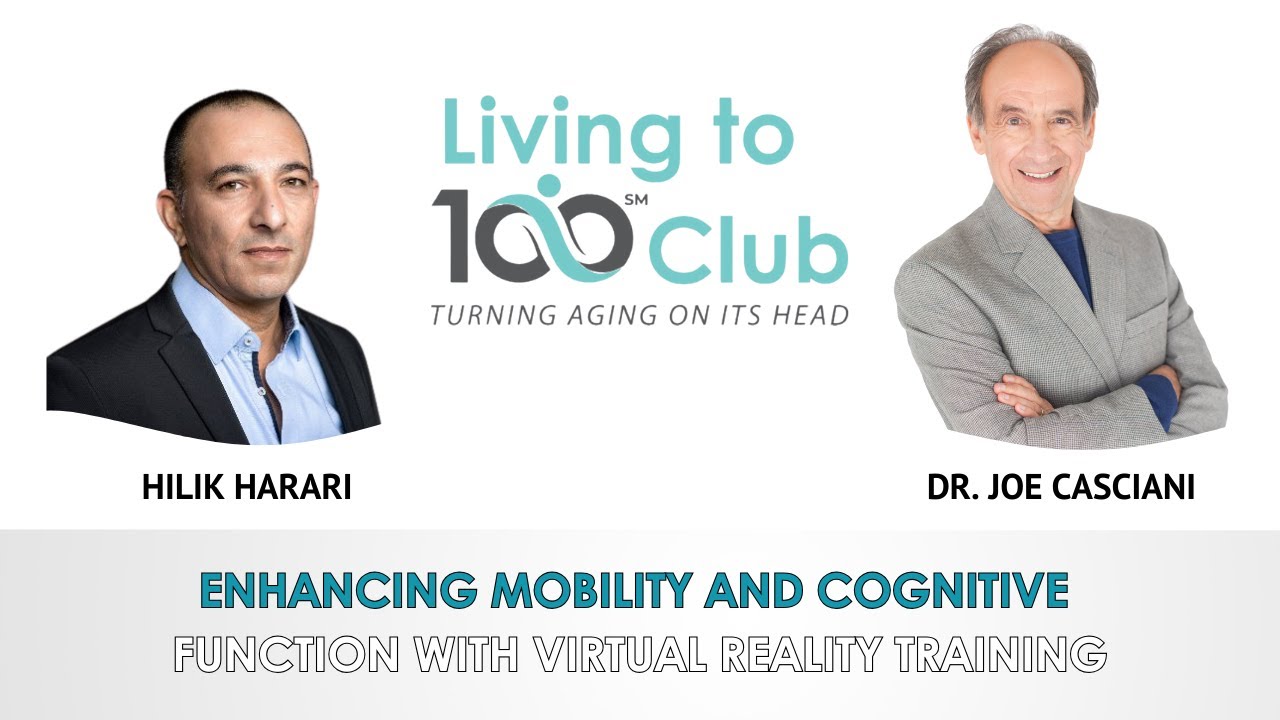
Hillis Harari, CEO of Gait Better, discusses an AI-powered treadmill system that combines virtual reality and cognitive exercises to improve mobility in older adults. The technology has shown over 70% reduction in fall risk across eight clinical trials and 22 peer-reviewed papers, including studies in The Lancet. The system adapts in real time to each user's ability, from post-stroke patients to active seniors.
Chapters
Welcome to the Living to 100 Club Podcast. Here's our host, Dr. Joseph Casciani.
Well, hello to everyone joining us today. You're listening to the Living to 100 Club Podcast, and I'm your host, Joe Casciani. I'm passionate about helping people embrace the principles of psychologically healthy aging. Staying positive, finding purpose, and making the most of all the years we're given, no matter what challenges come along. Each episode, we bring you conversations that educate and inspire, guiding you to age with resilience, optimism, and a positive mindset. Thank you for being part of this journey with us. Now, let's dive into today's conversation. Falls are one of the greatest health risks for older adults, and traditional gait training often lacks the cognitive component necessary for reducing fall risks. In this episode, I sit down with Hillik Harari, CEO of Gait Better, to discuss the intersection of cognitive capacity and mobility and how virtual reality technology is revolutionizing fall prevention. Hillix shares insights about how Gait Better System, an AI-powered treadmill-based training tool, improves walking ability and cognitive function through gamified challenges and real-world simulations. With clinical trials demonstrating a 70% reduction in fall risk, this technology is changing the landscape of rehabilitation Senior Living and Preventive Care. First, a little background. Hillik Harari is the CEO of Gait Better, a training solution for gait rehabilitation and fall prevention. With more than 20 years of international experience in early and late-stage technology companies, Hillik holds extensive experience in strategy, business development, marketing, product, R&D, and professional services. Prior to co-founding GateBetter, Hillig held different executive and operational positions, including with Cryon, Clear Forest, and Invest.com. Hillig holds a BA in computer science from the Tel Aviv Academic College and EMBA from Kellogg-Rikonati, Northwestern University, and Tel Aviv University. Hillig, welcome to our program today.
Thank you for having me, Joe. Thank you for that introduction.
Yeah, well, I'm looking forward to our conversation. This is an important subject. I always like to begin by asking our guests to maybe share the highlights that brought you to where you are today. You've covered a lot of ground, we know. Touched on some of that in the intro, but what are the pivot points that really stand out that brought you to where you are today?
Sure. So, well, I've been in technology solutions throughout my career, but about, well, now almost 7 years ago, I decided it is time to take those experiences and really make change in people's lives. Because, you know, uh, there's no more rewarding, uh, type of job that you see that your work can actually impact people's lives. So it's not more, you know, just making money for yourself or making money for your clients, but we really wanted to make some impact in the world. And that's, that's what I intend to do for the rest of my career.
Sure, sure. So what inspired the creation of Gatebetter? What, what, what What problem do you target? What's the aim of Gait Better?
Sure. So I've been associated in working with one of the leading hospital universities in Israel. It's called Ichilov Hospital in the heart of Tel Aviv. And they, the research team that I'm familiar with, came up with this brilliant idea. That by mixing up and intervene cognitive therapy or cognitive training together with gait therapy, we can lead to much better outcomes and enhance older adults, really helping them to live healthier, longer, and mostly healthy life in aging. So You know, when I'm thinking about it, often we talk about longevity and, and long life, but it's really living healthy ages.
Yes, sure.
Uh, and, and that's what we want to achieve, and, and that's what the research team have found a way, uh, to address that. And I thought that that would be a brilliant idea to bring to market and, and make impact.
Yeah, that's so interesting. How, How do you see that connection working between cognitive functioning and walking ability? What's the link there?
So that's fascinating. You know, we often, and historically, both researchers and practitioners kind of related falls to maybe slow gait and, you know, some motor limitations. And then cognitive decline, and I will say a word about cognitive decline, and cognitive decline was mostly associated with dementia dementia. But over the last, I would say, 15 years, there's a body of evidence that show that the two are tightly related. So decline in cognitive capacity affects your gait, but, and walking abilities. And so the opposite, right? Decline in walking abilities may impact your cognitive skills. So research has found that the two are you know, tightly related to each other and affect one each other.
Wow.
Now I want to say something really important about cognitive decline. When we are talking about cognitive decline, people are immediately referred to, uh, uh, oh, is it dementia? Are we talking like severe diseases? The answer is no. We are talking even about slight alterations in in executive function skills. So what are executive function skills? And we can all feel them every day. They have to do with dual task abilities. Can we do multiple things at the same time? Do we still sharp on that short-term memory? Do we pay attention to the surroundings? Right. I asked my dad one day, he failed. I asked him, so why did you fail? And he gave me the same answer that 95% of all the adults that I meet would give me. I didn't pay attention.
I didn't pay attention.
And paying attention, that's a cognitive skill.
Yeah. Yeah. So you're right. I can see the executive functioning, the attention, the kind of processing, the speed, the decision-making.
Exactly.
All that works together and one affects the other, one supports the other and vice versa. So if there's a decline on one part, it's going to affect the other. So Gait Better, the approach is focusing on maintaining cognitive function.
So, Joe, you know, before I'm diving into this, I even will tell you, give you some more interesting approach to look at that. Yeah, you can think about it as a gas tank in a car, right? When we have enough reserve, it would go smooth for a longer time, but when we start losing that reserve, things get problematic, right?
Okay.
And the problem is that with— as we age, that reserve declines. Right? That reserve of the connectivity and the ability for cognitive and motor skills to work really good together, that reserve decline over time. And in order to reverse it, or at least maintain the status, we want to practice that. It's like a muscle. We want to practice both of them the same time. And this is our approach. What we're doing with Gait Better is we add cognitive exercise, or we couple cognitive exercise with walking ability.
Yeah.
And we do that in a safe environment in a way that people can improve the endurance. They can walk longer, they can take bigger, you know, more strides. Mm-hmm. Again, in a safe environment. And by doing that,, we impact their life.
Yeah. So that's interesting because most approaches that focus on cognitive training, maybe, um, motor tasks or cognitive skills, they're looking at maintaining cognitive functioning, but you're looking at that plus maintaining the walking ability.
Correct. So let me tell you how we do that.
You have two approaches. Yeah. How do they work? What's your— tell us about that.
So actually we took what may be considered kind of, I would, I hate to call it simple, but it is a straightforward approach. But it all, it can only be enabled with harnessing technology. So we place a single camera in front of any existing treadmill. We're not selling treadmills, right? We're providing an add-on to existing treadmills. We place a camera in front of any existing treadmill using our own proprietary technology. We track gait movement in real time, and then we project those gait movement onto a simulation that is displayed on front— on a front screen. We are not using goggles because people feel they don't like it too much and they may lose their balance really quick. So imagine that you're walking on a treadmill. Now you see the reflection of your feet movement on the simulation. So you kind of feeling that you're walking in an outdoor environment that resemble real life experiences.
So you see your footsteps on the screen.
Correct. You more than just your footsteps, you literally see your— the the movement of your feet, right? The 3D trajectory of your feet.
That's great. Good. Okay.
Now, when we, when we do that, then it becomes interesting, right? Then, then we get you to walk in a personalized training that involves both motor exercise. So you need to cross over virtual obstacles, and we use hurdles and puddles. We use hurdles so you will practice step height because we really want to get those knees high to make sure that you cross curbs and, you know, other type of obstacles properly. And then we use puddles to practice step length because we know step length is really important. So, and as you do that type of exercise by crossing over virtual obstacles, you're being challenged with different cognitive demands that affect your executive skills. Let me give you some examples.
Yeah.
So in one exercise, you will walk down a path in kind of like a wooden environment, and animals appear on either side of the street or other side of the path.. And you need to, as you do that obstacle negotiation, you need to spot on those animals and click a button on which it appears, right? So that will practice your attention abilities, your scanning abilities. All of these are executive function. Another exercise will involve memory and navigation. So in this exercise, we will ask you Oh, you're walking in this city type of environment, you know, looks like downtown New York, right? You'll have cars, you'll have noises, you'll have buildings and people around you, and you need to get to Times Square, right? So you need to navigate your way to get there, and you need to memorize, oh, how do I get there? I need to, you know, in the second turn I will take a left, and then maybe take the next turn I will take right, right? Will give you a little map that you need to memorize and you need to navigate your way together. So that will work on, on your short-term memory and decision-making capability. So each one of those games, and we have multiple games, will focus on a specific executive function skill. Again, coupled with that obstacle negotiation, crossing over obstacles, and by doing that, Again, doing that intervention, doing that type of training in parallel, we actually lead to a much better outcome than doing each one of them separately.
How do you mean that? Combining them?
So, so, you know, again, if the common approach, if one will go to a physical therapy clinic Uh, the common approach would be that the physical therapist will work on your motor skills, right? They'll teach you how to climb, uh, you know, uh, just walk better.
Okay. Walking up steps, for example. Yeah.
For example. And then occupational therapy might work with, with you on your cognitive skills, right? They'll work with you on attention, on memory, additional. Okay. But that type of exercise when we combine both in one type of experience, we, you know, we've shown that it leads to better outcomes.
Yeah.
In what sense? Yeah. Both motor aspects are improved. So people are walking faster, they take larger steps, which are really important. They, we see improvement in cognitive skills in various tests. But most importantly, that type of exercise reduces falls and fall risk by more than 70%.
Yeah, I love that. I love that combination. And I'm always thinking about outcomes and, you know, what is the effect of this approach or treatment? And you're saying you see improvement in baseline walking ability. And action in falls.
Absolutely. And you know, not only that, and we've done, you know, before we even brought it to market, we've done more than 8 clinical trials and we have 22 peer-reviewed publications, including with some of top papers like The Lancet. And what's fascinating about that technology is that today, not only that we know that we actually improve outcomes and impacting people's lives,, but we know why. And, and, and we've done, you know, number of studies that included brain imaging. We've done MRI post-intervention and fMRI and other imaging technique. And what we've discovered is that that type of training enhances brain plasticity, right? So we essentially create new pathways. New pathways in the brain that, that makes the brain eventually more efficient.
Yeah.
And by making the brain more efficient, we create that reserve that we've discussed before, right? We, yeah, refuel the tank, if you, if you will.
Ah, that's great. Yeah, I, I understand the concept of the, the brain plasticity, neuroplasticity. Certain activities can help us create those new pathways, those new neuropathways. And even for physical therapy, when we would think that certain brain function has been lost, with certain approaches, we can restore some of that ability.
That's exactly that.
That's beautiful, Hilik. Can we extend this to say that if you're walking, just as a practice of daily walking, does that in turn improve cognitive functioning? Would you go there?
Well, important. Absolutely. Walking is certainly important, right? So, you know, even if you don't use Gait Better, yeah. Do, do those walks. We know it's essential for your health. We know that people are, you know, will maintain healthier life and longer life if they'll practice walking daily. But when you add that cognitive aspect to that, Yeah. Then you doubling the effect.
Yeah. Whether you're on a program like this or maybe just paying attention to your surroundings where, you know, maybe at other times you'd ignore it, but when you really pay attention, more mindful of what the surroundings are, maybe the steps and the trees and the traffic and the sounds, maybe that is creating that extra cognitive stimulation.
Absolutely. And look, the reason why we built GateBetter It's because it makes it easier, right?
Yeah.
Uh, when you do that, when we don't have a technology, it's just harder to do.
Sure. Right. Sure.
If you know, and I can think about, or let's even think about the physical therapy, maybe some of the audience experienced that, right? You come to a clinic, they'll put some obstacles on the floor and then you need to cross over them. Right. So you might walk in an exercise, I don't know, maybe 20 feet, maybe a hundred yards.
Sure.
When you do that on a treadmill, which is augmented with virtual reality, now suddenly you're walking for a mile.
Yeah.
And we add, when we add gamification to that, because for with each hurdle that we cross, with each cognitive decision that you make correct, you get points.
Yeah.
And it's all gamified. Now you really not only enjoying that, that creates motivation, that creates endurance. And we see people taking many more steps, many more strides than you would do without it.
Yeah. That you couldn't typically do in a rehab clinic or a smaller office where—
Again, you could, but you will not get the same effect. Right. And it would be much— so, you know, we shouldn't be— we should always embrace technology because it gives us that, you know, it opens the door to so many opportunities.
Yeah. Yeah. Yeah, no, I love the way you're bridging the whole science of this and bringing it into practical use, you know, combining those two modalities. So who are the primary users of Gait Better? What's your target audience?
So from the people who train with that, we have two types of users, right? So who are the operators, Who and who are the people that actually walk, right? So let's start with the later, with the latter one, right? Who uses it? The people that use it are mostly older adults, right? And it ranges. We have folks in the early '60s and I've seen patients in the literally very late '80s. I had a patient, 98, 98 years old that was using GaitBed, which was kind of fascinating., right? So we see all that spectrum, but we also, it's that technology is also ideal for neurological condition. So we also have plenty of stroke survivors, people with Parkinson's disease, people with MS, and various other neurological conditions that affect their gait. So this is the kind of the, these would be the type of populations that will use K-Pedal. And when they use GateBetter, they use it in one or they use it in, you know, in different locations. So we have, and these would be frankly at the end of the day, these are our customers. We sell GateBetter to senior living facilities, independent living communities, assisted living communities, daycare facilities, right, adult daycare facilities, but also to physical therapy clinics, to rehabilitation hospitals, right? So, you know, sometimes when, at least when my investors are asking me, who do we sell to? I'd say, well, anytime that an older adult or people or a person with neurological condition and a treadmill may meet, it's gonna be an ideal place for a gait bed.
Yeah, yeah. Well, even when they don't have treadmills, I guess, because they might not use that in some of these clinics, but well, maybe they do. But I can see the kind of the upside to so many groups in so many different settings. I can see that.
Yeah, absolutely. And you know what's interesting, and you mentioned at the beginning that we are using AI, One of the cool things in the application is that the training is automatically adapted to the person's needs and capabilities. Now, by utilizing that kind of advanced technology and to adapt to specific person's needs, now we can apply the same technology to various functional levels, right? So it might be great for a very early stage in rehabilitation of a person that after a stroke, right, they still in a hospital, they can hardly walk, and, and they'll— and the system will adapt to that level. So it would be very easy. They might even not walk, just standing and shifting their balance from one side to another. But then, you know, all the way to independent living facilities, people that will walk at, you, you know, 4 miles per hour. They literally almost running on that, right? So we have all that spectrum with a single technology because it can adapt.
Yeah, that's interesting. So the outcomes, again, basically you're saying the, you know, maybe the first minutes on the treadmill you do that assessment. So you start where Oh, did I freeze up? No. Okay, so you start where the patient is.
All right, it's back, it's back, we're back.
Yeah, okay, yeah, we'll get this edited out anyway. Um, starting where, where the individual is, whatever, whatever level of ability they have, but it adapts, as you're saying, it adapts and presents the challenges once it does that. Initial assessment or initial evaluation, it then adapts the program to that.
Well, initially and then constantly, right? So initially to get you started, but then as you perform, right, if we— if the system kind of recognized that you can do even more, right? So it's always keeping you on the edge. We want you to succeed so you'll feel good about it, but we don't want it to be too easy for you. So it would make enough effect.
That's really good. So if the progress is faster, the program keeps up.
Exactly.
And continues to keep the person at the edge. Exactly. That's great. That's great. Yeah. So I'm just curious more about the outcomes. Do you show benefits? I mean, have you got some literature, some research that says patients with these kind of motor impairments after X number of sessions will actually be able to walk? I mean, do you have some?
So the answer is absolutely yes. We've done plenty of clinical trials with more than 15,000 people already use that program. We've seen significant improvement in walking abilities, again, pace, stride, number of strides, cadence. Step length, cognitive function. But again, the most important are reduction in number of falls, more than 70%.
Wow.
But you know, Joe, all those studies, I love those studies, right? I'm a, you know, I have a, you know, I love research and I love researchers.
You gotta have the data. You gotta have the metrics. Yeah.
However, what really keeps me happy is those specific use cases, right? I have a person writing to me saying, oh, I can play with my grandchild, with my grandkids again. Or I used to use a cane. You know, I walked with a cane for the last 2 years. I'm not using it anymore. Right. So these are the little short case studies that I'm hearing from patients that really makes me emotional.
Yeah. Yeah. The real world. Successes.
Yeah, absolutely. You know, the other day, I have to tell you a story that was literally a week ago. Uh, we've installed a system in one of, uh, the leading, uh, leading hospital in Detroit. And, uh, they had— here come this, uh, person is in his, uh, early 70s. He had a severe stroke, uh, one year before, and he's, he's been struggling with walking since. And, um, that was the same first day that we set up the system, right? So the therapist brought him in, uh, been treating him for almost a year. He came with his spouse and he's starting to use the system. And I'm telling you, even in the very first training, his wife start to tear and she goes, I never— I haven't seen him walking this way for the last year.
Wow.
And I'll tell you, Joe, that's my thing. You know, if I'm going back to what I told you before, that's what I'm doing, what we are doing, right?
Yeah, that's certainly the affirmation, the confirmation that you need. I mean, the data is great, like you say, the data and the research findings, but those small stories, the personal stories make a big difference. Yeah. Are there some candidates who do not succeed, who don't respond to this?
Yes, obviously, right? There are always what we call in science non-responders, right? Non-responders.
Sure.
So non-responders, obviously. So obviously if you can't walk, you can't use it, right? If your cognitive capacity is too low, right? If you can't really understand instructions, if it's a more severe case of dementia, of Alzheimer's, you can't use it. And then There are some folks that, you know, like anything else, the folks that respond less than others, but for the most part, it affects most of the population. Again, we've seen time and time again significant improvement.
So to use your metaphor, you have to have a little gas in the tank.
Exactly. Yeah. Yeah.
Interesting. Sure.
Don't wait, right? That is really important. Don't wait until it runs out because that might be too late.
Yeah. So what are the, what are the biggest challenges that, that you find in introducing this to healthcare settings? What are, what's the, what's the resistance if you come across any?
Well, you know, unfortunately we always need to separate between patient out outcomes and healthcare and you know what it is that we are trying to do. But we are still living in a, in a, in a, in a capitalized world, right?
Sure.
Uh, so, so making good is not, is not sufficient in order to succeed, right? So when we sell to— when we sell, we also need to show, uh, physical therapists and on those other type of, uh, clients that we sell to, we need to show them that they can actually also, you know, return their investment in the technology and how can we help them to also succeed from a business, uh, perspective.
So is this always introduced within the physical therapy setting or department in these?
Not necessarily. It can be, again, it can be in a regular, like any gym, right? Any gym can put it in.
Okay.
So imagine a gym in adult daycare center or imagine a gym in senior living, in an independent living community.
Okay.
We have not yet created a home version of it. Although we are considering.
Sure. So is it— I'm just kind of wondering about the billing aspect of this. Is this covered by health insurance? Does Medicare cover this when it's introduced in a medical setting?
It is. And that's a great question because as we just talked, right, getting a new technology in the healthcare space to succeed You really want to make sure that there would be a, uh, that payers or insurance companies will cover that. And since we have, since we do have such a strong clinical evidence, we were able to present that case to Medicare. And now Medicare gives providers a higher reimbursement when they utilize that type of Well, good for you. That helps us to, that help us to bridge that gap.
Good for you. Gold stars there. That's a major, that's a major accomplishment. Yeah.
Thank you. Thank you.
Well, so what's next for Gate Better? Any, any new innovations? You're talking about a home model or—
so, so two, actually two areas where we kind of exploring, I would say that in a, from a research, from a research perspective, um, So I'll say that, you know, we have products in the market which we continue to develop and make them more engaged and fun for people. That's what we're currently doing. But from a research perspective, we're exploring two new products that I'm, you know, probably will hit the market in the next couple of years. The first one is a home edition indeed that I mentioned. Yeah, right. So bringing that to people's home. Imagine, or, you know, sometimes I call it Peloton for older adults, right? So, but I hate to use the Peloton because, you know, they had a bad reputation. So it's going to be better than Peloton, but for older people.
Yeah, yeah.
Right. And the other one, which I believe is fascinating even more, is using the same technology or leveraging or harnessing the same technology we've created a test which we call, uh, motor cognitive reserve test, right? So before I talked about that reserve, imagine that we can actually measure that. We can measure and quantify how much reserve of motor cognitive capacity a person has. And we believe, and we actually have initial, although, but very strong initial evidence that we can predict neurodegeneration by quantifying the reserve capacity. Oops, I lost you again.
Okay.
I lost you.
And then once you, yeah, if you, that's fascinating. If you could establish that as a metric, then you can prescribe certain approaches.
I mean, you, you know where the person should start rather than, Well, so, so, so, so what we, what we aim to do, and, and again, you know, without it's getting maybe too scientific and too detailed, but imagine that we will have a test. I, I will give the analysis, right? Today, uh, when we turn 50 or older, right, we'll, we'll, we'll We have been sent to do colonoscopy because we want to make sure, you know, that nothing is wrong. Or maybe, you know, if we have some problem with our heart, they'll send us to a stress test, right, to measure the reserve capacity of your cardiac system. So what we're trying to build, and again, we have good evidence that we actually succeeding in that path, is that we're building a test or stress test to predict neurodegeneration. We would like to make sure that we can, that we can provide the information to the people and to the clinicians that they have a risk, that they are at risk to develop Alzheimer's, that they are at risk to develop Parkinson's. And if we know that, years, years in advance, before, before physical symptoms begin, we can treat those patients and hence prolong the healthier life.
So based on what you're saying, based on their performance on these procedures, you'll be able to predict exactly what rate of decline they might experience based on how well they do with it.
So, so it's not an intervention, it's a test. It's more of a stress test, right? So it's, we take a person, we put them through that, uh, relatively challenging motor cognitive test. We measuring hundreds of data points through that exercise. And we, we utilize machine learning algorithm to quantify and measure reserve capacity. And the more reserve that you have, again, back to that analogy, you're good to go. But if your reserve really is low, right? Although you don't have any physical symptoms to, to, to, to, to, you know, to refer to other conditions or disease, but you have that low reserve, that means that you at full risk to develop that because that tank is, is, is finishing up.
Yeah, greater risk. Interesting. Yeah. Well, you're doing some great things for healthcare, for science, for seniors. I really admire this program. I love it. I think it's great that you can combine the two areas of functioning and use each one to complement the other. I think that's great.
So thank you so much.
Yeah, yeah. Thank you. Yeah. Well, so what's the final takeaway, Kilik? What would you hope our listeners remember from this conversation?
Well, you know, I always say, you know, use your head to keep moving forward. So definitely don't, you know, think about it. Don't know that that's really important. Walking is important, but get your dead brain to work. And if you do that in parallel, you'll gain from both worlds.
Yeah. The dual tasking model.
Exactly. And if you do that with Gait Better or without Gait Better, right? But make sure that don't, you know, don't disregard both functions because both of them are really important for healthy aging.
Well, that's a great message. That's a great message. Thank you. So it looks like we're out of time. But before I wrap up, I just want to remind my listeners to visit my website at livingto100.club. Sign up as a club insider. As an insider, you'll enjoy many benefits, important articles and tips, resources, invitations to discussions, and you'll be able to participate in our private group forum. And if you're affiliated with a senior living community, be sure to explore my Better, Longer, and Happier card deck series. You'll find them at livingto100.solutions, a powerful resource designed to promote positive aging and engagement in senior communities. Hilik, thanks so much for being a guest. For those who might want to learn more about Gait Better, where can they go for this?
So just go to gatebetter.com, and it's gate, G-A-I-T, right? So walking, gate, G-A-I-T, better.com. And, uh, or shoot me an email at hilik@gatebetter.com.
Okay, that's great. gatebetter.com and hilik@gatebetter.com. Well, thanks again for being part of our programming. I really appreciate this, and I love to be the messenger here to share sharing such important information with our listeners.
Yeah, thank you so much again for having me. I'm much, much appreciated, Joe.
I appreciate it. And thanks to all of our listeners for joining us today. Hope to see you next time. Bye.
More from Joseph

The Hidden Cause of Aging? How Chronic Inflammation Affects Your Health with Joel Brind








