Fearless Aging with Rico Caveglia | Joseph Casciani 💪
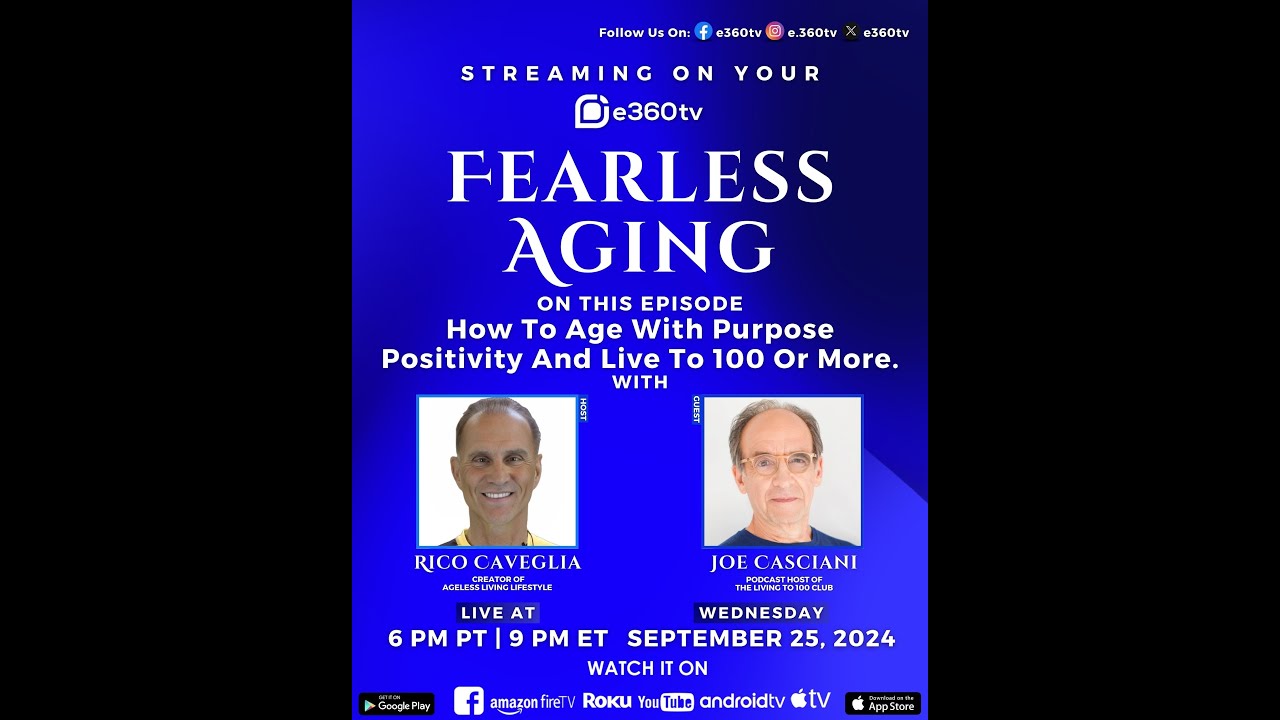
Psychologist Dr. Joe Casciani, who spent 30 years in senior care, created the Living to 100 Club and a card-deck series called Better, Longer, and Happier. The decks contain 60 cards each across 12 modules covering cognitive health, dementia, loneliness, and Blue Zones nutrition. He argues age is only a number and that older adults have untapped capacity for growth.
Chapters
Hello, I'm Rico Cavella. I want to welcome you to this episode of Fearless Aging. Where in every episode my guests and I, we strive to offer you proven tips and strategies that you can implement immediately to greatly improve your overall health and well-being. So we're here to inspire you and empower you to become your best self so you can go out and make a bigger positive difference in the world. So the title of today's episode is How to Age with Purpose, Positivity, and Live to 100 or More. And I don't think there's anybody who doesn't want to do that. And so our expert guest today is Dr. Joe Casciani. He's a psychologist who specializes in senior— who has specialized in senior care for over 30 years. He is the creator of the Living to 100 Club and the new card deck, which is a guide to aging with purpose and positivity. So, Dr. Joe, thanks so much for being here.
Thanks so much. Thanks so much, Rico. I'm really glad to be here. I look forward to our conversation.
Yeah, it's going to be a lot of fun. Yeah, I know you have— you have this new product called the Card Deck. Really interesting. We're going to talk a lot about that, and we'll just— we'll just get a little bit about your background, you know, how you got going and all this. And I do want to mention too, uh, an interesting thing. We are actually neighbors. We only live a few blocks apart.
That's right.
And we still haven't even met in person, so we're gonna have to do that pretty soon.
I did come and watch you play your drums though with your group once.
Yeah. Oh, okay. Yeah. Okay. Very good. Okay. So just tell us a little bit. You originally were a psychologist. Well, you still are a psychologist.
Sure.
So how did you get so interested in aging and developing all the things for aging?
Yeah. Covers a lot of territory, but I started working with a inpatient psychiatric unit for seniors right out of the gate as soon as I got licensed. And then I was contracted to do some work for the Department of Aging here in California. I wrote a training manual for nurses who are working in nursing homes. And after that, Medicare changed their reimbursement to allow psychologists to get paid for providing psychological services to Medicare beneficiaries. I did that for many years. We started a group practice. We contracted with nursing homes in many states, um, probably 25 years. And then I left that group, started my own called Concept Healthcare. We did that some more. And then in 2018, I closed my clinical practice and just wanted to work more with older adults in the community, and I started the Living to 100 Club. Which is all about educating and inspiring people, as you like to share as well. So educating and inspiring people about living longer, no matter what gets in the way. We know there's always gonna be bumps and hurdles, but I maintain with a positive attitude, we can work through those challenges and still stay positive.
Yeah, absolutely. That sounds really good. And we know that everybody actually does wanna live to be 100.
Sure.
You know, just from the funny saying that everybody wants to go to heaven, but nobody wants to die, right?
Yeah, that's right.
So everybody wants to live as long as they possibly can. And that's what you and I are about, to let people know that you definitely can stay healthy and energetic and be contributing and live a fulfilled life no matter what your age, 100 or even more.
Right. Well, we know so much about living longer. We know so much about what contributes to longevity, you know, fitness, which you're an expert in. And nutrition, and engagement, staying active, staying involved with mission, and purpose, and all of that. But my niche is really what happens when we lose that, you know, that desire, when we lose that positive attitude. And that happens because I've seen so many times people are just saying, I don't have it anymore, I just can't, you know, I don't have that strength inside. And I say as long as we're alive, as long as we're taking a breath, we can always tap into that resilience, that fire, that grit, whatever you want to call it. It's always there. So that's what I hope to focus on. Yeah.
Yeah. I think what you and I do really complement each other because it does, it starts in your mental, emotional state, but then you also, you gotta take care of your physical state. I think so many people, you know, just kind of lose it and get pushed aside because they're dealing with so many health issues and lack of energy and all those things. So yeah, that's so true. So let's, before we get into your new product, which is really exciting, your card decks, I know on your website you say working in this field of aging has taught you many things. So let's talk about some of those things, like how your future could be bigger than your past and age is only a number and all those things.
Yeah, well, I believe that, you know, it's age is only a number and We know 60-year-olds who have slowed down, and we know 90-year-olds who are as vibrant and vital as ever, so let's not get caught up in that number itself, and as you just mentioned, that quote from Sullivan, Matt Sullivan, I think our future should be bigger than our past, and I maintain, we have good memories, we hold on to our, you know, good times, family, vacations, holiday, But let's not get stuck there. Let's look at what's lying ahead, what doors we can open ahead. So that's one of the things I've learned. And you know this, I think we sometimes focus on what we cannot do, what's wrong, what we lost. And I say, let's look at what we still can do. Let's look at what we still have. Let's pay attention to those strengths because, you know, the glass is half full and half empty. Which one do you want to focus on? I say, let's focus on half full and look at what opportunities lie ahead. So, you know, I put this card deck together to kind of capture a lot of my writing, a lot of my experiences, a lot of my insights about staying positive. So yeah, I'd be happy to talk about more my card decks. Yeah.
Yeah, we'll definitely do that in just a minute. But yeah, I just want to add, yeah, you know, actually, if you think about it, our life should be getting better as we age because we gain wisdom and we gain knowledge and we learn how to live better. And hopefully we learn how to get control of our emotions better. And so, and what I like to add, Joe, and I know you agree with this, one of the biggest reasons what I like to tell people, aside from the fact, you know, for your own personal benefit, you wanna be as healthy and energetic and be able to enjoy your life. No matter what your age. But also, I think you'll agree, as I just said, as we age, we gain wisdom and knowledge. So we need more people as they age to stay healthy and energetic so they can give back that wisdom and knowledge to help solve these monumental challenges that we're having as humanity. And also to be role models and mentors like yourself for younger people.
Hmm. That's a good point. That's a good point. We have our legacy, what we're leaving behind, what people think of us. I wrote a paper a few months ago about what is there to celebrate about aging. I said plenty. So you can go to my website, it's one of my blogs. But there is, as you mentioned, the wisdom, the relationships. I think we have a greater tolerance for people who are different from us. We don't react so much, we kind of accept and roll with things a lot better. And, you know, the relationships, I think there's also time for more kind of introspection and spiritual growth that we didn't have time for when we were younger, maybe raising families. So there are a lot of things that we really need to pay attention to. I was doing a support group yesterday, and I'd love to have these discussion groups with seniors. One woman said, you know, aging is just— I won't say the word, but it's meaning, you know, that was a common theme in the group. And I talked about, well, We can talk about what's wrong or we can talk about what's right. So let's look at what we still have, not what we don't have. Yeah. So that's, I think that's important, that attitude. Yeah.
Yeah. Really well said. I like that saying, you gotta keep your attention on what you want, not what you don't want.
Yeah.
That's so important.
Yeah.
Okay. Well, I think a good way to introduce your card deck, you guys made a really cool video. So we got about a 2-minute video here we're going to play for you, and then we'll have you talk all about it. And also be sure to stay tuned to the end, and we'll let you know how you can connect with Joe and join his Live to 100 Club, and also how you can get your own copy of his new card deck. So we're going to play this really cool video right now. It's coming up, I hope. Come on.
Welcome, welcome to—
oh my goodness, it doesn't seem to be playing. I'm clicking on it, it doesn't want to play. Let's see here.
It was there for a flash. Yeah.
Welcome to Better, Longer, and Happier, founded by a psychologist with over 40 years of experience working with older adults. Our program is dedicated to help care facilities and senior organizations gain new perspectives on how to create communities of joy and purpose. But today we'll explore how these card decks are made just for program and activity directors to help them come up with fun and inspiring activities. Moreover, these tools can be used to create engaging experiences that boost cognitive health and keep seniors more positive and involved. Each deck is part of a comprehensive program designed to support daily learning and engagement. With 60 cards per module, there's a wealth of knowledge and inspiration waiting to be discovered. Choose from our 12 specialized modules covering topics from enhancing cognitive health to overcoming challenges like depression and isolation, living longer and healthier, age is only a number, thinking styles and outlook, etc. Whether you're addressing specific needs or simply exploring new interests, there's a module tailored for every situation. Each card is divided into 4 sections: Key Thoughts provide concise lessons, Knowledge Deep Dive offers in-depth information, Activities and exercises engage participants, and inspirational stories inspire and uplift. Scan the QR code on any card to delve deeper into its background and explore additional content online. These decks aren't just tools, they're companions in an older adult's journey toward better living and happiness. You can get a single module, 4 or more modules, or simply get a complete complete set of 12 to unlock full potential of our program. Join this journey because you deserve better. For more information, visit our website, www.livingto100.club.
Wow. Well, yeah, I can see you've been a busy guy. I can appreciate the amount of effort you had to put into creating all that. Really good job.
Yeah, thank you. Thank you. I spent the last year on it. Of course, I, like I said, I collected a lot of the past writings I have and activities. And, you know, I've got a great designer who did the box design and a great copy editor. And, you know, I spent every day for a year. And one of the best things is that, you know, I have a sample box here, but each card has a QR code on it so you can get to the original you know, the source of that particular topic and, you know, discussion topics, activities, and, you know, 12 different topics. So there's a lot of information there.
Yeah, yeah, kind of. How about let's kind of briefly go through, uh, we don't have to go through all of them if you want, but if we have time, go through them and tell a little bit more about what's in there and how people can use it, how they best could use it.
Yeah, well, again, 12 topics And, you know, it's really designed for people who are doing group activities like at senior centers or senior communities, senior living settings. But I found that there are some family members and caregivers who are attracted to this concept because it gives them something if they're spending, you know, several hours a day, you know, maybe a home care aide. How can we make this activity more engaging, more stimulating, cognitively challenging? So I've got 12 topics and let me see, I don't have a good list, but what we know about living longer and healthier. Let me grab them.
Yeah, I can see, I can see the real value in this too, just to get people more engaged mentally, right?
Exactly, yeah, yeah. Scientific proof that age is only a number. This is all about thinking styles and positive psychology, what's going on in our head, affirmations and negative thinking, and then coping skills when we're faced with, you know, there's a lot of topics, and I know we're short on time, but my goal was to really help people understand that older adults have an untapped ability to grow and change. And it's easy to, you know, think that, gee, I'm in my 70s, 80s, I better slow down. That's an old stereotype, and we're getting rid of that. So that ageist attitude doesn't work anymore, and we really have so many more years. You know, I won't say that forever. We're not all going to live to 100. We know that, and I'm not promoting that we all should live to 100. I'm saying as long as we're living and moving forward, staying positive no matter what gets in the way. So, you know, we can open new doors. We can look at opportunities. My last, last module, number 12, is— I thought it was going to be hard, but it was actually fun and almost one of the easiest. What opportunities lie ahead? And all kinds of opportunities out there, not just travel, but there's all kinds of volunteering and mentoring and, you know, being involved with the national parks. And the Department of Labor has wonderful websites available on what kind of jobs to look at, and what kind of opportunities after retirement. There's a lot of information, so I wanted to bring this all to the user. And I think family members— there's someone who bought one of the chapters on depression, overcoming depression, because he was concerned and, you know, had a family member. And it talks about, you know, manic depression and grief disorders and all of that. So There are some clinical topics. Another chapter is on understanding delirium and dementia and depression and how they look alike and how they're different. So again, a lot of useful information. One of the best parts is that all the research is done for you. Half of the cards have the— there's 60 in each deck, but half the cards are background information like research books articles, learning, you know, lesson plans. So if you want to dig, if you want more information, it's there, you know, no matter how much you want. If you want a little, it's there. If you want a lot, it's there. And then the other half is really all about activities, exercises, inspirational stories. I got some great videos from YouTube where people can talk about, um, gee, my life opened up when I took this direction, I opened up this door. So there's, you know, education and inspiration.
Yeah, it sounds like it's a great resource. You've got really good resources for all the different— well, maybe not all the challenges that we'll deal with, but a lot of the main challenges that people are dealing with, and especially as we age. I mean, there are some specific challenges to aging, no question about that.
Just quickly, if I could add, one of the modules is just on increasing engagement and connection because I've seen, we all see people who are kind of retreating and pulling back and sometimes just isolating. We know loneliness is a real serious issue for older adults, as the Surgeon General talked about last year. So I devoted this whole, this whole deck just on helping people overcome some of those barriers, helping them drop some of the walls that they need because they're, you know, kind of fearful or isolated, they're not social. And how can we help people, you know, get more engaged? Because social engagement, that's one of the, one of the keys to longevity. And the Blue Zones taught us that, and so many other research studies are showing that connection with other people really helps us to live longer and live healthier.
That's just what I was going to say as you were talking about the Blue Zones. I've showed one of the main— I think it's probably one of the most important things why people in the Blue Zones, in these communities that the majority of people do live to 100 and stay fairly healthy, can take care of themselves, is they have— they're real connected, that they have a real good community, they take care of each other, they engage with each other, they have activities. Yeah, that, that's so good. That, that's, that's really a big one. Uh, and, and of course, so do, do you also address, uh, things like, like exercise and diet, eating healthy?
That's, you know, I talk a lot about the Blue Zones, and I consider that kind of the foundation for longevity and what we've learned from the centenarians. So yeah, um, there's sections on, you know, diet, nutrition, and intermittent fasting, and you know, the importance of staying physically fit and all of that. I think the Blue Zones taught us, are still teaching us so much about staying healthy as we age.
You know, an interesting thing is, you know, there's one Blue Zone in Yorba Linda, which is just up in Orange County. Pretty interesting. I always forget because I think the main reason is that it's a kind of a smaller city, And the majority of the people there, there's some religious, religious science or something. I don't know what it is. But one time, here's the funny thing though. I heard an interview of the head minister guy there. He was like 90 years old.
Oh, wow.
Really energetic. And it was funny because, you know, what I teach, Joe, as you know, is not anti-aging but anti-growing old. You know, you have to age, but you don't have to become old. And they asked him, well, what's one of your biggest secrets for not becoming old? And you know what he said? Don't hang around with old people. And that's not— again, old's got nothing to do with your age. It's how you, you know, how you are living, how you present yourself, and how you feel about yourself.
Yeah.
Yeah. It's just how you take care of yourself.
That's great. I read about this, um, the oldest person who living in the US, and he he died a couple months ago. Maury Markov was his name. He was 111. And, you know, it's a great story, and I'd like to tell the story because he, you know, had different jobs over the years and worked in factories and kind of as a mechanic. And he started creating his own sculptures, you know, from metal. And he would create these artworks, and at age 100, he had his first exhibit, gallery exhibit of his artwork. And, you know, he talked about, well, this— what difference does my age make because I'm still very active and I want to do this. So I think that's, you know, that just kind of opens our eyes a little bit that why, you know, why think about slowing down? Why not think about growing and changing? And Like I say, opening new doors.
Yeah, there's some really good, really good living proof. Okay, we're gonna— I have an important message for you. We're going to take a short 60-second break, and when we come back, we'll let you know how you can join Joe's club and get his card decks and a little bit more information about that. Hello, I'm Rico Cavella, creator of the Ageless Living Lifestyle. If you are concerned about premature aging and you want to avoid disease and old age, and you want to live a more healthy, energetic, and vital long life, I have proven solutions for you. So number one, go to agelesslivinglifestyle.com and take our aging quiz to see how well you are doing. And number two, book your free coaching session with me to discuss your wellness challenges, and I promise to get you going on the right track. You can transform your health and your life, and I can help. All right, we're back with psychologist and author Joe Casciani with his new, his new, uh, Purpose and Positivity card decks. So I tell, I tell our, our audience how they can, where they can go and how they can join your club and how they can get a copy of your deck.
Yeah, so my website is livingto100.club, not .org or .com, but .club, livingto100.club, and you can go there, sign up for my email list, and you can download a free copy of my 9 strategies for living longer and healthier. It's a free PDF, so you just can sign up for that and you get that download it. You can, you can read my blogs. I do podcasts. I've been doing podcasts for 6 years. I've got, well, I just did my 238th episode this week, and I love to do podcasts, and I love to bring information to, to my audience. Thirdly, you can pick up a copy of my book, which is "Living Longer Is the New Normal," and that's available on Amazon. I'm available for one-on-one consultation if anyone is interested in that and, you know, maybe helping through the rough spots, concerned about a family member. You can go to my website, you can give me a call, 858-272-3992, or my email is jc@livingto100.club. And lastly, take a look at my website which has a new landing page all about my Better Longer and Happier Card Deck series. That's livingto100.club/blh. So a lot of information out there, and tune into my podcast. I got great guests. Rico was a guest in the past, and I continue to enjoy thoroughly the messages that our guests share.
Yeah, well, thank you so much for that, and Yeah, we'll, we'll also put all that information, the contact information, in the show description for you.
Great.
Well, we've just got about a little over a minute to go here. How about just, just real briefly, who would you, who would you say would really— who you designed the card decks for, who would benefit most from them?
Yeah, I, I think people who are involved with older adults in some setting maybe activity directors, you know, program directors, really that want to engage their members in some challenging cognitive challenge discussions, helping them overcome some of the barriers about maybe engaging, staying socially connected. But again, it's really, it can be useful for an individual family member or consumer who are concerned, and home health directors, senior centers. There's a whole range of people. I think it's, it's a, it's a good useful resource to make use of.
Yeah, really good, really good, Joe. Thanks so much. Thanks so much for your, for what you offered people. Thank you very much. I really appreciate it. Great interview. And so if you like today's episode, tell your friends about the Fearless Asian TV show. And you, you can also go to agelesslivinglifestyle.com and there, and click on our TV podcast link, and you can subscribe to our TV show, and you can watch our shows anytime on my YouTube channel as well. So thank you very much for being here, and I look forward to seeing you for our next episode. Thanks, thank you, that was great.
More from Joseph

The Hidden Cause of Aging? How Chronic Inflammation Affects Your Health with Joel Brind








