From 135 lbs Lost to a New Identity | The 1% Mindset for Healthy Aging
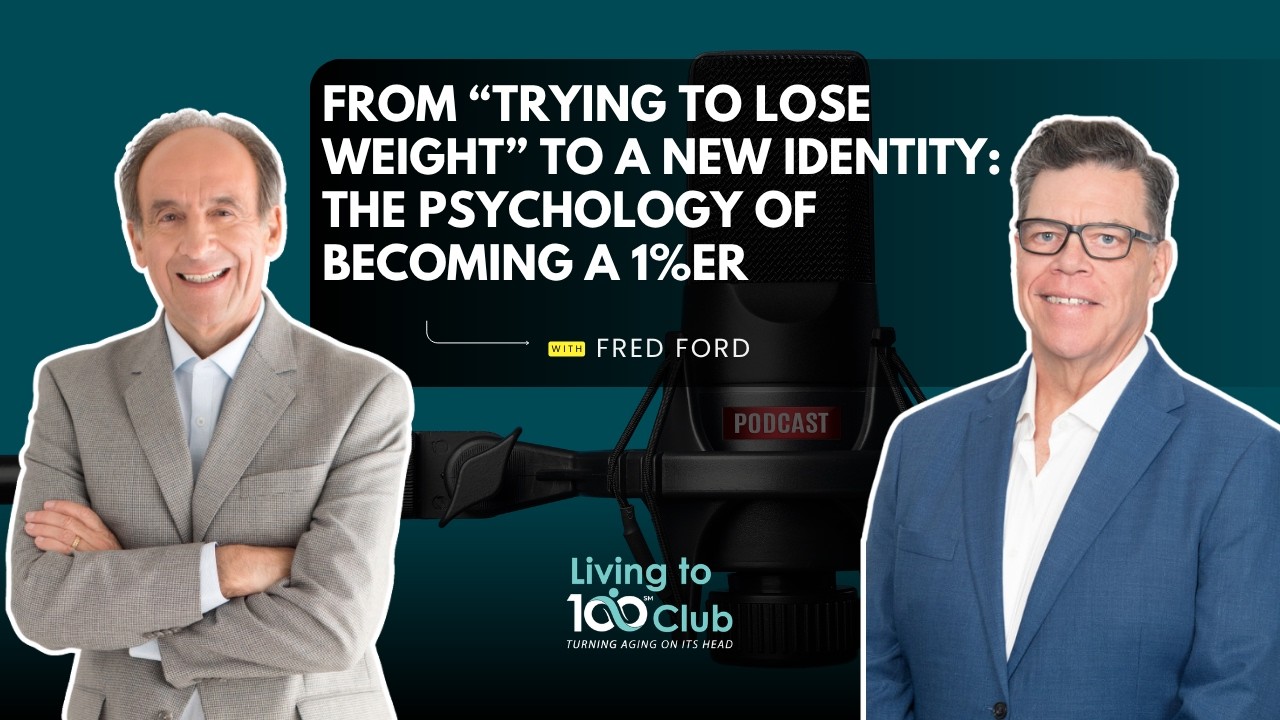
Fred Ford lost 135 pounds by shifting his identity to that of a "1%er" who sustains lasting health change, using prayer, visualization, and present-tense affirmations. He talks with geropsychologist Dr. Joseph Casciani about why inside-out identity change works better than diets, and how to build habits that stick.
Chapters
Welcome to the Living to 100 Club Podcast. Here's our host, Dr. Joseph Casciani.
Welcome to the Living to 100 Club, where we explore what it really means to live longer and better. I'm Joe Casciani, a geropsychologist focused on the mindset, habits, and science of aging well. Each episode brings you practical ideas and conversations to help stay engaged, resilient, and purposeful at any age. Program of today's podcast is From Trying to Lose Weight to a New Identity. We're speaking with Fred Ford, author of the international bestselling book Think and Grow Thin. Fred shares the remarkable story of how he lost 135 pounds, not through dieting alone, but by transforming his mindset and identity. Fred explains how shifting from trying to lose weight to becoming the kind of person who naturally lives a healthy lifestyle changed everything. The conversation explores the psychology behind identity change, visualization, daily habits, and the importance of rewriting the internal story we tell ourselves. Such an important message. First, a little background. Fred Ford is an author, speaker, and personal development coach. He's the international best-selling author of Think and Grow Thin a book that combines mindset principles with practical lifestyle change strategies to help people create lasting health transformation. Earlier in life, Fred spent more than 20 years performing as a stand-up comedian, honing his ability to connect with audiences through humor and storytelling. Today, he blends that same humor with motivational insights to inspire individuals especially those over 50, to take control of their health and their future. Fred, welcome to our program today.
Thank you so much, Joe. Pleasure to be here.
Oh, you're very welcome. I'm really looking forward to our conversation. This is a topic that I've been talking about for, for a long time— how to, how to understand that ability to reinvent ourselves, right, redefine ourselves. So Let me open with this question. The loss of 135 pounds is remarkable. You said that the turning point wasn't a diet. When did you stop seeing yourself as someone trying to lose weight and instead seeing yourself as a different person?
It, it happened early on, right after I decided again to go on a diet. I had been on the weight loss, weight gain roller coaster for 30 years. I've been well over 300 pounds for, for 2 decades. And when I reached 350.2 pounds— is what I weighed on March 1st, 2021— uh, the first thought that came to my mind is, I'm closer to 400 pounds than I am 300. I have to do something. I have to make permanent changes here. And Of course, the default strategy is always go on a diet. Someone had given me a book called Bright Lines Eating. So I said, all right, let me read this book and let me, let me get on this diet. And I got to page 3 and I didn't get past page 3 on the book. On page 3, the author writes that of obese people trying to get thin, the failure rate is 99%, literally. And this is a statistic, it's not her opinion. And I just put the book down, and I was so discouraged, having lost and gained weight so many times in my life. I was ready to just give it up right there. But instead, I closed my eyes, I imagined myself sitting across from, from Jesus, and I said a prayer. And I said, I'm confused. I'm scared. I don't know what to do. I don't know what to eat. I don't know how to proceed. But I, I want to become a 1-percenter. If there's 1% of the population that's able to, to do this, that's what I want to do. I'm praying for divine guidance. And in retrospect, I now realize that creating that identity, instead of associating myself as someone who's struggling to lose weight who's on the weight loss, weight gain roller coaster and all these other things attached to that story. Instead of that, at that moment, I became a 1%er at 350 pounds. I started to act, feel, and identify as a 1%er. And that was reinforced in a book called Atomic Habits by James Clear. Great book. And he talks about people. His example was people trying to quit smoking, and you have two people who've quit smoking, and someone comes up to the first person and says, "Would you like a cigarette?" And that person says, "No, I'm trying to quit." Goes up to the second person and says, "Excuse me, would you like a cigarette?" "No, I'm a non-smoker." That subtle difference is huge because the first one implies all kinds of effort and overcoming, you know, addiction and all this other stuff. It can really be very heavy on people, whereas The other person is just simply stating their new identity. No, I'm a nonsmoker. Very simple, very easy. So applying that to my own journey, I went from being a person who struggles with weight to a person, I'm a 1%-er. And I lived that identity from day one. And here I am 5 years later. And I did get, you know, it wasn't easy, but it was, I made progress every day. But from day one, that was the biggest difference, saying the prayer from day one and creating that new identity in my mind and recommitting to that identity every day of the journey.
Yeah, yeah, you describe it as a subtle shift. It is. It's a powerful shift too, because without that change, people just go through life struggling with their diets and their weight loss programs and different approaches. So it's a necessary ingredient, it seems, to change that identity. I'm a non-smoker. I'm a person who weighs X number of pounds, whatever it is. You shift that whole self-definition.
Yeah, you— it's, it's so big. It can't be underestimated or underappreciated. It's the difference between living your result from the inside out as opposed to living from the outside in, which is what all the solutions that are being advertised and broadcast to us daily are outside-in solutions. Get our drug and you lose the weight. Go on our diet, you lose the weight. Get the surgery, you'll lose the weight. Have the hypnosis done, you'll lose the weight. Um, you know, instead of create a new identity and start to change your life from the inside out. And that is where the identity really— the identity shift allows you to create from the inside out, which is how all sustainable success is achieved from the inside out. The outside-in solution is just a temporary Band-Aid, and it will never give you the sustainable results you're looking for.
Yeah, yeah, exactly. The doctor who says you need to lose X number of pounds, that's nice, but it's not going to do anything. So weight loss, it occurs to me, weight loss isn't just subtraction, it's, it's really reconstruction.
Yeah, that's a good way to put it.
Yeah.
And I reconstructed my entire life. I'm living an entirely different existence nowadays.
Yeah.
It was a number of lifestyle changes that I made an intentional plan that included everything and included the way I eat. Of course, the reason I got fat in the first place was poor diet, but it wasn't just eating too much. It was also the quality of the foods that I was eating were poor. And that's really the Western diet— processed foods, deep-fried foods, and a lot of sugar, alcohol, you know. I mean, I could go on and on. It wasn't one thing.
Yeah, of course.
Um, and then I also changed the way I operate, the way I move my body, the way I think, the way I pray. Uh, it was just a multitude of, of, uh, of lifestyle changes that I changed, you know, across the board.
Yeah.
And I'm now operating as a different person. I really am. As a 1%er, 1% looks very, very different than it did 5 years ago.
Yeah, that's such a great story. And we'll get into more of the detail. I really applaud you for that shift. So let me ask you one of the tough questions. How can someone begin writing rewriting their internal narrative when it's been reinforced for so many years?
Yeah, it takes a lot of courage. But the first thing you really need to do is determine, okay, I don't care what precedent tells me. I don't care what my best weight loss to date has been. In my case, it was 50 pounds. That was the best I had done over the course of 30 years. And when I decided to create this new identity, a 1%er, I said, well, what do I want to weigh? And, and really, that's the question you have to ask. Not is it possible, or what has been my best to date. What do I want to weigh? And I looked at a picture of myself when I was a senior in college. I was 215 pounds, and here I was at 350. And I said, that's what I want to weigh. I want to weigh 215 pounds. So I wrote down a goal and I said it in the present tense as if it was an existing fact. On May 3rd, on or before May 3rd, 2023. Now, this is March 2021. I am so happy and grateful now that I've weighed 215 pounds and I've reached my personal mountaintop. And in exchange for this goal, I'm changing my relationship with food. I'm moving my body. I'm visualizing, you know, and I wrote the whole thing out on an index card. And that essentially is a snapshot of what you want your life to look like. Yeah, not just what you're going to weigh, but what are you going to be doing to contribute to this wellness and health goal. Uh, you can't get something for nothing, and it's not just diet, it's, it's everything.
It's everything. Sure.
So that's really where people need to make a decision based on what is possible and not what their precedent says. Because I set a goal to lose 135 pounds. My best goal to date was 50. So who was I at 61 years old to say I was going to lose nearly 3 times my personal best? But that's what I did. And I did it because on day 1, I wrote out a goal that was specific, measurable, bold, and was very specific about what I was going to do in exchange for that particular goal.
Yeah.
And it didn't happen overnight and it wasn't easy, but that was the first domino was that decision to reach 15 pounds.
To be the 1%. That's the way we rewrite that internal narrative. We've been telling ourselves a story all along of, gee, I know I should lose weight or I should probably try harder. But it's that very concrete decision. Here's where I want to be, and here's how I can see myself being.
Exactly, that's, that's exactly right. And what it does is it creates the images in your mind. We think in pictures, and people don't understand that. If I, if I were to say to you, think of your bed, what would happen? You would get a picture of your bed on movie screen in your mind. Now picture, picture your car. That changes. Picture Mick Jagger. Again, the The image of Mick Jagger pops up on your mind.
Yeah.
What if I say to you, what— think of your best, healthiest self? You know, for a lot of people, the screen, a movie screen in their mind goes black. They haven't contemplated what their best healthy self looks like. And I did. I had an image in my mind. This is who I am right here, right now. And that's what I'm going to live into.. And it really was the, the words that I used and chose from day one really kind of dictated what that picture and what that life was going to look like. How was I going to be operating differently in my world? And that's how I operate today, what I have written down on day one.
Yeah, so you were able to envision that, that new picture of Fred Ford. You could, you could create, you could paint that new picture. And I, I talk about that a lot as I talk about starting new chapters with our advancing age and how we can create a new script, write a new script. You know, it occurs to me, I read a book years ago called Solution-Oriented Psychology or Psychotherapy, and it talked about restorying. We write a new story for ourselves because we've been living this past story, maybe other multiple stories, But now we can write a new story. And here's the new script. Here's the new character who's near the new definition and so on. So I think it's exactly what you're talking about. Once you have that new position, it allows you to make changes and new decisions from that new place.
Yeah, exactly. You are, you are in a different place, and that is what's going to motivate your thoughts, and your thoughts are going to motivate your actions, and that's going to compound as you move forward, as you're, you know, developing this, uh, in your physical world, this new identity.
Yeah.
Um, you, you're operating differently. Your expectations change. Your— the image and the story that you're telling yourself changes, and that's really all that matters.
Yeah.
Uh, very, very, uh, big part of— in the first chapter of my book is not about dieting or eating or food or even moving your body. The first chapter in my book is, is the, the hero's journey. You are willingly becoming the hero in your own new story. Uh, you're changing the narrative and you're stepping up to say, you know, I've been a, I've been a, uh, I've been operating on, on a, on a low level here. I've been— I haven't given it my best. I'm— I haven't opened up my mind to this possibility. I'm gonna— I am gonna be the hero of my own story. I'm going to be a 1-percenter. And that's what I want to encourage your audience is, yeah, yeah, step up and be a hero for your own self. You don't have to say that, and you don't have to be cocky or arrogant about it, but that's how your mentality is going to be.
Yeah, you're right. It's, it's a new description of ourselves. So you talked about present tense affirmation. I guess that's like the smoker who says, I'm not a smoker.
Yeah, yeah. Well, that's something I learned from Bob Proctor. He, um, who was an expert, uh, in Think and Grow Rich. He was, you know, a preeminent student of that. He, he claims to have read a page of that book every day from the time he was 26 until when he died when he was 86. And when I trained with Bob—
excuse me— remarkable.
I trained with Bob. He said when you write out your goal State it in the present tense as if it's an existing fact and attach the words I am and some kind of gratitude statement. So his way of doing it is on or before May 3rd, I am so happy and grateful now that I have reached my mountaintop and my goal weight of 215 pounds. That's a goal I read twice a day for 3 years until I reached my— literally every day. And now I rewrite the goal. Every morning, as far as a maintenance goal. So I am associating my— I'm saturating my mind with the possibility of being at my goal weight. And I did that every day of the journey. And so the present moment, I didn't wait until I got to the mountaintop. In other words, I was that weight in my mind on day one.. And, uh, that's a big distinction and sometimes a little bit difficult for people to get, uh, acclimated to because we think in linear terms, you know. But if you're thinking, if you're projecting out there and you're imaging yourself at 215 pounds and you're taking ownership in the present moment, boy, it's very powerful.
Yeah. Now I've read things about the brain not being able to distinguish between our own self-talk and reality. Does that ring a bell for you? Because it does. If we tell us—
I actually, what I say in the, in, in my book, and it's something I, I forget which book I picked it up from, it may have been Wallace Wattles' work, uh, maybe somebody else, but it's one of those New Age authors, says that your subconscious mind cannot differentiate between what's real and what's imagined. So if you, uh, insist upon, uh, because imagined reality is reality. So if you can imagine yourself operating as a certain— in a certain profession, or in front of a large audience giving a speech, or in a 215-pound body when you're 350, that becomes your existing reality. People make the mistake of thinking, you know, this change that they're seeking is going to take a long time. No, change takes place in one second. The minute you decide to be your ideal weight, that change has been affected. The, the results are going to take time. You're obviously not going to lose 135 pounds overweight, but the change took place on day one, on March 1st, 2021, when I assumed a feeling of the wish fulfilled. And that's That comes from Neville Goddard, who's another New Age author. But your, your subconscious mind can't tell, can't differentiate between what's real and what's imagined. So if you're, if you're flooding and saturating your mind with images of you operating in your world as the hero of your own story at your ideal weight, and if you insist upon thinking those thoughts and having those images repeating in your mind, now you're living from a different place. You're not living your own version of Groundhog's Day anymore. Now you're living the hero's journey, and that's all up to you.
Yeah. Oh, that's great. So the belief in what is imagined is what now drives the new behaviors?
100%. Yeah, it's the belief that drives the behavior. Yeah, it's the behavior that gets you the result and the feedback from the world that reinforces that belief.
Yeah.
And it becomes a process. One of the things that I stress with my coaching clients, if you're going to take this program on, understand implicitly that this has no finish line. This is not something you're going to do for a short period of time. You're going to make permanent changes to your life. And once you've reached the mountaintop, sure, have that big celebration as I did. Yeah, but then what? The celebration lasts one meal.
Yeah.
Now you wake up the next day, you have a decision to make. You're going to continue to be the hero of your own journey. Under the radar, not bringing a lot of attention to yourself, but are you going to continue to apply these success principles and be in that person? And that's what I've decided to do. Of course, I have, um, I have an investment at stake. This is my business now. I'm going out to stages and I'm coaching people, so I, I have to more or less keep, uh, going with the Think and Grow Thin, uh, uh, strategy.
Sure.
But I think even if I wasn't getting in front of audiences, I love being thin or thinner than I was. I love being, uh, walking. I love being active. I, I love how I feel. I love how I look. And, uh, um, so for one more day, I'm going to commit to doing this, and that's all I need to do.
Now, these are the, the ripple effects of this new identity. There's a lot of ripple effects, all, all the changes that permeate the rest of your life, not just the way you eat, but so many other things that kind of spin out from—
yeah, that's not a phrase that I've used, but, but you're right on there. The ripple effects of this, not only in, in, in other areas of my life, but it's also touching the people in my life, you know. Yeah, I've inspired a number of people in my own family and my own network, uh, to take some action, and that was a not something I intended, but it's certainly something that has happened. Um, uh, someone said to me not too long ago, maybe a few weeks ago, that they've seen some of the posts on Facebook, and they said, you know, you've been a real inspiration to me. And I reached out to that person and said, uh, you know, thank you, uh, what, what have you actually done? And, uh, she said, I started following your journey a year ago, I've lost 70 pounds. And now I hadn't spoken to her you know, for many years. She's a high school friend of mine.
Yeah.
And so you never know how you're going to touch people if you just go about your business and do the right thing.
Yeah. Well, I have to ask about the, you know, the problems with sustaining this change, and people struggle with consistency and follow-up. And what helps sustain motivation beyond that initial burst of enthusiasm?
You know, it's gotta be an inside job. As I, I said earlier, the, the truth is, and the dialogue needs to be in our country, we, we don't have a weight loss problem in our country. We have a weight loss maintenance problem. That's really where it's at because no matter what strategy you try, you're going to lose weight initially. I mean, no matter what diet, no matter what, if you get surgery, if you take these medications that are available now in all over the place, you're going to get the initial weight loss. But you know what's going to allow you to sustain that? The key that I've found is you need to do— you need to recommit every day to this, and you need to do the things you promised yourself you would do whether you feel like it or not. And that is the key. Recommitting daily and doing these things repetitively until they become habits. I never feel like going out for a walk. Never. And I walk every day and I'm now 66 years old and I walk 7.5 miles or more every single day. And just before I go outside, my ego saying, oh, take the day off. Oh, it's lousy weather out. Oh, you know, you know, You're doing good. And I just say, you know, thank you for sharing, but I'm going to go out and walk. And I never feel like it. But then 20 steps into my walk, I got the affirmations going. I'm counting my blessings. It's become a habitual part, a good habit that I have developed. And it really would not have developed had it not been for the fact that I was willing to show up and do the things I promised myself I would do, whether I feel like it or not. And that's a key. A lot of times you're not going to— Once that initial, as you mentioned, the initial inspiration is gone, you've lost 20 pounds, okay, great. Now you're starting to get a little bit bored. Maybe you're starting to feel, you know, that depriving yourself of these things is something you don't want to do. You know, you've— there is no finish line if you want the sustainable result. And the sustainable result can only be achieved if you're making a fresh commitment every day and showing up and doing the work. And that's— people don't want to hear that, frankly. You know, people don't want to hear that, you know, it's, it's— there's no finish line. You got to just keep going. You got to make permanent changes and turn those changes into habits until that's your habitual way of being. But that's what it takes to sustain this. It's not easy. And that's what the weight loss industry— one of the biggest lies they tell people is if you just get our drug you'll lose the weight, you'll get to the promised land. If you take this diet, you know, we'll eat the food, lose the weight. That's one of the taglines for one of these companies. You know what, they're doing a disservice because they're not saying it's going to be hard. Sure, they're trying to tell you it's going to be easy if you'll just get our product, and that's simply a lie. Yeah, yeah.
So it's more than a destination, right? I mean, Yeah, it's, it's lifestyle. It's lifestyle. It is lifestyle. It's not something you do for a while and then everything is great. It's lifestyle.
Yeah, it's lifestyle and it's mindset. You know, someone had in a, in my, uh, coaching group, someone had said, what would you say, um, uh, what percentage of this program would you say is attitudinal? And I said 100%. Yeah, of course it's 100%. You have to be that person in your mind.
Yeah.
All the time. Yeah, when you make mistakes and you have that indulgent weekend, you know, that could be a portal back to eating unhealthy again. And it was in my case, you know. Why did I stop the diets in the past? Lots of reasons, I suppose, but it was usually a vacation or a long weekend where I just overindulged. And then, you know, came Monday or the, the end of the vacation, and I just couldn't get back, uh, eating the way it was before the vacation. So I just went back to eating lousy. You know, you have to get up one more time than you fall, you know. And, and that's really— you turn this into a simple math problem. Just, you know, when you have that slip up, forgive yourself easily and freely, and then get right back to it and make that fresh commitment and get back on the horse. Um, it's hard, but it's, it's eminently doable when you break it down into, you know, into daily, uh, habit. You know, one day at a time.
And it's so easy to get pulled back into that old behavior too. So as you say, it's recommitting every day. There's a saying, be the change that you want to become. And we— it's nonstop. It's a very dynamic process.
It is. And I love that quote. I have that in my day planner. It's from Gandhi.
I love it too. Yeah.
Yeah. And You know, one of the things that I think helps people, and they don't want to hear initially, but I try to explain to them— we've heard, you've been around a while as I have, Doc, and you've probably heard the saying old habits die hard. And I tell people flat out, old habits never die. Old habits never die. The possibility of going back to eating the way you used to is simply that— it's a possibility. That you are deciding against because you're deciding in your favor in the present moment. But that possibility will show up again tomorrow. Someone asked me, um, I think early on in the journey, maybe a year into the journey, how often do you feel like quitting? And I said, every day. Yeah, because quitting is just a possibility, and that possibility shows up in my mind every day. My ego wants me to stop because it wants to go back to living that comfortable lifestyle where I'm overindulging and I'm drinking too much and I'm not moving and I'm being lazy. And, you know, it's just a possibility that old habit will always follow me the rest of my days on Earth. So I just have to, you know, when it shows up— thank you for sharing, I'm going in a different direction— you know, very casually tossing that possibility aside. But old habits never die, so don't think that they do.
That's so good that you can, you know, just not just admit it but pronounce it, that there's always that possibility of stopping. There's always that temptation or inclination to say, well, maybe I've done enough. But I mean, that's just being honest. We have to accept that because all these thoughts come into play. That doesn't mean we have to follow them. It is something that we can pursue. Or we can continue on the same journey. Yeah, this is great stuff, Fred. Um, before we continue, uh, one of the questions I often hear is, these are great ideas, but how do I actually put them into practice? That's really the purpose behind my Living to 100 community and my Better, Longer, and Happier programs— turning insight into action, whether for your own life or within a group setting. You can explore both @livingto100.club. Fred, I just, you know, I have to commend you on the information that you're sharing. I think it's such groundbreaking information. I think it's so powerful. And I know my listeners will benefit from this. But what advice would you give to someone in midlife or later who just feels stuck in an old identity?
Yeah, my first bit of advice is stop saying that you're stuck. You know, language is declarative in nature. What we say, we declare to be true in our own life. And everything is an inside job. So, you know, I felt stuck. I felt like I was on that weight loss, weight gain roller coaster that I'd never get off.. And I just made a decision that this was— it was do or die, that I was going to do this. And, and, you know, I understand, I can completely relate to people who feel stuck. There's a lot of people out there who are in the similar boat that I was in, you know, having lost the weight, gained the weight back, and then some. And then, you know, the trajectory was like this. I mean, it was, it was weight loss, weight gain, but, you know, through trajectory was— I got— when I got married in 1992, I weighed 265 pounds. So that 100 pounds or so came on over the course of a long period of time. When you finally stop and you stop the inner dialogue that relates to that heavy person that's stuck or frustrated, when you stop saying those things, when you start a whole new inner dialogue That is really the portal to get to a better result. And it's also the portal to the renewed thinking, the identity shift that I've talked about a lot throughout this podcast. That was the big one for me, was I stopped saying, I can't lose weight, I'm just a person who struggles with weight. And I started saying, I'm a 1%er. And that colored every other thought that followed.
Mhm. Yeah, yeah, that first— your first answer there about stop using the word stuck, because that again, we hang on to these and in some ways they're a crutch, they're a buffer. I'm stuck, I'm not getting anywhere. Um, so we let go of that and we hold on to a new word, right?
Exactly.
Changing. I'm not a smoker.
Yeah, exactly. I've— you probably heard the saying that what follows your I am is, is what becomes your truth. So if you say, I am stuck, the universe is just responding in kind, saying, okay, you're stuck, let me keep you stuck. When you say, I am a 1-percenter, you know, the, the creative energies of the universe are complicit in helping you in whatever way, but they're neutral to your desires. So if you're saying, I'm broke, it's going to keep you— it's going to keep you in poverty. If you say, I am rich with ideas and, and I am thriving, You know, I say affirmations every day and a lot of my affirmations start with I am. I am eating the best foods in the right amounts every single day. I am living my best life now and so on. And the verbs that I use are active verbs, -ing verbs. So it's— again, it reflects and is in sync with the idea that this is an ongoing thing. It has no finish line. I am contributing to my health every day. I am living as a hero in my own journey. And yeah, it's the whole inner dialogue for me has completely shifted and changed.
Yeah. Yeah. Well, that is, I mean, I said this word already, powerful, but it is powerful information. And it's at the heart of how we improve our lives, how we change, because I mean, I've known as a psychologist for 40-plus years, it's hard to change behavior. But you're giving us kind of a really kind of heartfelt inside approach to this because it's coming from your own experience. It's coming from books, people— Bob Proctor, I mean, powerful man and such an influential thinker. All of your experience you're putting in and sharing this. And I really think this is like, I don't know, it's the heart of behavior change.
It absolutely is. And it's, and I don't believe, you know, one of the lines that I use in my book is when you're looking for the outside-in solution, whether it be Big Pharma, you know, the drug or the diet or whatever, one of the common threads of those outside-in solutions is they don't want you to think and grow thin. They want to do the thinking for you. They're going to tell you how, uh, you need to behave. And the truth is that it's, it's not a behavior issue, it's an identity issue. And when you begin to identify as the healthy person that you want to be and living from the inside out, uh, when you begin to cultivate that mindset of a 1%er, of a healthy person. You're rejecting the outside-in solution, and you are thinking and growing thin. That's where the, the name of the book— you know, I, I've used the success principles that Bob had taught me and, and that I had read in all these— I've been a personal development student for, for 30 years, and I had never thought to apply these principles to a health and weight loss goal until I had that, you know, that moment when I was 350.2 and I said, let me gather all my material together here and let me do this, uh, the right way. And I, I think I found something.
I, I love the idea that you spent 10 years in stand-up comedy. Um, what did, what did comedy teach you about human psychology?
You know, I, I, I— someone, I don't know who said it, but they said the, the straightest line between two people is humor. And I've found that to be true, that if you can lighten up the conversation, uh, it, it makes everyone in the, in the room, uh, comfortable, more comfortable. Um, and what, what I really learned is, you know, to lighten up, uh, take a lighter approach to your life. Don't take yourself so seriously. Maybe that sounds contrary to what I'm talking about here because I'm talking about being a 1%er But it comes into play when, you know, when you slip up and you don't do what you said you're going to do. And, you know, you can just lighten up on yourself, forgive yourself freely and easily. And, you know, believe it or not, during my study of weight loss and different strategies, laughter actually helps with weight loss. Believe it or not, that's actually— if you can look that up, on Google or, you know, AI or whatever, you'll find that that's true, you know, that a good belly laugh can aid you in your weight loss. So there's another reason to take things lightly and just search out humor.
Well, humor is, we know, among people who live longer and, you know, is a factor for longevity, humor seems to be kind of a contributing factor here. What role does it play in aging well? What, what role does laughter play in longevity?
You know, I recently saw an interview with Dick Van Dyke, who just turned 100, and someone was asking him what, what is his key to, uh, to living that long. He, he told the story about his father. He said his father was always angry, a very angry man. He's angry at everything. He was always yelling at the TV and this, that. And his father died fairly young. And Dick Van Dyke said, you know, I took that as my cue from the universe to just be light, to be happy, to not— to reject the anger, not walk around with a chip on my shoulder. I think, you know, if you're enjoying your life, if you're laughing a lot, it's not only just helping with your overall health, I think it's the quality of your life improves. And if you're— on the other hand, if you're angry about everything, the quality of your life diminishes. And I think it really does, not just psychologically. I think it affects your physical body. I've found that to be true in my own life, and I can catch it if I'm in that, you know, that a period of time where I'm angry about everything or I'm anxious about something or, you know, whatever it happens to be that's going on. Outside in the world that I'm, that I'm angry about. When I, when I reel myself back in and I say, look, you know, I can control only one thing, and that's what I'm thinking about. You know, you have very little control over your environment, but you have absolute control over how you respond to your environment. So if you're just taking things lightly, uh, and living your life one day at a time, I think it's, it's, it's, uh, it has a major impact on, on health and longevity.
Sure. Yeah, that's a good point. That's a good point. And we know people who are, you know, living longer, the centenarians say that humor is a big part of living longer. And part of that humor is, as you say, it's that we can't control things. We can't control a lot of things. And we do have to adapt and kind of flow with things. And we become more tolerant of other people who are different. And humor I think lightens the load, as you said.
100%. It's, it's, um, and that's something we have control over. And, and a lot of people are, are living the life of a victim because that's what they've gotten accustomed to doing. I tell a story, a parable, about two identical twins who were, who were raised by an abusive alcoholic father. And after the father died, the twins went in separate directions. One turned out to be a model citizen, had a beautiful family, and a house in the suburbs. His brother ended up into drugs and, and alcohol and gambling and ended up with a long prison sentence. And a local reporter heard the story and said, you know, how could two identical twins growing up in the same environment have, have turned out so drastically different? So she decided to go and interview them, and she was determined to ask just one question. That one question was going to be, how did you turn out the way you did? And to her surprise, the identical twins gave the same answer to that question. When asked, how did you turn out the way you did? Both twins answered, I was raised by an alcoholic, abusive father. I had no choice but to turn out this way. And both of them, of course, were wrong. They had absolute choice over— you know, the environment they were born into was, was unfortunate. But one of them decided, I'm not going to be like my father. And the other one said, you know, I was abused. So one was acting as a victor and the other one was acting as a victim. And they became— that became their identity. And that's what they lived into, uh, different— with the same exact environment and the same DNA, they turned out to be completely different, uh, because of the way that they reacted to their environment.
Yeah, these, these beliefs have such a strong influence on us early on. We don't even know the, the role they play until we stop and look at it. Why do I do that? Why do I keep doing that?
Yeah.
And then we understand.
Very true.
Yeah. Well, this has been great, a great conversation, Fred. Uh, thank you for joining me on this program. For those who might want to buy your book or learn more about you, do you have a website?
I do, yeah. It's, uh, author fredford.com. Um, the book is available on Amazon. It's called Think and Grow Thin. Um, and, uh, you can reach me at my website, but I— my email address is fred@authorfredford.com. I'd love to, uh, hear from some of your listeners, and I hope they get some good value out of the conversation we had today. I've really enjoyed, uh, the time.
Great. I hope so too. Thanks for that. So, authorfredford.com and your email fred@authorfredford.com. Well, thanks again. Thanks to all of our listeners for tuning in. If today's conversation gave you something to think about, you'll find more ideas, tools, and discussions at liveinto100.club and inside the Living to 100 community. Until next time, keep moving forward with purpose, curiosity, and a commitment to living well at every age.
More from Joseph

The Hidden Cause of Aging? How Chronic Inflammation Affects Your Health with Joel Brind








