Life Plan Communities and Informed Choices with Stuart Almer of Gurwin Healthcare
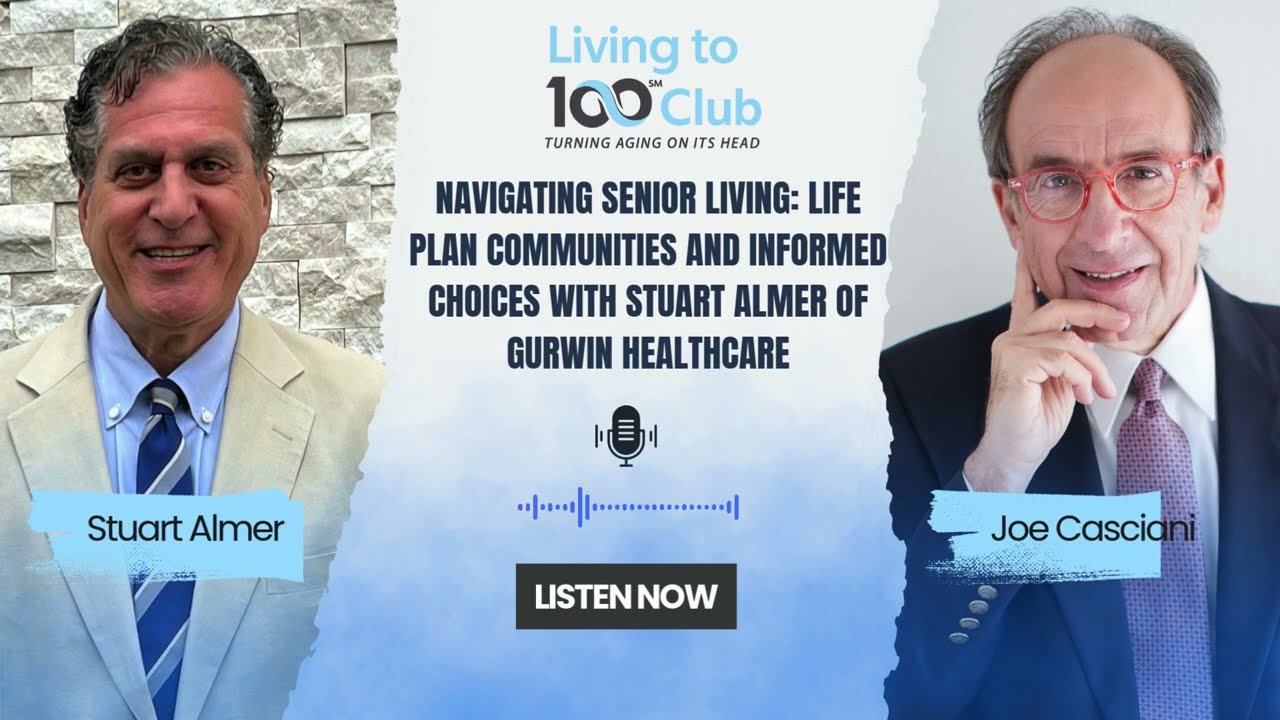
Stuart Almer, CEO of Gurwin Healthcare, discusses their Long Island Life Plan Community with independent living, assisted living, and skilled nursing on one 36-acre campus. Entrance fees range from $400k to $1M, with optional insurance-style packages covering future care needs. Residents get amenities like a salt-water pool, gym, and dog park, plus seamless transitions as care requirements change.
Chapters
Welcome to the Living to 100 Club Podcast. Here's our host, Dr. Joseph Casciani.
Well, hello to everyone joining us today. You're listening to the Living to 100 Club Podcast, and I'm your host, Joe Casciani. I'm passionate about helping people embrace psychologically healthy aging, staying positive, finding purpose, and making the most of all the years we're given, no matter what challenges come along. This podcast is part of a larger mission I call the Living to 100 Network, which brings together 3 powerful tools. One, my podcast. Second, my Better, Longer, and Happier card deck series for senior living communities. And third, the Living to 100 Community, a forum where people can connect, learn, and thrive together. To learn more, you can visit my website, livingto100.club, for the podcasts and blogs. You can join my group forum at livingto100.community. And for the card decks, go to livingto100.solutions. Thanks for being part of this journey. Now let's dive into today's conversation. In today's episode, I welcome Stuart Ulmer, President and CEO of Gerwin Healthcare System on Long Island to discuss the evolving landscape of senior living options. Stuart shares insights into Life Plan Communities, also known as Continuing Care Retirement Communities, or CCRCs, highlighting the unique features of Gerwin's Fountain Gate facilities, financial models, and the benefits of maintenance-free Wellness-focused living. First, a little background. Stuart Almer is the president and CEO of Gerwin Healthcare System, which has been serving Long Island seniors for over 35 years. Under his leadership, Gerwin has expanded into one of the true life plan communities in the region, offering a wide range of care options vibrant social programming, and a unique financial structure that supports lifetime care. Stuart, welcome to our program. Great. Hi, Joe.
Thanks for having me here today.
Oh, you're very welcome. I'm looking forward to our conversation. Let's start right at the beginning. Tell us about Derwent's journey and walk us through the evolution from a 300-bed nursing home into the complex that we have today?
So we have enjoyed having a relatively short but rich history in developing post-acute services now for almost 36 years. So what began as a 300-bed nursing home in the late 1980s has really grown now into a full continuum of care where now we are known as a Life Plan Community. So we're very proud of what we've done here on Long Island. Our reach is great beyond the Long Island area. But we enjoy being on a 36-acre campus, a beautiful sprawling campus on Long Island, right in the center of Long Island. And we also own and operate an additional skilled nursing facility, 120-bed facility known as Island Nursing and Rehab Center, about 20 minutes east of Girwan in Holtsville, New York.
Mm-hmm. Okay, so you have the complex there. We'll learn more about that. And then the nursing home, Island Health Care?
Island Nursing and Rehab Center.
Okay. Well, help us understand the whole concept of Life Plan Community. What does that entail? What's covered under that umbrella?
Sure. Well, I like to consider it an all-inclusive approach. It's really the easiest way to describe also what is easier living Safe and Secure Living. So one has to have three components, uh, that is skilled nursing care rehabilitation, uh, number two is to have assisted living facilities as part of the network, and of course the independent living community. So we have all three, but it's a special state designation. Just because you have the three doesn't mean you're a life plan community or CCRC. The, the prior older name. So we applied for that designation several years ago, and now we've been operating our independent living community, which was the last piece of the puzzle, just 3 years ago, known as Fountain Gate Gardens. A beautiful community with, uh, 3 buildings, 129 luxury apartments. All the buildings are interconnected with many amenities, which I'll get to at some point soon. This is not, as popular a concept in New York. Uh, it's much more well-known in other states. So we have to do a lot of education of the public so they understand, um, the Life Plan Community, what it's all about, how people enter our system, which again, I could discuss that later as well. Uh, but you know, we're very proud over the 3 years we're open, we've had a number of lovely folks join us who've sold their home in the community and they enter our system through the independent living.
Yeah.
If I can just explain, you know, prior to our having independent living, most folks would enter the Gerwin system from the hospital side into rehab, into our other programs. Here now, it was a bit of a sea change for us. Folks enter our system by selling their home, in most cases moving into independent living, and then ultimately graduating to the other pieces. As they need them.
Sure, sure. So the Life Plan Community concept is relatively new in New York, or it's been around, but it's not been as popular a concept here.
We are one of three on Long Island and just one of 13 in all of New York State. Okay, the concept works in the three relatively short years that we're open. You know, we've seen members where something changes with their health regarding them or their partner or spouse and now may need to reside in our assisted living facility or to go for inpatient rehab to our— what we call our center. And so we know it works.
Okay, so you have the 3 levels. You have the SNF rehab, you have the assisted, and now you have the independent. And that seems to make a lot of sense because people can transition. And of course, they can move directly from their own home in the community to your independent setting, your Fountain Gardens. And if they come from a hospital, they may need rehab or long-term skilled care or assisted, but really gives them a lot more options. I can see that.
And interestingly enough, we had a session with all the members yesterday with our team to talk about transitioning when or if that's ever needed so that we can make things as seamless as possible. Certainly a lot of questions about insurance, long-term care. But the goal is to answer any questions so that when or if they need to transition, we'll be there to support them. We're, we're a, we're a big diverse organization. We offer everything in post-acute care. So even though the life plan covers the independent, the assisted living and the skilled care, folks can access other services that we offer. Whether it be adult daycare, whether it be home care services, rehab, etc.
Yeah, or hospice rehab services. Are you contracted with these outside services vendors and they can bring in like rehab?
Well, it depends upon the— it depends upon the, the program we're talking about. So the question, right, and I guess a good example of that would be home care services.
Yeah.
So if someone, even at Fountain Gate, although they need to be independent to live at Fountain Gate, if someone needs some minimal home care services, they could tap into our agency that could provide it, whether it be an aide, maybe something for short duration, or anything more in terms of skilled care. We have those services available, so no one has to look outside of Gerwin for any of the services.
Sure.
However, one thing that makes us very unique here on Long Island is that the main thoroughfare that cuts through Commack is Commack Road. And there is a plethora of healthcare services available right at anyone's fingertips. I've even moved my own healthcare services locally to, to the centers here. Uh, two large tertiary medical centers have outpatient, uh, programs and practices here. Um, and Memorial Sloan Kettering, a large cancer center, they're also here. So that makes it very attractive for folks because the average individual is an older adult who comes into our independent living community, and all of those services are here at someone's fingertips. We've even had physicians come and provide lectures from the different facilities to our members to, number one, provide education, and if they ever need the services, that they're available to them as well.
Yeah, and offering peace of mind, of course, to your residents so they know the services are available, the backup care is, is there if needed. Yeah. So let's talk about the independent level. That's the Fountain Gate. Tell us about some of the programming that supports their independence. And, you know, I'm always looking at how people can, you know, age gracefully, more psychologically minded, managing some of those challenges that come along, staying involved, staying engaged. Tell us about some of the programs there that offer this. This kind of additional purpose.
Well, we know a lot about our members, and because we know a lot of our members, we can cater our services to their needs. And the goal here is to develop a worry-free, maintenance-free living. And we want someone to understand the continuum of care and have peace of mind. So we've developed a very vibrant, active community. So one of the amenities we have is a beautiful art room. With all types of activities that go on. By the way, that's a member-driven program. We have an artist, uh, within our midst at Fountain Gate, a member who runs the program there. We also have, um, our, um, our pool, which is extraordinary. It's a heated saltwater pool. It's very therapeutic. Um, but while we're talking about therapy, we added a rehab component last year. So if anyone has any rehab need at all and they have a prescription from their physician, they can now get rehab on site through a contracted service here within Fountain Gate in the gym, which is high-end, beautiful, and available to the members. We actually have one full-time dedicated personal trainer that is dedicated, to, to folks who live there. I believe they receive about 3 hours of time up to a month that's included with the personal trainer. So they can get rehab, they can get personal training, um, quite a lot of activities that are offered, offered there. We've constructed walking paths, uh, around our campus, some new paths. And every morning, just like today, I'm getting out of my car and Two of our lovely members are doing the walking trails. It's really park-like. We have a bocce court. We added last year a dog park. We have a pickleball court. That's quite popular. And we recently added putting greens, so you can even do little chip shots right here on, on the campus. And we're always looking, you know, what can we add, what can we do, what would people want, and what makes us unique. We have a nature preserve with fountains. It's, it's spectacular, loaded with thousands of fish, um, and it's just, uh, it's just extraordinary. But our program is, is also largely educational, so we have a book club that's also a member-driven program, and that's held in our library in our clubhouse. Our clubhouse is interconnected to the two residential buildings for all of Fountaingate. So, you know, inclement weather, people don't have to go outside. Underground parking under both facilities. We recently added electronic vehicle charging stations. Everything to make things as easy as possible, you know, for members who are, who are here.
Yeah, that sounds great. That really sounds great, Stuart. A full array of services and people can stay connected. I think that's what's so important. To stay engaged and not, you know, not isolate. So I'm always concerned about residents that don't leave their units, don't come out of their apartments. What do you— how do you address that? Sometimes there's good reason they want to be alone, and other times they're just uneasy being around others. How do you address that issue?
Well, in independent living, at least in ours, we don't really see that. We know about the interest in socialization. In fact, if you came and you came during the dinner hour or hours here, everybody comes down for dinner. Of course, people have their own, you know, kitchen. They don't have to, but everyone comes down. They're looking for the socialization. But also, if you saw how we're structured, it's very beautiful, it's very serene. If someone just wanted to sit in the little lobby area that's closest to their room It's quiet, peaceful. They don't have to interact. But it's interesting, you know, sometimes you have folks who are reluctant, you know, they're leaving their home they've been in for some people, you know, 40-plus years.
Sure.
It's amazing. Almost everyone adjusts very rapidly. It's very rare that someone is not almost immediately adjusting. In fact, one woman who recently joined us, she moved in about 2 weeks ago, I knew was coming from upstate New York. Private home, might have been some reluctance there. Um, you have to see her now with all the friends she has.
Yeah.
Um, it's incredible. It happens so quickly, but that's also true in almost all aspects of long-term care.
Yeah.
But we do a good job of, of bringing people on board. In fact, one of our full-time staff is a move-in coordinator to make the transition in easier. We have access to people resources. If someone's looking to move into Fountain Gate and they need help with downsizing, there are experts who deal in downsizing aside from movers.
Sure.
And so we have vetted all of these folks again to make it easier for people coming in.
Yeah, yeah, I think that's great. A lot of great services. And I've heard people say, you know, as reluctant as I was to move in, I wish I had moved in a year ago or 2 years ago. Once they overcome some of those barriers, they jump in and they just love it. Yeah, which is great.
It's easy to get one of the pair, one of the, you know, partners on board. Sometimes it's getting the other on board. And then, yes, usually they say that, you know, why didn't I come sooner? It's just easier. And everybody's so nice. We really offer what I believe is a concierge service. Chef-prepared meals, and I'll say, are the warmest staff you'll ever find.
Oh, so tell me about the financial model for Fountain Gate. What's the— you don't have to get into details, but the entrance fee, refundability, and lifetime care— does it allow people to move back and forth from one level to another?
Sure. So when someone comes into our system, into a Life— or any Life Plan Community, they're buying into the community. So the same someone might be purchasing their home, they're paying a price to live here. So, you know, someone could come in on the low end at over $400,000, and someone could come in at the higher end and have a $1 million apartment. But again, it's, it's an all-inclusive approach. So many of the amenities I mentioned are all included in that. So Um, but an individual can purchase, or individual, each, each can purchase what's called a life plan package. It's basically, call it an insurance product. So for an additional upfront one-time fee and a monthly fee, if someone needs to move over into the assisted living or nursing home, it's fully paid for, it's covered. If someone does not take that option, it's, it's a Life Care Type A contract, but someone just has what's called a modified Type B contract, um, they would still receive 60 days of coverage lifetime in either assisted living or, um, or in, uh, or in the nursing home should they need it. So, you know, sometimes the decision is guided on based on whether someone has long-term care insurance, and we'll help someone with that. We'll, we'll help walk them through what might be the best option for them because they have, you know, good insurance coverage.
Sure.
So those are really the two options that exist. And the, the important piece here is— two very important pieces— is that the apartment, if someone needs to move on to another level of care, they don't lose the apartment. So if the husband is living here and things aren't going so well for his wife, uh, and she moves over, let's say, to assisted living They don't lose the apartment. They don't pay anything additional for that. If once the apartment fully vacates, it comes back to Gerwin. We resell it so someone doesn't even have to bother with the resale of a home. The individual, or it could be gone, go to an estate, can get back up to 80% of the initial investment. And, um, and that option is, is available. So again, it's like buying and then selling your home without having the hassle of, uh doing it on your own. And we find that the, the children of the members who live here, their adult children, they like the safety net approach. They know that they're on a campus. They know that we have the healthcare services. They know that if something happens to mom or dad, you know, where they'll be going on to in terms of their care on the campus, you know, in the same family.
Yeah, yeah. So if someone needs to get into a SNF, maybe after some acute event, maybe a fall or a stroke, their insurance, their Medicare would likely cover it, right? Under—
would, would cover the rehab stay, correct?
Right. And then if the insurance runs out or they have to stay long-term, then that goes into Medicaid in New York. Is that how it works?
Yes.
Yeah. Okay.
And someone could be responsible for a portion of the copay while on a rehab stay, but for the most part, covered. Um, everything's covered. You know, we learn in talking to members, like yesterday's meeting that we had about transition, is that everyone has a different policy, everyone has taken a different contract, set this up differently. So there's no— no two really look alike. Um, but the members here have, you know, safety and security. When people are interested in looking at coming to our community, they, they do— we do a very nice side-by-side on paper that lists all of their monthly expenses. So we can make this very predictable. So for example, you know, the, the cable is included and the, uh, the taxes are rolled in. Um, you know, so much is rolled in as part of this. You know, maybe someone was paying a personal trainer or paying in the past for a parking spot. Um, so now when you see everything built in, utilities for example as well, um, when you do the math, you know, although initially this can seem daunting it's actually usually very affordable because you're not paying for all of the other services or having to coordinate them all any longer.
Yeah, yeah, yeah, yeah. Makes a big difference, especially when you lay it out like that on paper. So I'm curious about, let's say you have some, um, uh, prospective residents come in and maybe one spouse is really eager to move in and the other, maybe the husband, is more reluctant. He says, I don't want them move. I like where I'm living. I don't want to, you know, pack up everything and downsize. And, um, your move-in manager is, I'm sure, very adept at working with individuals like this. But how does that get resolved? I mean, we have friends right now where the wife is ready to move in, she's ready to sell their condo, and the husband is very reluctant. And even though they did give a deposit, he still is on the fence. So How do you, how do you manage that?
Well, a lot of— there's a lot of education, a lot of hand-holding. We have so many success stories, and we'll share that with potential members. We'll often have prospective individuals meet our members. We've had special events where folks come back, and we've had our existing members talk to them so they can speak to the positive experience they have had, to reassure them. If we need to speak to the children, adult children, we're happy to do that, but that's up to the members if they'd like us to to do that. But we've also offered— we're always offering tours, but we also offer free trial stays. So if someone is thinking, gee, I don't know if I want to move from California to New York, I'm thinking about it, can I stay there? Or we'll offer it to them. We've had people stay here. In fact, we had someone who lives far out on the East End of Long Island and spent an overnight here. And we're just happy to learn about a week ago that she's put in her paperwork to hopefully live here at There you go. So, you know, so it works because then they get a taste of the community. All you have to do is spend one evening, you know, just in the dining room and feel the vibe from the, the current members. And we work hard at this, um, you know, it doesn't just happen without a lot of good hard work and caring and attention for, uh, for members. But the trial stay really, really works. We try to address, you know, financial questions they might have. Look, it's overwhelming, and we understand that, but, you know, this is what we do.
Yeah, that's good. I appreciate that. It is a process, and it's not going to be a quick conversation. It's a, it's a, it's just an unfolding process where people can examine their concerns and reluctance and, you know, discuss it. That's, that's really a good idea. I'm going to suggest to our friends of their prospective facility might allow them a couple of nights overnight. I think that'd be good. Yeah. So stepping back a little bit, let's talk about the whole industry of senior living communities and assisted living. I think when you and I spoke earlier, you talked about assisted living settings being overbuilt. Is that still kind of the—
yeah, it's interesting. What we found, one of many things we found, is that as we exited the COVID period or the extreme period we went through due to COVID. Um, you know, all of us who operate assisted living facilities, nursing homes too, had significant amount of vacancies. Now what's interesting is, uh, in the assisted living world, um, there are so many buildings and apartments that have been built everywhere, uh, that overall occupancy is not what it was, uh, 5 or 6 years ago. So for example, on Long Island alone, Um, average occupancy is in the low 70s, 70-something percent of apartments occupied across Long Island when we were 95%, all of us, 6 years ago. Yeah, because so much overbuilding. Everyone planned for future for the aging population, um, without anticipating there would be a shift. And, um, so, you know, many people, you know, you know, began not to look for residential care. So we're now seeing that again, or I should say communal care. So now we're seeing a shift. People are coming back. And so the occupancy, thankfully, is increasing everywhere. And but it's changing the mix in assisted living facilities. It's having facilities maybe hold on to residents who maybe even need to move on to a higher level of care. There aren't people to backfill. You want to— you want to have an independent facility. You want independent members in an assisted living facility. You want true assisted living members.
Sure.
And so if we were full in assisted living, all of us, we probably look to move on quicker, those who need a higher level of care.
Mm-hmm.
So it's just— these are just forces that we're all dealing with. So the good news then for people joining our independent living community who need assisted living services is that there are vacancies available. Um, that part right now is easy until such time we get very, very busy again. But as I said to our members yesterday, because of Gerwin's overall size and scope, we have a lot of flexibility and a lot of ability to move folks through our system. Um, our, our skilled nursing facility, our, our nursing home has 460 beds here on our campus. We're quite large. Our assisted living facility has 210 apartments. So I just reassured everyone yesterday, again, based on our size and scope, we can help people much more easily in transition than other people can.
Yeah. Yeah. That's a, that's a huge capacity that you have. So are the occupancy rates going down in these ALFs, would you say?
I mean, well, they, they, they hit a low point and now, you know, down to about 69 or 70% overall. And now they're climbing again. I think people are having more confidence in communal care. Um, but it's a very competitive time in the assisted living world. Advice that I would give anyone, uh, you know, dialing in today, if you're looking at assisted living facilities anywhere for your loved ones, um, you can ask for things and negotiate. Um, you shouldn't be afraid to do that. I give that advice to folks. People do that here. We offer certain incentives. Because we need to fill our buildings, we need to stay viable. You know, we have staff who are taking care of residents, and we need to have residents for them to take care of. So it's a good time, uh, good time to do that. And there are things that people can ask for that they may not even think about— furnishing an apartment, maybe covering a move-in fee from a mover. So many things, certain amenities, you know, upgrades, things that, you know, we can relatively easily do. We would do.
Yeah, of course, the aging-in-place model is still strong. People are adapting their homes so they can stay longer with ramps and grab bars and even elevators in some cases. But what advice do you have, Stuart, for people that are just, just beginning to consider transitioning to a senior community, to a Life Plan Community? What What do you, what do you recommend they look for or ask about?
Well, certainly starting early and making a plan is the best. You know, one of my mantras is, you know, don't wait for a crisis. You know, if you can see where things are going, plan and adapt. I think it's human nature at times to wait, and now you're in a crisis situation, and it's not fun planning during a crisis. You know, I've been through that, you know, myself personally, and I understand that. Establish a budget. Visit communities as well. You know, I'll always suggest to folks, you know, seeing it, you'll really get a feel whether it's the right setting for you. You know, do you want a larger setting, a smaller setting? Do you want to be in a bit where you can walk into town, or would you rather be in a private campus-like setting? It's almost like you know, looking at the college hunt, you know, and sometimes people make decisions not based on, you know, curriculum, but they might base it on a feel.
Sure.
I think if you came to our 36-acre campus, there's a wow factor there, um, and then the whole scope of services. But some people like small hidden away facilities, so you have to visit, you have to ask questions, and if you're doing it not under stress to make a better informed decision.
Yeah, yeah, that's really good advice to plan early, start to explore, start to investigate, find out what, what facilities, what type of setting you like. But that makes a lot of sense to avoid that last minute or last week or last month kind of hasty decision because those are— they don't work out so well. We know that. Yeah, yeah, that's good. That's good. So overall, Stuart, what's the final takeaway? I mean, it sounds like Gowen System has got some really notable, valuable settings there for residents on Long Island. What's the final takeaway for the listeners on our program today?
Well, I think, as I said again, you know, planning when you're not in a crisis is important. There is one other important service we added a year ago that means a lot. We're one of the very few nursing facilities that has its own in-house pharmacy. Again, demonstrating our size and scope. Our pharmacy now services all Gerwin entities, all buildings, including the Independent Living at Fountaingate. So you can even have your prescription filled here at Gerwin, and that's important. But certainly, you know, I mentioned, you know, not waiting for a crisis.
Yeah.
Having peace of mind. Um, also, you know, geography is so important. We have a number of members who've come to Gerwin, um, and they might have been out of state for several years, but the adult children live on Long Island and they end up coming back to live here. So we've had many people who've come from Florida, California, I recall Chicago, um, to come back to their roots and their children here. It's quite interesting to see that, you know, fully evolving circle.
Yeah.
Um, and because we do know that folks who often make care decisions, not always on care, they're often making it on geography. So we know being close by is important. You know, I'll have folks reach out to me, you know, I'm thinking of bringing, you know, my mom there to your facility, uh, and then I find out, you know, they live an hour away. Well, how are you going to visit your loved one? You know, I wouldn't ever, you know, promote if it wasn't going to be workable for them. Geography is very, very key here.
Sure, sure. Wonderful information. I know our listeners will get a lot out of this, just the education itself about the range of services, what to ask for, what to look for, how important planning is, how important the setting is, the ambiance. All of that makes for a smoother transition. So this is great. Great. What's a website Stewart, that people can look up your campus and learn more about it? Sure.
So there's two ways to find that information. If you were specifically interested in the independent living at Fountaingate Gardens, you would go on to www.fountaingatel.org, or you can simply just go www.gurwin.org. Gurwin.org. That'll bring you to everything. Whether you're interested in any of the services that I spoke about earlier.
Sure. So—
or, I'm sorry, or you could just simply call 631-715-2000 and you'd be directed, you know, accordingly to whatever might interest you.
Sure. Okay, so we have fountaingatelI.org specifically for the independent setting, or for the whole campus, the whole complex, it's gerwin.org? Correct. Yeah. And the phone number? 631-735-2000.
715-2000.
Writing quick. Okay, got that. All right, well, thanks very much. Um, looks like we're out of time for today. Stuart, this has been great, a lot of information. But before we wrap up, I just want to remind my listeners to visit my podcast, my website for my podcast library and blog library, that's livingto100.club. Visit my community for connection and interacting experiences, livingto100.community. And if you're part of a senior living community like Gerwin, don't miss our Better, Longer, and Happier card deck series. That's at livingto100.solutions. Stuart, thanks again for joining us today. We have your information, your websites, and I appreciate that. And, uh, to all of our listeners, thanks for tuning in. Hope to see you next time.
More from Joseph

The Hidden Cause of Aging? How Chronic Inflammation Affects Your Health with Joel Brind








