Optimizing Hormones for Healthy Aging | Menopause, Longevity & Vitality with Dr. Prudence Hall
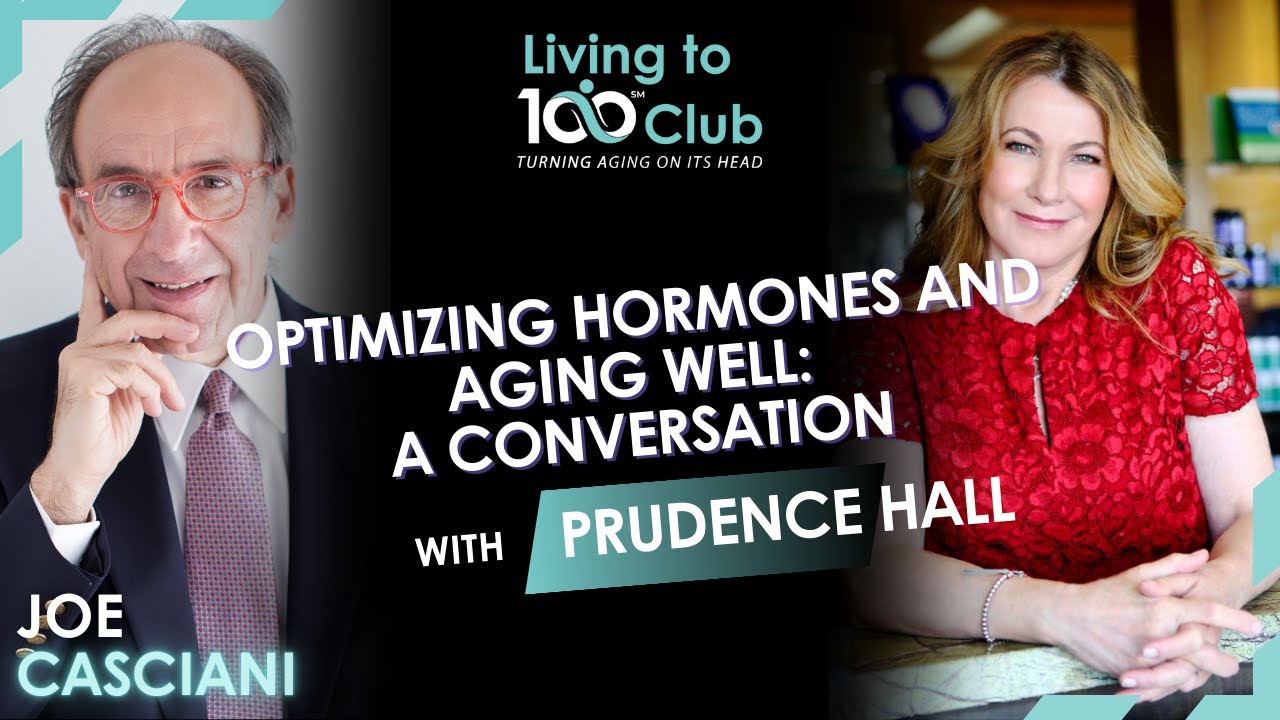
Dr. Prudence Hall, a gynecologist, argues hormones are the body's operating system. When estrogen, progesterone, and testosterone decline, she says, chronic disease and cognitive decline follow. Personalized hormone replacement, combined with sleep and anti-inflammatory food, can restore energy, mood, and brain function.
Chapters
Welcome to the Living to 100 Club Podcast. Here's our host, Dr. Joseph Casciani.
Hello and welcome. You're listening to the Living to 100 Club Podcast where we explore the upsides of aging. I'm your host, Dr. Joe Casciani. In my programs, I talk with experts and thought leaders about how to stay positive, resilient, and purposeful. Because growing older isn't about adding years, it's about making those years count. This podcast is part of my broader Living to 100 Network, which brings together 3 core pillars: these conversations and blogs, a growing collection of practical tools and learning resources like my card decks and other products designed for individuals, families, and senior living settings, and my Living to 100 Community, which is a space to connect, share insights, and support one another on the journey. You can explore it all at my livingto100.club, livingto100.solutions, and livingto100.community. Thanks for joining me as we focus on living better, longer, and happier. Let's get started with today's guest. Hormone balance plays a central role in how we age, influencing energy, mood, sleep, strength, cognitive clarity, and overall vitality. In this episode, I speak with Dr. Prudence Hall, a gynecologist and pioneer in bioidentical hormone therapy and functional medicine. Dr. Hall shares her 4 decades of experience helping patients navigate menopause, and beyond, using personalized hormone treatment, nutrition, peptide therapy, and holistic lifestyle approaches. Together, we explore the concept of health age versus chronological age and how mindset, purpose, and self-talk shape long-term well-being. This conversation is about aging with agency, not slowing down, but supporting our bodies and outlook to remain strong, joyful, and engaged at every stage of life. First, a little background. Dr. Prudence Hall is passionate about helping women reclaim their health and their lives. From perimenopause to menopause and the challenges along the way, Dr. Hall uses regenerative and integrated medicine to guide women everywhere in rediscovering their energy, vitality, and joy for life. After years as a traditional gynecological surgeon, it was this passion that led her to create the Hall Center in Santa Monica, California, and write her book Radiant Again and Forever, which helps women understand what's happening to their bodies and become empowered as they navigate this transition. With care and compassion, Dr. Hall is here to help you get to the root cause of those frustrating symptoms and reinstate harmony within. Welcome to our program, Dr. Hall.
Ah, Joe, thank you. I'm so happy to be here.
Oh, you're very welcome. I'm glad you're here too. I'm looking forward to our conversation. Yeah, let's, let's just jump right in. You've been working in hormone medicine for over 40 years. How did you come to specialize in this area? What drew you to it initially?
Well, first of all, my kids say, don't say 40 years, you sound so old. I said, yeah, but we're only 20.
Okay. 20 plus. Yeah.
Yeah. But really, I, uh, it came out of necessity, Joe. I trained at a wonderful gynecology residency and obstetrical residency at USC at Keck School of Medicine. And I was dealing with the sickest and toughest cases I would say ever presented to gynecologists. Patients came in, uh, really destitute, crossing the border from Mexico, no healthcare at all, and they would end up in our hands. So I thought when I left the residency that I knew everything. I wasn't— it wasn't a hubris, it wasn't a pride, it was just a solid grounding in what I thought was the reality of gynecology. Then I started meeting my menopausal patients.. And I was faced with this huge deficit in my training. I mean, we had a menopausal clinic and the, you know, check and make sure they haven't had a period for a year. Check the FSH. That's the brain hormone that tells us if it's above 20, you're in menopause, below 20, you're not. And if it's above 20, give them Premarin, pregnant mare's urine, for a year and then see them back in a year. So that's what I did. And my patients came in weeping and furious. It's like, you're mad at me? Okay, what can I do? So anyway, I went back to school and I, for years, I studied how do women's hormones work? What do they do? What effect do they have on the body? And very rapidly, within a year, I realized, okay, we're changing the whole way I'm doing things with menopause. And it just lit me up to see the changes that women went through. Rather than crying and upset and angry, they felt literally— they felt younger again and healthier and vital. Their sexuality was improved and restored. Their positive thoughts were restored. So, I'm in it for life. I just love this field.
So, time to rethink the whole traditional approach. Many people still think hormone therapy is only about menopause symptoms. So how's the field evolved and what broad roles do hormones play?
Yeah, I'm not sure if the field has really evolved completely where I would like to see it. But for 20, 25 years, maybe even 30 years, I've been saying, look, hormones decrease heart disease, dementia like Alzheimer's and Parkinson's. They decrease diabetes and strokes. And Yeah, there was this huge ocean of pushback against that. Well, I was actually sanctioned by the medical board because I was supposed to say it causes osteo— I mean, it prevents bone loss and it prevents symptom control. Now, luckily, about a month ago, the black box warning was removed from hormones, and the black box warning said, yeah, it causes heart disease, dementia, I mean, on and on. Terrible stuff, terrifying women. So, you know, I mean, that's really great. I was actually on TV talking about it, and I— great that it was removed. It's about 20 years late, and women are still afraid of breast cancer. And I mean, no one wants to, you know, hurt their health by making themselves feel better. So, but you know, this is refreshing. I think the field is catching up with the scientific data. I'm very grateful for that. And, um, it's now being considered an accepted and vital treatment in many fields. I mean, in many areas of medicine.
Yeah, beyond. So what was the pushback about? I mean, I appreciate people who kind of stand up to tradition, say let's look at something else about it. What was the pushback from the medical community about? Yeah.
Well, first of all, individualized healthcare is not considered a standard of care. You do not individualize things. There's a protocol that you follow. You follow that protocol. And I was redefining menopause. I mean, menopause starts at age 35 or 38, something like that. No one considered that that was even a possibility. So, you know, I was on Oprah, Joe, and Dr. Phil and all of these shows as a really sincerely educating and wanting the public to know the benefits that I had been experiencing with my patients for at least 10 years before that. And it wasn't— it was early. You know, pioneers have arrows in their back. I was daring greatly, as Bernays says. You know, the field of medicine is very conservative. And I like to say that it's scientific-based. But one of my friends who actually died of a glioblastoma had companies around the world. And when he developed this glioblastoma, he said, "Prudence, if medicine progresses like I'm experiencing right now in the medical field at Cleveland Clinic," great clinic, medicine will collapse. I mean, my companies would collapse if I even began to have this lag in, in from science to application of the scientific principles. Sure, I would not have these businesses. Medicine is so far behind the IT field. He was in the IT and we got to change it. Now, he did die of melanoma. I mean, not of melanoma, glioblastoma. But that's great as where to live and to help transform and bring the medical field up to the degree of of, I would say, competence that the IT field is in. And I hope we can do that, Joe.
Sure. It takes time, but I think you're right. I think we are progressing. So you've described hormones as kind of a software for the body. How do you, how do you mean that? And how does that apply in practice?
Right. So how does the body work? How does it run? Well, we need food, we need water, we need sleep. And the chemicals that make the cells function correctly are hormones and then also enzymes. So if we don't have enzymes, we're gonna really get sick.
Mm-hmm.
We won't digest our food. Enzymes do almost everything in the body also. And hormones will specifically beat our heart, connect our neurons, connect our, our brain cells. It builds muscle mass, bone density. It, it, it guides the body. It creates— it's the janitors in the body, for example. It does all the bodily functions. So just like when you boot up your computer, you have to have software that's not corrupted or else there are a bunch of lines across the computer.
Yeah, the operating system.
The operating system. It's our operating system. And when that becomes corrupted or deficient, Well, the cells don't work, the body doesn't work. And that's why these diseases start occurring right at menopause and before. So huge increase in breast cancer, heart disease. Heart attacks are the number one cause of death in women. And in my practice of, you know, 40,000 or something patients, I've had 4 women have a heart attack. They're all alive. They're all well. Yeah. How can— of course, I talk about lifestyle and diet, and it's not just hormones, but hormones are a tremendous benefit to get the body functioning correctly and to help prevent, you know, the LDL cholesterol from going up, the sugar, the inflammation, the stress. All of those go up in menopause. And those are the core root causes of most chronic diseases.
So the inference is that the hormones drop off, right? Or there's fewer hormones or less present. They're less present. Is that with age?
Or yes, with age and illness. So when I think about ill— when I think about aging, I don't really think about the chronological age. Yes, let's live to 100 chronologically. Let's be biologically 40 or maybe, maybe probably more like 40, 35, 40 our entire lives. So yes, as we age chronologically, the hormone levels do decline. In fact, estrogen becomes zero. You know, at menopause. And also the thyroid gland, due to toxicity and due to the other hormonal interactions, declines. The body is extremely stressed when we lose our estrogen and when men lose testosterone, by the way, Joe, you know, very stressed. And so then the adrenal glands, which are little glands that sit on top of the kidneys, those decline. And so you have a pan— meaning a full across deficiency in our operating system. We don't operate well. We're tired, we're depressed, we can't sleep, we don't want to make love, we have no energy. We, you know, where's the energy? Where's that essential, beautiful radiance of energy that you talk about and which gives rise to purpose and a meaningful life?
Yeah. And it makes us more vulnerable to other infection, disease processes. As you say, how about the cognitive function? What is there a relationship between hormone decline and, you know, cognitive impairment?
Absolutely. And that is something that's being investigated extensively in this field. I think the leader in this field is Dr. Dale Bredesen. He wrote the book, The End of Alzheimer's Disease, and he has a new book out about all the survivors of Alzheimer's disease. And I love this man. He is icon in his field. He's been both loved and vilified, as many pioneers are. But he has conclusively shown that estradiol— and he's told me this personally— estradiol is critical for the brain's functioning, and testosterone is critical for men's brain functioning. So you want to prevent Alzheimer's disease? Well, rebalance your hormones to youthful levels. Your sugar, exercise more, get 8, 9 hours of sleep. I mean, there are many things, many supplements that also help to resuscitate mitochondria. That's the powerhouse, little vesicles in each cell that create all the power. So it is preventable and it is curable. You need to— our brain starts to decline as early as 30. So we want to jump on this bandwagon early and make sure our hormones are balanced. This is one reason, Joe, that I don't like the birth control pill. Because it really hurts our hormones. It hurts the hormones of young women.
Well, so the, the whole notion of hormone deprivation or decline and, and how it might produce dementia or Alzheimer's, I take it this is the, as you said, a reversible, it's a modifiable risk factor. It's not like some other neurodegenerative disease where the neural pathways are clouded with, you know, all those precursors, the tau and the amyloid plaque. So this is different from that, right? I mean, this is, or is it?
It's the same. So, so at a certain point, tau and plaquing does occur. So plaquing is the result of a brain insult and, and inflammation in the brain and toxicity in the brain. So tau is created and, you know, plaquing, plaquing is the hallmark of Alzheimer's disease.
Sure, sure.
Right across the board, hormones decrease all neurodegenerative diseases. Now, that's just a little bit of an exaggeration. It'll help to prevent Parkinson's, of course, Alzheimer's disease, Lewy body disease. These are really ALS because they have core root causes of toxicity, low hormones, and all these lifestyle things. There is a genetic component to Alzheimer's disease. And possibly to these other diseases. But we can overcome our genetics. We are not our genes.
Excuse me, I like to turn the audio off when I'm coughing. Yeah, that's so interesting. You know, I've really been kind of understanding this whole notion of reversible dementia, and then there are the, you know, the true, like I said, neurodegenerative causes of Alzheimer's and vascular But as you say, the hormone decline will interrupt that whole progression of the Alzheimer's onset.
Absolutely. That is one of the newest messages coming out. And it's being suppressed, actually, by— it's being suppressed by a number of different organizations who have perhaps, you know, a different set of criteria that they talk to their constituents about. But yes, I mean, that's a message that's now been out here for maybe 15 or 20 years.
Yeah.
And it's really in the forefront because there are all these survivors of Alzheimer's disease and neurodegenerative decline that really couldn't function, and now they're functioning. They're driving, they're working, they're back to normal. Sure. It's a miracle, Joe. It really is. And I think that this is the field opening up into greater potential for human lives. Yeah, we don't develop Alzheimer's disease and, you know, any neurodegenerative decline if we're living to 100.
Sure.
We want to have a youthful, pliable brain.
Yeah, yeah, that's so, that's so useful. I mean, that's really great. I, I, you know, I, I know there are other reversible causes like diabetes and hearing loss and toxins in the air and secondhand smoke. All of these things are shown to be contributing to dementia, but those are also, like we said, the reversible factors, modifiable risk factors. But this is really great information to share. I always like to be the messenger on these kind of topics. You mentioned the testosterone. Is there a role for testosterone for women? Therapy for women?
Absolutely.
Yeah.
And it has been declined by the FDA. I know there are weird ideas out there about testosterone. So testosterone is important for women. Our levels are someplace between 40 and 100 ideally. I don't actually use the traditional lab values for ideal, you know, those lab values look at a lot of elderly people, sick people. So I use youthful levels when I look at parameters for labs. And testosterone, generally it's sort of like 50 to 100, 40 to 100, which is healthy for women. It builds our bones, our muscles, our tendons. It helps with directional forward thinking so we don't loop around. And, yes, yes, it gives us confidence. And, Joe, it really helps with sexuality. When, when Abe Morgenthauer announced— he's the father of testosterone therapy— that he went before the FDA, and the FDA declined testosterone therapy, and this more data than, you know, I mean, like an avalanche of data in terms of testosterone. I stopped making testosterone in the clinic. I gave it all away. And, uh, it's been quite a while that I haven't made it now. But I came off the testosterone and I felt more down. I felt my brain was more foggy. I couldn't have orgasms. It was horrible. And it's like, oh my God, Thank you for allowing me personally to experience this. I was more frightened, a little bit more, oh, something's gonna— I got back on testosterone and all of those symptoms disappeared. And it's— I mean, my patients have been telling me about this for years, but I had always been on it. I had never seen what does a deficit feel like. Now, for men, the deficit is even more. I mean, I take care of men and men whoa, when their testosterone is low, they really decline.
But it has the same effect or very similar effects, whether it's for men or women. And when the treatment is testosterone is taken, it's— it serves the same role for both.
Yeah, yeah. So men, men develop belly fat, they're grumpy, you know, they have a lot more negative thinking, they lose their muscle mass, they lose their erections. Men tell me all the time, you know, what's happening? Just, you know, these erections just are not what I'm used to. And I mean, I kind of don't think about sex like ever. Even 32-year-olds, they'll say, yeah, I mean, am I gay? I'm not thinking about women. What's going on? Oh, Prudence, I'm frightened. You know, I used to do these big deals, these multimillion-dollar deals. I'm feeling, you know, a little bit like I shouldn't be doing that. And then men are back in the saddle. Oh my God, Joe, they just do. They show up. Building muscle mass, going to the gym, feeling positive, defending women rather than, rather than criticize us.
Very powerful effects. All right. Yeah, that's confirming what I, what I've heard and have already, uh, kind of understood. Well, let's talk a little bit more about lifestyle. And, um, where does lifestyle come into play? We know that it's, it's so important as we age, and, you know, our cognition and our overall functioning. How does it interact with hormones? And I mean, do one complement the other? And how does that work?
Well, I consider lifestyle front and center to any therapy. So you can give women and men hormones. If they don't exercise, sleep, and eat in a, in a manner that's healthy for them, the hormones are going to have much less of an effect. Oh, interesting.
So they complement.
Yeah. The core of functional medicine, even though it's Jeff Bland, Jeff Bland, the father of functional medicine, really changed the way I practice and thousands of doctors practice. Front and center is nutrition. So when I started doing all these classes in functional medicine, and a lot of times they would just say, just change the diet. That's all you have to do. And I could not believe how changing the diet got rid of or decreased body pain, depression, weight gain. So yeah, front and center is lifestyle. 8 to 9 hours of sleep. Decrease the toxicity in your body by eating clean. Decrease your, you know, simple carbohydrates. Eat meat, which is okay. You know, clean pasture-raised beef. Pasture-raised eggs, enough protein. Yeah, it's anti-inflammatory diet. That's what I call it. It's the functional medicine diet.
Sure, sure. Does it replace or substitute hormone therapy? I mean, is it sufficient?
No, no. But, you know, we talk about decreasing ovarian decline, so we don't want the ovaries to go into a premature deficient state. And I take care of a lot of women who do. And I think that stress plays a big role in this toxicity, our increased sugar in our diet. Sugar, you know, the, the more sugar and refined carbohydrates we eat, the more the cells get covered with sugar. We call that glycation. It's candied apple. I mean, apples in there, but it's covered by sugar, and that causes decreased cellular function. And also, these powerhouse inclusion parts of the cell, the mitochondria, can decrease with unhealthy aging. So we want to keep those cells alive and functioning and very healthy. And so diet and lifestyle really play a huge role in that, and also hormones. So it's a cocktail.
Yeah. So we can change our lifestyle, improve our activity and physical exercise and diet and engagement with others, that doesn't reduce the need for hormone therapy. Yes.
Regardless of how healthy you live, how wonderful your thoughts are, positive your thoughts are, and how many wonderful deeds you do for humanity.
Yeah.
Hormones will decline.
Okay.
And they absolutely decline in everyone. You don't want 'em to decline too prematurely. So that's one of the ways that we can use functional medicine to help us. Support our cellular health. But yes, it declines in everyone, and it's younger now. Menopause, 44 to about 48, not 50, 51, 52, 53 like it was 4 decades ago. Earlier, I certainly see, you know, the sperm count in men is decreasing a lot, I think due to stress and toxicity. I see a lot more younger men who are 38, 40 who have very low testosterone due to stress.
Sure.
Other factors.
So the lifestyle changes are necessary, but they're not sufficient. Can we say that?
I would say that is very correct.
Okay.
Yeah.
In fact, both, I mean, hormones are necessary, but not sufficient. The lifestyle is also part of the picture. Yeah. Yeah.
If I had to choose one. I'm not sure that I could. I mean, I'm sort of— it would just change your lifestyle. I would say that right now we should all change our lifestyle and make it a healthy, healthy lifestyle. That's amazing to do that. Get enough minerals. I mean, the thyroid, for example, you want to improve your thyroid function, 3 Brazil nuts a day, and that has 200 micrograms of selenium in it, and then some iodine. That, that's lifestyle. Because eating more sea plants and things like that, taking more iodine sources, that alone will help your thyroid function much better. And avoid fluoride in your toothpaste because fluoride, bromide, that'll block thyroid function. And take some omega-3. That really helps with everything. So, yeah, I mean, it's a complex matrix that we're dealing with. There's no one simple solution. But yeah, you want help, gut health. Yeah, you want a healthy gut. You want to have a detoxified body.
Sure. And the message is there. We, we need both. We need both. And we really should focus on all aspects of health. I mean, we, we know so much now about living longer and living healthier, and lifestyle is one of the big ones, right?
Yeah, huge, Joe. It's, yeah, all the way to the outer, outer planets and back. That's how important it is.
So what, what innovations are you excited about? What do you see on the horizon where we're going to be able to have a greater impact on, on our health?
That is such a good thing to ponder. I would say that there's an exploration of consciousness that hasn't been really explored enough, and answers are not there. But at the very core root of this being and these beings that we are is consciousness. That's how we differ from other animals. And for us to be able to consciously change our body just by our thoughts, which we know we can do. I mean, this happens all the time. To really understand the process a little bit better, that would be a huge innovation, a huge way where we could, I would say, alter different parts of our body that become sick and heal those parts and keep ourselves well. So that's right where I am. How do our thoughts affect us? How does love really regenerate and, and prevent disease and death?
Um, yeah, that's, that's a fascinating subject. Maybe I can invite you back and we can continue that conversation. But you know, it's that consciousness that connects everything, right? And we're connected to this universe. Um, it's part of the epigenetics field, right? Understanding how our our environment can affect us too because of our thoughts and the way we connect with the environment. Yeah, that's very powerful. Very powerful. Yeah.
Yeah, it really can help with— it can move us forward to enter, um, maybe a more tender or more true purpose for ourselves. And it takes us away from self-criticism and self-hatred, and of course spills out onto the rest of humanity. Um, Yeah, we're at a real stage of growth in terms of humanity.
Yeah.
In terms of who— what is our potential? Who can we actually be for each other and for ourselves?
Yeah. Well, that's true. I think that's great. Um, you know, I, I think you and I both are working beyond the usual retirement age, and I wonder what, what keeps you moving, what motivates you, and what brings a spark to your day.
Well, chronologically, I'm 75. I'm a 75-year-old Leo in both Vedic and American astrology. No, but just 75. So that's a chronological age. My hormones are about age 35 to 40. I have no diseases. So it's not only this feeling of well-being inside of me that creates well-being, joy, sensuality, love. Wanting to be in service to humanity because I have so much energy and enthusiasm for what's possible. It comes out of that positive well. So I would say that it's how I see the transformation of my patients who go from despair to joy or from despair to hope. In the beginning, the first couple of months is from despair and from depletion and fatigue to hopefulness. Hope can really be very inspiring. And then from hope to a greater sense of themselves, not only physically, but also knowing who they are. I love to have these conversations. Who are we? Who am I? And the change, because, Joe, once we feel full of life, life blesses us with her bounty. And women climb mountains, write books, start schools in underprivileged areas. They give back. They love. I mean, one person who loves and gives can change everything in that community and household. So it's the gentle and radical change that I see in my patients.
Patients.
I really love them, Joe. I'm behind them. I want them to become the person that they know they are and they used to be, maybe even a different person. I'm kind of a cheerleader and I'm an interpreter of their hormones and of their help give them feedback. And it's just, I love it, Joe. I love it. Yeah.
You know, I think that's great. I have similar feelings when I speak to seniors about the opportunities that lie ahead rather than decline. There's really doors to open and new chapters. I'd love to see the changes in that attitude about aging. And you're talking about something very similar, the changes in your patients as they kind of remove those barriers and open up new talents and new possibilities. I think that's beautiful. Yeah.
Thank you. It's also an intellectual field. It's also scientific. So, you know, the mind is active learning all the time. I think lifelong learning is important for all of us. Because if we're not growing and learning and embracing change, we're declining.
Yeah, that's right. So tell us about your website. Where can people learn more about your work and get your book, copy of your book?
They're going to see this podcast that you do.
That's right.
All the rest of them that you do. So you can reach me at thehallcenter.com. My book there, Radiant Again and Forever, is for free. You just put your email in and it downloads to your email. And Suzanne Somers encouraged me to write this book, actually strong-armed me to write this. She'd interviewed me many times and I've been in her books. I absolutely loved her very, very much. And she said, you got to write the book. Write the book. She's very smart. I said, I don't have time.
She did well as a motivator, didn't she?
Yeah, she did. And she said, okay, this is what you do. Each chapter is a different, a different illness for women. Menopause, perimenopause, low thyroid, low adrenals. And then, you know, end up with some potential of women. It's like, oh, I can do that. She said, bring women into your consult room and just tell them what happens to a patient. So I did that. And when she gave me that structure, it just flowed forth. It was easy. It's free.
Yeah, free.
I don't, you know, I'm not trying to Starts once we have the container.
It's, it's easy to fill it up, isn't it? That's how I see it. Like, yeah, it is. That's great. So thehallcenter.com, people can learn more about you and your work and download a copy of your book. That's great. Yeah. Well, um, Dr. Hall, our— looks like our time has come to, uh, an end here. And thank you for sharing your insights and expertise. And for listeners who like to learn more about your work, they can visit JosephCasciani.com. And to the audience, thanks for spending part of your day with us. If you'd like to continue exploring the upsides of aging, visit my websites, LivingTo100.club for blogs and podcasts and articles, LivingTo100.community for live interactions and roundtables every month. And then my online store, LivingTo100.solutions. You'll find a bunch of materials and products and card decks and all that. So thanks again, Dr. Hall, and thanks to our audience for tuning in. Living longer is becoming the norm, but living better is the opportunity.
Okay, thank you.
Thank you. You're very welcome.
More from Joseph

The Hidden Cause of Aging? How Chronic Inflammation Affects Your Health with Joel Brind








