The Link Between Dementia and Oral Health: A Conversation with Dr. Whitney Deitz of Aspen Dental
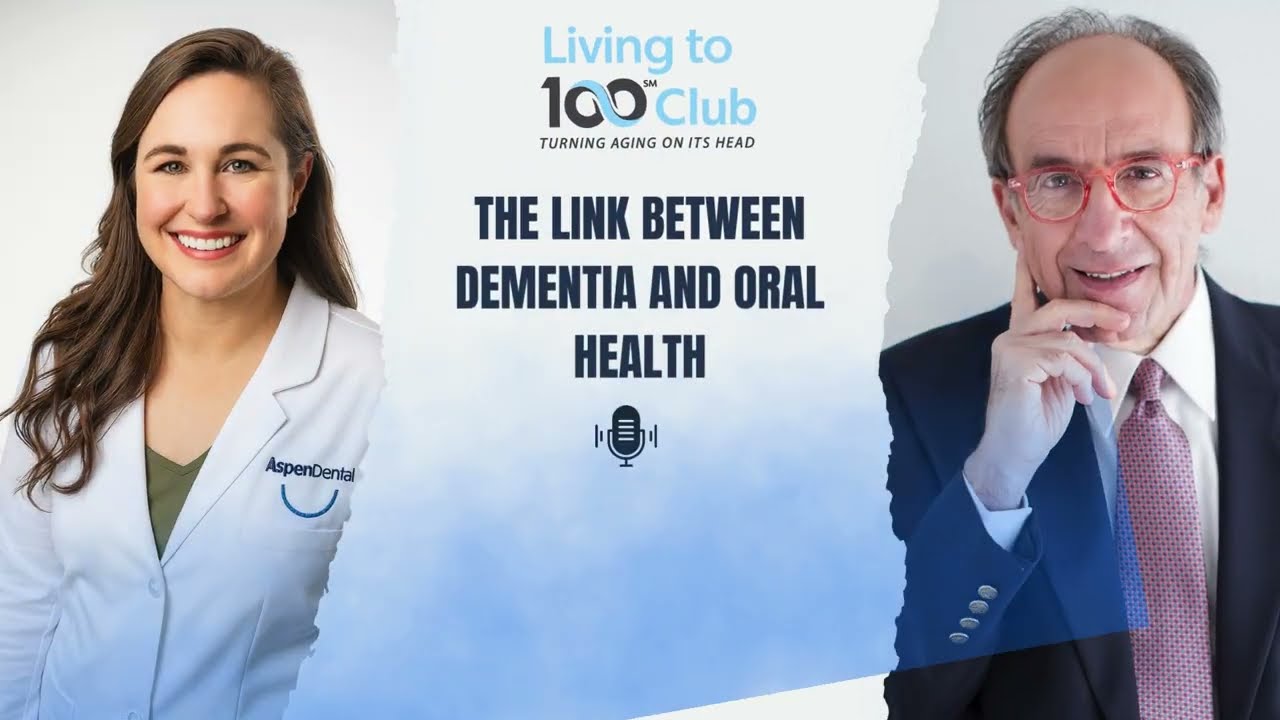
Dr. Whitney Deitz explains how oral bacteria, particularly Porphyromonas gingivalis, appears in Alzheimer's brains and impairs memory in mice. Over half the global aging population has periodontal disease. She discusses barriers to dental care for seniors and practical tools like electric toothbrushes and salivary substitutes, plus the cardiovascular risks of poor oral health.
Chapters
Welcome to the Living to 100 Club Podcast. Here's our host, Dr. Joseph Casciani.
Well, hello to everyone joining us today. You're listening to the Living to 100 Club Podcast, and I'm your host, Joe Casciani. I'm passionate about helping people embrace psychologically healthy aging staying positive, finding purpose, and making the most of all the years we're given, no matter what challenges come along. This podcast is part of a larger mission I call the Living to 100 Network, which brings together 3 powerful tools: my podcasts, my Better, Longer, and Happier card deck series, and the Livingto100.community, a place to connect can learn and thrive together. To learn more, visit my Living to 100 Club for podcasts, join the group forum at livingto100.community, and for the card decks, visit livingto100.solutions. Thanks for being part of this journey. Now let's dive into today's conversation. In today's episode, I welcome Dr. Whitney Dietz, a practice owner at Aspen Dental, as we explore the powerful connection between oral health and cognitive decline. Dr. Dietz shares insights about how periodontal disease may increase the risk for Alzheimer's and dementia, the challenges of maintaining dental hygiene in indiv— in individuals with reduced dexterity, and the critical role of prevention throughout the lifespan. We'll learn about the role of bacteria in periodontal disease and its potential link to dementia. We'll learn about the importance of maintaining oral health for dignity, pleasure, and overall well-being. We'll talk about practical dental care strategies for older adults, and we'll talk about how dry mouth, tooth loss, and limited mobility can all contribute to declining oral health and cognitive outcomes. Join us as we uncover why oral health isn't just about teeth, it's about quality of life, cognitive health, and longevity. Dr. Dietz, welcome to our program today.
Thank you very much for having me, Doc.
Yeah, yeah, you're very welcome. I'm looking forward to our conversation. Let's jump right into it. Tell us about the, the research behind How periodontal disease is linked to cognitive decline. There's a lot of new science and evidence coming up about that. Share, share what you can about that for us.
Of course. I think first we should highlight that over 50% of our aging global population has periodontal disease, whether diagnosed or undiagnosed. So this is a concern for aging adults. Um, across the globe. When we look at the connection between oral bacteria and the development and progression of Alzheimer's disease and dementia, it's important to consider the mouth, teeth, gums, bone as part of your overall system. Periodontal disease, if placed on your skin, would be an open, festering, pussy wound the size of your hand. And that is a significant infectious source very close to the brain. So it's no surprise that as research has been ongoing over the last 10 years— the first study that I even found was a year after I graduated dental school in 2015. So the research is fairly new that we see the bacteria that is in periodontal disease in the brains of people with Alzheimer's and dementia.
Wow.
Wow.
That's significant. That's clearly some direct links. So the periodontal disease just spreads from the gums throughout the brain. Throughout our tissue. Yeah. And so what is this P. gingivalis? Is that part of the disease process or what is that?
So P. gingivalis is a major player. It's a bacteria in periodontal disease. For, and for your, for your listeners that may not have a good working definition for that, periodontal disease is a bacterial infection of the gum and bone that supports the teeth. P. gingivalis, one of the main players, is significant because there has been some more recent research specifically with that bacteria that's demonstrating that once that bacteria is introduced, like in a mouse model for example, they lose long-term memory in maze trials. Wow. And furthermore, another recent study, this one was out of Japan, they looked at treating specifically that bacteria that's present in periodontal disease. And what they found was that it actually mitigates Alzheimer's disease progression. And that to me, that spells out the link that it's, that P. gingivalis I'll give the analogy of a toddler throwing a tantrum. Okay, the toddler's throwing the tantrum either way, but if that toddler had 10 bags of Skittles an hour ago, that tantrum is much, much worse. So I consider P. gingivalis the Skittles in that scenario.
Yeah. So just so I understand, the Japanese study found that if that expansion or progression of gingivalis can be halted. The decline of mental functioning is also in process. Yeah. Whoa. That's, that's better than medication. That's better than a lot of these anti-Alzheimer's drugs. Wow. Yeah.
It's a beautiful thing that our bodies are designed in such a way that In many ways, we can heal ourselves with healthy practices and with the information to take care of issues when they're small, and even when they're larger, small changes to have big effects. That is one of my favorite things about dentistry, is that there's almost always a solution to the problem, and the solution then brings with it a great deal of quality of life for the person.
Yeah, so caring for our teeth may be the primary goal. It has many other subsidiary goals or kind of spillovers into other areas of functioning, not just maintaining healthy gums and teeth, but also maintaining our overall health and well-being. Wow, that's amazing. That's amazing. So I read in a recent article, um, AARP magazine talked about Oral Health for Older Adults, and they said that 20% of older adults have untreated tooth decay. How can we stem that? How can we do something about that?
Well, I think that the biggest part of that is having providers in areas that are accessible for older adults.
Oh, okay.
This is an area of great passion for me. It's part of why I own 5 Aspen Dental practices, and we go to areas that are generally underserved.
Yeah.
We participate with almost everyone's insurance to allow for there to be access points. Yeah. I find that my older adults often have significant time barriers and financial barriers and distance barriers to receiving their care, even if they know that they need it. So being a part of a system that decreases the barrier, tries to break down the barrier for the patients that are seeking care, becomes critical in seeing that number change.
Yeah. Well, thank you for that. That— it's all about access then. People do not have access to proper care and treatment. So that's going to impact their, their own progression of possible tooth decay. Yeah, fascinating. So, um, what are some of the tools or strategies for seniors who struggle with brushing and, um, flossing due to their own lack of dexterity or, um, maybe even cognitive loss?
Absolutely, I think that it's a good, it's good to have a practical marker for that. Am I still capable of doing this effectively, or is my aging parent or the person I'm caring for, can they do their own oral hygiene effectively? The benchmark that I like to use for my older adults is the same one that I use for my little kids that come into my practice. Can your child, or can you, or can your aging parent double knot their own shoes? If you can double knot your own shoes, you have the dexterity to do it. If you cannot, unfortunately, you don't. And so we have to look at, at different methods, maybe beyond traditional, to really get us there. One of my favorites is an electric toothbrush. An electric toothbrush in many ways is a miracle worker in this population because it does a lot more work with a lot less movement on the part of the person using it. And two of my favorites, I like the Philips Sonicare. I really like for my older adults the Oral-B Genius or the Oral-B X because that one, they can connect it to their smartphone, which a lot of, most people do have a smartphone, even older adults. You mount it on the bathroom wall, and then as you're brushing, it gives you active feedback of, hey, you missed that area, go back. Give it a little, little longer. And for older adults with cognitive decline, that app for that toothbrush, you can connect it to their caregiver or whoever is assisting them and helping taking care. And then it will send a report every day. How long did they brush? How effective did they brush? So that they can measure that. And then if there comes a point in time where it just can't be done on their own, then that's a good way to measure, okay, we've gone past the adjuncts. Now, those aren't inexpensive, you know, they're a couple hundred dollars. So sometimes that's a barrier. If that's a barrier, I love a Collis Curve toothbrush. A Collis Curve toothbrush brushes the top of the tooth and the cheek side of the tooth and the tongue side of the tooth all at once. So it looks like a tunnel of a toothbrush for a tooth. And again, it's that same idea of less movement with less dexterity required to remove the bacterial burden in the mouth.
Yeah. How do you spell that? Callus? C-O-L-L?
Let me see. I think it's, I actually think it's C-A-L-L-U-S. I'll check that.
Okay. And the other one was the Oral-B Genius.
Yes, the Genius and the X. And the X. Oral-B Genius. They both have those features. Yeah.
I really like my Sonicare, Philips, and my wife swears by the Oral-B. I never could quite understand why she liked the Oral-B, but obviously they've made some real progress. That's a, that's a great development that people, Yeah, it's a, it's a bit of an expense. Not a significant barrier, but maybe, but in terms of saving potential damage to our teeth down the road, it's, it's a small price to pay. Yeah.
When you consider that a single extraction ranges somewhere between $200 and $400, you know, you've already saved, you've already made the cost worth it.
Yeah, for sure. Yeah. How about, are there some risks associated with dry mouth, and especially for older adults? Does that come into the picture?
Yes. A dry— I say this every day that I practice— a dry mouth is one that's full of cavities. Saliva, spit, it is a very important lubricant. In a similar way that you wouldn't go to vacation in Florida and lay out on the beach for 8 hours without sunscreen, you don't want your mouth to be without spit. Um, your, your saliva is protective in that same way that sunscreen protects your skin from the sun. So when I have older adults that have dry mouth, which most do, because 4 out of 5 medications, a side effect, common side effect, dry mouth.
Sure.
Um, so as the med list grows, so does the risk of dry mouth. Then come all of the issues— decay, increased ulceration. Um, you don't have that washing away of the bacteria, then it sits It can become very uncomfortable for older adults, change the way that food tastes. The loss of a moist oral environment brings a lot of symptoms for older adults.
Yeah, and I can understand certainly where medications can contribute to that. Any, any ways to increase our saliva and spit in our mouth?
Yeah. Yes, absolutely. Ironically, there's prescription medications. There are certain reasons that that can't be prescribed to everyone, but things like pilocarpine would be an example that will induce the salivary glands to make more spit. Um, but what I typically encourage people to use is something called Dry Mouth Gel. That one's flavored. Um, or Oral Balance Gel. That one's very easy to find. Um, Oral Balance Gel, it's made by Biotene. And the manner in which that's used, you put a dime-sized amount on the tip of your tongue and then swab the mouth And it functions as a salivary substitute for lubrication and for washing away of the bacteria that's sitting in our mouth day after day.
Oh, yeah. Is that prescribed often? I, frankly, I've never had a question about that from my dental team. Dry mouth. Does that get diagnosed often? I mean, or does somebody have to report the, you know, kind of complain about it?
Right, of course. For me, it is when I do my oral exam, if my glove sticks to their cheek, then it's a question because it shouldn't be sticky. If your saliva is ropey or you feel like your tongue and your lips stick to your gums, then you do not have an adequate salivary production and there should be things done to increase that or your oral health will decline. I often tell my patients with dry mouth, you, to keep your teeth, have to have better oral hygiene at home than I do. And I'm a dentist. You have to be Superman of your own oral hygiene, or you're going to have increased issue.
Yeah. Yeah. Wow. So I can see that. Because you, I mean, you're not going to often get a self-report. I mean, sometimes, but maybe it's more the professional's observation or your dental exam where you're going to pick that up, because people might progress so slowly, people might just become habituated to it and they don't even realize that they have this problem. Yeah, so those are some interesting— I'm sorry. Oh, go ahead.
It's a— dry mouth is certainly something of habituation, and Putting the onus onto the provider in this instance, I find very appropriate. Yeah, the word doctor, and I know I'm sure you know this, but for your listeners, I'll share it. It's one of my favorite facts. The word doctor in Latin means teacher.
Teacher.
So our first obligation to our patients, number one obligation, is to educate them in our field of expertise at a level that creates buy-in for them, for their health, and also motivates behavior and understanding. So that's our job. That's our piece of the puzzle, is making sure that there's appropriate relationship there with our patient.
Yeah, I really like that, Whitney. I think that's so, so important. Um, I mean, we have to understand where the patient is at and what they're resisting or what they're reluctant to, um, kind of listen to or follow. But teaching is— teaching is a big part of it. I think that's maybe 90% of the, the role that we have as professionals. Yeah, yeah, because I mean, they can follow or not follow, they can comply or not comply, and that's part of the treatment, but education is really the start of it. Yeah, this is such helpful information. I'm so glad to be able to share this with my listeners. I really think it's so important. Are there other, other risks in poor oral health in terms of how it affects the body? I mean, we talked about some of them, um, kind of bacteria getting to the brain. Are there other risks in, in terms of poor dental care, poor oral health?
Very notably, there are cardiovascular, um, there's a cardiovascular component.
Yeah.
So people with periodontal disease, this, this shakes me every time I share this, have a 2 to 3 times more likelihood of having a heart attack, a stroke, or an otherwise serious cardiovascular event. So we're, we're talking about inflammatory processes, and I'm not going to get too far into the weeds, you know, with how all of that works. But when you're talking about a system that relies on everything working together, if you throw in the mix a tremendous burden burden of inflammation, other things that are happening are going to happen faster and more severe.
Sure, sure. So what's the link? Can you, can you share some of that connection between the oral health and the system— systemic issues in the body?
Of course. Um, I think one of the easiest ones to picture is how tooth abscess can be related to infective endocarditis, which— that's something that creates long hospitalizations with valve replacement surgeries, and that's not uncommon. Um, the— around 30% of those cases in hospitals are directly linked to oral bacteria. 30%. So the way that that works is if there's a— if there's an abscessed tooth, it's particularly a lower tooth in the back of the jaw. Our bodies are sacs inside of sacs inside of sacs inside of sacs, which means there are spaces between those sacs, and the lower jaw shares a space with the sac that holds the heart. So if the bacteria is proliferative and is taking over and has created a tremendous swelling or an abscess, that can travel into the sac that holds the heart, infect the valve of the heart, and create a life or death situation for the patient. I mean, my— one of my best— my childhood's best friend's dad had this surgery last month because he had an untreated dental abscess that he ignored. And here we go.
Wow.
Down the line, 6 weeks of hospitalization.
Yeah, yeah, yeah. So, well, just to reiterate, it goes way beyond the health of our teeth and gums and all of that. It really— it's all so interconnected. I mean, it's all interrelated in our systems. And when you talk about that connection between, um, that, that kind of tooth abscess or whatever is going on and how it can spread into other parts of the body, that's, um, that's, that's such important information. Yeah, yeah, yeah.
Sepsis would be another one. That's a term that I feel is very commonly known. Yeah, going septic, or they were septic, or they had blood— they had a blood infection. I hear patients call it that. Um, it's— I've seen multiple patients every year that have blood infection from tooth infection., and then that requires hospitalizations, IV antibiotics. Those are major medical events that are 100% preventable.
Yeah. Wow. Well, this is a wealth of information. I'm so glad you're sharing it with us. How can we get, as we talk about people not having access to care of their teeth and gums, how can we improve access? How can we reach people? I mean, you're doing a great job in rural areas where you are and helping to expand your reach, but what do we do in other parts of the country? I'm sure it's happening all over, but what are your recommendations?
So the first is awareness and information. While different dental diseases can't be treated without a dentist. A lot of them can be mitigated even at home.
Hmm.
So things like this podcast, um, providers being willing to teach children from a young age at school fairs. And I, I also think that there is a lack of integration between primary care medicine and dentistry, or even cardiac care, or diabetes care. We haven't even talked about diabetes, and there's tremendous links there, um, that the specialties that are most affected should cross-pollinate better with dental.
Yeah.
And if a cardiologist looks at a patient and says you have to see your dentist, then suddenly the priority for doing so is much higher. And I saw this yesterday, you know, yesterday afternoon, I had a patient. The reason that she was there, she had severe periodontal disease. All of her teeth were going to have to be removed. It was beyond saving. And the only reason that she was there is because she had recently been diagnosed with a head and neck cancer.. And the doctor said, we cannot do your radiation until you see your dentist. I see this with heart surgeries. We cannot do your valve replacement until you see your dentist. And then most of the time it's 10, 15 years of accumulated dental need that's been put off. That the moment they were told to do it, they did it.
Yeah. Yeah. But obviously the two were interconnected and who knows which came first, but Um, yeah, so I'm just wondering, um, the, the access to care is really— we really need to get away from the silos and the overspecialization in medicine because I think people, the professionals, have their specialties and, um, yes, of course they communicate with others. But this whole lifestyle medicine is really what it's all about to me, where all of the medical practitioners and, um, other specialists can understand how everything works together. And that's what you're talking about, I think, because it's, it's getting away from just one specialist to another. It's where everybody can, can kind of cross-communicate. Yeah.
Yeah, when collaboration happens, the patient wins. Yeah, when it doesn't, diagnosis goes longer, patients are on more medications that maybe could be avoided, or incorrect medications, interventions are delayed. Collaboration is, is a cornerstone for excellent patient management.
Yeah, yeah, yeah. That's such an important message. That's such an important message. Thank you. So what's the, what's the takeaway for our audience? What do you think? What do you want people to remember from this conversation?
I want for every person that's listening to know that their oral health is worth it, that their life is worth it. And do the small incremental things to give yourself the longest, best quality of life you can.
Yeah, yeah, yeah. And, uh, our bodies are interconnected and all of our systems are interconnected, and, um, taking care of our oral health is really, is really much bigger than we ever thought. Yeah.
I would also want for your older adults to understand that having a dental need is not a character flaw, and having an inability to do it yourself is also not a character flaw.
Yeah, yeah.
That needing help is part of being human. And that's why we go into different fields of medicine, is to be helpers in the overall system.
Sure.
So there's an element that I see in a lot of my patients of shame that has kept them away for far too long, and problems have gotten bigger. There's no judgment. It's not a character flaw to have a dental need. Like, we're here to help you be better and to help you feel better.
Yeah, yeah, yeah. Like any chronic condition or obesity, these are, these are systems, these are conditions that are treatable. And regardless of who's at fault or what the cause is, neglecting our oral health doesn't mean that we're bad or, you know, we should point the finger at ourselves. It's really like, that's where I am and I need some care. They need some help. Yeah, because there is a lot of good help available. That's, that's what's inspiring from this conversation. There's a lot of very useful, very welcoming information that people can benefit from regarding their oral care. Yeah. Yeah. Thank you, Whitney. Tell us, what's a website people can go to and learn about you and your work?
aspindental.com is a great starting place. That will direct to a myriad of resources regardless of where your listener is in the country.
Mm-hmm. Yeah. AspenDental.com. Okay. Thanks very much. Looks like we're out of time. Um, Whitney, uh, before we wrap up, I just want to remind my listeners to visit my website for my blog, library, and podcasts. That's at LivingTo100.club. And visit my new community for a connection. That's at livingto100.community. And if you're part of a senior living community, don't miss my Better, Longer, and Happier card deck series. That's at livingto100.solutions. Thanks again for being a guest on our program today, Winnie. I, um, I know this information is valuable, and I'm so glad that you could help share it with my listeners. Thank you.
My pleasure.
Okay, and thanks to all of our listeners for tuning in. Hope to see you next time.
More from Joseph

The Hidden Cause of Aging? How Chronic Inflammation Affects Your Health with Joel Brind








