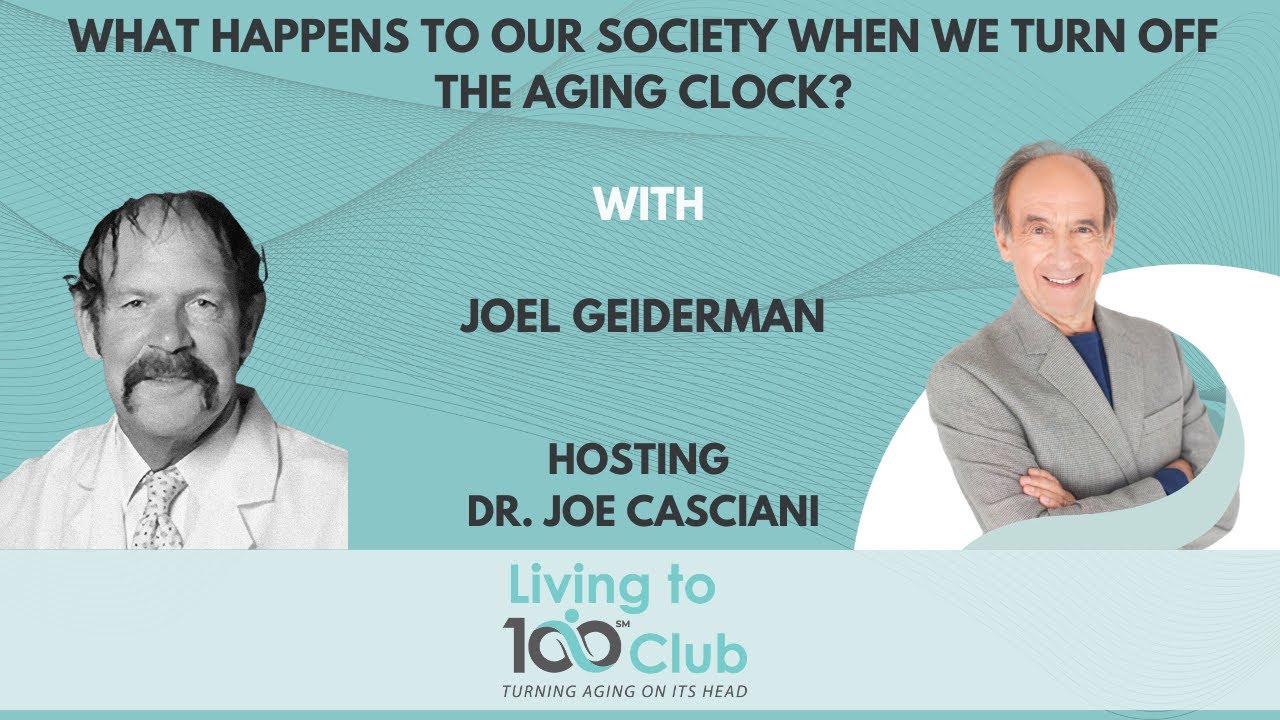
In this episode of the Living to 100 Club podcast, host Joseph Casciani interviews Dr. Joel Geiderman, a veteran emergency‑medicine physician and author of the medical thriller The Plasma Cell Report. The conversation begins with Dr. Geiderman’s personal background – his mother’s Holocaust survival, his long tenure at Cedars‑Sinai, and his work opening a geriatric unit in the emergency department. He explains why he chose to write a novel rather than a scholarly paper: fiction allows him to embed conflict, humor, and a narrative that explores the societal fallout if aging were cured. He outlines the scientific premise that aging is a biological process that could, in principle, be switched off, citing progeria as a natural example of an “on” aging clock. Dr. Geiderman speculates that a cure could arrive within a decade to a few decades, but stresses uncertainty. The bulk of the interview examines the cascading social, economic, and ethical consequences of dramatically extended lifespans: shortages of housing, energy, transportation, and food; the notion of “death control” where governments might allocate life‑quotas; the role of birth control as a human right versus a population‑management tool; and the potential for governmental agencies (e.g., the NSA) and political leaders to clash over access to life‑prolonging technologies. He distinguishes between prolonging healthspan – which he supports – and true immortality, which he views skeptically. Lifestyle factors that already improve longevity (exercise, social interaction) are mentioned. Dr. Geiderman also shares future plans for a sequel, a trilogy, and possible film adaptation of his book, and provides his website (theplasmacellreport.com) for listeners to learn more. The episode closes with promotional plugs for Casciani’s own resources for successful aging.
Chapters
Welcome to the Living to 100 Club Podcast.
Well, hello to all of our listeners joining us today on our podcast. You're listening to one of our Successful Aging episodes this month on the Living to 100 Club program, and I'm your host, Joseph Casciani. On each program, our conversations educate and inspire, helping you get the best out of all the years we're given, regardless of what comes our way. You can learn more about my club at our website. Be sure to take a look at my new training and activities manual Better, Longer, and Happier: A Guide to Aging with Purpose and Positivity. This is a series of 12 modules in a card deck format developed for activities directors at senior living communities. My website is livingto100.club/blh. Now on to our podcast. On today's program, our guest is Dr. Joel Geiderman. Dr. Geideman has served as the co-chair of emergency medicine at Cedars-Sinai Medical Center in Los Angeles for 30 years. The focus of this podcast, however, centers on Dr. Geideman's concerns about the ethical, social, and economic consequences of stopping the natural aging process. What happens if people no longer get old? In his new medical thriller, The Plasma Cell Report, our guest has taken up the serious societal dilemmas that are posed if and when the aging process is cured, that is, stopped. If the aging clock starts at some point, what will happen when science learns how to stop it? Will there be competition for life-prolonging treatments? Will we run out of resources to provide for everyone on the planet? Will a policy like death control become necessary to pare down the elderly population? Alarming questions that are explored in our guest's new book of fiction, but questions that must be raised as science flirt with prolonging life indefinitely. First, a little background. Dr. Joel Geidiman has been practicing medicine for more than 40 years. He's been the co-chair of emergency medicine at Cedars-Sinai Medical Center in Los Angeles for 30 years. He's a professor at both Cedars-Sinai and the David Geffen School of Medicine at UCLA. Dr. Geidiman was also formerly the vice chair of the United States Holocaust Memorial Museum in Washington, D.C. Appointed by President George W. Bush. He's authored more than 100 peer-reviewed papers and book chapters. This is his first novel. Dr. Gottman lives in Beverly Hills with 2 of his 4 children and his dog, affectionately named Reagan. Dr. Gottman, welcome to our program. Thank you, sir.
Thank you for having me on.
Oh, you're welcome. You're welcome. I'm looking forward to our conversation. I always like to open by asking our guests to tell us briefly about the highlights. You've had a long distinguished career as a physician. What are some of the, maybe the points that stand out to you that brought you to where you are today?
Well, um, that's a difficult question.
Sure.
Um, as you know, my mother was a Holocaust survivor. And, um, she told me I could do anything I wanted to do, and which included writing my book. So I dedicated my book to her, and she was a wonderful lady. Yeah, but my, my career has been great because what we do is we help all people. We have no— we have no barriers. To helping people in the emergency department. We take care of all comers, and that, that's made me proud.
Yeah.
So you see a lot, especially the elderly. We've actually opened a unit for the elderly in our emergency department.
Geriatric medicine ER.
Yes.
Interesting. Sure, sure. So with the— I'm sure you've seen numbers and numbers of people coming into the ER and seeing more older adults, you began to question, how are we going to manage? How are we going to continue to provide this care, this medical care for seniors? Did that prompt you to write your book at all?
No, not really. I mean, I think— don't get me wrong, I think keeping people healthy to into their 100 is a good idea. Um, the Bible prescribed 120 years was the great age, and, um, I think that's a good idea. And we all want to— we all want to live longer, but immortality is a different issue.
Sure. So what got you started on the, you know, this whole topic, the consequences of a cure for aging?
You know, I came up with the idea that there could be a cure for aging, and I looked into it and I did a lot of research on it. And I honestly believe that we eventually will be able to, quote unquote, cure aging.
Sure.
I think that, you know, my tagline in my book is whatever can go forward can go backward.
Yeah.
So if there's some reason that the clock turns on, it makes us all grow older. There's something can turn back the clock so we won't all grow older. And a certain amount of people die of trauma, infectious diseases, uh, you know, HIV, things like that. But, um, most of the population will, will continue to live for a long time.
Sure.
And the question is, is that a good thing or a bad thing? And that's the, you know, that's the, um, essence of my book.
Yeah, yeah, yeah. I read your book, by the way. I, I'm not a fan of fiction, but I was engrossed in, in this book. Uh, um, we can talk more about it in a little bit, but Why, why a book of fiction? Why not, you know, a white paper on the perils of longevity? Not perils of longevity, but—
Oh, because I wanted to write a novel.
Yeah. Okay. Yeah. Yeah.
And then, you know, in any good novel, you have to have conflict resolution. That's the— that's always important.
Mm-hmm.
And then a little sex, a little humor never hurts either.
Yeah, yeah, yeah, yeah, that was a nice touch. Um, how did you come to understand all the inner workings? I don't want to give away the plot entirely, but you, you got a lot of in-depth knowledge of government and different agencies and what's going on in, you know, among all the power players. How did you get all that information?
Well, um, I acquired it. Yeah, there was a book by a man named James Bamford. It came out in around 1990 about the National Security Agency, and I read that. I was intrigued by it, and he was actually picked up by them and interviewed by them and interrogated by how he knew so, how he knew so much about it.
Yeah.
But nowadays with the internet and other things that are available, we know a lot about it. And I have nothing against these agencies. I actually started out being kind of anti-NSA.
Mm-hmm.
And now I'm, I respect them. They keep us safe.
Sure.
Like when you hear things, the term chatter, you hear there's increased chatter, it's because the NSA is listening and they pick up all these, they pick up all the chatter.
Yeah.
So, um, I'm not really against them, it's just a plot line, you know, the idea that the president and the NSA had different ideas about this.
Yeah. So you, you picked up this information, you did your own investigative work, and learned about the agencies, and, um, it, it played out in, in your storyline. I mean, it's, it's great. So, um, I did, and also I had some interactions with some presidents.
Um, there was a— the president of my book was sort of a, um, well, he was, he was He was not a good person, but he wasn't modeled after Joe Biden, who I met and I like, or Ronald Reagan, who I met and I liked. He was modeled after Richard Nixon.
Yeah, yeah. As I was reading through it, I, I couldn't quite place who it was that you were referencing, but, um, theoretically Reagan, would you say?
Yeah, I met Reagan a few times. He's a nice man.
Yeah.
And so was Joe Biden.
Yeah. Yeah.
I try to be apolitical in my book.
How close are we to turning off the aging clock? What's your sense?
My sense is it could be, it could be tomorrow, it could be in, in, in 10 years, or it could be in 20 years, but I think it's It's going to happen. There's something that underlies it. We don't know what it is, but there's something that underlies it. It's got to be. It's a biological process.
If the clock starts, it can be stopped, so to speak. Yep. Yeah.
In fact, in my book, I describe the disease called progeria.
Yes.
And there's little kids who get when they're 1 or 2 years old, they turn— their aging clock turns on and they look like they're 90 when they're 10 years old, right? So something turns it on, and if someone can turn it on, somebody can turn it off, I believe.
Yeah, yeah. And that's— yeah, I mean, that's the premise there. If it can be done, what are the consequences of that? How do we— how do we wrestle with untold numbers of people living longer. You touch on that, and when you and I spoke earlier, you also said that there are so many social and economic and all told consequences of having so many people on the planet that we couldn't serve, you know, we couldn't manage all of them, couldn't feed all of them. Is that still the case? Yeah, yeah.
So I think that's true. I mean, we're already running out of room for— we can't— we don't have enough homes in the United States.
Yeah.
Or elsewhere. Yeah. We don't have energy, we don't have enough highways, airport slots, anything. So Believe me, I want to live forever, but yeah, you know, it's impossible.
Of course, of course. Yeah, I mean, even if it was possible, there's a heavy toll to pay, right? Yeah, I mean, yeah, and somebody's got to pay for it. Yeah, somebody got to pay for it. Yeah, you also mentioned the topic of Uh, death control. I, I, I never heard that expression. Um, kind of— we've seen that in movies, I think. But what, what is that? What does that connote to you, death control?
Well, the idea would be that you would only get a quota of your life because you couldn't live forever, that the government Or some governments might decide that there's only a portion that they can give you, and after that, you would take somebody else to take her place. I, I don't really know, but I think that's a possibility.
Mm-hmm. How could that be implemented, do you think? I mean, remember the movie Soylent Green, but, um, that's kind of a different—
Yeah. Yeah, that was different. Yeah, I'm not sure.
Not sure.
I'm not sure how it would be implemented. I mean, the Nazis had a concept of lives are not worth living. Um, yeah, so we don't know. Yeah, I don't know what mankind's capable of. Sure, they're capable of a lot of bad things.
Yeah, if we didn't— if we went down that road before, it's possible we could find a similar road. Right. If we had to. Yeah. Yeah. Yeah, you're right. We don't know what's capable, what, what, what, what can be done.
Uh, especially, but again, just to be clear, it's a novel, you know, I'm not saying that this will happen or what, no, it's what, what anybody, any government will do.
Yeah.
But, you know, it's my novel. It's what I, yeah, what I created.
Sure, sure. What about, um, this is sort of related but maybe peripherally, uh, the whole notion of birth control. If, if we're kind of on the edge now of managing, uh, the population growth and supporting all the human lives, um, where does the concept of birth control come in? I, I know it's very controversial. I've had other guests on the program that You know, we've touched on this, but what's your view? We're not— we're not doing very much in the way of birth control as a kind of way to manage the overgrowth of population.
Well, I think birth control should be a right of people. It shouldn't be mandated by the government or not mandated by the government. I think it's just a human right. In some countries, I think there's— they just can't really support the populations that they— that grow. But that's, you know, I don't believe in— I don't have an opinion about that. But I— but the point is that the population can only— the planet can only support a population of so many people.
Right.
And so either people are going to have less children or they're going to die at some point. But we can't have, we can't have both because the planet can't support it. We already have, what, 8, 9 billion people on the planet.
Yeah.
And we're running out of resources.
Yeah.
So again, I'm not trying to be I am an ethicist. I've written a lot of ethical papers, but I didn't write my book as an ethics document.
Sure, sure. Yeah, yeah. Not to belabor the point, but, um, we don't hear very much about efforts to kind of manage the population growth. I don't hear it. You must have come across some of it in your research for the book. We don't hear very much about ways to kind of control the overgrowth of the population? Have you come across—
No, no, yeah, no, we don't, we don't. And I'm not sure it's a— I don't know how to approach that. It's a little bit— but I, but I do think that my point, my book was I think this will happen. I think eventually we're going to have to confront the idea that people may just be able to live forever.
Mhm. Right. Yeah, that's a good point. And use the book of fiction, uh, to, to raise our awareness, raise our consciousness about this. At some point we're going to have to wrestle with this if and, if and when we do find some solutions to Aging. Yeah. Yeah, sure.
It did. But again, my book was a book of fiction. I wanted to create some tension between the government agencies and the president.
Yeah.
There's a lot more to the book than just the idea of aging, but that was the premise. Yeah.
Yeah. And the tension with the medical community as well, right?
Yeah, yeah, yeah, I think so. I'm not sure if I got their attention or not.
Yeah, yeah.
Also need to point out that I published this book when I was 73 years old.
Uh, any thoughts of it being made into a movie?
Yeah, I've had some, I've had some conversations, and, um, I'm working on my sequel and I have a trilogy in mind. So I think that, yeah, that'll happen.
Sure. Well, good. That'd be good. That'd be a good development. If you were asked, what, what solutions would you propose to scientists who want to turn off the aging clock? I mean, if you were asked your opinion, Dr. Guideman, what do you think we should do about if we continue to study this? What's your opinion on our— if we are successful, what do you think?
Well, I don't really have an opinion. I mean, I don't think we can actually stop it. It's like I quoted Robert Oppenheimer in my book.
Yeah.
That, you know, we find things because they're not because they're useful, but because we can find them. Right. And so I don't know what'll happen, but I think it will.
So you're pretty neutral. You're staying pretty objective on this whole question. I mean, you know, the possibility is there, but you're not advocating one way or the other.
No, I mean, I don't think it's a good idea. Yeah, but I don't know how we would stop it or not stop it.
Sure, sure.
I think, you know, medical, medical science, prolonging aging is a good idea. I mean, I believe in that. I work on that every day. And I think prolonging life is, is, is, is what we aim for in medicine.
Sure.
But immortality is different subject. Yeah, not only prolonging life but the quality of life.
The quality of life, of course. And we're learning so much more about how to improve our, um, longevity just by improving our lifestyle, right? Lifestyle changes are making—
Exactly. Exercise.
Yeah.
Social interaction.
Yeah.
Um, you know, all those things keeps your brain working.
Yeah, yeah, yeah, yeah, yeah. So we're, we're making progress. I mean, I, I've heard this expression, the older you get, the older you get.
Yeah, that's true.
Yeah. I mean, once we get over the major humps, if we do, and we kind of eliminate a lot of the chronic conditions, we can live you know, 110, 115. I mean, I heard about the, um, the person who passed away recently. He was the oldest man in the US. His name was Maury Makov, right? Something like that. And he, he was, um, worked in odd professions along the way, careers. And he started becoming a sculptor. He started doing sculptures out of scrap metal. And he had his first exhibit at age 100. His first museum exhibit at a gallery exhibit at age 100. I mean, how beautiful is that, right?
So my great-grandfather allegedly lived 113 years old.
Yeah, yeah. Wow, wow.
Yeah. And I have an aunt who's a Holocaust survivor who's 101.
Oh wow. So your mother and your aunt both were survivors? Yeah.
A mother, two sisters, and her brother. Yes.
Wow. Wow. Yeah. Okay. Well, congratulations on the book. I think it's a wonderful, um, you know, document that you put together. What's the— what's the takeaway for our listeners? What would you hope they remember from this conversation?
Um, That's a great question. I mean, I'm— it's hard to be— I'm obviously want people to live long and happy lives, but the question of living forever is just imponderable. And, uh, that's what happened in my book. There was a tension between the president and the agency over how they would approach it because of what the consequences could be. Yeah, but it's almost imponderable.
Yeah, I, I have a lot of respect for that. We, we don't have the answers so many times, and we try to force them and we can't. So I, I appreciate what you're saying. So your book is The Plasma Cell Report. Where can people buy a copy?
Amazon, Barnes Noble, wherever, um, online books are sold.
Okay, well, uh, looks like we're— uh, thanks so much for being a guest, Dr. Ganiman. I, um, how can people, um, contact you? Or that you have a website?
I do have a website, it's theplasmacellreport.com. And I'll be happy to answer any questions.
Okay. So people can submit a message on the contact form and you can—
Yes.
Great. That'd be great. That'd be great. Thanks. Well, looks like we're out of time for today, but before I wrap up, I just want to remind my listeners to visit my website, livingto100.club, sign up for my email list, and download a free copy of my 9 Tips to Make Living Longer in enjoyable. And if you're affiliated with a senior living setting, be sure to look for my new training manual, Better, Longer, and Happier. Dr. Gottman, thanks so much for being a guest on our show today. The website is—
thank you for having me.
Oh, you're very welcome. You're very welcome. Theplasmacellreport.com is the website, and people can pick up a copy of your book on Amazon and other book dealers. So Yes, wishing you much success, and I'll look for the movie when it comes out.
Thank you. I'll invite you to the opening.
Okay, thank you.
Thank you.
Yeah, keep up the good work, and, uh, you're, you're doing, um, you know, your medical work at the hospital there at Cedars-Sinai. I am sure it's a great contribution to our society, so thank you for all you've done.