The Future Of Skills In A World Full Of AI - Collision 2023
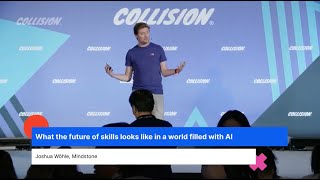
This is a YouTube video titled "The Future Of Skills In A World Full Of AI - Collision 2023" containing a talk delivered on August 3, 2023. The speaker, who is the CEO of Mindstone and an experienced entrepreneur and investor in education technology, discusses how AI is transforming the job market and the future of skills. The talk covers the impact of AI automation on various roles, parallels with software engineering, the importance of collaboration, learning, and problem-solving skills, and the evolving ways employers assess skills beyond traditional degrees. The content is a single-speaker presentation focused on AI's influence on workforce skills and hiring practices.
So thank you for being here. I am going to try and talk a little bit about the future of skills today in a world that's now full of a just about to be full of AI. So three things that I want to or I want you hopefully to takeaway today is one, how has AI changed the game? I think you hear a lot about it here at the conference. Two, what stays valuable and then three, what can we learn to try and stay ahead and still be relevant in a few years? So unless you have been hiding under a rock, half of this conference is about AI. But there is a lot of of consequences around skills as well. IBM already put seven and a half thousand jobs or so on hold, thinking they'll all automate this in the near future. CNET started publishing articles that were entirely written by AI before they got some pushback and stopped the project. And the World Economic Forum did a survey where they got to the conclusion where about 42% of business tasks would be automated by 2027. That's four years from now. We're talking about almost half of the skills that we would use in a business context. So who am I to talk about some of this? I'm the CEO of Mindstone. We turn daily learning into quantifiable skills that employers recognize. Previously I built a company called super awesome that was acquired by Epic Games. I am a venture partner and limited partner to Emerge Education, one of the most active early stage education venture funds in Europe. And I'm an active angel in 40 odd different companies, including Learnably. That helps optimize the L and D spend in companies. So first thing to try and figure out, or at least as I was trying to think through this, is are there any parallels that we can learn from and I think, and I'll try and make the case for it today, that we can learn a lot from what has happened in software engineering over the last 15 years to try and understand what might be ahead for all the other industries and jobs that are about to get automated. Fifteen years ago, your ability to code as an engineer was a key differentiator. The mere fact that you understood a language coding language that somebody else didn't was enough to get you a job and it would actually make you a productive member in a company today. Node JS alone, which is one of the more popular execution environments, has more than 2 million different modules that engineers use to do their job day to day. A module for an engineer is basically an equivalent of an AI. You give it some data, it transforms it, you get something Back, you might send it to another module, it transforms it again, you get it back. And basically your role today as an engineer would be to combine the result of these modules into something that is more than the sum of its parts, something that actually works. And so I think what is happening with AI is very similar. We're seeing more and more of these vertical AIs that are starting to automate parts of our job. Creating a marketing strategy, writing technical documentation, even creating a legal argument. These are all things that are starting to get automated and you can compare them to modules for an engineer. So this might, you might think that this is something that is very far in the future. Today already everyone's aware of Jasper. I think everyone talks about how you can use AI to produce blog posts and ads and things like that. You might also be aware of midjourney that creates images. Everyone will have seen these go, go viral everywhere. But what you might not be aware of yet, and as Harvey, for example, creates your legal arguments, writes your contracts for you, or ultimate that entirely automate the customer service function, not replace parts of it, it's an actual full on one to one replacement for customer service. Canmigo is a personal tutor that gives you answers based on your profile and where you might get stuck from Khan Academy. And one of my personal favorites is a plugin to ChatGPT today. It's called AI Counsel. It takes an argument and then figures out which are the five experts in the world that might have something interesting to say on the topic with different viewpoints. And it then gives you all five different viewpoints so that you're not stuck on your one single view of the world, but instead you get different views at the same time. And if you thought that was an interesting starting point, behind me you have a map of the AI APIs that exist today. These are not the apps that automate. These are the building blocks that the other thousands of startups busy building today are using to build their solutions. Each one of them trying to attack different functions, different tasks in our respective roles. So the amount of automation that you're going to be looking at in the next six months, two years or so, is an order of magnitude bigger to what you see behind me on the screen. Now, if we can learn from software engineering, or at least some of these things might give us an interesting indication. I thought today, software engineers that already live in that world, the people that hire these software engineers, what are the skills they are looking for? If we have to start using these modules, these agents, and glue them together in different ways. What would be the interesting things to look at. And so I'm part of one of the biggest CTO groups in the world. I asked a few hundred CTOs what are the criteria they look for when they hire engineers. The three skills that came back are an ability to collaborate, an ability to learn and ability to problem solve. And you will have noticed that the ability to code didn't even make the top three. It's not there. It was part of the decision set. Just to be clear, it just didn't make the top three. And then Pearson and Google recently did a study as well about which would be the skills that are most in demand in 2026. Pearson is one of the biggest education groups in the world. I imagine, you know Google, and you can see that it came to very similar conclusions. The ability to collaborate, the ability to learn and the ability to these skills. This is where I think it becomes even more interesting because AI also has some of the arms we built to try and keep track of them are just no longer up to date. They're not able to keep pace. And employers have recognized this. 76% or so are now starting to look at skill based hiring, moving away from traditional degrees and other ways of signaling. And about 88% have started to move to accepting micro credentials, getting smaller and smaller units of these skills that we're trying to acquire. But I would argue that this is just a band aid on a system or on a problem within a system that is no longer apt for purpose. And again, I would look to software engineering. How does software engineering think about signaling of skills? What have required? What can we do? And there are two big platforms that stand out to me, GitHub and Stack Overflow. For those of you that are not familiar with these platforms, GitHub is basically a repository where engineers would submit their code and they can showcase the work that they have done in the past. It's kind of like a portfolio for engineers. And then Stack Overflow is a question and answer forum. It's where an engineer goes to ask a question and others answer them. Good questions get upvoted, bad questions get downvoted. Over time you construct a profile, that profile. Both GitHub and Stack Overflow today often get you more interviews than a degree from a top tier university because they show that you are actually able to create things, that you have acquired these skills. So this is something we're working on. I think many others will be working on this as well, but I think that we will move towards some way of creating a portfolio of these, of all of our respective jobs, and then being able to showcase that in a way that is recognized, understood by the employers that are looking for the skills that we are building. So what can you do today? Where do you start? First thing, short term, that I would encourage everyone to do is suspend your disbelief. If you think that AI is not going to go automate part of your job, there's a very high chance that it likely will. You have only to win from suspending your disbelief and trying to see how you can start to automate yourself and augment everything you're doing. It's the people that don't lean in that will at some point get surprised by what's coming. In the long term, train these three skills. Collaboration, problem solving, learning, learning with AI with people, and AI. Use it to accelerate and make sure that you can stay ahead. There's no reason that you, you have to have to fall behind. You can actually use it to learn faster. The differentiator here is to consider AI as a copilot, enhancing everything you're doing. So to paraphrase William Gibson, the futures of skills is already here. It's just unevenly distributed at the moment. Thank you very much.
More from Joshua

Why Most ‘AI Experts’ Suck, And Ways You Can Blow Right Past Them, with Mindstone CEO, Joshua Wohle


Why Are Startups Messy - Daniel Bodonyi, Bernard Ivezić, Joshua Wohle & Nina Sesto
The Future of Skills: Qualifications in the Age of AI - Joshua Wohle (Mindstone)