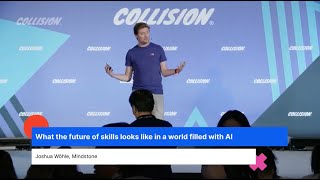
The Future of Skills: Qualifications in the Age of AI - Joshua Wohle (Mindstone)
This is a YouTube video titled "The Future of Skills: Qualifications in the Age of AI - Joshua Wohle (Mindstone)" created on October 18, 2023. It features a talk by Joshua Wohle, CEO of Mindstone, discussing how AI is transforming the workforce, the evolving nature of skills, and the importance of human skills like collaboration, problem solving, and learning. He also addresses the impact of AI automation on jobs and the shift from traditional degrees to skill-based hiring and micro-credentials.
Hello. I've never done a Talk with a 360 view before, so sorry if I don't have the routine totally right yet. I'm Joshua and today I'm going to talk to you about the future of skills, which I think for everyone in this room is going to be particularly relevant. So at a high level, I'm going to go over how AI has changed the game, what stays and will be valuable, how fast things are changing, and what we can learn to stay ahead. Now, I think everyone has heard a lot about AI, even just these two weeks. Every single conference has three quarters of their conference about AI. Right now, if you haven't yet, you really must have been sleeping under a rock. But the World Economic Forum predicted that about 42% of business tasks will be entirely automated by 2027. That's four years from now. And just two months ago, McKinsey revised their previous estimate now saying that about 60 to 70% of employee time can be automated with current generative AI technologies. So that is today, it's not tomorrow, it's not in a few years. Now, who am I to talk about this? I'm CEO at Mindstone. We're building an AI coach for adult learners, turning everyday learning into skills that employers recognize. I previously built a company called super awesome that became one of the biggest kids technology companies in the world. It was acquired by Epic Games, the creators of Fortnite. For those that are gamers. I am also an investor with Emerge Education. They are the leading early stage education venture capital in Europe and an active angel in about 40 different startups, many of which are in this particular field around skill development, Learnerbli being one of them, which maybe some of you are actually using already. So where can we look to? This is where I tend to start when I try to analyze where we might go to. Where can we look to something that exists today that gives us an insight into where we're going. And especially for this room, I actually think we can learn a lot about the travel of software engineering in the last 15 years to figure out where everything else is headed very soon. So 15 years ago, your ability to code was enough to get a job. Just the ability you knew how to write Java, php, C, whatever it was that you were looking at that was enough to get you a job. Today, Node alone has over 2 million different modules. The job of a software engineer has entirely changed. Often it is about taking some data, piping it into a module, getting the result, transforming it, sending it to another module, visualizing it with a whole other library. And so a lot of the tasks that we used to manually do have been automated through different means there. I think the same is happening from an AI perspective. Creating marketing strategies, writing contracts, predicting financial models. All of these can be equated to the way we think about modules from a software engineering perspective. We're automating them one by one. A lot of you are already familiar with obviously all the more popular AI plays today, Mid Journey, chatgpt, Jasper, but you might not be aware of Harvey, which automates all legal work for you, or ultimately which doesn't just try to automate part of your customer success function, but actually automates it all together, removes the function from a human perspective. To start Khan Academy, who's got its AI tutor, agent runner now, who's making agents available through a web interface so you can just play around with them again, for many of the audience here, you can run your own agents, but for the majority of the world they can't. And making these available for verticalized tasks is going to have a a big impact everywhere else. Code interpreter, if you haven't used it yet, send a CSV to it. Ask it just what are the interesting trends that it can analyze through the CSV? Absolutely transforming part of the data science function there as well. Now this is a map of January this year. Got an enormous amount of companies in the AI space, but this is just the map of AI APIs. So this is the map on which everyone else is currently building their verticalized solution. You can only imagine how many companies are right now working at verticalizing every task across a bunch of different industries. Now, we've talked a lot about AI in the last six months. The thing is, from a product perspective, there is a lag. Most of the world discovered or started properly leaning into AI about nine months ago. It takes about six months for people to get their head around it, start changing the way that you think, and then it takes about six months to get a product out once you've figured out how you can do and what it actually helps you automate properly. So we are about to see a wave of different vertical AI solutions that are going to automate all of these tasks across the board. Now, if it holds true that software engineering has kind of gone down this path, I thought, what if we ask CTOs, the people that are hiring software engineers today, what they look for when they're hiring engineers? And you probably won't be surprised to know that the top three were the ability to learn, the ability to collaborate, and the Ability to solve problems. The ability to code didn't even make the top three and it was on the list. And for those of you that haven't heard yet, was it Scott Guthrie marched this year, said about 40% of the code committed to GitHub today is AI generated and unmodified. So this is purely committed code to GitHub that has not gone through or maybe a human has looked at it, but it hasn't been modified before. It was actually committed. Now that was my own survey as I went through it was to Europe's biggest CTO group. But I also looked to a study done by Pearson and Google combined. Pearson, biggest education group in the world and Google. Well, obviously everyone knows. And all those three skills were what they predicted to be the most relevant skills in the world. Collaboration, learning and the ability to own and solve a problem. Now how do we build these skills? What can we learn from AI there? And I think there is a very interesting framework that we can look towards here as well. And this was David Epstein's book called Range. He talks about kind environments and wicked environments. Kind environments are environments where the feedback loop is fast. You make a mistake, you quickly spot that a mistake was made, you can get some feedback, iterate on it, change your approach, get feedback again. So the speed of the feedback cycle is really fast. Wicked environments are environments where this feedback cycle is long. So it takes a long time to either get to result and even longer to get to feedback on the result or the decision you made. Good example of a kind environment is programming when you spot a mistake or when you make a mistake. System often very quickly tells you you can change your approach, run it again, figure out if it made a difference, and so on. So you can very quickly iterate through different solutions and learn from it. Now, wicked environments, good. The typical example would be investing, which is you make a decision, you wait eight years for an outcome, and even at the outcome you don't know if you made a bad decision or if it was just a consequence. Like the either the success or the failure of your decision was direct, was a consequence of your decision or not. So it takes a very long time and the feedback quality is very low. But the other skills that have a long feedback cycle that are in these wicked environments are collaboration, problem solving and learning. They're ambiguous. You don't quite know when you do something. Well, often you're getting feedback from people around you and that feedback is ambiguous itself. Now what is interesting is that AI can actually help us make these wicked environments look More like kind environments. So the feedback loop is very simple. You have an action somewhere, you get a result and then you get feedback on the result. Not, not much to it. What is interesting is that AI can help you extrapolate scenarios faster from the result that you're getting before you even get your result. It can help you contextualize and provide different potential results that come from a decision you are contemplating or some scenario you're trying to plan out. And it can provide indicative benchmarking which is comparing it to other people that were in similar situations that made these decisions and results that exist. In essence, it's able to get you to a simulated result faster with the ability to start to learn from these simulated cycles. And the same is true for feedback, which is that AI can give you different explanations for why you got to a particular result. It is always there for you to ask more questions. It doesn't come with the emotional load of asking feedback from colleagues around you. It also will never stop answering your questions as you ask for more context. And in the feedback, it's able to simulate in order to get this entire cycle much faster than it was before. And so through AI, even the wicked environments start to look a little bit more like kind environments, which should allow us to build these difficult skills in a much faster way, just like a kind environment is able to do or was able to do in the past. So I believe we are at a once in a lifetime tipping point. The world around us is changing faster than it ever has. The lifetime that any particular skill stays relevant keeps going down. Because by the time you you finished a degree, the skills aren't even relevant anymore. They don't mean much and you won't get hired for them. But our entire system has been built around degrees. And how do you train the right skills? How do you demonstrate that you have the right skills? If degrees don't exist, this becomes a big problem for employers and people that are trying to hire. The previous system was built on an information scarce environment. I call this. Basically it used to make sense when only one person in a group of a few hundred knew how to read and they had access to a book and stand in front of 300 others to try and disseminate the knowledge in the best possible way. Today we have the opposite problem. We're overloaded with information and we're trying to figure out what is actually relevant in the first place and what should we pay attention to. But the system hasn't changed and employers are realizing all over the biggest poster boys for Using degrees and only hiring from top tier universities have changed their tone. About 76% of employers today look at skill based hiring, trying to understand which skills they should be hiring for. And about 88% today value micro credentials and alternative credentials in a similar way to degrees in the past. Now what is interesting again is that in engineering we have found different potential solutions. A good GitHub profile or stack overflow profile often gets you more good interviews today than a degree from a top tier university for very good reason, because it demonstrates what you've actually done. It's a portfolio type approach to showcasing what you can do. Alternatively, this is actually what we're trying to do at Mindset, trying to figure out how can you think about a portfolio type approach but for every other industry so that you can showcase your abilities, the skills they actually built up instead of the certificates and just listing them one by one. Coming back to what I was talking about before, 42% of business tasks will be automated by 2027. Or if you believe McKinsey, 60 to 70% of the time of employees today can be automated with existing technology. This is a live or die moment for a bunch of companies. They are trying to figure out what to do and they have to respond in order to stay competitive. So what can you do today? What are the things that you can take away to try and prepare for it? I think there are two things. One is a suspension of disbelief and I cannot stress this more. If you think AI is not going to have an impact on your job, think again. You have much more to win by leaning in right now than by being caught off guard in a year or two from now. @ the same time, you have very little to lose to lean in. Worst case, I'm wrong. Now, long term, focus on these three skills. Focus on your human skills, collaboration, problem solving and learning. And in this room, the paradigm of thinking about AI as a copilot is not something that is lost, which I hope for most people today. But also the future of skills is already here. It is just unevenly distributed. Thank you very much.
More from Joshua

Why Most ‘AI Experts’ Suck, And Ways You Can Blow Right Past Them, with Mindstone CEO, Joshua Wohle


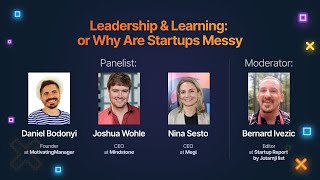
Why Are Startups Messy - Daniel Bodonyi, Bernard Ivezić, Joshua Wohle & Nina Sesto