Why Are Startups Messy - Daniel Bodonyi, Bernard Ivezić, Joshua Wohle & Nina Sesto
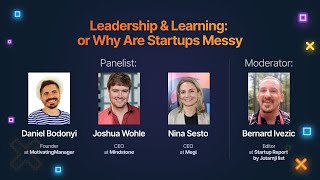
This is a YouTube video titled "Why Are Startups Messy - Daniel Bodonyi, Bernard Ivezić, Joshua Wohle & Nina Sesto" recorded in October 2023. It features a panel discussion moderated by Bernard Ivezić with panelists Joshua Wohle, Nina Sesto, and Daniel Bodonyi. The discussion covers leadership and learning challenges in startups, focusing on topics such as layoffs, remote work, scaling, the anti-Agile movement, and the impact of artificial intelligence on management and motivation. Joshua Wohle contributes extensively, sharing insights from his experience as a CEO and founder in the tech and AI sectors.
So welcome to our panel discussion Leadership and Learning. Why are Startup Messy? Today we'll explore the evolving landscape of careers and working lives. Our past 30 to 40 years we've seen significant shifts in what motivates people and changes in management techniques. Additionally, startups have become increasingly ubiquitous and scaling them can be challenging. While we won't be able to cover everything in just one panel, we hope to provide a great starting point for this vital conversation. Thank you for joining us. We are fortunate to have three top experts in the field joining us today. So please introduce yourself briefly. Thank you.
So hi everyone, my name is Nina. I'm CEO and co founder of Maggie startup and also related to cardiovascular clinic called Magdalena.
Hello everyone, I'm Josh, I'm co founder and CEO at Mindstone. We're building an AI coach for adult learners. Previously I built a company called super awesome that became the biggest kids technology company in the world. It was acquired by Epic Games, the creators of Fortnite. And I also run the biggest AI meetup in London.
Hi you guys and ladies are super hardcore to still be here and pay attention to what we are trying to say. My name is Daniel, I'm the founder of Motivating Manager which is an online code based leadership development program and I previously founded two other companies, consultancy and a software startup called Attuned. Co founded I should say. So that's my background.
Okay, I'll be your moderator. My name is Bernard Ivizic. I kick started the first Croatian mainstream startup application Startup Report by yout Arnelist and I'm the editor of that publication. So Nina, Daniel, Joshua, welcome. Five key topics highly relevant when it comes to leadership and learning in the world of startups today are layoffs, remote work, smooth scaling, anti agile movement, artificial intelligence. So let's start with the hottest of them all and those are layoffs. There's no need to Introduction the impact of layoffs on motivation, leadership and organizational knowledge is tremendous. How did layoffs impact the motivation of leaders and employees? Joshua.
Nice one to start with.
So.
Actually to start almost off on, I guess somewhat controversial note, the layoffs that we're going through are happening at a time where there's an enormous amount of change and the role of leaders is not necessarily to do the thing that everyone wants to happen, but to show a path to a world, a future that ends up being better for most, if not everyone. And we can't just close our eyes to how AI is automating more and more across the stack and how that is going to remove or move People that are doing one job into hopefully people that can do another job. And I think that what is part of what is going on is that a lot of the layoffs are that that are happening today are camouflaged efficiencies, and they use the excuse of the current downturn in order to do so. It's not like these companies can't support the wages anymore. They're making enough money to support it, but they're making structural changes in order to try and position themselves in a better way. So there's that one part of, okay, what does it. What does an ideal company setup look like? We're all familiar with what happened at Twitter, right? The entire thing is working on 15% of the people that were there only nine months ago, something like that. Now we can like, dislike what happened, how it happened, and the way it functioned, but the fact that the entire organization can function on 15% of the people that were there is something we as leaders can't ignore either because that leads to unsustainable situations where it's just a question of time when those things start to fall over. So trying to strike the right balance between making sure people are treated in a humane way, that they have a path forward to a bright future, but at the same time building a company that has a sustainable future for itself, I think is. Is really what leaders should focus on.
Nina, are there some ways to address layoffs in advance? Maybe some strategies?
I mean, I would agree with everything Joshua said. And I mean, we as growing a small startup company now, we can also see those layoffs as an opportunity because there is now a lot of talent there on the market that is in fact, quite difficult to find. But maybe, I don't know, maybe this is just a specificity of being on this market. Here in Croatia, you know, quite, I would still say conservative European market, we are perhaps a little bit more mindful about, you know, even growing a number of employees, growing a company and a bit more conservative in, you know, the employment and how many people you. You really need, you know, calculating a lot more. Okay, when and for what do I really need this next person for? Because I can't even imagine how, you know, how can you, you know, reduce your company to 15%? I mean, what were okay for? For sure, a lot is in the, you know, increasing efficiency, AI tools, definitely, but so much in what were all those people doing there before?
So just to kind of jump off of that. What is interesting is that when you're scaling organizations, you have dramatically less friction when you're hiring people? No one, actually, if anything, the entire ecosystem takes hiring more people as a sign of your success. But then there's an enormous amount of friction when you're trying to reduce because obviously you're trying not to have an impact on people's lives. It's seen as a negative signal when you're reducing. And so when you have a system where there's no friction going up, an enormous amount of friction going down, weirdly enough, you end up with an enormous amount of fat in the middle. And that's what just has happened all across the industry. It's just that because these companies were so hugely profitable, it's been hidden for 15 years.
And you know, like the typical question you get, so how big is your company.
Daniel? What is your opinion about position of employees, motivation of employees when they think about layoffs?
Yeah, I don't know. Was anyone personally impacted by layoffs in the room or do you know people who were. Maybe it's not something that's happening around here as much as in the US I have a few friends who have been struggling to find jobs, really accomplished. Sorry, sorry.
I have like 10 or 15 people that I know that got laid off in the last year.
Yeah.
So is there anybody else who have friends who, who are laid off? Yeah. 1, 2, 3, 4.
Okay, so there are some people.
Okay, thank you.
So you probably know that it's painful and, and it can be really hard, for example, if you are in recruitment, to find, find a role these days, even if you've had a really accomplished recruitment career, you're a recruitment leader who's done great things for 15, 20 years and you still can't find a job and you have a family to support. I find it hard to look at this in a very abstract way. I, I, to me, this is a little bit more personal. I feel it's not only the fact of the layoffs, but the way they have been conducted in many ways that led to a very deep break in trust in the psychological contract between companies and employees, which used to be that if you do a good job and you deliver, then you are pretty safe and you can get ahead and you're not going to be fired in a way that your email gets disconnected unexpectedly in the morning or your offer is not going to be rescinded the day before your start date. And if you think about it the other way around, what would a company think of an employee who just fails to show up at work the next day or on their first day at work without notice? I Mean, I think it's pretty easy to see that this leads to broken trust. And what can you do once trust is broken?
Yeah. Do you have any suggestions?
Yeah. Ideas what to do? So one way to conceptualize trust is that it has two components. One is care or warmth, and the other is competence. And in, in this case, I think people will probably feel that both of these dimensions are broken. So they don't feel that these companies care about them after a decade of service, you know, just laying them off from one day to the next. And they don't feel that leadership is competent because it was leadership that built those inefficient organizations that now need to be scaled back, and it was leadership that took the money to hire those people that they now have to let go. It's difficult to decide which one to start with, but probably it's best to start by demonstrating care for the people who do remain at the company.
And.
You know, trying to be very transparent in your communication about what went wrong, where you made mistakes if you had to lay people off. And I've been in those shoes. I've been the founder who took money that was thrown at him to hire people that I shouldn't have hired at that stage, and I had to let them go. And it really had a big personal impact on their lives. And I know it can be hard to make amends in those situations, but there has to be some kind of acknowledgment of the harm done, I think.
Thank you. Thank you, Daniel, for that.
Share.
Another really challenging topic when we talk about leadership and motivation is remote work that is challenging the whole business landscape, not just startups. We say that the careers and working lives look very different compared to what they looked like 30 to 40 years ago. But what are the differences? What is the impact of this change that remote work is bringing?
Daniel okay, so I think Hybrid is here to stay for sure. 90% of the Fortune 500 companies have two or three day work from home policies now. So if those guys can do it, pretty much anyone can. Fully remote for me is an attractive option, and it is an attractive option for many people. There is some good research out there that shows that it can be difficult to maintain the kind of bridging ties between teams, for example, or different departments like sales, marketing, product and development. So you need to be intentional about a few things and you need to be prepared for the challenges. To me, the biggest change in these decades is maybe this sort of boundarylessness that we now have between work and life. It's really hard to tell the two apart. Then are you working from home or homing from work or working from work? I don't know. Is there a point at which you can really shut down your brain and focus on totally different things? So this is, this I think brings a lot of challenges with it.
Thank you. Thank you. Nina is, if I understood correctly, Maggie is remote first company.
Yeah, I mean we are, we are a very small team. Right. But still, you know, the whole team is in a way remote. So we have a clinical team that is linked with the hospital which is a bit outside of Zagreb. Then we have a team in Zagreb, we have a business development in Paris. So, you know, we are, you know, primarily we are in a way remote, trying to also maximize the contact and you know, be physically in the office of course as well. I think this always needs to be there. But I think also advantage of building a company out of Croatia is that you have to think, okay, you know, remote first because, you know, you want to be present on other places as well, you know. So we are in a way trying to build a company so that, you know, that this is in that it can function this way primarily.
Thank you. Joshua, what do you think about remote work?
So I've changed my opinion on this over time. When it was not a massive thing, I was a massive advocate. I built remote companies 20 years ago, but that was me as a student and we didn't have an office and not having an office was a financial benefit and was getting going in the world. Now I'm a little bit on the other side, I must say. I think that we have overcompensated to a degree. I think that actually think that for big corporations it's harder than for smaller startups. If you're 10 people, you can make remote work properly so long as you have enough in person meeting points at the moment. We every two months we have an entire week somewhere in Europe that we bring the entire, the whole team together and things like that and it just about works. But I do think we often in this discussion don't acknowledge the trade off. I do genuinely think that you are likely going to be growing slower. There is no good example yet of a company that genuinely changed the world that was actually fully remote. And even the ones that are, that we point towards that are doing really good, they all kind of plateaued once they got big. So I do think that acknowledging there is that trade off would make for a much more productive discussion. Now that doesn't mean that everyone has to be in person or that everyone has to be remote. But if you're building a company and you're trying to have a global impact, then yes, you have to ask yourself the question, does that work if you are fully remote? If you're trying to build a lifestyle business or you're trying to, you're happy to spend 30 years building a company that has good impact on a national level, no problem. Probably you can, you can do that. But it is, it is important to, to trade that off.
Sorry.
Yeah, no, I just want. So what would you say is like the tipping point, like, you know, between fully remote hybrid and completely in person? You know, what is like the sweet spot?
Let's say so. Yeah, so I haven't figured that out yet. We're right in the middle. So it was an interesting one. When we built my previous company, we were entirely in person with a few people. It was really the exception, the remotes. We had like five out of 150, 200 that were fully remote. Now we started fully remote because we started literally the first day of the UK lockdown. So you could not go to an office. We. Which meant that our entire DNA was remote. But we are gravitating slowly back towards it every time we meet each other. It's very interesting because everyone in the company has a remote first mentality. Every time at the end of our two month, kind of one week window at the end, everyone's like, shit, this was so much more productive than a normal week. So even at 10 people, I would say we're already less productive of being remote. But it's compensated by the fact that we can hire better talent. And so you do get access to the better talent in that way. It's just that we often forget to acknowledge that there is the trade off. So the ideal would be all of the people. Okay, I think everyone agrees to basically go and spend as much time together as possible in order to try and scale. That would be my answer.
That's awesome. So remote actually is not just a benefit, it's much more and it impacts a lot of impacts motivation of employees. And when, when I started to prepare this panel, there were two big learning curves for me there. And one of them is like really a gem. A research that Joshua shared that, that actually showed that there is no difference in motivation levels across different generations. So Joshua, can you elaborate on that? Sorry, sorry. Daniel, can you elaborate on that?
I like the name Joshua. I'll take it.
Yeah, I'll take credit.
Yeah, yeah. There is this pervasive myth that different Generations are motivated by different things which no credible research supports. I've done my own research on this, but there are other more accomplished people who have researched this. And basically the conclusion is that, you know, there are some motivational needs that a little bit dwindle with age. So, for example, young people on average need more feedback than us, you know, who are above 40 and older, or they care more about having relationships and friends at work than most of us above 40 and beyond. So there are differences that are age related on average, but there are more exceptions to this rule than people conforming to it because the individual variability is a lot more interesting. And then there are some needs that actually tend to go a little bit up with age. So autonomy, for example, the need for autonomy goes up a little bit with age. And then there are some others that seem to peak around the time when we start families and buy homes. So around 30, 35, our need for financial needs can go up a little bit. Very understandably. But other than these slight age related differences, on average, basically we are more alike than we think on a group level and more different than we sometimes think on an individual level.
Did you expect that results when you started the research?
I was keeping an open mind. So yeah, I wanted to know the answer rather than just looking, looking at memes, you know, and we analyzed 13,000 motivational profiles for this, and it kind of lines up with previous research on this.
There's one big factor in that though, is like the younger generation today is talking about unknown unknowns. They don't know what it was like before the older generation has something to compare it to. Right. So there's, there's an interesting. If you're asking people what do they prefer and how do they look at it, one is talking from experience and the other other not.
Yeah, so these motivations develop through socialization and experience and probably as you go through life and, you know, you kind of become more secure in your position. You go up on the career ladder, you have that experience of competence, you know, like your need for it decreases as well.
Okay, smooth scaling. Any advice, Joshua?
It's not scaled. If it's smooth, you're not scaling as fast as you can. Like, what was this saying? If you're proud of your product, when you ship it, you shipped too late. It's the same with scaling. If you're smooth scaling, you're not scaling fast enough.
You mentioned before the panel that it was really hard and really painful to scale a company and you managed to solve it for substantial amount of money. What was the hardest, what was the hardest part of that journey?
For me personally, it was the flying around. I was on a plane a week and a half in every month, if not two weeks during, during about three years of scaling the company. And that became very isolating. So when we went from kind of mostly Europe based to also doing the US and Asia, requires every time to go in, start a team. And it's very kind of solo. You're outside of the team, you're on your own doing the thing. It's physically very demanding, but at the same time you're losing connection with your existing team. So you're also isolated at an emotional level to try and do that. And on top of the fact, because you're further away or you're spending less time with the team, more problems come up and because you've lost some of the connection, those problems are harder to solve at the same time. So everything kind of hits at the same time, mostly at an emotional level. Like there were at least five or six times where I was like, well, yeah, I'm just going to throw it all out the window and this is it, this is not the life I want. But luckily enough, my wife talked me out of it. She was like, no, no, you wanted to do this. You said this for years. And I ended up actually having an interesting framework that I used, which is I told myself I could not decide to give up in a moment that I felt emotionally in a bad place. So I said, okay, if I ever get to a point where I feel emotionally in a good place and I still want to actually want to do something else, that's the sign to stop. But if I'm otherwise, it's very hard to distinguish between am I just having a really bad week or a bad month, or is this actually a life choice that I want to make?
Okay, a second gem, a second learning curve. For me preparing this panel was actually you mentioning a whole new movement. Actually, I practically built my magazine based on Agile principle and now you're starting to talk about anti Agile movement. So I'm really intrigued. What's your stand on that and what can you tell us more about it?
So it looks like I'm saying a bunch of controversial stuff, so sorry for that. I think that Agile has become such of a religion at this point that there is an enormous amount of bad that gets mixed in with some of the good. Obviously I believe in the idea that you build something, absorb the feedback and try and improve that core fundamental principle I think is right. But actually when And I believe a lot of this myself, by the way. When we started my second company, the one now Mindstone that we're working on, we launched on week two and then like every day we would get feedback and go through absolutely most horrible thing I could have done. Basically we shipped a crappy product and then we got crappy feedback and we were surprised we got crappy feedback. We started feeling bad about what we shipped and we're like, okay, well maybe we're just doing the wrong thing. It's like, no, we weren't doing the wrong thing, we just shipped a crappy product. And so the problem that often now comes with Agile is that people forget, including myself. And that was a very hard learned lesson, is that it only works if the first product you're shipping is something that people actually want, can use and want to use. And so then if you thought you were shipping something that you actually thought was good enough and you're getting negative feedback, that's feedback to take into account, that's feedback to try and tweak what you're doing and question yourself and the direction you're going up. But if you're mixing it in and you're basically what we did is get really drawn into the Agile movement where you're shipping every second day getting all the feedback, looking at your metrics, we had a few hundred users here and there. It's like, oh well, our conversion rate didn't increase by 5% due to this crappy sign up change that we made the other day. Well, that's normal because we didn't actually think it through. And so if Agile becomes a way to replace thoughtfully thinking through your product and building something people want, that's where it starts to become a problem. And I've seen a lot of people getting caught in that trap. Like we were not the only ones that just purely looked at the data and stopped thinking about the experience. And that's where I think it, yeah, it starts to contribute negatively to the overall discussion.
Awesome. I think I read also less meetings. I don't know. That sounds really good. Okay, our last topic is artificial intelligence and its impact on leadership, motivation, education. Do you see IE as the biggest threat or the biggest opportunity on the horizon for managers and employees? And Joshua, maybe you would like to continue?
I would say both. It's both the biggest player and the biggest opportunity. I think we're still under talking about it. I know that we're talking about it everywhere, but I still think the changes that are about to come are much bigger than what people realize, I think there are going to be a lot of jobs that are going to be changed, but it also means it's the biggest opportunity we've had in decades to actually affect real change. And it is our role as leaders to lead that by the way. And I would say if there's one thing to take away is if you're leading a team and you're not leaning into AI right now, you're probably doing a disservice to your team purely because you need to really understand what's coming in order to be able to help your team. Whatever you decide to do is up to you. But if you're not leaning in, then you don't know what's happening. If you don't know what's happening, you can't possibly. We lead.
Okay. Mindstorm is using OpenAI. Maggie is also using Open AI. Do you use it for, for other things besides building a better product?
I mean Maggie is based on AI and she's not, she's just creating a different, reinventing the whole healthcare experience. She's not replacing something that already existed. She's creating a new opportunity for patients and for the doctors. So you know, in, in, but, and this is how things are in, in health care that really the AI people say that one of the industries that will be impacted the most by AI is health care. Because this is really data rich industry and everybody, everything is based on data analytics and AI can be really all along the patient journey from diagnostics, you know, to most complex treatments. So in healthcare industry it's, it's creating.
New opportunities definitely, but in a leadership way in maybe market research, some other areas that can actually help you scale.
I mean what leaders in healthcare industry should be aware of is that you know, everything that concerns patients, diagnosis and you know, going into the medical part then AI is considered a medical device and it's regulated and you know, in a hyper regulated market as healthcare disposes of a certain risk and healthcare leaders like managers of hospitals are very cautious of when they're going to integrate this kind of tools in the existing clinical workflows. But the nearer opportunity and the lower hanging fruit is precisely what you said. Let's integrate AI in healthcare where it doesn't concerns directly patients but all the, either administrative or operational processes within the clinics that can be done more easily automated, I don't know such as inventory management or scheduling doctor shifts. So this will be definitely the first step.
Okay.
When we started our panel we talked about layoffs and it leads us to more empathic management. And on the other hand we have artificial intelligence which doesn't have any empathy. So Daniel, what do you think should managers actually founders should think of in this new time?
I'm actually very optimistic about the opportunities in AI to help managers with that because I can see a world where you go into a one on one and 15 minutes before you are pinged by an AI which tells you that this person has been working overtime for two weeks. And at the same time their past survey responses indicate that they really feel they need more appreciation and they haven't been able to connect with their best friends at work for a while now. So here are a few coaching questions you can use to make sure that this person stays motivated and they take care of their own mental health and health. So I think AI as a tool can support managers in building that kind of empathy. All the elements are there somehow I think habits change a little bit slower than technology does and our brains change much slower than technology does. So adoption isn't there yet, but I hope I will see the day.
The last topic actually we passed our time but this I think is really important. It's learning and now AI can help us with that and it can also. There are also a lot of tools and possibilities to share knowledge which is really important when you, when you are scaling startup. Nina, you mentioned that you have internal wiki and that you are building knowledge inside, inside your startup. Can you share a little bit more about that?
Yeah, I mean, because our startup is creating a digital assistant that helps cardiovascular patients. So you know, it's the whole startup kind of grew out of the clinic that specializes in cardiovascular diseases. So we have this really in depth knowledge in cardiology. But then we combine cardiology with technology, with artificial intelligence, with behavioral science and then add to that marketing and business development. So you have a bunch of people that don't speak the same language. So you know, it's a small team. But we are so different and you know, so we have to learn not only from our customers, from the market, but we learn from each other every single day in every conversation we have. So you know, we found it really effective. Then you know, we are building our own database, let's say like a internal knowledge base of the company because the intersection that we are creating is very, very unique and the knowledge that we have. So everybody that is then joining the team has, you know, everything in the one place. So it's, we found it very practical.
Thank you. Joshua. Your company is practically based on the, on the premises of creating of Sharing knowledge in career paths, in building, in building new knowledge to actually to find, to find better jobs and to find, to find a new learning, new learning opportunities. How do you see this ie and how can IE actually help you with that? And how is this, how do you see that this is going to. I mean, when we, when we talk about ie, the biggest question is where is going to lead us? And nobody seems to know the answer, where we are heading. So in, in which sense can you, can you advise people to actually develop their career paths for the better to, to cope with, with this technology? I'm sorry for. Yeah, I know it's hard talking about.
This tomorrow, so you get a little bit of a preview of tomorrow's talk. But the. Actually, for all the engineers in the room, there's actually a very interesting parallel, which is that about 15 years ago your ability to code got you a job. Literally just your ability to write, see Java, whatever it was, that was enough to get you a job because other people didn't know how to code. Today, the ability to code barely matters because you've got millions of libraries, modules. The actual job of an engineer is often taking a module, putting some data in it, figuring out what it spits out, transforming that, putting it into another module, trying to visualize it with a third library. You're basically patching stuff up together. What's happening with AI is very similar, which is that you're going to see all of these vertical AIs that basically automate the vertical skills that are required in a bunch of different jobs. Which means that the role for each of these people in their respective industry becomes the orchestration and the bundling together of these different vertical AIs into a bigger end result. And so what I actually asked the, I think it's the biggest in Europe, but definitely the biggest in London group of CTOs. And I asked them, what are the things you look for when you're hiring an engineer today? And they were the ability to learn, the ability to collaborate, and the ability to own and solve a problem. Those were the three skills that people look for. The ability to code didn't even make the top five. It was on the actual survey that went out, by the way. And so if you're trying to kind of prepare yourself for the future, I would say focus on those three. Interesting enough, the more AI we have, the more the human skills end up being important. And I think all of that is about to unfold and it's going to go again faster than most realize.
Thank you so much. Our allocated time for this panel has come to an end. We appreciate you lending us your ears and sharing your valuable, valuable perspectives. Let's show our panelists some appreciation. With a round of applause. Thank you.
More from Joshua
Why Most ‘AI Experts’ Suck, And Ways You Can Blow Right Past Them, with Mindstone CEO, Joshua Wohle


The Future of Skills: Qualifications in the Age of AI - Joshua Wohle (Mindstone)