Biohacking Your Body 💪 and Brain 🧠 with Jean Fallacara - The Dr. Joy Kong Podcast
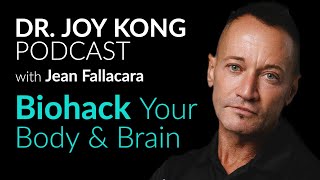
Jean Fallacara talks about his ADHD, entrepreneurial failures, and philosophy as a visionary disruptor. He covers practical performance methods: meditation, flow states, calisthenics, sleep, cold plunges, and sauna. He pushes back on loose use of the term biohacking and emphasizes science-backed validation.
Chapters
Your physique and your physical capabilities. It's very impressive. So how do you achieve that and what are some of your favorite hacks?
Meditation is probably one of the best tool that you can use to have your brain always putting things in perspective and being focused. But the flow state is probably the best hack. It takes a certain discipline to get there. For example, in sports, you will never see me with a phone and you will never see me training with other people. And then I focus breathing techniques help you to get into that flow state. And then when you perform, there's tricks to remember the movement that you're doing.
Okay, welcome back everybody. I am super excited today because I have a very special guest that's going to illuminate us on the biohacking industry, neuroscience longevity. So this is going to be quite a treat. So John Fattacata is my guest and John very much welcome you to the podcast.
Thank you so much. I'm so thrilled to be on this podcast. We've been talking for a long time. I've been looking at what you, you've done in your career, where you are and how you drive your life and I'm impressed and I'm with full respect and appreciation of being on this podcast. Thank you so much for having me kind.
Yeah, I feel like we're all fellow warriors, you know, trying to drive humanity into a better life, you know, better, you know, longer life and more vibrant, more youthful and just more effective way of, you know, being alive. So I'm excited to talk to a dear colleague. So I just want to introduce you a little bit to the audience. So John is a visionary disruptor. So with glasses you're going to expand on that?
I see through things.
Yeah. I mean this is very interesting description. Visionary disruptor, master of chaos. I love to hear about that and risk and figuring it out. So I'm a big fan of risks. No risk, no gain. Right. And your motivational influencer that ignite people's powerful inner fire to create the bright future they dreamed about in the past. And you're also very gifted with an IQ of 167. You were born in France and have always been a strong advocate of getting control of the brain, consciousness and the body to improve performances, focus, wellness and longevity. And you're also an author of an award winning biohacking book, Neuroscience Hijack youk body clock. In 2020, you acquired a Biohackers Update magazine, which is the first magazine about biohacking and human optimization. In 2021, you acquired your biotech Group and acted as managing director for Intesthermal. So if you want to introduce us to that.
Oh my God. Yeah, you can do you know, I think there it's information. Yeah.
So you're also founder and mastermind behind Cypor Cyborg games.
Yes.
Right. Which is the first human optimization program to incorporate functional neuroscience into lifestyle to redefine workouts and enhance performance of the body and the brain. So, so okay, so with all these things are into which is a lot first maybe tell us, you know, why do you consider yourself a visionary disruptor, a master of chaos?
Well, I don't know. I think I have this talent since I went. I was born, I'm trying to change this world. I know that many people on this planet have the same mission and have the same feeling, but I don't know, I felt invested by that and been, you know, being kind of rejected when I was a kid because I was hypersensitive. I was crying all the time. If somebody was looking at me and not looking the right way, I could cry for that. At school, of course I was going up and down because I was bored all the time. And when you're having a high iq, I don't think it's. It's a quality. It may be a burden in your life. So it's difficult to have friends when you think too much, when you. You're trying to over analyze everything that is around you and yourself included into that. But I found out that I had this talent of breaking down stuff, creating chaos. And from. Yeah and from the chaos it is true that I can unify people and just make them realize that they are all unique snowflakes and they can achieve great things in their lives. So this is what became my mission after I've mastered or I centralized this chaotic energy that was driving me all over the place. And even like of course ADHD didn't help. But when you put everything together and all these like boiling energy and you get them on one single pathway and track this is powerful. And that power, of course I used it for me to. I have created, merged, sold, acquired over 11 companies in my life. But the most important is I make people smile.
Well, you have to tell us how you do that. How are you creating chaos and then unify people and make people smile. I'm very curious.
It's an easy process still. Everyone lives in some sort of easy environment that they created and they try to stay on their track because they don't want to go out of their comfort zone. That's an Easy and cheesy stuff to say. But if you crack down that and you push them outside of these simple limits, like changing their routine one step at a time every day, a single thing, not, not like completely breaking down what they're doing or thinking or having in mind, but just a part of that. You make them step backwards a bit, look at where they are. And disruption exists because of that. And when you disrupt that process, that pattern, you create chaos. Because chaos is, it's a big disruption with no borders or no guidelines. And from the chaos rise something's beautiful. Always something's beautiful. Because we realize that we have a powerful tool. We're equipped with some things that is unique and most of the time we just forget to use it. It's our brain.
Yeah. So can you give me example of what kind of chaos you created and what changes made? Maybe I, I need some chaos in my life.
You think, right? Yeah, maybe. Well, yeah, I think that we all need some chaos. Yeah, we all need some chaos in our lives. You can create chaos on people that are not feeling great in their life. And they don't, they undervalue themselves, for example. That's the easiest chaos to create. So because they undervalue their, their power or their intelligence or their beauty, inner beauty, outside beauty, both, both are, have the same power. Please, give me a break. Don't come back and say it's the inner beauty that counts. It's bullshit. Okay. I think that it's an equilibrium between both, but people not feeling comfortable with themselves on any aspect. Okay, you put them to the limit where breaking down that pattern, like not making them feeling better by saying, oh, but no, you are beautiful. No, you're not overweight. No, you are not stupid. You go the other way, you push them to the limit. And when you cross that limit, you make them understand that. Okay, now you got it. You've perceived what you are doing. Yourself to yourself. Change it, put it the other way. Your chaos is created. You just realize that you are brutal with yourself when you think, oh, I'm, I don't worth that. I, I, I'm, I'm not intelligent enough to go there. I'm not strong enough to do this. Okay, fine, yeah, it's true. You're not go further. You're, you're, you're super weak. Yeah, but when you realize that you don't like, you like to tell yourself these things, but you don't like other to tell you. And if you push, of course you have to be very careful. But when you push the you push people to understand that the perception that you, you give to others is actually a magnification of the perception you have of yourself. So don't be brutal on that perception and try to wake up every morning and when you look at the mirror, you should be loving yourself. Not to the point to be completely egocentric or whatsoever, but you have to love yourself. You have to be grateful for the person you are. And of course we all went through our life to, through shitty situation or made a lot of mistakes, but that's fine. We are human, okay? And just understand that and, and, and keep going. Because honestly, life is beautiful. As simple as that.
Yeah.
When people ask me, how are you today, of course I'm doing well. I'm alive. I woke up this morning, I'm here.
Felt that way.
Always, always a little kid. Yeah. Yeah. I'm a hyper positive thinker, honestly. And I've been going through deep. I. Yeah, I started my first business and I lost everything I had and I went bankrupt. Most people, they would just like sit on the couch and cry, wake up, do it, realize why and go back. You have to be positive. It's not being negative that will help you. So you seem perplexed. Tell me.
Yeah, so igniting people's inner fire and thus by them accepting and loving themselves.
Yeah. Most people have this fire that is kind of very little or even like close to be extinguished. I think that you need to make people brilliantly shining. And everyone is capable of shining. Honestly. When you walk in the street and you take two minutes of your time to stop and talk to a stranger, you'll find this person, a beautiful person. We don't spend enough time paying attention to others. And this is why we say, ah, Republicans are dumb, Democrats are stupid, political are these. White are like that, black are like that. And we categorize everything. But when we take just a bit of our time and we open up our mind and our heart and we listen to others, every single person you will meet is a fantastic and unique snowflake.
Wow, that's beautiful. That's beautiful. If, if people can remember that when they go out of the door, when they try it, life will become a lot more beautiful.
Yeah. And you know what, and this is why you were asking me were you like that or your own lives? Yeah, when I was a kid even it's, I was rejected because I was considered like some sort of thinker, playing with insects and stuff like that. I've always tried to talk to people, to understand, to, to, to, to, to see why what, what their why was? And even I step outside of my apartment here and I'm gonna go to the elevator. If someone is there, I'm gonna talk to. And if I'm in the elevator, I'm gonna talk to the person. I'm gonna, hi, how are you? Because most people, they go in an elevator and they are just like. But if you say, hi, how are you? They start to open up their mind and their heart and it's easy. We are all like that. And most people, the answer they're going to give you is, yeah, I'm okay today. Then. Oh, what happened? Oh, no, nothing. So why you say that?
Wow, very open. That's a, that's a great way to, to start, which is the attitude.
Absolutely.
So, so you overcame the first, you know, basically failure, Right. And that, that didn't daunt, you know, that, that didn't phase you. And then, and then he went on to optimize your own mind and body, Right. Performance and, and, and brain health. So, you know, since we're in this subject maybe and we were talking about biohacking, since that's really what you're doing, right, you're biohacking your body and your brain. So maybe we can talk a little bit about your thoughts on the current biohacking world, since it's a hot world. Yeah. A lot of very high powered people are into it because they want to optimize whatever the power in the world that they have.
Yeah.
They want to amplify it. So what are your thoughts on, on biohacking world? I think it started, would you say started about 15 years ago?
Yeah, I would say about 15 years ago. So Dave, Dave Asprey says that he brought biohacking to this world, but some people like Oz Garcia were already biohacking themselves 30 years ago. So I think that, yeah, he did great marketing by taking the name of biohacking and making it his brand name. I like that guy. He's a rock star. But biohacking is, you know, it's a term, it's a name that says a lot and at the same time doesn't say anything. Because what is bioalking what it is? Is it like waking up in the morning and looking at the sunshine? Is it called biohacking or is it called neuroscience or is just called common sense of living? So where do you put the limits? Where do you put the standards? This is the difficult thing that is going on today. It's because since the industry came from $200 million to $200 billion I think if I'm not wrong, some people are trying to jump and to join that for money and market proposals. So whatever companies are coming with as a product, even T shirts and whatever they present to be in the biological industry, I think it's time now today to set some standards and say, okay, I would say that everything that is, that could be called biohacking has to be backed up by science as a real tool to improve lives. But it has to be an innovation, not something that was existing before and just with a brand on it, because otherwise it's not biohacking. It's just like commercialization into the biohacking industry. And we really need to make a difference on that. So breakthrough technologies, innovation, and then science validation of whatever you bring to the market to improve life and make longevity an accessible thing. This is biologging for me. Biohackers magazine or magazine has actually launched a program that is derivated straight from there, the cyborg certified program. Now we have a committee of scientists that look at the biohacking product or technique or technologies. We make the validation, we test them, and we put a stamp. Verified, certified, yes or no, you pass. You don't pass. And I think that will clean up a lot of BS that is in this industry. At the end of the day, biohacking is like trying to optimize our life in general longevity. But we have to be very careful because the medical side, for example, in the sport industry is trying to optimize life as well by creating cultured new organs that you can insert into human and change liver, part of pulmonary system, whatsoever and that, or even ligaments, artificial ligaments and things like that. So that is life improvement as well. And is it biohacking or is it medical? We need to set some limits. And we probably the name the term biohacking. That's why it's so confusing, doesn't mean much because when you look at the root of biohacking, biohacking, no sense, make no sense. You're a doctor, you know, biological. You cannot bio any biology. You can improve, you can adapt, you can change, you can shift, but you cannot hack anything that is biological. Right, Right.
So, well, I, you know, I think humans have been biohacking, you know, for as long as we've been around. We've always been trying to find shortcuts to enhance ourselves.
Yeah.
So what is making this explosion happen? That there's so many people who are, you know, are amateur hackers into their body. So what, what do you think allowed this explosion?
Well, I Think that, you know, people are more and more knowledgeable, which is fantastic. Knowledge is. Some people say knowledge is power. I kind of agree with that. Knowledge is a source of power when it's well mastered. So knowledge today allow people to live better. And if you live better, you live longer. And longevity, look at the longevity business. This has been the biggest business ever because we haven't found the magic pill that will make you live forever. So we have another route to take is the pathways bioalking. How can we live longer and better in shape and not just getting older, but not being able, able to move. So people are trying to get into that because many people and more and more people are looking at our society and they go like, hey, man, I work up to 55, 60, 70 or whatsoever. I want to be in shape. I want to be able to go outside and play. But remember our grandfather and before, when they were over 60, what were they doing? Sitting at the table, playing card, not moving, being not really autonomous anymore. Now you see people at 65 doing calisthenics, have friends that are like 65, 70, they're still on the bars doing pull up and, and push up and whatever. And I love that. I, I think that this is the way that the society should evolve. Being top shape, of course, senescence of the cell put some certain limit, but we can push that to keeping our organs in better shape and not getting them becoming too old too fast. So this is why people are jumping into that. Ask anybody in your environment, in your surro, in your network, would you prefer to live longer or just die at 65 or 70? Every. Everybody will tell you, wow, I would dream to live up to, of course I would dream to live up to 100. It's, it's some sort of a standard today. But we know that we can live up to 125 easily. That's not a big milestone. Some say 150, and some even a great friend, Sergey, has the goal to say 200. But overall, it's way better than where we are today.
So to be honest, I think people comparing, you know, I hear people compare, you know, their goals on podcasts, you know, I'm going to live to 150. No, I, you know, you know, I want to live to 180. I mean, it seems there's a bit of an ego involved. Of course, competition. And the consensus I hear from people definitely is not about how long they live, it's about how well, you know.
This is, this is the thing I'm more aligned with Your thoughts here and you're thinking is I want to do what I'm doing today when I'm going to be 75. I want to do an end stand the planche and things like that. And I know that I will be doing it. I don't care. Yes, I do care that I'm gonna leave up 225 or whatsoever, wherever life takes me. But I think that being a performer and keeping being a performer is way more important. Like remembering name, remembering thinking thoughts, ideas, being creative. This is a point. Many people when they get older, they just lose their creativity. And this is sad. We need to be creative as we were creative when we were kids. And most people in our society, as soon they turn into 2025, they lose all this beautiful creativity that's changed the world. And going back to what you asked me before, create chaos.
Okay, so how would you suggest people do to maintain their creativity?
You have to have a punk attitude.
A punk attitude? Yeah, explain that one.
You have to say fuck it to the politically correct.
Yeah, that I'm definitely up for.
Yeah. Because this is the, this is the, the illness of our society. You know, we don't say think because we want to polite, but we're boiling inside. Sit, spit it. People will deal with it and we're going to make a better world.
Yeah. And so besides the attitude, are there things that people should do, you know, to, to help maintain their edge in their performance and in their brain power. So you feel that creativity is a big part of it.
Yeah, creativity, enhance neuroplasticity in general then keeping your brain in good shape. It's important. Sleep. Of course. All these things that we hear and hear all the time by everyone that pretends to know the, the secrets of biohacking, but we all know. Wake up in the morning, drink water, go outside, look at this move. Exercise. Okay. We all know these things. It's. It's not biochemist. It's like common sense of being alive. But keep your creativity at higher pace. Be pleasant with others. Don't be an asshole all the time and try to be pleasant and don't be nasty with other because you have certain power or money or a title. This is another chapter of the punk attitude. Let's get rid of all these titles that we have incorporated America. They're useless. They make people weak anyway. Yeah. But yeah, there is a lot of things that need to be done to keep you in shape and at the edge of your performances. First is to have a healthy diet for sure. And I'm not like talking about the keto or the vegan or whatever diet, they're not sustainable. We, you need to have a balanced diet and balance on every aspect of nutrients that you have. Avoid the toxics, of course. Drink a lot of water. Life. Water is life. This is the first and most important parameter. Water. That's drink, drink, drink, drink, drink water and then move. Because people or society became kind of not moving after a certain age. Just because we don't train people to keep using their legs, knees, knees, muscle in general. And of course, it's part of getting older. You lose a part of your muscle because you're getting old. So you have to compensate by taking a bit more of proteins, of course, exercise to keep regenerating your protein. And then if you want to push further, of course we have the cold plunges, we have the sauna, we have all these things. And, and try to always go for the best, for the ultimate tool that can help you to improve your life. If you have to choose between 20 minutes sauna and 20 minutes sitting on the couch, well, go for a sauna. You know those choices. Every decision we make impact our biology. This is what I say in my book, and this is so true. Every decision we make every day has an impact on our life. So choose the right one. Be wise on your decision. If you decide, oh, am I gonna have a whiskey tonight or a glass of water and a walk, I'm gonna go for a walk and water. Yeah.
You're in amazing shape and I've seen your Instagram posts and so you know, both your physique and your capability, physical capabilities, it's, it's very impressive. So how do you achieve that and what are some of your favorite hacks?
Oh, there's a lot, actually. Meditation is probably one of the, the best tool that you can use to have your brain always putting things in perspective and being focused. But the flow state is probably the best hack that helps you achieve everything. Business, physical, emotional and even interpersonal or personal relationship. When you are able to put your brain in this mind in this state of like a flow state that helps you to go through everything at a pace that you don't even realize that you're getting there, that is probably the best hack. But it takes it, it takes a certain discipline to get there.
So how do you achieve that? Some of the skill sets that you've.
Gained, okay, for example, in sport, you will never see me with a phone and you will never see me training with other people. I like people, but when I train, I train and I'm in the zone because I'm not paying attention to whoever it is around in the gym or my phone that is popping up messages and stuff like that. If I have a phone, it's going to be on mute and not even vibration, just mute on everything except music. And I listen to music and then I focus. Breathing techniques help you to get into that flow state. And then when you perform, there's tricks to remember the movement that you're doing. Some people find that I, I can look dumb sometimes in, in, in a gym because for example, I'm gonna walk backward, eye close and people are just like what the is doing. But it's because I just made a set of movement and I'm very happy with the performance of that set of movement. Just to make my brain remember them deeply, I just close my eyes and I walk backward. And that improves my motor pathway network and memorization. And I have a ton of tricks like that to keep the focus. I could like stare at some things outside and then stare at a point just in between my two palms of ants. And just to keep my focus when I'm going to go on an ant stand, those are simple trick but let's pretend I'm with someone and talking. And I go for an instant. So I'm going to talk, I'm going to go to my handstand, my hand think is going to look like a banana or something just because I'm not concentrated, I'm not focused enough. Or if I'm not with someone training, but I look at my phone and I read the message or I go on Instagram and I put my phone down and I do the same movement. It's not going to be the same. So everything I've learned is less than five years ago. And I've seen people 10, 12 years in the same sport, they don't even do half of what I'm doing. And they're half my age and I can teach them. I'm just open to teach anyone to do things. And I say, you want to start start tomorrow. You're going to do it.
So to achieve the flow state. So you're talking about when you are, you know, doing physical, you know, performances. What about you said with even with other people so you can keep yourself in the flow state when you are interacting with others. And how do you achieve that?
Well, you have to pay attention to the words that they're saying. Our brain has always this capacity of we're not listening, you know, we're thinking about what's going to be our next punchline or sentence. So you're not, you're not. You're not cooperating with the people around you. You're just like, trying to egocentrically make your point. If you carefully listen to each word, but you make them resonate in your mind. And you'll see with. If you combine the words that someone like, I'm talking now and I'm saying these sentences and these words. So if you pay attention to every single word I just said, and at the same time you pace your breathing, you're going to see your brain is going to go, like, straight into a pattern of, like, you're dedicated to that. And of course you're going to improve your relationship because you just listen to that and you have the time to put that in perspective and open up the discussion instead of just putting a point that you've probably learned from a book you read. Like many people talk from the book they've read instead of talking from their real thinking. And I think it is important to express ourselves as we think and not as other teachers to think.
That's a great tip. Remember that. Because I have a tendency for my brain to go everywhere.
Of course, adhd, your intelligence. That's why. But you know what? You could work, close your eyes, walk backward. You're going to remember it.
I am going to try that. Yeah, I've tried that. When I was a teenager, you know, I heard about that. And playing basketball with my left hand, you know.
Right.
With my left hand. I guess all these are good tricks.
Absolutely. You know, when I go for a walk every day, in the morning, I go for a walk 5K. And at night, after my dinner, I go for a walk as well, but I do about 1k backward. And once again, people probably think that I'm crazy sick, but I walk backward and I can close my eyes or look at people. And since you're going the other way, your brain is completely messed up. And this is beautiful.
Yeah. Yeah. Okay, I'm gonna try that. And while stay the same. Stay safe at the same time.
Yeah, you have to at the beginning. Don't go too fast, but learn. And the more you do it, the more you're comfortable. And you can, you can even, even run backward when you're really used to it. It's a learning process. We have no limit in the learning.
Yeah. And I'm really curious about, you know your book, right? It says neuroscience, calisthenics, so. And then hijack your body clock. What do you mean by that? And how do you bring calisthenics into neuroscience?
Calisthenics means gymnastic, means movement. But the calisthenic movement in our society, in our modern society was born because people couldn't afford to go to gym. But they were fanatic of gymnastic. So they started to do that in the street. And it was, it became two movement separated. One was called calisthenic, which was mainly gymnastic, derivated static movement. And the other one was called street workout because it was done in the street before COVID That took really a big eye because gym were closed during COVID as well. And so calisthenic became very, very popular. But if you look at the studies that were done in sports, for example, the one from the psychology department, University of Florida, they found out that gymnastics was one of the sport that could trigger most part of the brain and make multiple part of our brain connected at the same time. You cannot have that by lifting weight, for example, you cannot have that. The runner high is another thing that we know as a flow state trigger. But gymnastic, because you're using every single part of your body, even muscle, that you don't even know that they exist as these capability or ability to trigger your brain in a certain way. So I was curious to see what was the neuroscience behind it. And I started to study more and more neuroscience and. And then I saw that, well, yeah, the brain has really a lot to do with the body. When you do very difficult exercises is not just like the strength of your muscle, but it's mainly the mindset that you have to do that. So just because I liked it, I like science in general. I called it Neuroscience Calisthenics. But honestly, it's an easy book. It's not the best book. It's more a biohacking kind of resume of what is out there. And talking about the neuroscience principle. What Andrew Huberman is doing as super well. But the book was done before it was popular. But it's the same principle and explaining people that the brain has a big part of our performances and achievements. My next book is more like some things that you're gonna like because it's about the neuroscience of taking risk. This is probably what drives people differently. Like why some are entrepreneur, some other are not. Some are jumping on skydiving or things like that, and some others are not. There's really a brain impact behind that and behind those behaviors.
So what are some of your best, you know, best tricks to enhance the brain? Like maybe you could give some pointers, some of your favorite Ones that you think can really move the needle.
There's natural things like meditation. I. I spend sometimes and actually often I could spend like two hours outside. No music, nothing, just. Just like being myself. Centered on and not even trying to think about something, but just like being myself. I think that improves the brain a lot.
You're saying just by sitting in nature?
Not even in nature. I could, I could sit in between buildings. It's sitting or walking or just staying yourself with. You know, this is tricky because many people go like two hours. You're not bored. Remember I was adhd. Okay. Being two hours without no phone, no music, nothing, not talking, but just you with you and only you. This is one of the best thing that improves your brain. You see everything crystal clear. You put everything on perspective. Your life becomes super shiny actually, because realize that, yeah, there's a lot of beautiful things to go after and to have and to do and to improve. So we never take the time to do that. So that's one. That's the best.
That's really interesting. I'm wondering. So I'm wondering if that's why I love solo traveling so much, because I'm in complete silence. I'm observing the world, right. Walking by me and I'm feeling it and it's. It's all in silence and somehow feels.
Really good to get the. The energy from the outside. So, yeah, nature or buildings. And you can have the same if you walk on the beach, close to the oce, if you walk in in nature, if you're traveling hiking in the mountains, or even in a train or in a plane. You can do that. Yeah.
Have you done research on what this kind of silence does?
Yes, I'm digging into that. But you know, there is no research in putting people two hours without anything. There's not much people willing to do it. Oh, it's true about. But yeah, I've been doing that for quite a while. And honestly, I'm. I'm at the utmost state of I. Enlightenment in my life of Zenness. I've never felt so great in my entire life. And I'm. I'm sad that it didn't happen 20 years ago, but it's. It's okay. But today there's nothing that can bother me or like go against my, my mood. It's just like I'm part of this universe and I'm just in harmony with everything because I take time to, to observe. Yeah, just look out. We're a part of this beautiful universe.
We're just so less balanced and Then you became. Yeah, partially because the silence. You were willing to give yourself that.
One big factor I think is the fact that I moved to Miami. I lived in Canada for a long time. Then I moved to Boston because I sold my company. But I think that, you know, in our lives we have these little buggers. They're like something stopping us for getting to the state, to the ultimate state of wellness. And one of them for me was just getting dressed, for example. And like in Canada, what kind of weather is going to be, Is it going to rain? Is it going to be cold here in Miami? Honestly, I don't care. I'm wearing pretty rare that I have a T shirt, but I'm wearing a short and that's it. It's a 0.1% of my life, but it's a 0.1% of the buggers of my life. So I remove these, I remove the fact that can I go outside? It's a bugger. I lived in Boston. My apartment didn't have any balcony while I was in Canada and I had a lake access and things like that. So the not having a balcony in Boston was a burden. Now here it's not only the balcony, but I can go in the park downstairs and have that. So it's another buggers that is removed. And I have removed all these small buggers of life that, you know, this 1% at the time that improves you. This old quote that we say you have to improve your life one percent at a time. I think that you have to improve your life just removing every single little bugger that is in your life. And when you get to the point that you have removed all these buggers, you're in the state I am today where I'm ultimate state of wellness and Zen ness. I am super balanced. I couldn't be for small details. But now today I have nothing that bothers me. Nothing.
Wow.
Yeah.
I'm sure that's a state that most are, are hoping for, that they can achieve.
They can.
Okay. And you gave us some, some good tips of how they can achieve it. Yeah. This is a wonderful, you know, you know, conversation. So I really appreciate you sharing your experiences and wisdom and you know, and some of the even techniques to the audience. So I hope people can take up on some of the, you know, the, the, the wisdom you're sharing and enhance their lives and how can they find you and follow you more and just learn more from you.
Yeah. So cyborg gains like a cyborg. They called me Cyborg because I was doing performance movement faster than anyone. So cyborg gains with the. Yeah, it was a nickname. Others on Instagram. Thank you. Thank you. But, you know, this is it. Just to make a short story out of that is like, I'm not living to prove to others that you can. I'm better than others. But I'm always trying to go further. Like, I. I stay 40 minutes in the cold plunge, and a guy goes to me and he go, he's a manufacturer of cold plants. And he goes, why? And I go like, that's the best question I've ever had. People are just like, wow. But it's. The true question is why? And the why is because I want it. Because I want to see how far I can go. And this is the same for cyborg games, for whatever. So where can people find me? Instagram is the best. Or Biohackers magazine. It's the magazine that I acquired a few years ago. We're doing. We're talking a lot about biohacking, life in life improvement optimization, longevity hack, Biohack, and everything that's related to that. And just jeanfalagara.com leads you to everything. I think so. Yeah.
Fantastic. Yes. I look forward to keep following you.
And thank you.
Same conversations. Yes. Thank you so much.
Yeah, thank you.
Lovely conversation.
It was an honor for me.
Wonderful. Thank you, John, it's been a pleasure. And I hope everybody is gaining a lot from the conversation. Okay, bye now.










