Breast Implant Illness BII - Interview With Dr. Kayte Susse
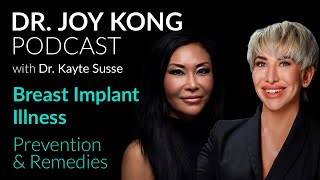
This is a recorded interview (YouTube/podcast) between Dr. Joy Kong and Dr. Kayte Susse about breast implant illness (BII). Dr. Susse recounts her own illness from silicone breast implants, describes clinical findings (gel bleed, thin/fragile capsules, possible microsilicone migration), and explains her rationale for a three-part silicone-support supplement she developed (collagen/histamine/MMP9 support; detox support including active B-vitamins and calcium D-glucarate; immune support focusing on glutathione and T-regulatory pathways). They discuss regulatory context (FDA removal of silicone implants circa 1992, later re-approvals with incomplete long-term studies), estimated implant volumes in the US (Dr. Susse cites ~350–500k/year), anecdotal user feedback, and the role of regenerative medicine (birth-tissue-derived mesenchymal stem cells and exosomes) for organ rejuvenation and improving detox capacity. Product availability: DrKates.com (as stated by guest).
Questions this video answers
"roughly 350 to 500,000" (guest estimate)
"1992" (guest's recollection)
R&D cycle ~6 years (personal timeline); formula developed ~1 year and "launched a couple months ago" (relative to interview)
DrKates.com (stated by guest)
"about 75% of the population" (guest's claim)
Chapters
What does it look like when someone's healthy with implants? I think that that process is dependent on your body's ability to make nice scar tissue capsule around your breast implant. That's the basis of my patent for this formula is creating a nice scar tissue capsule. And like with anything in the body, like an overreaction is a negative outcome and an under reaction is a negative outcome. So we're thinking about balance foreign.
To the Dr. Joy Con podcast. And today's content is really, really interesting because I have Dr. Katie Seuss here with us and we're going to talk about the health of women who've had breast implants. So anyhow, so if found, if you found this content interesting and you enjoy listening to this channel, please subscribe if you to Joycong MD YouTube channel. And now we're gonna get into it. So Dr. Kate.
Hi Dr. Joy. I'm so excited to be here at your beautiful clinic and studio. It's a really great, it's a great. Every time I come here, I experience some sort of great healing or fun time.
I'm so glad. I'm so glad. And you are a fountain of knowledge and you're very passionate about what you do and, and you actually have come up with this innovative formula to help women. So maybe tell us a little bit about what you think about breast implants. What are the issues and how you've come to design something to help women who have implants.
Okay. So I started this journey as a person who had breast implants who was experiencing a tremendous amount of symptoms and negative health symptoms and was very unclear why. And I went to a lot of different types of doctors. This was many years ago now. And I ended up eventually figuring out that breast implants were a big problem for my body. And then when I ended up removing my implants through the correct type of surgery on block capsulectomy, my breast implants were very sticky to the touch and they were exhibiting what we call gel bleed or so. It's sort of similar to a rupture except it doesn't really. It's not a full on rupture where the silicone has moved and migrated, but it's bleeding out its contents. Additionally, I had very thin scar tissue capsule, which is the protective collagen scar tissue that your body makes around any device that you put inside of it. I had very tiny paper thin capsules.
So.
The likelihood is that the immune system is getting in through those thin capsules and pulling off little pieces of the implant which is responsible for the Gel bleed. Nonetheless, I was riddled with health symptoms. And I've seen autopsies of women who had severe jaw bleed and severe rupture. And we found microsilicone in all the organs of those patients. In the autopsies, like in the brain.
And the organs, do they die from the breast implants?
It's unclear, but there's a few case studies that I can send you that are really interesting. The point is just to see that this microsilicone can move through the whole body. And I have no way of verifying if that's the case in my body, if there's microsilicone in my brain. But, you know, we're thinking about the way we're thinking about toxicity in that way. So early in my career, I was really focused on helping women, first of all, learn about the possibility that breast implants could be the underlying problem in their health crisis or chronic health issues, or even the underlying trigger for an autoimmune disease. And then I started moving into helping women who had explanted but were still experiencing health problems. And then I moved now into this new space of trying to figure out a way to compromise and meet people where they are. Because I've met a lot of people who do not want to get rid of their breast implants no matter what I tell them, and a lot of people who are committed to augmenting. So I started to embrace a new approach to beauty. And I have a kind of whole new perspective on it.
That you were trying to get everybody to take out their implants. I was.
You're like, yeah, right. Exactly.
Right, right. Good luck. So you were being trained in chiropractic school. Right. And then. Was that when you got the implant? No.
So I had breast implants prior to chiropractic school. I started suffering severe health issues right about nine months after getting breast implants. And my primary problems were musculoskeletal problems like severe pain and fatigue in the muscles and joints. So I started researching health programs, and I really thought I knew nothing about health. And I thought chiropractic school is where you learn everything about muscles and joints, and that's my primary issue. So I'm going to go to that program. And then when I got into the program, I quickly realized that those interventions didn't help my pain at all. Like, it made. No. And then I was watching people around me with pain, getting adjusted and getting acupuncture and learning about muscle patterns, and they were getting out of pain. So it was really confusing. And luckily, within my program, there are a lot of people doing functional medicine and training people on basically internal medicine. There's a program within chiropractic called Chiropractic Internists, which is basically internal medicine study and learning about the metabolic causes of pain. And I started learning that there's many different pathways for pain related to blood sugar and diabetes and inflammation and gut health and, you know, parasitic infections and, you know, more things that are not coming to mind right now. And then, lo and behold, of course, like the exposure to toxic chemicals like mercury and how mercury affects the nervous system and, and the nerves that come out of the brain and the spinal cord over time. Studying the biochemistry of toxicokinetics and understanding the ingredients in pharmaceutical grade silicone that include mercury and lead and arsenic and platinum, aluminum and a lot of chemicals.
Are these chemicals contained in the silicone or silicone is completely different set of chemicals?
Yeah, no, those are all contained in the silicones.
So why would they put those chemicals in the silicone? Right.
It's a good question. So the best answer I could say is because in the 90s, we had a lot of problems with silicone being migratory. And in my naive understanding of silicone in the early days, I thought silicone was similar to silica, which is similar to sand. And I thought it was like a natural thing. And that's probably. Oh, that's why this medical device is made out of that. Because it's natural. Right, because we just assume that they would think that way. But really, I think what was happening was there was a big problem in the 90s with silicone breaking apart and it would move down the rib cage and say there was a huge lawsuit that Dow Corning, which is the manufacturer of silicone, lost the lawsuit and there was a lot of money paid out to women. And the FDA pulled silicone filled implants from the market in 92. Believe it was 92. And after many, like a couple decades, two companies did reformulation of their implants. And their primary thing was to show cohesiveness. So they showed the FDA and even consumers, like, look, you can run this implant over with a car and it won't break apart. Because in their perspective, that was all that mattered, was the cohesiveness. So I think that that created the need for more chemicals in the formulation.
And I see.
Without tinkering with it. Yeah, without. So. So, yeah, I don't think they're rupturing like they used to, but I mean, I know they're not rupturing like they used to, but now we're seeing kind of a rise of other types of issues and it parallels with our world becoming more toxic. Right. So we're seeing more pollution and more gene degradation through the generations. Right. As being children born of parents exposed to chemicals. And so it's, it's not really good.
So nowadays, I mean, breast implants has been a highly popular procedure. And what's the proximate number per year of women actually undergoing the procedure?
So actually the amount has gone down in the last few years, but the trend in silicone over 20 years is very rising. I mean, I think 30%, don't quote me on that, but roughly 350 to 500,000 women get breast implants in the United States per year. And that does not include other types of silicone devices like butt implants and chin and jaw. And I see pec and penile, you know, that's a thing.
So the product you designed really is helping all these implants, Right? Yeah.
I hope that anyone who has a silicone device in their body will consider this formula. It's an augment to silicone devices. But my primary focus is breast implants because that's, you know, that was like my foundation story. And also I think it's the most popular cosmetic surgery as far as silicone devices.
Yeah. Do you have a sense of the how many women that got silicone implant, breast implant actually have had issues?
Well, I can tell you that there are, you know, in recent years there have been releases of suppressed state like complaints and reports that were given to companies and the fda, there had been some suppression and there was a whistleblower and there's now archives of these, like, you know, just tons and tons and tons of reports and complaints that were kind of like not acknowledged. But the FDA has done a really good job. In the fall of last year, they issued new informed consent for surgeons that is like alerting them women or you know, people who got implants about the safety concerns so that they can, you know, consent to them up front. This has been because women who are not really being counted are coming forward, like vocally on social media and through advocacy groups because we don't really have a system in place to track systemic health concerns. Because for decades the medical community has been suppressing the idea that that's even. And they still are, they're still suppressing the idea that that's even possible.
So.
So if they're denying that something is possible, there's no system to track it, which is a big problem.
Right, right, right.
And the safety Studies were never finished. So the companies that presented to the FDA in 2005 or 6 and got their approval, the FDA asked them to finish these studies that were supposed to be 10 year studies, they were three year studies. So they had started and they were supposed to follow the FDA study design which had been a big failure in the 90s. It wasn't followed. So the FDA was really trying, I believe, but there was not any follow up. And so the studies were not finished. And now I think that they've been asked to finish. So I'm hoping that that happens.
Okay. Yeah. Yeah. So what are the range, what's the range of symptoms that you have, you know, you have studied and found that people, you know, can, maybe a lot of people are experiencing symptoms. They have no idea it might be related to the implant.
Absolutely. So it's a really complex question to answer because in essence we're talking about a person's body's response to basically a negative epigenetic environment. So and I think, you know, you can relate because you, you're like one of the healthy. Your lifestyle is one of the cleanest of anyone I know. Like you don't drink alcohol, you know, you're doing stem cells regularly. Get you started a little bit for.
The mental health as, but you know.
Community and I'm sure you have talked about this, when someone is participating in negative habits, it can change the way their genes are expressing themselves. And sometimes a disease process that wouldn't manifest for later in life can manifest earlier. So when you have kind of this clouded internal environment that's caused by an onslaught of toxins 24 hours a day, seven days a week, and your body is not getting a break, it's sort of like up to your own body what it's going to look like, how it's going to manifest. And so that could be a little confusing for a clinician to understand. Right? Clinicians looking at a patient and seeing, okay, well you have a family history of XYZ and you're manifesting. It's kind of, you're kind of young to be manifesting this. But I can say across the board there are commonalities. Like we're looking at cases of fibromyalgia in the absence of joint, like an obvious joint connective tissue autoimmunity. Like, you know, they look for those markers and don't find it yet. The patient has fibromyalgia. Like what's the cause? Right. Things like an auto, joint and other types of autoimmunity. Anytime before an object is put in the body, it can be a trigger event for an autoimmune process. Like. Right. So we're also thinking about swelling and brain fog, which is related to gut health, which goes back to the liver and the pathways and the ability to kind of detox these things out. In my case, I had a lot of just pain and I personally feel that when people have pre existing heavy metal toxicity, which may or may not be causing symptoms, but then they put in another like another thing like breast implants, that can be another toxic burden on what's an already burdened system. I think that that's when things can really start to manifest, like in the true nature of that initial heavy metal. Like in the case of mercury, it's like a central nervous system attacker. So it can look like hyperreflexia, it can look like Ms. In the absence of finding ms, things like that.
So you had pretty drastic reaction to the implant, right? Yes. So it's possible a lot of women may have mild symptoms and they can't contribute to that. But have you seen other drastic cases?
Oh yeah, absolutely. I've seen like an entire spectrum of response and I've seen everything from like people who are completely bed bound that are, you know, look like a chronic fatigue syndrome patient. And people who were like think. Thought that they felt great and just removed their implants because they heard they had chemicals and then experienced like a massive kind of like inflammatory. De. Inflammatory process where they just left, looked way better than they did before, like aesthetically and looked thinner and like I. One of my close friends actually ended up explaining because of what I went through. And then she just lost a lot of weight and she thought it was like weight she had from having a baby and thought it was just like, oh, this is baby weight. And then as soon as she explained it, she's just like. Now it's interesting because we're segueing into like what does it look like when someone's healthy with implants? And do you have to, if you have implants, you know, do you have to have symptoms even if you're aware or not aware? Right. And I get it.
Right.
So. So, you know, I think that the answer is that there is a possibility that you can be healthy with breast implants. I think that that process is dependent on your body's ability to make nice scar tissue capsule around your breast implant. That's the basis of my patents for this formula is creating a nice scar tissue capsule in plastic surgery. They talk a lot about the antithesis of a Good outcome is that capsular contracture where it's like too thick and hard and it pulls you. And that's like what they really worry about.
Right.
And like with anything in the body, like an overreaction is a negative outcome and an underreaction is a negative outcome. So we're thinking about balance.
I see. I've definitely seen women with contractures and is not pretty and they have to go back under the knife to correct that. So you're saying that the formula you've designed is possible to prevent the over encapsulation or connect tissue formation and under.
So I would say that this formula supports a healthy scar tissue formation which includes balance. So preventing is the role of a drug. Right.
So treading.
But. But yes, cautiously, you know, as a physician that recommends this formula. You can talk about the micro like the chemistry of like what these ingredients do in the research. I don't really have that luxury as a vendor, but I can educate doctors and you know.
So yeah. So how long ago did you start to work on this formula?
Yeah, so I say my R and D cycle is six years because I go back to like the day, my first day of being six, but you know, really about a year for developing the formula. And I just launched it a couple months ago and yeah, we're essentially a startup but it is for sale online and I hope to one day have it in surgeons offices so that they can, you know, recommend it to all of their patients that get implants so that, you know, they can support them. Yeah, well through that process and sort of enhance the patient's experience with silicone devices.
I see. So how many ingredients are in your formula?
You know, I don't know how many. I've never counted though I have a bunch of spreadsheets at home because I kept taking things off and putting things on and then I would be like, oh, I'm going to add this in to support the co factor of this ingredient. But basically there's three blends. Like one is a collagen blend. So the intention is to support that capsule formation. It does it in a unique way. It's actually supporting the process in which our body, when it secretes histamine, can break down collagen. So it's sort of supporting the histamine pathway to prevent the breakdown of excess collagen.
Okay, so that supports the capsule. The integrity.
Exactly. And another great side effect of supporting the collagen pathway is that it can be in a way like abuse beauty supplement. So a lot of people have taken it have called me and said that they feel like their skin looks tighter, that, you know, they are seeing cosmetic beauty effects. If they have flushing as an issue, which is a cons can be a consequence of excess histamine. They're seeing a dampening of that redness. Okay. Which is kind of cool. And there's a lot of stuff that happens in the gut related to histamine. So it's not uncommon to experience gut change, like, you know, positive gut motility changes. None of those are in my claims, although I might, down the line, look into trying to figure out if I can structure claims like that. It's just claims are accommodations.
So that's just from helping the connective tissue.
It's from working on histamine. Basically, it's from supporting the MMP9 pathway. So that's one sleeve. The other sleeve is supporting detox. So this is in no way a product that is pushing detox or enhancing conjugation. Like you might see detox formulas on the market, like milk thistle and things like that. It's nothing like that at all. It's more just if there's common genetic mutations like on B12 and B9, I've included the active form of those B vitamins so that, you know, they're kind of like the quarterback of detox. So if you're not converting and that people, about 75% of the population have mutations on those enzymes that convert B12. So you consume it, but it doesn't ever make it into methylcobalamin or methylmalonic acid. And then we just don't. We just have compromised abilities. So I added the downstream form. And then I also included things like calcium D glucarate, which helps to prevent. So when you have exposure to xenoestrogens or chemicals in the environment that act like estrogen, which is a negative outcome that can lead to all sorts of things like breast cancer and estrogen dominance. And so people with chronicity, they tend to have this gut dysbiosis where they end up with excess of beta glucuronidase, which is the enzyme that basically your liver goes through all this work to wrap up those bad estrogens, puts them into bile to eliminate, and then the. The enzymes in the gut then just unwrap them and put them back in the bloodstream. So we don't want that. So I put calcium deglucarate, which helps to support dampening beta glucuronidase, so we can eliminate those xenoestrogen chemicals.
So what do the xenoestrogens do when it's related to breast implants.
Yeah. So whether you're getting toxins from the environment or outside of you or from the internal environment, you know, by having devices, you're going to need to be able to support the elimination of xenoestrogen. Xenoestrogens act like estrogen and they can cause imbalance in your entire hormone pathway. Right. So. And I'm sure you could speak to estrogen dominance and why that's not ideal. But, but most people know a little bit nowadays that's like a common thing. Right. Estrogen dominant. Okay.
So it helps balance the body in general. But does that do anything specifically for the breast implants?
So what it's doing is so like, let's say that your body, like you have the silicone devices in your body and your immune system is pulling off tiny pieces of silicone and mobilizing them. They're going to go to the liver so that they can be eliminated. And if you, if you have flora imbalance such that beta glucuronidase is prevalent, which is very common, you're going to unwrap those, you're going to have the potential to unwrap those xenoestrogens and put them back in the circulation. So it's like a big vicious cycle. So when we look at diseases long term, like breast cancer, and we look at the role of xenoestrogen chemicals in breast cancer, we see there's studies showing calcium deglucrate in conjunction with vitamin A is, is helping in the prevention of that particular type of cancer. So that's just like a relationship. I'm in no way like relating my formula to cancer, but that's like one example of how chemicals can be dampened. Right. So we can help. So when you add calcium, D glucarate and vitamin A together, they're going to prevent the unwrapping of chemical estrogen so they can be eliminated. Okay, okay, okay. It was a round of.
Sorry.
It was a long winded explanation. Let me drink some tea.
Yeah. So you said there are three main blends, right?
There's one more that we haven't.
Yeah, yeah.
So the third is supporting the immune system. So going back to, you know, the early days when we're looking at autoimmunity related to silicone devices, even though this is still a. I for the life of me don't understand how people can still say that. It's not an obvious like relationship. But you know, there's still people who say that a lifestyle Autoimmune disease is not necessarily attributed to a trigger like silicone or a foreign device. But in my clinical opinion, it's an obvious relationship that it can turn on an autoimmune process. But there's things that we know about autoimmunity that like people who are missing certain key nutrients in their diet or because they're not absorbed, they're more likely to have a dysregulated immune system that's going to lead to turning on an autoimmune process. So we look at the T regulatory system and the glutathione system and its relationship to basically like saying yes or no when the body presents soft tissue as antigen. So when the body is saying like, hey, like this little piece of your, of your joint, we think it's a bad thing that should be attacked. And then if the T cells are agreeing and like the T regulatory cells which are policing the T helper cells, if they're not like really fostered by glutamine and vitamin C and the substrates that recycle glutathione. Right. If that system is not nourished, then the body is going to be more likely to agree and say that is a pathogen, attack it, and the next thing you know you're like attacking your body. Right. So I just wanted to make sure that everyone had all of those raw materials. And that's what the immune sleeve looks like.
Yeah, yeah. So I'm sure you have heard some stories of what people, how they did after they took your product.
Yeah. So we're collecting that data now and I've had great. Yeah, I've had great feedback and I look forward to having more formal questionnaires in the future that can really show the benefit outside of just like me raving about it and saying, everyone says it's great, you know.
Well, we heard from our office manager. She had some kind of a histamine reaction, redness of skin, and that really helped calm that down.
So she's an example of someone who doesn't have silicone devices. But when I was talking to her about what the formula did, she resonated with a lot of the things. So again, we're talking about exposures to chemicals, which a lot of people are getting. Right. Whether they have silicone devices in their body or they're getting it from the LA air or the myriad of places that we can get exposed now. Right. Which I think would be a good segue into talking about my favorite topic, which is regeneration Right. After exposures, because we're Talking about supporting the body. But what happens when you need more than support? What happens when you need to regenerate? And that's where you come in.
Yeah. So you have come to our clinic for some regeneration. What are your thoughts. Thoughts about, you know, stem cells and. And exosomes, you know, to help you, I guess, achieve a better state.
Yeah. So I was really just blown away. Like, the first time we did stem cells, I had no idea that they were going to be so powerful. And I was, to be honest, skeptical. And I think, like, we. Even when I interviewed you in 2019 or 20. No, it was 20. I think I was still. I was reverberating some of the kind of criticisms I'd heard about stem cell therapy. And you were talking about those things really articulately. And I was. You know, I had heard things and listened to podcasts and heard about the bad players. Right. And so when we finally came around and, you know, to be honest, like, stem cell therapy is expensive. So when people go out on a limb to pay for an expensive therapy, and then they're like, not sure. Right. That's hard to mitigate. So every time I talk about your work, I'm always saying, like, you know, like, her. Her supply chain, it's on, like, completely managed. Like, you have everything from, like, the infancy in the lab, and, like, you're just completely in control of the process with that, like, integrity and, you know, understanding of the quality. So that's so great, right?
Yeah. I mean, the problem with the regenerative medicine field, I think a lot of people, the public may not know because there's so much money involved. So every actor is coming in is like a fly, you know, they all want a piece. And so many of the people who are in the field are really paying attention to the profit that's number one above anything else. And the efficacy and the science comes way below. So whatever people can do to maximize, maximize the profit, that's what they were doing. And then when I discovered that's what's going on, that's when I decided, okay, I have to be on the business side of this so that I can really have control of the quality of.
The product and set the standard.
Right. And also use science, because there are all this research that's been going around all around the world, and why can't we take pieces of what we know that really work and put them all together? So that's kind of what I did. So the supporting the immune system, reducing the autoimmune reactions, and even helping Tissue heal, even breaking down excess scar tissue.
Right.
And then building new healthy tissue. So that's all part of what the mesenchymal stem cells can do. Right.
And I think one of the stories you told me before I did stem cells that helped me feel so confident and excited was you talked about your liver cirrhosis patient who experienced like this tremendous like liver recovery after one infusion. Right. And I don't know how many cc's it was. Was it a lot? Two cc's really.
It was not very much. He's not a big guy, but it was, it was a very low amount. And my protocol at the time was that he was supposed to come back in two weeks to get the second one and he just never showed up. And I didn't know what happened to him until. So a couple months later, his brother who paid for the treatment, told me that he is completely normal, running around like a normal person. And I got his lab tested and his liver was normal. This is somebody that was in hospice, so he was in deathbed, really. So to me that was miraculous. And it doesn't happen every day, but when it happens, that really gives you a sense of the power of these.
Absolutely. And so when I was thinking about the application for myself as someone with chronic toxicity, and that's like a common thing among breast implant illness patients, you know, I know that you could regenerate me back to being like a fetus and I would still be sick if I was toxic. Right. Toxic toxicity is still. I could be a 10 year old and if I have this high exposure to toxic chemicals, I'm still going to be dealing with those things like stem cells do not in themselves detox your body. However, I know personally that my organs of detox have suffered over the years. You know, they've been trying to move this stuff out and they have aged in that process. So rejuvenating my liver is going to make that a better liver to continue to eliminate. And I think that's exactly what I saw. I saw an increase in vitality and an increase in a youth feeling of energy. And then that was sort of followed by unfortunately or fortunately another kind of onslaught of deep. So it's almost like the body is like, great, you can handle even more. Like we're going to mobilize even more out of tissue. And this is, this is the story of my life. Like, I'll have a really great day followed by a really bad. You know, that's just how it happens. Right? It's just our bodies are really Smart and they know what you can handle. But yeah. So I'm excited to work more with stem cells. I'm glad I did it later in the process after detoxing more. And it's a huge tool. Like, I think it's like a cornerstone tool.
Yeah, I call it the engine for the body. So the body is like a vehicle, a car. And you need really pristine, good, high powered engine to get you to where you want to go. But you know, a lot of people are putting everything they could, you know, all the vitamins, all the, you know, minerals, and all, you know, light therapy. But if the engine is barely going right, it's running down because as we get older, the number of stem cells and their potency have decreased drastically. So then the engine is, you know, it's barely, it's not really keeping up. So if you want this to be a powerful Ferrari and to really take you places and you know, with high speed and for a long time, then you need to upgrade your engine. So I think that's what's missing in a lot of the, the functional medicine until stem cells came along because it can revamp your engine. So there are a lot of things we can do which are all important. And I'm a big fan of all these biohacking methods. But you've got to address the engine and the fuel. So everything else we're doing, I feel like, are the fuel to help the engine to function better.
And could you speak a little bit about the senescent cells and stem cells and how they interact?
Well, the senescent cells. So as we get older, we accumulate these old cells that are just not functioning very well. So stem cells, actually they are able to detect. So not only they boost your immune system, which will help you.
Like the NK cells that kill the senescent.
Exactly. Will help you get rid of senescent cells. But if the cell is not functioning well and they're too old, the stem cells have a way of detecting. This is a cell that doesn't belong. Just like pre cancer cells, they can detect cells that are not functioning optimally and they're able to send signals to send these cells onto a death path and then they can be gone and then the new cells can come along because as long as they're occupying the physical space and they're not doing their job. There's a Chinese saying that's really funny. I'm not going to say say it because they said you're sitting on the toilet, but you're not, you know, you're not producing anything. There's an American saying, micro.
Yeah. I'm not gonna say it. It's very vulgar.
But people probably know, right? So these senescent cells are like those, you know, folks that are just sitting on, on this spot that's not doing anything. You gotta get rhythm so your body can regenerate, you know, and they're not.
It's not that they're not even doing anything. I think they're actually communicating. Communicating bad messages. So they're kind of like sending out toxic signals. Yeah. So they're kind of throwing a wrench in the telephone game that's being played as the cells are being born and trying to live to their full potential. And they're giving them kind of a bad blueprint.
Right, exactly. That's a danger of this.
And that's aging. That's what aging is. That's why we don't look the way we looked, you know, years before. Some of us, well, you do, but.
Some of us, well, I mean, you look fantastic.
Better than when we met. Right. Do you think? I think I can see you don't have to say that. But I think stem cells really, really made a difference. Although I'm ready for more, but my budget is not ready. But my body wants more. But, you know, we're trialing, airing different things to see, like, what does exosomes do in isolation. I actually found them to be. I felt so fatigued after doing solo exosomes and, you know, so many factors to say. But I think that like viruses play a role in that. And like you were talking about the NK cell immune system relationship and it's very variable. Right. The response that people can. Oh, I wanted you to talk about other BII patients because I think people who are listening might be. Because people have asked me about stem cells in BII specifically, and I feel.
Like the breast implant, I can't really say I've treated people with the, you know, I can't say that's breast implant, you know, produce problems. I mean, I have. I've helped people who. Before they were doing surgery. Okay, what these are actually fat transfers. They were going to transfer fat to the breast because that's another method.
Right.
They think it's is more natural. But a lot of times the newly.
Transferred fat don't really survive like the necrosis or just.
No, they just, they did just. Yeah, they've been change from one place to another and, you know, you'd be lucky if a third of them are still there, you know, by the time it's you know, a month or two down the line. So I was giving patients stem cell pre treatment so to give their body enough of these regenerative potential and that really enhanced the retention of these cells after they got the fat transplant.
So was that an infusion in an IV or you were doing local injections? No, I was just doing, doing infusion.
Because I do believe that you want to want the cells to talk to your immune system. And that's one of the most pivotal power of these cells is that they are asking your immune system to come and participate to help with removal of the bat cells and regenerating new cells.
And so with my understanding of the way an injury in the immune system system works, I would imagine if you just had a surgery in this area, it's almost like telling the immune system to hyper focus on that area. So if they're going in anyway, they might just be pulling that fat out too, thinking it's inappropriate. And so I could see how that would dampening that with stem cells which are really anti inflammatory could lead to kind of like a more balanced integration of that fat. Right. So that makes sense to me.
Yeah, the survival of the cells, the new cells, you know, it requires certain nurturing environment. So more regenerative environment. Without that they probably would just withers like I don't belong here. You just suck me out of my, you know, my thigh and then now I'm in the breast. So why should, you know, like they got traumatized and they go on to die. And stem cells, one of the benefits or function of mesenchymal stem cells, anti apoplex apoptotic property. Which means if the cells are damaged, they think they should die. They are able to send signals to prevent that programmed cell death pathway. So it really, you know, kind of halts them on their path to die. So then you're retaining more.
So how does that work? That's really interesting. I didn't, I've never, I haven't heard that, that particular point. So how does that work in relation to like the apoptosis that you want to have in what's on going senescent cells?
Yeah, that's completely different pathway. I mean that's the magic of stem cells. And that's something that, you know why I'm always in awe, you know, when I treat patients. Because the cells know when it's cancer cells, when the cells are not don't belong. There's something really wrong with the cells. These mesenchymal stem cells are able to send signals to tell, to trigger them onto apoptotic pathway, basically create what's called trail ligand. So that actually kind of lights up that pathway. So then they go down and die. But when the cells are semi damaged, but really could be salvaged, like let's say you got a burn or you know, some kind of mechanical damage, some kind of radiation damage or even ischemia in stroke victims, the area that got damaged, they die, you know, that severe. But then they would leak out all these calcium, these signals. And the neighboring cells would also all of a sudden decide, okay, I think, you know, it's time for me to die.
Oh, wow.
But in those cases, the mesenchymal stem cells are able to say, no, no, no, you don't have to die. You know, you don't, you know, you don't qualify.
Interesting.
And then they are able to save, save these neighboring cells so you don't have to have massive lesions. Right.
Isn't it so interesting? And I know you have a background in psychology or psychiatry, rather one of your diploma. I think it's so phenomenally interesting how on the local, like cellular level we see these parallels to just our social interaction in life. Right, right.
Yeah. Intelligence. And that's what I call. So that's true. You know, the, the, the bigger universe and the little universe. We are, you know, literally a universe. We're walking around with all these, you know, what, what 90% of our genetic material are, you know, microbes. Right. So we're this walking universe. So the cells, when they are senescent and when they get older, they lose certain intelligence. And that happens to stem cells as well. So I coined the term cellular dementia. So these cells, you know, your stem cells are getting demented because when you put fat derived stem cells, which is from an adult person, you know, 40, 50 years old, years of age, they have lost some of the intelligence that were still contained in the early cells. Comparing to when the baby's really young or in the birth tissue, which is way younger than the baby's stem cells. When you use those really early cells and you put them next to cancer cells, they've done this in research studies. The new, the birth tissue derived MSCs next to this brain cancer cell glioblastoma, they're able to kill off the cancer cells, make them shrink and go away. But if you got fat derived MSCs and put them next to these cancer cells, it helped them grow. They just get bigger and bigger. No way. So that's the cellular dementia.
I'm so sorry to interrupt you I just got excited. I got so excited. So finish, finish.
It is exciting. Yes.
I wanted to know because I've heard that in the people who criticize stem cells that they say they can drive cancer.
Well, because, I mean, I. Okay. Watch my YouTube video. Are all mics created equal?
I think I've seen that one.
Yeah. They're not. Because stem cells from a birth tissue, which is kind of in between the stem cells from the newborn baby and the embryonic stem cell, they're kind of sitting in the middle because they got surface receptors that are very similar to em embryonic stem cells that you just don't find in the stem cells in the baby anymore. So they're kind of in between because they got sequestered and you know, you know, they got cornered off in very early in the embryogenesis process. So these young cells are. Have all this powerful intelligence that have gradually been lost as we get older and older. So it just, you know, it's.
So when people are trying to decide what type of stem cell infusion they need for their health, you're saying the older the patient is, if they're thinking about an adipose or even a bone marrow, which I would never do, but I know people do that, right?
Yeah, yeah.
You're saying maybe think more about getting.
Yeah. Well, I'm a big proponent of birth tissue derived stem cells because my mission is to give people the most powerful form of therapy. Right. The most beneficial results and then the least chance of problems of harm. So the best, you know, if you watch that lecture, it gives you all this research studies looking at evidence of the potency between these different cell types and the safety. So there's really no equivalence that there's no, you know, there's no confusion that these birth tissue derived stem cells are more potent and more powerful and are safer. So I wouldn't do it on myself and I don't want to do it for a patient especially. And I think if a person's over the age 50, 55, I really think they're just way better off if they just use birth tissue derived stem cells.
Got it.
And besides, you know, you may be using this for more of helping with your health and the condition that you're dealing with, but I'm sure part of it is also you using it for anti aging process.
Absolutely. Well, because I feel like toxicity took away a lot of my youth and aged me more than. Well, I know I have an aging gene, an SOD2 gene.
I see.
So I want to get it totally downregulated but when it was really active in my, I mean there's no way to know for sure. Sure that that was happening. But yeah, that was my personal experience.
It's almost impossible to do anti aging treatments using your own. So how many times can you take your own bone marrow or fat out and then re infuse? Every time you take something out and you put it back, those things will do, you know, make its effect known, you know, and then they will die. So it's not like they just because it's yours, it's going to stay. Once you activate certain cells, they are going to live a defined lifetime, which means that you take your cells out and you put back in the body, they go to work and they die and you have just depleted your own stem cell supply.
Wait, really? Yes, really. So you're saying even though I am a self regenerating organism, you have only.
So many generations you can regenerate. That's why you run out of stem cells as you get older.
Wow. So is there any way to measure like your level of stem cells or can you look at correlations of telomeres or like what type of. Do you have any metrics?
Well, I think the statistic and people have done the research study and looking at the, you know, percentage of MSE's, you know, in relationship to total number of cells when you were born, every 10,000 cells is a mesenchymal stem cell.
Okay.
And when you reach your teenage years becomes 1 in 100,000. So that's tenfold less. When you reach your 40s is 1 in 400,000. When you reach your 80s is 1 in 2 million. So that is the trend of the human species, you know, when it comes to stem cells.
And are there other cell types that follow this? Like do immune cells follow this as well? Because I'm thinking of course about, I.
Think it's probably going to be very similar.
Yeah, I'm thinking about the, the NK cell transplants. Of course I go, my brain is really like tunnel vision on NK right now. I'm just obsessed with that research. But I'm thinking about that as well. So taking them out, but you're taking only a little bit, you know, and then you're cloning them. So you're. And we're going on a side topic of what you're talking about.
But I just, yeah. So I, you know, I think there's some research have shown benefits right. In K cells and how they give aging mice, that's a progeria model mice that they have Premature aging. It's because they're, you know, NK cell, you know, the pathway. They have defects so they could not kill off old cells. So just like young kids, young babies, they are getting old cells too. Right. They constantly are, you know, their cells are getting defective or getting older, and then their body's so regenerative, they just replace it. Replace it. So that's why they maintain they're so plumb and so, so beautiful and resilient. Yeah, but then when you get older, we're losing that capacity. But these kids, they lose their capacity way younger. So then when they give them stem cells, well, these mice, they give them stem cells. All of a sudden they look like young mice because they just got rid of the bad cells.
So I'm just still looping on the idea that when I take out stem cells from fat, that. So I think about that. That's like a huge, huge aging that you're giving yourself. Because my brain, I'm thinking about plastic surgery, I immediately go to bbl, Right. You know, BBL is like this big trend in plastic surgery now where they're moving the fat around, taking it from the stomach and putting it in the butt. Yeah. And then, you know, regular liposuction. Right. So by that logic, is regular liposuction an aging procedure if you're removing quite a bit of your stem cell capacity?
That's a good question. So what happens when they do liposuction and they're getting the stem cells. It's really not stem cells from the fat. The fat is the fat. They're getting the stem cells that are huddling around the blood vessels. So all the fat are still supplied by the blood. And then they're really getting the stem cells from the blood vessels that are in the fat. So in that sense. Yes, yes. You're reducing the number, the amount of tissue, the number of, you know, the amount of blood vessels and the cells that are rounded. So. Yes, you are reducing the number of stem cells, the total number of stem cells.
So. And then this is going to sound like a stupid question. So if you're someone who loses a lot of fat metabolically, you don't necessarily.
Lose your blood vessels because you're keeping the blood.
Yeah, see, I answered it, but I was talking about. Because it's interesting, right? I mean, our fat. Yeah, our fat.
All right, yeah, our fat are important. But, you know. Cause they blew up, you know, that's what we don't want. We want them to shrink to a little fat cell.
So would you say this is a way out of left field. But I'm just thinking about the concept of removing from the body and then how it affects aging. So when we think about blood donation and any type of anything where we take blood out and the triggering of the mobilization of growth factors and immune cells from the bone, would you consider that to be an aging activity?
Well, there are only so many generations that you have. There's so many stem cells, and they only have so many generations. So once you activate them, then you're activating means you're making the them divide. Right. So the more you divide, the less you have, you know, less to divide. Because there, there's the Hayflick principle. There's only so many generations you can divide. So once you reach that number, then you can't divide anymore. But so, yes, then you're triggering that division. Then you probably have less generations left.
That's so interesting. So, like, previously I would have thought of that as like a, like a youth, you know, your blood dip, you're getting all the. Especially when you put the plasma back in. But that's like a regenerative process. But I didn't really think about the compromise of creating extra division and like. But no, baby, you know, I learned thinking about how new infections age the immune system. And like, it's the same concept. Right. So it does make sense.
Yeah. I mean, I know they're, you know, different hacks. You know, they're. They're, you know, people are selling well.
Prp. Prp. Right, Right. So you're doing that, you're taking it out to put it back.
Well, that's not stem cells, so that just the platelet. So.
But it's moving immune cells out. Right? That's the point of the marrow, because you're taking blood out.
Okay, not very much. Okay. So I pulled that out. So they're taking it. They're kind of mature, more mature cells. And then you putting back in the playlist, that's end stage styles. But yeah, I don't know how much you're, you know, really invoking the bone marrow. But I think the bottom line is there's only so much your body, there's so much potential your body has. That's why from our entire human history, the most, the richest, most powerful kings and queens, they all end up getting older and die because that just, you know, no matter what you have, you know, even if now you have some technology, there's still this hay flick principle. I mean, there's just only so many generations you have left. And we know, no matter how good you take care of yourself, your stem cell supply is going downhill like this. This is why it's so revolutionary that now we can infuse these declining supply and return the body to a younger state. And it's not only that in theory it sounds good, good. But also in experimental models, when they look at mice who they have infused given stem cells and then dissecting, looking at their muscles and their brain and looking at the growth factor levels, looking at all kinds of inflammation markers and the neurotransmitter levels, everything has reverted to the younger state. And that's how powerful the signal the new signals are.
So by that logic is the especially someone like you who's doing regular infusions, right? You're, are you, are you also in regenerating the stem cell evolution like of the innate stem cells? Like if, if. So you're going back, right? See that? See that's the catch 22 that I think about a lot. Is it something that's keep maintaining you where you are? I mean I know we look, look younger, but if it can't. Right, Same thing. Devil's advocate here.
But you understand, my own stem cell supply probably are still going down, but because I got new infusions and they were able to replace, you know, they, to, to exert the benefits of what my own stem cells can't do, all of a sudden I'm brought back in.
My, you know, markers and what you look like. But in theory, is it actually adding longevity to your lifespan?
Well, at least in animal models it has been pretty consistent that when you give some, you know, an animal, middle aged animal, regular stem cell treatments extends their lifespan by about 30%.
Okay.
Yeah. And that's pretty consistent. So that's, you know, been verified. And even if you give somebody stem cell infusion when they're 75. Well, human equivalent age of 75, if you give them stem cells, these mice, if you give them stem cells versus not giving them. The mice that got stem cells at age 75 are living three times as long from the time of effusion to death compared to the one that did not get. And then they also look a lot younger, their mobility is great and their cognition is good. So it's been proven in animal models that it improves longevity and the health span.
Amazing. And I have a colleague who recently did like a really high, was like 4 cc's of stem cells on her grandmother in her 80s who just had a stroke and she just, you know, threw everything she had in her arsenal and this woman was walking within like a couple of weeks of the stroke after being completely immobilized in her 80s. And you could just see like her face was brighter. And of course she was very tired after that amount of cells infused. I mean, she was resting for quite a while. But when she finally came back, it was, you know, almost a miracle, especially that age to see that type of.
Yeah, that's pretty cool.
Yeah.
Because it, it gave her body all the signals that she has not been receiving probably for a couple decades.
So, yeah, it makes me want to like, cry. It makes me emotional just thinking about the potential.
And it's powerful. Yeah.
And. And then if. And then, of course, it always goes to accessibility. Like, how do we get this to be a more accessible treatment?
Because, you know, I do wonder because right now it's given as a tissue transplant, so it's still, you know, even though people think it's expensive, it's still fairly affordable. Because if you look at gene editing, I mean, you've seen the price tag, $750,000. You know, I mean, it's absolutely insane. So there's part of me that what are wondering, you know, I'm wondering, okay, so, you know, I'm thinking maybe when FDA approves stem cell therapy as a treatment, that would drive the price down because insurance companies are going to cover it. But then I realized, oh, then it's going to be under the control of these drug companies who have gotten FDA approval. They could put the price way up and then, you know, it could really be chaotic. So I don't know which direction it's going to go.
That's an interesting point. I didn't think about how that could be a problem.
Monopoly. Yeah, that's what I'm afraid of. Yeah. So right now, stem cells, because we use unmanipulated stem cells, so they are considered tissue transplants. So from one person, nothing's changed. You don't use enzymes, you don't grow them, and then you put in another person's body. So it's not that different from just blood transfusion or organ transplantation. But if you use start to manipulate and then you. Yeah. And you don't count them as just tissue transplant, then there could be patents.
Yeah. It reminds me of the Hydrafacial. I was just talking with my esthetician about the Hydrafacial. It's a great facial, but they have this proprietary solution that you can't do a hydrafacial without the solution. And they price fixed it. So, you know, that's why Hydrafacials are like 300 bucks even though they could be like 80 bucks. And yeah, it's because of the solution and it's a pharma conspiracy. No, it's a, it's a business. I get it.
But it's, it's concerning. So anyhow, but we have to stop.
Okay.
Because even though this is such an.
Incredible conversation, it was great.
But, but Dr. Kate, you have to come back and we'll do this again. This is just super fun. So I hope you enjoyed listening to our chat and find this really interesting and maybe getting some tips for your own health. So if you really like this, please subscribe to the YouTube channel JoyCon MD and then I want to thank you.
Thank you so much for having me.
I'm excited and thank you for making this great product. Dr. Cates.
So if you're interested in silicone support formula.
Okay, where can they get this?
@Drkates.Com okay.
Wonderful. Okay, thank you everybody. It.










